Using Open Textbooks in
     Community Colleges


 John Hilton III        Jared Robinson
johnhiltoniii.org   tjaredrobinson.com
A Problem
 Textbook costs are a significant part of overall
  college expenses.
 High costs of education may deter some students
  from pursuing or continuing their education.
 While free resources are sometimes available, some
  question whether books that are distributed for
  free online will have the educational impact of full-
  color textbooks that have been vetted by
  traditional publishers.
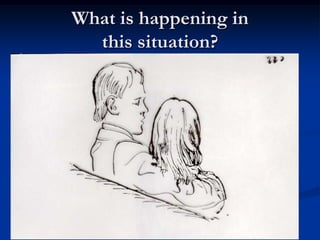
What is happening in
  this situation?
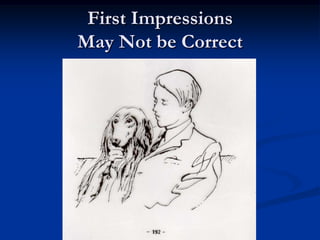
First Impressions
May Not be Correct
Can Open Textbooks Make a Difference?
        Comparing Open and
       Traditional Textbooks
  Houston Community College’s use of Flat
   World Knowledge’s Introduction to Psychology
   textbook.
  Virginia State University’s adoption of
   several Flat World Knowledge business
   textbooks
  The Kaleidoscope Project
Houston Community College
 Houston Community College (HCC) is a
  large community college with more than
  70,000 students. 33% of its students are
  Hispanic, 33% are African American, 17%
  are white, 14% Asian, and 3% are classified
  as ‘other.’ Fifty-nine per cent of the students
  are female, and 41% are male.
 HCC’s Psychology department chose to
  adopt Flat World Knowledge’s (FWK)
  textbook Introduction to Psychology.
Why a FWK Textbook?
 They could modify it to meet the needs of their
  students (lowered the reading level, added in
  additional learning videos).
 It was a lot cheaper (free) when compared to
  other textbooks!
 Came with a variety of other resources,
  packaged along with it.
 During a pilot study 690 students used the
  FWK text.
 So what happened?
HCC – Student Feedback
   Eighty-four per cent of students surveyed agreed
    with the statement that ‘Having a free online book
    helps me go to college’.
   Of the 108 students who responded to a question
    regarding the difficulty of using an online text, 45
    (42%) said that it was easy, 28 (26%) said that it
    was moderately easy, 26 (24%) said that it was
    neither hard nor easy, and nine (8%) said that it was
    moderately difficult. Zero students reported that it
    was difficult to use an online text.
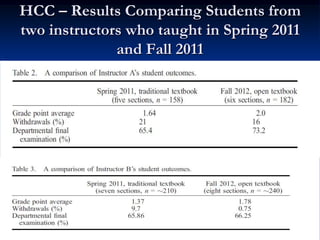
HCC – Results Comparing Students from
two instructors who taught in Spring 2011
              and Fall 2011
Virginia State University
 Virginia State University (VSU) has 5,300
  students. They offer 55 baccalaureate and
  masters degree programs, two doctoral
  degree programs and three certificates.
 VSU’s Business Department adopted nine
  FWK text and paid $30.00 per student for an
  unlimited seat license for all FWK content.
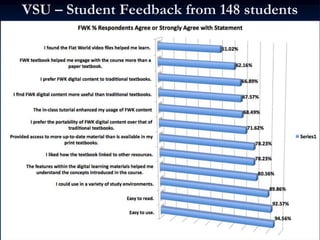
VSU – Student Feedback from 148 students
VSU – Results

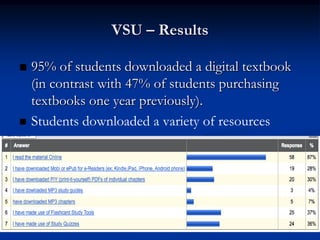
   95% of students downloaded a digital textbook
    (in contrast with 47% of students purchasing
    textbooks one year previously).
   Students downloaded a variety of resources
VSU – Results
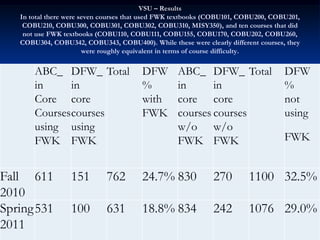
   In total there were seven courses that used FWK textbooks (COBU101, COBU200, COBU201,
    COBU210, COBU300, COBU301, COBU302, COBU310, MISY350), and ten courses that did
    not use FWK textbooks (COBU110, COBU111, COBU155, COBU170, COBU202, COBU260,
   COBU304, COBU342, COBU343, COBU400). While these were clearly different courses, they
                        were roughly equivalent in terms of course difficulty.


       ABC_ DFW_ Total                  DFW       ABC_ DFW_ Total                  DFW
       in      in                       %         in      in                       %
       Core core                        with      core core                        not
       Courses courses                  FWK       courses courses                  using
       using using                                w/o w/o
       FWK FWK                                    FWK FWK                          FWK


Fall 611          151        762        24.7% 830            270        1100 32.5%
2010
Spring 531        100        631        18.8% 834            242        1076 29.0%
2011
Project Kaleidoscope
The study context is an open education initiative
called Project Kaleidoscope (http://www.project-
kaleidoscope.org/). This initiative is comprised of
eight community colleges serving predominantly at-
risk students. These colleges work together to create
courses that replace traditional, expensive textbooks
with OER. During the 2011-2012 academic year,
Project Kaleidoscope (PK) impacted over 4,000
students across 80 teachers in a controlled pilot, with
another 5,000 students using PK course designs and
materials outside the controlled pilot.
Project Kaleidoscope – Teacher Perceptions

   58 teachers from 8 PK institutions completed some
    items on the questionnaire.
   Student preparedness. Most teachers (63%) believed
    that their students were equally prepared in the
    course with PK texts compared to students in the
    same course before implementation of PK texts
    (Figure 3). At the same time, more than a quarter of
    teachers (26%) felt that students were more
    prepared than students in the same course in the
    past. Only 11 percent perceived students as being
    less prepared.
Project Kaleidoscope – Teacher Perceptions

   Teacher perceptions of quality. Twenty out of 57
    (35%) teachers indicated that they thought the OER
    textbook was better than texts they had used
    previously to teach the course. Only 6 (11%) felt
    the OER texts were worse than traditional texts.
    The remaining 31(54%) teachers indicated that their
    OER texts were of the nearly the same quality as
    other texts they had used in the past.
Project Kaleidoscope – Student Perceptions
 490 students from all eight PK institutions
  completed the questionnaire. 60% were female.
 39% of students indicated that they thought the
  OER textbook was better than texts they had
  used in other courses. 6% felt the OER texts
  were worse and 55% indicated that their OER
  texts were of the nearly the same quality as other
  texts they had used in the past.
Project Kaleidoscope – Student Perceptions
   160 students provided a description of what they
    thought made the OER texts better. Their
    responses clustered in six major categories:
    technical advantages (8%), learning aides (9%),
    customization (10%), cost (20%), access (26%), and
    quality/presentation (27%).
   Conversely, 20 students provided a description of
    what they thought made the OER texts worse than
    other texts they had used in the past. Their
    responses clustered in 2 major categories; six
    students described technology issues and 15
    students took issue with text quality.
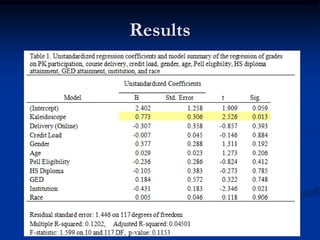
Project Kaleidoscope—Learning Outcomes

 Does open textbook adoption have an
  impact on student learning as manifest by
  grades?
 649 students in intermediate algebra
  (developmental math) courses at four PK
  schools.
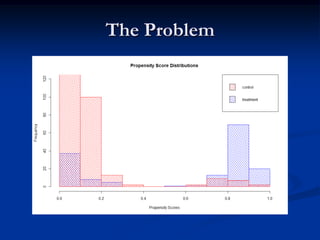
 What kind of analysis is appropriate?
The Problem
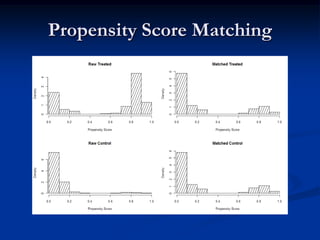
Propensity Score Matching
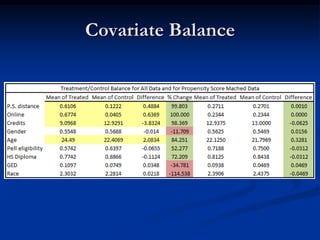
Covariate Balance
Results
Strengths
 The data approximates random sample to the
  extent that we have captured key covariates.
 We have acceptable balance across all
  measured covariates.
 Statistical analyses are much more robust
  because the assumptions are met
 Have a stronger basis to engage in causal
  induction (Reuben Causal Model)
Limitations
 Grades are contextual—not universal
  markers of meaning
 We had a limited number of observed
  covariates.
 Some key covariates are unobservable.

 We lose statistical power by cutting our
  sample from 649 to 128.
Questions?


 John Hilton III                Jared Robinson
johnhiltoniii.org           tjaredrobinson.com

Using Open Textbooks in Community Colleges

  • 1.
    Using Open Textbooksin Community Colleges John Hilton III Jared Robinson johnhiltoniii.org tjaredrobinson.com
  • 2.
    A Problem  Textbookcosts are a significant part of overall college expenses.  High costs of education may deter some students from pursuing or continuing their education.  While free resources are sometimes available, some question whether books that are distributed for free online will have the educational impact of full- color textbooks that have been vetted by traditional publishers.
  • 3.
    What is happeningin this situation?
  • 4.
  • 5.
    Can Open TextbooksMake a Difference? Comparing Open and Traditional Textbooks  Houston Community College’s use of Flat World Knowledge’s Introduction to Psychology textbook.  Virginia State University’s adoption of several Flat World Knowledge business textbooks  The Kaleidoscope Project
  • 6.
    Houston Community College Houston Community College (HCC) is a large community college with more than 70,000 students. 33% of its students are Hispanic, 33% are African American, 17% are white, 14% Asian, and 3% are classified as ‘other.’ Fifty-nine per cent of the students are female, and 41% are male.  HCC’s Psychology department chose to adopt Flat World Knowledge’s (FWK) textbook Introduction to Psychology.
  • 7.
    Why a FWKTextbook?  They could modify it to meet the needs of their students (lowered the reading level, added in additional learning videos).  It was a lot cheaper (free) when compared to other textbooks!  Came with a variety of other resources, packaged along with it.  During a pilot study 690 students used the FWK text.  So what happened?
  • 8.
    HCC – StudentFeedback  Eighty-four per cent of students surveyed agreed with the statement that ‘Having a free online book helps me go to college’.  Of the 108 students who responded to a question regarding the difficulty of using an online text, 45 (42%) said that it was easy, 28 (26%) said that it was moderately easy, 26 (24%) said that it was neither hard nor easy, and nine (8%) said that it was moderately difficult. Zero students reported that it was difficult to use an online text.
  • 9.
    HCC – ResultsComparing Students from two instructors who taught in Spring 2011 and Fall 2011
  • 10.
    Virginia State University Virginia State University (VSU) has 5,300 students. They offer 55 baccalaureate and masters degree programs, two doctoral degree programs and three certificates.  VSU’s Business Department adopted nine FWK text and paid $30.00 per student for an unlimited seat license for all FWK content.
  • 11.
    VSU – StudentFeedback from 148 students
  • 12.
    VSU – Results  95% of students downloaded a digital textbook (in contrast with 47% of students purchasing textbooks one year previously).  Students downloaded a variety of resources
  • 13.
    VSU – Results In total there were seven courses that used FWK textbooks (COBU101, COBU200, COBU201, COBU210, COBU300, COBU301, COBU302, COBU310, MISY350), and ten courses that did not use FWK textbooks (COBU110, COBU111, COBU155, COBU170, COBU202, COBU260, COBU304, COBU342, COBU343, COBU400). While these were clearly different courses, they were roughly equivalent in terms of course difficulty. ABC_ DFW_ Total DFW ABC_ DFW_ Total DFW in in % in in % Core core with core core not Courses courses FWK courses courses using using using w/o w/o FWK FWK FWK FWK FWK Fall 611 151 762 24.7% 830 270 1100 32.5% 2010 Spring 531 100 631 18.8% 834 242 1076 29.0% 2011
  • 14.
    Project Kaleidoscope The studycontext is an open education initiative called Project Kaleidoscope (http://www.project- kaleidoscope.org/). This initiative is comprised of eight community colleges serving predominantly at- risk students. These colleges work together to create courses that replace traditional, expensive textbooks with OER. During the 2011-2012 academic year, Project Kaleidoscope (PK) impacted over 4,000 students across 80 teachers in a controlled pilot, with another 5,000 students using PK course designs and materials outside the controlled pilot.
  • 15.
    Project Kaleidoscope –Teacher Perceptions  58 teachers from 8 PK institutions completed some items on the questionnaire.  Student preparedness. Most teachers (63%) believed that their students were equally prepared in the course with PK texts compared to students in the same course before implementation of PK texts (Figure 3). At the same time, more than a quarter of teachers (26%) felt that students were more prepared than students in the same course in the past. Only 11 percent perceived students as being less prepared.
  • 16.
    Project Kaleidoscope –Teacher Perceptions  Teacher perceptions of quality. Twenty out of 57 (35%) teachers indicated that they thought the OER textbook was better than texts they had used previously to teach the course. Only 6 (11%) felt the OER texts were worse than traditional texts. The remaining 31(54%) teachers indicated that their OER texts were of the nearly the same quality as other texts they had used in the past.
  • 17.
    Project Kaleidoscope –Student Perceptions  490 students from all eight PK institutions completed the questionnaire. 60% were female.  39% of students indicated that they thought the OER textbook was better than texts they had used in other courses. 6% felt the OER texts were worse and 55% indicated that their OER texts were of the nearly the same quality as other texts they had used in the past.
  • 18.
    Project Kaleidoscope –Student Perceptions  160 students provided a description of what they thought made the OER texts better. Their responses clustered in six major categories: technical advantages (8%), learning aides (9%), customization (10%), cost (20%), access (26%), and quality/presentation (27%).  Conversely, 20 students provided a description of what they thought made the OER texts worse than other texts they had used in the past. Their responses clustered in 2 major categories; six students described technology issues and 15 students took issue with text quality.
  • 19.
    Project Kaleidoscope—Learning Outcomes Does open textbook adoption have an impact on student learning as manifest by grades?  649 students in intermediate algebra (developmental math) courses at four PK schools.  What kind of analysis is appropriate?
  • 20.
  • 21.
  • 22.
  • 23.
  • 24.
    Strengths  The dataapproximates random sample to the extent that we have captured key covariates.  We have acceptable balance across all measured covariates.  Statistical analyses are much more robust because the assumptions are met  Have a stronger basis to engage in causal induction (Reuben Causal Model)
  • 25.
    Limitations  Grades arecontextual—not universal markers of meaning  We had a limited number of observed covariates.  Some key covariates are unobservable.  We lose statistical power by cutting our sample from 649 to 128.
  • 26.
    Questions? John HiltonIII Jared Robinson johnhiltoniii.org tjaredrobinson.com