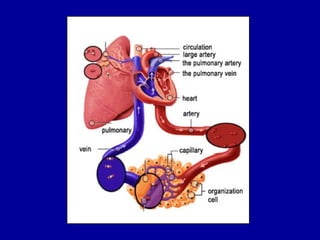
Blood Vessels and Circulation

           Chapter 13
          Pgs 389-403
Overview
• Introduction                     • Cardiovascular
• The Anatomy of Blood               Regulation
  Vessels                             – The autoregulation of blood
   –                                    flow
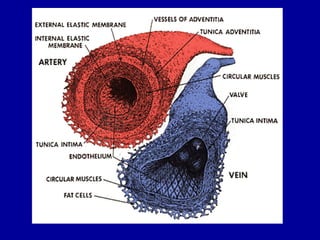
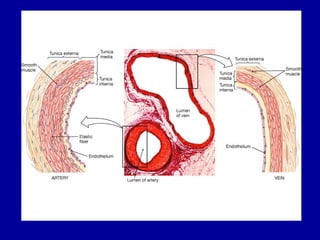
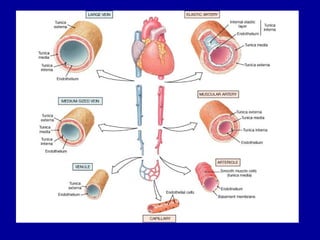
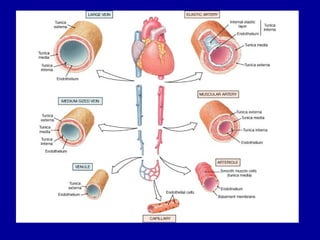
       Structure of vessel walls
                                      – The neural control of blood
   –   Arteries
                                        pressure and flow
   –   Capillaries
                                      – Hormones and
   –   Veins                            cardiovascular regulation
• Cardiovascular
  Physiology
   – Pressure
   – Resistance
   – Circulatory pressure
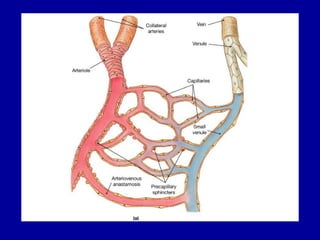
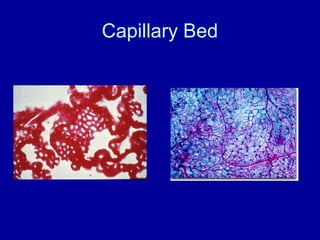
Capillary Bed
Circulatory Physiology
• 2 factors affect blood flow through
  capillaries:
  – Pressure
  – Resistance
     • Vascular resistance
     • Viscosity
     • Turbulence
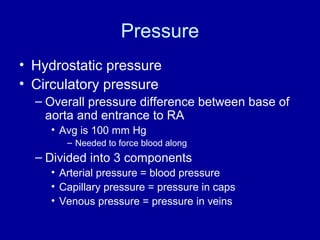
Pressure
• Hydrostatic pressure
• Circulatory pressure
  – Overall pressure difference between base of
    aorta and entrance to RA
    • Avg is 100 mm Hg
       – Needed to force blood along
  – Divided into 3 components
    • Arterial pressure = blood pressure
    • Capillary pressure = pressure in caps
    • Venous pressure = pressure in veins
Resistance
• For blood to flow:
  – Circulatory pressure must be great enough to
    overcome total peripheral resistance
     • But pressure low in veins so focus on arterial system (called
       peripheral resistance)
• Neural and hormonal controls
• Sources of peripheral resistance:
  – Vascular resistance
  – Viscosity
  – Turbulence
Vascular Resistance
• Resistance of the blood vessels
• Most important factor is friction between
  the blood and the vessel walls
  – Friction depends on:
     • Length
     • Diameter
Viscosity
• Resistance to flow caused by interactions
  among molecules and suspended
  materials in a liquid
• Viscosity of blood 5xs that of water
• Remains constant
Turbulence
• Blood flow smooth
  – Slowest flow near the walls; fastest at the
    center
• High flow rates, irregular surface, sudden
  changes in vessel diameter = turbulent
  flow (swirls and eddies created)
• Slows the flow, increases resistance
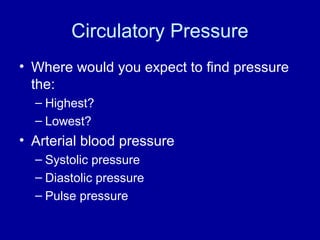
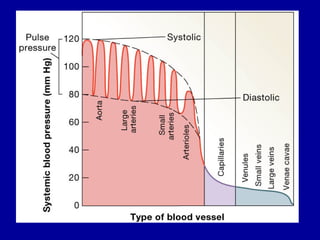
Circulatory Pressure
• Where would you expect to find pressure
  the:
  – Highest?
  – Lowest?
• Arterial blood pressure
  – Systolic pressure
  – Diastolic pressure
  – Pulse pressure
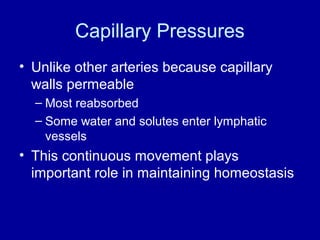
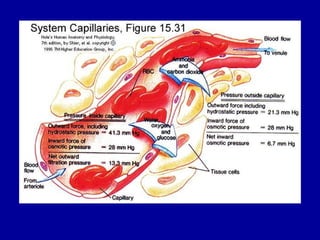
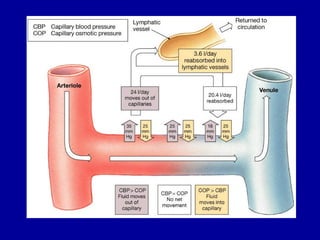
Capillary Pressures
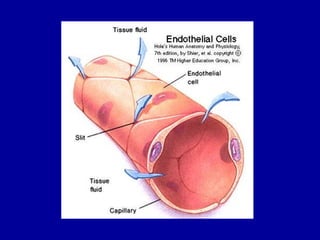
• Unlike other arteries because capillary
  walls permeable
  – Most reabsorbed
  – Some water and solutes enter lymphatic
    vessels
• This continuous movement plays
  important role in maintaining homeostasis
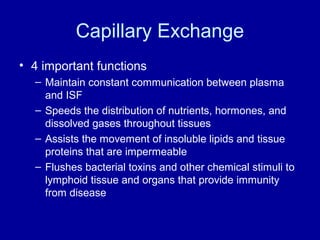
Capillary Exchange
• 4 important functions
  – Maintain constant communication between plasma
    and ISF
  – Speeds the distribution of nutrients, hormones, and
    dissolved gases throughout tissues
  – Assists the movement of insoluble lipids and tissue
    proteins that are impermeable
  – Flushes bacterial toxins and other chemical stimuli to
    lymphoid tissue and organs that provide immunity
    from disease
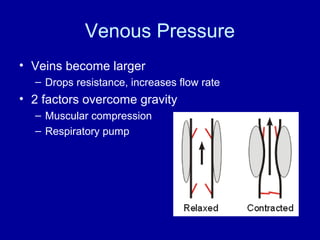
Venous Pressure
• Veins become larger
  – Drops resistance, increases flow rate
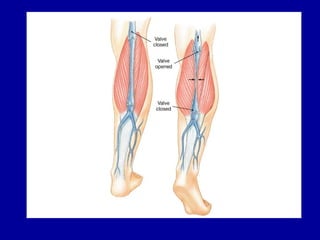
• 2 factors overcome gravity
  – Muscular compression
  – Respiratory pump
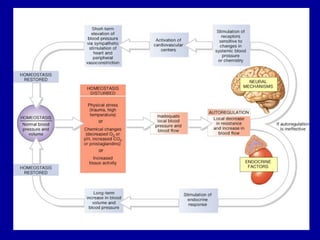
Cardiovascular Regulation
• Tissue perfusion—tissue blood flow
• Homeostatic mechanisms regulate
  cardiovascular activity to ensure tissue perfusion
  meets demand for oxygen and nutrients
• 3 variable factors that influence tissue perfusion:
   – Cardiac output
   – Peripheral resistance
   – Blood pressure
Cardiovascular Regulation
• Cells become active = increased circulation to region
• Goal of cardiovascular regulation is to ensure that these
  blood flow changes occur:
   – At an appropriate time
   – In the right area
   – Without drastically altering blood pressure and blood flow to vital
     organs
• Factors involved in regulation of cardiovascular function
  include:
   – Local factors
   – Neural mechanisms
   – Endocrine factors
Autoregulation of Blood Flow
• Precapillary sphincter
  – Respond automatically to alterations in local
    environment
     • Increased or decreased levels of oxygen and/or
       carbon dioxide
  – Dilation caused by vasodilators
  – Contraction caused by vasoconstrictors
Neural Control of Blood Pressure
     (BP) and Blood Flow (BF)
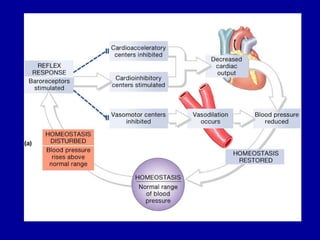
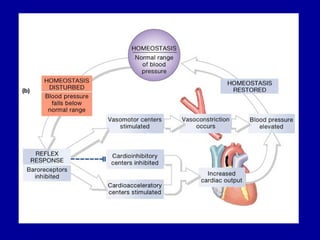
• Cardiovascular (CV) centers in medulla responsible
   – Includes a cardioaccelerator center and cardioinhibitory center
• Vasomotor center (part of CV)
   – Primarily controls diameters of arterioles
   – Inhibition of center leads to vasodilation
       • Will this increase or decrease peripheral resistance?
   – Stimulation of center leads to vasoconstriction
• CV centers detect changes in tissue by monitoring:
   – Arterial blood (esp bp)
   – pH
   – Dissolved gas concentrations
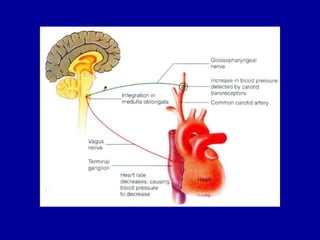
Baroreceptor Reflexes
• Monitor degree of stretch in walls of expandable
  organs
• Located in:
   – Carotid sinuses
   – Aortic sinuses
   – Wall of RA
• Initiate baroreceptor reflexes
   – Autonomic reflexes that adjust CO and peripheral
     resistance to maintain normal arterial pressures
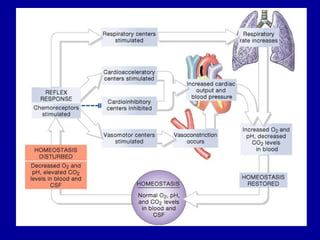
Chemoreceptor Reflexes
• Respond to changes in carbon dioxide
  levels, oxygen levels, or pH in blood and
  CSF
• Found in:
  – Carotid bodies
  – Aortic bodies
  – Medulla (CSF)
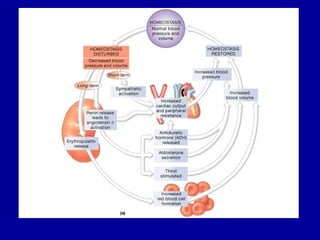
Hormones and Cardiovascular
           Regulation
• Provides both short term and long term
  regulation
• E and NE immediately stimulate CO and
  peripheral vasoconstriction
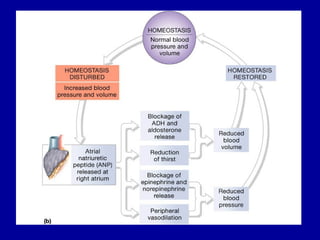
• ADH, angiotensin II, EPO, and ANP
  – Affect long term regulation of blood volume
Blood vessels and circulation

Blood vessels and circulation

  • 1.
    Blood Vessels andCirculation Chapter 13 Pgs 389-403
  • 2.
    Overview • Introduction • Cardiovascular • The Anatomy of Blood Regulation Vessels – The autoregulation of blood – flow Structure of vessel walls – The neural control of blood – Arteries pressure and flow – Capillaries – Hormones and – Veins cardiovascular regulation • Cardiovascular Physiology – Pressure – Resistance – Circulatory pressure
  • 9.
  • 12.
    Circulatory Physiology • 2factors affect blood flow through capillaries: – Pressure – Resistance • Vascular resistance • Viscosity • Turbulence
  • 13.
    Pressure • Hydrostatic pressure •Circulatory pressure – Overall pressure difference between base of aorta and entrance to RA • Avg is 100 mm Hg – Needed to force blood along – Divided into 3 components • Arterial pressure = blood pressure • Capillary pressure = pressure in caps • Venous pressure = pressure in veins
  • 14.
    Resistance • For bloodto flow: – Circulatory pressure must be great enough to overcome total peripheral resistance • But pressure low in veins so focus on arterial system (called peripheral resistance) • Neural and hormonal controls • Sources of peripheral resistance: – Vascular resistance – Viscosity – Turbulence
  • 15.
    Vascular Resistance • Resistanceof the blood vessels • Most important factor is friction between the blood and the vessel walls – Friction depends on: • Length • Diameter
  • 16.
    Viscosity • Resistance toflow caused by interactions among molecules and suspended materials in a liquid • Viscosity of blood 5xs that of water • Remains constant
  • 17.
    Turbulence • Blood flowsmooth – Slowest flow near the walls; fastest at the center • High flow rates, irregular surface, sudden changes in vessel diameter = turbulent flow (swirls and eddies created) • Slows the flow, increases resistance
  • 18.
    Circulatory Pressure • Wherewould you expect to find pressure the: – Highest? – Lowest? • Arterial blood pressure – Systolic pressure – Diastolic pressure – Pulse pressure
  • 20.
    Capillary Pressures • Unlikeother arteries because capillary walls permeable – Most reabsorbed – Some water and solutes enter lymphatic vessels • This continuous movement plays important role in maintaining homeostasis
  • 21.
    Capillary Exchange • 4important functions – Maintain constant communication between plasma and ISF – Speeds the distribution of nutrients, hormones, and dissolved gases throughout tissues – Assists the movement of insoluble lipids and tissue proteins that are impermeable – Flushes bacterial toxins and other chemical stimuli to lymphoid tissue and organs that provide immunity from disease
  • 24.
    Venous Pressure • Veinsbecome larger – Drops resistance, increases flow rate • 2 factors overcome gravity – Muscular compression – Respiratory pump
  • 25.
    Cardiovascular Regulation • Tissueperfusion—tissue blood flow • Homeostatic mechanisms regulate cardiovascular activity to ensure tissue perfusion meets demand for oxygen and nutrients • 3 variable factors that influence tissue perfusion: – Cardiac output – Peripheral resistance – Blood pressure
  • 26.
    Cardiovascular Regulation • Cellsbecome active = increased circulation to region • Goal of cardiovascular regulation is to ensure that these blood flow changes occur: – At an appropriate time – In the right area – Without drastically altering blood pressure and blood flow to vital organs • Factors involved in regulation of cardiovascular function include: – Local factors – Neural mechanisms – Endocrine factors
  • 28.
    Autoregulation of BloodFlow • Precapillary sphincter – Respond automatically to alterations in local environment • Increased or decreased levels of oxygen and/or carbon dioxide – Dilation caused by vasodilators – Contraction caused by vasoconstrictors
  • 29.
    Neural Control ofBlood Pressure (BP) and Blood Flow (BF) • Cardiovascular (CV) centers in medulla responsible – Includes a cardioaccelerator center and cardioinhibitory center • Vasomotor center (part of CV) – Primarily controls diameters of arterioles – Inhibition of center leads to vasodilation • Will this increase or decrease peripheral resistance? – Stimulation of center leads to vasoconstriction • CV centers detect changes in tissue by monitoring: – Arterial blood (esp bp) – pH – Dissolved gas concentrations
  • 30.
    Baroreceptor Reflexes • Monitordegree of stretch in walls of expandable organs • Located in: – Carotid sinuses – Aortic sinuses – Wall of RA • Initiate baroreceptor reflexes – Autonomic reflexes that adjust CO and peripheral resistance to maintain normal arterial pressures
  • 34.
    Chemoreceptor Reflexes • Respondto changes in carbon dioxide levels, oxygen levels, or pH in blood and CSF • Found in: – Carotid bodies – Aortic bodies – Medulla (CSF)
  • 36.
    Hormones and Cardiovascular Regulation • Provides both short term and long term regulation • E and NE immediately stimulate CO and peripheral vasoconstriction • ADH, angiotensin II, EPO, and ANP – Affect long term regulation of blood volume