Customer Relationship
Management Systems
What Is Customer Relationship
Management?
• Knowing the customer
• In large businesses, too many customers and too many ways
customers interact with firm
• Customer relationship management (CRM) systems
• Capture and integrate customer data from all over the
organization.
• Consolidate and analyze customer data.
• Distribute customer information to various systems and
customer touch points across enterprise.
• Provide single enterprise view of customers.
Customer Relationship
Management (CRM)
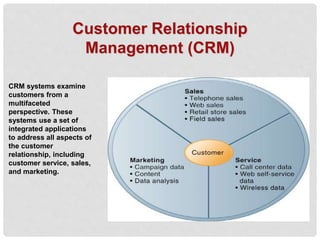
CRM systems examine
customers from a
multifaceted
perspective. These
systems use a set of
integrated applications
to address all aspects of
the customer
relationship, including
customer service, sales,
and marketing.
CRM Software
• CRM packages range from niche tools to large-scale enterprise
applications.
• More comprehensive have modules for:
• Partner relationship management (PRM)
• Integrating lead generation, pricing, promotions, order
configurations, and availability
• Tools to assess partners’ performances
• Employee relationship management (ERM)
• E.g., setting objectives, employee performance
management, performance-based compensation, employee
training
CRM Software
(Continued…)
• CRM packages typically include tools for:
• Sales force automation (SFA)
• E.g., sales prospect and contact information, and sales
quote generation capabilities
• Customer service
• E.g., assigning and managing customer service requests;
Web-based self-service capabilities
• Marketing
• E.g., capturing prospect and customer data, scheduling
and tracking direct-marketing mailings or e-mail
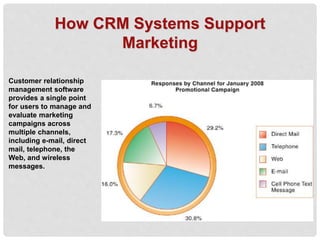
How CRM Systems Support
Marketing
Customer relationship
management software
provides a single point
for users to manage and
evaluate marketing
campaigns across
multiple channels,
including e-mail, direct
mail, telephone, the
Web, and wireless
messages.
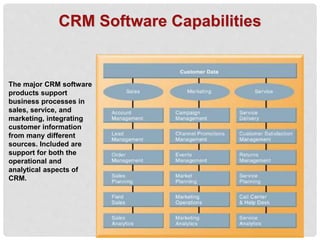
CRM Software Capabilities
The major CRM software
products support
business processes in
sales, service, and
marketing, integrating
customer information
from many different
sources. Included are
support for both the
operational and
analytical aspects of
CRM.
• Operational CRM:
• Customer-facing applications such as sales force automation, call
center and customer service support, and marketing automation
• Analytical CRM:
• Analyzes customer data output from operational CRM applications
• Based on data warehouses populated by operational
CRM systems and customer touch points
• Customer lifetime value (CLTV)
Operational and Analytical CRM
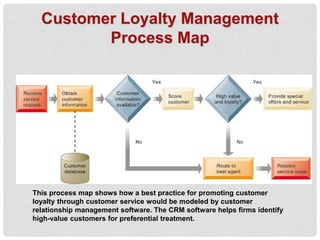
Customer Loyalty Management
Process Map
This process map shows how a best practice for promoting customer
loyalty through customer service would be modeled by customer
relationship management software. The CRM software helps firms identify
high-value customers for preferential treatment.
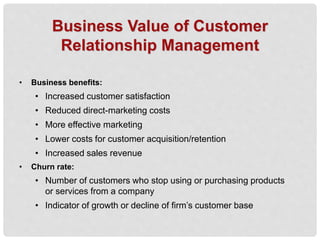
Business Value of Customer
Relationship Management
• Business benefits:
• Increased customer satisfaction
• Reduced direct-marketing costs
• More effective marketing
• Lower costs for customer acquisition/retention
• Increased sales revenue
• Churn rate:
• Number of customers who stop using or purchasing products
or services from a company
• Indicator of growth or decline of firm’s customer base
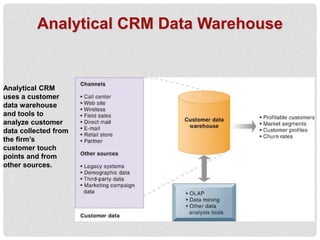
Analytical CRM Data Warehouse
Analytical CRM
uses a customer
data warehouse
and tools to
analyze customer
data collected from
the firm’s
customer touch
points and from
other sources.
THANK YOU

Customer relationship management systems

  • 1.
  • 2.
    What Is CustomerRelationship Management? • Knowing the customer • In large businesses, too many customers and too many ways customers interact with firm • Customer relationship management (CRM) systems • Capture and integrate customer data from all over the organization. • Consolidate and analyze customer data. • Distribute customer information to various systems and customer touch points across enterprise. • Provide single enterprise view of customers.
  • 3.
    Customer Relationship Management (CRM) CRMsystems examine customers from a multifaceted perspective. These systems use a set of integrated applications to address all aspects of the customer relationship, including customer service, sales, and marketing.
  • 4.
    CRM Software • CRMpackages range from niche tools to large-scale enterprise applications. • More comprehensive have modules for: • Partner relationship management (PRM) • Integrating lead generation, pricing, promotions, order configurations, and availability • Tools to assess partners’ performances • Employee relationship management (ERM) • E.g., setting objectives, employee performance management, performance-based compensation, employee training
  • 5.
    CRM Software (Continued…) • CRMpackages typically include tools for: • Sales force automation (SFA) • E.g., sales prospect and contact information, and sales quote generation capabilities • Customer service • E.g., assigning and managing customer service requests; Web-based self-service capabilities • Marketing • E.g., capturing prospect and customer data, scheduling and tracking direct-marketing mailings or e-mail
  • 6.
    How CRM SystemsSupport Marketing Customer relationship management software provides a single point for users to manage and evaluate marketing campaigns across multiple channels, including e-mail, direct mail, telephone, the Web, and wireless messages.
  • 7.
    CRM Software Capabilities Themajor CRM software products support business processes in sales, service, and marketing, integrating customer information from many different sources. Included are support for both the operational and analytical aspects of CRM.
  • 8.
    • Operational CRM: •Customer-facing applications such as sales force automation, call center and customer service support, and marketing automation • Analytical CRM: • Analyzes customer data output from operational CRM applications • Based on data warehouses populated by operational CRM systems and customer touch points • Customer lifetime value (CLTV) Operational and Analytical CRM
  • 9.
    Customer Loyalty Management ProcessMap This process map shows how a best practice for promoting customer loyalty through customer service would be modeled by customer relationship management software. The CRM software helps firms identify high-value customers for preferential treatment.
  • 10.
    Business Value ofCustomer Relationship Management • Business benefits: • Increased customer satisfaction • Reduced direct-marketing costs • More effective marketing • Lower costs for customer acquisition/retention • Increased sales revenue • Churn rate: • Number of customers who stop using or purchasing products or services from a company • Indicator of growth or decline of firm’s customer base
  • 11.
    Analytical CRM DataWarehouse Analytical CRM uses a customer data warehouse and tools to analyze customer data collected from the firm’s customer touch points and from other sources.
  • 12.