Application of KM:
CUSTOMER RELATIONSHIP
MANAGEMENT (CRM)
รัฐ ธนาดิเรก, PhD
15 กรกฎาคม 2551
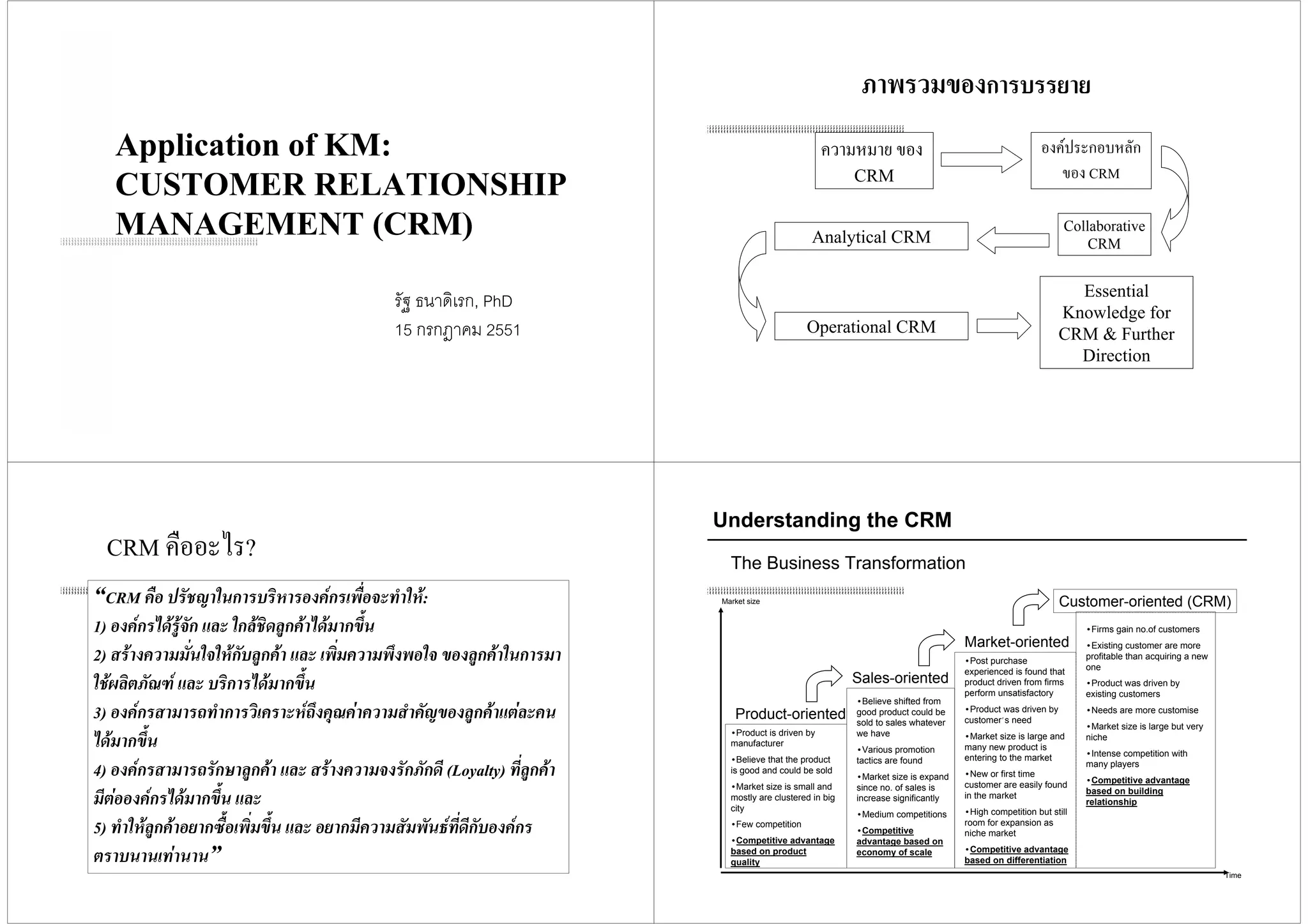
ภาพรวมของการบรรยาย
ความหมาย ของ
CRM
องคประกอบหลัก
ของ CRM
Collaborative
CRMAnalytical CRM
Operational CRM
Essential
Knowledge for
CRM & Further
Direction
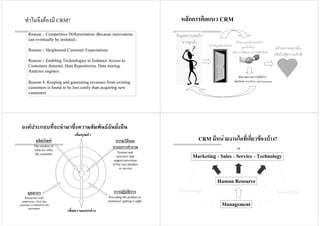
CRM คืออะไร?
“CRM คือ ปรัชญาในการบริหารองคกรเพื่อจะทําให:
1) องคกรไดรูจัก และ ใกลชิดลูกคาไดมากขึ้น
2) สรางความมั่นใจใหกับลูกคา และ เพิ่มความพึงพอใจ ของลูกคาในการมา
ใชผลิตภัณฑ และ บริการไดมากขึ้น
3) องคกรสามารถทําการวิเคราะหถึงคุณคาความสําคัญของลูกคาแตละคน
ไดมากขึ้น
4) องคกรสามารถรักษาลูกคา และ สรางความจงรักภักดี (Loyalty) ที่ลูกคา
มีตอองคกรไดมากขึ้น และ
5) ทําใหลูกคาอยากซื้อเพิ่มขึ้น และ อยากมีความสัมพันธที่ดีกับองคกร
ตราบนานเทานาน”
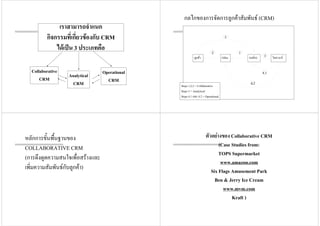
Understanding the CRM
The Business Transformation
Product-oriented
Sales-oriented
Market-oriented
Customer-oriented (CRM)
•Product is driven by
manufacturer
•Believe that the product
is good and could be sold
•Market size is small and
mostly are clustered in big
city
•Few competition
•Competitive advantage
based on product
quality
•Believe shifted from
good product could be
sold to sales whatever
we have
•Various promotion
tactics are found
•Market size is expand
since no. of sales is
increase significantly
•Medium competitions
•Competitive
advantage based on
economy of scale
Time
Market size
•Post purchase
experienced is found that
product driven from firms
perform unsatisfactory
•Product was driven by
customer’s need
•Market size is large and
many new product is
entering to the market
•New or first time
customer are easily found
in the market
•High competition but still
room for expansion as
niche market
•Competitive advantage
based on differentiation
•Firms gain no.of customers
•Existing customer are more
profitable than acquiring a new
one
•Product was driven by
existing customers
•Needs are more customise
•Market size is large but very
niche
•Intense competition with
many players
•Competitive advantage
based on building
relationship
ทําไมจึงตองมี CRM?
Reason 1: Competitive Differentiation (Because innovations
can eventually be imitated.)
Reason 2: Heightened Customer Expectations
Reason 3: Enabling Technologies to Enhance Access to
Customers (Internet, Data Repositories, Data mining,
Analysis engines)
Reason 4: Keeping and generating revenues from existing
customers is found to be less costly than acquiring new
customers
หลักการคิดแนว CRM
พัฒนาคุณภาพการปฏิบัติการ,
ผลิตภัณฑ, การบริการ, และ Promotion
ดึงดูดความสนใจ
จากลูกคา
ทําใหลูกคาเปดใจ
ศึกษาและพิจารณาถึง
ลูกคาที่เรา
ตองการพัฒนาความสัมพันธ
สรางความผูกพัน
เพื่อไปสูความภักดี
องคประกอบที่จะนํามาซึ่งความสัมพันธอันยั่งยืน
ผลิตภัณฑ
The essence of
what we offer
the customer
บุคลากร
Interaction with
employees - how the
customer is treated in the
encounter
การปฏิบัติการ
Providing the product as
promised -getting it right
กรรมวิธีและ
ระบบการทํางาน
System and
activities that
support provision
of the core product
or service
เพิ่มคุณคา
เพิ่มความแตกตาง
CRM มีหนวยงานใดที่เกี่ยวของบาง?
=
Marketing + Sales + Service + Technology
Management
Human Resource
Knowledge Knowledge
เราสามารถจําแนก
กิจกรรมที่เกี่ยวของกับ CRM
ไดเปน 3 ประเภทคือ
Collaborative
CRM
Analytical
CRM
Operational
CRM
กลไกของการจัดการลูกคาสัมพันธ (CRM)
องคกรOfferลูกคา วิเคราะห
2 1
3
3
4.1
4.2Steps 1,2,3 = Collaborative
Steps 3 = Analytical
Steps 4.1 และ 4.2 = Operational
หลักการขั้นพื้นฐานของ
COLLABORATIVE CRM
(การดึงดูดความสนใจเพื่อสรางและ
เพิ่มความสัมพันธกับลูกคา)
ตัวอยางของ Collaborative CRM
(Case Studies from:
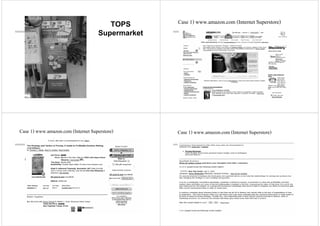
TOPS Supermarket
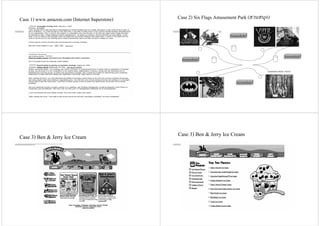
www.amazon.com
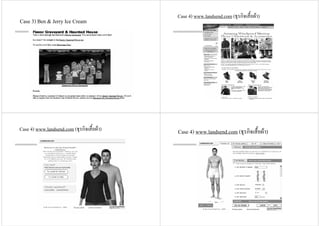
Six Flags Amusement Park
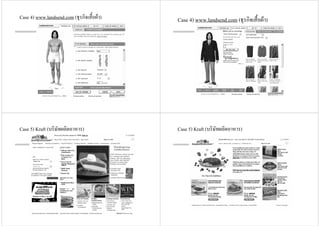
Ben & Jerry Ice Cream
www.mvm.com
Kraft )
TOPS
Supermarket
Case 1) www.amazon.com (Internet Superstore)
Case 1) www.amazon.com (Internet Superstore) Case 1) www.amazon.com (Internet Superstore)
Case 1) www.amazon.com (Internet Superstore) Case 2) Six Flags Amusement Park (สวนสนุก)
รานขายของที่ระลึก
รานขายของที่ระลึก
รานขายของที่ระลึก
รานขายของที่ระลึก
Case 3) Ben & Jerry Ice Cream Case 3) Ben & Jerry Ice Cream
Case 3) Ben & Jerry Ice Cream
Case 4) www.landsend.com (ธุรกิจเสื้อผา)
Case 4) www.landsend.com (ธุรกิจเสื้อผา) Case 4) www.landsend.com (ธุรกิจเสื้อผา)
Case 5) Kraft (บริษัทผลิตอาหาร) Case 5) Kraft (บริษัทผลิตอาหาร)
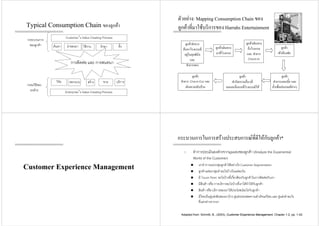
Typical Consumption Chain ของลูกคา
Customer’s Value Creating Process
คนหา นําของมา ใชงาน รักษา ทิ้ง
วิจัย ออกแบบ สราง ขาย บริการ
การติดตอ และ การสนทนา
Enterprise’s Value Creating Process
กรระบวนการ
ของลูกคา
กรรมวิธีของ
องคกร
ตัวอยาง: Mapping Consumption Chain ของ
ลูกคาที่มาใชบริการของ Harrahs Entertainment
ลูกคาทําการ
คนหาโรงแรมที่
อยูในดุลพินิจ
และ
ทําการจอง
ลูกคาเดินทาง
มาที่โรงแรม
ลูกคาเดินทาง
ถึงโรงแรม
และ ทําการ
Check-In
ลูกคา
เขาหองพัก
ลูกคา
ทําการแลกเบี้ย และ
ตั๋วเพื่อเลนเกมสตางๆ
ลูกคา
ทํากิจกรรมอื่นๆที่
นอกเหนือจากที่โรงแรมมีให
ลูกคา
ทําการ Check-Out และ
เดินทางกลับบาน
Customer Experience Management
กระบวนการในการสรางประสบการณที่ดีใหกับลูกคา*
1. ทําการประเมินองคกรจากมุมมองของลูกคา (Analyze the Experiential
World of the Customer)
เราทําการแบงกลุมลูกคาไดอยางไร Customer Segmentation
ลูกคาแตละกลุมทําอะไรบางในแตละวัน
มี Touch Point อะไรบางที่เกี่ยวของกับลูกคาในการติดตอกับเรา
มีสินคา หรือ การบริการอะไรบางที่เราไดทําใหกับลูกคา
สินคา หรือ บริการของเราใหประโยชนอะไรกับลูกคา
มีใครเปนคูแขงขันของเราบาง คูแขงประสพความสําเร็จแคไหน และ คูแขงทําอะไร
ที่แตกตางจากเรา
Adapted from: Schmitt, B., (2003), Customer Experience Management, Chapter 1-2, pp. 1-42.
2. สราง platform ที่เนนถึงประสบการณที่ลูกคาจะไดรับจากการมาติดตอกับบริษัท
ระบุถึงประสบการณที่แตกตางที่ลูกคาจะไดรับจากบริษัท (Experiential Positioning) e.g. RED
BULL “Energy in a Bottle”
ทําใหลูกคามั่นใจวาจะไดรับประสบการณที่ระบุ (Experiential Value Promise) e.g. RED BULL
“Strengthening the Heart, Accelerating Mechanism, and Fighting Stress
ทําการปฏิบัติการเพื่อสรางภาพลักษณใหสอดคลองกับภาพลักษณที่บริษัทตองการจะสื่อ (Overall
Implementation Theme) e.g. RED BULL Sponsorship of Extreme Game
3. Design วิธีการที่จะทําใหลูกคาไดรับประสบการณที่สอดคลองกับภาพลักษณที่เรา
ตองการสื่อ
สราง Product Experience, Look and Feel, และ Experiential Communication)
4. พัฒนาชองทางการติดตอ
5. มีการคิดคนสรางนวัตกรรมใหมๆอยางตอเนื่อง
กระบวนการในการสรางประสบการณที่ดีใหกับลูกคา*
Adapted from: Schmitt, B., (2003), Customer Experience Management, Chapter 1-2, pp. 1-42.
หลักการขั้นพื้นฐานของ
Analytical CRM
(การเก็บขอมูลเพื่อทําการวิเคราะห
ถึงพฤติกรรมและคุณคาของลูกคา)
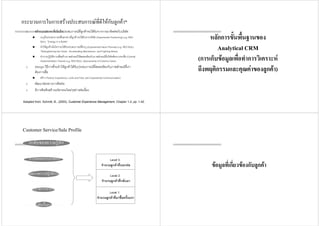
Customer Service/Sale Profile
Level 2:
จํานวนลูกคาที่กลับมา
Level 1:
จํานวนลูกคาที่มาฃื้อครั้งแรก
Level 3:
จํานวนลูกคาที่บอกตอ
ผลิตภัณฑหรือการบริการ
กรรมวิธีการทํางาน
คุณภาพการปฏิบัติการ
การติดตอกับองคกร
ระดับของความรูสึก
ขอมูลที่เกี่ยวของกับลูกคา
Data Required for Satisfying
Customer Demandment
• Customer Profiling (ขอมูลทั่วไปของลูกคา)
• Customer Segmentation (ขอมูลเกี่ยวกับพฤติกรรมในการซื้อ)
• Customer Lifecycle (ขอมูลเกี่ยวกับพฤติกรรมในการซื้อ
ของลูกคาในแตละชวงเวลา)
• Customer Attitudes and Personality
(ขอมูลเกี่ยวกับทัศนคติ และ ลักษณะนิสัยของลูกคา)
• Customer Valuation (ขอมูลเพื่อชวยวัดคุณคาของลูกคา)
• Profitability
• Customer Lifetime Value
• Share of Wallet
การปฏิบัติการเพื่อนํามาซึ่ง
ความสัมพันธที่ดีกับลูกคา
(Operational CRM)
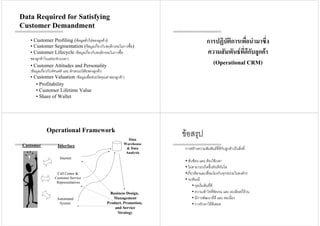
Operational Framework
Interface
Internet
Call Center &
Customer Service
Representatives
Automated
System
Data
Warehouse
& Data
Analysis
Business Design,
Management
Product, Promotion,
and Service
Strategy
Customer
ขอสรุป
การสรางความสัมพันธที่ดีกับลูกคาเปนสิ่งที่:
• ซับซอน และ ตองใชเวลา
• ไมสามารถเกิดขึ้นทันทีทันใด
•เกี่ยวของและเชื่อมโยงกับทุกหนวยในองคกร
• จะตองมี
• จุดเริ่มตนที่ดี
• ความเขาใจที่ชัดเจน และ ละเอียดถี่ถวน
• มีการพัฒนาที่ดี และ ตอเนื่อง
• การรักษาใหดีเสมอ

Customer Relationship Management การบริหารความสัมพันธ์กับลูกค้า

  • 1.
    Application of KM: CUSTOMERRELATIONSHIP MANAGEMENT (CRM) รัฐ ธนาดิเรก, PhD 15 กรกฎาคม 2551 ภาพรวมของการบรรยาย ความหมาย ของ CRM องคประกอบหลัก ของ CRM Collaborative CRMAnalytical CRM Operational CRM Essential Knowledge for CRM & Further Direction CRM คืออะไร? “CRM คือ ปรัชญาในการบริหารองคกรเพื่อจะทําให: 1) องคกรไดรูจัก และ ใกลชิดลูกคาไดมากขึ้น 2) สรางความมั่นใจใหกับลูกคา และ เพิ่มความพึงพอใจ ของลูกคาในการมา ใชผลิตภัณฑ และ บริการไดมากขึ้น 3) องคกรสามารถทําการวิเคราะหถึงคุณคาความสําคัญของลูกคาแตละคน ไดมากขึ้น 4) องคกรสามารถรักษาลูกคา และ สรางความจงรักภักดี (Loyalty) ที่ลูกคา มีตอองคกรไดมากขึ้น และ 5) ทําใหลูกคาอยากซื้อเพิ่มขึ้น และ อยากมีความสัมพันธที่ดีกับองคกร ตราบนานเทานาน” Understanding the CRM The Business Transformation Product-oriented Sales-oriented Market-oriented Customer-oriented (CRM) •Product is driven by manufacturer •Believe that the product is good and could be sold •Market size is small and mostly are clustered in big city •Few competition •Competitive advantage based on product quality •Believe shifted from good product could be sold to sales whatever we have •Various promotion tactics are found •Market size is expand since no. of sales is increase significantly •Medium competitions •Competitive advantage based on economy of scale Time Market size •Post purchase experienced is found that product driven from firms perform unsatisfactory •Product was driven by customer’s need •Market size is large and many new product is entering to the market •New or first time customer are easily found in the market •High competition but still room for expansion as niche market •Competitive advantage based on differentiation •Firms gain no.of customers •Existing customer are more profitable than acquiring a new one •Product was driven by existing customers •Needs are more customise •Market size is large but very niche •Intense competition with many players •Competitive advantage based on building relationship
  • 2.
    ทําไมจึงตองมี CRM? Reason 1:Competitive Differentiation (Because innovations can eventually be imitated.) Reason 2: Heightened Customer Expectations Reason 3: Enabling Technologies to Enhance Access to Customers (Internet, Data Repositories, Data mining, Analysis engines) Reason 4: Keeping and generating revenues from existing customers is found to be less costly than acquiring new customers หลักการคิดแนว CRM พัฒนาคุณภาพการปฏิบัติการ, ผลิตภัณฑ, การบริการ, และ Promotion ดึงดูดความสนใจ จากลูกคา ทําใหลูกคาเปดใจ ศึกษาและพิจารณาถึง ลูกคาที่เรา ตองการพัฒนาความสัมพันธ สรางความผูกพัน เพื่อไปสูความภักดี องคประกอบที่จะนํามาซึ่งความสัมพันธอันยั่งยืน ผลิตภัณฑ The essence of what we offer the customer บุคลากร Interaction with employees - how the customer is treated in the encounter การปฏิบัติการ Providing the product as promised -getting it right กรรมวิธีและ ระบบการทํางาน System and activities that support provision of the core product or service เพิ่มคุณคา เพิ่มความแตกตาง CRM มีหนวยงานใดที่เกี่ยวของบาง? = Marketing + Sales + Service + Technology Management Human Resource Knowledge Knowledge
  • 3.
    เราสามารถจําแนก กิจกรรมที่เกี่ยวของกับ CRM ไดเปน 3ประเภทคือ Collaborative CRM Analytical CRM Operational CRM กลไกของการจัดการลูกคาสัมพันธ (CRM) องคกรOfferลูกคา วิเคราะห 2 1 3 3 4.1 4.2Steps 1,2,3 = Collaborative Steps 3 = Analytical Steps 4.1 และ 4.2 = Operational หลักการขั้นพื้นฐานของ COLLABORATIVE CRM (การดึงดูดความสนใจเพื่อสรางและ เพิ่มความสัมพันธกับลูกคา) ตัวอยางของ Collaborative CRM (Case Studies from: TOPS Supermarket www.amazon.com Six Flags Amusement Park Ben & Jerry Ice Cream www.mvm.com Kraft )
  • 4.
    TOPS Supermarket Case 1) www.amazon.com(Internet Superstore) Case 1) www.amazon.com (Internet Superstore) Case 1) www.amazon.com (Internet Superstore)
  • 5.
    Case 1) www.amazon.com(Internet Superstore) Case 2) Six Flags Amusement Park (สวนสนุก) รานขายของที่ระลึก รานขายของที่ระลึก รานขายของที่ระลึก รานขายของที่ระลึก Case 3) Ben & Jerry Ice Cream Case 3) Ben & Jerry Ice Cream
  • 6.
    Case 3) Ben& Jerry Ice Cream Case 4) www.landsend.com (ธุรกิจเสื้อผา) Case 4) www.landsend.com (ธุรกิจเสื้อผา) Case 4) www.landsend.com (ธุรกิจเสื้อผา)
  • 7.
    Case 4) www.landsend.com(ธุรกิจเสื้อผา) Case 4) www.landsend.com (ธุรกิจเสื้อผา) Case 5) Kraft (บริษัทผลิตอาหาร) Case 5) Kraft (บริษัทผลิตอาหาร)
  • 8.
    Case 5) Kraft(บริษัทผลิตอาหาร) Case 5) Kraft (บริษัทผลิตอาหาร) Case 5) Kraft (บริษัทผลิตอาหาร) Case 5) Kraft (บริษัทผลิตอาหาร)
  • 9.
    Typical Consumption Chainของลูกคา Customer’s Value Creating Process คนหา นําของมา ใชงาน รักษา ทิ้ง วิจัย ออกแบบ สราง ขาย บริการ การติดตอ และ การสนทนา Enterprise’s Value Creating Process กรระบวนการ ของลูกคา กรรมวิธีของ องคกร ตัวอยาง: Mapping Consumption Chain ของ ลูกคาที่มาใชบริการของ Harrahs Entertainment ลูกคาทําการ คนหาโรงแรมที่ อยูในดุลพินิจ และ ทําการจอง ลูกคาเดินทาง มาที่โรงแรม ลูกคาเดินทาง ถึงโรงแรม และ ทําการ Check-In ลูกคา เขาหองพัก ลูกคา ทําการแลกเบี้ย และ ตั๋วเพื่อเลนเกมสตางๆ ลูกคา ทํากิจกรรมอื่นๆที่ นอกเหนือจากที่โรงแรมมีให ลูกคา ทําการ Check-Out และ เดินทางกลับบาน Customer Experience Management กระบวนการในการสรางประสบการณที่ดีใหกับลูกคา* 1. ทําการประเมินองคกรจากมุมมองของลูกคา (Analyze the Experiential World of the Customer) เราทําการแบงกลุมลูกคาไดอยางไร Customer Segmentation ลูกคาแตละกลุมทําอะไรบางในแตละวัน มี Touch Point อะไรบางที่เกี่ยวของกับลูกคาในการติดตอกับเรา มีสินคา หรือ การบริการอะไรบางที่เราไดทําใหกับลูกคา สินคา หรือ บริการของเราใหประโยชนอะไรกับลูกคา มีใครเปนคูแขงขันของเราบาง คูแขงประสพความสําเร็จแคไหน และ คูแขงทําอะไร ที่แตกตางจากเรา Adapted from: Schmitt, B., (2003), Customer Experience Management, Chapter 1-2, pp. 1-42.
  • 10.
    2. สราง platformที่เนนถึงประสบการณที่ลูกคาจะไดรับจากการมาติดตอกับบริษัท ระบุถึงประสบการณที่แตกตางที่ลูกคาจะไดรับจากบริษัท (Experiential Positioning) e.g. RED BULL “Energy in a Bottle” ทําใหลูกคามั่นใจวาจะไดรับประสบการณที่ระบุ (Experiential Value Promise) e.g. RED BULL “Strengthening the Heart, Accelerating Mechanism, and Fighting Stress ทําการปฏิบัติการเพื่อสรางภาพลักษณใหสอดคลองกับภาพลักษณที่บริษัทตองการจะสื่อ (Overall Implementation Theme) e.g. RED BULL Sponsorship of Extreme Game 3. Design วิธีการที่จะทําใหลูกคาไดรับประสบการณที่สอดคลองกับภาพลักษณที่เรา ตองการสื่อ สราง Product Experience, Look and Feel, และ Experiential Communication) 4. พัฒนาชองทางการติดตอ 5. มีการคิดคนสรางนวัตกรรมใหมๆอยางตอเนื่อง กระบวนการในการสรางประสบการณที่ดีใหกับลูกคา* Adapted from: Schmitt, B., (2003), Customer Experience Management, Chapter 1-2, pp. 1-42. หลักการขั้นพื้นฐานของ Analytical CRM (การเก็บขอมูลเพื่อทําการวิเคราะห ถึงพฤติกรรมและคุณคาของลูกคา) Customer Service/Sale Profile Level 2: จํานวนลูกคาที่กลับมา Level 1: จํานวนลูกคาที่มาฃื้อครั้งแรก Level 3: จํานวนลูกคาที่บอกตอ ผลิตภัณฑหรือการบริการ กรรมวิธีการทํางาน คุณภาพการปฏิบัติการ การติดตอกับองคกร ระดับของความรูสึก ขอมูลที่เกี่ยวของกับลูกคา
  • 11.
    Data Required forSatisfying Customer Demandment • Customer Profiling (ขอมูลทั่วไปของลูกคา) • Customer Segmentation (ขอมูลเกี่ยวกับพฤติกรรมในการซื้อ) • Customer Lifecycle (ขอมูลเกี่ยวกับพฤติกรรมในการซื้อ ของลูกคาในแตละชวงเวลา) • Customer Attitudes and Personality (ขอมูลเกี่ยวกับทัศนคติ และ ลักษณะนิสัยของลูกคา) • Customer Valuation (ขอมูลเพื่อชวยวัดคุณคาของลูกคา) • Profitability • Customer Lifetime Value • Share of Wallet การปฏิบัติการเพื่อนํามาซึ่ง ความสัมพันธที่ดีกับลูกคา (Operational CRM) Operational Framework Interface Internet Call Center & Customer Service Representatives Automated System Data Warehouse & Data Analysis Business Design, Management Product, Promotion, and Service Strategy Customer ขอสรุป การสรางความสัมพันธที่ดีกับลูกคาเปนสิ่งที่: • ซับซอน และ ตองใชเวลา • ไมสามารถเกิดขึ้นทันทีทันใด •เกี่ยวของและเชื่อมโยงกับทุกหนวยในองคกร • จะตองมี • จุดเริ่มตนที่ดี • ความเขาใจที่ชัดเจน และ ละเอียดถี่ถวน • มีการพัฒนาที่ดี และ ตอเนื่อง • การรักษาใหดีเสมอ