Naumaan Anees
Sarmad Tufail
Talha Ali
Waseem Akram
 Muhammad Asad
Ansub Azeem
What is an ANGLE
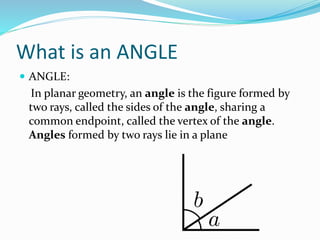
 ANGLE:
In planar geometry, an angle is the figure formed by
two rays, called the sides of the angle, sharing a
common endpoint, called the vertex of the angle.
Angles formed by two rays lie in a plane
Types Of Angle
 Acute Angle:
The acute angle is the small angle which is less than 90°.
 Right Angle:
The angle equal to 90° is right angle.
 Obtuse Angle:
The obtuse angle is the smaller angle. It is more than
90° and less than 180°.
 Reflex Angle:
The reflex angle is the larger angle. It is more than 180°
but less than 360°.
What are Polygons
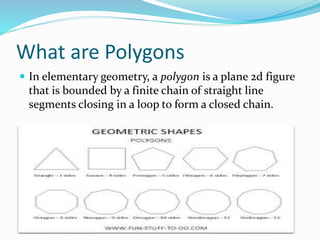
 In elementary geometry, a polygon is a plane 2d figure
that is bounded by a finite chain of straight line
segments closing in a loop to form a closed chain.
Use of polygons in Drawing
 Hexagonal Nut Head:
The drawing of hexagonal nut is drawn with the help
of hexagon.
 L-N Key Head:
The drawing of inside groove of head of
L-N key is made through
hexagonal construction
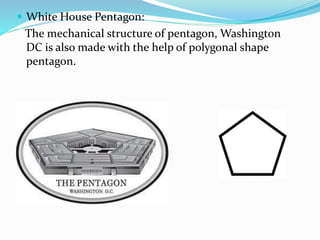
 White House Pentagon:
The mechanical structure of pentagon, Washington
DC is also made with the help of polygonal shape
pentagon.
What is Involute
 Involute :
An Involute is a curve traced by the free end of a thread
unwound from a circle or a polygon in such a way that
the thread is always tight and tangential to the figure.
Involute of a circle
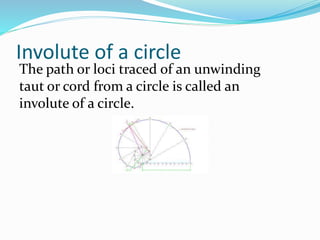
The path or loci traced of an unwinding
taut or cord from a circle is called an
involute of a circle.
Uses of Involute
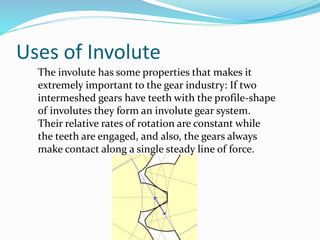
The involute has some properties that makes it
extremely important to the gear industry: If two
intermeshed gears have teeth with the profile-shape
of involutes they form an involute gear system.
Their relative rates of rotation are constant while
the teeth are engaged, and also, the gears always
make contact along a single steady line of force.
What is an Ellipse
an ellipse is a curve on a plane that surrounds two focal
points such that the sum of the distances to the two
focal points is constant for every point on the curve.
The length of minor axis is less than Length of Major
Axis.
Use Of Ellipse In Drawing
 The equation of an ellipse whose major and minor axes
coincide with the Cartesian axes is
Use of Ellipse In Drawing
It is use to make geometry of glasses of spectacles.
It is use to show circle on any view in an isometric
diagram.
It is also use to show a circle from a side view.
What is Hyperbola
 If we cut side of cone except from centre along vertical
axis than a hyperbolic curve is obtained.
• A symmetrical open curve formed by the
intersection of a circular cone with a plane at
a smaller angle with its axis than the side of the
cone.
Use of hyperbola in drawing
 In construction of Nuclear Reactor Walls.
What is Parabola
 A symmetrical open plane curve formed by the
intersection of a cone with a plane parallel to its side.
The path of a projectile under the influence of gravity
ideally follows
Uses of parabola in drawing
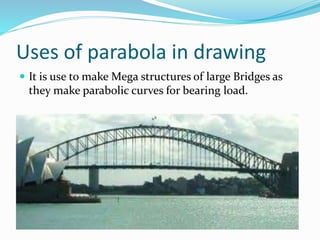
 It is use to make Mega structures of large Bridges as
they make parabolic curves for bearing load.
What is Directrix
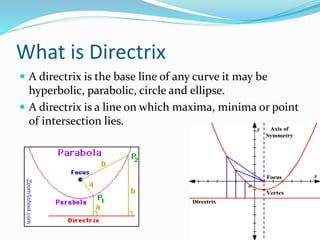
 A directrix is the base line of any curve it may be
hyperbolic, parabolic, circle and ellipse.
 A directrix is a line on which maxima, minima or point
of intersection lies.
Directrix in parabola
 A parabola is set of all points in a plane which are an
equal distance away from a given point and given line.
The point is called the focus of the parabola, and the
line is called the directrix.
 The directrix is perpendicular to the axis of symmetry
of a parabola and does not touch the parabola. If the
axis of symmetry of a parabola is vertical, the directrix
is a horizontal line.
 If we consider only parabolas that open upwards or
downwards, then the directrix is a horizontal line of
the form y = c .
Relation between focus vertex and
directrix
 The vertex of the parabola is at equal distance between
focus and the directrix.
 If F is the focus of the parabola, V is the vertex and D is
the intersection point of the directrix and the axis of
symmetry, then V is the midpoint of the line segment .
.
Calculation of Directrix
What Is Foci
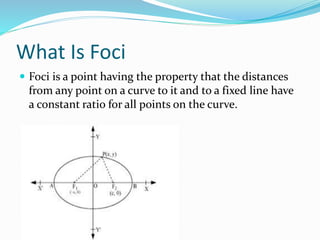
 Foci is a point having the property that the distances
from any point on a curve to it and to a fixed line have
a constant ratio for all points on the curve.
Foci of ellipse
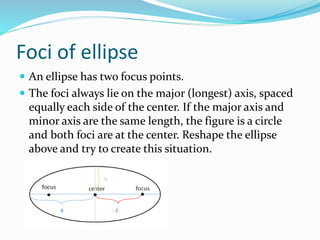
 An ellipse has two focus points.
 The foci always lie on the major (longest) axis, spaced
equally each side of the center. If the major axis and
minor axis are the same length, the figure is a circle
and both foci are at the center. Reshape the ellipse
above and try to create this situation.
Calculation of foci
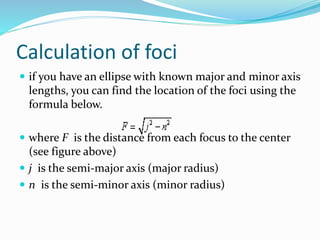
 if you have an ellipse with known major and minor axis
lengths, you can find the location of the foci using the
formula below.
 where F is the distance from each focus to the center
(see figure above)
 j is the semi-major axis (major radius)
 n is the semi-minor axis (minor radius)
What is eccentricity
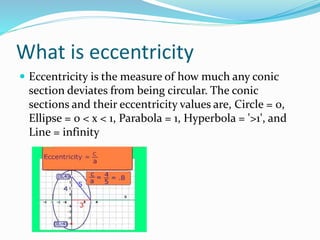
 Eccentricity is the measure of how much any conic
section deviates from being circular. The conic
sections and their eccentricity values are, Circle = 0,
Ellipse = 0 < x < 1, Parabola = 1, Hyperbola = '>1', and
Line = infinity
Eccentricity in ellipse
 The eccentricity of an ellipse is a measure of how
nearly circular the ellipse. Eccentricity is found by the
following formula eccentricity = c/a where c is the
distance from the center to the focus of the ellipse a is
the distance from the center to a vertex
Calculation of Eccentricity
 The eccentricity is calculated by the formula given as
 where
c is the distance from the center to a focus.
a is the distance from that focus to a vertex

drawing geometry

  • 1.
    Naumaan Anees Sarmad Tufail TalhaAli Waseem Akram  Muhammad Asad Ansub Azeem
  • 2.
    What is anANGLE  ANGLE: In planar geometry, an angle is the figure formed by two rays, called the sides of the angle, sharing a common endpoint, called the vertex of the angle. Angles formed by two rays lie in a plane
  • 3.
    Types Of Angle Acute Angle: The acute angle is the small angle which is less than 90°.  Right Angle: The angle equal to 90° is right angle.
  • 4.
     Obtuse Angle: Theobtuse angle is the smaller angle. It is more than 90° and less than 180°.  Reflex Angle: The reflex angle is the larger angle. It is more than 180° but less than 360°.
  • 5.
    What are Polygons In elementary geometry, a polygon is a plane 2d figure that is bounded by a finite chain of straight line segments closing in a loop to form a closed chain.
  • 6.
    Use of polygonsin Drawing  Hexagonal Nut Head: The drawing of hexagonal nut is drawn with the help of hexagon.  L-N Key Head: The drawing of inside groove of head of L-N key is made through hexagonal construction
  • 7.
     White HousePentagon: The mechanical structure of pentagon, Washington DC is also made with the help of polygonal shape pentagon.
  • 8.
    What is Involute Involute : An Involute is a curve traced by the free end of a thread unwound from a circle or a polygon in such a way that the thread is always tight and tangential to the figure.
  • 9.
    Involute of acircle The path or loci traced of an unwinding taut or cord from a circle is called an involute of a circle.
  • 10.
    Uses of Involute Theinvolute has some properties that makes it extremely important to the gear industry: If two intermeshed gears have teeth with the profile-shape of involutes they form an involute gear system. Their relative rates of rotation are constant while the teeth are engaged, and also, the gears always make contact along a single steady line of force.
  • 11.
    What is anEllipse an ellipse is a curve on a plane that surrounds two focal points such that the sum of the distances to the two focal points is constant for every point on the curve. The length of minor axis is less than Length of Major Axis.
  • 12.
    Use Of EllipseIn Drawing  The equation of an ellipse whose major and minor axes coincide with the Cartesian axes is
  • 13.
    Use of EllipseIn Drawing It is use to make geometry of glasses of spectacles. It is use to show circle on any view in an isometric diagram. It is also use to show a circle from a side view.
  • 14.
    What is Hyperbola If we cut side of cone except from centre along vertical axis than a hyperbolic curve is obtained. • A symmetrical open curve formed by the intersection of a circular cone with a plane at a smaller angle with its axis than the side of the cone.
  • 16.
    Use of hyperbolain drawing  In construction of Nuclear Reactor Walls.
  • 17.
    What is Parabola A symmetrical open plane curve formed by the intersection of a cone with a plane parallel to its side. The path of a projectile under the influence of gravity ideally follows
  • 18.
    Uses of parabolain drawing  It is use to make Mega structures of large Bridges as they make parabolic curves for bearing load.
  • 19.
    What is Directrix A directrix is the base line of any curve it may be hyperbolic, parabolic, circle and ellipse.  A directrix is a line on which maxima, minima or point of intersection lies.
  • 21.
    Directrix in parabola A parabola is set of all points in a plane which are an equal distance away from a given point and given line. The point is called the focus of the parabola, and the line is called the directrix.  The directrix is perpendicular to the axis of symmetry of a parabola and does not touch the parabola. If the axis of symmetry of a parabola is vertical, the directrix is a horizontal line.  If we consider only parabolas that open upwards or downwards, then the directrix is a horizontal line of the form y = c .
  • 22.
    Relation between focusvertex and directrix  The vertex of the parabola is at equal distance between focus and the directrix.  If F is the focus of the parabola, V is the vertex and D is the intersection point of the directrix and the axis of symmetry, then V is the midpoint of the line segment . .
  • 23.
  • 24.
    What Is Foci Foci is a point having the property that the distances from any point on a curve to it and to a fixed line have a constant ratio for all points on the curve.
  • 25.
    Foci of ellipse An ellipse has two focus points.  The foci always lie on the major (longest) axis, spaced equally each side of the center. If the major axis and minor axis are the same length, the figure is a circle and both foci are at the center. Reshape the ellipse above and try to create this situation.
  • 26.
    Calculation of foci if you have an ellipse with known major and minor axis lengths, you can find the location of the foci using the formula below.  where F is the distance from each focus to the center (see figure above)  j is the semi-major axis (major radius)  n is the semi-minor axis (minor radius)
  • 27.
    What is eccentricity Eccentricity is the measure of how much any conic section deviates from being circular. The conic sections and their eccentricity values are, Circle = 0, Ellipse = 0 < x < 1, Parabola = 1, Hyperbola = '>1', and Line = infinity
  • 28.
    Eccentricity in ellipse The eccentricity of an ellipse is a measure of how nearly circular the ellipse. Eccentricity is found by the following formula eccentricity = c/a where c is the distance from the center to the focus of the ellipse a is the distance from the center to a vertex
  • 29.
    Calculation of Eccentricity The eccentricity is calculated by the formula given as  where c is the distance from the center to a focus. a is the distance from that focus to a vertex