Volume and Surface area
Cone
Pyramid
Sphere
Pyramid
• A pyramid is a polygonal base with a
vertex
• All the faces are triangle which meet at the
vertex
• There are several types of pyramid





Triangle based pyramid- Tetrahedron
Quadrilateral based pyramid
Pentagon based pyramid
Hexagon based pyramid
• The pyramid where vertex is directly
above the centre of the base is known as
right pyramid and the pyramid that doesn’t
have vertex directly above the vertex is
called Oblique Pyramids.
• Perpendicular of pyramid (height) :
distance from the vertex to the base of the
pyramid
• Slant height: distance from the vertex to
the mid point of an edge of the base
Volume of Pyramid
Net of Pyramid
Surface area pf Pyramid
•

•

•

Surface area: : The number of
square units that will exactly cover
the surface of a pyramid.
In the case of a right pyramid, the
side faces are all the same, so we
can simply find the area of one
and multiply by the number of
faces. Once we add the area of
the base, we have the total
surface area.
Surface area of pyramid= total
area of all its faces+ base area.

Area of the
base
Area of the four
faces 4 times
=TOTAL
Cone
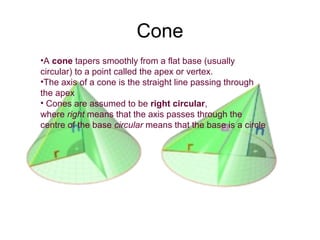
•A cone tapers smoothly from a flat base (usually
circular) to a point called the apex or vertex.
•The axis of a cone is the straight line passing through
the apex
• Cones are assumed to be right circular,
where right means that the axis passes through the
centre of the base circular means that the base is a circle
Volume of cone
• The volume of any conic solid is one third
of the product of the area of the base and
the height (the perpendicular distance
from the base to the apex).
• 1/3*base area* height
Surface area of cone
• By folding the quadrant a cone will be
obtained
• The curved surface area of the cone is the
area of quadrant
• Curved Surface Area = πrl
Total surface area
• Area of quadrant or curved surface area+
base area
Sphere
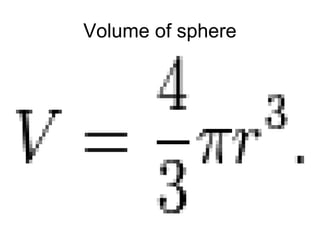
Volume of sphere
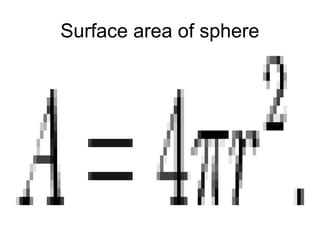
Surface area of sphere

Volume and surface area

  • 1.
    Volume and Surfacearea Cone Pyramid Sphere
  • 2.
    Pyramid • A pyramidis a polygonal base with a vertex • All the faces are triangle which meet at the vertex • There are several types of pyramid     Triangle based pyramid- Tetrahedron Quadrilateral based pyramid Pentagon based pyramid Hexagon based pyramid
  • 3.
    • The pyramidwhere vertex is directly above the centre of the base is known as right pyramid and the pyramid that doesn’t have vertex directly above the vertex is called Oblique Pyramids.
  • 4.
    • Perpendicular ofpyramid (height) : distance from the vertex to the base of the pyramid • Slant height: distance from the vertex to the mid point of an edge of the base
  • 5.
  • 6.
  • 7.
    Surface area pfPyramid • • • Surface area: : The number of square units that will exactly cover the surface of a pyramid. In the case of a right pyramid, the side faces are all the same, so we can simply find the area of one and multiply by the number of faces. Once we add the area of the base, we have the total surface area. Surface area of pyramid= total area of all its faces+ base area. Area of the base Area of the four faces 4 times =TOTAL
  • 8.
    Cone •A cone taperssmoothly from a flat base (usually circular) to a point called the apex or vertex. •The axis of a cone is the straight line passing through the apex • Cones are assumed to be right circular, where right means that the axis passes through the centre of the base circular means that the base is a circle
  • 9.
    Volume of cone •The volume of any conic solid is one third of the product of the area of the base and the height (the perpendicular distance from the base to the apex). • 1/3*base area* height
  • 10.
    Surface area ofcone • By folding the quadrant a cone will be obtained • The curved surface area of the cone is the area of quadrant • Curved Surface Area = πrl
  • 11.
    Total surface area •Area of quadrant or curved surface area+ base area
  • 12.
  • 13.
  • 14.