





Adding Jumbo Motivation to
Online Courses and Activities
with the TEC-VARIETY Model

        Dr. Curtis J. Bonk
Professor, Indiana University, IST Dept
    http://php.indiana.edu/~cjbonk
          cjbonk@indiana.edu
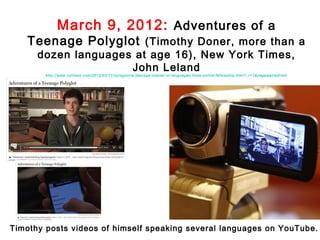
March 9, 2012: Adventures of a
   Teenage Polyglot (Timothy Doner, more than a
      dozen languages at age 16), New York Times,
                     John Leland
        http://www.nytimes.com /2012/03/11/nyregion/ a-teenage-master-of-languages-finds-online-fellowship.html?_r=1&pagewanted=all


Timothy posts videos of himself speaking several languages on YouTube.
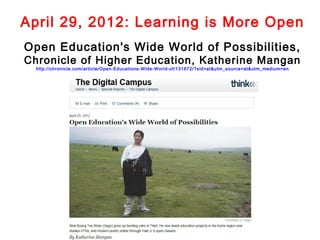
April 29, 2012: Learning is More Open
Open Education's Wide World of Possibilities,
Chronicle of Higher Education, Katherine Mangan
  http://chronicle.com/article/Open-Educations-Wide-World-of/131672/?sid=at&utm_source=at&utm_medium=en
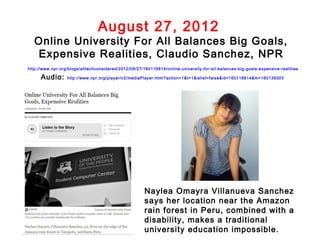
August 27, 2012
   Online University For All Balances Big Goals,
   Expensive Realities, Claudio Sanchez, NPR
http://www.npr.org/blogs/alltechconsidered/2012/08/27/160116814/online-university-for-all-balances-big-goals-expensive-realities

      Audio:      http://www.npr.org/player/v2/mediaPlayer.html?action=1&t=1&islist=false&id=160116814&m=160135003


                                                       Naylea Omayra Villanueva Sanchez
                                                       says her location near the Amazon
                                                       rain forest in Peru, combined with a
                                                       disability, makes a traditional
                                                       university education impossible.
December 9, 2012
          Retired Earn Degrees
http://www.nytimes.com/2012/11/30/us/80-year-old-graduate-of-wgu-texas-kept-hi s-promi se.html ?ref=education&_r=0
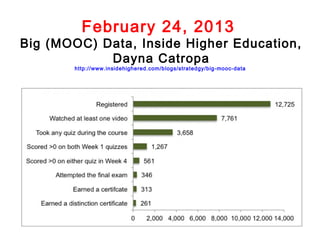
February 24, 2013
Big (MOOC) Data, Inside Higher Education,
            Dayna Catropa
       http://www.insidehighered.com/blogs/stratedgy/big-mooc-data
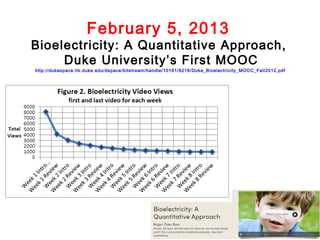
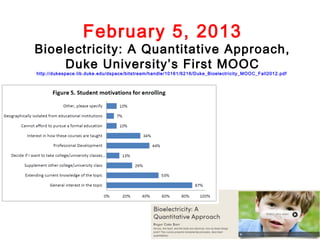
February 5, 2013
Bioelectricity: A Quantitative Approach,
     Duke University’s First MOOC
http://dukespace.lib.duke.edu/dspace/bitstream/handle/10161/6216/Duke_Bioelectricity_MOOC_Fall2012.pdf
February 5, 2013
Bioelectricity: A Quantitative Approach,
     Duke University’s First MOOC
http://dukespace.lib.duke.edu/dspace/bitstream/handle/10161/6216/Duke_Bioelectricity_MOOC_Fall2012.pdf
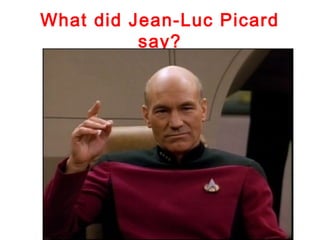
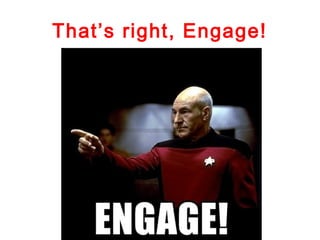
What did Jean-Luc Picard
          say?
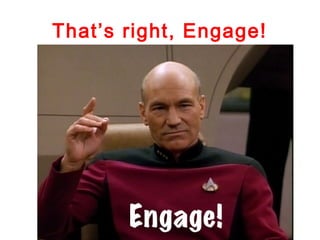
That’s right, Engage!
Where would we all like
      to work?
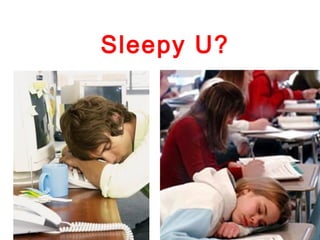
Sleepy U?
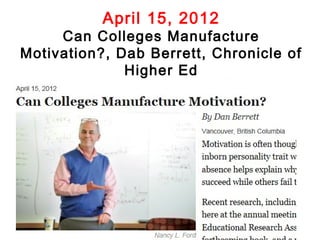
April 15, 2012
     Can Colleges Manufacture
Motivation?, Dab Berrett, Chronicle of
              Higher Ed
 http://chronicle.com/article/Can-Colleges-Manufacture/131564/
What was it that he said?
That’s right, Engage!
Ok, Million Dollar Question:
How do you motivate online learners?
    What Words come to mind?
Motivation Research Highlights
  (Jere Brophy, Michigan State University)
1. Supportive, appropriate challenge, meaningful,
   moderation/optimal.
2. Teach goal setting and self-reinforcement.
3. Offer rewards for good/improved performance.
4. Novelty, variety, choice, adaptable to interests.
5. Game-like, fun, fantasy, curiosity, suspense, active.
6. Higher levels, divergence, dissonance, peer
   interaction.
7. Allow to create finished products.
8. Provide immediate feedback, advance organizers.
9. Show intensity, enthusiasm, interest, minimize anxiety.
10. Make content personal, concrete, familiar.
Intrinsic Motivation
“…innate propensity to engage one ’s
 interests and exercise one ’s
 capabilities, and, in doing so, to seek
 out and master optimal challenges
(i.e., it emerges from needs, inner strivings,
   and personal curiosity for growth)
     See: Deci, E. L., & Ryan, R.
     M. (1985). Intrinsic
     motivation and self-
     determination in human
     behavior . NY: Plenum
     Press.
Jumbo Motivation is Needed!
Framework #1: TEC-VARIETY for
Online Motivation and Retention
1. Tone/Climate: Psych Safety, Comfort,
    Belonging
2. Encouragement, Feedback: Responsive,
    Supports
3. Curiosity: Fun, Fantasy, Control
     …
4. Variety: Novelty, Intrigue, Unknowns
5. Autonomy: Choice: Flexibility, Opportunities
6. Relevance: Meaningful, Authentic, Interesting
7. Interactive: Collaborative, Team-Based,
    Community
8. Engagement: Effort, Involvement, Excitement
9. Tension: Challenge, Dissonance, Controversy
10. Yields Products: Goal Driven, Products,
    Success, Ownership
Examples of TEC-VARIETY
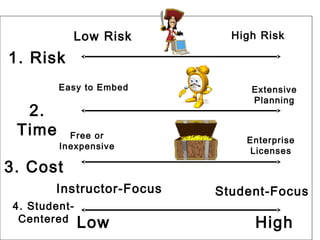
Low Risk         High Risk

1. Risk
        Easy to Embed         Extensive
                              Planning
  2.
 Time     Free or
                             Enterprise
        Inexpensive
                              Licenses

3. Cost
      Instructor-Focus   Student-Focus
4. Student-
 Centered Low                  High
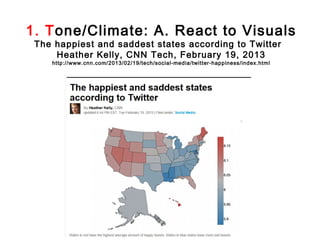
1. Tone/Climate: A. React to Visuals
 The happiest and saddest states according to Twitter
     Heather Kelly, CNN Tech, February 19, 2013
    http://www.cnn.com/2013/02/19/tech/social-media/twitter-happiness/index.html
2. Encouragement,
Feedback, etc.: A. Create
               Screencasts
(Jing, GoView, Screenr, slide from Zaid Ali Alsagoff
            [zaid.alsagoff@gmail.com])
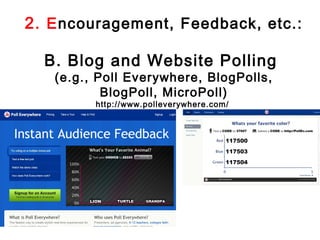
2. Encouragement, Feedback, etc.:

  B. Blog and Website Polling
   (e.g., Poll Everywhere, BlogPolls,
           BlogPoll, MicroPoll)
         http://www.polleverywhere.com/
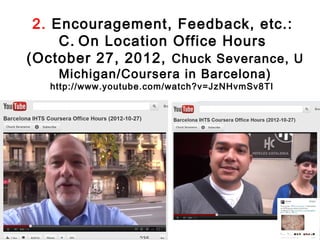
2. Encouragement, Feedback, etc.:
     C. On Location Office Hours
(October 27, 2012, Chuck Severance, U
    Michigan/Coursera in Barcelona)
   http://www.youtube.com/watch?v=JzNHvmSv8TI
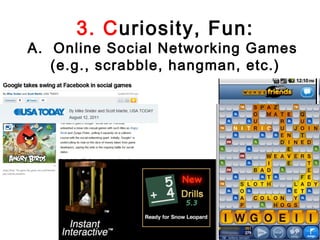
3. Curiosity, Fun:
A. Online Social Networking Games
   (e.g., scrabble, hangman, etc.)
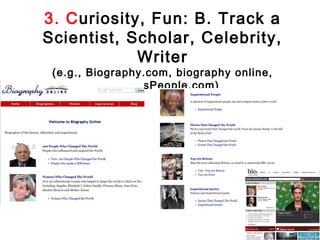
3. Curiosity, Fun: B. Track a
Scientist, Scholar, Celebrity,
            Writer
 (e.g., Biography.com, biography online,
           FamousPeople.com)
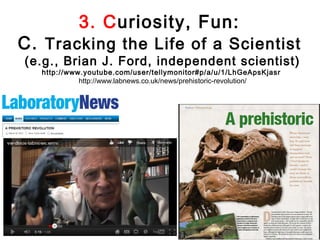
3. Curiosity, Fun:
C. Tracking the Life of a Scientist
(e.g., Brian J. Ford, independent scientist)
  http://www.youtube.com/user/tellymonitor#p/a/u/1/LhGeApsKjasr
            http://www.labnews.co.uk/news/prehistoric-revolution/
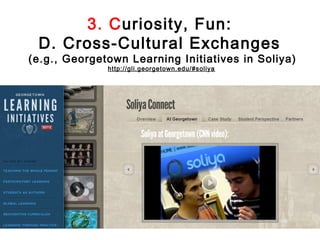
3. Curiosity, Fun:
 D. Cross-Cultural Exchanges
(e.g., Georgetown Learning Initiatives in Soliya)
              http://gli.georgetown.edu/#soliya
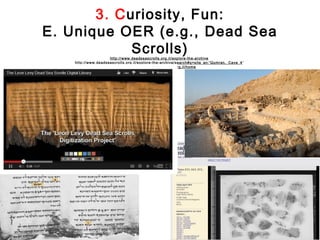
3. Curiosity, Fun:
E. Unique OER (e.g., Dead Sea
            Scrolls) http://www.deadseascrolls.org.il /explore-the-archive
    http://www.deadseascrolls.org.il/explore-the-archi ve/search#q=site_en:'Qumran,_Cave_4 '
                             http://www.deadseascrolls.org.il /home
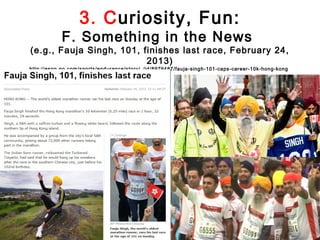
3. Curiosity, Fun:
            F. Something in the News
(e.g., Fauja Singh, 101, finishes last race, February 24,
                          2013)
http://espn.go.com/sports/endurance/story/_/id/8979487/fauja-singh-101-caps-career-10k-hong-kong
3. Curiosity, Fun:
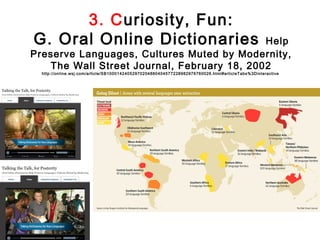
G. Oral Online Dictionaries                 Help
Preserve Languages, Cultures Muted by Modernity,
   The Wall Street Journal, February 18, 2002
  http://online.wsj.com/article/SB10001424052970204880404577228982976760026.html#articleTabs%3Dinteractive
4. Variety, Novelty:
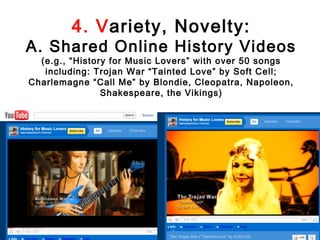
A. Shared Online History Videos
  (e.g., “History for Music Lovers” with over 50 songs
   including: Trojan War “Tainted Love” by Soft Cell;
Charlemagne “Call Me” by Blondie, Cleopatra, Napoleon,
                Shakespeare, the Vikings)
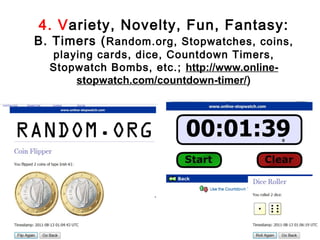
4. Variety, Novelty, Fun, Fantasy:
B. Timers ( Random.org, Stopwatches, coins,
  playing cards, dice, Countdown Timers,
  Stopwatch Bombs, etc.; http://www.online-
      stopwatch.com/countdown-timer/)
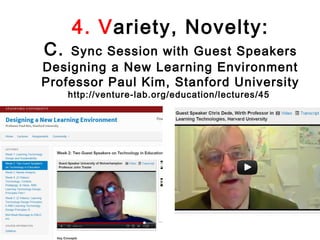
4. Variety, Novelty:
C.  Sync Session with Guest Speakers
Designing a New Learning Environment
Professor Paul Kim, Stanford University
     http://venture-lab.org/education/lectures/45
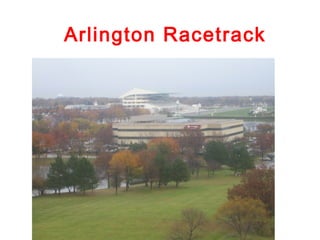
Arlington Racetrack
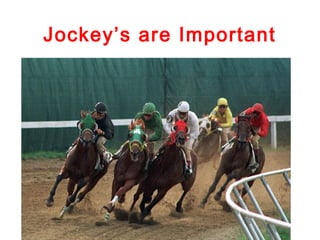
Jockey’s are Important
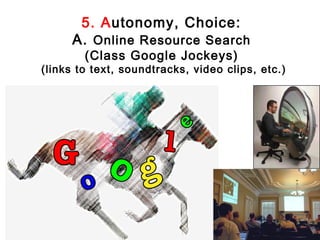
5. Autonomy, Choice:
     A. Online Resource Search
        (Class Google Jockeys)
(links to text, soundtracks, video clips, etc.)
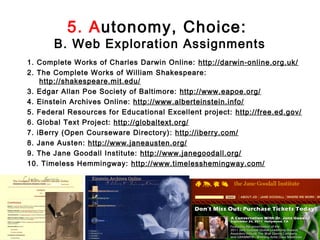
5. Autonomy, Choice:
       B. Web Exploration Assignments
1. Complete Works of Charles Darwin Online: http://darwin-online.org.uk/
2. The Complete Works of William Shakespeare:
    http://shakespeare.mit.edu/
3. Edgar Allan Poe Society of Baltimore: http://www.eapoe.org/
4. Einstein Archives Online: http://www.alberteinstein.info/
5. Federal Resources for Educational Excellent project: http://free.ed.gov/
6. Global Text Project: http://globaltext.org/
7. iBerry (Open Courseware Directory): http://iberry.com/
8. Jane Austen: http://www.janeausten.org/
9. The Jane Goodall Institute: http://www.janegoodall.org/
10. Timeless Hemmingway: http://www.timelesshemingway.com/
Poll #1:
  Which of the first 5 motivational
  principles will you use the most?
A. Tone/Climate
B. Encouragement/Feedback
C. Curiosity/Fun
D. Variety/Novelty
E. Autonomy/Choice/Flexibility
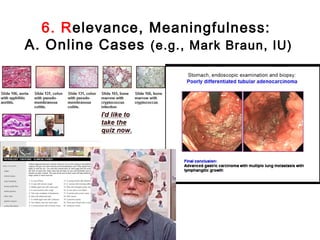
6. Relevance, Meaningfulness:
A. Online Cases (e.g., Mark Braun, IU)
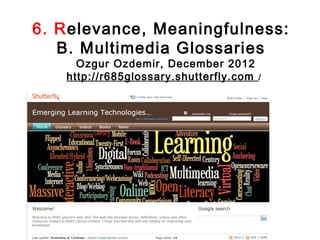
6. Relevance, Meaningfulness:
   B. Multimedia Glossaries
     Ozgur Ozdemir, December 2012
   http://r685glossary.shutterfly.com   /
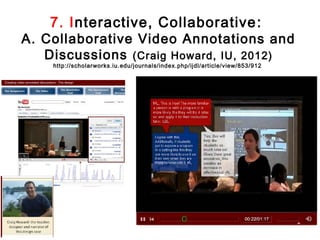
7. Interactive, Collaborative :
A. Collaborative Video Annotations and
   Discussions (Craig Howard, IU, 2012)
    http://scholarworks.iu.edu/journals/index.php/ijdl/article/view/853/912
7. Interactive, Collaborative :
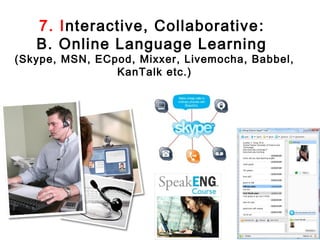
   B. Online Language Learning
(Skype, MSN, ECpod, Mixxer, Livemocha, Babbel,
                KanTalk etc.)
7. Interactive, Collaborative :
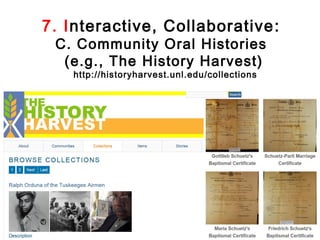
 C. Community Oral Histories
  (e.g., The History Harvest)
    http://historyharvest.unl.edu/collections
7. Interactive, Collaborative :
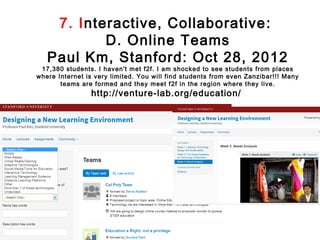
           D. Online Teams
   Paul Km, Stanford: Oct 28, 2012
 17,380 students. I haven't met f2f. I am shocked to see students from places
where Internet is very limited. You will find students from even Zanzibar!!! Many
       teams are formed and they meet f2f in the region where they live.
                http://venture-lab.org/education/
7. Interactive, Collaborative :
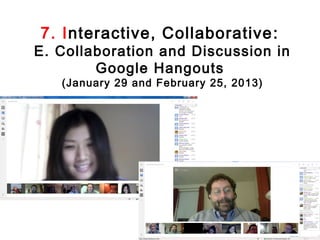
E. Collaboration and Discussion in
        Google Hangouts
   (January 29 and February 25, 2013)
7. Interactive, Collaborative :
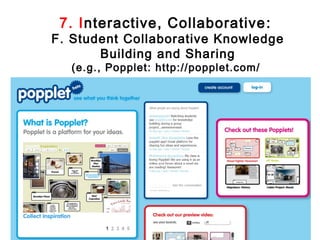
F. Student Collaborative Knowledge
       Building and Sharing
  (e.g., Popplet: http://popplet.com/
8. Engagement, Effort:
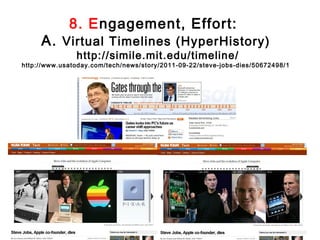
     A. Virtual Timelines (HyperHistory)
               http://simile.mit.edu/timeline/
http://www.usatoday.com/tech/news/story/2011-09-22/steve-jobs-dies/50672498/1
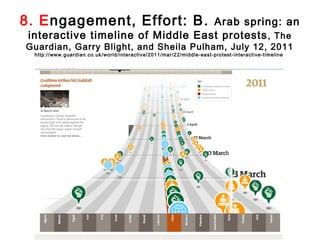
8. Engagement, Effort: B .         Arab spring: an
 interactive timeline of Middle East protests , The
Guardian, Garry Blight, and Sheila Pulham, July 12, 2011
  http://www.guardian.co.uk/world/interactive/2011/mar/22/middle-east-protest-interactive-timeline
8. Engagement, Effort:
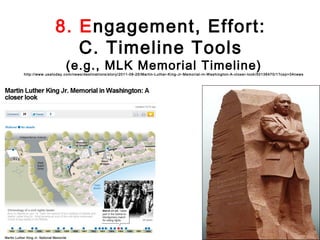
                   C. Timeline Tools
                     (e.g., MLK Memorial Timeline)
http://www.usatoday.com /news/destinati ons/story/2011-08-25/Martin-Luther-K ing-Jr-Memorial -in-Washington-A-cl oser-look/50136470/1?cs p=34news
8. Engagement, Effort:
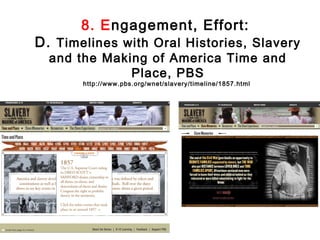
D. Timelines with Oral Histories, Slavery
  and the Making of America Time and
              Place, PBS
       http://www.pbs.org/wnet/slavery/timeline/1857.html
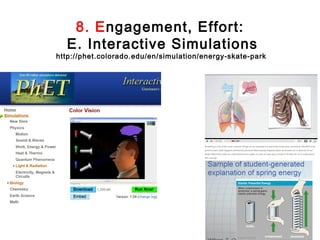
8. Engagement, Effort:
  E. Interactive Simulations
http://phet.colorado.edu/en/simulation/energy-skate-park
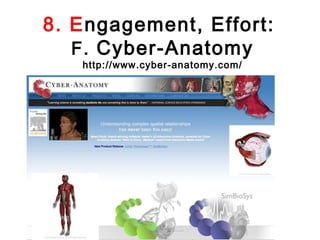
8. Engagement, Effort:
   F. Cyber-Anatomy
   http://www.cyber-anatomy.com/
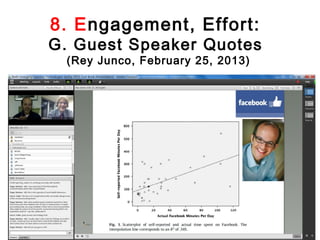
8. Engagement, Effort:
G. Guest Speaker Quotes
 (Rey Junco, February 25, 2013)
9. Tension, Challenge,
            etc.:
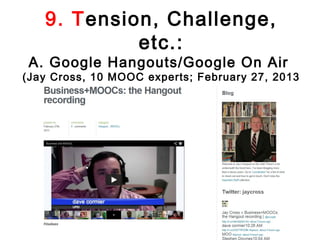
 A. Google Hangouts/Google On Air
(Jay Cross, 10 MOOC experts; February 27, 2013
     http://www.jaycross.com/wp/2013/02/businessmoocs-the-hangout-recording/
9. Tension, Challenge, etc.:
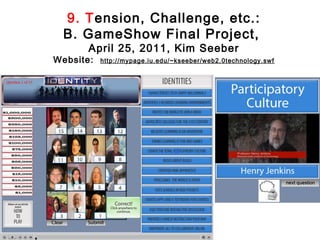
  B. GameShow Final Project,
         April 25, 2011, Kim Seeber
Website:   http://mypage.iu.edu/~kseeber/web2.0technology.swf
10. Yields Products, Goals:
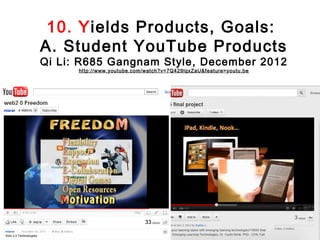
A. Student YouTube Products
Qi Li: R685 Gangnam Style, December 2012
      http://www.youtube.com/watch?v=7Q429lqxZaU&feature=youtu.be
10. Yields Products, Goals:
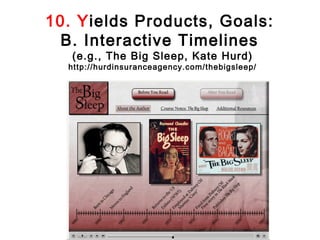
 B. Interactive Timelines
   (e.g., The Big Sleep, Kate Hurd)
  http://hurdinsuranceagency.com/thebigsleep/
10. Yields Products, Goals:
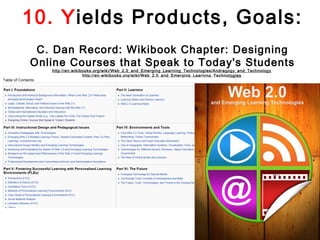
 C. Dan Record: Wikibook Chapter: Designing
Online Courses that Speak to Today's Students
   http://en.wikibooks.org/wiki/Web_2.0_and_Emerging_Learning_Technologies/Andragogy_and_Technology
                  http://en.wikibooks.org/wiki/Web_2.0_and_Emerging_Learning_Technologies  
Poll #2:
  Which of the last 5 motivational
  principles will you use the most?
A. Relevance/Meaningfulness
B. Engagement/Effort
C. Interactive/Collab/Community
D. Tension/Challenge/Dissonance
E. Yielding Products/Goals
Poll #3:
How many ideas did you get so far?
1.   0 if I am lucky.
2.   1 or 2.
3.   3-5.
4.   6-10.
5.   More than 10.
Commitments:
            Stop and Share:
Which principle(s) of TEC-VARIETY will you
                    use?
        Tone/Climate
        Encouragement,
          Feedback
        Curiosity

        Variety
        Autonomy
        Relevance
        Interactive
        Engagement
        Tension
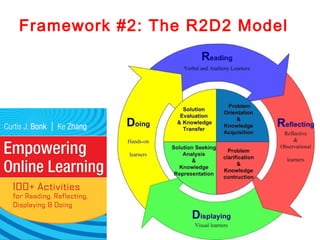
Framework #2: The R2D2 Model
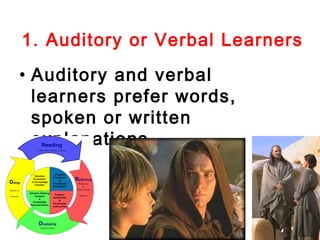
1. Auditory or Verbal Learners
• Auditory and verbal
  learners prefer words,
  spoken or written
  explanations.
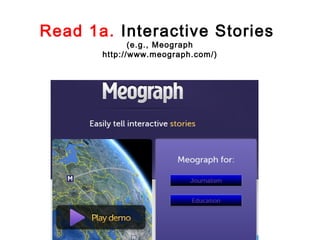
Read 1a. Interactive Stories
              (e.g., Meograph
       http://www.meograph.com/)
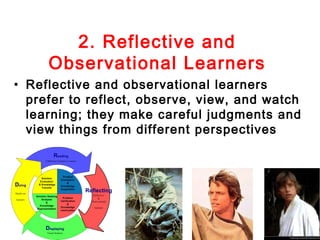
2. Reflective and
     Observational Learners
• Reflective and observational learners
  prefer to reflect, observe, view, and watch
  learning; they make careful judgments and
  view things from different perspectives
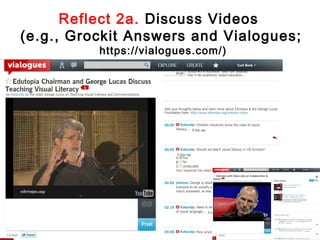
Reflect 2a. Discuss Videos
(e.g., Grockit Answers and Vialogues;
          https://vialogues.com/)
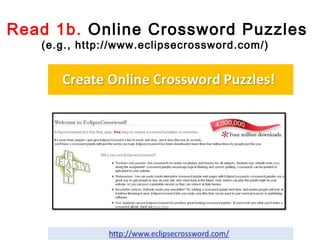
Read 1b. Online Crossword Puzzles
   (e.g., http://www.eclipsecrossword.com/)
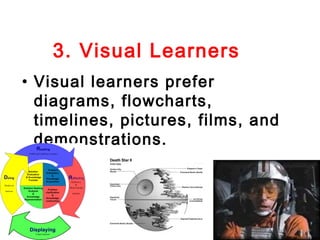
3. Visual Learners
• Visual learners prefer
  diagrams, flowcharts,
  timelines, pictures, films, and
  demonstrations.
 
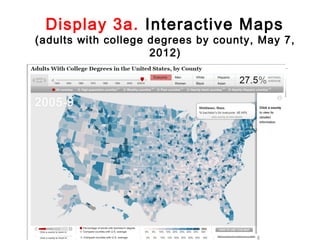
 Display 3a. Interactive Maps
(adults with college degrees by county, May 7,
                     2012)
                                                              
     http://todayscampus.com/article/Keith_Hampson_Interviews_Josh_Keller_on__Interactive_Graphics_for_Higher_Education
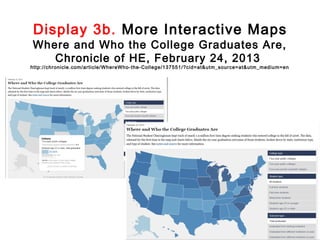
Display 3b. More Interactive Maps
Where and Who the College Graduates Are,
   Chronicle of HE, February 24, 2013
http://chronicle.com/article/WhereWho-the-College/137551/?cid=at&utm_source=at&utm_medium=en
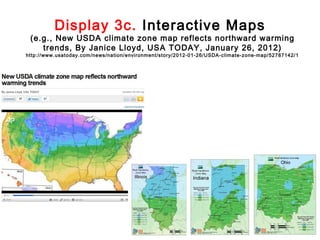
Display 3c. Interactive Maps
 (e.g., New USDA climate zone map reflects northward warming
    trends, By Janice Lloyd, USA TODAY, January 26, 2012)
http://www.usatoday.com/news/nation/environment/story/2012-01-26/USDA-climate-zone-map/52787142/1
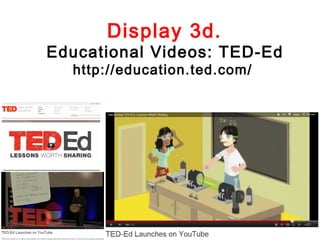
Display 3d.
Educational Videos: TED-Ed
  http://education.ted.com/
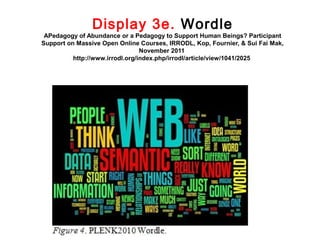
Display 3e. Wordle
 APedagogy of Abundance or a Pedagogy to Support Human Beings? Participant
Support on Massive Open Online Courses, IRRODL, Kop, Fournier, & Sui Fai Mak,
                                 November 2011
          http://www.irrodl.org/index.php/irrodl/article/view/1041/2025
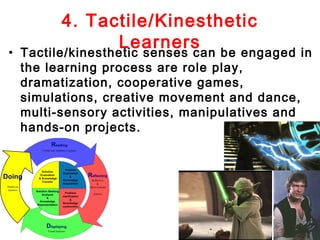
4. Tactile/Kinesthetic
•
                   Learners be engaged
    Tactile/kinesthetic senses can                in
    the learning process are role play,
    dramatization, cooperative games,
    simulations, creative movement and dance,
    multi-sensory activities, manipulatives and
    hands-on projects.
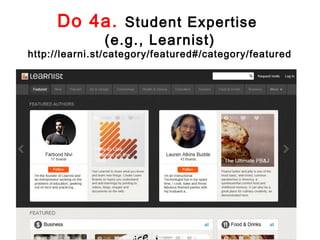
Do 4a. Student Expertise
               (e.g., Learnist)
http://learni.st/category/featured#/category/featured
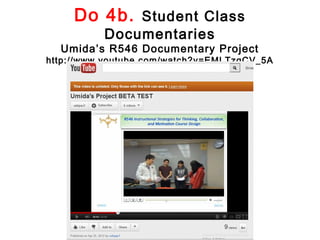
Do 4b. Student Class
          Documentaries
  Umida’s R546 Documentary Project
http://www.youtube.com/watch?v=EMLTzqCV_5A
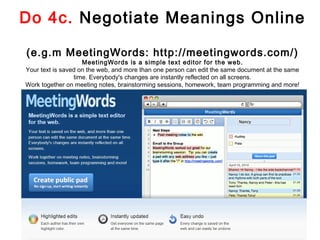
Do 4c. Negotiate Meanings Online

(e.g.m MeetingWords: http://meetingwords.com/)
                    MeetingWords is a simple text editor for the web.
Your text is saved on the web, and more than one person can edit the same document at the same
                 time. Everybody's changes are instantly reflected on all screens.
Work together on meeting notes, brainstorming sessions, homework, team programming and more!
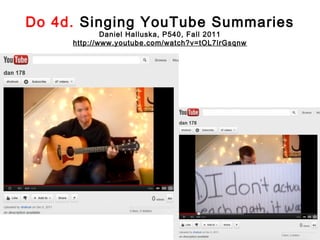
Do 4d. Singing YouTube Summaries
             Daniel Halluska, P540, Fall 2011
     http://www.youtube.com/watch?v=tOL7lrGsqnw
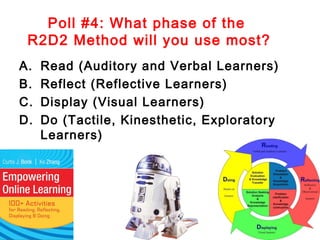
Poll #4: What phase of the
 R2D2 Method will you use most?
A.   Read (Auditory and Verbal Learners)
B.   Reflect (Reflective Learners)
C.   Display (Visual Learners)
D.   Do (Tactile, Kinesthetic, Exploratory
     Learners)
Poll #5:
Do you feel “MOTIVATED” to try
        any of this out?
        A. Yes, both
       B. Yes, R2D2
   C. Yes, TEC-VARIETY
         D. Neither
Poll #6:
     Any light bulbs going off in
        your head so far…?
A. Yes definitely
B. Maybe
C. No
Stop and Share:
Three Words from this session!
Do you feel JUMBO
 MOTIVATION?
Note: Bonk papers and talks at:
 http://www.publicationshare.com/
 http://www.trainingshare.com/
Curt Bonk – CJBonk@Indiana.edu

Engage 2013 SXSWedu, Curt Bonk, Adding Jumbo Motivation to Online Courses and Activities with the TEC-VARIETY Model

  • 2.
    Adding Jumbo Motivationto Online Courses and Activities with the TEC-VARIETY Model Dr. Curtis J. Bonk Professor, Indiana University, IST Dept http://php.indiana.edu/~cjbonk cjbonk@indiana.edu
  • 3.
    March 9, 2012:Adventures of a Teenage Polyglot (Timothy Doner, more than a dozen languages at age 16), New York Times, John Leland http://www.nytimes.com /2012/03/11/nyregion/ a-teenage-master-of-languages-finds-online-fellowship.html?_r=1&pagewanted=all Timothy posts videos of himself speaking several languages on YouTube.
  • 4.
    April 29, 2012:Learning is More Open Open Education's Wide World of Possibilities, Chronicle of Higher Education, Katherine Mangan http://chronicle.com/article/Open-Educations-Wide-World-of/131672/?sid=at&utm_source=at&utm_medium=en
  • 5.
    August 27, 2012 Online University For All Balances Big Goals, Expensive Realities, Claudio Sanchez, NPR http://www.npr.org/blogs/alltechconsidered/2012/08/27/160116814/online-university-for-all-balances-big-goals-expensive-realities Audio: http://www.npr.org/player/v2/mediaPlayer.html?action=1&t=1&islist=false&id=160116814&m=160135003 Naylea Omayra Villanueva Sanchez says her location near the Amazon rain forest in Peru, combined with a disability, makes a traditional university education impossible.
  • 6.
    December 9, 2012 Retired Earn Degrees http://www.nytimes.com/2012/11/30/us/80-year-old-graduate-of-wgu-texas-kept-hi s-promi se.html ?ref=education&_r=0
  • 7.
    February 24, 2013 Big(MOOC) Data, Inside Higher Education, Dayna Catropa http://www.insidehighered.com/blogs/stratedgy/big-mooc-data
  • 8.
    February 5, 2013 Bioelectricity:A Quantitative Approach, Duke University’s First MOOC http://dukespace.lib.duke.edu/dspace/bitstream/handle/10161/6216/Duke_Bioelectricity_MOOC_Fall2012.pdf
  • 9.
    February 5, 2013 Bioelectricity:A Quantitative Approach, Duke University’s First MOOC http://dukespace.lib.duke.edu/dspace/bitstream/handle/10161/6216/Duke_Bioelectricity_MOOC_Fall2012.pdf
  • 10.
    What did Jean-LucPicard say?
  • 11.
  • 12.
    Where would weall like to work?
  • 13.
  • 14.
    April 15, 2012 Can Colleges Manufacture Motivation?, Dab Berrett, Chronicle of Higher Ed http://chronicle.com/article/Can-Colleges-Manufacture/131564/
  • 15.
    What was itthat he said?
  • 16.
  • 17.
    Ok, Million DollarQuestion: How do you motivate online learners? What Words come to mind?
  • 19.
    Motivation Research Highlights (Jere Brophy, Michigan State University) 1. Supportive, appropriate challenge, meaningful, moderation/optimal. 2. Teach goal setting and self-reinforcement. 3. Offer rewards for good/improved performance. 4. Novelty, variety, choice, adaptable to interests. 5. Game-like, fun, fantasy, curiosity, suspense, active. 6. Higher levels, divergence, dissonance, peer interaction. 7. Allow to create finished products. 8. Provide immediate feedback, advance organizers. 9. Show intensity, enthusiasm, interest, minimize anxiety. 10. Make content personal, concrete, familiar.
  • 20.
    Intrinsic Motivation “…innate propensityto engage one ’s interests and exercise one ’s capabilities, and, in doing so, to seek out and master optimal challenges (i.e., it emerges from needs, inner strivings, and personal curiosity for growth) See: Deci, E. L., & Ryan, R. M. (1985). Intrinsic motivation and self- determination in human behavior . NY: Plenum Press.
  • 21.
  • 22.
    Framework #1: TEC-VARIETYfor Online Motivation and Retention 1. Tone/Climate: Psych Safety, Comfort, Belonging 2. Encouragement, Feedback: Responsive, Supports 3. Curiosity: Fun, Fantasy, Control … 4. Variety: Novelty, Intrigue, Unknowns 5. Autonomy: Choice: Flexibility, Opportunities 6. Relevance: Meaningful, Authentic, Interesting 7. Interactive: Collaborative, Team-Based, Community 8. Engagement: Effort, Involvement, Excitement 9. Tension: Challenge, Dissonance, Controversy 10. Yields Products: Goal Driven, Products, Success, Ownership
  • 25.
  • 26.
    Low Risk High Risk 1. Risk Easy to Embed Extensive Planning 2. Time Free or Enterprise Inexpensive Licenses 3. Cost Instructor-Focus Student-Focus 4. Student- Centered Low High
  • 27.
    1. Tone/Climate: A.React to Visuals The happiest and saddest states according to Twitter Heather Kelly, CNN Tech, February 19, 2013 http://www.cnn.com/2013/02/19/tech/social-media/twitter-happiness/index.html
  • 28.
    2. Encouragement, Feedback, etc.:A. Create Screencasts (Jing, GoView, Screenr, slide from Zaid Ali Alsagoff [zaid.alsagoff@gmail.com])
  • 29.
    2. Encouragement, Feedback,etc.: B. Blog and Website Polling (e.g., Poll Everywhere, BlogPolls, BlogPoll, MicroPoll) http://www.polleverywhere.com/
  • 30.
    2. Encouragement, Feedback,etc.: C. On Location Office Hours (October 27, 2012, Chuck Severance, U Michigan/Coursera in Barcelona) http://www.youtube.com/watch?v=JzNHvmSv8TI
  • 31.
    3. Curiosity, Fun: A.Online Social Networking Games (e.g., scrabble, hangman, etc.)
  • 32.
    3. Curiosity, Fun:B. Track a Scientist, Scholar, Celebrity, Writer (e.g., Biography.com, biography online, FamousPeople.com)
  • 33.
    3. Curiosity, Fun: C.Tracking the Life of a Scientist (e.g., Brian J. Ford, independent scientist) http://www.youtube.com/user/tellymonitor#p/a/u/1/LhGeApsKjasr http://www.labnews.co.uk/news/prehistoric-revolution/
  • 34.
    3. Curiosity, Fun: D. Cross-Cultural Exchanges (e.g., Georgetown Learning Initiatives in Soliya) http://gli.georgetown.edu/#soliya
  • 35.
    3. Curiosity, Fun: E.Unique OER (e.g., Dead Sea Scrolls) http://www.deadseascrolls.org.il /explore-the-archive http://www.deadseascrolls.org.il/explore-the-archi ve/search#q=site_en:'Qumran,_Cave_4 ' http://www.deadseascrolls.org.il /home
  • 36.
    3. Curiosity, Fun: F. Something in the News (e.g., Fauja Singh, 101, finishes last race, February 24, 2013) http://espn.go.com/sports/endurance/story/_/id/8979487/fauja-singh-101-caps-career-10k-hong-kong
  • 37.
    3. Curiosity, Fun: G.Oral Online Dictionaries Help Preserve Languages, Cultures Muted by Modernity, The Wall Street Journal, February 18, 2002 http://online.wsj.com/article/SB10001424052970204880404577228982976760026.html#articleTabs%3Dinteractive
  • 38.
    4. Variety, Novelty: A.Shared Online History Videos (e.g., “History for Music Lovers” with over 50 songs including: Trojan War “Tainted Love” by Soft Cell; Charlemagne “Call Me” by Blondie, Cleopatra, Napoleon, Shakespeare, the Vikings)
  • 39.
    4. Variety, Novelty,Fun, Fantasy: B. Timers ( Random.org, Stopwatches, coins, playing cards, dice, Countdown Timers, Stopwatch Bombs, etc.; http://www.online- stopwatch.com/countdown-timer/)
  • 40.
    4. Variety, Novelty: C. Sync Session with Guest Speakers Designing a New Learning Environment Professor Paul Kim, Stanford University http://venture-lab.org/education/lectures/45
  • 41.
  • 42.
  • 43.
    5. Autonomy, Choice: A. Online Resource Search (Class Google Jockeys) (links to text, soundtracks, video clips, etc.)
  • 44.
    5. Autonomy, Choice: B. Web Exploration Assignments 1. Complete Works of Charles Darwin Online: http://darwin-online.org.uk/ 2. The Complete Works of William Shakespeare: http://shakespeare.mit.edu/ 3. Edgar Allan Poe Society of Baltimore: http://www.eapoe.org/ 4. Einstein Archives Online: http://www.alberteinstein.info/ 5. Federal Resources for Educational Excellent project: http://free.ed.gov/ 6. Global Text Project: http://globaltext.org/ 7. iBerry (Open Courseware Directory): http://iberry.com/ 8. Jane Austen: http://www.janeausten.org/ 9. The Jane Goodall Institute: http://www.janegoodall.org/ 10. Timeless Hemmingway: http://www.timelesshemingway.com/
  • 45.
    Poll #1: Which of the first 5 motivational principles will you use the most? A. Tone/Climate B. Encouragement/Feedback C. Curiosity/Fun D. Variety/Novelty E. Autonomy/Choice/Flexibility
  • 46.
    6. Relevance, Meaningfulness: A.Online Cases (e.g., Mark Braun, IU)
  • 47.
    6. Relevance, Meaningfulness: B. Multimedia Glossaries Ozgur Ozdemir, December 2012 http://r685glossary.shutterfly.com /
  • 48.
    7. Interactive, Collaborative: A. Collaborative Video Annotations and Discussions (Craig Howard, IU, 2012) http://scholarworks.iu.edu/journals/index.php/ijdl/article/view/853/912
  • 49.
    7. Interactive, Collaborative: B. Online Language Learning (Skype, MSN, ECpod, Mixxer, Livemocha, Babbel, KanTalk etc.)
  • 50.
    7. Interactive, Collaborative: C. Community Oral Histories (e.g., The History Harvest) http://historyharvest.unl.edu/collections
  • 51.
    7. Interactive, Collaborative: D. Online Teams Paul Km, Stanford: Oct 28, 2012 17,380 students. I haven't met f2f. I am shocked to see students from places where Internet is very limited. You will find students from even Zanzibar!!! Many teams are formed and they meet f2f in the region where they live. http://venture-lab.org/education/
  • 52.
    7. Interactive, Collaborative: E. Collaboration and Discussion in Google Hangouts (January 29 and February 25, 2013)
  • 53.
    7. Interactive, Collaborative: F. Student Collaborative Knowledge Building and Sharing (e.g., Popplet: http://popplet.com/
  • 54.
    8. Engagement, Effort: A. Virtual Timelines (HyperHistory) http://simile.mit.edu/timeline/ http://www.usatoday.com/tech/news/story/2011-09-22/steve-jobs-dies/50672498/1
  • 55.
    8. Engagement, Effort:B . Arab spring: an interactive timeline of Middle East protests , The Guardian, Garry Blight, and Sheila Pulham, July 12, 2011 http://www.guardian.co.uk/world/interactive/2011/mar/22/middle-east-protest-interactive-timeline
  • 56.
    8. Engagement, Effort: C. Timeline Tools (e.g., MLK Memorial Timeline) http://www.usatoday.com /news/destinati ons/story/2011-08-25/Martin-Luther-K ing-Jr-Memorial -in-Washington-A-cl oser-look/50136470/1?cs p=34news
  • 57.
    8. Engagement, Effort: D.Timelines with Oral Histories, Slavery and the Making of America Time and Place, PBS http://www.pbs.org/wnet/slavery/timeline/1857.html
  • 58.
    8. Engagement, Effort: E. Interactive Simulations http://phet.colorado.edu/en/simulation/energy-skate-park
  • 59.
    8. Engagement, Effort: F. Cyber-Anatomy http://www.cyber-anatomy.com/
  • 60.
    8. Engagement, Effort: G.Guest Speaker Quotes (Rey Junco, February 25, 2013)
  • 61.
    9. Tension, Challenge, etc.: A. Google Hangouts/Google On Air (Jay Cross, 10 MOOC experts; February 27, 2013 http://www.jaycross.com/wp/2013/02/businessmoocs-the-hangout-recording/
  • 62.
    9. Tension, Challenge,etc.: B. GameShow Final Project, April 25, 2011, Kim Seeber Website:   http://mypage.iu.edu/~kseeber/web2.0technology.swf
  • 63.
    10. Yields Products,Goals: A. Student YouTube Products Qi Li: R685 Gangnam Style, December 2012 http://www.youtube.com/watch?v=7Q429lqxZaU&feature=youtu.be
  • 64.
    10. Yields Products,Goals: B. Interactive Timelines (e.g., The Big Sleep, Kate Hurd) http://hurdinsuranceagency.com/thebigsleep/
  • 65.
    10. Yields Products,Goals: C. Dan Record: Wikibook Chapter: Designing Online Courses that Speak to Today's Students http://en.wikibooks.org/wiki/Web_2.0_and_Emerging_Learning_Technologies/Andragogy_and_Technology http://en.wikibooks.org/wiki/Web_2.0_and_Emerging_Learning_Technologies  
  • 66.
    Poll #2: Which of the last 5 motivational principles will you use the most? A. Relevance/Meaningfulness B. Engagement/Effort C. Interactive/Collab/Community D. Tension/Challenge/Dissonance E. Yielding Products/Goals
  • 67.
    Poll #3: How manyideas did you get so far? 1. 0 if I am lucky. 2. 1 or 2. 3. 3-5. 4. 6-10. 5. More than 10.
  • 68.
    Commitments: Stop and Share: Which principle(s) of TEC-VARIETY will you use? Tone/Climate Encouragement, Feedback Curiosity Variety Autonomy Relevance Interactive Engagement Tension
  • 69.
  • 70.
    1. Auditory orVerbal Learners • Auditory and verbal learners prefer words, spoken or written explanations.
  • 71.
    Read 1a. InteractiveStories (e.g., Meograph http://www.meograph.com/)
  • 72.
    2. Reflective and Observational Learners • Reflective and observational learners prefer to reflect, observe, view, and watch learning; they make careful judgments and view things from different perspectives
  • 73.
    Reflect 2a. DiscussVideos (e.g., Grockit Answers and Vialogues; https://vialogues.com/)
  • 74.
    Read 1b. OnlineCrossword Puzzles (e.g., http://www.eclipsecrossword.com/)
  • 75.
    3. Visual Learners •Visual learners prefer diagrams, flowcharts, timelines, pictures, films, and demonstrations.
  • 76.
      Display 3a.Interactive Maps (adults with college degrees by county, May 7, 2012)   http://todayscampus.com/article/Keith_Hampson_Interviews_Josh_Keller_on__Interactive_Graphics_for_Higher_Education
  • 77.
    Display 3b. MoreInteractive Maps Where and Who the College Graduates Are, Chronicle of HE, February 24, 2013 http://chronicle.com/article/WhereWho-the-College/137551/?cid=at&utm_source=at&utm_medium=en
  • 78.
    Display 3c. InteractiveMaps (e.g., New USDA climate zone map reflects northward warming trends, By Janice Lloyd, USA TODAY, January 26, 2012) http://www.usatoday.com/news/nation/environment/story/2012-01-26/USDA-climate-zone-map/52787142/1
  • 79.
    Display 3d. Educational Videos:TED-Ed http://education.ted.com/
  • 80.
    Display 3e. Wordle APedagogy of Abundance or a Pedagogy to Support Human Beings? Participant Support on Massive Open Online Courses, IRRODL, Kop, Fournier, & Sui Fai Mak, November 2011 http://www.irrodl.org/index.php/irrodl/article/view/1041/2025
  • 81.
    4. Tactile/Kinesthetic • Learners be engaged Tactile/kinesthetic senses can in the learning process are role play, dramatization, cooperative games, simulations, creative movement and dance, multi-sensory activities, manipulatives and hands-on projects.
  • 82.
    Do 4a. StudentExpertise (e.g., Learnist) http://learni.st/category/featured#/category/featured
  • 83.
    Do 4b. StudentClass Documentaries Umida’s R546 Documentary Project http://www.youtube.com/watch?v=EMLTzqCV_5A
  • 84.
    Do 4c. NegotiateMeanings Online (e.g.m MeetingWords: http://meetingwords.com/) MeetingWords is a simple text editor for the web. Your text is saved on the web, and more than one person can edit the same document at the same time. Everybody's changes are instantly reflected on all screens. Work together on meeting notes, brainstorming sessions, homework, team programming and more!
  • 85.
    Do 4d. SingingYouTube Summaries Daniel Halluska, P540, Fall 2011 http://www.youtube.com/watch?v=tOL7lrGsqnw
  • 86.
    Poll #4: Whatphase of the R2D2 Method will you use most? A. Read (Auditory and Verbal Learners) B. Reflect (Reflective Learners) C. Display (Visual Learners) D. Do (Tactile, Kinesthetic, Exploratory Learners)
  • 87.
    Poll #5: Do youfeel “MOTIVATED” to try any of this out? A. Yes, both B. Yes, R2D2 C. Yes, TEC-VARIETY D. Neither
  • 88.
    Poll #6: Any light bulbs going off in your head so far…? A. Yes definitely B. Maybe C. No
  • 89.
    Stop and Share: ThreeWords from this session!
  • 91.
    Do you feelJUMBO MOTIVATION? Note: Bonk papers and talks at: http://www.publicationshare.com/ http://www.trainingshare.com/ Curt Bonk – CJBonk@Indiana.edu