OPEN ONLINE
LEARNING K12
 BREAKING DOWN CLASSROOM
           WALLS
         @VERENANZ
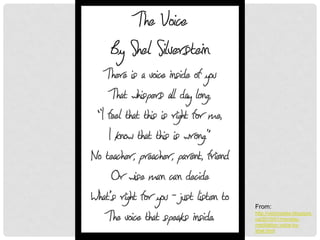
From:
http://victoriadee.blogspot.
ca/2010/01/monday-
meditation-voice-by-
shel.html
W
WHO HAS PARTICIPATED IN:
  ELCOME! QUESTION #1

•   open online courses
•   open online webinars
•   open online conferences
WHO HAS CREATED:
           QUESTION #2
•   blogs
•   wikis
•   RSS feeds
•   online courses
•   other open online content options?
WHAT AUDIENCE ARE YOU LOOKING
TO CREATE AN "OPEN" ENVIRONMENT

•   Staff
•   Community of Practice
•   Administrators
•   Students
•   Parents
•   Others?
TAKEAWAYS….WHAT IS OPEN
       LEARNING?


Open Learning wiki:
http://openlearningk12.wikispaces.
com

GoogleDoc: http://bit.ly/R7BM3k
Rather than thinking of
   public education as a
 burden that schools must
shoulder on their own, what
 would it mean to think of
   public education as a
  responsibility of a more
   distributed network of
 people and institutions...
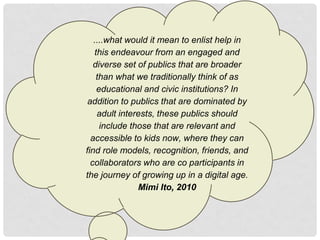
....what would it mean to enlist help in
   this endeavour from an engaged and
   diverse set of publics that are broader
    than what we traditionally think of as
    educational and civic institutions? In
 addition to publics that are dominated by
    adult interests, these publics should
     include those that are relevant and
  accessible to kids now, where they can
find role models, recognition, friends, and
  collaborators who are co participants in
the journey of growing up in a digital age.
               Mimi Ito, 2010
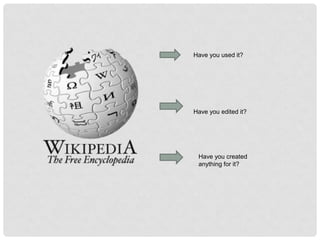
Have you used it?


Have you edited it?


 Have you created
 anything for it?
FOCUS:


         http://thecleversheep.blogspot.ca/2012/06/seven
         -degrees-of-connectedness_06.html
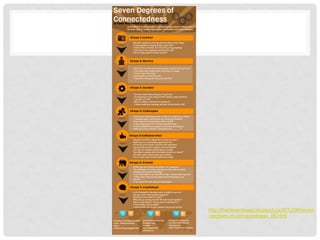
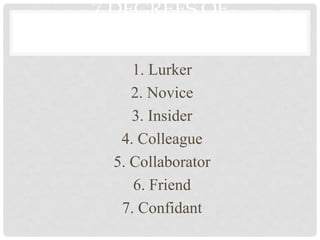
7 DEGREES OF
CONNECTEDNESS
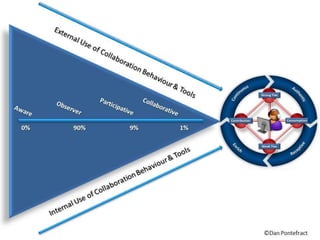
      1. Lurker
      2. Novice
      3. Insider
    4. Colleague
   5. Collaborator
      6. Friend
    7. Confidant
WHAT IGNITED THE IDEA
      EVEN MORE...
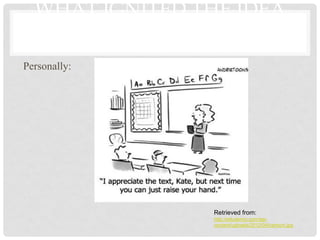
Personally:


                 Retrieved from:
                 http://edudemic.com/wp-
                 content/uploads/2012/04/cartoon.jpg
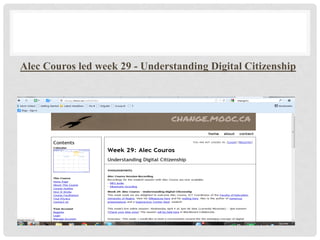
#CHANGE11 MOOC -
     MASSIVE OPEN ONLINE
           COURSE
Alec Couros led week 29 - Understanding Digital Citizenship
MY PERCEPTIONS OF A
         MOOC
As I listened and participated in Alec's
 session - I wondered how come I had
 never experienced this kind of
 "online" learning before? How could I
 apply it to k-12 audience? Is there a
 k-12 MOOC? What does it look like?
 Would others want to help me create
 a MOOC for k-12?
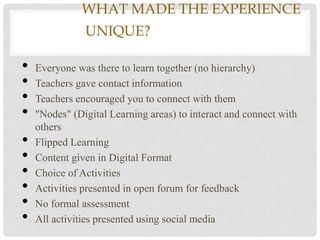
WHAT MADE THE EXPERIENCE
               UNIQUE?ONLINE COURSES

•   Everyone was there to learn together (no hierarchy)
•   Teachers gave contact information
•   Teachers encouraged you to connect with them
•   "Nodes" (Digital Learning areas) to interact and connect with
    others
•   Flipped Learning
•   Content given in Digital Format
•   Choice of Activities
•   Activities presented in open forum for feedback
•   No formal assessment
•   All activities presented using social media
TRADITIONAL ONLINE
 LEARNING ATTEMPTS.....
T O C O N N E C T A N D N E T WO R K
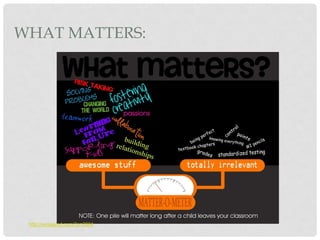
WHAT MATTERS:


 http://venspired.com/?p=2804
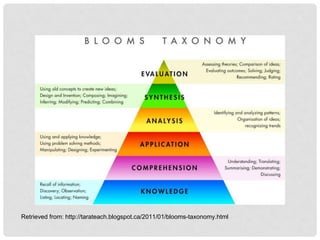
Retrieved from: http://tarateach.blogspot.ca/2011/01/blooms-taxonomy.html
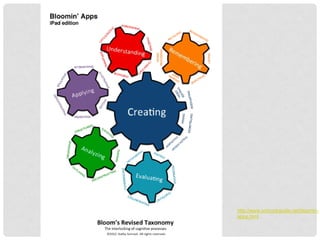
http://www.schrockguide.net/bloomin-
apps.html
WHY OPEN ONLINE COURSES...


 ...HAVE A FUTURE IN
  WILL MEET K -12 NEEDS
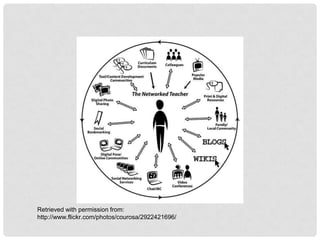
Retrieved with permission from:
http://www.flickr.com/photos/courosa/2922421696/
IT’S ABOUT TEACHERS AND STUDENTS
       USING THE TECHNOLOGY


To create learning for
all…https://vimeo.com/43401199
HOW TO DESIGN A MOOC


1. Who is your audience or what
   are your creating the Open
           Course for?
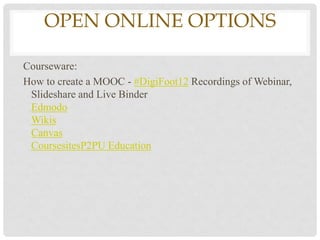
OPEN ONLINE OPTIONS

Courseware:
How to create a MOOC - #DigiFoot12 Recordings of Webinar,
 Slideshare and Live Binder
 Edmodo
 Wikis
 Canvas
 CoursesitesP2PU Education
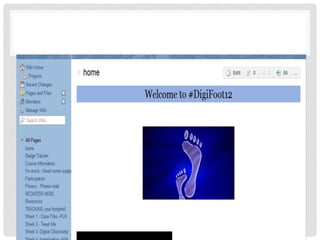
WIKISPACES
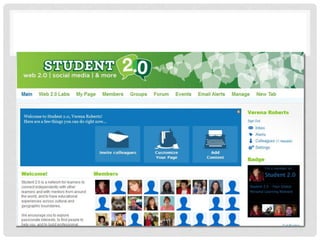
STUDENT 2.0
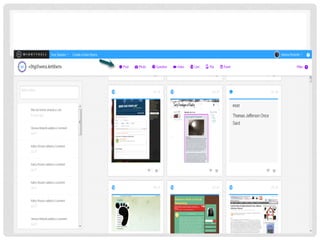
MIGHTYBELL
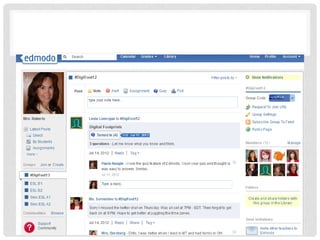
EDMODO
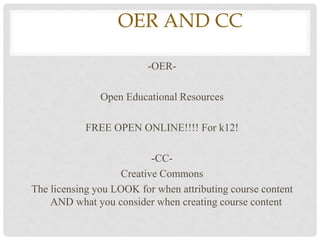
OEROER AND CC

                         -OER-

               Open Educational Resources

            FREE OPEN ONLINE!!!! For k12!

                          -CC-
                   Creative Commons
The licensing you LOOK for when attributing course content
    AND what you consider when creating course content
ASSESSMENT
    Assessment:


Created by: Jeremy Macdonald @MrMacnology

I chose a "Badge" System of Assessment
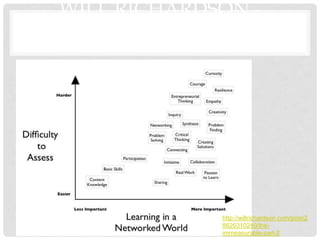
WILL RICHARDSON -
ASSESSMENT GRAPH


             http://willrichardson.com/post/2
             8626310240/the-
             immeasurable-part-2
WHAT I HAVE
        LEARNED…..EARNING....#1

•   I can create an environment where all
    participants felt "included“in some way

           • We all like to be the examples
VERENA'S LEARNING #2

 Participants can be beginners to advanced - I could to scaffold
     options for new learners while challenging my advanced
  learners. Open Learning naturally offer personalized learning
                              options

Participant mentors were asked to volunteer to MODEL, to write
   comments anytime they saw something unanswered, to help
       me moderate Blackboard sessions, Twitter, Netvibes,
   Google.docs and various other tools. I encouraged others to
     lead in order to help make the course sustainable for me.
VEVERENA’S LEARNING
       #3LEARNING #3
Student questions and teacher feedback seemed
 "amplified" in an open online forum

I learned to accept that failure was possible, learn
  from my mistakes and do my best.

Being authentic got me through and accepting that I
 am a learner too!
WHAT DO YOU FINISH WITH?WHAT
         WILL YOU END WITH?
Collection of Learning Artifacts

•   You will have a collection of resources based on a collaborative effort

•   You will have developed leadership skills among your peers and ensured that
    everyone is identified by their strengths

•   You will have created the foundations for autonomous learning for all participants
    which will offer them the opportunities outside of the school and/or district
HOW OPEN ONLINE LEARNING
         "COULD” BE USED IN K-12

An online Module or Course (Students, Teachers, Admin,
 Districts, Gov't)

•   Using an open or closed wiki, you could use the MOOC
    model to create an online course or module of your own
    based on this PPT presentation
AS A PROFESSIONAL DEVELOPMENT
              OPTION

Open Courses can be offered on any topic and can be a "course" or way to
 connect and learn.

Pick one topic - then pick various subtopics for your "experts" to focus on.

You don't have to ask others to be "experts" you could be the lead facilitator
  the whole way through....However, asking others to "lead" a week based
  on their "strength" is a great way to connect and network.

You can choose to keep the course within a school, district or consider
  opening your "course" to others.
WHATWHAT ABOUT YOU?

Questions?

Cuebc open online

  • 1.
    OPEN ONLINE LEARNING K12 BREAKING DOWN CLASSROOM WALLS @VERENANZ
  • 2.
  • 3.
    W WHO HAS PARTICIPATEDIN: ELCOME! QUESTION #1 • open online courses • open online webinars • open online conferences
  • 4.
    WHO HAS CREATED: QUESTION #2 • blogs • wikis • RSS feeds • online courses • other open online content options?
  • 5.
    WHAT AUDIENCE AREYOU LOOKING TO CREATE AN "OPEN" ENVIRONMENT • Staff • Community of Practice • Administrators • Students • Parents • Others?
  • 6.
    TAKEAWAYS….WHAT IS OPEN LEARNING? Open Learning wiki: http://openlearningk12.wikispaces. com GoogleDoc: http://bit.ly/R7BM3k
  • 7.
    Rather than thinkingof public education as a burden that schools must shoulder on their own, what would it mean to think of public education as a responsibility of a more distributed network of people and institutions...
  • 8.
    ....what would itmean to enlist help in this endeavour from an engaged and diverse set of publics that are broader than what we traditionally think of as educational and civic institutions? In addition to publics that are dominated by adult interests, these publics should include those that are relevant and accessible to kids now, where they can find role models, recognition, friends, and collaborators who are co participants in the journey of growing up in a digital age. Mimi Ito, 2010
  • 9.
    Have you usedit? Have you edited it? Have you created anything for it?
  • 11.
    FOCUS: http://thecleversheep.blogspot.ca/2012/06/seven -degrees-of-connectedness_06.html
  • 12.
    7 DEGREES OF CONNECTEDNESS 1. Lurker 2. Novice 3. Insider 4. Colleague 5. Collaborator 6. Friend 7. Confidant
  • 13.
    WHAT IGNITED THEIDEA EVEN MORE... Personally: Retrieved from: http://edudemic.com/wp- content/uploads/2012/04/cartoon.jpg
  • 14.
    #CHANGE11 MOOC - MASSIVE OPEN ONLINE COURSE Alec Couros led week 29 - Understanding Digital Citizenship
  • 15.
    MY PERCEPTIONS OFA MOOC As I listened and participated in Alec's session - I wondered how come I had never experienced this kind of "online" learning before? How could I apply it to k-12 audience? Is there a k-12 MOOC? What does it look like? Would others want to help me create a MOOC for k-12?
  • 16.
    WHAT MADE THEEXPERIENCE UNIQUE?ONLINE COURSES • Everyone was there to learn together (no hierarchy) • Teachers gave contact information • Teachers encouraged you to connect with them • "Nodes" (Digital Learning areas) to interact and connect with others • Flipped Learning • Content given in Digital Format • Choice of Activities • Activities presented in open forum for feedback • No formal assessment • All activities presented using social media
  • 17.
    TRADITIONAL ONLINE LEARNINGATTEMPTS..... T O C O N N E C T A N D N E T WO R K
  • 19.
  • 20.
  • 21.
  • 22.
    WHY OPEN ONLINECOURSES... ...HAVE A FUTURE IN WILL MEET K -12 NEEDS
  • 23.
    Retrieved with permissionfrom: http://www.flickr.com/photos/courosa/2922421696/
  • 24.
    IT’S ABOUT TEACHERSAND STUDENTS USING THE TECHNOLOGY To create learning for all…https://vimeo.com/43401199
  • 25.
    HOW TO DESIGNA MOOC 1. Who is your audience or what are your creating the Open Course for?
  • 26.
    OPEN ONLINE OPTIONS Courseware: Howto create a MOOC - #DigiFoot12 Recordings of Webinar, Slideshare and Live Binder Edmodo Wikis Canvas CoursesitesP2PU Education
  • 27.
  • 28.
  • 29.
  • 30.
  • 31.
    OEROER AND CC -OER- Open Educational Resources FREE OPEN ONLINE!!!! For k12! -CC- Creative Commons The licensing you LOOK for when attributing course content AND what you consider when creating course content
  • 32.
    ASSESSMENT Assessment: Created by: Jeremy Macdonald @MrMacnology I chose a "Badge" System of Assessment
  • 33.
    WILL RICHARDSON - ASSESSMENTGRAPH http://willrichardson.com/post/2 8626310240/the- immeasurable-part-2
  • 34.
    WHAT I HAVE LEARNED…..EARNING....#1 • I can create an environment where all participants felt "included“in some way • We all like to be the examples
  • 35.
    VERENA'S LEARNING #2 Participants can be beginners to advanced - I could to scaffold options for new learners while challenging my advanced learners. Open Learning naturally offer personalized learning options Participant mentors were asked to volunteer to MODEL, to write comments anytime they saw something unanswered, to help me moderate Blackboard sessions, Twitter, Netvibes, Google.docs and various other tools. I encouraged others to lead in order to help make the course sustainable for me.
  • 36.
    VEVERENA’S LEARNING #3LEARNING #3 Student questions and teacher feedback seemed "amplified" in an open online forum I learned to accept that failure was possible, learn from my mistakes and do my best. Being authentic got me through and accepting that I am a learner too!
  • 37.
    WHAT DO YOUFINISH WITH?WHAT WILL YOU END WITH? Collection of Learning Artifacts • You will have a collection of resources based on a collaborative effort • You will have developed leadership skills among your peers and ensured that everyone is identified by their strengths • You will have created the foundations for autonomous learning for all participants which will offer them the opportunities outside of the school and/or district
  • 38.
    HOW OPEN ONLINELEARNING "COULD” BE USED IN K-12 An online Module or Course (Students, Teachers, Admin, Districts, Gov't) • Using an open or closed wiki, you could use the MOOC model to create an online course or module of your own based on this PPT presentation
  • 39.
    AS A PROFESSIONALDEVELOPMENT OPTION Open Courses can be offered on any topic and can be a "course" or way to connect and learn. Pick one topic - then pick various subtopics for your "experts" to focus on. You don't have to ask others to be "experts" you could be the lead facilitator the whole way through....However, asking others to "lead" a week based on their "strength" is a great way to connect and network. You can choose to keep the course within a school, district or consider opening your "course" to others.
  • 40.