PHILIPPINE NATIONAL POLICE MANUAL
      PNPM – DIDM – DS – 9 – 3


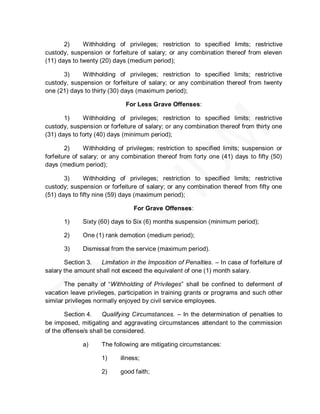
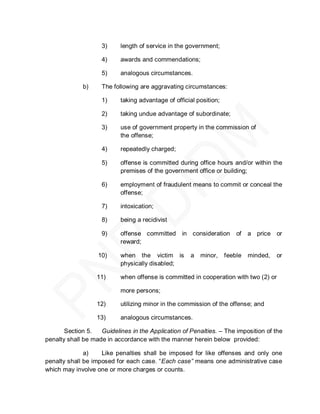
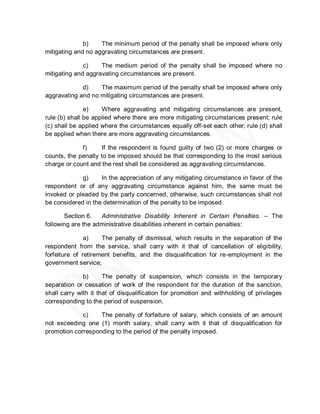
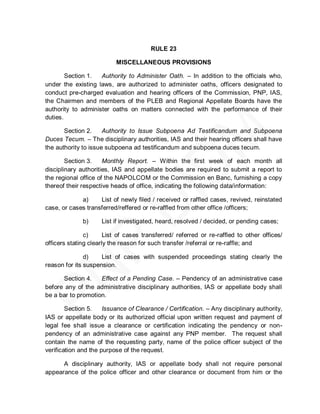
  PNP PRE - CHARGE EVALUATION

                  and

     SUMMARY HEARING GUIDE

    (PNP Internal Discipline Mechanism)

                   2011
PNP PRE - CHARGE EVALUATION

                        and

        SUMMARY HEARING GUIDE

       (PNP Internal Discipline Mechanism)

                         2011


                    Published by:


Directorate for Investigation and Detective Management
                Philippine National Police
COPYRIGHT PAGE


PNP Pre-Charge Evaluation and Summary Hearing Guide (PNP Disciplinary
Mechanism) 2011
Copyright 2011.

Printed by:
PNP Directorate for Investigation and Detective Management
2011

All rights reserved. This publication may not be reproduced, in whole or in part, in any
form or by any means electronic or mechanical or by any information storage and
retrieval system now known or hereafter invented, without prior written permission of
The Director, PNP Directorate for Investigation and Detective Management with
postal address at DIDM Office, 2 nd Flr., NHQ Bldg., Camp Crame, Quezon City.
Telephone Nos. (632) 724-8773; (632) 724-8767.

Infringement of the copyright protection law and the provisions expressed here under
Intellectual Property Rights Law of the Philippines.


                “To teach is to touch lives forever.” (Anonymous)
Republic of the Philippines
            DEPARTMENT OF THE INTERIOR AND LOCAL GOVERNMENT
                 (Kagawaran ng Interyor at Pamahalaang Lokal)
                           Kamuning, Quezon City


                                      Message

         Discipline is one of the key factors that make any organization succeed. But to
instill discipline the leader must carry the burden of administering sanctions against
those who refuse to comply or obey the rules and the authority. The publication by
the Philippine National Police of the Pre-Charge Evaluation and Summary Hearing
Guide (PNP Internal Discipline Mechanism) therefore comes as an appropriate
response to His Excellency President Benigno S Aquino III’s call to join him in
transforming our government into one that is credible and truly works for the welfare
of our people.

         This Guide is definitely one of the PNP’s most important tool in helping the
appointed PNP disciplinary authorities administer sanctions against erring PNP
personnel who fail to abide by the rules and regulation of the PNP. More importantly
this will help raise the competence of our police pre-charge evaluators and summary
hearing officers who are tasked to keep the PNP Disciplinary Mechanism running
and expedite the resolution of administrative cases involving both the uniformed and
non-uniformed personnel.

       Congratulations to the PNP and more particularly to the staff of the Directorate
for Investigation and Detective Management (DIDM) for this ground-breaking
endeavor. It is my pleasure to assure you that the Department of the Interior and
Local Government will continue to support your undertakings.

      More power. Mabuhay kayong lahat!


                                                      ORIGINAL SIGNED
                                                      JESSE M ROBREDO
                                                      DILG Secretary
HEADQUARTERS
                        Philippine National Police
                      OFFICE OF THE CHIEF PNP
                NHQ PNP Building, Camp Crame, Quezon City
                           Manila, Philippines


                                       MESSAGE

       The challenge of our times is to propagate the reform and transform agenda
into real action, tangible results that can be seen and felt by our stakeholders and our
community as a whole.

       One area where this can be done with certainty and reliability is in the
processes that we apply to our internal operations, in particular, the disciplinary
measures that we must necessarily impose on those who depart from the norm of our
service.

       I welcome the speedy publication of the Pre-Charge Evaluation and Summary
Hearing Guide (PNP Internal Discipline Mechanism) not only for its timeliness and
usefulness, but equally important, for its affirmation of the sincerity and the
seriousness of our intent to see the PNP Integrated Transformation Program all the
way through.
      Congratulations are in order for the DIDM personnel who collaborated with the
DPRM and IAS counterparts to craft this ground-breaking guide. The Guide that has
been produced is a prime example of how much more can be done with teamwork.
       All officers are encouraged to take this Guide to heart, and let its spirit shape a
more responsive Internal Discipline process that satisfies both the demands of our
service and the expectations of those whom we serve.
       Mabuhay ang PNP!


                                                  ATTY RAUL M BACALZ O, PhD
                                                  Polic e Director General
                                                  Chief , PNP
HEADQUARTERS
                             Philippine National Police
                      DIRECTORATE FOR INVESTIGATION AND
                            DETECTIVE MANAGEMENT
                     NHQ PNP Building, Camp Crame, Quezon City
                               Manila, Philippines


                                    Message

       It is indeed a privilege on my part being The Director for Investigation and
Detective Management (TDIDM) to have the opportunity to publish another DIDM
manual, the PNP Pre-Charge Evaluation and Summary Hearing Guide (PNP Internal
Discipline Mechanism). I would like to congratulate the DIDM Technical Working
Group particularly POLICE CHIEF SUPERINTENDENT ALEX PAUL I.
MONTEAGUDO, Deputy Director, DIDM for providing the much needed direction and
guidance in the consolidation of all the materials and the final crafting of this Guide.

       As we all know, actions taken within the parameters of PNP laws, rules and
regulations at the outset of an investigation of any particular complaint against erring
policemen can play a pivotal role in the full resolution of a case. While the realization
of bringing justice to the victims and their family is the DIDM’s main goal, it is equally
important for DIDM to help instill discipline within the ranks and insuring transparent
investigation of all disciplinary cases being handled.

        This Directorate had taken drastic steps through the help of DPRM and IAS to
craft a guide based on NAPOLCOM Memorandum Circular 2007-001 that will help
the pre-charge evaluators and summary hearing officers conduct the processes more
efficiently and effectively. In the simplest manner this guide sets the step-by-step
procedures in a manner that will be easily understood by any police officer who may
be tasked to evaluate or hear a case and therefore help ensure the expeditious
resolution of administrative cases.

       Maraming Salamat po.


                                           PDIR ARTURO G CACDAC JR, CEO VI
                                           The Director for Investigation
                                           and Detective Management
TECHNICAL WORKING GROUP
     PNP Pre-Charge Evaluation and Summary Hearing Guide
              (PNP Internal Discipline Mechanism)
                              2011

                                     DIDM

POLICE DIRECTOR ARTUROG G. CACDAC, JR - Director, DIDM
POL CHIEF SUPT ALEX PAUL I. MONTEAGUDO - Deputy Director, DIDM
POL CHIEF SUPT RICARDO C. MARQUEZ      - Executive Officer, DIDM
PSSUPT RICARDO DC ZAPATA JR            - Chief, CMD, DIDM
PSSUPT KEITH ERNALD L. SINGIAN         - Chief, SIDD, DIDM
PSSUPT JUANITA S. NEBRAN               - Chief, PCEID, DIDM
PSUPT MARLON M. GANZON                 - Chief, BFO, DIDM
PSUPT Atty ISAGANI S. AGUAS(ret)       - PCEID, DIDM
Ms PATRICIA CANTERO                    - OCPNP

                                      IAS

POLICE DIRECTOR ATTY IFOR I. MAGBANUA            - Acting IG, IAS
Atty MISAEL RAYMUNDO C. DINSAY                   - Chief, Spcl Action Cntr, IAS
Atty MICHAEL DARWIN M. BAYOTAS                   - Acting Legal Asst, IAS

                                     DPRM

POLICE DIRECTOR JAIME E. MILLA                   - Director, DPRM
PSSUPT BARTOLOME C. TOBIAS                       - Chief, DLOD, DPRM


  “For God so loved the world that he gave his only begotten Son that whosoever
      believes in him should not perish but have everlasting life.” (John 3:16)
ACKNOWLEDGEMENT


        The crafting of this PNP Pre-Charge Evaluation and Summary Hearing Guide (PNP
Internal Discipline Mechanism) required a lot of patience, research and collective effort. It
involved the conversion of a lot of legal parlance into layman’s language so that the guide
would be more easily understood by the users.

         The enforcement of sanctions against erring personnel is one of the most serious
responsibilities of any designated Chief of Police or appointed Disciplinary Authority. But
since very few officers are familiar with the provisions of the NAPOLCOM Memo Circ 2007-
001 or the URACCS (Uniform Rules on Administrative Cases in the Civil Service), some
would even opt not to initiate the proceedings. Furthermore, there are very few officers with
the training or competence to evaluate a complaint and even less PCO’s who can conduct a
summary hearing with authority. However, necessity being the mother of invention, the DIDM
identified the deficiency and crafted this innovative Guide to address the need.

       The publication of this Guide was made possible by the dedication of the DIDM
Technical Working Group (TWG) particularly PCSUPT ALEX PAUL I. MONTEAGUDO,
Deputy Director, DIDM, who provided the direction and guidance in the consolidation of all
the needed materials, and personally supervised and edited the final crafting of this Guide. It
is also noteworthy to recognize the assistance and support extended by PSUPT Atty.
ISAGANI S. AGUAS (ret) of DIDM who shared his legal knowledge and experience,
PSSUPT BARTOLOME C. TOBIAS, Chief, Discipline, Law and Order Division (DLOD),
Directorate for Personnel and Records Management (DPRM) and the Internal Affairs Service
(IAS) under PDir IFOR I. MAGBANUA for their contribution to the content and organization of
this manual. Acknowledgement must also be given to the members of PNP Aviation Security
Group Technical Working Group (TWG) who, under the guidance of the then DDA, PSSUPT
MONTEAGUDO, first conceptualized the crafting of the first-ever PCE and SHO Guide which
became the template for this DIDM Manual. These are: PSUPT JEANNE B PANISAN,
PCINSP ALMEL S MANGANDOG, PCINSP JONATHAN T GALANG, PCINSP ALEX P LIM,
and PCINSP JULIE A CABRERA.

       Finally, we acknowledge the support of our foreign partner, the European Union-
Philippine Justice Support Program (EPJUST) thru Mr. DETLEV MEHLIS, Team Leader
and Mr. BO ASTROM, Senior Police Key Expert, for their invaluable help in providing the
funding assistance for the printing of this manual.


    “I can do all things through Christ who gives me strength….” (Philippians 4:13)
Table of Contents

                                                                          Page
I.     INTRODUCTION
       How to Use This Guide

II.    PRE-CHARGE EVALUATION GUIDE
       Complaint
       Pre-Charge Evaluation
       Approval by the Disciplinary Authority
       Personnel Section Action
       Flowchart
       Sample Forms
          Complaint Sheet
          Affidavit of Complaint
          Certificate of Non-Forum Shopping
          PCE Memo Recommending Case be Closed and/or Dropped
          PCE Memo Referral to the Appropriate Disciplinary Authority
          PCE Memo Recommending Summary Hearing
          Charge Sheet
          Memo to Disciplinary Authority re Pre-Charge Evaluation
          Memo to a PNP Complainant re PCE Result
          Letter to a Private Complainant re PCE Result
          Letter to PNP Personnel Being Complained of

III.   SUMMARY HEARING GUIDE
       Initial Action of SHO
       Pre-Hearing Conference
       Hearing Proper
       Report of Investigation/Resolution
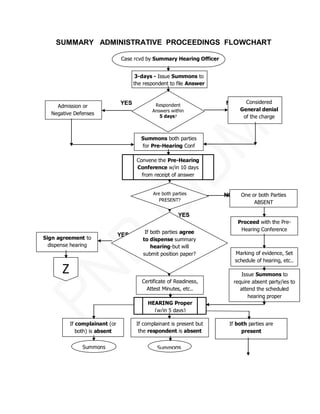
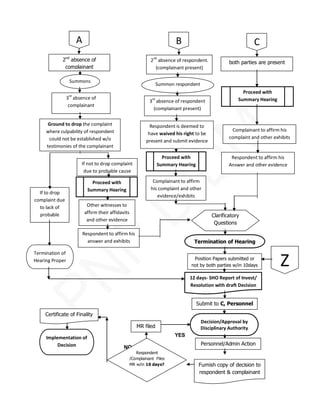
       Summary Administrative Proceedings Flowchart
       Sample Forms
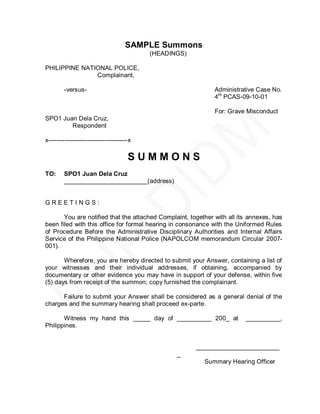
            Summons
            Answer
            Notice of Pre-Hearing Conference
            SHO’s Script for Pre-Hearing Conference
            Agreement to Dispense Hearing Proper
            Certificate of Readiness
            Minutes of Pre-Hearing Conference
            SHO’s Script for Hearing Proper
            Minutes of the Hearing Proper
            Position Paper
            Report of Investigation/Resolution by the SHO (Exoneration)
            Report of Investigation/Resolution by the SHO (Guilty)
            Draft Decision (Exoneration)
            Draft Decision (Guilty verdict)
Page
  III.   APPENDICES

         Appendix ―A‖ - NAPOLCOM Memorandum Circular No. 2007-001 re:
            Uniform Rules of Procedure Before the Administrative
            Disciplinary Authorities and the Internal Affairs Service of the
            Philippine National Police

         Appendix ―B‖ - PNP Memorandum Circular No. 2010-021 re:
            Defining and Delineating the Functions of Directorates/Offices
            Involved in the Disposition of Administrative/Disciplinary Cases
            Against Members of the PNP

         Appendix ―C‖ - PNP Memorandum Circular No. 2008-0116 re:
            Policy and Guidelines on Grievance Mechanism for PNP
            Uniformed Personnel


“ Education does not mean teaching people to know what they do not know; it means
           teaching them to behave as they do not behave.” (John Ruskin)
I. INTRODUCTION


“Whoever loves instructions loves knowledge, but he who hates corrections is
                          stupid.” (Proverbs 12:1)
I.            Introduction

       The Philippine National Police is mandated to investigate all forms of crime
with the ultimate objective of giving justice to the victims and bringing the perpetrators
to the bar of justice. Hence, the PNP is a vital and indispensable institution of the
Criminal Justice System. It is in effect a guardian of justice. But what if a guardian of
justice intentionally skews the investigation to favour the suspects for any
consideration? Or, what if by their sheer incompetence or laziness or negligence the
investigation is bungled? Who will hold them accountable? Que custodiet, custodias?
or Who will guard the guardians?

       The PNP has instituted several mechanisms to ensure that fidelity by its
members to laws and regulations is ensured. One of the primary mechanisms which
covers internal discipline is provided under NAPOLCOM Memo Circular 2007-001 re
Rules of Procedures Before the Administrative Disciplinary Authorities and the
Internal Affairs Service of the Philippine National Police. This Memo Circular
provides the rules and procedures and the scale of penalties to be imposed upon any
member of the PNP who commits breach of discipline or becomes a subject of an
administrative complaint. The memo also provides that the Internal Affairs Service
(IAS) shall conduct, motu proprio, automatic investigation of the following cases:

              a) incidents where a police personnel discharges a firearm;
              b) incidents where death, serious physical injury, or any violation of
              human rights occurred in the conduct of a police operation;
              c) incidents where evidence was compromised, tampered with,
              obliterated, or lost while in the custody of police personnel;
              d) incidents where a suspect in the custody of the police was seriously
              injured; and,
              e) incidents where the established rules of engagement have been
              violated.

       However, there have been several factors which have hampered the effective
implementation of this Memo Circular. This PNP Pre-Charge Evaluation and
Summary Hearing Guide (PNP Internal Discipline Mechanism) therefore, is intended
to address two of the major factors that have hampered the effectiveness of the
internal discipline mechanism: the lack of familiarity by the majority of the appointed
Chiefs of Police or equivalent supervisors and other PNP Disciplinary Authorities on
how to exercise their disciplinary authority; and the lack and/or inadequacy of
training of the designated Pre-Charge Evaluators as well as the Summary Hearing
Officers (SHO) to systematically and expeditiously resolve administrative cases.
        This Guide is intended for the use of the Pre-Charge Evaluators, Summary
Hearing Officers, the Chiefs of Police or other equivalent disciplinary authorities, and
the IAS. Hence, this guide includes, among others, flowcharts to visually aid the
users in implementing the process, and a simplified step-by-step scheduled
procedure which shall be followed from the time a report of infraction or complaint is
received by the office of the disciplinary authority or the IAS which has jurisdiction
over the respondent, up to the action of the Personnel Section and the issuance of
Certificate of Finality.

       This Guide also contains sample forms and formats of the different reports,
memoranda, letters, summons, resolutions, certificates of service, affidavits and other
documents which the Pre-Charge Evaluator and the Summary Hearing Officer may
have to prepare or use in the course of the process. This guide also includes a
script in the conduct of the Pre-Hearing Conference and Hearing Proper to provide
the Summary Hearing Officer a more authoritative, methodical and sequential system
of presiding over the conference and hearing.

       Also included in this Guide are copies of the following: PNP MC No. 2008-
0116 re: Policy Guidelines on Grievance Mechanism for PNP Uniformed Personnel;
PNP MC No. 2010-021 re Defining and Delineating the Functions of
Directorates/Offices Involved in the Disposition of Administrative/Disciplinary Cases
Against Members of the PNP which provides among others the guidelines in the
handling of cases involving NUPs; and, NAPOLCOM Memo Circ No. 2007-001, re
Rules of Procedures Before the Administrative Disciplinary Authorities and the
Internal Affairs Service of the Philippine National Police, as the main reference
material.

        It is hoped that with this guide, which was painstakingly prepared by the DIDM
with the support of the DPRM and IAS, and through the guidance of PCSUPT ALEX
PAUL I. MONTEAGUDO, Deputy Director, DIDM, we shall have provided a clear,
usable and effective guide which in turn will ensure that the designated PNP
Disciplinary Authorities will be better equipped to exercise their dis ciplinary powers
and resolve administrative cases of their personnel more expeditiously while assuring
that the rights of respondents and complainants are protected in the best interest of
justice.
How to Use This Guide

        This Guide has been presented in the simplest manner to make it ―user
friendly‖. At the outset, it is important to mention that this PCE and SH Guide is
based mainly on the provisions of NAPOLCOM Memorandum Circular 2007-001.
Majority of the cases that are referred to the PNP disciplinary authorities involve
breach of discipline, citizen’s complaints against uniformed personnel, and IAS-
initiated investigations.

        On the procedure concerning complaints against uniformed PNP
personnel or investigation initiated by the IAS, all that the disciplinary authority,
pre-charge evaluators and summary hearing officers have to do is follow the step-by-
step guide and the instructions as contained therein. If possible, the user should refer
to the flowcharts every so often to visualize the procedures. It will also be noted that,
as far as practicable, the specific Section of NPC MC 2007-001 which is the basis for
the procedure is indicated to aid the user should he want further clarification on the
matter. There are also “Notes” to remind the user on matters of importance. Also,
the schedule or number of days allotted for each activity is included in both the
flowcharts and the instructions. It is important that the user adhere to this schedule to
ensure that the case is expeditiously resolved within the prescribed period.

       For complaints against NUPs, the procedure is almost the same except for a
few provisions. Among the most notable difference are: 1) based on the URACCS
(Uniform Rules on Administrative Cases in the Civil Service), instead of a pre-charge
evaluation, a Preliminary Investigation shall be conducted when the person being
complained of is an NUP; 2) instead of probable cause as required in a PCE, the
requirement is a prima facie case; and, 3) the grace period before finality of
decision is 15 days not 10 days if it was a case involving uniformed PNP personnel.
To ensure adherence to procedures, the designated PCE/Preliminary Investigators
and SHOs should also familiarize themselves with the provisions of PNP Memo Circ
2010-021, a copy of which is provided in the Appendix. There is no separate
flowchart for cases involving NUPs as the process is basically the same.

        A copy of NAPOLCOM Memo Circ 2007-001 is also provided in this guide as a
ready reference and in case there are matters which the user would like to be
clarified about, such as the appropriate Offenses and Penalties and such other
issues as may arise.

      Finally, it is recommended that the evaluators and SHO refer to the sample
forms, especially the sample scripts for the SHO in the conduct of pre-hearing
conference and summary hearing proper, as these will most definitely help him
conduct the proceedings more effectively and authoritatively. The sample forms will
also help the user prepare the reports required.


            “To learn, you must want to be taught.” (Proverbs 12:1)
II. PRE-CHARGE EVALUATION
           GUIDE


   “Men learn while they teach.” (Lucius Annaeus Seneca)
II. PRE-CHARGE EVALUATION GUIDE


                                   Complaint
“An administrative complaint may be initiated by filing a written and sworn
statement before any disciplinary authority, or the IAS accompanied by
affidavits of witnesses, if any, and other evidence in support thereof.” (Sec 1
Rule 13 of NAPOLCOM Memorandum Circular 2007-001).


1. Upon receipt of the complaint or report from either a private complainant or the
   personnel’s immediate supervisor or the concerned office, the Office of
   Disciplinary Authority/IAS shall immediately refer the complaint to his Inspectorate
   or Chief, Investigation, as the case may be, and direct him to assist the
   complainant to reduce the complaint into an Affidavit duly subscribed or
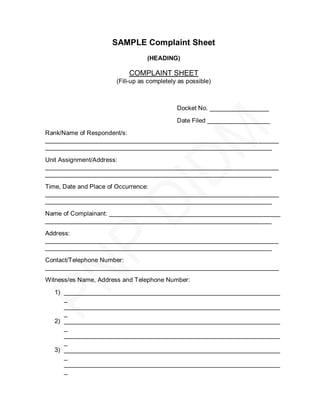
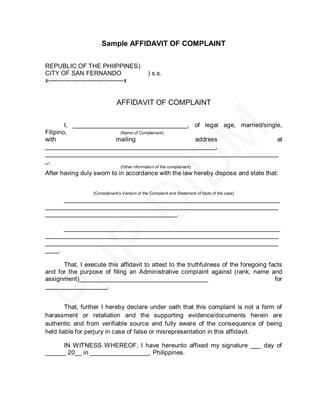
   notarized. (refer to Sample Complaint Sheet page 26 and Sample Affidavit of
   Complaint page 28)

      Note: #1
      Who may subscribe the Affidavit of Complaint?

      a. For PNP Uniformed Personnel — Officials of the Commission who are
      appointed by the President, as well as officers of the PNP from rank of
      Inspector to Senior Superintendent, shall have the power to administer
      oaths on matters which are connected with the performance of their official
      duties. (Section 50 of RA 6975 as amended)

      b. For Civilian – PCOs of the Pre Charge evaluation/investigation offices
      pursuant to Section 50 of RA 6975 as amended, or a notary public or any
      person authorized to administer oath.

      Note: #2
      The Chief, Investigation/Pre-Charge Evaluator shall have three (3) days
      to evaluate the complaint, exclusive of the 5-day period to file the
      Certificate of Non-Forum Shopping and/or investigation and validation
      (Sec 2, Rule 14, NPC MC 2007-001). He shall maintain two (2) copies of
      all the documents of the PCE, and once approved, he shall retain one (1)
      copy at the office of the Inspectorate/Chief, Investigation, while one (1)
      copy shall be forwarded to Personnel or Admin Section of the concerned
      office.

2. The Chief, Investigation shall immediately determine if the person being
   complained about is within the administrative jurisdiction of the Disciplinary
   Authority/local IAS. If the person being complained about is outside or not within
the administrative jurisdiction of the disciplinary authority/local IAS, the complaint
  shall be referred to the office of the concerned Disciplinary Authority/IAS.

3. If the person being complained about is within the administrative jurisdiction of the
   Disciplinary Authority/local IAS, the Chief, Invest shall undertake any of the
   following:

      a. If the complaint is a verbal/personal complaint from a Walk-in
         Complainant, the Chief, Investigation shall assist in reducing the complaint
         into an affidavit, or require the complainant to submit an Affidavit of
         Complaint along with affidavits of witnesses and other evidence. The Chief,
         Invest shall likewise require from the complainant a Certificate of Non-
         Forum Shopping which shall be a requirement before the pre-charge
         evaluation can be conducted;

             Note:
             The Certificate of Non-Forum Shopping shall be required to be
             submitted by the complainant within five (5) days from notice,
             otherwise, the complaint shall be dismissed. (Sec 1 para 2, Rule
             13 NAPOLCOM MC 2007-001). However, the Insp/Chief,
             Investigation shall inform the complainant of the dismissal of said
             complaint. (refer to Sample Certificate of Non-Forum Shopping
             page 30)
      b. If the complaint is a Letter-Complaint, the Chief, Invest shall contact or
         notify the complainant thru a letter or other official means and require
         him/her to affirm his/her signature, and to further require to execute and
         submit (or assist him in submitting) an Affidavit of Complaint and a
         Certificate of Non-Forum Shopping;

      c. If the complainant in the letter-complaint fails to submit an affidavit, the
         letter-complaint shall be treated similar to an anonymous complaint
         which shall be investigated and validated;

      d. If the complaint is from an Anonymous Complainant, the Chief, Invest
         shall within five (5) days investigate, validate and gather evidence on
         the matter being complained about as a basis to determine the validity of
         the complaint; (Sec 1d, Rule 13 NPC MC 2007-001)

      e. If after the investigation and validation, the material allegations in the
         Anonymous Complaint are not validated, the complaint shall be
         recommended for outright dismissal;

      f. However, if after the investigation and validation the material allegations in
         the anonymous complaint are validated, the Inspectorate/Chief,
         Investigation, now acting as the Nominal Complainant, shall issue a
         Certificate of Non-Forum Shopping and subsequently have the Pre-
         Charge Evaluation conducted.
Pre-Charge Evaluation
      “Pre-charge Evaluation is a process to determine the existence of probable
      cause based on the allegations on the complaint and supporting evidence.”
      (Sec. 1, Rule 14 of NAPOLCOM Memorandum Circular No 2007-001)


4. The Chief, Invest shall designate from among his personnel or officers the pre-
   charge evaluator or he himself may evaluate, as the case may be.


5. The Pre-Charge Evaluator shall ensure that the reporter/complainant has
   submitted his affidavit as well as other documents, affidavits of witnesses and
   other evidence; or, if it is an anonymous letter, the complaint must be
   accompanied by a copy of the Investigation Report.
      Note:
      The complaint affidavit shall be accompanied by a Certificate of Non-
      forum Shopping duly subscribed and sworn to by the complainant. If the
      complaint is not accompanied by Certificate of Non-Forum Shopping, the
      complainant shall be required to submit the same within five (5) days
      from notice; otherwise the complaint shall be dismissed. (Sec 1 para2,
      Rule 13 of NAPOLCOM Memorandum Circular 2007-001)

6. The Pre-Charge Evaluator shall assign a docket number to the complaint filed and
   shall be recorded into the docket book exclusively for the purpose.
7. Upon receipt of the affidavit of complaint and the certificate of non-forum
   shopping, or the Investigation Report and its validating evidence as the case may
   be, the Pre-Charge Evaluator will review/evaluate the case within three (3)
   days. The Pre-Charge Evaluator will determine whether it shall be recommended
   for any of the following: (Sec 3, Rule 13 of NAPOLCOM Memorandum Circular
   2007-001).
      a. Closed and/or dropped for lack of probable cause;

          Note:
          Any recommendation by the pre-charge evaluator closing and/or dropping
          an administrative complaint for lack of probable cause shall in all cases be
          approved by the Chief, Invest or the Chief, Prosecution Division of IAS.
          (refer to Sample PCE ―Dropped or Closed‖ page 31)

      b. Referred to the appropriate disciplinary authority;

          If the pre-charge evaluation determines that the offense for which the
      respondent is liable for is beyond the jurisdiction of the Disciplinary Authority,
      the case shall be elevated to the appropriate office through a memorandum.
      (refer to Sample PCE ―Referred to Appropriate Authority‖ page 33)
c. Treated as a grievance/request for assistance which may be referred to
         the concerned office or government agency;

      d. Recommended for Summary Hearing;

         If the pre-charge evaluation finds that probable cause exists which
      warrants the conduct of summary hearing, (Sec 3, Rule 13 of NAPOLCOM
      MC 2007-001) the Chief, Investigation shall submit a memorandum for the
      approval of the concerned Disciplinary Authority or Chief/Head of the local IAS
      recommending the offense for which the person being complained of shall
      be indicted. Once approved, the Chief, Investigation shall prepare the
      Charge Sheet which shall become part of the case folder and which shall be
      forwarded to Personnel/Admin Section or to the designated IAS Summary
      Hearing Officer for the conduct of summary hearing. (refer to Sample PCE
      “Recommendation for Summary Hearing” page 35 and Sample Charge Sheet
      page 38)

             Note #1.
             The recommendation or result of the Pre-Charge Evaluation shall
             be in memorandum format and it should be approved by the
             concerned disciplinary authority or Chief of the local IAS.

             Note #2.
             Refer to Rule 21 of NAPOLCOM Memo Circular 2007-001 for an
             enumeration of the OFFENSES administratively punishable and
             their respective classifications.

             Note#3.
             In case of PCE conducted by DIDM, the venue of summary
             hearing must be indicated in the PCE Report pursuant to PNP
             Memo Circular No. 2010-021 dtd Nov 3, 2010.


                  Approval by Disciplinary Authority
8. With the concurrence of the DIDM/RIDMD or Chief, Investigation Section the
   recommendation of the Pre-Charge Evaluator shall be endorsed, thru a
   memorandum, with the report of evaluation to the Disciplinary Authority or the
   chief of the local IAS requesting for the latter’s approval.

9. Once approved by the disciplinary authority, the Chief, Investigation Section shall,
   within three (3) days, prepare a memo or letter addressed to the complainant
   informing the party of the result of the evaluation and the approval by the
   disciplinary authority in consonance with Section 5 (a) of RA 6713, otherwise
   known as the Code of Conduct and Ethical Standards for Public Officials: “Act
   promptly on letters and requests. - All public officials and employees shall, within
   fifteen (15) working days from receipt thereof, respond to letters, telegrams or
other means of communications sent by the public. The reply must contain the
   action taken on the request.” (refer to Sample Memo and Letter to Complainant
   pages 39-40)

             Note:

             Simultaneously (within 3 days), the Chief, Invest shall also send a
             memo to the PNP personnel being complained about/ respondent
             to ensure that he/she is immediately made aware of the complaint filed
             against him/her as well as the decision of the disciplinary authority and,
             if probable cause did exist, avoid duplication of proceedings more
             particularly if the investigation was initiated motu propio. (refer to
             Sample Memo to PNP Personnel being complained of page 41)

10. The Inspectorate/Chief, Investigation shall forward two (2) copies of the case
    folder together with the Charge Sheet and the Pre-Charge Evaluation report,
    which have been approved by the Disciplinary Authority for summary hearing, to
    DLOD/RLOS or Personnel/Admin Section of the concerned office or the
    designated IAS SHO which shall undertake the following:


                o Retain one (1) copy of the records of the administrative case.
                o Enter the data of the case into its Official Docket:

                       a.   Date;
                       b.   time of receipt from the evaluator;
                       c.   case number;
                       d.   name of parties;
                       e.   offense charge;
                       f.   hearing officer;
                       g.   implementing orders;
                       h.   other relevant and material data.

                        Personnel Section Action
11. The DLOD/RLOS or Personnel Section or Admin Officer of the concerned Unit
    shall issue an order assigning/designating the Summary Hearing Officer (SHO) as
    approved. A complete set of the case folder will then be turned over by the
    Personnel/Admin section to the assigned/designated Summary Hearing Officer
    with the appropriate receipt indicating its contents and the number of pages
    therein.
             Note:
             The Personnel/Admin office or the concerned office may also
             employ or designate a recorder who will assist the hearing officer
             and may assign process server/s who will serve the summons.
(END OF PCE GUIDE)


“When I hear, I forget; When I see, I remember; When I do, I understand.”
                                                         Confucius
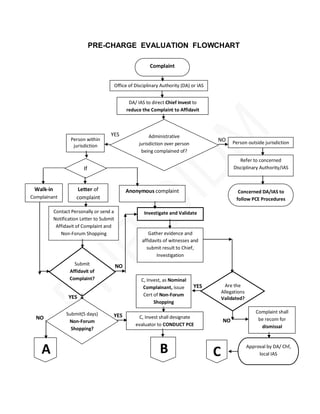
PRE-CHARGE EVALUATION FLOWCHART

                                                            Complaint


                                           Office of Disciplinary Authority (DA) or IAS


                                                  DA/ IAS to direct Chief Invest to
                                                 reduce the Complaint to Affidavit


                                      YES                   Administrative
                   Person within                                                          NO
                                                       jurisdiction over person                    Person outside jurisdiction
                    jurisdiction
                                                        being complained of?
                                                                                                      Refer to concerned
                         If                                                                        Disciplinary Authority/IAS


 Walk-in               Letter of                Anonymous complaint                                   Concerned DA/IAS to
Complainant           complaint                                                                      follow PCE Procedures
  NO
           Contact Personally or send a                  Investigate and Validate
           Notification Letter to Submit
            Affidavit of Complaint and
              Non-Forum Shopping                           Gather evidence and
                                                        affidavits of witnesses and
                                                          submit result to Chief,
                                                               Investigation
                    Submit                 NO
                  Affidavit of
                  Complaint?                            C, Invest, as Nominal
                                                         Complainant, issue       YES           Are the
                                                                                              Allegations
                  YES                                    Cert of Non-Forum
                                                                                              Validated?
                                                              Shopping

                 Submit(5 days)                                                                                 Complaint shall
  NO                                   YES            C, Invest shall designate
                  Non-Forum                                                                   NO                 be recom for
                                                     evaluator to CONDUCT PCE                                     dismissal
                   Shopping?


    A                                                            B                        C
                                                                                                            Approval by DA/ Chf,
                                                                                                                 local IAS
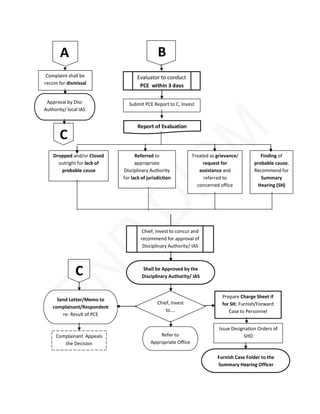
A                                      B
 Complaint shall be                 Evaluator to conduct
recom for dismissal                  PCE within 3 days

 Approval by Disc              Submit PCE Report to C, Invest
Authority/ local IAS


                                    Report of Evaluation
       C
    Dropped and/or Closed          Referred to                 Treated as grievance/          Finding of
      outright for lack of         appropriate                      request for            probable cause,
       probable cause        Disciplinary Authority               assistance and           Recommend for
                             for lack of jurisdiction               referred to               Summary
                                                                 concerned office           Hearing (SH)


                                      Chief, Invest to concur and
                                     recommend for approval of
                                      Disciplinary Authority/ IAS


               C                      Shall be Approved by the
                                      Disciplinary Authority/ IAS


                                                                            Prepare Charge Sheet if
      Send Letter/Memo to
                                              Chief, Invest                 for SH; Furnish/Forward
    complainant/Respondent
                                                  to….                         Case to Personnel
        re: Result of PCE

                                                                           Issue Designation Orders of
     Complainant Appeals                      Refer to                                SHO
        the Decision                      Appropriate Office

                                                                          Furnish Case Folder to the
                                                                          Summary Hearing Officer
SAMPLE Complaint Sheet
                                 (HEADING)

                          COMPLAINT SHEET
                      (Fill-up as completely as possible)


                                            Docket No. _________________

                                            Date Filed __________________
Rank/Name of Respondent/s:
___________________________________________________________________
_________________________________________________________________

Unit Assignment/Address:
___________________________________________________________________
_________________________________________________________________
Time, Date and Place of Occurrence:
___________________________________________________________________
_________________________________________________________________
Name of Complainant: _________________________________________________
_________________________________________________________________

Address:
___________________________________________________________________
_________________________________________________________________

Contact/Telephone Number:
___________________________________________________________________
Witness/es Name, Address and Telephone Number:

  1) ______________________________________________________________
     _
     ______________________________________________________________
     _
  2) ______________________________________________________________
     _
     ______________________________________________________________
     _
  3) ______________________________________________________________
     _
     ______________________________________________________________
     _
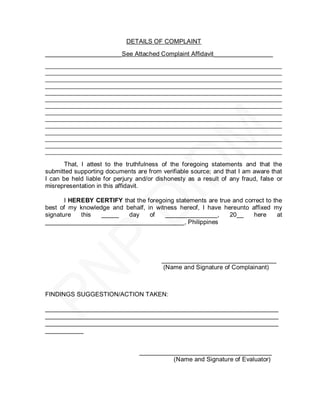
DETAILS OF COMPLAINT

______________________See Attached Complaint Affidavit_________________
__________________________________________________________________________
__________________________________________________________________________
__________________________________________________________________________
__________________________________________________________________________
__________________________________________________________________________
__________________________________________________________________________
__________________________________________________________________________
__________________________________________________________________________
__________________________________________________________________________
__________________________________________________________________________
__________________________________________________________________________
__________________________________________________________________________
__________________________________________________________________________
__________________________________________________________________________

       That, I attest to the truthfulness of the foregoing statements and that the
submitted supporting documents are from verifiable source; and that I am aware that
I can be held liable for perjury and/or dishonesty as a result of any fraud, false or
misrepresentation in this affidavit.

       I HEREBY CERTIFY that the foregoing statements are true and correct to the
best of my knowledge and behalf, in witness hereof, I have hereunto affixed my
signature   this  _____   day     of   _______________,       20__    here      at
________________________________________, Philippines


                                         _________________________________
                                          (Name and Signature of Complainant)


FINDINGS SUGGESTION/ACTION TAKEN:

___________________________________________________________________
___________________________________________________________________
___________________________________________________________________
___________


                                 ______________________________________
                                           (Name and Signature of Evaluator)
Sample AFFIDAVIT OF COMPLAINT


REPUBLIC OF THE PHIIPPINES)
CITY OF SAN FERNANDO                            ) s.s.
x------------------------------------x


                               AFFIDAVIT OF COMPLAINT


        I, _________________________________, of legal age, married/single,
Filipino,                (Name of Complainant)
with                   mailing                 address                   at
_________________________________________________,
___________________________________________________________________
_,
                                 (Other information of the complainant)
After having duly sworn to in accordance with the law hereby dispose and state that:


                   (Complainant’s Version of the Complaint and Statement of facts of the case)
     ______________________________________________________________
___________________________________________________________________
______________________________________.

      ______________________________________________________________
___________________________________________________________________
___________________________________________________________________
____.

      That, I execute this affidavit to attest to the truthfulness of the foregoing facts
and for the purpose of filing an Administrative complaint against (rank, name and
assignment)_____________________________________                                      for
__________________.


        That, further I hereby declare under oath that this complaint is not a form of
harassment or retaliation and the supporting evidence/documents herein are
authentic and from verifiable source and fully aware of the consequence of being
held liable for perjury in case of false or misrepresentation in this affidavit.

     IN WITNESS WHEREOF, I have hereunto affixed my signature ___ day of
______ 20__ in _________________, Philippines.
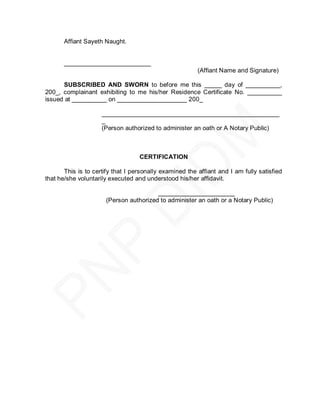
Affiant Sayeth Naught.


       _________________________
                                                         (Affiant Name and Signature)

      SUBSCRIBED AND SWORN to before me this _____ day of __________,
200_, complainant exhibiting to me his/her Residence Certificate No. __________
issued at __________ on ____________________ 200_

                     ___________________________________________________
                     _
                     (Person authorized to administer an oath or A Notary Public)


                                   CERTIFICATION

       This is to certify that I personally examined the affiant and I am fully satisfied
that he/she voluntarily executed and understood his/her affidavit.

                                        ______________________
                      (Person authorized to administer an oath or a Notary Public)
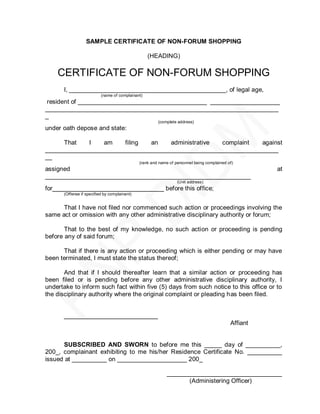
SAMPLE CERTIFICATE OF NON-FORUM SHOPPING

                                                  (HEADING)

    CERTIFICATE OF NON-FORUM SHOPPING
      I, _____________________________________________, of legal age,
                          (name of complainant)
 resident of _____________________________________ ____________________
___________________________________________________________________
_
                                                       (complete address)
under oath depose and state:

     That    I   am    filing an    administrative complaint  against
___________________________________________________________________
__
                                              (rank and name of personnel being complained of)
assigned                                                                                              at
___________________________________________________________
                                                                 (Unit address)
for________________________________ before this office;
      (Offense if specified by complainant)


      That I have not filed nor commenced such action or proceedings involving the
same act or omission with any other administrative disciplinary authority or forum;

       That to the best of my knowledge, no such action or proceeding is pending
before any of said forum;

      That if there is any action or proceeding which is either pending or may have
been terminated, I must state the status thereof;

       And that if I should thereafter learn that a similar action or proceeding has
been filed or is pending before any other administrative disciplinary authority, I
undertake to inform such fact within five (5) days from such notice to this office or to
the disciplinary authority where the original complaint or pleading has been filed.


      ___________________________
                                                                                            Affiant


      SUBSCRIBED AND SWORN to before me this _____ day of __________,
200_, complainant exhibiting to me his/her Residence Certificate No. __________
issued at __________ on ____________________ 200_

                                                            _________________________________
                                                                  (Administering Officer)
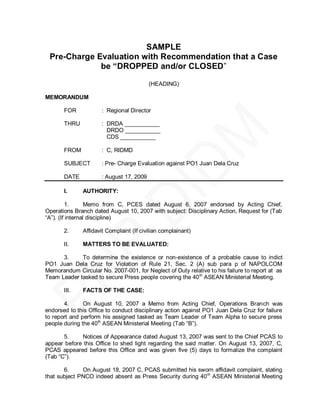
SAMPLE
 Pre-Charge Evaluation with Recommendation that a Case
             be “DROPPED and/or CLOSED‖

                                          (HEADING)

MEMORANDUM

       FOR            : Regional Director

       THRU           : DRDA ___________
                        DRDO ___________
                        CDS ___________

       FROM           : C, RIDMD

       SUBJECT        : Pre- Charge Evaluation against PO1 Juan Dela Cruz

       DATE           : August 17, 2009

       I.     AUTHORITY:

         1.       Memo from C, PCES dated August 6, 2007 endorsed by Acting Chief,
Operations Branch dated August 10, 2007 with subject: Disciplinary Action, Request for (Tab
―A‖). (If internal discipline)

       2.     Affidavit Complaint (If civilian complainant)

       II.    MATTERS TO BE EVALUATED:

      3.     To determine the existence or non-existence of a probable cause to indict
PO1 Juan Dela Cruz for Violation of Rule 21, Sec. 2 (A) sub para p of NAPOLCOM
Memorandum Circular No. 2007-001, for Neglect of Duty relative to his failure to report at as
Team Leader tasked to secure Press people covering the 40 th ASEAN Ministerial Meeting.

       III.   FACTS OF THE CASE:

       4.      On August 10, 2007 a Memo from Acting Chief, Operations Branch was
endorsed to this Office to conduct disciplinary action against PO1 Juan Dela Cruz for failure
to report and perform his assigned tasked as Team Leader of Team Alpha to secure press
people during the 40th ASEAN Ministerial Meeting (Tab ―B‖).

       5.    Notices of Appearance dated August 13, 2007 was sent to the Chief PCAS to
appear before this Office to shed light regarding the said matter. On August 13, 2007, C,
PCAS appeared before this Office and was given five (5) days to formalize the complaint
(Tab ―C‖).

       6.     On August 18, 2007 C, PCAS submitted his sworn affidavit complaint, stating
that subject PNCO indeed absent as Press Security during 40 th ASEAN Ministerial Meeting
and this was corroborated by SPOI Bravo who checked the attendance of every policemen
deployed on that day.

DISCUSSION:

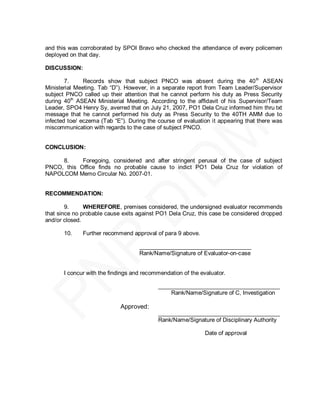
        7.     Records show that subject PNCO was absent during the 40 th ASEAN
Ministerial Meeting. Tab ―D‖). However, in a separate report from Team Leader/Supervisor
subject PNCO called up their attention that he cannot perform his duty as Press Security
during 40th ASEAN Ministerial Meeting. According to the affidavit of his Supervisor/Team
Leader, SPO4 Henry Sy, averred that on July 21, 2007, PO1 Dela Cruz informed him thru txt
message that he cannot performed his duty as Press Security to the 40TH AMM due to
infected toe/ eczema (Tab ―E‖). During the course of evaluation it appearing that there was
miscommunication with regards to the case of subject PNCO.


CONCLUSION:

     8.     Foregoing, considered and after stringent perusal of the case of subject
PNCO, this Office finds no probable cause to indict PO1 Dela Cruz for violation of
NAPOLCOM Memo Circular No. 2007-01.


RECOMMENDATION:

        9.     WHEREFORE, premises considered, the undersigned evaluator recommends
that since no probable cause exits against PO1 Dela Cruz, this case be considered dropped
and/or closed.

       10.    Further recommend approval of para 9 above.

                                    ___________________________________
                                    Rank/Name/Signature of Evaluator-on-case


       I concur with the findings and recommendation of the evaluator.

                                           ______________________________________
                                               Rank/Name/Signature of C, Investigation

                             Approved:
                                           ______________________________________
                                           Rank/Name/Signature of Disciplinary Authority

                                                             Date of approval
SAMPLE Memorandum Recommending for case to be
        Referred to the Appropriate Disciplinary Authority
                                          (HEADING)
MEMORANDUM

         FOR            : Regional Director

         ATTN           : C, RIDMD

         FROM           : PD, Nueva Ecija

         SUBJECT        : Pre-Charge Evaluation against PO1 Cesar Asar

         DATE           : July 12, 2009

I.     AUTHORITY:

         1. Incident Report rendered by Insp. Maria Clara, C, Opns Section NEPPO, dtd June
         22, 2009 re Alleged threats at Gabaldon Nueva Ecija.

         2. Endorsement Letter dated ______ from M/GEN ANGELO PINATUBO, AFP, Fort
         Magsaysay, Cabanatuan City;

       MATTERS TO BE INVESTIGATED:

        4. To determine the facts that surrounding the circumstances on the alleged simple
threats committed by PO1 Cesar Asar against Ms. Juan Dela Cruz;

         5. To determine further if subject PNCO is administratively liable or not.

II. FACTS OF THE CASE:

      6._____________________________________________________________
__________________________________________________________________________

III.     DISCUSSION:

      7.__________________________________________________________________
________________________________________________________________________

         IV.    CONCLUSION:

       8. After a careful assessment of the case at hand, the evaluator-on-case arrived on
a conclusion that a prima facie case exist against subject PNCO for violation of Rule 21,
Section 2 Para C sub para 3 (r) which reads ―commit any act or omission that constitutes a
crime punishable under the Revised Penal Code or Special Laws‖ under NAPOLCOM
Memorandum Circular No. 2007-001.
V.     RECOMMENDATION:

      9. WHEREFORE, the undersigned recommends that the case against PO1 Cesar
Asar be referred to the RIDMD for evaluation and disposition as the imposable penalty for
GRAVE MISCONDUCT is beyond the disciplinary power of the Provincial Director.


                                                     Provincial Director


                                          APPROVED:


                                                        Disciplinary Authority
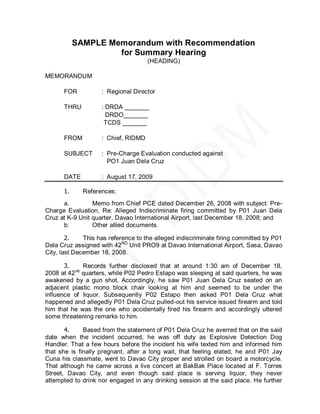
SAMPLE Memorandum with Recommendation
                    for Summary Hearing
                                     (HEADING)

MEMORANDUM

      FOR           : Regional Director

      THRU          : DRDA _______
                      DRDO_______
                     TCDS _______

      FROM          : Chief, RIDMD

      SUBJECT       : Pre-Charge Evaluation conducted against
                      PO1 Juan Dela Cruz

      DATE          : August 17, 2009

      1.     References:
      a.         Memo from Chief PCE dated December 26, 2008 with subject: Pre-
Charge Evaluation, Re: Alleged Indiscriminate firing committed by P01 Juan Dela
Cruz at K-9 Unit quarter, Davao International Airport, last December 18, 2008; and
      b.         Other allied documents.

        2.    This has reference to the alleged indiscriminate firing committed by P01
Dela Cruz assigned with 42ND Unit PRO9 at Davao International Airport, Sasa, Davao
City, last December 18, 2008.

       3.    Records further disclosed that at around 1:30 am of December 18,
2008 at 42nd quarters, while P02 Pedro Estapo was sleeping at said quarters, he was
awakened by a gun shot. Accordingly, he saw P01 Juan Dela Cruz seated on an
adjacent plastic mono block chair looking at him and seemed to be under the
influence of liquor. Subsequently P02 Estapo then asked P01 Dela Cruz what
happened and allegedly P01 Dela Cruz pulled-out his service issued firearm and told
him that he was the one who accidentally fired his firearm and accordingly uttered
some threatening remarks to him.

       4.     Based from the statement of P01 Dela Cruz he averred that on the said
date when the incident occurred, he was off duty as Explosive Detection Dog
Handler. That a few hours before the incident his wife texted him and informed him
that she is finally pregnant, after a long wait, that feeling elated, he and P01 Jay
Cuna his classmate, went to Davao City proper and strolled on board a motorcycle.
That although he came across a live concert at BakBak Place located at F. Torres
Street, Davao City, and even though said place is serving liquor, they never
attempted to drink nor engaged in any drinking session at the said place. He further
averred that at around 1:30 am said date, upon his return at K-9 quarters he
attempted to unlock his belt in a manner so he could urinate but unfortunately, his
service firearm a 9mm Glock 17 Pistol fell off from his inside holster and when he
tried to catch the same he accidentally pulled the trigger causing said accidental fire.
That unfortunately, P02 Estapo while sleeping at their quarters was awaken by the
noise and the latter asked him what happened to which he allegedly politely replied
that his gun accidentally went off.

       5.      On the allegation of P02 Estapo that he uttered threatening remarks,
P01 Dela Cruz vehemently denied said allegation and averred that he was aware and
what happened on the said time and date, and that he could not do such actuation to
P02 Estapo as he respected P02 Estapo not only as his co-handler but as his senior.
That in fact, ever since he entered the service, he never got involved in any quarrel
nor offended his co-handler within his Unit.

       6. On the other hand, the affidavit of SP01 Bastian, Team leader of the K-9
Unit AVSEGROUP detailed at Davao International Airport, averred that when he
arrived at their quarters, he saw his two (2) companions P02 Estapo and P01 Dela
Cruz, and accordingly P02 Estapo uttered the words, to quote “Pre bata mo
nagmaoy” P02 Estapo then told him that he will go home to settle some problem and
subsequently drove his car and left the area. That at around 4:30 am same date he
was awakened by the sound of a vehicle and noticed that it was P02 Estapo who
arrived. Thereafter, P02 Estapo informed him that he went to Buhangin Police Station
and had the incident put into blotter, then the latter presented him an extract copy of
the blotter. Thereafter, he directed P02 Estapo to inform PSSUPT NEIL CABANGA
thru text messages about the said incident. SP01 Bastian did not mention that P01
Dela CRuz was drunk nor seemed to be drunk when he saw him.

       7. After perusal of the entire case records of this present case, it can be
observed specifically based from the affidavit of P02 Estapo that he was able to
fabricate a story as he told his Team leader SP01 Bastian that he will go home to
settle some problem, but P02 Estapo went to Buhangin Police Station to have the
said incident blottered. Moreover, P02 Estapo failed to secure affidavit of any witness
who could precisely attest his allegation against P01 Dela Cruz for allegedly uttering
threatening remarks to him.

        8. Further, it can be gleaned from the records that after undergoing paraffin
test at Regional Crime Laboratory Office XI, NEGATIVE result on both hands of P01
Dela Cruz, clearly indicates the absence of gunpowder nitrates, hence, said incident
was purely accidental, contrary to the allegation of P02 Estap0 that P01 Dela Cruz
indiscriminately fired his issued firearm. Moreover, P01 Dela Cruz readily submitted
himself for alcohol test to prove that he was not under the influence of liquor,
unfortunately, said test is not available at the Department of Pathology and
Laboratories at Davao Medical Center. However, what is evident is that P01 Dela
Cruz failed to immediately inform his Superior Officer or submit a written report
relative to the accidental firing of his issued firearm Cal. 9mm Glock 17 Pistol, instead
he just slept at their quarters together with SP01 Sebastian rather than go to their
Office and report the said incident, thus, constituting ―NEGLECT‖ on his part.
9. Comes the charge of Misconduct rendered by 8 th PCAS wherein it stated
that accidental firing constitutes MISCONDUCT, after evaluation conducted by this
Office it was affirmed that the actuation by P01 Juan Dela Cruz constituted Neglect
and not Misconduct. As the high court ruled Misconduct – implies malice or wrongful
intent, not error of judgment- (Suroza v. Honrado, Adm. Matter No. 2026 – CFI,
December 19, 1981; 110 SCRA 396.) Since the incident was ACCIDENTAL firing, it
cannot be considered as misconduct, as the term ACCIDENTAL means there is
absence of a wrongful intent. On the case of Dela Cruz v. Capital Insurance & Surety
Co., 123 Phil 1414, it was ruled that ACCIDENTAL – that which happens by chance
or fortuitously, without intention and design, and which is unexpected, unusual and
unforeseen. Further, reads thus; Accident – An occurrence out of the usual course
of events which happens suddenly and unexpectedly, without any design on the part
of the person affected and which ordinary prudence could not have granted against,
CABANAS vs LADRERA, 61-og 5539.

        10. Wherefore, premises considered this Office opines that the infraction
committed by P01 Juan Dela Cruz falls under Simple Neglect of Duty, pursuant to 28
NAPOLCOM Memorandum Circular No. 2007-001, under Rule 21, Section 2, Para
A(1), sub para k. (Light Offense) to wit: ―fail to submit a written report to his superior
officer immediately or within a reasonable time after accidental firing, of his firearm,
when time and circumstances would permit‖.

              As the high court ruled that – Neglect of Duty is to fail to give due
attention, especially to the performance of a task or duty‖. DUNGCA, Jose M., CSC
Resolution No. 97 – 3280, July 7, 1997 citing MAGALLANES v. PROVINCIAL
BOARD, 66OG 7839.

       11.    FOREGOING, respectfully recommend that this case against P01 Juan
Dela Cruz for LESS GRAVE NEGLECT OF DUTY, pursuant to afore-cited
NAPOLCOM provision be elevated for Summary Proceeding to properly determine
the extent of his administrative liability and for him to have full opportunity to offer
controverting evidence and convince this jurisdiction that he did not commit the act
complained of.

      12.    Further recommend that this case be referred to the Director as the
appropriate Disciplinary Authority

      13.    Further request approval of Para 11, above.


                                          ___________________________________
                                               Rank/Name/Signature C, PCE
I concur with the findings and recommendation of the evaluator.


                             _______________________________________
                                     Rank/Name/Signature of C, RIDMD


                             Approved:


                             _______________________________________
                               Rank/Name/Signature of Disciplinary Authority

                                                      ______________
                                                      Date of approval
SAMPLE Charge Sheet
                                      (HEADING)

PHILIPPINE NATIONAL POLICE,
      Complainant,

        -versus-                                                 Administrative Case No.
                                                                       4PCAS-09-10-01
                                                                       For: Simple Misconduct
                                                                               (Offense)


SPO1 Juan Dela Cruz
  Respondent.

x------------------------------------------x

                                         CHARGE SHEET

      The undersigned nominal complaint hereby accuses the above-named
respondent of ______________________________________ pursuant to RA 8551
in
                                               (Offense)
relation to NAPOLCOM Memorandum Circular 2007-001, committed as follows:

     ―That________________ (State Facts of the Case)____________________________
___________________________________________________________________
____
___________________________________________________________________
________________________________________________________.‖

        Contrary to existing PNP laws, Rules and Regulations.

        _______________, Philippines. _____________ _____, 20___.
                 (City)                                          (Month)   (Day)    (Year)


                                                           __________________________
                                                           Name and signature
                                                           Chief, PCID/RIDMD/C, Invest Sec
SAMPLE Memorandum to Disciplinary Authority
                Re Pre-Charge Evaluation
                                          (HEADING)

MEMORANDUM

      FOR           : Regional Director

      THRU          : DRDA _______
                      DRDO_______
                      TCDS _______

      FROM          : C, RIDMD/R7

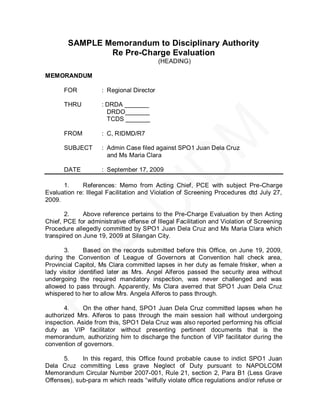
      SUBJECT       : Admin Case filed against SPO1 Juan Dela Cruz
                      and Ms Maria Clara

      DATE          : September 17, 2009

      1.     References: Memo from Acting Chief, PCE with subject Pre-Charge
Evaluation re: Illegal Facilitation and Violation of Screening Procedures dtd July 27,
2009.

       2.     Above reference pertains to the Pre-Charge Evaluation by then Acting
Chief, PCE for administrative offense of Illegal Facilitation and Violation of Screening
Procedure allegedly committed by SPO1 Juan Dela Cruz and Ms Maria Clara which
transpired on June 19, 2009 at Silangan City.

       3.      Based on the records submitted before this Office, on June 19, 2009,
during the Convention of League of Governors at Convention hall check area,
Provincial Capitol, Ms Clara committed lapses in her duty as female frisker, when a
lady visitor identified later as Mrs. Angel Alferos passed the security area without
undergoing the required mandatory inspection, was never challenged and was
allowed to pass through. Apparently, Ms Clara averred that SPO1 Juan Dela Cruz
whispered to her to allow Mrs. Angela Alferos to pass through.

       4.     On the other hand, SPO1 Juan Dela Cruz committed lapses when he
authorized Mrs. Alferos to pass through the main session hall without undergoing
inspection. Aside from this, SPO1 Dela Cruz was also reported performing his official
duty as VIP facilitator without presenting pertinent documents that is the
memorandum, authorizing him to discharge the function of VIP facilitator during the
convention of governors.

      5.     In this regard, this Office found probable cause to indict SPO1 Juan
Dela Cruz committing Less grave Neglect of Duty pursuant to NAPOLCOM
Memorandum Circular Number 2007-001, Rule 21, section 2, Para B1 (Less Grave
Offenses), sub-para m which reads ―wilfully violate office regulations and/or refuse or
neglect to comply with said provisions‖ and Ms Maria Clara for committing violation of
reasonable office rules and regulations pursuant to Rule IV, Section 52, Para C –
Light Offense, sub-para 3 of the Uniform Rules on Administrative Cases in the Civil
Service.

      6.     From the foregoing, this Office recommends the following:

             a. That Summary Hearing Proceeding be conducted against           SPO1
                Juan Dela Cruz to further determine his administrative culpability;

             b. That the administrative case against Ms Maria Clara be transmitted
                to USEC. ANDRES BONIFACIO, Administrator, Office for
                Transportation Security for their appropriate action.

      7. Further, recommend approval of Para 6, above and signature on the
         attached Memo addressed to USEC. ANDRES BONIFACIO.


                                               JUAN MIGUEL LUNA
                                               Police Senior Superintendent
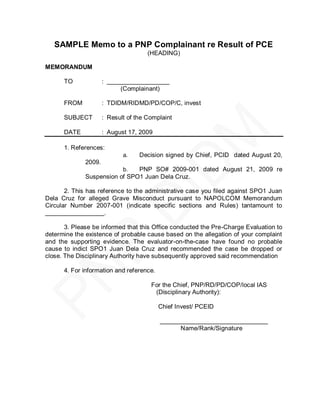
SAMPLE Memo to a PNP Complainant re Result of PCE
                                      (HEADING)

MEMORANDUM

      TO              : __________________
                            (Complainant)

      FROM            : TDIDM/RIDMD/PD/COP/C, invest

      SUBJECT         : Result of the Complaint

      DATE            : August 17, 2009

      1. References:
                             a.    Decision signed by Chief, PCID dated August 20,
              2009.
                             b.PNP SO# 2009-001 dated August 21, 2009 re
              Suspension of SPO1 Juan Dela Cruz.

       2. This has reference to the administrative case you filed against SPO1 Juan
Dela Cruz for alleged Grave Misconduct pursuant to NAPOLCOM Memorandum
Circular Number 2007-001 (indicate specific sections and Rules) tantamount to
_________________.

       3. Please be informed that this Office conducted the Pre-Charge Evaluation to
determine the existence of probable cause based on the allegation of your complaint
and the supporting evidence. The evaluator-on-the-case have found no probable
cause to indict SPO1 Juan Dela Cruz and recommended the case be dropped or
close. The Disciplinary Authority have subsequently approved said recommendation

      4. For information and reference.

                                       For the Chief, PNP/RD/PD/COP/local IAS
                                        (Disciplinary Authority):

                                          Chief Invest/ PCEID

                                          _______________________________
                                                Name/Rank/Signature
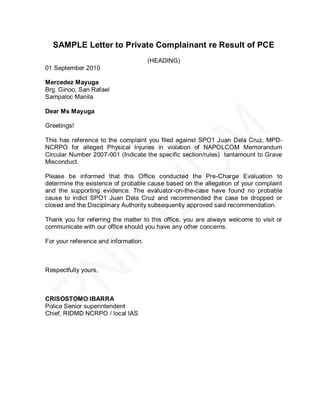
SAMPLE Letter to Private Complainant re Result of PCE
                                      (HEADING)
01 September 2010

Mercedez Mayuga
Brg. Ginoo, San Rafael
Sampaloc Manila

Dear Ms Mayuga

Greetings!

This has reference to the complaint you filed against SPO1 Juan Dela Cruz, MPD-
NCRPO for alleged Physical Injuries in violation of NAPOLCOM Memorandum
Circular Number 2007-001 (Indicate the specific section/rules) tantamount to Grave
Misconduct.

Please be informed that this Office conducted the Pre-Charge Evaluation to
determine the existence of probable cause based on the allegation of your complaint
and the supporting evidence. The evaluator-on-the-case have found no probable
cause to indict SPO1 Juan Dela Cruz and recommended the case be dropped or
closed and the Disciplinary Authority subsequently approved said recommendation.

Thank you for referring the matter to this office, you are always welcome to visit or
communicate with our office should you have any other concerns.

For your reference and information.


Respectfully yours,


CRISOSTOMO IBARRA
Police Senior superintendent
Chief, RIDMD NCRPO / local IAS
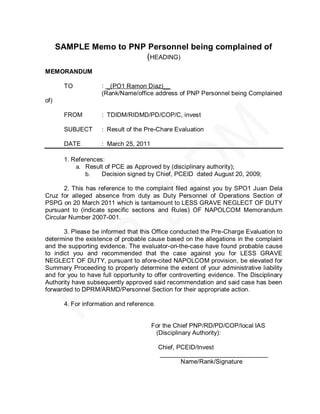
SAMPLE Memo to PNP Personnel being complained of
                         (HEADING)
MEMORANDUM

       TO           : _(PO1 Ramon Diaz)__
                    (Rank/Name/office address of PNP Personnel being Complained
of)

       FROM         : TDIDM/RIDMD/PD/COP/C, invest

       SUBJECT      : Result of the Pre-Chare Evaluation

       DATE         : March 25, 2011

       1. References:
           a. Result of PCE as Approved by (disciplinary authority);
               b.   Decision signed by Chief, PCEID dated August 20, 2009;

       2. This has reference to the complaint filed against you by SPO1 Juan Dela
Cruz for alleged absence from duty as Duty Personnel of Operations Section of
PSPG on 20 March 2011 which is tantamount to LESS GRAVE NEGLECT OF DUTY
pursuant to (indicate specific sections and Rules) OF NAPOLCOM Memorandum
Circular Number 2007-001.

       3. Please be informed that this Office conducted the Pre-Charge Evaluation to
determine the existence of probable cause based on the allegations in the complaint
and the supporting evidence. The evaluator-on-the-case have found probable cause
to indict you and recommended that the case against you for LESS GRAVE
NEGLECT OF DUTY, pursuant to afore-cited NAPOLCOM provision, be elevated for
Summary Proceeding to properly determine the extent of your administrative liability
and for you to have full opportunity to offer controverting evidence. The Disciplinary
Authority have subsequently approved said recommendation and said case has been
forwarded to DPRM/ARMD/Personnel Section for their appropriate action.

       4. For information and reference.


                                       For the Chief PNP/RD/PD/COP/local IAS
                                        (Disciplinary Authority):

                                           Chief, PCEID/Invest
                                           _______________________________
                                                   Name/Rank/Signature
IV.        SUMMARY HEARING GUIDE


      “ Apply thine heart unto instruction, and thine ears to words knowledge.”
                                  (Proverbs 23:12)
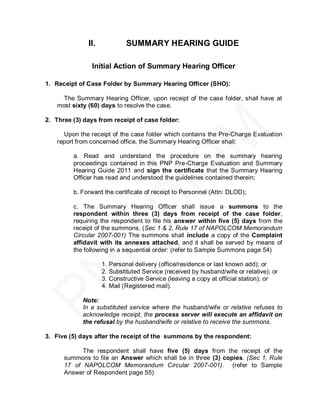
II.              SUMMARY HEARING GUIDE

                Initial Action of Summary Hearing Officer

1. Receipt of Case Folder by Summary Hearing Officer (SHO):

      The Summary Hearing Officer, upon receipt of the case folder, shall have at
    most sixty (60) days to resolve the case.

2. Three (3) days from receipt of case folder:

      Upon the receipt of the case folder which contains the Pre-Charge Evaluation
    report from concerned office, the Summary Hearing Officer shall:

         a. Read and understand the procedure on the summary hearing
         proceedings contained in this PNP Pre-Charge Evaluation and Summary
         Hearing Guide 2011 and sign the certificate that the Summary Hearing
         Officer has read and understood the guidelines contained therein;

         b. Forward the certificate of receipt to Personnel (Attn: DLOD);

         c. The Summary Hearing Officer shall issue a summons to the
         respondent within three (3) days from receipt of the case folder,
         requiring the respondent to file his answer within five (5) days from the
         receipt of the summons. (Sec 1 & 2, Rule 17 of NAPOLCOM Memorandum
         Circular 2007-001) The summons shall include a copy of the Complaint
         affidavit with its annexes attached, and it shall be served by means of
         the following in a sequential order: (refer to Sample Summons page 54)

                    1.   Personal delivery (office/residence or last known add); or
                    2.   Substituted Service (received by husband/wife or relative); or
                    3.   Constructive Service (leaving a copy at official station); or
                    4.   Mail (Registered mail).

            Note:
            In a substituted service where the husband/wife or relative refuses to
            acknowledge receipt, the process server will execute an affidavit on
            the refusal by the husband/wife or relative to receive the summons.

3. Five (5) days after the receipt of the summons by the respondent:

            The respondent shall have five (5) days from the receipt of the
      summons to file an Answer which shall be in three (3) copies. (Sec 1, Rule
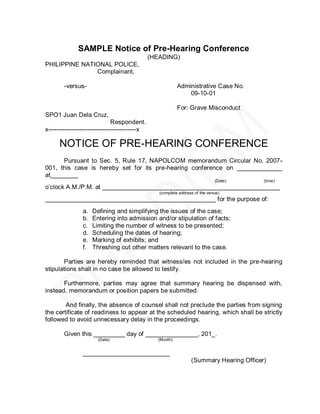
      17 of NAPOLCOM Memorandum Circular 2007-001). (refer to Sample
      Answer of Respondent page 55)
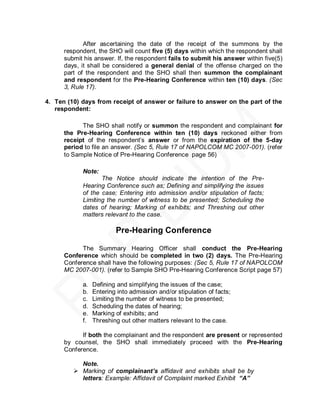
After ascertaining the date of the receipt of the summons by the
      respondent, the SHO will count five (5) days within which the respondent shall
      submit his answer. If, the respondent fails to submit his answer within five(5)
      days, it shall be considered a general denial of the offense charged on the
      part of the respondent and the SHO shall then summon the complainant
      and respondent for the Pre-Hearing Conference within ten (10) days. (Sec
      3, Rule 17).

4. Ten (10) days from receipt of answer or failure to answer on the part of the
   respondent:

            The SHO shall notify or summon the respondent and complainant for
      the Pre-Hearing Conference within ten (10) days reckoned either from
      receipt of the respondent’s answer or from the expiration of the 5-day
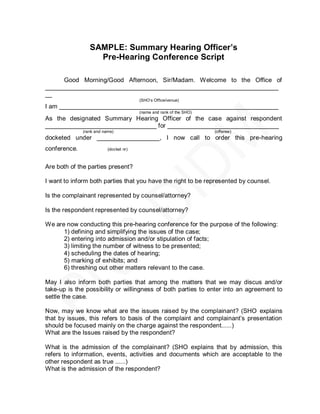
      period to file an answer. (Sec 5, Rule 17 of NAPOLCOM MC 2007-001). (refer
      to Sample Notice of Pre-Hearing Conference page 56)

            Note:
                   The Notice should indicate the intention of the Pre-
            Hearing Conference such as; Defining and simplifying the issues
            of the case; Entering into admission and/or stipulation of facts;
            Limiting the number of witness to be presented; Scheduling the
            dates of hearing; Marking of exhibits; and Threshing out other
            matters relevant to the case.

                         Pre-Hearing Conference

            The Summary Hearing Officer shall conduct the Pre-Hearing
      Conference which should be completed in two (2) days. The Pre-Hearing
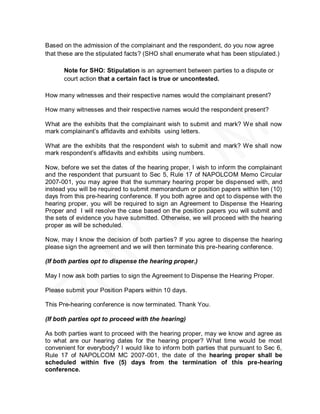
      Conference shall have the following purposes: (Sec 5, Rule 17 of NAPOLCOM
      MC 2007-001). (refer to Sample SHO Pre-Hearing Conference Script page 57)

            a.   Defining and simplifying the issues of the case;
            b.   Entering into admission and/or stipulation of facts;
            c.   Limiting the number of witness to be presented;
            d.   Scheduling the dates of hearing;
            e.   Marking of exhibits; and
            f.   Threshing out other matters relevant to the case.

            If both the complainant and the respondent are present or represented
      by counsel, the SHO shall immediately proceed with the Pre-Hearing
      Conference.

           Note.
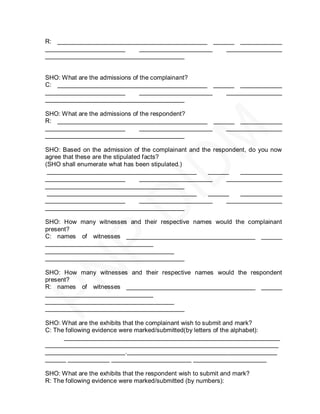
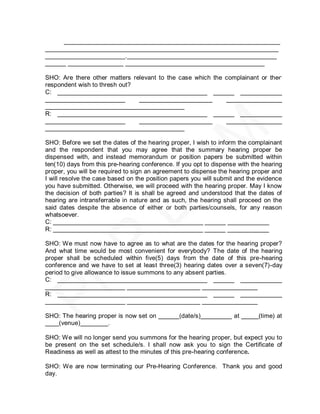
          Marking of complainant’s affidavit and exhibits shall be by
           letters: Example: Affidavit of Complaint marked Exhibit “A”
 Marking of respondent’s answer and exhibits shall be by
     numbers: Example: Answer Affidavit marked Exhibit “1”

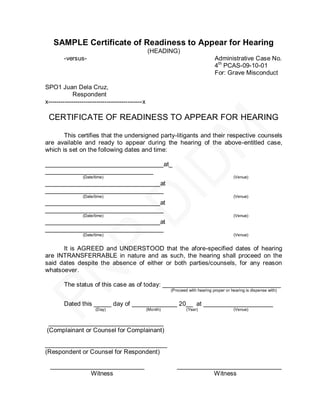
        Whether the parties are represented by counsel or not, the Summary
Hearing Officer shall require them to sign the Certificate of Readiness to
appear at the scheduled hearings which shall be set within five (5) days
after the pre-hearing conference. At most three (3) hearing dates shall be set
to give allowance for absences of any of the parties, and the schedule agreed
upon shall be strictly followed to avoid unnecessary delay in the
proceedings. (Sec 5, Rule 17). (refer to Sample Certificate of Readiness to
Appear for Hearing page 61)

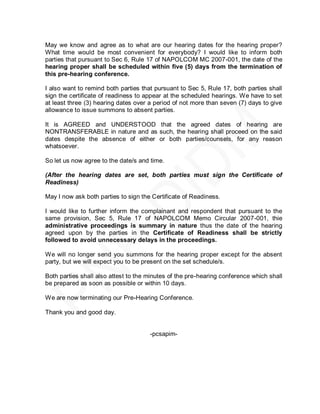
      The SHO shall inform both parties and their counsels that the
administrative proceeding is summary in nature and emphasize that the
scheduled hearings shall be strictly followed.

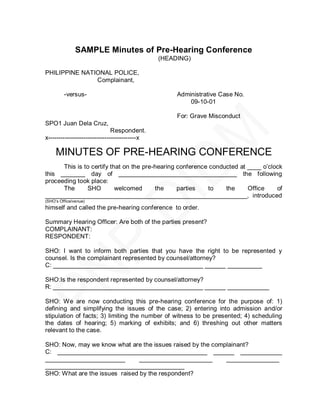
       Note #1.
      Minutes of Pre-Hearing Conference shall be recorded and
       maintained by Summary Hearing Officer and attested by both
       parties/or their counsel within ten (10) days. (Sec 17, Rule 17)
       All documents must be compiled in the case folder for safe
       keeping and safety. (refer to Sample Minutes of Pre-hearing
       Conference page 62)

       Note #2.
      The Summary Hearing Officer can accept additional evidence
       or exhibits only during the Pre-Hearing Conference.

       Note #3.
      Even if the respondent admits to his culpability, a hearing
       shall still be conducted to consider mitigating and aggravating
       circumstances and determine the appropriate penalty. (Sec 4,
       Rule 17)

       Note #4.
      The Summary Hearing Officer shall schedule no more than
       three (3) hearing dates over a seven (7)-day period as he may
       deem necessary.

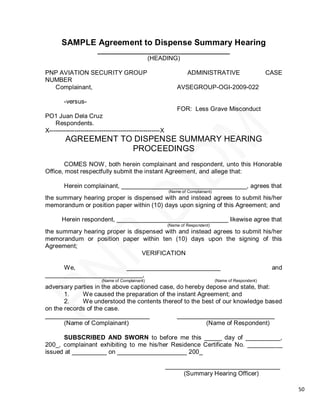
    The Summary Hearing Officer shall inform the parties that they may
agree to dispense with the conduct of a summary hearing and instead
submit their respective memoranda or position papers within ten (10) days
from the pre-hearing conference (Sec 5, Rule 17). If both parties agree, the
Summary Hearing Officer will require both parties to sign an agreement to
dispense with the hearing proper and he may then resolve the case based
on the position papers submitted within twelve (12) days from date of receipt
of the position papers. (refer to Sample Agreement to Dispense Summary
Hearing page 60)
Even if one or both of the parties are absent, the SHO shall
      nevertheless proceed with the Pre-Hearing Conference with the marking of
      the exhibits submitted by both parties, setting the scheduled dates of the
      hearing within five (5) days, signing of the Certificate of Readiness by the
      present party, and accomplishing the other purposes of the conference. The
      SHO shall subsequently issue another summons to the absent party/ies to
      appear for the hearing proper. The summons shall be served with proof of
      receipt/certificate of service. (Refer to Sample Forms Pre-Hearing Script.)

5. Five (5) days from termination of the Pre-Hearing Conference:


                             Hearing Proper
      The Hearing Officer will immediately set the date of summary hearing proper
      within five (5) days from the Pre-Hearing Conference. (refer to Sample
      Summary Hearing Officer’s Script for Hearing Proper page 66)
            Note:
            It is mandated that the summary hearing of a case shall proceed
            within five (5) days from the termination of the Pre-Hearing
            Conference. (Sec 6, Rule 17).

            Note:
            The summary hearing shall not be a trial-type proceeding but
            rather it shall be a clarificatory hearing in case there are
            clarificatory questions to be profounded. It shall not exceed
            three (3) settings and shall be confined strictly to material and
            releveant matters pertaining to a particular case.

            If the respondent admits to the offense during the hearing proper, the
      Summary Hearing Officer shall nevertheless proceed with the summary
      hearing proper to determine the appropriate penalty for the offense (Sec 4,
      Rule 17 of NAPOLCOM Memorandum Circular 2007-001). The Summary
      Hearing Officer shall subsequently submit the resolution with the appropriate
      recommendation to the disciplinary authority.
             If the complainant is absent (or both are absent) during the summary
      hearing proper, the Summary Hearing Officer shall serve another summons
      within five (5) days with proof of receipt/certificate of service. The Summary
      Hearing Officer shall serve a summons to the complainant for at least three
      (3) times for as long as the complainant fails to attend the scheduled hearing.

            If on the third scheduled date, the complainant is still absent from the
      summary hearing proper even after being summoned at least three (3) times,
      the Summary Hearing Officer may resolve the case and may use the
      complainant’s absence as a ground to recommend the dropping of the
      complaint where the culpability of the respondent could not be established
without the testimony of the complainant. However, if there is probable
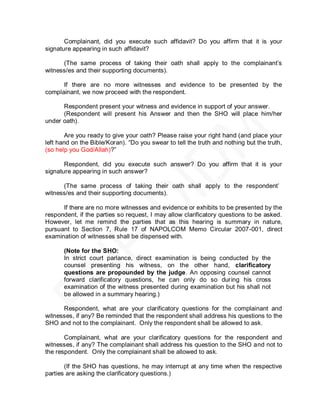
      cause, the hearing may still proceed and the witness/es shall be asked to
      affirm their affidavits. (Sec 12, Rule 17 of NAPOLCOM Memorandum Circular
      2007-001).

             If the complainant is present but the respondent is absent during
      summary hearing proper, the Summary Hearing Officer shall serve another
      summons to the respondent within five (5) days with proof of
      receipt/certificate of service. The Summary Hearing Officer shall serve a
      summons to the respondent at least three (3) times for as long as the
      respondent fails to attend the scheduled hearing.

            If on the third scheduled date, the respondent still fails to appear for
      the summary hearing proper without justifiable reason, he/she is deemed to
      have waived his right to be present and submit evidence and the
      Summary Hearing Officer may proceed with the hearing proper. (Sec 13,
      Rule 17).


             If both parties are present during the summary hearing, the Summary
      Hearing Officer shall conduct the hearing proper. The complainant shall affirm
      his complaint affidavit and other exhibits, and the respondent shall also affirm
      his answer and other exhibits. In any case, the hearing being summary in
      nature, clarificatory questions may be allowed if requested, but direct
      examination of witnesses shall be dispensed with. (Sec 7, Rule17)
             The Summary Hearing Officer may schedule another or
      additional hearings as he/she deems it necessary. At all times, minutes
      of the proceeding shall be maintained by the Summary Hearing Officer.

            Note:.
            Stenographic notes/minutes of the hearing shall be
            maintained by Summary Hearing Officer which shall be certified
            by the disciplinary authority or the hearing officer and preferably
            attested by both parties/or their counsel within ten (10) days.
            (Sec 17, Rule 17) All documents must be compiled in the case
            folder for safe keeping and safety. (refer to Sample Minutes of
            Hearing Proper page 69)

            (Refer to Sample Forms SHO Script for Hearing Proper page 66)

6. Ten (10) days from termination of hearing proper:
              After the termination of summary hearing proper, the Summary Hearing
      Officer, if he deems it necessary to resolve the case, may require both parties
      to submit their position papers ten (10) days after the Summary Hearing
      Proper (Sec 8, Rule 17 of NAPOLCOM Memorandum Circular 2007-001).
      (refer to Sample Position Paper page 72)
Note:
            The Position papers may help the Summary Hearing Officer in
            drafting the resolution.

7. Twelve (12) days from deadline for submission of Position Papers:

             Report of Investigation (Resolution)
             The Summary Hearing Officer shall submit his Report of Investigation
      (Resolution) together with the draft Decision to the disciplinary authority
      within twelve (12) days from the submission of position paper from both
      parties. (refer to Sample Report of Investigation/Resolution page 72-94 and
      Draft Decision page 95)
                   Refer to Rule 22 NPC MC 2007-001 for PENALTIES


             If both parties signify their preference not to submit their position
      paper, the Summary Hearing Officer shall submit his/her resolution and draft
      Decision within twelve (12) days from the date of termination of the
      Summary Hearing proper to the Disciplinary Authority thru the Personnel or
      Admin section of the concerned office.

             If any or both parties signify their intention to submit position papers
      but fails to do so within ten (10) days from the termination of the summary
      hearing proper, the Summary Hearing Officer shall submit his/her resolution
      together with the draft Decision within twelve (12) days reckoned from the
      date of expiration of the ten (10) days grace period to submit the position
      paper.

            Note.
            The Summary Hearing Officer will turn over the entire case folder of the
            respondent with the draft decision to the Personnel or Admin section of
            the concerned office/Head of local IAS. In return, the case folder will be
            properly received by the concerned office.


                     Personnel Section Action
8. Five (5) days from receipt of resolution from SHO by Per/Admin Section:

             The Personnel/Admin section shall endorse the case folder with the
      draft decision to the disciplinary authority within five (5) days from receipt of
      the entire case folder from the SHO for the decision/approval of the
      disciplinary authority.
The disciplinary authority shall render his decision/approval based on
    the recommendation of the Hearing Officer within thirty(30) days. (Sec 19,
    Rule 17)
           The Personnel/Admin of the concerned office shall serve the copy of
    the decision personally to the respondent. Respondent shall sign and indicate
    the time and date of receipt of the proof of service. If the respondent is not
    available or refuses to receive a copy of the decision, the server shall resort to
    substituted service. If substituted service is not possible, server shall transmit
    the copy of the decision by registered mail, and, in any case shall execute an
    affidavit of proof of service.
            Similarly, the Personnel or Admin section shall send a letter/memo
    addressed to the complainant within five (5) days from the
    decision/approval of the disciplinary authority to inform the complainant of the
    result of the summary hearing and the decision of the disciplinary authority.

            The Personnel or Admin section of the concerned office shall prepare a
    certificate of finality of the decision or resolution to be signed by the
    disciplinary authority finally disposing of the case when no motion for
    reconsideration or appeal is filed within the prescribed period of ten (10) days
    from receipt by the respondent of the copy of the decision. (Sec 24, Rule 17)


                              (END OF SH GUIDE)


“Knowledge is a comfortable and necessary retreat and shelter for us in an
advanced age; and if we do not plant it while young, it will give us no shade
                 when we grow old.” (Lord Chesterfield)
SUMMARY ADMINISTRATIVE PROCEEDINGS FLOWCHART

                                Case rcvd by Summary Hearing Officer


                                       3-days - Issue Summons to
                                      the respondent to file Answer


                                YES                                    NO       Considered
     Admission or                             Respondent
                                             Answers within                   General denial
   Negative Defenses
                                                5 days?                        of the charge


                                         Summons both parties
                                         for Pre-Hearing Conf

                                       Convene the Pre-Hearing
                                       Conference w/in 10 days
                                         from receipt of answer


                                              Are both parties
                                               N                       NO      One or both Parties
                                                 PRESENT?
                                                                                    ABSENT

                                                          YES
                                                                             Proceed with the Pre-
                                          If both parties agree               Hearing Conference
                                YES
Sign agreement to                        to dispense summary
                                                         YES
  dispense hearing                           hearing-but will
                                         submit position paper?             Marking of evidence, Set
                                                                            schedule of hearing, etc..

       Z                                           NO
                                                                               Issue Summons to
                                         Certificate of Readiness,          require absent party/ies to
                                           Attest Minutes, etc..               attend the scheduled
                                                                                  hearing proper
                                           HEARING Proper
                                             (w/in 5 days)

           If complainant (or          If complainant is present but    If both parties are
              both) is absent           the respondent is absent             present


               Summons                          Summons
A                                                    B                                     C
             2nd absence of                                    2nd absence of respondent.             both parties are present
              complainant                                        (complainant present)

                  Summons
                                                                     Summon respondent
                                                                                                            Proceed with
                  rd
                 3 absence of                                   rd                                        Summary Hearing
                                                               3 absence of respondent
                  complainant
                                                                (complainant present)

      Ground to drop the complaint                             Respondent is deemed to
     where culpability of respondent                                                                   Complainant to affirm his
                                                              have waived his right to be
      could not be established w/o                                                                    complaint and other exhibits
                                                             present and submit evidence
     testimonies of the complainant

                                                                       Proceed with                    Respondent to affirm his
                       If not to drop complaint                      Summary Hearing                  Answer and other evidence
                        due to probable cause

                               Proceed with                      Complainant to affirm
                             Summary Hearing                    his complaint and other
  If to drop
                                                                   evidence/exhibits
complaint due
  to lack of                Other witnesses to
                           affirm their affidavits
  probable                                                                                    Clarificatory
                            and other evidence
     cause                                                                                     Questions

                           Respondent to affirm his
                             answer and exhibits                                    Termination of Hearing

Termination of
Hearing Proper                                                                     Position Papers submitted or
                                                                                  not by both parties w/in 10days            Z
                                                                                  12 days- SHO Report of Invest/
                                                                                  Resolution with draft Decision


                                                                                       Submit to C, Personnel

     Certificate of Finality
                                                                                         Decision/Approval by
                                                        MR filed                         Disciplinary Authority
     Implementation of                                                      YES
          Decision                                                                       Personnel/Admin Action
                                               NO
                                                        Respondent
                                                     /Complainant Files
                                                     MR w/in 10 days?                  Furnish copy of decision to
                                                                                       respondent & complainant
SAMPLE Summons
                                           (HEADINGS)

PHILIPPINE NATIONAL POLICE,
               Complainant,

        -versus-                                              Administrative Case No.
                                                              4th PCAS-09-10-01

                                                              For: Grave Misconduct
SPO1 Juan Dela Cruz,
        Respondent

x--------------------------------------x

                                      SUMMONS
TO:     SPO1 Juan Dela Cruz
        ________________________(address)


GREETINGS:

       You are notified that the attached Complaint, together with all its annexes, has
been filed with this office for formal hearing in consonance with the Uniformed Rules
of Procedure Before the Administrative Disciplinary Authorities and Internal Affairs
Service of the Philippine National Police (NAPOLCOM memorandum Circular 2007-
001).

       Wherefore, you are hereby directed to submit your Answer, containing a list of
your witnesses and their individual addresses, if obtaining, accompanied by
documentary or other evidence you may have in support of your defense, within five
(5) days from receipt of the summon; copy furnished the complainant.

      Failure to submit your Answer shall be considered as a general denial of the
charges and the summary hearing shall proceed ex-parte.

       Witness my hand this _____ day of __________ 200_ at              __________,
Philippines.


                                                        ________________________
                                                  _
                                                          Summary Hearing Officer
SAMPLE Answer of Respondent
                                                (HEADING)

PHILIPPINE NATIONAL POLICE,
               Complainant,

        -versus-                                        Administrative Case No.
                                                            09-10-01

                                                        For: Grave Misconduct
SPO1 Juan Dela Cruz,
                                 Respondent.
x------------------------------------------x

                                               ANSWER

      Comes now, respondent, by (himself or through the undersigned counsel), unto this
Honorable Office, most respectfully submit the instant Answer, and in support thereof, state,
that;

1. Herein respondent specifically (denies/affirm) the allegations as contained in paragraph
   no. ___ of the complaint, the truth of the matter being that ___________ (statement of
   facts and circumstances) __________________________________ ________.

2. _______________________________________________________________________
   _______________________________________________________________________
   _________________________________;

                                               PRAYER

        WHEREFORE, It is most respectfully prayed before this Honorable Office that the
instant complaint be dismissed for lack of merit.

        Just and equitable relief, under the premises, are likewise prayed for.

        (Date and place of execution)

                                                        ____________________________
                                                        Name and Signature of Respondent
                                                        Or Counsel of the Respondent
                                                        Address:


      SUBSCRIBED AND SWORN to before me this _____ day of __________, 200_,
complainant exhibiting to me his/her Residence Certificate No. __________ issued at
__________ on ____________________ 200_

                                                  _________________________________
                                                  (Person authorized to administer an oath)
SAMPLE Notice of Pre-Hearing Conference
                                               (HEADING)
PHILIPPINE NATIONAL POLICE,
               Complainant,

        -versus-                                           Administrative Case No.
                                                               09-10-01

                                                           For: Grave Misconduct
SPO1 Juan Dela Cruz,
                               Respondent.
x------------------------------------------x

      NOTICE OF PRE-HEARING CONFERENCE
      Pursuant to Sec. 5, Rule 17, NAPOLCOM memorandum Circular No. 2007-
001, this case is hereby set for its pre-hearing conference on _____________
at________
                                                                              (Date)      (time)
o’clock A.M./P.M. at ___________________________________________________
                                                  (complete address of the venue)
_________________________________________________ for the purpose of:
                a.   Defining and simplifying the issues of the case;
                b.   Entering into admission and/or stipulation of facts;
                c.   Limiting the number of witness to be presented;
                d.   Scheduling the dates of hearing;
                e.   Marking of exhibits; and
                f.   Threshing out other matters relevant to the case.

       Parties are hereby reminded that witness/es not included in the pre-hearing
stipulations shall in no case be allowed to testify.

       Furthermore, parties may agree that summary hearing be dispensed with,
instead, memorandum or position papers be submitted.

        And finally, the absence of counsel shall not preclude the parties from signing
the certificate of readiness to appear at the scheduled hearing, which shall be strictly
followed to avoid unnecessary delay in the proceedings.

        Given this _________ day of _______________, 201_.
                       (Date)                    (Month)


                _________________________
                                                                  (Summary Hearing Officer)
SAMPLE: Summary Hearing Officer’s
                   Pre-Hearing Conference Script

     Good Morning/Good Afternoon, Sir/Madam. Welcome to the Office of
___________________________________________________________________
__
                                        (SHO’s Office/venue)
I am _______________________________________________________________
                                        (name and rank of the SHO)
As the designated Summary Hearing Officer of the case against respondent
________________________________ for ________________________________
              (rank and name)                                        (offense)
docketed under __________________, I now call to order this pre-hearing
conference.               (docket nr)


Are both of the parties present?

I want to inform both parties that you have the right to be represented by counsel.

Is the complainant represented by counsel/attorney?

Is the respondent represented by counsel/attorney?

We are now conducting this pre-hearing conference for the purpose of the following:
      1) defining and simplifying the issues of the case;
      2) entering into admission and/or stipulation of facts;
      3) limiting the number of witness to be presented;
      4) scheduling the dates of hearing;
      5) marking of exhibits; and
      6) threshing out other matters relevant to the case.

May I also inform both parties that among the matters that we may discus and/or
take-up is the possibility or willingness of both parties to enter into an agreement to
settle the case.

Now, may we know what are the issues raised by the complainant? (SHO explains
that by issues, this refers to basis of the complaint and complainant’s presentation
should be focused mainly on the charge against the respondent......)
What are the Issues raised by the respondent?

What is the admission of the complainant? (SHO explains that by admission, this
refers to information, events, activities and documents which are acceptable to the
other respondent as true ......)
What is the admission of the respondent?
Based on the admission of the complainant and the respondent, do you now agree
that these are the stipulated facts? (SHO shall enumerate what has been stipulated.)

      Note for SHO: Stipulation is an agreement between parties to a dispute or
      court action that a certain fact is true or uncontested.

How many witnesses and their respective names would the complainant present?

How many witnesses and their respective names would the respondent present?

What are the exhibits that the complainant wish to submit and mark? We shall now
mark complainant’s affidavits and exhibits using letters.

What are the exhibits that the respondent wish to submit and mark? We shall now
mark respondent’s affidavits and exhibits using numbers.

Now, before we set the dates of the hearing proper, I wish to inform the complainant
and the respondent that pursuant to Sec 5, Rule 17 of NAPOLCOM Memo Circular
2007-001, you may agree that the summary hearing proper be dispensed with, and
instead you will be required to submit memorandum or position papers within ten (10)
days from this pre-hearing conference. If you both agree and opt to dispense with the
hearing proper, you will be required to sign an Agreement to Dispense the Hearing
Proper and I will resolve the case based on the position papers you will submit and
the sets of evidence you have submitted. Otherwise, we will proceed with the hearing
proper as will be scheduled.

Now, may I know the decision of both parties? If you agree to dispense the hearing
please sign the agreement and we will then terminate this pre-hearing conference.

(If both parties opt to dispense the hearing proper.)

May I now ask both parties to sign the Agreement to Dispense the Hearing Proper.

Please submit your Position Papers within 10 days.

This Pre-hearing conference is now terminated. Thank You.

(If both parties opt to proceed with the hearing)

As both parties want to proceed with the hearing proper, may we know and agree as
to what are our hearing dates for the hearing proper? What time would be most
convenient for everybody? I would like to inform both parties that pursuant to Sec 6,
Rule 17 of NAPOLCOM MC 2007-001, the date of the hearing proper shall be
scheduled within five (5) days from the termination of this pre-hearing
conference.
May we know and agree as to what are our hearing dates for the hearing proper?
What time would be most convenient for everybody? I would like to inform both
parties that pursuant to Sec 6, Rule 17 of NAPOLCOM MC 2007-001, the date of the
hearing proper shall be scheduled within five (5) days from the termination of
this pre-hearing conference.

I also want to remind both parties that pursuant to Sec 5, Rule 17, both parties shall
sign the certificate of readiness to appear at the scheduled hearings. We have to set
at least three (3) hearing dates over a period of not more than seven (7) days to give
allowance to issue summons to absent parties.

It is AGREED and UNDERSTOOD that the agreed dates of hearing are
NONTRANSFERABLE in nature and as such, the hearing shall proceed on the said
dates despite the absence of either or both parties/counsels, for any reason
whatsoever.

So let us now agree to the date/s and time.

(After the hearing dates are set, both parties must sign the Certificate of
Readiness)

May I now ask both parties to sign the Certificate of Readiness.

I would like to further inform the complainant and respondent that pursuant to the
same provision, Sec 5, Rule 17 of NAPOLCOM Memo Circular 2007-001, thie
administrative proceedings is summary in nature thus the date of the hearing
agreed upon by the parties in the Certificate of Readiness shall be strictly
followed to avoid unnecessary delays in the proceedings.

We will no longer send you summons for the hearing proper except for the absent
party, but we will expect you to be present on the set schedule/s.

Both parties shall also attest to the minutes of the pre-hearing conference which shall
be prepared as soon as possible or within 10 days.

We are now terminating our Pre-Hearing Conference.

Thank you and good day.


                                      -pcsapim-
SAMPLE Agreement to Dispense Summary Hearing
                        ______________________________________
                                      (HEADING)

PNP AVIATION SECURITY GROUP                                        ADMINISTRATIVE                        CASE
NUMBER
  Complainant,                                                AVSEGROUP-OGI-2009-022

        -versus-
                                                              FOR: Less Grave Misconduct
PO1 Juan Dela Cruz
    Respondents.
X-----------------------------------------------------X
         AGREEMENT TO DISPENSE SUMMARY HEARING
                     PROCEEDINGS
        COMES NOW, both herein complainant and respondent, unto this Honorable
Office, most respectfully submit the instant Agreement, and allege that:

        Herein complainant, ____________________________________, agrees that
                                                          (Name of Complainant)
the summary hearing proper is dispensed with and instead agrees to submit his/her
memorandum or position paper within (10) days upon signing of this Agreement; and

       Herein respondent, ________________________________ likewise agree that
                                                          (Name of Respondent)
the summary hearing proper is dispensed with and instead agrees to submit his/her
memorandum or position paper within ten (10) days upon the signing of this
Agreement;
                                 VERIFICATION

     We,               ___________________________                                                        and
____________________________,
                          (Name of Complainant)                                   (Name of Respondent)
adversary parties in the above captioned case, do hereby depose and state, that:
       1.    We caused the preparation of the instant Agreement; and
       2.    We understood the contents thereof to the best of our knowledge based
on the records of the case.
______________________________                 ____________________________
       (Name of Complainant)                             (Name of Respondent)

      SUBSCRIBED AND SWORN to before me this _____ day of __________,
200_, complainant exhibiting to me his/her Residence Certificate No. __________
issued at __________ on ____________________ 200_

                                                          _________________________________
                                                               (Summary Hearing Officer)

                                                                                                                50
SAMPLE Certificate of Readiness to Appear for Hearing
                                                  (HEADING)
        -versus-                                                                   Administrative Case No.
                                                                                   4th PCAS-09-10-01
                                                                                   For: Grave Misconduct

SPO1 Juan Dela Cruz,
             Respondent
x---------------------------------------------x

 CERTIFICATE OF READINESS TO APPEAR FOR HEARING

       This certifies that the undersigned party-litigants and their respective counsels
are available and ready to appear during the hearing of the above-entitled case,
which is set on the following dates and time:

__________________________________at_
_______________________________
                 (Date/time)                                                                 (Venue)
_________________________________at
__________________________________
                 (Date/time)                                                                 (Venue)
_________________________________at
__________________________________
                 (Date/time)                                                                 (Venue)
_________________________________at
__________________________________
                 (Date/time)                                                                 (Venue)


      It is AGREED and UNDERSTOOD that the afore-specified dates of hearing
are INTRANSFERRABLE in nature and as such, the hearing shall proceed on the
said dates despite the absence of either or both parties/counsels, for any reason
whatsoever.

        The status of this case as of today: __________________________________
                                                            (Proceed with hearing proper or hearing is dispense with)


        Dated this _____ day of _____________ 20__ at ____________________
                       (Day)                      (Month)           (Year)                   (Venue)


 _________________________________
(Complainant or Counsel for Complainant)

___________________________________
(Respondent or Counsel for Respondent)

  ___________________________                                  ______________________________
              Witness                                                     Witness
SAMPLE Minutes of Pre-Hearing Conference
                                               (HEADING)

PHILIPPINE NATIONAL POLICE,
               Complainant,

         -versus-                                   Administrative Case No.
                                                        09-10-01

                                                    For: Grave Misconduct
SPO1 Juan Dela Cruz,
                               Respondent.
x------------------------------------------x

     MINUTES OF PRE-HEARING CONFERENCE
      This is to certify that on the pre-hearing conference conducted at ____ o’clock
this _______ day of __________________________________ the following
proceeding took place:
      The      SHO         welcomed      the     parties   to    the     Office    of
__________________________________________________________, introduced
(SHO’s Office/venue)
himself and called the pre-hearing conference to order.

Summary Hearing Officer: Are both of the parties present?
COMPLAINANT:
RESPONDENT:

SHO: I want to inform both parties that you have the right to be represented y
counsel. Is the complainant represented by counsel/attorney?
C: ___________________________________________ ______ __________

SHO:Is the respondent represented by counsel/attorney?
R: ___________________________________________ ______ ____________

SHO: We are now conducting this pre-hearing conference for the purpose of: 1)
defining and simplifying the issues of the case; 2) entering into admission and/or
stipulation of facts; 3) limiting the number of witness to be presented; 4) scheduling
the dates of hearing; 5) marking of exhibits; and 6) threshing out other matters
relevant to the case.

SHO: Now, may we know what are the issues raised by the complainant?
C: ___________________________________________ ______ ____________
_______________________         _____________________       ________________
________________________________________
SHO: What are the issues raised by the respondent?
R: ___________________________________________ ______ ____________
_______________________    _____________________   ________________
________________________________________


SHO: What are the admissions of the complainant?
C: ___________________________________________ ______ ____________
_______________________         _____________________ ________________
________________________________________

SHO: What are the admissions of the respondent?
R: ___________________________________________ ______ ____________
_______________________         _____________________ ________________
________________________________________

SHO: Based on the admission of the complainant and the respondent, do you now
agree that these are the stipulated facts?
(SHO shall enumerate what has been stipulated.)
 ___________________________________________           ______   ____________
_______________________            _____________________    ________________
________________________________________
 ___________________________________________           ______   ____________
_______________________            _____________________    ________________
________________________________________

SHO: How many witnesses and their respective names would the complainant
present?
C: names of witnesses _____________________________________ ______
_______________________________
_____________________________________
________________________________________

SHO: How many witnesses and their respective names would the respondent
present?
R: names of witnesses _____________________________________ ______
_______________________________
_____________________________________
________________________________________

SHO: What are the exhibits that the complainant wish to submit and mark?
C: The following evidence were marked/submitted(by letters of the alphabet):
      ______________________________________________________________
___________________________________________________________________
_______________________.___________________________________________
______ ____________ _______________________ _____________________

SHO: What are the exhibits that the respondent wish to submit and mark?
R: The following evidence were marked/submitted (by numbers):
______________________________________________________________
___________________________________________________________________
_______________________.___________________________________________
______ ________________ ________________________________________

SHO: Are there other matters relevant to the case which the complainant or thee
respondent wish to thresh out?
C: ___________________________________________ ______ ____________
_______________________        _____________________        ________________
________________________________________
R: ___________________________________________ ______ ____________
_______________________        _____________________        ________________
________________________________________

SHO: Before we set the dates of the hearing proper, I wish to inform the complainant
and the respondent that you may agree that the summary hearing proper be
dispensed with, and instead memorandum or position papers be submitted within
ten(10) days from this pre-hearing conference. If you opt to dispense with the hearing
proper, you will be required to sign an agreement to dispense the hearing proper and
I will resolve the case based on the position papers you will submit and the evidence
you have submitted. Otherwise, we will proceed with the hearing proper. May I know
the decision of both parties? It is shall be agreed and understood that the dates of
hearing are intransferrable in nature and as such, the hearing shall proceed on the
said dates despite the absence of either or both parties/counsels, for any reason
whatsoever.
C: ___________________________________________ ______ ____________
R: ___________________________________________ ______ ____________

SHO: We must now have to agree as to what are the dates for the hearing proper?
And what time would be most convenient for everybody? The date of the hearing
proper shall be scheduled within five(5) days from the date of this pre-hearing
conference and we have to set at least three(3) hearing dates over a seven(7)-day
period to give allowance to issue summons to any absent parties.
C: ___________________________________________ ______ ____________
_______________________ _____________________ ________________
R: ___________________________________________ ______ ____________
_______________________ _____________________ ________________

SHO: The hearing proper is now set on ______(date/s)_________ at _____(time) at
____(venue)________.

SHO: We will no longer send you summons for the hearing proper, but expect you to
be present on the set schedule/s. I shall now ask you to sign the Certificate of
Readiness as well as attest to the minutes of this pre-hearing conference.

SHO: We are now terminating our Pre-Hearing Conference. Thank you and good
day.
Additional Remarks:(Additional pages   attached  as   necessary)
______________
___________________________________________________________________
_.

                         Certified Correct:


                                       ___________________________
                                        (Summary Hearing Officer)
With our conformity:

________________________________
(Complainant or Counsel for Complainant)

_________________________________
(Respondent or Counsel for Respondent)
Basis: Sec 17, Rule 17
SAMPLE:
  Summary Hearing Officer’s Script for the Hearing Proper

     Good Morning/Good Afternoon, Sir/Madam. Welcome to the Office of
___________________________________________________________________
__
                                         (SHO’s Office/venue)
I am _______________________________________________________________
                                         (Rank and name of the SHO)
As the designated Summary Hearing Officer of the case against respondent
_______________________________                                       for
__________________________________
             (rank and name)                                          (offense)
docketed under _________________________, I now call this hearing to order.
                               (docket nr)


Are both of the parties present? I want to inform both parties that you have the right
to be represented by counsel.

Is the complainant represented by counsel/attorney?

If represented by counsel,

      Appearances of the counsel for complainant (Counsel will state his/her name),

Is the respondent represented by counsel/attorney?

If represented by counsel,

      Appearances of the counsel for respondent (Counsel will state his/her name).

Before we begin may I remind both parties that this administrative proceeding is
summary in nature and we will observe the schedule as agreed upon to avoid any
delay. We will be asking both parties to submit position papers stating their
respective claims and defenses ten (10) days after the hearing proper.

We shall now begin with the order of Summary Hearing.

      Complainant present your witness and evidence in support of your complaint.
      (Complainant will present his complaint affidavit and SHO will place him/her
      under oath).

        Are you ready to give your oath? Please raise your right hand (and place your
left hand on the Bible/Koran). ―Do you swear to tell the truth and nothing but the
truth,(so help you God/Allah)? ―
Complainant, did you execute such affidavit? Do you affirm that it is your
signature appearing in such affidavit?

      (The same process of taking their oath shall apply to the complainant’s
witness/es and their supporting documents).

      If there are no more witnesses and evidence to be presented by the
complainant, we now proceed with the respondent.

      Respondent present your witness and evidence in support of your answer.
      (Respondent will present his Answer and then the SHO will place him/her
under oath).

        Are you ready to give your oath? Please raise your right hand (and place your
left hand on the Bible/Koran). ―Do you swear to tell the truth and nothing but the truth,
(so help you God/Allah)?‖

       Respondent, did you execute such answer? Do you affirm that it is your
signature appearing in such answer?

      (The same process of taking their oath shall apply to the respondent’s
witness/es and their supporting documents).

      If there are no more witnesses and evidence or exhibits to be presented by the
respondent, if the parties so request, I may allow clarificatory questions to be asked.
However, let me remind the parties that as this hearing is summary in nature,
pursuant to Section 7, Rule 17 of NAPOLCOM Memo Circular 2007-001, direct
examination of witnesses shall be dispensed with.

       (Note for the SHO:
       In strict court parlance, direct examination is being conducted by the
       counsel presenting his witness, on the other hand, clarificatory
       questions are propounded by the judge. An opposing counsel cannot
       forward clarificatory questions, he can only do so during his cross
       examination of the witness presented during examination but his shall not
       be allowed in a summary hearing.)

      Respondent, what are your clarificatory questions for the complainant and
witnesses, if any? Be reminded that the respondent shall address his questions to the
SHO and not to the complainant. Only the respondent shall be allowed to ask.

       Complainant, what are your clarificatory questions for the respondent and
witnesses, if any? The complainant shall address his question to the SHO and not to
the respondent. Only the complainant shall be allowed to ask.

       (If the SHO has questions, he may interrupt at any time when the respective
parties are asking the clarificatory questions.)
If there are no more clarificatory questions, then this Summary Hearing shall
now be terminated/(or….. As we have not satisfactorily resolved some of the major
issues, as previously agreed, we shall again set the next hearing on _________ at
________ at________. The proceedings is now adjourned.

         Both parties are hereby required to submit their respective Position Papers
within ten (10) days from the termination of this hearing. If you prefer not to submit or
fail to submit within the ten (10)-day grace period, I shall, nevertheless, resolve the
case based on the evidence you submitted and the result of this proceedings. This
proceedings is now hereby terminated.

       Thank you and good day.


                                            -apim-
SAMPLE Minutes of Hearing Proper
                                                 (HEADING)

4th POLICE CENTER FOR AVIATION SECURITY,
                      Complainant,

        -versus-                                                          Administrative Case No.
                                                                          4th PCAS-09-10-01
                                                                          For: Grave Misconduct

SPO1 Juan Dela Cruz,
             Respondent
x----------------------------------------------x

          MINUTES OF THE SUMMARY HEARING PROPER
       This is to certify that on the hearing proper conducted at ____ o’clock this
_______ day of __________________________________ the following proceeding
took place:


Summary Hearing Officer:
Good Morning/Good Afternoon, Sir/Madam. Welcome to the Office of
___________________________________________________________________
__
                                             (SHO’s Office/venue)
 I                                                                am
_________________________________________________________________
                                             (name and rank of the SHO)
As the designated Summary Hearing Officer of the case against respondent
________________________________                                     for
__________________________________
                 (rank and name)                                          (offense)
docketed under _________________________, I now call this hearing to order.
                                   (docket nr)


SHO: Are both of the parties present?
Complainant: ________________________
Respondent: ________________________

SHO: Is the complainant represented by counsel/attorney?
Complainant: ___________

SHO: If represented by counsel, Appearances of the counsel for complainant
(Counsel will state his/her name).
Complainant/Counsel:__________________________________________________
___________________________________________________________________
_______
SHO: Is the respondent represented by counsel/attorney?
Respondent: _____________

SHO: If represented by counsel, Appearances of the counsel for respondent
(Counsel will state his/her name).
Respondent/Counsel:__________________________________________________ 54
___________________________________________________________________
______

SHO: We shall now begin with the order of Summary Hearing.

SHO: Complainant present your witness and evidence in support of your complaint.
(Complainant will present his complaint affidavit and SHO will place him/her under
oath).

SHO: Are you ready to give your oath?
C: ______________________________

SHO: Please raise your right hand (and place your left hand on the Bible/Koran). Do
you swear to tell the truth and nothing but the truth, so help you God/Allah?
C: _________________

SHO: Complainant, did you execute such affidavit? Do you affirm that it is your
signature appearing in such affidavit?
C: _________

      (The same process of taking their oath shall apply to the complainant’s
witness/es and their supporting documents).

SHO: If there are no more witnesses and evidences to be presented by the
complainant, we now proceed with the respondent.

SHO: Respondent present your witness and evidence in support of your answer.
     (Respondent will present his Answer and then SHO will place him under oath).

SHO: Are you ready to give your oath?
R: ___________

SHO: Please raise your right hand (and place your left hand on the Bible/Koran). Do
you swear to tell the truth and nothing but the truth, so help you God/Allah?
R: ____________


SHO: Respondent, did you execute such answer? Do you affirm that it is your
signature appearing in such answer?
R: _____________
(The same process of taking their oath shall apply to the respondent’s
witness/es and their supporting documents).

SHO: If there are no more witnesses and evidence to be presented by the
respondent, if the parties so request, I may allow clarificatory questions to be asked.
However, let me remind the parties that as this hearing is summary in nature,
pursuant to Section 7, Rule 17 of NAPOLCOM Memo Circular 2007-001, direct
examination of witnesses shall be dispensed with.

SHO: Respondent, what are your clarificatory questions for the complainant and
witnesses, if any?
R:       ____________________________________________________________.
___________________________________________________________________ 55
__
C:__________________________________________________________________
___________________________________________________________________
___________________________________________________________________
___________________________________________________________________
______________


SHO: Complainant, what are your clarificatory questions for the respondent and
witnesses, if any?
C:__________________________________________________________________
___________________________________________________________________
______
R: _________________________________________________________________
___________________________________________________________________
___________________________________________________________________
_______

(If the SHO has questions, he may interrupt at any time when the respective parties
are asking the clarificatory questions.)

SHO: If there are no more clarificatory questions, then this Summary Hearing shall
now be terminated/adjourned. (Or.... As we have not satisfactorily resolved some of
the major issues we shall again set the next hearing on _________ at ________
at________.)

SHO: Both parties are hereby required to submit their respective Position Papers
within ten(10) days from the termination of this hearing. If you prefer not to submit or
fail to submit within ten(10) days, I shall, nevertheless, resolve the case based on the
evidence you submitted and the result of this proceedings. This proceedings is now
hereby terminated/adjourned. Thank you and good day.
Additional Remarks:(Additional pages   attached  as   necessary)
______________
___________________________________________________________________
_.


                         Certified Correct:


                                       ___________________________
                                                (Summary Hearing Officer)

With our conformity:


________________________________
(Complainant or Counsel for Complainant)

_________________________________
 (Respondent or Counsel for Respondent)
Basis: Sec 17, Rule 17


                                                                            56
SAMPLE Format: Position Paper of Complainant
                            Republic of the Philippines
                   Department of the Interior and Local Government                            58
                            National Police Commission
            PHILIPPINE NATIONAL POLICE AVIATION SECURITY GROUP
                       OFFICE OF THE GROUP INSPECTOR
                                Pildera II, Pasay City


PNP AVIATION SECURITY GROUP                                  ADMINISTRATIVE            CASE
NUMBER
  Complainant,                                            AVSEGROUP-OGI-2009-022

        -versus-

                                                          FOR: Less Grave Misconduct
PO1 Juan Dela Cruz
    Respondents.
X-----------------------------------------------------X

                                          POSITION PAPER

      COMES NOW, herein complainant, unto this Honorable Office, most
respectfully submits this instant Position Paper, and in support thereof alleges: That –

                                           I. THE PARTIES

       1.1   Herein                                                   complainant
____________________________________(name),                    of             legal
age,_______________(nationality), _____________(civil status), with postal address
at       _____________________________________________________________
where this Honorable Office can serve him copies of summons, orders and other
court processes.

       1.2 Herein        respondent____________________________________
(name), of legal age,___________________(nationality), ______________(civil
status),           with            postal             address           at
_______________________________________________________       where this
Honorable Office can serve him copies of summons, orders and other court
processes.
II. STATEMENT OF THE CASE

       2.1    A complaint was filed on ____________________ by herein
complainant to the office of ___________________________________(disciplinary
authority) alleging therein, among others, that herein respondent committed
_____________________________(act/omission) which constitutes the offense of
___________________________ (name of offense).

     2.2   Herein     respondent               filed      his        Answer         on
______________________(date).

       2.3    Pre-Hearing Conference then ensued on _______________ (date)
wherein         it      was        stipulated, among        others,      that
_________________________________ (significant stipulations or admissions or
denials during the pre-hearing as applicable).

      2.4    Hearings were then conducted which upon its termination required the
submission of Position Papers by both parties. Hence, the instant Position Paper.


                         III. STATEMENT OF THE FACTS
                                                                                          59

      3.1____________________________________________________________
___________________________________________________________________
___________________________________________________________________
_______________________________________.    (State the factual allegations in
the Answer)

                         IV. ARGUMENTS/DISCUSSIONS

     4.1____________________________________________________________
___________________________________________________________________
___________________________________________________________________
__________________________________________________(State                       the
arguments/legal bases in support of the contention as contained in the Answer)

                                      PRAYER

      WHEREFORE, premises considered, it is respectfully prayed from this
Honorable Office that herein respondent be held administratively liable for the offense
of ________________________________(offense charged).
Other reliefs, just and equitable, are likewise prayed for.

______________(date), (place)


                                                 _________      (signature)            .
                                                      (Complainant or Counsel)

      _______________________(address)
                                                 ______________________________


                                   VERIFICATION

       I,      ___________________________________________(name              of
complainant), of legal age,____________________ (nationality),________________
(civil         status),         with        postal           address         at
_________________________________________________,do hereby depose and
state: That –

      1.     I am the party complainnt in the above-captioned case;

      2.     I caused the preparation of the instant Position Paper;

      3        I fully understood its contents based on my knowledge and as to the
records that I am aware of.


                                                        _____                 (signature)
                                                 .
                                                                Complainant


     SUBSCRIBED AND SWORN to before me this __________________ at
_________________ the affiant presented to me his ID ______ with ID no.
_________.
SAMPLE REPORT OF INVESTIGATION / RESOLUTION (GUILTY VERDICT)

                                Republic of the Philippines
                        Department of the Interior and Local Government
                              NATIONAL POLICE COMMISSION
                  NATIONAL HEADQUARTERS PHILIPPINE NATIONAL POLICE
                       OFFICE OF THE SUMMARY HEARING OFFICER
                                 Camp Crame, Quezon City


PHILIPPINE NATIONAL POLICE, Admin Case Number DIDM-ADM-06-247
                 Complainant ,

                                               FOR: Grave Misconduct
                                                    (Arbitrary Detention)
            -versus-

SPO1 Glen Ilang,
MPD, NCRPO
                     Respondent.
x- - - - - - - - - - - - - - - - - - x

PHILIPPINE NATIONAL POLICE, Admin Case Number DIDM-ADM-06-248
                 Complainant ,

                                               FOR: Grave Misconduct
                                                    (Extortion)
            -versus-

SPO1 Glen Ilang,
MPD, NCRPO
                     Respondent.
x- - - - - - - - - - - - - - - - - - x

                               REPORT OF INVESTIGATION / RESOLUTION

       This pertains to the Administrative Summary Proceedings against SPO1 Glen Ilang
for Grave Misconduct (Alleged Arbitrary Detention and Alleged Extortion) pursuant to Section
42 of RA 6975 and NAPOLCOM Memo Circular No. 96-010.

        In the charge sheets [Annexes “A” & “B”] both dated June 23, 2006, the Pre-Charge
Investigation Division of the Directorate for Investigation and Detective Management of the
PNP charged respondent SPO1 Glen Ilang, as follows:

         “That on November 10, 2005 at Police Station 4, MPD, Sta Mesa Manila, the above-
      named respondent, while being an active member of the Philippine National Police and
      within the disciplinary authority of the Chief, PNP, willfully and unlawfully, without legal
      ground, detain Cherry Joy, Keano Reeves, Raymart Santiago Alvarez and Kelly
      Santiago against her (their) will and without their consent. Contrary to existing PNP laws,
      rules and regulations.” AND
That on November 20, 2005 at Police Station 4, MPD, Sta Mesa, Manila, the above-
    named respondent, while being an active member of the Philippine National Police and
    within the disciplinary authority of the Chief, PNP, willfully and unlawfully, with intent to
    gain, by means of force, violence, intimidation, to wit: by then and there demanding the
    sum of Php 60,000.00 from Cherry joy or else the latter with Keano Reeves, Raymart
    Santiago Alvarez and Kelly Santiago shall remain detained at said police station, if
    Cherry Joy would not give the said amount, to her damage and prejudice in the
    aforesaid amount. Contrary to existing PNP laws, rules and regulations.”

FACTS OF THE CASE

       A.      VERSION OF THE COMPLAINANTS

               On November 20, 2005, Kelly Santiago was caught by surprise when several
persons entered their house and conducted search therein that resulted in the loss of Cherry
Joy’s cellphone and undetermined cash belonging to his sister, myleen. Two of them
approached him and handcuffed him for alleged violation of law. The handcuffed was later
removed and he was made to board a black vehicle that headed towards Pasig City. At Mary
Johnson Hospital, they saw Cherry Joy, Keano Reeves, Raymart Santiago Alvarez and Kelly
Santiago and Myleen, who were amazed why he was boarding the said vehicle. After the
suspects and Cherry Joy talked, the latter and Rayart Santiago Alvarez also boarded the
same vehicle and they were brought to the Sta Meda PS where they were detained including
the 3-year old son of Cherry Joy. The next day, policemen and Cherry Joy conversed and
thereafter the latter accompanied by respondent SPO1 Ilang left. Upon their return, the
policemen and Cherry Joy talked again and thereafter they were allowed to leave the Police
Station. [Annex “C”]

               Cherry Joy and Raymart Santiago Alvarez in their Pinagsamang Sinumpaang
Salaysay-Reklamo [Annex “D”] declared that on November 20, 2005 at about 5:00 p.m., they
saw her brother, Kelly Santiago on board the vehicle of SPO1 Ilang and others, who forced
them to board the same vehicle. She thought that policemen would just patch up their
families small quarrel but upon arrival in the Sta. Mesa PS they were detained because
Cherry joy’s parents allegedly filed a carnapping case against her boyfriend, Raymart
Alvarez. Cherry Joy with her 3-year old son, Raymart Alvarez and Kelly Santiago were then
detained. The next day, Php 100,000.00 was demanded from them in exchange of their
liberty. Cherry Joy got angry and so the demand was lowered to Php 60,000.00, hence
Cherry and Raymart were allowed to go out to withdraw money from the Landbank and after
they handed over the Php 60,000.00, they were released.

       B.      VERSION OF THE RESPONDENT

               SPO1 Lang claimed that on November 19, 2005 at about 10:15 a.m., Ignacio
Santiago appeared before their office and reported that his Toyota Innova bearing plate
number SAF-705 was stolen while parked along NIA Road, Quezon City. [Annex “E”] On
November 20, 2005 at about 11:00 a.m., Mr. Santiago returned and informed them the
probable whereabouts of said motor vehicle, hence an operation was conducted which
resulted in the recovery of the subject vehicle and the arrest of the suspects later identified
as Cherry Joy, Keano Reeves, Raymart Santiago Alvarez and Kelly Santiago. [Annex “F”]

             After the operation, they found out that Cherry Joy and Kelly Santiago are
daughter and son of Colonel Ignacio and that a misunderstanding between them was the
source of the complaint. SPO1 Ilang declared that complainants were never put behind bars
and were released without any condition or monetary consideration. [Annex “G”]

ISSUES

       1.      Whether or not respondent is guilty of grave misconduct for arbitrary
               detention.

       2.      Whether or not respondent is guilty of grave misconduct for arbitrary extortion.

DISCUSSIONS

1.     Whether or not respondent is guilty of
       grave misconduct for arbitrary detention.

        Arbitrary detention is committed by any public officer who, without legal grounds,
detains a person or who shall detain any person for some legal ground but shall fail to deliver
such person to the proper judicial authorities within the period of: twelve (12) hours for crimes
or offenses punishable by light penalties or their equivalent; eighteen (18) hours for crimes or
offenses punishable by correctional penalties, or their equivalent; and thirty six (36) hours for
crimes or offenses punishable by afflictive or capital penalties or their equivalent.

        As found by PCID-DIDM and borne out by the records of the case, the team of MPD
lead by SPO4 Jose Castillo performed a legitimate operation in response to the call of duty
and public service when they arrested Cherry Joy, Keano Reeves, Raymart Santiago Alvarez
and Kelly Santiago on November 20, 2005. Said operation was properly documented and
conducted on the basis of a complaint lodged before the police station. There was nothing
left for the operatives but to perform what was incumbent upon them otherwise faith
deserving of the PNP may go astray due to their non-performance.

        Since, complainants’ arrest was done lawfully, it follows that their subsequent
 detention was done legally and respondent, SPO1 Ilang cannot be faulted violating Article
 125 of the Revised Penal Code. The question then would be: Did he deliver the arrested
 persons to the proper authorities within the reglementary periods mandated by law? The
 answer would be in the negative because there was no case ever filed in the Prosecutor’s
 Office.

        For that reason, is SPO1 Ilang liable for Arbitrary Detention under Article 126 of the
 Revised Penal Code? To answer this question, it would be best res-examined the time
 element within which complainants were detained in the police station purportedly by SPO1
 Ilang. The complaint was for carnapping, which under Republic Act No. 6539 is punished by
 a minimum penalty of not less than fourteen (14) years. This oenalty is considered afflictive
 and so SPO1 Ilang had 36 hours within which to release the arrested persons because a
 case was not filed.

        The counter-affidavit of SPO4 Jose Castillo and others revealed that complainants
 were arrested at about 7:00 p.m. of November 20, 2005, while the sinumpaang salaysay of
 complainants would show that they were released the next day. It is then safe to conclude
 that complainants’ release was well within the 36 hours reglementary period and so it is not
 correct to indict SPO1 Ilang for Arbitrary Detention and it follows that the grave misconduct
 arising from this criminal case does not exist.
2.     Whether or not respondent is guilty of
       grave misconduct for arbitrary extortion.

        Extortion may fall under Grave Threat or Robbery. In both crimes, there is intimidation
by the offender to ―extort money‖ for Threat and ―to obtain gain‖ for Robbery. The differences
are: (a) In robbery, the intimidation is actual and immediate; whereas in threats, the
intimidation is conditional or future, that is not immediate; (b) In robbery, the intimidation is
personal, while in threats, it may be through an intermediary; (c) In threats, the intimidation
may refer to the person, honor or property of the offended party or that of his family; while in
robbery, the intimidation is directed only to the person of the victim; and (d) In robbery, the
gain of the culprit is immediate; whereas in threats, the gain of the culprit is not immediate.

        Taking cue from the above comparisons and differentiations, it may appear that the
questioned extortion would fall more on robbery because the intimidation was actual and
immediate, and the gain of the culprit was also immediate. The detention of the complainants
constitutes the intimidation, which was at the time actual and current, and the giving of the
alleged Php 60,000.00 was immediate, without which complainants would not have been
released from detention.

        Even if the extortion would fall under grave threats, it would not relieve the
respondent from his culpability for grave misconduct. There is no question that if a police
officer extorts money from the public, he is guilty of grave misconduct because that is a
wrongful, improper or unlawful conduct that transgresses established and definite rule of
action. One may contend that he does not have corrupt motive or criminal intention but still
his act implies wrongful intention and not mere error of judgment.

      It would thus imperative for us to determine if indeed extortion was committed
because making an innocent one liable would be injustice to say the least.

        In their complaint, Cherry Joy and Raymanrt Alvarez claimed that they were initially
asked to give Php 100,000.00 by the policemen who arrested them but when Cherry Joy got
angry the demand was lowered to Php 60,000.00. They were detained for one and a half day
and were released only after handing over the Php 60,000.00 cash, which she and Raymart
withdrew from the land bank. It was SPO1 Ilang who was specifically charged by the
complainants for extortion because he was the one directly talking to them at that time. Kelly
Santiago even declared that SPO1 Ilang accompanied Cherry Joy and Raymart in leaving
the police station and when they came back and talked anew, that was the time that they
were released.

        SPO1 Ilang in his counter-affidavit, retorted that assuming arguendo that
complainants were imprisoned and subsequently released to withdraw money, it is quite
strange that they did not report this extortion to the authorities at the time, which he said
could be made the subject of an entrapment operation, and only did so afterwards. He further
said that the complaint is motivated by vendetta brought about the operation that they have
conducted against the complainants.

       Weighing their respective version of the story, the summary hearing officer gave
more credence to the version of the complainants and that the scale of justice titled in favor
of them. The amount of evidence which a reasonable mind must accept as adequate to
support a conclusion is present and established in the present case. There is malice when
respondent detained the complainants for one and a half day knowing fully well that the
parties to the carnapping complaint are parents-and-children and that the case stemmed
from simple family feud even before they launched the operation.

        Complainants, Cherry Joy and others should have been released immediately after
the parents and children settled their differences. Respondent’s failure to release them and
instead detaining them for one and a half day rendered complainants’ version even more
credible. The only thing that respondent could offer is denial and his frail position that is quite
strange for complainants into not reporting the extortion to the authorities at the time for a
possible entrapment operation. He may have overlooked the declaration of Kelly Santiago
that he accompanied Cherry Joy and Raymart Santiago Alvarez in going out of the police
station. It would be absurd at the least that these complainants would report the extortion to
the authorities when they were accompanied by the police.

       There being no evidence to the contrary that respondent is a first time offender and
considering no mitigating circumstance pleaded in this case respondent is found guilty of
grave misconduct in its maximum period pursuant to NAPOLCOM Memorandum Circular 93-
024.

CONCLUSION:

        WHEREFORE, premises considered, this Summary Hearing Officer finds the
following:

        a.      Respondent is not guilty for the charge of grave misconduct arising from the
alleged arbitrary detention. The arrest of complainants by the team of respondent was lawful
and their subsequent detention within the reglementary period before they were released is
also lawful.

        b.    Respondent is guilty of grave misconduct for alleged extortion of Php
60,000.00 from complainants in exchange for the latter’s release and hereby recommends
that he be meted a penalty of DISMISSAL from the police service pursuant to Section 42 of
RA 6975 in relation to NAPOLCOM Memo Circulars No. 96-010 and 93-024.

       SO RESOLVED.

       Camp Crame, Quezon City, January 2, 2010.


                                                              ATTY NICANOR JIMENEZ
                                                              Police Chief Inspector
                                                              Summary Hearing Officer
SAMPLE REPORT OF INVESTIGATION /RESOLUTION (EXONERATION)

                                Republic of the Philippines
                        Department of the Interior and Local Government
                              NATIONAL POLICE COMMISSION
                  NATIONAL HEADQUARTERS, PHILIPPINE NATIONAL POLICE
                       OFFICE OF THE SUMMARY HEARING OFFICER
                                Camp Crame, Quezon City


PHILIPPINE NATIONAL POLICE,                                 NHQ-AC-61-071009
                 Complainant,                                    (DIDM-ADM-09-141)

                -versus-                                           FOR: Serious Neglect of Duty
                                                                         (Fail to appearance in
court xxx
PSINSP CRISENCIO CHOW                                              when duly notified or subpoenaed
DIDMD, SPD, NCRPO                                                  as witness. xxx)
x----------------------------------------x


                              REPORT OF INVESTIGATION/RESOLUTION


I. PRELIMINARY STATEMENT:

         1.        Brief statement of the case:

              In the Court Order dated November 8, 2005 issued by Hon. HAJJI
ALEJANDRO Presiding Judge of Branch 4, Manila RTC, in Criminal Case Nos. 02-207680-
81 & 03-212195, entitled: PP vs. Angelou Panganiban, Derek Panganiban, said drug cases
were provisionally dismissed for failure of of the prosecution witnesses, which include
PSINSP CRISENCIO CHOW, to appear despite due notice.

               On February 13, 2006, upon learning the dismissal of the said cases, the
apprehending officers filed a timely motion for its revival claiming that they did not receive
any subpoena setting the cases for hearing on November 11, 2005. Finding the same with
merit, the Court issued an Order granting the said motion and revived the case.

                 Trial on the merits ensued. After trail, the Court rendered a Decision on
January 21, 2008 ordering the dismissal of said cases for failure of the prosecution to prove
the guilt of the accused beyond reasonable doubt.

         2.        Brief statement of the procedural matters undertaken such as:

                            a.        Notices were sent to the parties for pre-hearing conference;

                    b.     Appearance of parties and conducts of pre-hearing conference
on September 16, 2009; and
c.       Submission of position paper in lieu of trial type hearing as
agreed upon by the parties. They were given until September 30, 2009 to submit position
paper but the prosecution failed to submit the same up to this date with no valid reason.

II.    STATEMENT OF THE CASE:

       A.       Complainant’s version.

              In the letter of Gen. DIONISIO R SANTIAGO (Ret), Sr.
Undersecretary/Director General, PDEA, in response to the letter of PDIR JEFFERSON P
SORIANO, TDIDM/Task Force Commander, AIDSOTF dated August 14, 2008 requesting for
the records of dismissed drug cases for non-appearance of police witnesses, the name of
PSINSP CRISENCIO CHOW was listed, among others, as witness under Criminal Case Nos.
02-207680-81 and 03-212195.

                In a TDIDM Memorandum dated July 6, 2009 which was approved by the C,
PNP on July 10, 2009 in reference to the memorandum of the Chief, Pre-Charge
Investigation Division, DIDM dated May 12, 2009, it was concluded that the unwarrantable
failure of the respondent to appear in court as witness can be attributed to lack of prudence
and diligence required as a police officer. Said act falls within the purview of Section 2 (C),
Rule 21, sub-para ―i‖ of NAPOLCOM Memorandum Circular No. 2007-001, to wit: “fail to
appear in court xxx when duly notified or subpoenaed as witness. xxx.” Thus, a formal
charge was filed. In the ―Charge Sheet‖ dated July 10, 2009, it states that:

               “That on November 11, 2005 and sometime in the year 2007, respondent
       while being an active member of the PNP and within the disciplinary jurisdiction of the
       Chief, PNP , did then and there, without sufficient justification, fail to appear as
       prosecution witness before the Branch 2 of the Manila Regional Trial Court despite
       notice for the hearing of the Criminal Case Nos. 02-207680 & 03-212195, entitled:
       PP vs Angelou Panganiban, Derek Panganiban.”

             In support of the charge, the prosecution submitted and marked the following
documentary exhibits for consideration:

                       1. EXHIBIT ―A‖        -      Memorandum of the C, PNP dated July
6, 2009 consisting of two (2) pages.

                                     ―A-1‖   -      Second page.

                        2. EXH ―B‖   -       Memorandum for TDIDM dated May 12, 2009
consisting of three (3) pages.

                                     ―B-1‖   -      Second page.

                                     ―B-2‖   -      Third page.

                       3. EXH ―C‖    -       Charge Sheet

                                     ―C-1‖ -        Verification.

                     4. EXH ―D‖     -      Letter to PDIR JEFFERSON P SORIANO (DSC)
       from Gen. Dionisio R. Santiago (Ret).
5. EXH ―E‖ -    List of names of witnesses which include the
       name of PSINP RAYMOND CHOW.

                   6. EXH       ―F‖ Order in Crim. Case No. 02-207680-81 against
       ANGELOU PANGANIBAN y ORILLOSA and DEREK PANGANIBAN y PANUELA,
       dated November 11, 2005.

                    7. EXH ―G‖     -       Motion to Revive Crim. Case Nos. 03-312195
       and 02-307680-81 consisting of two (2) pages dated February 13, 2006.

                                    ―G-1‖ -       second page.

                    8. EXH ―H‖      -       Order in Crim. Case No. 02-207680-81 dated
       March 24, 2006.

                      9. EXH ―I‖     - Decision in the following Crim. Case Nos. 02-
       207680, 02-207681, and 03-212195 filed against ANGELOU PANGANIBAN y
       ORILLOSA and DEREK PANGANIBAN y PANUELA, dated January 21, 2008
       consisting eleven (11) pages.

                                    ―I-1‖   -     2nd page,

                                    ―I-2‖   -     3rd page,

                                    ―I-3‖   -     4th page,

                                    ―I-4‖   -     5th page,

                                    ―I-5‖   -     6th page

                                    ―I-6‖   -     7th page,

                                    ―I-7‖   -     8th page,

                                    ―I-8‖   -     9th page,

                                    ―I-9‖   -     10th page, and

                                    ―I-10‖ -      11th page.

                      10. EXH      ―J‖   -      Memorandum for DIDM (Attn: C, PCID),
Subject: Explanation Re: CC No. 02-207680 dated April 29, 2009.

                    11. EXH         ―k‖     -     AFFIDAVIT OF PSINSP CRISENCIO
CHOW consisting of three (3) pages.

                                    ―K-1‖   -     2nd page, and

                                    ―K-2‖   -     3rd page.
12. EXH     ―L‖  -    Memorandum for C, IAO, RTMG 3,
Subject: Explanation of PSINSP CRISENCIO CHOW dated February 17, 2006 consisting of
two (2) pages.

                                      ―L-1‖   -      2nd page.

                      13. EXH         ―M‖     -      Joint Affidavit of Apprehension consisting
of two (2) pages.

                                      ―M-1‖ -        2nd page.

                       14.    EXH ―N‖        -     Memorandum for C, SOCO/WPD from
Chief, Inves. Section, Subject: Laboratory Exam, Request for, dated 29 October 2002.

                      15.  EXH ―O‖        -     Information with I.S. No. 02J-46315-16
filed against Angelou Panganiban y Orillosa and Derek Panganiban y Panuela, signed by
DOMINGO I ORDA, JR. Asst. City Prosecutor, RTC Branch 02, Manila dated November 6,
2002, with ―NO BAIL.‖

                    16.    EXH ―P‖       -     Information with I.S. No. 02J-46316 filed
against Derek Panganiban y Panuela, signed by Asst. City Prosecutor DOMINGO I ORDA,
JR., RTC Branch 02, Manila, with ―BAIL RECOMMENDED: ONE HUNDRED TWENTY
THOUSAND (120,000.00) PESOS.‖


       B.      Respondent’s version.
               Respondent on the other hand argued that he could not be held liable as
charged claiming that he was never remised in his duties as police officer, especially in this
particular case. He embarked on the following grounds and arguments:

                     a.      He was not a material witness to the case. Although he was the
Chief of the apprehending officers at that time, he did not actually participated in the
arrest/apprehension of the accused. He was merely a signatory in the referral slip/letter to the
Crime Laboratory Service for examinations of the pieces of evidence recovered from the
accused;

                        b.    He was not furnished copies of the summons/notices of the
scheduled hearings of the case . In fact he initiated the revival of the case when it was
provisionally dismissed by the Judge by prodding his former personnel/subordinates to file a
Motion for the revival/reopening of the case which was granted by the court;

                     c.      He was among those PNP personnel who had undergone
Training on Crime Scene Investigation in Japan on November 14-28, 2004 at the time the
case was scheduled for hearing;

                       d.  He was likewise detailed at Philippine Public Safety College
(PPSC) to undergo the mandatory schooling for Public Safety Officers Basic Course
(PSOBC) from July 14 to November 21, 2005 although he was ready to appear in case
required by the court; and

                     e.     The eventual dismissal of the case was on the ground of “the
failure of the prosecution witnesses to prove the guilt of the accused persons beyond
reasonable doubt”, not on the failure of the witnesses to appear during the scheduled hearing
as alleged.

               To form part of his evidence, respondents adopted the exhibits of the
Prosecution from Exhibits ―A‖ to ―P‖ and its sub exhibits to be marked as Exhibits ―1‖ to ―16‖.
He further submitted additional evidence marked as:

                      1. EXH ―17‖    -       Letter from Clerk of Court -   ATTY,   JANE     T
JAVIER.

                2. EXH ―18‖ -      Subpoena issued by the Clerk of Court,
RACHELLE D LIKWONG-ANOS dated October 13, 2005.

                3. EXH ―19‖ -     Subpoena issued by the Clerk of Court,
RACHELLE D LIKWONG-ANOS dated November 8, 2004.

                4. EXH ―20‖ -    Letter to HON. Secretary ALBERTO                            G
ROMULO from SECRETARY ANGELO T REYES dated November 10, 2004.

                 5. EXH ―21‖ -     Letter to PCSUPT PEDRO ESTRELLA
BULAONG from HIROHIKO TAKATA, Deputy Resident Representative dated 14 September
2004.

                      6. EXH ―22‖ -         Certificate issued by SADAKO OGATA,
President, Japan International Cooperation Agency, Japan dated November 26, 2004.

                    7. EXH ―23‖ - Copy of the Final Order of Merit in Public Safety
Officers Advance Course (PSOAC) Class No. 45-BRAVO-2005, dated 21 November 2005.

                    8. EXH ―24‖ -       Photocopy of Japan Visa with stamp showing
that RAYMUND A LIGUDEN departed from the Philippines for Japan on November 14, 2004
and returned home on November 28, 2004.

                   9. EXH ―25‖ -            Photocopy of Japanese Form showing that
respondent undergone Scientific Investigation (Crime Scene Investigation) on November 14
to 28, 2004.

IV. ISSUE/S TO BE RESOLVED:

       The issue to be resolved is whether or not PSINSP CRISENCIO CHOW is guilty of
Serious Neglect of Duty (failure to appear as witness)?

V. EVALUATION OF THE CASE:

       After careful perusal of the pieces of evidence submitted by the parties for
consideration, the undersigned Summary Hearing Officer (SHO) is morally convinced that the
arguments of the Respondent is meritorious as against the arguments of the prosecution.

      As stated in the Charge Sheet and in the Pre-Charge Evaluation Report, Respondent
was charged with Serious Neglect of Duty for his failure to appear as witness on November
11, 2005 and sometime in the year 2007 despite due notice in Criminal Case Nos. 02-
207680 & 03-212195, entitled: PP vs Angelou Panganiban y Orillosa, Derek Panganiban y
Panuela‖. Such failure allegedly resulted in the dismissal of the case due to non-appearance
of witnesses as argued by the prosecution.

       Although it was proven by records that respondent, who is considered to be one of
the material witnesses having been part of the chain of custody of evidence as against his
claim of a mere endorser, failed to appear during the schedule hearing on November 16,
2004 and October 28, 2005, such absences were, however, justified having been on official
business in another country. Further, there is no record showing that he was officially
informed prior to the scheduled hearing although such notices were sent and received by
other policemen assigned in his former unit. Respondent then could not be considered
negligent for such failure. In fact, when it was provisionally dismissed, the same was later on
revived on timely motion of the arresting policemen and upon prodding of the respondent.
Such an effort would show that policemen-witnesses, including the respondent, could not
have been remised in their duties as prosecution witnesses.

         As to the subsequent hearing after the revival of the case, no record showing that a
notice/subpoena was sent to the respondent directing him to appear before the court to
testify. The same was reinforced by the letter of ATTY. JANE T JAVIER, Branch Clerk of
Court, RTC, Manila, Branch 2 dated September 8, 2009, stating that a subpoena was issued
and received by PO3 Jesus Manalo on November 10, 2004 for the scheduled hearing on
November 16, 2004. A second subpoena was further issued which was received by PINSP
ART A MASANG on October 10, 2005 for the scheduled hearing on October 28, 2005.
However, no statement as to whether a subpoena was later on issued requiring respondent
to appear in court and to testify after its revival until its eventual dismissal on January 21,
2008.

VI.    FINDINGS/CONCLUSION:

               In the absence of any substantial evidence to warrant the imposition of
administrative penalty, there is no basis to hold respondent liable of the offense charged.
Pursuant to Section1 (1), Rule 21 of NAPOLCOM Memorandum Circular No. 2007-001,
Neglect of duty or Nonfeasance “is the omission or refusal, without sufficient excuse, to
perform an act or duty, which it was the peace officers’ legal obligation to perform; implies a
duty as well as its breach and the fact can never be found in the absence of duty”.

        As defined above, the evidence would show that the failure of the respondent to
appear in court to testify prior to the provisional dismissal of the case was based on justifiable
ground as he was attending official schooling/training in another country as representative of
the Philippine National Police. Although notices were sent by the court which were received
by the other policemen assigned in his former unit, there is no showing that said notices were
timely handed to the respondent prior to the scheduled hearing.

       Meanwhile, policemen-witnesses, including the respondent, exerted effort in filing a
motion for the revival of the case which was granted by the court. However, due to some
reasons which could not be attributed to the witnesses, said cases were eventually dismissed
based on the appreciation of the judge that the prosecution failed to prove the guilt of the
accused beyond reasonable doubt.

      In People vs. Capili, 333 SCRA 354, the Supreme Court held that: “Proof beyond
reasonable doubt means that degree of proof which after investigation of the whole record,
produces moral certainty in an unprejudiced mind of the accused’s culpability.”
From this, it would simply mean that due process, such as presentation of evidence and
witnesses, were observe but the amount of testimony and evidence presented could not
convinced the judge that the accused indeed committed such a crime.

       Notable also is the fact that after the revival of the case until it was eventually
dismissed by the court on January 21, 2008, no record showing that a subpoena was ever
issued requiring the appearance of the respondent to testify. Only the other policemen-
witnesses were subpoenaed and, in fact, testified.

VII. RECOMMENDATION:

        WHEREFORE, foregoing premises considered, the undersigned Summary Hearing
Officer recommends that respondent, PSINSP CRISENCIO CHOW be EXONERATED of the
offense charged for lack of substantial evidence.

       Done this 7th day of October 201__, Camp Crame, Quezon City.


                                          ATTY ADRIANO SANTOS
                                          Police Superintendent
                                          Summary Hearing Officer
SAMPLE DRAFT DECISION (EXONERATION)

                                  Republic of the Philippines
                          Department of Interior and Local Government
                                 National Police Commission
                   NATIONAL HEADQUARTERS, PHILIPPINE NATIONAL POLICE
                                OFFICE OF THE CHIEF, PNP
                                 Camp Crame, Quezon City

PHILIPPINE NATIONAL POLICE,                       Admin Cases No. DIDM-adm-090141
                 Complainant,                     For: Serious Neglect of Duty
                                                              (Fail to appear in Court xxx when
                                                         duly notified or subpoenaed as witness)
                  -versus-

PSINSP CRISENCIO CHOW,
                             Respondent,
x- - - - - - - - - - - - - - - - - - - - - - -x

                                             DRAFT DECISION

         This is an administrative case filed by the Philippine National Police thru the Pre-
Charge Investigation Division, Directorate for Investigation and Detective Management
(PCID-DIDM) against PSINSP CRISENCIO CHOW, formerly assigned with the District
Intelligence and Investigation Division, Manila Police District (DIID, MPD) and presently
assigned with the District Investigation and Detection Management Division, Southern Police
District, NCRPO.

          The facts culled from the records are as follows:

        In the Court Order dated November 8, 2005 issued by Hon. HAJJI ALEJANDRO
Presiding Judge of Branch 4, Manila RTC, in Criminal Case Nos. 02-207680-81 & 03-
212195, entitled: PP vs. Angelou Panganiban, Derek Panganiban, said drug cases were
provisionally dismissed for failure of of the prosecution witnesses, which include PSINSP
CRISENCIO CHOW, to appear despite due notice.

       On February 13, 2006, upon learning of the dismissal of said cases, the
apprehending officers filed a timely motion for its revival claiming that they did not receive
any subpoena setting the cases on November 11, 2005. Finding the motion with merit, the
Court granted the same.

       Trial on the merits ensued. After trial, court rendered a Decision on January 21, 2008
ordering the dismissal of said cases for failure of the prosecution to prove the guilt of the
accused beyond reasonable doubt.

       In the letter of GEN DIONISIO R SANTIAGO (Ret.), Sr Undersecretary/Director
General, PDEA, to PDIR JEFFERESON P SORIANO, TDIDM/Task Force Commander,
AIDSOTF dated August 14, 2008 with attached list of PNP personnel who allegedly failed to
appear in Court as witnesses that led to the dismissal of said criminal cases, the name of
PCINSP LIGAW was included. On this reason, pre-charge evaluation ensued at DIDM, after
which, probable cause was found, thus, the filing of the formal charge. The ―Charge Sheet‖
dated July 10, 2009. States that:
“That on November 11, 2005 and sometime in the year
               2007, respondent while being an active member of the PNP and
               within the disciplinary jurisdiction of the Chief, PNP, did then and
               there, without sufficient justification, fail to appear as prosecution
               witness before the Branch 2 of the Manila Regional Trial Court
               despite notice for the hearing of the Criminal Case Nos. 02-207680
               & 03-212195, entitled: PP vs.            Angelou Panganiban, Derek
               Panganiban.”

        Respondent, however, denied the allegations arguing the he could not be held liable
as charged claiming that he was never remised in his duties as police officer, especially in
this particular case. He claimed that he was not a material witness to the case. Although he
was the Chief of the apprehending officers at that time, he did not actually participated in the
arrest/apprehension of the accused. He was merely a signatory in the referral slip/letter to the
Crime Laboratory Service for examinations of the pieces of evidence recovered from the
accused.

       He further claimed that he was not furnished copies of the summons/notices or
informed of the scheduled hearing. In fact, he was officially sent overseas and undergone
Training on Crime Scene Investigation in Japan on November 14-28, 2004 at the time the
case was scheduled for hearing. Despite the dismissal of the case, he initiated for the revival
of the case when it was provisionally dismissed by the Judge by prodding his former
personnel/subordinates to file a Motion for its revival/reopening which was granted by the
Court.

        He was likewise detailed at Philippine Public Safety College (PPSC) to undergo the
mandatory schooling for Public Safety Officers Basic Course (PSOBC) from July 4 to
November 21, 2005 although he was ready to appear in case required by the Court but was
not furnished copies of the subpoena. Furthermore, the eventual dismissal of the case was
on the ground of the ―failure of the prosecution witness to prove guilt of the accused beyond
reasonable doubt‖, not on the failure of witnesses to appear during the scheduled hearing.

       This Office finds the version of the respondent meritorious.

       As defined in Section 1 (1), Rule 21 of NMC No. 2007-001, Neglect of Duty or
Nonfeasance “is the omission or refusal, without sufficient excuse, to perform an act of duty,
which it was the peace officer’s legal obligation to perform; implies a duty as well as its
breach and the fact can never be found in the absence of duty”.

         The evidence would show that respondent’s failure to appear in Court prior to the
provisional dismissal of the case was based on valid grounds as he was attending official
schooling/training in another country as representative of the Philippine National Police.
Although notices were sent which were received by other policemen in his former Unit, there
is no showing that said notices were timely handed to the respondent nor was he informed
prior to the schedule hearing.

       Notable is the revival of the case on timely motion by the prosecution witnesses. The
same, however, was eventually dismissed on January 21, 2008 for failure of the prosecution
to prove the guilt of the accused beyond reasonable doubt. In People vs. Capili, 333 SCRA
354, The Supreme Court held that: ―Proof beyond reasonable doubt means that degree of
proof which after investigation of the whole record, produces moral certainty in an
unprejudiced mind of the accused culpability.‖ From this, it would simply mean that due
process, such as presentation of evidence and witnesses, were observed but the amount of
testimony and evidence presented could not convince the judge that the accused indeed
committed such a crime.

       Further, after the revival of the case until it was eventually dismissed by the Court on
January 21, 2008, no record showing that a subpoena was ever issued requiring the
appearance of the respondent to testify. Only the other policemen-witnesses were
subpoenaed and has, in fact testified. These circumstances would show that prosecution
witnesses, which include respondent, were not remised in the duties.

        Wherefore, foregoing premises considered, respondent PSINSP CRISENCIO CHOW
is hereby EXONERATED of the offense charged for lack substantial evidence.

       SO ORDERED.

       Done this __________________ at Camp Crame, Quezon City, Philippines.


                                                    RAUL M BACALZO, Phd
                                                    Police Director General
                                                    Chief, PNP
SAMPLE DRAFT DECISION (GUILTY VERDICT)


                                         Republic of the Philippines
                   Department of the Interior and Local Government
                         NATIONAL POLICE COMMISSION
             NATIONAL HEADQUARTERS PHILIPPINE NATIONAL POLICE
                           OFFICE OF THE CHIEF, PNP
                            Camp Crame, Quezon City


PHILIPPINE NATIONAL POLICE,                         Admin Case Number DIDM-ADM-06-247
                Complainant ,

                                                    FOR: Grave Misconduct
                                                         (Arbitrary Detention)
           -versus-

SPO1 Glen Ilang,
Stn 4, MPD, NCRPO
                   Respondent.
x- - - - - - - - - - - - - - - - - - x

PHILIPPINE NATIONAL POLICE,                         Admin Case Number DIDM-ADM-06-248
                Complainant ,

                                                    FOR: Grave Misconduct
                                                         (Extortion)
           -versus-

SPO1 Glen Ilang,
Stn 4, MPDD, NCRPO
                   Respondent.
x- - - - - - - - - - - - - - - - - - x

                                         DR AFT DECISION

      This is an administrative case of two (2) counts of Grave Misconduct filed by
the Philippine National Police thru the Pre-Charge Investigation and Detective
Management (PCID-DIDM) against SPO1 Glen Ilang assigned with the Station 4,
Sta. Mesa manila , NCRPO pursuant to Section 42 of RA 6975 and NAPOLCOM
Memo Circular No. 96-010.

         The facts as culled from the records are as follows:
In the charge sheets both dated June 23, 2006, the Pre-Charge Investigation
Division of the Directorate for Investigation and Detective Management of the PNP
charged respondent SPO1 Glen Iang, as follows:

      “That on November 10, 2005 at Police Station 4, MPD, Sta Mesa Manila, the
    above-named respondent, while being an active member of the Philippine
    National Police and within the disciplinary authority of the Chief, PNP, willfully
    and unlawfully, without legal ground, detain Cherry Joy, Keano Reeves, Raymart
    Santiago Alvarez and Kelly Santiago against her (their) will and without their
    consent. Contrary to existing PNP laws, rules and regulations.” AND

       That on November 20, 2005 at Police Station 4, MPD, Sta Mesa, Manila, the
    above-named respondent, while being an active member of the Philippine
    National Police and within the disciplinary authority of the Chief, PNP, willfully
    and unlawfully, with intent to gain, by means of force, violence, intimidation, to
    wit: by then and there demanding the sum of Php 60,000.00 from Cherry joy or
    else the latter with Keano Reeves, Raymart Santiago Alvarez and Kelly Santiago
    shall remain detained at said police station, if Cherry Joy would not give the said
    amount, to her damage and prejudice in the aforesaid amount. Contrary to
    existing PNP laws, rules and regulations.”

       On November 20, 2005, Kelly Santiago was caught by surprise when several
persons entered their house and conducted search therein that resulted in the loss of
Cherry Joy’s cellphone and undetermined cash belonging to his sister, myleen. Two
of them approached him and handcuffed him for alleged violation of law. The
handcuffed was later removed and he was made to board a black vehicle that
headed towards Pasig City. At Mary Johnson Hospital, they saw Cherry Joy, Keano
Reeves, Raymart Santiago Alvarez and Kelly Santiago and Myleen, who were
amazed why he was boarding the said vehicle. After the suspects and Cherry Joy
talked, the latter and Rayart Santiago Alvarez also boarded the same vehicle and
they were brought to the Sta Meda PS where they were detained including the 3-year
old son of Cherry Joy. The next day, policemen and Cherry Joy conversed and
thereafter the latter accompanied by respondent SPO1 Ilang left. Upon their return,
the policemen and Cherry Joy talked again and thereafter they were allowed to leave
the Police Station.

       Cherry Joy and Raymart Santiago Alvarez in their Pinagsamang Sinumpaang
Salaysay-Reklamo [Annex “D”] declared that on November 20, 2005 at about 5:00
p.m., they saw her brother, Kelly Santiago on board the vehicle of SPO1 Ilang and
others, who forced them to board the same vehicle. She thought that policemen
would just patch up their families small quarrel but upon arrival in the Sta. Mesa PS
they were detained because Cherry joy’s parents allegedly filed a carnapping case
against her boyfriend, Raymart Alvarez. Cherry Joy with her 3-year old son, Raymart
Alvarez and Kelly Santiago were then detained. The next day, Php 100,000.00 was
demanded from them in exchange of their liberty. Cherry Joy got angry and so the
demand was lowered to Php 60,000.00, hence Cherry and Raymart were allowed to
go out to withdraw money from the Landbank and after they handed over the Php
60,000.00, they were released.
SPO1 Ilang claimed that on November 19, 2005 at about 10:15 a.m., Colonel
Santiago appeared before their office and reported that his Toyota Innova bearing
plate number SAF-117 was stolen while parked along NIA Road, Quezon City. On
November 20, 2005 at about 11:00 a.m., Colonel Santiago returned and informed
them the probable whereabouts of said motor vehicle, hence an operation was
conducted which resulted in the recovery of the subject vehicle and the arrest of the
suspects later identified as Cherry Joy, Raymart Alvarez and Kelly Santiago.

      After the operation, they found out that Cherry Joy and Kelly Santiago are
daughter and son of Colonel Santiago and that a misunderstanding between them
was the source of the complaint. SPO1 Ilang declared that complainants were never
put behind bars and were released without any condition or monetary consideration.
       This Office finds the version of the complainants meritorious.
        Arbitrary detention is committed by any public officer who, without legal
grounds, detains a person or who shall detain any person for some legal ground but
shall fail to deliver such person to the proper judicial authorities within the period of:
twelve (12) hours for crimes or offenses punishable by light penalties or their
equivalent; eighteen (18) hours for crimes or offenses punishable by correctional
penalties, or their equivalent; and thirty six (36) hours for crimes or offenses
punishable by afflictive or capital penalties or their equivalent.

        As found by PCID-DIDM and borne out by the records of the case, the team of
MPD lead by SPO4 Jose Castillo performed a legitimate operation in response to the
call of duty and public service when they arrested Cherry Joy, Rayart Alvarez and
Kelly Santiago on November 20, 2005. Said operation was properly documented and
conducted on the basis of a complaint lodged before the police station. There was
nothing left for the operatives but to perform what was incumbent upon them
otherwise faith deserving of the PNP may go astray due to their non-performance.
       Since, complainants’ arrest was done lawfully, it follows that their subsequent
detention was done legally and respondent, SPO1 Ilang cannot be faulted violating
Article 125 of the Revised Penal Code. The question then would be: Did he deliver
the arrested persons to the proper authorities within the reglementary periods
mandated by law? The answer would be in the negative because there was no case
ever filed in the Prosecutor’s Office.
      For that reason, is SPO1 Ilang liable for Arbitrary Detention under Article 126
of the Revised Penal Code? To answer this question, it would be best res-examined
the time element within which complainants were detained in the police station
purportedly by SPO1 Bueno. The complaint was for carnapping, which under
Republic Act No. 6539 is punished by a minimum penalty of not less than fourteen
(14) years. This penalty is considered afflictive and so SPO1 Ilang had 36 hours
within which to release the arrested persons because a case was not filed.
     The counter-affidavit of SPO4 Jose Castillo and others revealed that
complainants were arrested at about 7:00 p.m. of November 20, 2005, while the
sinumpaang salaysay of complainants would show that they were released the next
day. It is then safe to conclude that complainants’ release was well within the 36
hours reglementary period and so it is not correct to indict SPO1 Ilang for Arbitrary
Detention and it follows that the grave misconduct arising from this criminal case
does not exist.
        Extortion may fall under Grave Threat or Robbery. In both crimes, there is
intimidation by the offender to ―extort money‖ for Threat and ―to obtain gain‖ for
Robbery. The differences are: (a) In robbery, the intimidation is actual and
immediate; whereas in threats, the intimidation is conditional or future, that is not
immediate; (b) In robbery, the intimidation is personal, while in threats, it may be
through an intermediary; (c) In threats, the intimidation may refer to the person, honor
or property of the offended party or that of his family; while in robbery, the intimidation
is directed only to the person of the victim; and (d) In robbery, the gain of the culprit is
immediate; whereas in threats, the gain of the culprit is not immediate.
       Taking cue from the above comparisons and differentiations, it may appear
that the questioned extortion would fall more on robbery because the intimidation was
actual and immediate, and the gain of the culprit was also immediate. The detention
of the complainants constitutes the intimidation, which was at the time actual and
current, and the giving of the alleged Php 60,000.00 was immediate, without which
complainants would not have been released from detention.
        Even if the extortion would fall under grave threats, it would not relieve the
respondent from his culpability for grave misconduct. There is no question that if a
police officer extorts money from the public, he is guilty of grave misconduct because
that is a wrongful, improper or unlawful conduct that transgresses established and
definite rule of action. One may contend that he does not have corrupt motive or
criminal intention but still his act implies wrongful intention and not mere error of
judgment.
      It would thus imperative for us to determine if indeed extortion was committed
because making an innocent one liable would be injustice to say the least.
         In their complaint, Cherry Joy and Raymart Alvarez claimed that they were
initially asked to give Php 100,000.00 by the policemen who arrested them but when
Cherry Joy got angry the demand was lowered to Php 60,000.00. They were
detained for one and a half day and were released only after handing over the Php
60,000.00 cash, which she and Raymart Alvarez withdrew from the PNB. It was
SPO1 Ilang who was specifically charged by the complainants for extortion because
he was the one directly talking to them at that time. Khelly Santiago even declared
that SPO1 Ilang accompanied Cherry Joy and Raymart in leaving the police station
and when they came back and talked anew, that was the time that they were
released.
       SPO1 Ilang, in his counter-affidavit, retorted that assuming arguendo that
complainants were imprisoned and subsequently released to withdraw money, it is
quite strange that they did not report this extortion to the authorities at the time, which
he said could be made the subject of an entrapment operation, and only did so
afterwards. He further said that the complaint is motivated by vendetta brought about
the operation that they have conducted against the complainants.
Weighing their respective version of the story, the summary hearing officer
gave more credence to the version of the complainants and that the scale of justice
titled in favor of them. The amount of evidence which a reasonable mind must accept
as adequate to support a conclusion is present and established in the present case.
There is malice when respondent detained the complainants for one and a half day
knowing fully well that the parties to the carnapping complaint are parents-and-
children and that the case stemmed from simple family feud even before they
launched the operation.

       Complainants, Cherry Joy and others should have been released immediately
after the parents and children settled their differences. Respondent’s failure to
release them and instead detaining them for one and a half day rendered
complainants’ version even more credible. The only thing that respondent could offer
is denial and his frail position that is quite strange for complainants into not reporting
the extortion to the authorities at the time for a possible entrapment operation. He
may have overlooked the declaration of Kelly Santiago that he accompanied Cherry
Joy and Raymart Alvarez in going out of the police station. It would be absurd at the
least that these complainants would report the extortion to the authorities when they
were accompanied by the police.

       There being no evidence to the contrary that respondent is a first time offender
and considering no mitigating circumstance pleaded in this case respondent is found
guilty of grave misconduct in its maximum period pursuant to NAPOLCOM
Memorandum Circular 93-024.

        WHEREFORE, premises considered, this Office finds the respondent guilty of
extortion and meted the penalty of DISMISSAL from the police service pursuant to
Section 42 of RA 6975 in relation to NAPOLCOM Memorandum Circulars No. 96-010
and 93-024.

       SO ORDERED.
       Done this _______________________ at Camp Crame, Quezon City.


                                                  ATTY RAUL M BACALZO, Phd
                                                  Police Director General
                                                  C, PNP
III. APPENDIX


“A good law without execution is like an unperformed promise.” (V. Taylor)
Appendix “A”

                          Republic of the Philippines
                Department of the Interior and Local Government
                       NATIONAL POLICE COMMISSION
                      371 Sen. Gil Puyat Ave, Makati City

                    MEMORANDUM CIRCULAR NO. 2007-001


                   UNIFORM RULES OF PROCEDURE
    BEFORE THE ADMINISTRATIVE DISCIPLINARY AUTHORITIES AND THE
                 INTERNAL AFFAIRS SERVICE OF THE
                    PHILIPPINE NATIONAL POLICE


       Pursuant to Republic Act No. 6975, otherwise known as ―The Department of
the Interior and Local Government Act of 1990‖, as amended by Republic Act No.
8551, the following Rules of Procedure are hereby prescribed and promulgated.


                                       RULE 1

                            PRELIMINARY PROVISIONS

        Section 1.    Title - These Rules shall be known and cited as the Uniform
Rules of Procedure before the Administrative Disciplinary Authorities and the Internal
Affairs Service of the Philippine National Police (PNP).

      Section 2.     Scope and Application. - These Rules shall apply to all
administrative cases filed against uniformed members of the PNP before the different
administrative disciplinary authorities and the Internal Affairs Service (IAS).

       Section 3.   Construction. – These Rules shall be liberally construed to attain
just and expeditious disposition of administrative complaints and cases against PNP
members, ensure public accountability and utmost discipline in the police service.

        Section 4.    Nature of Proceedings. – The investigation and hearing before
the administrative disciplinary authorities and the IAS shall be summary in nature and
shall not strictly adhere to the technical rules of procedure and evidence applicable in
judicial proceedings. The Provisions of the Civil Service Law, Rules and Regulations
as well as the Revised Rules of Court shall be suppletorily applicable.
PART 1

                 ADMINISTRATIVE DISCIPLINARY AUTHORITIES,,
               INTERNAL AFFAIRS SERVICE, APPELLATE BODIES
                    AND THEIR RESPECTIVE JURISDICTION

                                        RULE 2

                               GENERAL PROVISIONS

      Section 1.    Definition of Terms. – As used in these Rules, the following
terms shall be understood to mean as follows:

               a)     Answer – a pleading in which a respondent or other adverse
party sets forth the negative and affirmative defenses upon which he relies;

              b)    Appellate Bodies – shall refer to the Regional Appellate Board
(RAB) and National Appellate Board (NAB) of the Commission; and Secretary of the
Interior and Local Government (SILG);

              c)     Breach of Internal Discipline – any offense committed by a
member of the PNP involving minor offense affecting the order and discipline within
the police organization;

               d)     Citizen’s Complaint – a formal charge initiated by a natural or
juridical person or his/its duly authorized representative or guardian on account of an
injury, damage or disturbance sustained as a result of an irregular or illegal act or
omission of a PNP member;

              e)    Commission – shall refer to the National Police Commission as
constituted pursuant to Republic Act No. 6975 as amended;

              f)     Complaint – a written and sworn statement regarding a wrong,
grievance or injury sustained by a person;

              g)  Complainant – one who initiates a complaint against a uniformed
member of the PNP, either as complaining witness or as a concerned government
agency or office;

              h)       Conduct Unbecoming of a Police Officer – any act or behavior of
a police officer, irrespective of rank, done in his official or private capacity which, in
dishonoring or disgracing himself as a police officer, seriously compromising his
character and standing in the PNP in such a manner as to indicate vitiated or corrupt
state of moral character which shows his unworthiness to remain in the police
service;
i)      Decision – the written disposition of the disciplinary authority or
appellate body stating clearly the facts and the law upon which it is based;

              j)    Disciplinary Authorities – shall refer to the city or municipal
mayors; chiefs of police or equivalent supervisors; provincial directors or equivalent
supervisors; regional directors or equivalent supervisors; People’s Law Enforcement
Board (PLEB); Chief of the PNP; National Police Commission En Banc
(NAPOLCOM);

              k)      Equivalent   Supervisors     –    PNP     Officers     occupying
positions/designations equivalent to that of Chief of Police, Provincial Director and
Regional Director who are vested with disciplinary authority over personnel of their
respective officers, charged with minor offenses involving breach of internal discipline
as provided under Section 41 (d) of R.A 6975, as amended.

              For the purpose of these Rules, the following are considered
supervisors equivalent to the Chief of Police, Provincial Director and Regional
Director, respectively:

                    1. The supervisor equivalent to the Chief of Police shall
                       include:

                           a. Group Director, Provincial Mobile Group.

                    2. The supervisors equivalent to the Provincial Police Director
                       shall include the following:


                           a. Group Director, Regional Mobile Group;

                           b. Chief of the Regional Unit of Administrative and

                              Operational National Support Units;

                    3. The supervisors equivalent to the Regional Police Director
                       shall include the following:


                           a. Director, PNP Administrative National Support Unit;

                           b. Director, PNP Operational National Support Unit;

                           c. Director, Police District Office, National Capital Region
                           Police Office.
In case the head of the various levels of command is an officer-in-
charge, he may conduct investigation and submit his recommendation to the next
higher disciplinary authority.

              l)    Finality of Decision – there is finality of decision when upon the
lapse of ten (10) days from receipt, or notice of such decision, no motion for
reconsideration or appeal has been filed in accordance with these Rules;

              m)      Formal Charge – a complaint initiated before any of the
disciplinary authorities or IAS after finding the existence of probable cause;

              n)     Forum Shopping – the filing of several complaints arising from
one and the same cause of action involving the same parties asking for the same
relief with the different administrative disciplinary authorities, the Internal Affairs
Service and the Office of the Ombudsman;

              o)     Jurisdiction – the authority vested by law to hear and decide a
case;

              p)      Minor Offense – any act or omission not involving moral
turpitude, but affecting the internal discipline of the PNP, and shall include but not
limited to simple misconduct; negligence; insubordination; frequent absences and
tardiness; habitual drunkenness; and gambling prohibited by law;

              q)    Moral Turpitude – includes everything which is done contrary to
justice, honesty, modesty, or good morals;

              r)      Newly Discovered Evidence – that evidence which could not
have been discovered and produced during the hearing of the case despite due
diligence, and if presented, would probably alter the decision;

             s)      Pending Case - refers to a case when the respondent had been
formally charged before any of the disciplinary authorities or IAS; or an appeal is
pending with any of the appellate bodies;

             t)     Recidivist – a person who has been previously penalized for a
grave offense and is again charged of another or the same grave offense;

               u)     Reglementary Period - the period required by law or these Rules
to perform a specific act. In the computation of a period of time, the first day shall be
excluded and the last day shall be included unless it falls on a Saturday, Sunday or
legal holiday, in which case the last day shall fall on the next working day;
v)     Repeatedly Charged – when a police officer was formally
charged administratively for at least three (3) times and was found culpable in any
one of them and meted a penalty not lower than sixty (60) days suspension;

            w)   Serious Charge – refers to a complaint involving an offense
where the maximum imposable penalty is dismissal from the service;

              x)    Subpoena Ad Testificandum – a process directed to a person
requiring him to appear and testify in an investigation or hearing;

              y)     Subpoena Duces Tecum – a process directing a person to
appear and bring with him books, documents or things under his control in an
investigation or hearing;

             z)    Substantial Evidence – such relevant evidence as a reasonable
mind might accept as adequate to support a conclusion;

               aa)   Summary Hearing Officer – an officer designated by the
disciplinary authority or IAS to conduct the formal hearing, and to submit a report of
investigation;

             bb)    Summary Proceeding – an expeditious administrative
proceeding conducted consistent with due process to determine the culpability or
innocence of the respondent; and

             cc)    Summons- is a written notice informing the respondent that he is
charged with an offense and directing him to file his answer.

        Section 2.    Principle of Exclusivity. – When a complaint or charge is filed
against a PNP member, it shall be heard and decided exclusively by the disciplinary
authority which first acquired original jurisdiction over the case: Provided, that
offenses which carry a higher or lower imposable penalty shall be referred to the
appropriate disciplinary authority: Provided further, that any disciplinary authority or
the IAS who shall take cognizance of any complaint beyond his jurisdiction and
renders a decision thereon, the same shall be void and shall not be a bar to the filing
of a complaint against the PNP member before the proper disciplinary authority . Any
disciplinary authority or IAS Officer who violates this provision shall be proceeded
against administratively for serious irregularity in the performance of duty.

      Section 3.   Prohibition against Forum Shopping or Multiple Filing of
Complaints. – To avoid multiplicity of cases for the same cause of action, the
complainant shall certify under oath in his pleading, or in a sworn certification
annexed thereto, and simultaneously filed therewith, to the truth of the following facts
and undertaking:
a)    That the complainant has not filed or commenced any complaint
involving the same cause of action in any other disciplinary authority, IAS or Office of
the Ombudsman;

             b)     That to the best of the complaint’s knowledge, no such complaint
is pending before any other disciplinary authority, IAS or Office of the Ombudsman;

            c)    That if there is any such complaint which is either pending or
may have been terminated, the complainant must state the status thereof; and

                d)     That if the complainant should thereafter learn that a similar
action or proceeding has been filed or is pending before any other police disciplinary
authority, IAS or Office of the Ombudsman, the complainant must report such fact
within five (5) days from knowledge.

      Section 4.    Effect of Forum Shopping. – Violation of the prohibition against
forum shopping shall be a ground for the dismissal of the case motu proprio or upon
motion of the respondent.

      Section 5.   Application of the Principle of Res Judicata / Bar by Prior
Judgment. For a prior judgment in an administrative case to constitute a bar to a
subsequent administrative action, the following requisites must concur:

              a)     It must be a final judgment or order;

               b)     The disciplinary authority rendering the same must have
jurisdiction over the subject matter and over the parties;

              c)     It must be a judgment on the merits; and

              d)     There must be between the two (2) cases, identity of
parties, subject matter and cause/s of action.

       Section 6.     When a respondent is a Presidential Appointee. – After a formal
charge is filed, a respondent who is a presidential appointee can only be subjected to
summary hearing after a clearance for such purpose is obtained from the Office of
the President. The report of investigation together with the complete original records
of the case shall be submitted to the Office of the President through the Commission.
A. ORIGINAL JURISDICTION

                                        RULE 3

                               CITIZEN’S COMPLAINT

       Section 1.     Where may be filed. – A citizen’s complaint against any member
of the municipal police station or city police office/station may be filed before the
following disciplinary authorities:

              a)     Chiefs of Police or Directors of City Police Offices, where the
offense is punishable by withholding of privileges; restriction to specified limits;
suspension or forfeiture of salary; or any combination thereof, for a period not
exceeding fifteen (15) days;

               b)      Mayors of Cities and Municipalities, where the offense is
punishable by withholding of privileges; restriction to specified limits; suspension or
forfeiture of salary; or any combination thereof, for a period of not less than (16) days
but not exceeding thirty (30) days;

               c)      People’s Law Enforcement Board (PLEB), where the offense is
punishable by withholding of privileges; restriction to specified limits suspension or
forfeiture of salary; or any combination thereof, for a period exceeding thirty (30) days
; demotion or by dismissal from the service;

             d)   All other citizen’s complaints against PNP members, who are not
assigned in the municipal station or city police office/ station or in areas where no
PLEB is organized, shall be filed with the provincial or regional Internal Affairs
Service where the offense was committed; Provided, that the jurisdiction of the
summary dismissal authorities shall not be affected.


                                        RULE 4

                        BREACH OF INTERNAL DISCIPLINE

        Section 1.    Where shall be filed. – A complaint for breach of internal
discipline shall be brought before the following disciplinary authorities:

               a)     Chiefs of Police or Equivalent Supervisors, where the imposable
penalty is admonition; reprimand; restriction to specified limits; withholding of
privileges; forfeiture of salary or suspension; or any combination of the foregoing:
Provided, that in all cases, the total period shall not exceed fifteen (15) days;
b)      Provincial Directors or Equivalent Supervisors, where imposable
penalty is admonition or reprimand; restrictive custody; withholding of privileges,
forfeiture of salary or suspension; or any combination of the foregoing: Provided , that
in all cases, the total period shall not exceed thirty (30) days;

              c)    Regional Directors or Equivalent Supervisors have jurisdiction
over offenses punishable by dismissal from the service and those where the
imposable penalties are admonition or reprimand; restrictive custody; withholding of
privileges; suspension or forfeiture of salary; demotion ; or any combination of the
foregoing: Provided, that in all cases, the total period shall not exceed sixty (60) days;
and

              d)    Chief of the PNP has jurisdiction over offenses punishable by
dismissal from the service; demotion; suspension or forfeiture of salary, or any
combination thereof for a period not exceeding one hundred eighty (180) days. The
Chief of the PNP has the authority to place police personnel under restrictive custody
during the pendency of a grave administrative or criminal case against him.


                                        RULE 5

                     SUMMARY DISMISSAL POWERS OF THE
                                NAPOLCOM,
                              CHIEF, PNP AND
                       THE PNP REGIONAL DIRECTORS

        Section 1.    Summary Dismissal Case. – Summary dismissal case is one
where the maximum penalty imposable is dismissal from the service and the offense
falls under any of the following cases:

              a)     Where the charge is serious and evidence of guilt is strong;

             b)    When the respondent is a recidivist or has been repeatedly
charged and there are reasonable grounds to believe that he is guilty of the charge;

            c)    When the respondent is guilty of a serious offense involving
conduct unbecoming of a police officer; and

              d)    When any member or officer has been absent without official
leave for continuous of thirty (30) calendar days or more; Provided, that where
dropping from the rolls is resorted to as a mode of separation from the service, the
police officer can no longer be charged for Serious Neglect of Duty arising from
absence without official leave (AWOL) and vice versa.
Section 2. Where filed. – The complaint may be filed before the following
disciplinary authorities:

             a) PNP Regional Directors or Directors of the National Support Units;

             b) Chief of the PNP; and

             c) The National Police Commission En Banc.


                                        RULE 6

                           INTERNAL AFFAIRS SERVICE

        Section 1.     Organization. – The Inspector General shall establish the
national, regional and provincial offices of Internal Affairs Service (IAS) in order to
effectively and efficiently carry out its mandated functions.

      Section 2.    Powers and Functions. – IAS shall perform the following powers
and functions:

             a)     pro-actively conduct inspection and audits on PNP personnel
and units;

             b)     investigate complaints and gather evidence in support of an
open investigation;

              c)    conduct    summary     hearings    on   PNP     members     facing
administrative charges;

              d)    submit a periodic report on the assessment, analysis, and
evaluation of the character and behavior of PNP personnel and units to the Chief,
PNP and the Commission;

              e)   file appropriate criminal cases against PNP members before the
court as evidence warrants and assist in the prosecution of the case; and

              f)    provide assistance to the Office of the Ombudsman in cases
involving the personnel of the PNP.

       Section 3.   Jurisdiction. – The IAS shall conduct motu proprio investigation
on the following cases:

             a)     incidents where a police personnel discharges a firearm;

             b)    incidents where death, serious physical injury, or any violation of
human rights occurred in the conduct of police operation;
c)     incidents where evidence was compromised, tampered with,
obliterated, or lost while in the custody of police personnel;

               d)    incidents where a suspect in the custody of the police was
seriously injured;

              e)     incidents where the established rules of engagement have been
violated.

       Section 4.    Inclusion of Supervisor and Superiors in IAS Investigations. –
The immediate superior or supervisor of the personnel or units being investigated
under Section 3 hereof shall be automatically included in the investigation of the IAS
to exclusively determine lapses in administration or supervision.

       Section 5.    Disciplinary Recommendations of the IAS. –

              a)    Any uniformed PNP personnel found guilty of any of the cases
mentioned in Section 3 and any immediate superior or supervisor found negligent
under Section 4 of Rule 6 of these Rules shall be recommended automatically for
dismissal or demotion, as the case may be.

              b)      Recommendations by the IAS for the imposition of disciplinary
measures against erring PNP personnel, once final, cannot be revised, set-aside, or
unduly delayed by any disciplining authority without just cause. Any PNP disciplining
authority who fails to act or who acts with abuse of discretion on the recommendation
of the IAS shall be made liable for gross neglect of duty. The case of erring
disciplinary authority shall be submitted to Director General for proper disposition.

      Section 6.     Appeals from IAS Resolution Dismissing an Administrative
Complaint. – Resolutions of the Prosecution Division of the National IAS Office or
Regional IAS dismissing the administrative complaint for lack of probable cause may
be appealed to the Inspector General. Decisions of the Inspector General affirming
the Resolutions of the Regional IAS may be appealed to the NAB.
B. APPELLATE JURISDICTION

                                        RULE 7

                          REGIONAL APPELLATE BOARD

       Section 1. Composition. –

              a)    The Regional Appellate Board (RAB) shall be composed of a
senior officer of the NAPOLCOM regional office as chairperson and one (1)
representative each from the PNP, and the Regional Peace and Order Council
(RPOC) as members.

               b)    The RPOC representative shall be designated by way of a
resolution of the Council; and the PNP representative shall be designated by the PNP
Regional Director. The designations shall be confirmed by the Vice-Chairperson and
Executive Officer of the Commission.

                c)     The term of office of the members representing the PNP and
RPOC shall be three (3) years form the date of confirmation of their designation
unless sooner revoked by their respective organization. Such members shall hold
office until their successors shall have been chosen and qualified. The NAPOLCOM
Regional Director may recommend for the revocation of the designation of the
members to the RPOC or PNP Regional Director, as the case may be, by reason of
sickness, non-performance or inability to perform their duty; and request for their
replacements.

      Section 2.     Quorum. – The presence of the chairperson and any one of its
members constitutes a quorum. If the chairperson or any member is related to the
complaining witness or respondent within fourth civil degree by affinity or
consanguinity, he/she shall be disqualified form participating in the deliberation of the
appeal. In case of disqualification of the chairperson, a RAB chairperson from
another NAPOLCOM regional office or another senior official of the Commission shall
be designated by the Vice-Chairperson and Executive Officer to sit as chairperson of
the Board in the disposition of that particular case.

      Section 3.    What are appealable. – The following are appealable to the
Regional Appellate Board:

              a)    Decisions of the PLEB where the penalty imposed is demotion or
dismissal from the service;

            b)      Decisions of the PNP Regional Director or equivalent supervisor,
where the penalty imposed is demotion or dismissal from the service;
c)     Decisions of city and municipal Mayors in cases falling within
their respective jurisdictions; and

             d)    Disciplinary recommendations of the Regional IAS which were
not acted upon by the PNP Regional Director or equivalent supervisor within thirty
(30) days from submission by the Regional IAS, where the recommended penalty is
demotion or dismissal from the service.

      Section 4.  Raffle of Appealed Cases. – In regions where there are two (2)
or more RAB divisions, a raffle shall be conducted whenever there is/are newly
docketed case/s.

         Section 5.  Deliberations. – The Board shall deliberate on cases appealed to
it at least once a month.


                                      RULE 8

                         NATIONAL APPELLATE BOARD

       Section 1.    Composition. – The National Appellate Board shall be composed
of the four (4) regular commissioners and shall be chaired by the Vice-Chairperson
and Executive Officer.

      Section 2.    What are Appealable. – The following are appealable to the
National Appellate Board:

             a) Decisions of the Chief of the PNP where the penalty imposed is
demotion or dismissal from the service;

             b) Disciplinary recommendations of the Inspector General, IAS that
were not acted upon by the Chief, PNP within thirty (30) days from submission by the
Inspector General , IAS , where the recommended penalty is demotion or dismissal;
and

              c) Decisions of the Inspector General affirming the Resolution of the
regional IAS dismissing the complaint for lack of probable cause.
RULE 9

   APPELLATE JURISDICTION OF THE SECRETARY OF THE INTERIOR AND
                       LOCAL GOVERNMENT

      Section 1.    Jurisdiction of the Secretary. – Decisions of the National
Appellate Board (NAB) and the Regional Appellate Board (RAB) may be appealed to
the Secretary of the Department of the Interior and Local Government (SILG) in
accordance with the provisions of Rule 20 hereof.


                                       RULE 10

       APPELLATE JURISDICTION OF THE CIVIL SERVICE COMMISSION

       Section 1. Appellate Jurisdiction of the Civil Service Commission – Decisions
of the Secretary of the Department of the Interior and Local Government (SILG) in
the exercise of his appellate jurisdiction and decisions of the NAPOLCOM en banc as
summary dismissal authority may be appealed before the Civil Service Commission
in accordance with its Rules.


                             C. SPECIAL PROVISIONS

                                       RULE 11

                 PEOPLE’S LAW ENFORCEMENT BOARD (PLEB)
                    CREATION, FUNCTION, COMPOSITION,
                       TERM OF OFFICE AND QUORUM

        Section 1. Creation. – The Sangguniang Panlungsod/bayan in every city
and municipality shall create such number of People’s Law Enforcement Boards
(PLEBs) as may be necessary: Provided, that there shall be at least one (1) PLEB for
every five hundred (500) city or municipal police personnel and for each of the
legislative districts in a city.

      Section 2.      Functions, Powers and Duties. – The PLEB has the power to
hear and decide citizen’s complaints within its jurisdiction filed against any member of
the municipal police station or city police station/office.

      Section 3.    Composition. – The PLEB shall be composed of the following:

             a) A member of the Sanggunian Panlungsod/bayan chosen by his/her
respective sanggunian;
b) A punong-barangay of the city or municipality concerned chosen by
the liga ng mga Barangay; and

             c) Three (3) other members, who can be removed only for cause,
chosen by the city / municipal peace and order council from among the respected
members of the community known for their probity and integrity, one (1) of whom
must be a woman and another, a member of the Bar, or in the absence thereof, a
college graduate, or, the principal of the central elementary school in the locality.

      The Chairperson of the PLEB shall be elected from among its members.


         Except as provided in this Section or as may be provided by law, a public
official or employee is disqualified for appointment or designation as member of the
PLEB.

      Applying the provisions of Article 152, Chapter IV, Title III, Book II of the
Revised Penal Code, the members of the PLEB are considered persons in authority.

        Section 4.   Resolution and Executive Order Constituting the PLEB. – The
Sangguniang Panlungsod/bayan shall pass a resolution formally organizing the
members of the PLEB , a copy thereof shall immediately be submitted to the City/
Municipal Mayor who shall, within five (5) days from receipt of the same, issue the
appropriate executive order adopting the resolution of the sanggunian concerned. A
copy of said Executive Order shall be furnished the NAPOLCOM Regional Office
within ten (10) days from issuance.

       Section 5.   Term of Office. – The term of office of the members of the PLEB
shall be for a period of three (3) years from assumption of office unless sooner
removed for cause or some other valid grounds. Such member shall hold office until
his/ her successor shall have been chosen and qualified.

       The tenure of office of a PLEB member who has been designated as such by
virtue of his election to the Sangguniang panlungsod/bayan or his membership with
the Association of Barangay Captains ends upon the expiration of his term of office
as Sanguniang panlungsod/bayan member or as Barangay Chairman. If reelected,
and subsequently re-designated to the PLEB, he must take a new oath of office.

        Section 6.    Budget Allocation. – The annual budget of the city or municipality
shall include an item and the corresponding appropriation for the maintenance and
operation of their local PLEB(s).
Section 7.     Quorum. – The presence of three (3) members of the PLEB shall
constitute a quorum: Provided, however, that a vote of at least three (3) members
shall be required in rendering a decision.

      If for any reason, the chairperson is absent or is disqualified from participating
in the hearing, the members, there being a quorum, shall elect from among
themselves a temporary chairperson to perform the duties of a chairperson.

       When a PLEB member , after sufficient notice , fails or refuses to attend the
hearings and/ or deliberations of the Board without any valid and justifiable reason
and it could not proceed for lack of quorum, the Chairperson or the designated
presiding officer may request the Sangguniang Panlungsod/bayan or the Liga ng
mga Barangay or the City/ Municipal Peace and Order Council, as the case may be,
to designate a temporary representative to enable the body to constitute a quorum:
Provided, that such temporary representative shall act as such only for the specific
case.

       Section 8.    Disqualification by Reason of Affinity or Consanguinity. – The
Chairperson or any member of the PLEB who is related to the complainant or
respondent by affinity or consanguinity within the fourth civil degree shall be
disqualified from participating in the proceeding and the case shall be tried by the
remaining members: Provided, that there is a quorum. In the event that the PLEB
could not proceed with the hearing for lack of quorum, the Peace and Order Council,
the Sanguniang Panlungsod/bayan, or the Liga ng mga Barangay of the
city/municipality concerned shall appoint a temporary member for that specific case
only.


                                       PART II

                               COMMON PROVISIONS

                                       RULE 12

                                        VENUE

        Section 1.  Venue. – The administrative complaints or cases against any
PNP member shall be filed before the disciplinary authority or IAS having territorial
jurisdiction where the offense was committed, except citizen’s complaints falling
under Rule 3 Section 1 (d).

        For this purpose, when an administrative offense falling within the jurisdiction
of the Commission was allegedly committed within Metro Manila; the complaint may
be filed before the Central Office through its Inspection, Monitoring and Investigation
Service (IMIS) or its National Capital Region Office. In other cases, the same shall
be filed with the Regional Office having territorial jurisdiction where the offense was
committed.

        The preliminary evaluation, the designation of the summary hearing officer and
the conduct of summary hearing, if warranted, shall be undertaken by the Regional
Office, and thereafter the required Report of Investigation, together with the original
records of the case, shall be forwarded to the Commission en banc through the Legal
Affairs Service.

       Section 2.   Transfer of Venue. – The NAPOLCOM En Banc, the Chief, PNP
or the Inspector General may upon motion of either party, order a change of venue
for administrative cases pending before their respective offices on the following
grounds:

              a)     When any of the parties is exerting efforts to harass, intimidate,
coerce or unduly influence the other party, his witnesses or immediate members of
the family to withdraw the complaint or retract their statements;

             b)      When there is imminent and direct threat to the life and limb of
any of the parties so as to frustrate the successful investigation of the administrative
case;

              c)      When any of the parties is harmed the cause of which or the
motive is closely related to the pending case; or

             d)     To better serve the ends of justice.


                                       RULE 13

                        COMMENCEMENT OF COMPLAINT

      Section 1.    How initiated. –

               a)     An administrative complaint may be initiated by filing a written
and sworn statement before any disciplinary authority or the IAS, accompanied by
affidavits of witnesses, if any, and other evidence in support thereof.

              The complaint shall be accompanied by a certificate of non-forum
shopping duly subscribed and sworn to by the complainant. If the complaint is not
accompanied by a certificate of non-forum shopping, the complainant shall be
required to submit the same within five (5) days from notice; otherwise the complaint
shall be dismissed.
b)     However, if the complaint is verbally made with the PNP, IAS, or
NAPOLCOM, the concerned agency shall assist the complainant in preparing his
complaint-affidavit and other documents in support thereof.

               c) In case of a letter complaint, which is neither under oath nor based
on official reports, the evaluator shall require the complainant and witnesses to affirm
their signatures and to execute affidavits to substantiate the complaint.

            Such complaint shall likewise be accompanied by a certificate of non-
forum shopping.

              d)    An anonymous complaint may be the basis of a formal complaint
provided that the material allegations contained therein may be validated.

       Section 2.   Contents of a Complaint. – The complaint shall contain the
following;

             a)     Full name and address of the complainant;

             b)     Full name, rank and station or assignment of the respondent/s;
and

               c)    A narration of the material facts which show the act or omission
constituting the offense allegedly committed, the place, date and time of commission
of the offense.

       Section 3.  Evaluation. – Upon receipt of the complaint, the disciplinary
authority concerned shall designate the officer who shall conduct the evaluation of
the same to determine whether it shall be:

             a)     closed or dropped outright for lack of probable cause;

             b)     referred to the appropriate disciplinary authority;

               c)    treated as a grievance/request for assistance which may be
referred to the concerned office or government agency; or

             d)     recommended for summary hearing.

      Any recommendation by the evaluator closing or dropping an administrative
complaint for lack of probable cause shall, in all cases, be approved by the
concerned disciplinary authority or IAS.

       If after pre-charge evaluation probable cause is found to exist which warrants
the conduct of summary hearing, the recommendation of the evaluator for the
conduct of the same shall be approved by the disciplinary authority or IAS. When the
authority to conduct the pre-charge evaluation is delegated by the disciplinary
authority to any of its Office, the approval of the said recommendation shall be made
by the Head thereof.


                                       RULE 14

                            PRE-CHARGE EVALUATION

             Section 1.    Pre-charge Evaluation. – Pre-charge evaluation is a
process to determine the existence of probable cause based on the allegations on
the complaint and supporting evidence.

      Section 2.     Action on the Complaint. – All complaints for pre-charge
evaluation shall be stamped on its face with the date and time of its receipt and an
assigned reference number, and shall be recorded in a docket book exclusively
maintained for that purpose.

        Within three (3) days from receipt of the complaint or the referral from other
disciplinary authority or investigative agencies, the assigned officer shall evaluate the
same and submit his recommendation to the concerned disciplinary authority for
proper disposition.


                                       RULE 15

                            FILING AND ASSIGNMENT
                        OF CASES FOR FORMAL HEARING

         Section 1. When Deemed Filed. – Upon receipt of the approved pre-charge
evaluation report that the respondent should be administratively charged together
with the complete records of the complaint, the office tasked by the disciplinary
authority to maintain the records of administrative cases, shall enter the case into its
official docket by stamping on the face of the report or complaint the time and date of
receipt and assign a case number to it.

        A docket book shall be maintained by the said office and shall contain, among
others, the following data of the case: date and time of receipt from the evaluator, the
case number; the name of the parties; the offense charged; the hearing officer to
whom the case was assigned; the date decision was rendered; the implementing
orders; proof of service of decision; date appeal was filed; date the decision became
final and certificate of finality was issued; and other relevant and material data.

      The case shall be deemed formally filed and pending upon receipt and entry of
the same in the official docket of the disciplinary authority or IAS. The office tasked
to maintain the docket of administrative cases shall inform PNP Directorate for
Investigation and Detective Management (DIDM) of the pending cases, as well as the
PNP unit where the respondent is assigned.

      Section 2.    Assignment of Hearing Officers. - Except in cases filed before
the PLEBs, the disciplinary authority or the IAS shall within five (5) days from receipt
and docketing of the complaint, assign and transmit the same to a hearing officer.


                                       RULE 16

                            PREVENTIVE SUSPENSION

      Section 1.    Preventive Suspension of the Respondent by the Disciplinary
Authority and IAS. – The concerned disciplinary authority or IAS, upon motion of the
complainant may, at any time after a case is formally filed but before the presentation
of complainant’s evidence is terminated, place the respondent/s on preventive
suspension for a period not exceeding ninety (90) days under any of the following
circumstances:

             a)     That the charge is serious or grave and the evidence of guilt is
strong; or

             b)     There is evidence to show that the respondent is exerting efforts
to harass, intimidate, coerce, or unduly influence the complainant or his/her
witnesses into withdrawing his complaint or retracting his sworn statement or that of
his witnesses against the respondent or to tamper with the evidence.

       Section 2. Request for Preventive Suspension by the PLEB. – In the
following cases the superior office shall not deny a request for preventive
suspension:

             a)     When the respondent refuses to heed the PLEB’s summons or
subpoena;

              b)     When the PNP personnel have been charged with offenses
involving bodily harm or grave threats;

             c)     When the respondent is in a position to tamper with the
evidence; and

             d)     When the respondent is in a position to unduly influence the
witnesses.
Any superior who fails to act on any request for suspension without valid
grounds shall be held administratively liable for serious neglect of duty.

       Section 3.  Entitlement to Reinstatement and Salary. – A member of the
PNP who may have been suspended from office in accordance with R.A No. 6975 as
amended, or who shall have been separated from office, shall upon exoneration from
the charges against him, be entitled to reinstatement and to prompt payment of
salary, allowances and other benefits withheld from him by reason of such
suspension or separation.


                                       RULE 17

                FORMAL HEARING AND DISPOSITION OF CASES

                     Section 1. Summons. – Within three (3) days upon receipt of
the complaint by the Hearing Officer, he shall issue the summons to be served upon
the respondent, directing him to submit his answer within five (5) days from receipt
thereof, together with whatever documentary evidence the respondent may have in
support of his defense.

        Section 2.   Answer. – The answer shall be in writing, under oath and must
contain material facts, which may either be a specific denial or affirmation of the
allegations in the complaint. It shall be accompanied by documentary or other
evidence, if there be any, in support of the defense, copy furnished the complainant.
It shall also contain a list of witnesses and their individual addresses, whenever
appropriate.

        The answer shall be filed in three (3) copies either personally or by registered
mail, with proof of appropriate service to the complainant. If the answer is sent by
registered mail, it is deemed filed on the date and hour of receipt stamped by the post
office on the envelope. Said envelope shall be kept and made an integral part of the
answer and records of the case.

       No motion to dismiss, motion for bill of particulars or any other motion shall be
allowed, and the filing of the same shall not interrupt the running of the reglementary
period for filing an answer.

      Section 3.     Effect of Failure/Refusal to File Answer. – Failure of the
respondent to file an answer within the reglementary period shall be considered as a
general denial of the charges.

      Section 4.  Effect of Admission by Respondent. – When the respondent in
his answer admits his culpability to the charge, the hearing shall, nonetheless,
proceed in order to determine the degree of his responsibility, and the appropriate
penalty to be imposed.

        Section 5.  Pre-Hearing Conference – Within ten (10) days from receipt of
the answer, the disciplinary authority or IAS shall conduct the pre-hearing conference
for the purpose of:

             a)     defining and simplifying the issues of the case;

             b)     entering into admissions and/or stipulations of facts;

             c)     limiting the number of witnesses to be presented;

             d)     scheduling the dates of hearing;

             e)     marking of exhibits; and

              f)     threshing out matters relevant to the case. Witnesses not
included in the pre-hearing stipulations shall in no case be allowed to testify.

     The parties may agree that summary hearing be dispensed with, instead,
memorandum or position papers be submitted.

       The conference shall be completed within two (2) days and the proceedings
shall be duly recorded and attested by the parties and/or counsels.

        Whether the parties are represented by counsel or not, they shall be made to
sign the certificate of readiness to appear at the scheduled hearings. In the said
certification, the date of hearing agreed upon by the parties shall be strictly followed
to avoid unnecessary delay in the proceedings.

      Section 6.   Hearing Proper. – Within five (5) days from the pre-hearing
conference, the summary hearing of the case shall proceed.

       Section 7.    Order of Summary Hearing. – The order of the summary hearing
shall be as follows:

             a)     The complainant shall adduce evidence with proper identification
and marking thereof of his exhibits;

             b)     The respondent shall then present evidence in support of his
defense with proper identification and marking thereof of his exhibits;

              c)      The proceedings being summary in nature, direct examination of
witnesses shall be dispensed with and the sworn statements/affidavits of witnesses,
after proper identification and affirmation on the truth of the contents thereof, shall
take the place of their oral testimony, except for witnesses who appeared pursuant to
a subpoena;

              d)     Clarificatory questions may be allowed, if requested by either
party, but shall be confined strictly to material and relevant matters and, insofar, as
may be compatible with the ends of justice.

       Section 8.     Submission of Position Papers. – The hearing officer may
require the parties to submit their respective position papers within ten (10) days from
the date the summary hearing is terminated.

       Section 9.      Right to Counsel. - Parties have the right to avail of counsel. If
the parties at the start of proceedings appear without counsel, they shall be informed
of the right to avail of one if they so desire. However, the hearings shall proceed as
scheduled even in the absence of counsel.

       If a party is not represented by counsel, the Hearing Officer shall mark the
exhibits presented during the preliminary conference and may propound clarificatory
questions, if necessary.

        Section 10. Postponement. – Postponement of hearing should be
discouraged and shall be allowed only in meritorious cases, such as illness of a party
or his/her counsel and/or other similar unavoidable causes.            A request for
postponement on the ground of illness shall be supported by a duly sworn medical
certificate.

      Regardless of the ground invoked, not more than two (2) postponements shall
be granted for either of the parties. Thereafter, the hearing shall proceed as
scheduled.

       Section 11. Prohibition of Reassignment of Respondent During the
Pendency of an Administrative Case. – A respondent PNP member shall not be
reassigned or transferred to another city/municipal police station or unit during the
pendency of the case, unless the concerned disciplinary authority or IAS certifies that
the presence of the respondent is no longer necessary. Any superior who violates
this provision shall be administratively liable for irregularity in the performance of
duty.

      Section 12. Effect of Failure to Prosecute. – The failure to prosecute the
case during the hearing, despite due notice, shall be a sufficient ground to drop the
complaint where the culpability of the respondent could not be established or proven
without the testimony of the complaining witnesses. However, before dropping the
complaint, the disciplinary authority or designated hearing officer shall exert best
efforts to locate the complainant and his witnesses and to inquire into the reason(s)
for their failure to prosecute the case.

       In cases where the culpability of the respondent can be established by
evidence other than the testimony of the complainant, non-appearance of the latter
shall not be a ground to terminate the proceedings. The disciplinary authority or
hearing officer shall endeavor to continue with the hearing and secure the attendance
of other vital witnesses, upon proper motion by the prosecution.

       Section 13. Effect of Failure or Refusal of Respondent to Appear. – If the
respondent, despite due notice, fails or refuses to appear without justifiable reason
during the scheduled hearings, he is deemed to have waived his right to be present
and to submit evidence.

      The respondent shall however, be afforded every opportunity to adduce his
evidence during the pendency of the case.

       Section 14. Effect of Compulsory Retirement. – The compulsory retirement
of the respondent shall not affect the pendency of his administrative case and the
award of retirement benefits due him shall be subject to its final disposition.

      In the event that the respondent who has retired is found guilty and the penalty
of suspension is imposed, the corresponding amount relative to the period of
suspension shall be deducted from that portion of his retirement benefits that are
allowed by law.

       Section 15. Effect of Death. – Death of the respondent during the pendency
of the case shall terminate the administrative proceedings and has the effect of
exoneration.

      Upon presentation of a certified true copy of the death certificate, a resolution
dismissing the case shall be issued by the concerned disciplinary authority, appellate
body or IAS, where the case is pending.

       Section 16. Stenographic Records of the Proceedings. – The entire
proceedings during the conduct of summary hearing shall be taken in shorthand or
stenotype, if there is a stenographer.

       The stenographer shall immediately transcribe the transcript of stenographic
notes taken, but in no case beyond fifteen (15) days from the date of the hearing:
Provided however, that if the case is deemed submitted for report of
investigation/resolution/decision, he shall transcribe all the stenographic notes within
ten (10) days.
A transcript of the records made and certified to as correct by the official
stenographer or steno typist shall be a prima facie correct statement of the
proceedings.

       Section 17. Where Services of Stenographer Not Available – In areas and
cases, where the services of a stenographer are not available to the disciplinary
authority or IAS, a substantial account of the proceedings duly certified to as correct
by the disciplinary authority or hearing officer shall suffice.

       Section 18. Submission of Report of Investigation. – The hearing officer of
the disciplinary authority and IAS, whenever applicable, shall have thirty (30) days to
submit the report of the investigation accompanied by the complete original records
from the date the case is submitted for resolution. The report of investigation shall
contain the findings of facts and the corresponding recommendation.


       In cases filed before the IAS, the provincial director, regional director and the
Inspector General shall resolve and forward the recommendation to the disciplinary
authority, within thirty (30) days from receipt of the report of investigation from the
hearing officers.

       Section 19. Period to Render Decision. – The disciplinary authority shall
decide the case within thirty (30) days from receipt of the Report of Investigation, or
IAS resolution: Provided that failure of the disciplinary authority to decide on the IAS
recommendation within the above-prescribed period shall render the same final and
the disciplinary authority is mandated to implement the Decision.

       Section 20. Contents of Decision. – The decision shall contain the full name
of the parties, rank and assignment of the respondent, the offense charged, a brief
statement of the material and relevant facts, the findings as established during the
hearing, the conclusion, the applicable laws, rules and regulations, jurisprudence,
and the disposition thereof.

       Section 21. Respondent Found Liable for an Offense Separate and Distinct
from which he was Charged – A respondent may be found culpable of an offense
separate and distinct from that for which he was charged: Provided, that the acts
constituting the offense of which he was found guilty were alleged in the complaint,
and the respondent has been given the opportunity to answer.

      Section 22. Finality of Decision. – The disciplinary action imposed upon a
member of the PNP shall be final and executory: Provided, that a disciplinary action
imposed by the regional director or by the PLEB involving demotion or dismissal from
the service may be appealed to the Regional appellate board within ten (10) days
from receipt of the copy of the notice of decision: Provided, further, that the
disciplinary action imposed by the Chief of the PNP involving demotion or dismissal
may be appealed to the National Appellate Board within ten (10) days from receipt
thereof: Provided, furthermore, that the regional or National Appellate Board, as the
case may be, shall decide the appeal within sixty (60) days from receipt of the notice
of appeal: Provided, finally, that the decisions of the National Appellate Board and
Regional Appellate Board may be appealed to the Secretary of the Interior and Local
Government.

       Section 23. Motion for Reconsideration. – The party adversely affected may
file a motion for reconsideration from the decision rendered by the disciplinary
authority within ten (10) days from receipt of a copy of the decision on the following
grounds:

              a. Newly discovered evidence which, if presented, would materially
affect the decision rendered; or

               b. Errors of law or irregularities have been committed prejudicial to the
substantial rights and interest of the movant.

        The filing of a motion for reconsideration shall stay the execution of the
disciplinary action sought to be reconsidered. Only one (1) motion for reconsideration
shall be allowed and the same shall be considered and decided by the disciplinary
authority within fifteen (15) days from receipt thereof.

       Section 24. Certificate of Finality. – The disciplinary authority or appellate
body shall issue a certificate of finality of decision, or resolution finally disposing of
the case when no motion for reconsideration or appeal is filed within the prescribed
period.


                                        RULE 18

                      SERVICE OF NOTICES AND SUMMONS

        Section 1.   To whom and by whom served. – All notices and summons to
the respondent shall be served by handling the same to the respondent in person, or,
if he refuses to receive and sign for it, by tendering it to him. The process server of
the disciplinary authority or IAS shall effect said service.

      Section 2. How Served. – All notices and summons to the respondent shall
be personally delivered to him at his official station or residence. If for any reason, the
respondent cannot be located thereat, the notices and summons shall be served at
his last known address as appearing in his personal file with the Administrative
Office.

       However, if service by the disciplinary authority, IAS or Appellate Body cannot
be accomplished under the foregoing modes, the notices and summons directed to
the respondent shall be endorsed to his Chief of Police or equivalent supervisor who
shall have the duty to serve the same to him personally within five (5) days from
receipt.

       In all cases, the Return shall be made within twenty-four (24) hours from
service, either personally or by registered mail.

       Section 3.  Constructive Service. – If, for whatever justifiable reason, the
respondent cannot be served personally, service may be made by leaving a copy of
the notice and summons at the respondent’s official station.

      Section 4.     Responsibility of the Administrative/ Personnel Officer. – The
Administrative/Personnel Officer of a unit, office or station shall compile and keep a
complete record of the residential addresses of all the PNP uniformed personnel
assigned within his area of responsibility.
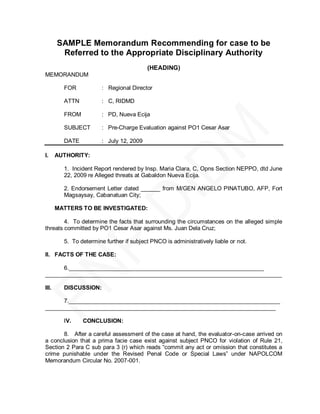


                                       RULE 19

                      FILING AND SERVICE OF PLEADINGS,
                          PROCESSES AND DECISIONS

       Section 1.    Filing of Pleadings. – The filing of pleadings by the parties shall
be made by presenting the original copies thereof to the concerned disciplinary
authority, IAS or Appellate Body or by sending them by registered mail with proof that
the other party was served with a copy.

       The date and time of the receipt shall be indicated on the face of the original
document and the receiving copies. In case the above-indicated documents where
sent by registered mail, the date and time of actual receipt shall be the time and date
of receipt as stamped on the envelope. The envelope is required to be attached to
the document as part of the record.

        Section 2.   Service of Subpoenas and Interlocutory Orders. – Subpoenas
and other interlocutory orders shall be served personally in the manner provided for
under Rule 18 hereof; Provided however, that if the complainant and / or respondent
is represented by counsel , service of orders to the counsel shall be deemed service
to his client.
Section 3.    Service of Final Orders/Decisions/Resolutions. – Final orders,
decisions, and resolutions shall be docketed after its release by the disciplinary
authority, IAS or Appellate Body and copies thereof shall be served upon the parties
personally or by registered mail.

      Section 4. Implementation of Final Orders/ Decisions, or Resolutions which
Have Become Final and Executory. – Final orders, decisions, or resolutions which
have become final and executory shall be referred to the PNP Regional Director or
his equivalent supervisor or the Director, Directorate for Personnel and Records
Management (DPRM) for implementation within five (5) days from receipt of the
request or order of the disciplinary authority or appellate body to implement the
same, copy furnished Director, PNP Finance Service; Directorate for Investigation
and Detective Management (DIDM); and the respondent’s unit assignment.


       Any PNP officer charged with the implementation of a Decision which has
become final and executory who fails to implement the same shall be liable for
serious neglect of duty.


                                       RULE 20

                                       APPEAL

        Section 1.    How appeal is taken; time of filing – Appeals from the decisions
of the disciplinary authority, Regional Appellate Board, National Appellate Board or
recommendation of IAS which ripened into a decision due to inaction by the
disciplinary authority, shall be taken by the party adversely affected by filing a notice
of appeal and furnishing a copy thereof to the other party and the appellate body,
with the deciding authority within ten (10) days from receipt of a copy of the decision.

       Section 2.    Notice of Appeal and Memorandum on Appeal. –

               (a) A Notice of Appeal shall be filed in three (3) legible copies which
shall contain the following:

                     1) the material dates showing that it was filed on time;

                     2) the assignment of the specific errors of fact or law, or both,
                        allegedly committed by the disciplinary authority; and

                     3) the specific appellate body to which the appeal is being
                     taken.
The appellant shall submit a Memorandum on Appeal in three (3)
legible copies not later than fifteen (15) days from the filing of the notice of appeal,
copy furnished the other party. However, the memorandum on appeal maybe
submitted upon filing the notice of appeal. Proof that copy of the memorandum on
appeal was served to the other party must be submitted by the appellant.

              (b) In all appealed cases, the title of the case shall remain as it was
before the disciplinary authority, but the party appealing the case shall be further
referred to as the appellant and the prevailing party as the appellee.

      Section 3.    Dismissal of the Appeal. – Failure of the appellant to comply with
the requirements provided in Sections 1 and 2 (a) of this Rule shall be sufficient
ground for the dismissal of the appeal.

       Section 4.    Transmittal of the Records. – Within fifteen (15) days from
receipt of the Notice of Appeal, the concerned disciplinary authority shall forward the
complete original records of the case to the appellate body, which shall be
systematically and chronologically arranged, paged and securely bound to prevent
loss of any piece of document thereof. The transmittal of the records shall be a
ministerial duty and failure to forward the same shall be a ground for administrative
action against the concerned official or personnel for serious neglect of duty.

       Section 5.    Docketing of Appealed Cases. – Upon receiving the complete
original records, which shall include the exhibits and transcript of stenographic notes
from the disciplinary authority, the appellate body shall immediately docket the same
by stamping the time and date or receipt on its cover, assigning the appellate the
case number and entering the same on the docket book which shall be purposely
maintained for appealed cases only.

       Section 6.    Period to Act on Appeal. – The Regional Appellate Board and
the National Appellate Board shall decide the appeal within the period of sixty (60)
days from receipt of the complete records of the case.

       Failure of the RAB to decide the appeal within sixty (60) days from receipt of
the case records shall render the decision of the disciplinary authority final without
prejudice to the filing of an appeal by the party adversely affected to the Secretary of
the Department of the Interior and Local Government.

       Should the RAB fail to decide the appeal within the reglementary period
provided in this Section, the concerned Board shall automatically make a written
explanation to the Commission En Banc on its failure to do so.
The Commission En Banc shall order the conduct of investigation against the
Chairman and the PNP representative of the concerned Board if it appears from the
explanation that an evident neglect of duty was committed by the Board.

       Section 7.   Withdrawal of Appeal. – At any time before the appellate body
renders its decision finally resolving the appeal, the appellant, as a matter of right,
can withdraw the same; which shall consequently, render the appealed decision final
and executory. No motion to reinstate the appeal shall be allowed.


                                        PART III

                  ADMINISTRATIVE OFFENSES AND PENALTIES

                                       RULE 21

                                      OFFENSES

      Section 1.    Offenses Punishable.       – The following are the offenses
punishable and defined as follows:

               1)     Neglect of Duty or Nonfeasance – is the omission or refusal,
without sufficient excuse, to perform an act or duty, which it was the peace officer’s
legal obligation to perform; implies a duty as well as its breach and the fact can never
be found in the absence of duty.

             2)   Irregularities in the Performance of Duty or Misfeasance – is the
improper performance of some act which might lawfully be done.

              3)      Misconduct or Malfeasance – is any wrongful, improper or
unlawful conduct motivated by premeditated, obstinate or intentional purpose. It
usually refers to transgression of some established and definite rule of action, where
no discretion is left except where necessity may demand; it does not necessarily
imply corruption or criminal intention.

                4)    Incompetence – is ignorance or the material lack of adequate
ability and fitness for the satisfactory performance of police duties. This refers to any
physical, intellectual, psychological and moral quality, the lack of which substantially
incapacitates a person to perform the duties of a police officer.

             5)     Oppression – imports an act of cruelty, severity, unlawful
exaction, domination, or excessive use of authority. The exercise of unlawful powers
or other means, in depriving an individual of his property or liberty against his will, is
generally an act of oppression.

              6)     Dishonesty – is the concealment or distortion of truth in a matter
of fact relevant to one’s office, or connected with the performance of his duties or
connected with the performance of his duties; and

              7)    Disloyalty to the Government – consists of the abandonment or
renunciation of one’s loyalty to the government of the Philippines, or advocating the
overthrow of the government, through overt and covert acts.

        Section 2.      Classification of Offenses. – For purposes of determining
jurisdiction and applying the appropriate penalty, administrative offenses are
classified into light, less grave and grave.


A. LIGHT OFFENSES:

       1) Simple Neglect of Duty – Shall include but not limited to the following:

             a)     fail to supervise, inspect and control subordinates directly under
his command as to their punctuality, attendance, prescribed attire, proper use and
maintenance of equipment, preparation and submission of reports, efficient
performance of their duties and responsibilities, and the observance of good order,
conduct, behavior and discipline;

                b)      fail to take corrective action by way of warning, advise,
admonition, suggestion or disciplinary action to subordinate, or to report such
conduct when such subordinate is committing or has already committed a dereliction,
irregularity or violation of departmental rules and regulations;

             c)     fail to order or cause the investigation of a subordinate reported
to him as absent without leave;

              d)     fail to disseminate any order, directive or instruction;

            e)      fail to coordinate or cooperate with other law enforcement
agencies and their personnel;

              f)     Absent oneself from office without having filed the necessary
application for leave or secured the approval of the superior officer for a period not
exceeding three (3) days in a month;

              g)     fail or refuse to give his name and badge number when properly
requested;
h)     fail to report upon declaration of alert levels;

               i)     fail to report on duty in prescribed uniforms with badge,
identification card, service firearm and other required equipment, except those not
required to wear the prescribed uniform by reason of the exigency of the service.

              j)    fail to keep an official appointment with a complainant, informer
or crime witnesses without lawful justification;

             k)    fail to submit a written report to his superior officer immediately
or within a reasonable time after accidental firing of his firearm, when time and
circumstances would permit;

           l)     fail to take custody of government issued property from a
member under his supervision who is suspended, separated, retired or dead;

             m)     fail to conduct within a reasonable period, proper, thorough and
complete investigation when assigned to do so;

             n)     fail to thoroughly search for, collect, preserve and identify
evidence in any arrest or investigation conducted by him;

              o)    fail to take proper custody, record, tag, and identify property
entrusted to him as evidence;

               p)     be delayed unnecessarily in attending to or in performing a duty;

               q)     fail to report to his superior officer his inability or incapability to
report for duty, attend a conference, general inspection, or participate in an operation;

               r)     delay or fail to respond to a call for assistance;

               s)     fail to inform his superior as to the result of action taken on a call
or dispatch;

             t)      fail to report to his superior officer a hazardous condition or
dangerous situation;

             u)      fail to prepare and submit properly written reports within the
prescribed period of time, if required by standing regulations;

              v)   fail to report to a new assignment within ten (10) days from the
order of reassignment without sufficient reason;

              w)     leave his post or beat before the end of tour of duty or leave
without the required turn over to the incoming duty personnel.
2) Simple Irregularity in the Performance of Duty - Shall include but not
limited to the following:

             a)    drive a marked police vehicle while not in prescribed uniform,
except those who are not required to do so by reason of the exigency of the service;

            b)      use siren and/or red blinker light while not responding to an
emergency or not in hot pursuit of a fleeing criminal or law violator;

              c)  malinger, loaf or consort with others while on duty or arrange
with another member to take his place during his tour of duty, without prior approval
of his superior;

            d)     allow unauthorized member of the PNP to drive marked or
unmarked police vehicles;

            e)      interfere or obstruct the work of other members or change the
assignment or tour of duty of subordinates not belonging to his unit/ offices;

             f)      arrange with another member to take his post or tour of duty
without superior’s approval.

       3. Slight or Simple Misconduct - Shall include but not limited to the
following:

                a)    fail to salute officials, dignitaries, superior officers and other
officials entitled thereto or the national colors during the playing of the national
anthem;

              b)    fight, threaten or quarrel with any member of the police force;
provided, that when the member being challenged or threatened is one of higher
rank, the charge shall be that of Grave Misconduct;

               c)    read newspaper, books or periodicals while in uniform or in
street duty;

            d)     be untidy or couth in his personal appearance and behave in an
ungentlemanly or undignified manner;

               e)    fail to recognize and satisfy any just debt;

              f)     engage in private business or practice his vocation or profession
during off duty hours without approval of proper authority;
g)        solicit attorneys, bondsmen or guarantors for arrested or
confined persons;

              h)     fail to be home or to be at the place of confinement without
legitimate reason after having been reported sick or suffering injuries;

                i)     use rude or insulting language or exhibit similar rudeness to the
public;

                j)      fail to report for record with the Complaint or Desk Officer a case
prior to its investigation;

              k)     allow or tolerate idlers, fixers or persons of questionable
character to stay or loiter in his office, post or place or assignment without any
legitimate reason or purpose;

              l)    fail to maintain cleanliness or orderliness in his office, premises,
post or surroundings;

              m)    use official forms, letterheads, seals and stamps privately or in
violation of protocol; provided, that when they are used for committing fraud or
dishonesty, the charge shall be Grave Misconduct;

             n)    be found to have the odor or smell of alcohol on his breath while
on duty, or processes alcoholic beverages on his person, police vehicle, post or
office;

             o)     make or conduct unauthorized solicitations of contributions from
subordinates or private persons.

B. LESS GRAVE OFFENSES:

          1) Less Grave Neglect of Duty – Shall include but not limited to the following:

             a)     Fail to execute lawful orders from higher authority or tolerate any
subordinate to ignore or ridicule any order, rule or regulation;

             b)      fail to make immediate correction or take appropriate action
when a dereliction, irregularity or violation of law or duty is being committed or has
been committed in his presence by a subordinate under his command, or fail to
report the same to his commanding officer within twenty-four (24) hours;

             c)      fail to prepare disciplinary or administrative complaint or take
such other disciplinary action as may be necessary against a subordinate under his
command who has committed a serious dereliction, violation or irregularity;
d)     fail to comply with any lawful order or instruction of a superior
officer or the Chief of Police;

               e)      fail to report immediately to his superior officer or to the Chief of
Police the injury, illness, death or escape of a prisoner who is under his custody;

               f)     fail to communicate to the Chief of Police, through channels, any
valuable information that will lead to the apprehension of a wanted person, or furnish
clues for the solution of a case, or for the recovery of stolen property;

             g)     fail to issue a Traffic Citation Ticket (TCT) or Temporary
Operator’s Permit (TOP) to an offending driver whose license is already confiscated;

             h)     fail to turn in the used of Traffic Citation Ticket or Temporary
Operator’s Permit together with the confiscated driver’s license at the end of his tour
of duty or within twenty-four (24) hours, or fail to account for the TCT’s or TOP’s
issued to and used by him;

            i)     fail to report as a peace officer any incident, condition or
occurrence witnessed by or reported to him which calls for immediate police action;

             j)    fail to properly patrol his beat, sector or post or to leave or
abandon the same without being properly relieved; fail to take appropriate action
concerning vice conditions in his beat and/or give written report of the same to his
superior;

                k)    fail to report to his superior officer, within a reasonable period,
injury inflicted by him to a person or animal, damage or loss of government property
while on or off duty;

              l)     fail to comply with the order of a court of competent jurisdiction;

             m)     willfully violate office regulations and/or refuse or neglect to
comply with said provisions;

              n)     sleep on his post while performing patrol or guard duty;

              o)     absent oneself from office without having filed the necessary
application leave or secured the approval of the superior officer for a period of more
than three (3) days but not exceeding fifteen (15) days.

       2) Less Grave Irregularities in the Performance of Duties – Shall include
but not limited to the following:
a)    apply for and serve a search or seizure warrant in any
establishment or private house without the knowledge or approval of the Chief of
Police or his superior officer;

            b)      use traffic violation traffic reports which are not duly validated by
the Land Transportation Office (LTO), the Metro Manila Development Authority
(MMDA), or city or municipal government;

              c)    use traffic violation reports duly validated by the LTO, MMDA, or
city/municipal government but are not issued to him for traffic enforcement work;

              d)   use the official insignia, markings and seal of the police force in
any privately owned vehicle, without the authority of the Chief of the Police/superior
officer;

              e)    disregard or violate traffic rules and regulations while driving a
police vehicle when not in hot pursuit and not responding to an emergency call.

       3) Less Grave Misconduct – Shall include but not limited to the following:

              a)     take advantage to his position by procuring goods and
commodities at a losing price to an unwilling seller, or partake of food, drinks and
cigarettes free of charge;

              b)     engage in regulated gambling or games of chance while on duty;

              c)      be drunk and disorderly while on off duty, or drunk while on duty
and in uniform or in recognizable uniform of the force;

               d)    maliciously intrigue against the honor of a co-officer, or indulge in
idle gossip or spread rumors that tend to discredit member;

              e)      exhibit marked discourtesy in the course of official duties or use
profane or insulting language to any superior officer;

              f)      serve as escort or security officer, whether on foot or by motor
vehicle, for any private individual regardless of his status in social or religious circles
on any occasion, unless authorized by the chief of police or the appropriate officials
authorized to do so;

              g)    take a trip abroad without approved leave and approval of the
authorities concerned;

              h)      borrow or solicit money or any valuable from his subordinates
unless the latter is engaged in the lending business.
C. GRAVE OFFENSES:

      1) Serious Neglect of Duty – Shall include but not limited to the following:

              a)     fail or refuse to take command in an emergency in order to carry
out police duty, being the officer present with the highest rank, grade or position;

              b)    fail to prevent or suppress the criminal act of a subordinate being
committed in his presence or fail to report the same to the Chief of Police within
twenty-four (24) hours after discovery;

               c)     fail to apprehend and/or arrest a person under circumstances
where it is his duty to do so;

             d)      fail to return personal effects of released prisoners or other
property used in evidence the release of which is ordered by a competent authority or
court;

              e)     fail to perform his assigned mission or fail to participate in an
operation for the security of the President, or other high ranking officials of the
Philippines or foreign heads of state;

               f)     fail to administer first aid when able and/or convey to the
hospitals, victims of traffic accidents, persons shot or stabbed, persons electrocuted
and other who are dying and in need of urgent medical or surgical attention;

             g)      fail to quell a disturbance or to protect a person from death or
injury when able to do so;

             h)     fail to help a brother peace officer in apprehending or arresting a
violator who resists, or in subduing one assaulting the arresting officer, or in
disarming an armed violator or in coming to the succor of another officer who is
wounded, injured or outnumbered;

              i)      fail to appear and testify in court, prosecutor’s office, the PNP
disciplinary authorities, appellate bodies, the IAS or any other quasi-judicial body
when duly notified or subpoenaed as witness. If his non-appearance resulted in the
dismissal of the case or the acquittal of the accused; or when he is the principle
witness or the arresting officer, the penalty of dismissal from the service shall be
imposed;

              j)     Absent oneself from the office without having filed the necessary
application for leave or secured approval of the authorized official for a period of
more than fifteen (15) days prior to the enjoyment of the leave.
2) Serious Irregularities in the Performance of Duties – Shall include but
not limited to the following:

              a)     act as a bodyguard or security guard for any public official or
candidate for any elective public office or position or any other person within three (3)
months immediately preceding any election and within one (1) month thereafter,
without authority from the Commission on Election;

           b)       acts as bodyguard or security guard for the person or property of
any public official, or private person unless approved by proper authorities
concerned;

            c)     reveal secret or confidential police matters and information which
jeopardize police mission and operations, or which cause injury or damage to
citizens;

             d)     Unauthorized establishment of checkpoints in any public
thoroughfare for the purpose of stopping or searching vehicles or persons or if
authorized does not comply with the Rules set by the PNP;

             e)    unauthorized escorting of any vehicle carrying highly dutiable or
taxable goods, merchandise, appliances or mechanism;

             f)    failure to turn over to the police station within a reasonable
period any apprehended or arrested person;

               g)    countermand any lawful order of the mayor, chief of police, or his
superior officer;

               h)    perform the duties and functions of customs or immigration
authorities without proper deputation in accordance with law;

              i)     escort or allow other members to escort detention prisoners
outside the jail in order to attend a funeral, visit a sick relative, or solicit a bond
without an order of the court or proper jurisdiction.

       3) Grave Misconduct – Shall include but not limited to the following:

              a)     maltreat or abuse any prisoner or detained person under his
custody;

              b)     receive for personal use of a fee, gift or other   valuable thing in
the course of official duties or in connection therewith when such      fee, gift or other
valuable thing is given by any person in the hope or expectation of     receiving a favor
or better treatment than that accorded to other persons, or             committing acts
punishable under the anti-graft laws;
c)     join a strike or refuse to report for duty in order to secure
changes in terms and conditions of his employment, or to oust the chief of police or
any other officer from office;

           d)     contract loans of money or other property from persons with
whom the PNP office has business relations;

              e)     solicit or accept directly or indirectly, any gift, gratuity, favor,
entertainment, loan or anything of monetary value which in the course of his official
duties or in connection with any operation being regulated by, or any transaction
which may be affected by the functions of his office. The propriety or impropriety of
the foregoing shall be determined by its value, kinship, or relationship between the
giver and receiver and the motivation. A thing of monetary value is one which is
evidently or materially excessive by its very nature;

             f)      directly or indirectly have financial and material interest in any
transaction requiring the approval of his office. Financial and material interest is
defined as pecuniary or proprietary interest by which a person will gain or lose
something;

              g)    own, control, manage or accept employment as officer,
employee, consultant, counsel, broker, agent, trustee, nominee in any private
enterprise regulated, supervised or licensed by his office, unless expressly allowed
by law;

              h)    publicly consort with women of ill repute and/or scandalously
cohabit with or maintain a wife other than his legitimate spouse;

               i)    fail or refuse to surrender or deposit his service firearm, badge,
identification card and police vehicle, if any, to his superior officer upon demand
during the period of suspension;

              j)     willful failure to pay just debts or obligation due to the
government;

              k)      appropriate for his or allow another person the beneficial use any
stolen property that is recovered, found or abandoned;

             l)     solicit money, valuable or favor for the amicable settlement of
cases under investigation;

               m)     engage directly or indirectly in partisan political activities or take
part in any election except to vote;
n)     deliberately or through gross negligence, destroy, damage or
lose government property entrusted to him for official use;

              o)     mutilate, deface or destroy any driver’s license, traffic citation
ticket or temporary operator’s permit issued in lieu thereof;

              p)     inflict physical injuries upon a suspect to force the latter to give a
confession;

             q)     act as a mediator or fixer for the return of any stolen vehicle or
property whether held for ransom or not; and

             r)    commit any act or omission that constitutes a crime punishable
under the Revised Penal Code or Special Laws.

        4) Oppression – Any member of the police force who shall abuse his authority
in a tyrannical, cruel and high-handed manner shall be guilty of Oppression.

        5) Gross Incompetence – When the offense or negligence is committed by
reason of manifest lack of adequate ability and fitness on the part of the respondent
member for the satisfactory performance of police duties, the erring member shall be
guilty of Gross Incompetence.

       6) Disloyalty to the Government – Any member of the PNP who shall
abandon or renounce his loyalty to the government of the Republic of the Philippines
or who shall advocate the overthrow of the government, through covert or overt acts,
shall be guilty of Disloyalty to the Government. He shall be punished with the
maximum penalty of dismissal from the service.

        7) Dishonesty – Any member of the police force who shall conceal, alter, or
distort the truth in a matter of fact relevant to his office, or connected with the
performance of his duties shall be guilty of Dishonesty. It shall include but not limited
to the following:

                  a) any member who shall knowingly enter in his Information Sheet
or CSC 212 Form, or in his Individual Police Profile, facts which are not true, or
conceal or distort material facts;

                b) makes a false report or entry in the police blotter or any
department record;

                  c) gives deliberate false testimony against or in favor of a person
facing a criminal or administrative charge;
d) destroy, conceal, or tamper physical evidence to be presented in
court or any office conducting an investigation by exchanging, altering, damaging or
diluting as to affect its original appearance, composition and content;

                   e) Intentionally provide the public with false information affecting
public interest.


                                         RULE 22

                                        PENALTIES

      Section 1.    Imposable Penalties. – The following are the penalties that may
be imposed in police administrative cases:
              a) Withholding of privileges


              b) Restriction of specified limits


              c) Restrictive custody


              d) Forfeiture of salary


              e) Suspension

              f) any combination of penalties under section 1, subparagraphs (a) to
                 (e)


              g) One (1) rank demotion


              h) Dismissal from the service
      Section 2.     Range of penalties. – The penalties for light, less grave and
grave offenses shall be made in accordance with the following ranges:

                                  For Light Offenses:

       1)     Withholding of privileges; restriction to specified limits; restrictive
custody, suspension or forfeiture of salary; or any combination thereof from one (1)
day to ten (10) days (minimum period);
2)     Withholding of privileges; restriction to specified limits; restrictive
custody, suspension or forfeiture of salary; or any combination thereof from eleven
(11) days to twenty (20) days (medium period);

      3)     Withholding of privileges; restriction to specified limits; restrictive
custody, suspension or forfeiture of salary; or any combination thereof from twenty
one (21) days to thirty (30) days (maximum period);

                              For Less Grave Offenses:

       1)     Withholding of privileges; restriction to specified limits; restrictive
custody, suspension or forfeiture of salary; or any combination thereof from thirty one
(31) days to forty (40) days (minimum period);

        2)     Withholding of privileges; restriction to specified limits; suspension or
forfeiture of salary; or any combination thereof from forty one (41) days to fifty (50)
days (medium period);

       3)      Withholding of privileges; restriction to specified limits; restrictive
custody; suspension or forfeiture of salary; or any combination thereof from fifty one
(51) days to fifty nine (59) days (maximum period);

                                 For Grave Offenses:

       1)     Sixty (60) days to Six (6) months suspension (minimum period);

       2)     One (1) rank demotion (medium period);

       3)     Dismissal from the service (maximum period).

       Section 3.   Limitation in the Imposition of Penalties. – In case of forfeiture of
salary the amount shall not exceed the equivalent of one (1) month salary.

        The penalty of ―Withholding of Privileges‖ shall be confined to deferment of
vacation leave privileges, participation in training grants or programs and such other
similar privileges normally enjoyed by civil service employees.

       Section 4.    Qualifying Circumstances. – In the determination of penalties to
be imposed, mitigating and aggravating circumstances attendant to the commission
of the offense/s shall be considered.

              a)     The following are mitigating circumstances:

                     1)     illness;

                     2)     good faith;
3)     length of service in the government;

                    4)     awards and commendations;

                    5)     analogous circumstances.

             b)     The following are aggravating circumstances:

                    1)     taking advantage of official position;

                    2)     taking undue advantage of subordinate;

                    3)     use of government property in the commission of
                           the offense;

                    4)     repeatedly charged;

                    5)     offense is committed during office hours and/or within the
                           premises of the government office or building;

                    6)     employment of fraudulent means to commit or conceal the
                           offense;

                    7)     intoxication;

                    8)     being a recidivist

                    9)     offense committed in consideration           of   a price or
                           reward;

                   10)     when the victim is        a   minor,     feeble   minded,   or
                           physically disabled;

                  11)      when offense is committed in cooperation with two (2) or

                           more persons;

                  12)      utilizing minor in the commission of the offense; and

                  13)      analogous circumstances.

       Section 5.   Guidelines in the Application of Penalties. – The imposition of the
penalty shall be made in accordance with the manner herein below provided:

              a)    Like penalties shall be imposed for like offenses and only one
penalty shall be imposed for each case. ―Each case” means one administrative case
which may involve one or more charges or counts.
b)    The minimum period of the penalty shall be imposed where only
mitigating and no aggravating circumstances are present.

              c)    The medium period of the penalty shall be imposed where no
mitigating and aggravating circumstances are present.

             d)    The maximum period of the penalty shall be imposed where only
aggravating and no mitigating circumstances are present.

               e)    Where aggravating and mitigating circumstances are present,
rule (b) shall be applied where there are more mitigating circumstances present; rule
(c) shall be applied where the circumstances equally off-set each other; rule (d) shall
be applied when there are more aggravating circumstances.

             f)     If the respondent is found guilty of two (2) or more charges or
counts, the penalty to be imposed should be that corresponding to the most serious
charge or count and the rest shall be considered as aggravating circumstances.

             g)     In the appreciation of any mitigating circumstance in favor of the
respondent or of any aggravating circumstance against him, the same must be
invoked or pleaded by the party concerned, otherwise, such circumstances shall not
be considered in the determination of the penalty to be imposed.

       Section 6.   Administrative Disability Inherent in Certain Penalties. – The
following are the administrative disabilities inherent in certain penalties:

               a)    The penalty of dismissal, which results in the separation of the
respondent from the service, shall carry with it that of cancellation of eligibility,
forfeiture of retirement benefits, and the disqualification for re-employment in the
government service;

              b)      The penalty of suspension, which consists in the temporary
separation or cessation of work of the respondent for the duration of the sanction,
shall carry with it that of disqualification for promotion and withholding of privileges
corresponding to the period of suspension.

             c)    The penalty of forfeiture of salary, which consists of an amount
not exceeding one (1) month salary, shall carry with it that of disqualification for
promotion corresponding to the period of the penalty imposed.
RULE 23

                          MISCELLANEOUS PROVISIONS

        Section 1.  Authority to Administer Oath. – In addition to the officials who,
under the existing laws, are authorized to administer oaths, officers designated to
conduct pre-charged evaluation and hearing officers of the Commission, PNP, IAS,
the Chairmen and members of the PLEB and Regional Appellate Boards have the
authority to administer oaths on matters connected with the performance of their
duties.

       Section 2.     Authority to Issue Subpoena Ad Testificandum and Subpoena
Duces Tecum. – The disciplinary authorities, IAS and their hearing officers shall have
the authority to issue subpoena ad testificandum and subpoena duces tecum.

        Section 3.    Monthly Report. – Within the first week of each month all
disciplinary authorities, IAS and appellate bodies are required to submit a report to
the regional office of the NAPOLCOM or the Commission en Banc, furnishing a copy
thereof their respective heads of office, indicating the following data/information:

             a)     List of newly filed / received or raffled cases, revived, reinstated
case, or cases transferred/reffered or re-raffled from other office /officers;

              b)     List if investigated, heard, resolved / decided, or pending cases;

               c)      List of cases transferred/ referred or re-raffled to other offices/
officers stating clearly the reason for such transfer /referral or re-raffle; and

               d)    List of cases with suspended proceedings stating clearly the
reason for its suspension.

      Section 4.    Effect of a Pending Case. – Pendency of an administrative case
before any of the administrative disciplinary authorities, IAS or appellate body shall
be a bar to promotion.

        Section 5.    Issuance of Clearance / Certification. – Any disciplinary authority,
IAS or appellate body or its authorized official upon written request and payment of
legal fee shall issue a clearance or certification indicating the pendency or non-
pendency of an administrative case against any PNP member. The request shall
contain the name of the requesting party, name of the police officer subject of the
verification and the purpose of the request.

      A disciplinary authority, IAS or appellate body shall not require personal
appearance of the police officer and other clearance or document from him or the
requesting party except for NAPOLCOM, PNP and IAS national offices which may
require clearances or certification from their lower units or offices.


                                       RULE 24

                             TRANSITORY PROVISIONS

       Section 1.    Repealing Clause. – Memorandum Circular Numbers 93-024,
96-010, 98-014, 99-006, 99-014, 2002-010, 2002-013 are repealed. All other
NAPOLCOM issuances or portions thereof inconsistent with this Memorandum
Circular are hereby superseded or modified accordingly.

       Section 2.    Application to Pending Cases. – These Rules shall apply to
pending cases with the different disciplinary authorities, appellate bodies and IAS,
Provided however, that the offenses and penalties reclassified under these Rules
shall have retroactive effect insofar as they are favorable to the respondent.

        Section 3.     Separability Clause – Any portion of this memorandum circular
inconsistent with the organic law or declared unconstitutional shall not affect the
validity of the other provisions.

        Section 4.     Effectivity Clause. – This Memorandum Circular shall be
effective after fifteen (15) days following the completion of its publication in at least
two (2) newspapers of general circulation nationwide.

       Issued this 6th day of March 2007 at Makati City.


                                   (Original signed)
                                  RONALD V PUNO
                                     Chairperson


                                 (Original signed)
                        LINDA L. MALENAB-HORNILLA
             OIC-Office of the Vice-Chairperson & Executive Officer


                                (Original signed)
                          CECELIA V. SANIDAD-LEONES
                                 Commissioner
(Original signed)     (Original signed)
MIGUEL G.CORONEL      OSCAR C. CALDERON
Commissioner            Commissioner

Attested by:

  (Original signed)
ADEMALYN A. MUTIEZA
Chief, Secretariat
Appendix “B”


                       Republic of the Philippines
               Department of the Interior and Local Government
                     NATIONAL POLICE COMMISSION
         NATIONAL HEADQUARTERS, PHILIPPINE NATIONAL POLICE
                       OFFICE OF THE CHIEF, PNP
                        Camp Crame, Quezon City

PNP MEMORANDUM CIRCULAR
NUMBER 2010-021                                        November 3, 2010


 DEFINING AND DELINEATING THE FUNCTIONS OF DIRECTORATES/OFFICES
 INVOLVED IN THE DISPOSITION OF ADMINISTRATIVE/DISCIPLINARY CASES
                    AGAINST MEMBERS OF THE PNP


I.    REFERENCES:

       a.      Sections 41 (b)(3) and 42, RA No. 6975, as amended by Sections 52
and 53, RA No. 8551;
       b.      Section 26, RA 6975;
       c.      NAPOLCOM Memorandum Circular (NMC) No. 2007-001 entitled:
―Uniform Rules of Procedure before the Administrative Disciplinary Authorities and
the Internal Affairs Service of the Philippine National Police‖;
       d.      Revised Uniform Rules in the Disposition of Administrative Cases in the
Civil Service (Revised URACCS [CSC Resolution No. 991936]);
       e.      Supreme Court Decisions on Administrative Cases; and
       f.      LOI Patnubay II.

II.   PURPOSE:

       This Circular aims to clearly define and delineate the functions of the different
Directorates and Offices involved in the disposition of information/reports and
administrative/disciplinary cases filed against members of the PNP to avoid
overlapping or duplication of functions and to improve coordination and feedback
mechanism with the end view of ensuring the expeditious administration of discipline
within PNP ranks without ignoring however, the basic requirements of due process of
law.
III.   SCOPE OF APPLICATION:

      This Circular shall apply to and govern the disposition of information/reports
and administrative complaints received or filed against uniformed and non-uniformed
personnel of the PNP.

IV.    DEFINITION OF TERMS:

       a.    Terms applicable to PNP Uniformed Personnel:

             1.     Appellate Authorities - refers to the Regional Appellate Board,
from decisions ordering the demotion or dismissal of the respondent rendered by the
Police Regional Directors or Equivalent Supervisors; The National Appellate Board,
from decisions rendered by the Chief, PNP ordering the demotion or dismissal of the
respondent; The Secretary of the Department of the Interior and Local Governments,
from decisions rendered by the NAB and RAB; and the Civil Service Commission, in
summary dismissal proceedings instituted before the National Police Commission en
banc.

             2.     Motion for Reconsideration - is an application submitted by the
respondent or the party adversely affected to the Disciplinary Authority to set aside or
modify the decision within ten (10) days from receipt of the copy of the decision
based on the following grounds:

                      2a.    Newly discovered evidence which if presented would
materially affect the decision rendered; and

                      2b.    Errors of law or irregularities have been committed
prejudicial to the substantial rights and interests of the movant.

              3.    Notice of Appeal - is a written notification filed by the
respondent or the party adversely affected with the Disciplinary Authority who
rendered the adverse decision that he/she is elevating the case on appeal to the
NAPOLCOM appellate board based on the grounds specified thereon and which
shall state the material dates showing the timeliness of the appeal. A copy of notice
of appeal should also be furnished to the other party and to the appellate body.

              4.    PNP Disciplinary Authorities - refer to the Chiefs of Police or
their equivalent supervisors; the Provincial Directors or their equivalent supervisors;
the Regional Directors or their equivalent supervisors; the Chief, PNP; and the
NAPOLCOM en banc.
5.    Pre-Charge Evaluation - is a process to determine the
existence of probable cause based on the allegations on the complaint and
supporting evidence.

                6.    Probable Cause - refers to the existence of such facts and
circumstances as would excite the belief, in a reasonable mind, acting on the facts
within the knowledge of investigating officer, that the PNP member complained of is
liable for the administrative offense for which he should be investigated.

              7.   Summary Dismissal Case - is one where the maximum
imposable penalty is dismissal from the service and the offense falls under the
following cases:


                    7a.    Where the charge is serious and the evidence of guilt is
strong;

                   7b.   When the respondent is a recidivist or has been
repeatedly charged and there are reasonable grounds to believe that he is guilty of
the charge;

                    7c.  When the respondent is guilty of a serious offense
involving conduct unbecoming of a police officer; and

                       7d.   When any member or officer has been absent without
official leave for continuous period of 30 days or more; Provided, that where dropping
from the rolls is resorted to as mode of separation from the service, the police officer
can no longer be charged for Serious Neglect of Duty arising from absence without
official leave (AWOL) and vice versa.

      b.     Terms applicable to PNP Non-Uniformed Personnel:

              1.  Finality of Decision – the decision against PNP Non-Uniformed
Personnel becomes final after the lapse of fifteen (15) working days without motion or
appeal filed.

              2.     Motion for Reconsideration - is an application submitted by the
respondent PNP Non-Uniformed Personnel or the party adversely affected to the
Disciplinary Authority to set aside or modify the decision based on:

                    2a.    Newly discovered evidence which materially affects the
decision rendered thereof;
2b.     The decision is not supported by evidence on record; and
                     2c.     Errors of law or irregularities committed prejudicial to the
substantial rights and interests of the movant.

              3.     Notice of Appeal - is a written notification filed by the
respondent PNP Non-Uniformed Personnel or the party adversely affected with the
Disciplinary Authority who rendered the adverse decision that he/she is elevating the
case on appeal to the Commission (Civil Service) proper based on the grounds
specified thereon and which shall state the material dates showing the timeliness of
the appeal.

             4.      Preliminary Investigation – it involves the ex-parte examination
of the records and documents submitted by the complainant and the person
complained of, as well as documents readily available from other government offices.
During the said investigation, the parties are given the opportunity to submit affidavits
and counter-affidavits.

                      Failure of the person complained of to submit his/her counter-
affidavit shall be considered as a waiver thereof.

                      Thereafter, if necessary, the parties may be summoned to a
conference where the investigator may propound clarificatory and other relevant
questions. Upon receipt of the counter-affidavit or comment under oath, the
disciplining authority may now determine whether a prima facie case exist to warrant
the issuance of a formal charge.

                    A fact-finding investigation may be conducted further or prior to
the preliminary investigation for the purpose of ascertaining the truth. A preliminary
investigation necessarily includes a fact-finding investigation.

               5.    Prima Facie Case – is a degree or quantum of proof greater
than probable cause. It denotes evidence which, if unexplained or uncontradicted, is
sufficient to sustain a prosecution or establish the facts, as to counterbalance the
presumption of innocence and warrant the conviction of the accused.

       c.     Common provisions:

             1.     Complaint – is a written and sworn statement regarding a
wrong, grievance or injury sustained by a person.
2.    Complaint Sheet – is an accomplished form of complaint written
in a clear, simple and concise language and in a systematic manner as to apprise the
respondent concerned of the nature and cause of the accusation against him/her and
to enable him/her to intelligently prepare his defense or answer. It shall contain
the full name and address of the complainant; full name and address of the person
complained of as well as his position and office of employment; narration of the
relevant and material facts which shows the acts or omissions allegedly committed by
the respondent; certified true copies of documentary evidence and affidavits of
complainant’s witnesses, if any; and certification or statement of non-forum shopping.

              3.    Charge Sheet – is a written information containing specific
allegation of every facts and circumstances necessary to constitute the offense
charged.

              4.     Decision - is the written disposition of the case signed by the
Disciplining Authority stating clearly the findings of facts and the provisions of the law,
applicable rules and regulations.

             5.     Information/Reports – pieces of information, reports received or
gathered including, among others, accounts from the tri-media, text messages, and
other sources.

            6.   Nominal Complainant – the one who initiates a complaint
against any member of the PNP representing the Disciplinary Authorities as active
prosecutor.

           7.      Private Complainant – the one who initiates a complaint against
any member of the PNP acting as complaining witness/es.

             8.     Proof of Service - is evidence submitted by a process server
that he/she has furnished the parties to an administrative case, particularly the
respondent, of the decision or resolution rendered by the Disciplinary Authority.

           9.      Public Complainant – the one who initiates a complaint against
any member of the PNP as concerned government agency or office.

             10.    Respondent – refer to any PNP personnel who were formally
charged by the Disciplinary Authority.

           11.    Sensational Case – refers to a widely-publicized case involving
PNP personnel as shown and heard either in print media or broadcast media (i.e.
radio, television, internet and others) arousing or intended to arouse strong curiosity,
interest, or reaction, especially by exaggerated or lurid details.

             12.    Summary Hearing Officer or Board - is the designated
representative/s of the Disciplinary Authority who is tasked to hear, conduct the
necessary proceedings, receive and evaluate the evidence presented and prepare
the appropriate report for reconsideration by the Disciplinary Authority.

                13.  Summary       Administrative Proceedings     – refers to
administrative proceeding conducted consistent with due process to determine the
culpability or innocence of the respondent.

              14.   Venue - the administrative complaints or cases against any PNP
member shall be filed before the Disciplinary Authority or IAS having territorial
jurisdiction where the offense was committed, except citizen’s complaints falling
under Rule 3 Section 1 (d) of NAPOLCOM Memorandum Circular No. 2007-001.

V.    DELINEATION OF FUNCTIONS:

      a.     The DIDM or RIDMD or its equivalent office in the NSU shall:

               1.   Initiate investigation and evaluation of information/reports,
particularly on sensational cases involving PNP personnel and involving Third Level
Officers (PSSUPT and above) in close coordination with the IAS/RIAS.

             2.    Receive and act on all complaints against PNP personnel and
conduct pre-charge evaluation as warranted in accordance with Rules 13 and 14,
NMC No. 2007-001 and Rule II of the Revised URACCS.

              3.     Initiate the filing of corresponding administrative case against
personnel who committed acts or omissions punishable by the Revised Penal Code
and Special Laws as provided in Section 2, Paragraph C (3) (r), Rule 21 of
NAPOLCOM Memorandum Circular No. 2007-001, and shall be the repository of
records on criminal cases filed against all personnel.

             4.   In case probable cause is established, transmit the complete
records of the case to the DPRM or its counterpart in the PROs or NSUs for
Summary Hearing. In cases when PCE was conducted by the DIDM itself, venue of
the summary hearing must be indicated in the PCE report.
5.      Recommend appropriate actions such as issuance of preventive
suspension, restrictive custody or filing of criminal cases in court against the erring
PNP personnel.

              6.      Actively prosecute administrative cases forwarded to the DPRM
or RPHRDD or its counterpart in the PROs or NSUs especially those grave and
sensational in nature before the Summary Hearing Officer by appearing for the
prosecution in all stages of summary administrative procedure.


             7.      Supervise all Court Process Officer [CPO] who shall be
responsible for the service of notices, subpoenas and other legal processes and
ensure timely delivery of such process to the parties concerned.

             8.    Initiate appellate actions for and in behalf of the PNP on any
adverse decision rendered by an appellate body such as the RAB, NAB, SILG, and
CSC.

             9.     Perform other functions as may be required.

      b.     The DPRM or RPHRDD or its equivalent office in the NSU shall:

               1.     Upon receipt of the pre-charge evaluation report and the
complete records of the complaint, the DPRM or its equivalent Office in the PROs
and NSUs shall enter the case into its official docket by stamping on the face of the
report or complaint the time and date of receipt and assign an administrative case
number to it. The PCE docket number shall not be omitted for monitoring purposes.
The DPRM or its equivalent Office in the PROs and NSUs shall inform the DIDM or
its equivalent Office in the PROs and NSUs of the pending cases, as well as the PNP
Unit where the respondent is assigned.

              2.    Ensure the timely disposition of cases through summary
administrative proceedings and monitor the progress of each case. If warranted, call
the attention of the SHO concerned to resolve his/her designated case within the
prescribed period.

            3.    Report SHOs who failed to resolve their designated cases
beyond prescribed period without any justifiable reasons and submit same to the
DLOD or counterpart for PCE.

             4.    Transmit the report of summary hearing to the Disciplinary
Authority concerned, along with complete records of the case.
5.     Resolve Motions for Reconsideration or Appeal, as the case may
be and submit recommendation to the Disciplinary Authority. A copy of the MR or
Appeal be furnished the DIDM for comment or opposition before resolving the same.

              6.   Furnish the offices concerned with a copy of the order
implementing the decision and require these offices to submit report of action taken
on the said order.

             7.     Initiate and dispose termination of case/s against PNP personnel
in temporary appointment status.

              8.     Maintain a pool of qualified SHO and conduct appropriate
training on quarterly basis in order to develop their skills in the conduct of summary
hearing as well as refresh their knowledge on amended or newly issued laws, rules,
regulations, and current Supreme Court jurisprudence pertaining to administrative
cases.

             9.     Serve as repository of records and implementer of the decisions
rendered by the Disciplinary Authority.

              10.    Issue Clearance of Non-Pending Case to PNP personnel
applying for: leave abroad; UN mission; personal loan; promotion; transfer to other
units; retirement, and resignation. The Clearance shall also be issued to any public or
private personality requesting to verify, when deemed appropriate, the good standing
of any PNP personnel on records that is subject for scrutiny.

               11.    Ensure efficient discharge of above function through formulation
of detailed or specific policy and procedures for the purpose in accordance with NMC
2007-001, Revised URACCS and other issuances.

            12.    Act as repository of all administrative cases involving PNP
personnel and perform other functions as may be required.

      c.     The NHQ or Regional Internal Affairs Service shall:

             1.   Initiate necessary investigation on cases in the exercise of its
motu proprio mandate.

             2.      Investigate complaints and gather evidence in support of an
open investigation in coordination with the DIDM/RIDMD.

              3.    Conduct     summary     hearing    on   PNP     members     facing
administrative charges.
4.    Submit a periodic report on the assessment, analysis and
evaluation of the character and behavior of PNP personnel and units to the Chief,
PNP and the Commission.

              5.   File appropriate criminal cases against PNP members before the
court as evidence warrants and assist in the prosecution of the case. .

              6.    Provide assistance to the Office of the Ombudsman in cases
involving the personnel of the PNP.

       d.    The NHQ or PRO Legal Service or Legal Officer, NSU shall:

              1.    Act on referrals made by the DPRM or RPHRDD or its equivalent
office in the NSU regarding the draft decisions prepared by the designated SHOs
only on matters involving the application of laws, rules and regulations.

          2.     Act on referrals or instructions made by the members of the
Command Group or the Disciplinary Authority concerned.

             3.     Perform other functions as may be required.

VI.    REPEALING CLAUSE:

      All PNP issuances which are contrary to or inconsistent with this Circular are
hereby amended or repealed accordingly.

VII.   EFFECTIVITY:

       This Circular takes effect fifteen (15) days from the date of filing with a copy
thereof with the University of the Philippines Law Center pursuant to Sections 3 and 4
of Chapter 2, Book VII of EO 292, otherwise known as the Administrative Code of
1987.


                                         (Original signed)
                                         ATTY RAUL M BACALZO, Ph.D.
                                         Police Director General
                                         Chief, PNP

DLOD/TOBIAS/ACDLOD/BALIGNASAYSHS/ODIVER/101110
Desktop/PNP MC _____/nupgeneschap-as
                               “To Serve and Protect."
                                                                    ISO 9001 : 2008
                                                                   CERTIFICATE NUMBER AJA10/AN/1452
Appendix “C”

                       Republic of the Philippines
              Department of the Interior and Local Government
                     NATIONAL POLICE COMMISSION
         NATIONAL HEADQUARTERS PHILIPPINE NATIONAL POLICE
                       OFFICE OF THE CHIEF, PNP
                        Camp Crame, Quezon City

                                January 16, 2008

                          MEMORANDUM CIRCULAR
                            NUMBER 2008-0116

          POLICY AND GUIDELINES ON GRIEVANCE MECHANISM
                  FOR PNP UNIFORMED PERSONNEL

   I.       REFERENCES:

            a. NAPOLCOM Memorandum Circular No. 93-022 dated November 4,
               1993 Entitled: ―Establishing a Complaint and Grievance Mechanism
               for PNP Uniformed Personnel‖;

            b. Civil Service Commission Resolution No. 010113 dated January 10,
               2001and implemented through CSC Memorandum Circular NO. 02,
               s. 2001, and

            c. PNP Integrity Development Review Action Plan

   II.      SCOPE:

              The Grievance Mechanism set forth in this policy and guidelines
shall cover all matters that give rise to PNP uniformed personnel dissatisfaction
and discontentment which include but are not limited to the following:

            a. Wrongful or non-implementation and/or violation of policies and
               procedures which affect PNP uniformed personnel from recruitment
               and/or      appointment       to    promotion, transfer,  detail/
               designation/assignment/placement, termination, dismissal, and
               other related issues that affect them:

            b. Wrongful or non-implementation and/or violation of policies and
               procedures on economic and financial issues and other terms and
               conditions of employment fixed by law including salaries, incentives,
               working hours, leave benefits, and other related terms and
               conditions.

            c. Physical working conditions; and
d. Interpersonal relationships and linkages

However, the following cases shall not be acted upon through the grievance
mechanism:

       a. Disciplinary cases which shall be resolved pursuant to the Uniform
          Rules on Administrative Cases;

       b. Complainants on official actions of Head of Offices pertaining to the
          exercise of disciplinary powers under the provisions of RA 6975
          where specific procedures for relief through appeal are hereby
          already provided;

       c. An objection to the terms or provisions of a policy, procedure and
          regulations;

       d. Sexual harassment cases as provided for in RA 7877, and

       e. Anonymous grievances and/or complaints.

III.   PURPOSE:

       This policy and guidelines prescribed the procedures for the hearing
and resolution of grievances and/or complaints filed by a PNP uniformed
personnel or group and the composition of grievance committees at the
different levels of offices in the PNP organization in order to have an efficient
and effective process that is fair to all parties and to help every committee
hear decide grievance in a manner that increases the likelihood that its
decision will be upheld, the roles of the committee chair and members,
complaint, respondent, and observers shall be defined.

       The establishment of this grievance mechanism intends to achieve the
following objectives:

       a. To provide a system for the promotion of wholesome and
          harmonious relationships between and among employees and
          supervisors in the PNP organization;

       b. To encourage PNP members to exercise their rights in presenting
          grievance and have them fairly, equitably expeditiously adjudicated
          thus preventing discontentment and dissatisfaction among them.

       c. To discover interpersonal problems of employees and find ways in
          resolve them within the ambit of this policy and guidelines., and

       d. To improve employee morale through management response to the
          needs of personnel and employees and vice versa.
IV.    DEFINITION OF TERMS:
      a. Grievance – means an employee’s expressed (written or spoken)
         feelings of discontentment and dissatisfaction on any or all of the
         matters or issues enumerated in section II. For intents and purposes,
         grievance has only reached Stage 1 of the procedures, the Oral
         Discussions.

      b. Complaint – refers to a grievance in writing which has , in the first
         instance and in the employee’s opinion, had been ignored,
         overridden or dropped without due consideration at the lowest level
         of the office where the complainant as assigned and has been
         lodged or elevated to the next level of office.

      c. Grievance Procedure – refers to the method prescribed in this policy
         and guidelines to resolve a grievance and/or complaint.

      d. Modes of Setting disputes:

             1. Conciliation – process whereby a third party (conciliator)
                brings the parties together, encourages them to discuss their
                differences and assists them in developing their own
                proposed solutions.

             2. Mediation – a process whereby a third party (mediator) is
                more active assisting the parties reach acceptable solutions
                to the problem/s and helps the disputing parties develop or
                come out with an acceptable solution. The mediator can even
                submit his own proposal/s for the settlement of disputes.

             3. Arbitration – a process whereby a third party who may be an
                individual arbitration, a heard of arbitrators of an arbitration
                could, is empowered to render decision which disposes of the
                dispute an his binding on both parties.

      (i)    Voluntary – a method of settling dispute/s by submitting the
             ‖disputed facts‖ before an arbitrator or panel of arbitrators
             chosen by both parties. The voluntary arbitrators shall be render
             a decision alter proper hearing of the issues. Yhe decisions of
             the arbitrator shall be final and binding on the contending parties.

      (ii)   Compulsory - a method of setting disputes which have become
             hardened and irreconcilable and remains unresolved after
             exhausting all available remedies and exploring all avenues for a
             peaceful settlement of the dispute under existing laws and
             procedures. For PNP Uniformed Personnel, a grievance may be
             elevated to the Civil Service Regional Office concerned only
             upon issuance of a Certification on the Final Action on
             Grievance(CFAG) issued by the grievance committee.
e. Levels of appointment - 1st – from PO1 to SPO1 Inspector to Police
               Superintendent 3 rd from Police Senior Superintendent under to
               Police Director General.

            f. Group – members of the PNP organization acting as complainants
               who are considered to have the locus standi or are party in interest
               to a grievance and/or complaint.

            g. Association – an organization of uniform and non unformed
               personnel having a common interest. It does not partake of a labor
               union.

      V.    PRINCIPLES AND POLICIES

            The following shall be the guidelines in the conduct of the grievance
and/or complaint proceeding

            a. Employees, individual or group, shall have the right to present their
               grievance(s) and/or complaint(s) to the management and have them
               settled as expeditiously as possible in the best interest of the
               employee or group concerned, the PNP organization, and the
               government as a whole;

            b. The complainant/aggrieved party shall first discuss his problem(s)
               with his immediate supervisor before considering the filling of a
               formal written complaint;

            c. The employee/subordinate presenting a grievance and/or complaint
               shall be assured freedom from coercion, discrimination, harassment
               or reprisal;

            d. Grievance(s) shall be settled al the lowest possible level of office.

            e. The grievance proceedings shall be aimed at determining ―What is
               right and Not ―who is right‖

            f. The right to appeal action/decision on grievance and/or complaint
               shall not be curtailed;

            g. Grievance and/or complaint concerning promotion shall be given the
               due course. However the party aggrieved may elect to proceed
               either under the procedure or pursuant to any other applicable
               law/regulations;

            h. All proceeding shall be treated as confidential;
            i. Grievance proceedings shall not be bound by formal legal rules and
               technicalities.
j.   The service of the legal counsel for the parties in this dispute shall
           not be allowed during the hearing. The grievance committee
           however shall have a legal officer as member to guide the chair and
           the member on issues and procedures.

      k. In no case shall member of the PNP ventilate their grievance, direct
         to any forum outside of the PNP organization; and

      l.   Supervisors and/or Head of Offices who refuse to take action on a
           grievance shall be liable for neglect of duty in accordance with
           existing civil service law, rules, regulations. At the instance of the
           complainant or the PNP, any personnel who shall be found violating
           the prescribed guidelines and procedures in violating or expressing
           complaints and/or grievances shall be held administratively liable
           and shall be meted with appropriate sanction.

VI.   PROCEDURES:

      a. Initiating and/or Filing a Grievance

      STAGE 1:

       Oral Discussion – a grievance shall be initially presented by the
personnel orally to the complainant’s direct supervisor or Head of the
Office as the case may be where the complainant/s is assigned, which will be
considered the 1st level of office or venue. The supervisors or the Head of the
Office shall take the following actions:

              (i)     Discuss with the complainant/aggrieved party his/her
                      complaint in private;

              (ii)    Keep the complainant/aggrieved party at ease and
                      encourage him to talk freely;

              (iii)   Refrain from expressing his/her views and opinions until
                      after the complainant or aggrieved party has given or
                      explained his/her side;

              (iv)    At the end of discussion, the direct supervisor or Head of
                      Office must state his/her stand clearly, accurately, and
                      without any display of affection or ill feeling towards the
                      employee/subordinate. He/She may not immediately give
                      a definite decision but shall inform orally the
                      employee/subordinate of his/her decision within three (3)
                      days from the date of presentation.
STAGE II:

                         1. Grievance in Writing – If the grievance is not settled at
                 the lowest level of office, the complainant shall submit his/her
                 grievance in writing to the Head of Office, who shall personally
                 decide on the matter or form an ad hoc Grievance Committee to
                 hear the issue and give its recommendation from which the Head of
                 Office will decide and inform the complainant of his/her decision in
                 writing within five (5) days from date of receipt of the committee’s
                 recommendation through the direct supervisor/superior(of the
                 complainant) if the complainant is not satisfied with the decision, the
                 Head of Office shall forward the written complaint with his comments
                 to the next level Head of Office within 48 hours. The succeeding
                 Head of Office shall follow the prescription at the lower level of
                 office. If the grievance reaches the Office where the Grievance
                 Committee is organized {PRO, NCRPO, NSU, National Office, PNP
                 NHQ}, the Head of Office may forthwith within fifteen (15) days
                 decide the case or refer it to the Grievance Committee.

      At the Police Regional Office (PRO) – NCRPO excluded – the Police station
(PS); City Police Station (CPS); Provincial Mobile Groups; Companies of the
Regional Mobile Groups (RMG); and Police Stations of City Police Offices (CPO) are
considered the lowest level offices. A grievance emanating from a group shall be
presented through the following scheme:

Members assigned at different offices       Grievance Presented to:
Within:
City Police Office                          City Director
Police Provincial Office                    Provincial Director
Regional Mobile Group                       Group Director
Police Regional Office                      Regional Director

        At the National Support Unit (NASU/NOSU), the regional office is considered
the lowest level of office. As to grievance and/or complaint presented by a group
which members are assigned at the different regional offices within a NSU, it shall be
first presented to the Director, NSU.

       At NCRPO, the Numbered Precincts of CPS, and the CPS without numbered
precincts are the lowest level of offices. A grievance emanating from a group shall be
presented through the following scheme:

Members assigned at different offices       Grievance Presented to;
Within
CPS with numbered precincts                 Chief of Police, CPS
NCRPO                                       Regional Director
At the NHQ Directorate, the Division is the lowest level of offices. As to
grievance presented by a group which members are assigned at the different
divisions within a Directorial Staff, it shall be first presented to the Director of the
Directorate concerned. If the grievance emanates from a group which members are
assigned at the different Directorial Staff, it shall be presented to the C, PNP

     Where the object of the grievance is the Grievance Committee, the
complainant shall present the grievance to next level Head of Office.

       As the grievance presented by a group which members are assigned in the
different offices of the PNP organization (PROs/NSUs/Directorates) and the
implication of which transcends the offices where they are assigned, it shall be
presented to the C, PNP.


Grievance Resolution Flow Chart
                                                Oral Discussion         Grievance in Writing
                         Respondent                   with                 Submitted to:

                                                Direct of higher         1st Level Head of
   Individual or             Peer                 supervisor                   Office
      Group
   Complainant         Direct of higher      1st Level Head of Office    2nd Level Head of
                           supervisor                                          Office
                       1st Level Head of       2nd Level Head of         3rd Level Head of
                       Office/Grievance             Office                     Office
                           Committee


                                                                        CSC Regional Office


              2. Activation of the Grievance Committee – upon the referral of the
                 appropriate Head of Office of a grievance and/or complaint to the
                 Grievance Committee.

              (i)       Initial meeting of the Committee

       The work of the Committee begins with an initial meeting of committee
members convened by the Chairman. The Chairman shall conduct a brief orientation
to ensure that the members of the committee have receive the grievance, that they
are familiar with the grievance procedures and that no member has no any conflict of
the interest that would prevent him/her from serving in the Grievance Committee.
After the orientation, the Committee’s task is to review the grievance to determine
whether it is to go forward or be dismissed.
(ii)       The Pre-hearing Conference

       The purpose of pre-hearing conference is to discuss the procedures that will
be followed in hearing the grievance. It also gives the committee the opportunity to
review the grievance, to resolved any jurisdiction issue, and to handle any question of
potential conflict of interest that may have been identified and remained unresolved.

             (iii)      The Grievance Hearing

      The purpose of the grievance hearing is to provide the complainant and
respondent the opportunity to present their respective evidence, points, and
arguments to the committee. The hearing is composed of four discrete segments: 1)
opening statements of each party; 2) presentation of the complainant’s case; 3)
presentation of the respondent’s case; and 4) closing arguments of each party.

             (iv)       Deliberations

       The Committee deliberations take place in closed session after the hearing
has been recessed. The deliberative phase allows the committee to discuss all the
issues that have been raised during the hearing and evidence presented by each
party in support of their respective case or in rebuttal to the case presented by the
other party. Conflicting the evidence is evaluated and the committee determines
which facts have been proven. The facts are then applied to the issued and the
committee determines what recommendations it should make regarding the
grievance.

             (v)        Writing the Decision

       The written report of the Committee’s decision must set forth the committee’s
findings and recommendations. Specifically, ―the report shall state a separate finding
for each particular issue of the grievance, shall make findings that resolved the
material issues of fact of that have been disputed, address any minority views, and
provide a recommendation for disposition of the grievance.‖ The Committee’s report
shall contain sufficient information to permit the Head of Office/unit understand t he
issue in the grievance, the facts as determined by the committee based upon the
credible evidence submitted by the parties during the grievance hearing, and the
rationale for the committee’s decision and recommendations.

             (vi)       The Official Record

       The Chairman is responsible for transmitting the record of the proceeding
along with the Committee’s final report and recommendations to the Head of
Office/Unit. The official record of a grievance hearing consists of ―all correspondence
pertaining to the grievance and every item, piece of information, document and
exhibit that was either submitted to or given consideration by the Committee, along
with transcript of the hearing. All information relevant to the committee’s procedural
rulings, factual findings, recommendations, and any other aspects of its final report
shall be included in the Official Record.‖
The Committee will determine the most appropriate manner to proceed with
the case. Options include the examination of written evidence, a hearing, or further
investigation, if needed. When a hearing is scheduled, the following guidelines serve
to protect the rights of both parties and to assure the fairness of the process:

             -   The Chairman shall schedule a hearing after giving notice to the
                 parties concerned within five(5) days upon the activation of the
                 committee;

             -   The respondent shall receive a copy of the complainants written
                 statement in advance of the first meeting of the Committee;

             -   Both parties shall received notice of the time and place of the
                 hearing in order to prepare for the hearing;

             -   Both parties have the right to be present when the case is heard;

             -   Both parties have the right to question all witnesses;

             -   All members of the committee shall be present during the hearings
                 and all proceedings shall be recorded;

             -     The complainant/aggrieved party shall be given not more than
                 three(3) days for an oral exposition of his grievance/s and to present
                 witness/es and evidence/s to support his allegations. He shall not be
                 allowed to dwell on aspects not covered by his written grievance/s.

             -   The respondent shall be allowed three (3) days within whichto
                 express his side, present witness/es on his behalf, and submit
                 evidence/s;

             -   The Grievance Committee may invite or subpoena any official or
                 employee of the PNP to clarify or shed light on certain matters
                 covered by or related to the grievance; and,

             -   Upon termination of the hearing, the Grievance Committee shall
                 immediately deliberate and decide without delay or adjournment and
                 submits its findings and recommendations to Head of Office/Unit not
                 later than three (3) days after the investigation.

             -   The Head of Office/Unit upon receipt of the records of the
                 proceedings submitted by the committee shall render his decision in
                 writing within three (3) days. Simultaneously, a copy of the records
                 of the proceeding including the certification on the Final Action on
                 Grievance (CFAG) issued by the Grievance Committee and the
                 decision rendered by the Head of Office shall be furnished to the
                 complainant. The CFAG shall contain, among others, the history
                 and final action taken by the agency on the grievance. The decision
of the Head of Office shall take effect immediately unless
                   appealed/referred within 15 days to the CSC Regional Office
                   concerned.

              STAGE III:

              Referral to the CSC Regional Office

        If the complainant is still not satisfied with recommendation of the Grievance
Committee that became the basis of the decision of the 3 rd level Head of Office, at
the instance of the complainant, the case shall be then referred within 15 days to the
Civil Services Regional Office concerned reckoning from the issuance of a
certification on the Final Action On Grievance (CFAG) by the Grievance Committee.

              b. Roles of the Participants to a Grievance Hearing

        The grievance process is initiated by any member or group of thePNP
organization who must file a written appeal or position with the head of office or unit if
he/she is not satisfied with prior decisions relative to his/her grievance. The written
petition must provide the following information:

              (i)        Name of the Complainant;
              (ii)       Rank;
              (iii)      Designation (if needed);
              (iv)       Present Section or Division of Assignment;
              (v)        Immediate Supervisor;
              (vi)       Present Department or Unit of Assignment;
              (vii)      Higher Supervisor;
              (viii)     Nature of Grievance;
              (ix)       Settlement Desired;
              (x)        Signature of Complainant;
              (xi)       Signature of Association Official/Representative
                         (if applicable); and
              (xii)      Date of Filing from the Lowest Level in the Agency.

        1. The complainant must follow certain preliminary steps as pre-requisite to
the formation of the grievance committee. No grievance may be entertained unless
earlier attempts to resolve the grievance with his/her immediate superior and the next
higher officer or supervisor were without success. The matter must also be within the
scope of the grievance procedure the complainant bears the burden of establishing
the grounds for the grievance and the burden of proving by a preponderance of the
evidence grounds for the grievance. A preponderance of evidence id defined as that
evidence which when fairly considered produce the stronger impression and is more
convincing as to the truth when weighed against other opposing evidence.
Preponderance of evidence is not determined by the number of witnesses or the
quantity of documentation but rather by the greater weight of all the evidence when
considering the opportunity for knowledge, the information possessed and the
manner of testifying. If the complainant does not follow the pre-requisite burden of
proof, the committee may dismiss the grievance.

             2. The Respondent

        A grievance may be brought against a superior, supervisor, or a colleague
(referred to as the ―respondent‖) for any action or omission adversely affecting an
individual’s professionals or personal capacity, standing, or position. Once the
grievance committee is constituted to hear the grievance, the respondent is provided
the opportunity to respond in writing to the grievance. The response joins the issue
and other with the grievance statement outlines the respective issues in dispute
between the two parties.

             3. Observers

       The grievance procedure permits each party to have a third party observer
who may attend the pre-hearing and hearing. An observer has no active role in the
process and is not allowed to advise a party during the hearing. As observer may be
a member of the organization, an association, a friend or relative, or an attorney. The
grievance procedure, has no limitations on who may an observer. Under the
grievance procedure, attorney’s for the parties have no active role in the process. If a
party is represented by an attorney, the attorney may attend the hearing but may do
so only in the capacity of an observer/attorney may provide advice to a party, prepare
correspondence and other documents for a party, and may be present during the
proceedings so long as their presence does not disrupt the hearing process.

             4. The Grievance Committee

                             (i)        Composition

        Only permanent officials and employees, whenever applicable, shall be
appointed or elected as members of the grievance. In the appointment or election of
the committee members, their integrity, probity, sincerity, and credibility shall be
considered. At all levels of office, the Chief of Personnel Office shall be designated
as the Chairman. Depending on the office level, the Division/section Chiefs or their
equivalent positions as committee members are chosen from among the different
division’s/section’s chiefs by themselves, while members from the rank-and-file of two
years and chosen through a general assembly or any other mode selections be
conducted for the purpose; one each from the three levels (1 st, 2nd and 3rd) of
appointment who shall participate in the resolution of the grievance of personnel with
his/her corresponding level. However, in case where the grievance is against one of
the members of the committee, the person who garnered the second highest votes
shall sit as alternate of the of the member being complained of, and in case where
the chairman is the subject of the grievance, any of the members of the Command
Group starting from the Chief of the Directorial Staff or its equivalent at any level of
office concerned shall act as the chairman.
PNP NHQ

      The Director for Personnel and Records Management              - Chairman
      Two (2) from the Directorial Staff                             - Members
      Director, Legal Service                                        - Member
      Rank and file                                                  - Member

             PRO

      Chief, RPHRDD                                                  - Chairman
      Two (2) Division Chiefs                                        - Member
      Chief, Regional Legal Services                                 - Member
      Rank and file                                                  - Member

             National Support Unit

      Chief, Personnel Division                                      - Chairman
      Two (2) Division Chiefs                                        - Member
      Legal Officer                                                  - Member
      Rank and file                                                  - Member

             Lower Level of Office

Ad hoc Committee (equivalent personalities as above)

              The Head of Office of any given level of Office shall ensure equal
opportunity for men and women to be responded in the grievance committee.

              The personnel section/division of the PNP office/unit shall extend
secretariat services to the grievance committee.

                             (ii)       Role of the Committee and its Members

        The grievance committee is a hearing body with the delegated authority to
hear grievances. The committee’s role is to determine whether or not the grievance
presents a matter that is within the purview of the grievance mechanism, and if so, to
hear the grievance. The Committee is responsible for making written findings of facts
and recommendations with regard to the grievance. A grievance committee has no
power to reverse the Head of Office’s decision. Its authority is only to recommend a
reassessment of the decision if it finds that the decision was reached improperly on
unfairly.

       The grievance committee acts as the agent of the PNP organization at the
different levels of Command to hear grievances brought by a complainant and
recommend by the Head of Office appropriate action appertaining to the grievance.
As a result of their delegated authority, members of the committee must at all times
maintain a neutral status vis-à-vis the parties to the grievance. Indeed, as a matter of
due process, committee member’s conduct or attitude in serving the grievance
committee. To be a fair and impartial decision maker, a committee member should
keep an open mind and not presume that either party to the grievance is right or
wrong.

       The Committee’s role is to make a decision based on the evidence presented
by each party. To maintain appropriate neutrality and to accord due process to both
complainant and respondent, ex parte communications on matters of substance
related to the grievance must never take place between the committee and a
complainant and/or respondent. (Ex parte communications are those that involve only
one party without the presence or knowledge of the other party.) Neither the
Committee Chairman nor Committee members may solicit or hear evidence sans the
presence of both parties, and all communications (oral) between any of the
contending parties and the chairman or committee members must take place in
scheduled meetings where in both parties have been informed through any form of
correspondence and given the opportunity to be present. Pursuant to this Grievance
Procedure, Committee members shall have the following responsibilities:


         (i)       Attend the orientation meeting, pre-conference hearing, and all
                   scheduled hearing dates;

         (ii)      Make preliminary determinations whether or not the complainant
                   has presented a matter within the purview of the grievance
                   mechanism, and if not, whether or not the complainant should be
                   dismissed at once;

         (iii)      Carefully listen and review all testimony and documentary
                   evidence presented during the hearing;

         (iv)      Weigh the credibility of evidence , make specific findings of fact,
                   and determine whether the complainant has established the
                   charges; and;

         (v)       Assist the chairman in finalizing the written report of the
                   committee’s decision submitting a minority report if necessary.

       Every grievance committee shall develop and implement pro-active measures
that would prevent grievance, such as employee assembly which shall be c onducted
at least once every quarter, ―talakayan‖ counseling HRD interventions and other
similar activities.

       Every grievance committee shall establish its own internal procedures and
strategies . Membership in the grievance committee shall be considered part of the
members regular duties.

      The Grievance Committees (PRO, NSU National Office and PNP NHQ) shall
submit a report of their respective accomplishments and status report of pending
cases quarterly to the concerned Civil Service Regional Office and the PNP Resident
Ombudsman.

       The personnel section/division in collaboration with the PNP office’s/unit’s
grievance committee shall conduct a continuing information drive on grievance
mechanism among its officials and employees.

             5. The Grievance Committee Chairman

      The Grievance Committee Chairman has the following responsibilities:

             (i) Convene and chair all meetings of the committee and the grievance
             hearings

             (ii) Provides information to the committee and participants about the
             grievance and grievance process;

             (iii)Handle all logistics related to the grievance process (arrange for
             recording and/or transcriptions of the hearing, counsel for the
             committee, conference rooms for the hearing, etc)

             (iv) Schedule committee meeting and grievance hearings and notify
             parties, committee members and committee counsel of location and
             dates (the first date not later than four weeks after receipt of the
             respondent’s response):

             (v) Exercises complete control over all stages of the hearing process;

             (vi) Draft all correspondence in behalf of the committee;

             (vii) Forward to the Office of Legal Services amended grievances and
             notices of all scheduled meetings;

             (viii) Ensure the timely and orderly process of the grievances and
             notices of all scheduled meetings;

             (ix) Instruct the committee on jurisdictional and other related matters
             and make all procedural rulings (including number of witnesses who
             may be called by a party, the length of each party’s presentation, the
             admissibility of evidence, etc.)

             (x) Keep a record of all meetings held and communications and
             correspondence with the parties and members of the committee;

             (xi) Prepare and submit a written report of the committee’s findings and
             recommendations to the Head of Office or Unit;
(xii)       Compile the Official record and transmit the record and Committee’s
               decision as specified in the procedure; and

   (xiii)      Convene and chair any meetings or hearing required by a remand of
               the grievance.

               6. The Grievance Committee Counsel

       The Committee shall have a legal counsel who comes from the Legal Service
to advise the committee on procedural matters related to the grievance. In the
absence of a Legal Service Officer especially at lower units, the Chairman of the
Committee shall make arrangement for the assignment of a committee c ounsel who
shall be present at all stages of the process , including committee deliberations.

        VII.   Effectivity

               This Memorandum Circular shall take effect upon approval.


                                                    AVELINO L RAZON
                                                    Police Director General
                                                    Chief, PNP


“When I hear, I forget; When I see, I remember; When I do, I understand.”
                                                         Confucius

Pnp pre charge evaluation and summary hearing guide

  • 1.
    PHILIPPINE NATIONAL POLICEMANUAL PNPM – DIDM – DS – 9 – 3 PNP PRE - CHARGE EVALUATION and SUMMARY HEARING GUIDE (PNP Internal Discipline Mechanism) 2011
  • 2.
    PNP PRE -CHARGE EVALUATION and SUMMARY HEARING GUIDE (PNP Internal Discipline Mechanism) 2011 Published by: Directorate for Investigation and Detective Management Philippine National Police
  • 3.
    COPYRIGHT PAGE PNP Pre-ChargeEvaluation and Summary Hearing Guide (PNP Disciplinary Mechanism) 2011 Copyright 2011. Printed by: PNP Directorate for Investigation and Detective Management 2011 All rights reserved. This publication may not be reproduced, in whole or in part, in any form or by any means electronic or mechanical or by any information storage and retrieval system now known or hereafter invented, without prior written permission of The Director, PNP Directorate for Investigation and Detective Management with postal address at DIDM Office, 2 nd Flr., NHQ Bldg., Camp Crame, Quezon City. Telephone Nos. (632) 724-8773; (632) 724-8767. Infringement of the copyright protection law and the provisions expressed here under Intellectual Property Rights Law of the Philippines. “To teach is to touch lives forever.” (Anonymous)
  • 4.
    Republic of thePhilippines DEPARTMENT OF THE INTERIOR AND LOCAL GOVERNMENT (Kagawaran ng Interyor at Pamahalaang Lokal) Kamuning, Quezon City Message Discipline is one of the key factors that make any organization succeed. But to instill discipline the leader must carry the burden of administering sanctions against those who refuse to comply or obey the rules and the authority. The publication by the Philippine National Police of the Pre-Charge Evaluation and Summary Hearing Guide (PNP Internal Discipline Mechanism) therefore comes as an appropriate response to His Excellency President Benigno S Aquino III’s call to join him in transforming our government into one that is credible and truly works for the welfare of our people. This Guide is definitely one of the PNP’s most important tool in helping the appointed PNP disciplinary authorities administer sanctions against erring PNP personnel who fail to abide by the rules and regulation of the PNP. More importantly this will help raise the competence of our police pre-charge evaluators and summary hearing officers who are tasked to keep the PNP Disciplinary Mechanism running and expedite the resolution of administrative cases involving both the uniformed and non-uniformed personnel. Congratulations to the PNP and more particularly to the staff of the Directorate for Investigation and Detective Management (DIDM) for this ground-breaking endeavor. It is my pleasure to assure you that the Department of the Interior and Local Government will continue to support your undertakings. More power. Mabuhay kayong lahat! ORIGINAL SIGNED JESSE M ROBREDO DILG Secretary
  • 5.
    HEADQUARTERS Philippine National Police OFFICE OF THE CHIEF PNP NHQ PNP Building, Camp Crame, Quezon City Manila, Philippines MESSAGE The challenge of our times is to propagate the reform and transform agenda into real action, tangible results that can be seen and felt by our stakeholders and our community as a whole. One area where this can be done with certainty and reliability is in the processes that we apply to our internal operations, in particular, the disciplinary measures that we must necessarily impose on those who depart from the norm of our service. I welcome the speedy publication of the Pre-Charge Evaluation and Summary Hearing Guide (PNP Internal Discipline Mechanism) not only for its timeliness and usefulness, but equally important, for its affirmation of the sincerity and the seriousness of our intent to see the PNP Integrated Transformation Program all the way through. Congratulations are in order for the DIDM personnel who collaborated with the DPRM and IAS counterparts to craft this ground-breaking guide. The Guide that has been produced is a prime example of how much more can be done with teamwork. All officers are encouraged to take this Guide to heart, and let its spirit shape a more responsive Internal Discipline process that satisfies both the demands of our service and the expectations of those whom we serve. Mabuhay ang PNP! ATTY RAUL M BACALZ O, PhD Polic e Director General Chief , PNP
  • 6.
    HEADQUARTERS Philippine National Police DIRECTORATE FOR INVESTIGATION AND DETECTIVE MANAGEMENT NHQ PNP Building, Camp Crame, Quezon City Manila, Philippines Message It is indeed a privilege on my part being The Director for Investigation and Detective Management (TDIDM) to have the opportunity to publish another DIDM manual, the PNP Pre-Charge Evaluation and Summary Hearing Guide (PNP Internal Discipline Mechanism). I would like to congratulate the DIDM Technical Working Group particularly POLICE CHIEF SUPERINTENDENT ALEX PAUL I. MONTEAGUDO, Deputy Director, DIDM for providing the much needed direction and guidance in the consolidation of all the materials and the final crafting of this Guide. As we all know, actions taken within the parameters of PNP laws, rules and regulations at the outset of an investigation of any particular complaint against erring policemen can play a pivotal role in the full resolution of a case. While the realization of bringing justice to the victims and their family is the DIDM’s main goal, it is equally important for DIDM to help instill discipline within the ranks and insuring transparent investigation of all disciplinary cases being handled. This Directorate had taken drastic steps through the help of DPRM and IAS to craft a guide based on NAPOLCOM Memorandum Circular 2007-001 that will help the pre-charge evaluators and summary hearing officers conduct the processes more efficiently and effectively. In the simplest manner this guide sets the step-by-step procedures in a manner that will be easily understood by any police officer who may be tasked to evaluate or hear a case and therefore help ensure the expeditious resolution of administrative cases. Maraming Salamat po. PDIR ARTURO G CACDAC JR, CEO VI The Director for Investigation and Detective Management
  • 7.
    TECHNICAL WORKING GROUP PNP Pre-Charge Evaluation and Summary Hearing Guide (PNP Internal Discipline Mechanism) 2011 DIDM POLICE DIRECTOR ARTUROG G. CACDAC, JR - Director, DIDM POL CHIEF SUPT ALEX PAUL I. MONTEAGUDO - Deputy Director, DIDM POL CHIEF SUPT RICARDO C. MARQUEZ - Executive Officer, DIDM PSSUPT RICARDO DC ZAPATA JR - Chief, CMD, DIDM PSSUPT KEITH ERNALD L. SINGIAN - Chief, SIDD, DIDM PSSUPT JUANITA S. NEBRAN - Chief, PCEID, DIDM PSUPT MARLON M. GANZON - Chief, BFO, DIDM PSUPT Atty ISAGANI S. AGUAS(ret) - PCEID, DIDM Ms PATRICIA CANTERO - OCPNP IAS POLICE DIRECTOR ATTY IFOR I. MAGBANUA - Acting IG, IAS Atty MISAEL RAYMUNDO C. DINSAY - Chief, Spcl Action Cntr, IAS Atty MICHAEL DARWIN M. BAYOTAS - Acting Legal Asst, IAS DPRM POLICE DIRECTOR JAIME E. MILLA - Director, DPRM PSSUPT BARTOLOME C. TOBIAS - Chief, DLOD, DPRM “For God so loved the world that he gave his only begotten Son that whosoever believes in him should not perish but have everlasting life.” (John 3:16)
  • 8.
    ACKNOWLEDGEMENT The crafting of this PNP Pre-Charge Evaluation and Summary Hearing Guide (PNP Internal Discipline Mechanism) required a lot of patience, research and collective effort. It involved the conversion of a lot of legal parlance into layman’s language so that the guide would be more easily understood by the users. The enforcement of sanctions against erring personnel is one of the most serious responsibilities of any designated Chief of Police or appointed Disciplinary Authority. But since very few officers are familiar with the provisions of the NAPOLCOM Memo Circ 2007- 001 or the URACCS (Uniform Rules on Administrative Cases in the Civil Service), some would even opt not to initiate the proceedings. Furthermore, there are very few officers with the training or competence to evaluate a complaint and even less PCO’s who can conduct a summary hearing with authority. However, necessity being the mother of invention, the DIDM identified the deficiency and crafted this innovative Guide to address the need. The publication of this Guide was made possible by the dedication of the DIDM Technical Working Group (TWG) particularly PCSUPT ALEX PAUL I. MONTEAGUDO, Deputy Director, DIDM, who provided the direction and guidance in the consolidation of all the needed materials, and personally supervised and edited the final crafting of this Guide. It is also noteworthy to recognize the assistance and support extended by PSUPT Atty. ISAGANI S. AGUAS (ret) of DIDM who shared his legal knowledge and experience, PSSUPT BARTOLOME C. TOBIAS, Chief, Discipline, Law and Order Division (DLOD), Directorate for Personnel and Records Management (DPRM) and the Internal Affairs Service (IAS) under PDir IFOR I. MAGBANUA for their contribution to the content and organization of this manual. Acknowledgement must also be given to the members of PNP Aviation Security Group Technical Working Group (TWG) who, under the guidance of the then DDA, PSSUPT MONTEAGUDO, first conceptualized the crafting of the first-ever PCE and SHO Guide which became the template for this DIDM Manual. These are: PSUPT JEANNE B PANISAN, PCINSP ALMEL S MANGANDOG, PCINSP JONATHAN T GALANG, PCINSP ALEX P LIM, and PCINSP JULIE A CABRERA. Finally, we acknowledge the support of our foreign partner, the European Union- Philippine Justice Support Program (EPJUST) thru Mr. DETLEV MEHLIS, Team Leader and Mr. BO ASTROM, Senior Police Key Expert, for their invaluable help in providing the funding assistance for the printing of this manual. “I can do all things through Christ who gives me strength….” (Philippians 4:13)
  • 9.
    Table of Contents Page I. INTRODUCTION How to Use This Guide II. PRE-CHARGE EVALUATION GUIDE Complaint Pre-Charge Evaluation Approval by the Disciplinary Authority Personnel Section Action Flowchart Sample Forms Complaint Sheet Affidavit of Complaint Certificate of Non-Forum Shopping PCE Memo Recommending Case be Closed and/or Dropped PCE Memo Referral to the Appropriate Disciplinary Authority PCE Memo Recommending Summary Hearing Charge Sheet Memo to Disciplinary Authority re Pre-Charge Evaluation Memo to a PNP Complainant re PCE Result Letter to a Private Complainant re PCE Result Letter to PNP Personnel Being Complained of III. SUMMARY HEARING GUIDE Initial Action of SHO Pre-Hearing Conference Hearing Proper Report of Investigation/Resolution Summary Administrative Proceedings Flowchart Sample Forms Summons Answer Notice of Pre-Hearing Conference SHO’s Script for Pre-Hearing Conference Agreement to Dispense Hearing Proper Certificate of Readiness Minutes of Pre-Hearing Conference SHO’s Script for Hearing Proper Minutes of the Hearing Proper Position Paper Report of Investigation/Resolution by the SHO (Exoneration) Report of Investigation/Resolution by the SHO (Guilty) Draft Decision (Exoneration) Draft Decision (Guilty verdict)
  • 10.
    Page III. APPENDICES Appendix ―A‖ - NAPOLCOM Memorandum Circular No. 2007-001 re: Uniform Rules of Procedure Before the Administrative Disciplinary Authorities and the Internal Affairs Service of the Philippine National Police Appendix ―B‖ - PNP Memorandum Circular No. 2010-021 re: Defining and Delineating the Functions of Directorates/Offices Involved in the Disposition of Administrative/Disciplinary Cases Against Members of the PNP Appendix ―C‖ - PNP Memorandum Circular No. 2008-0116 re: Policy and Guidelines on Grievance Mechanism for PNP Uniformed Personnel “ Education does not mean teaching people to know what they do not know; it means teaching them to behave as they do not behave.” (John Ruskin)
  • 11.
    I. INTRODUCTION “Whoever lovesinstructions loves knowledge, but he who hates corrections is stupid.” (Proverbs 12:1)
  • 12.
    I. Introduction The Philippine National Police is mandated to investigate all forms of crime with the ultimate objective of giving justice to the victims and bringing the perpetrators to the bar of justice. Hence, the PNP is a vital and indispensable institution of the Criminal Justice System. It is in effect a guardian of justice. But what if a guardian of justice intentionally skews the investigation to favour the suspects for any consideration? Or, what if by their sheer incompetence or laziness or negligence the investigation is bungled? Who will hold them accountable? Que custodiet, custodias? or Who will guard the guardians? The PNP has instituted several mechanisms to ensure that fidelity by its members to laws and regulations is ensured. One of the primary mechanisms which covers internal discipline is provided under NAPOLCOM Memo Circular 2007-001 re Rules of Procedures Before the Administrative Disciplinary Authorities and the Internal Affairs Service of the Philippine National Police. This Memo Circular provides the rules and procedures and the scale of penalties to be imposed upon any member of the PNP who commits breach of discipline or becomes a subject of an administrative complaint. The memo also provides that the Internal Affairs Service (IAS) shall conduct, motu proprio, automatic investigation of the following cases: a) incidents where a police personnel discharges a firearm; b) incidents where death, serious physical injury, or any violation of human rights occurred in the conduct of a police operation; c) incidents where evidence was compromised, tampered with, obliterated, or lost while in the custody of police personnel; d) incidents where a suspect in the custody of the police was seriously injured; and, e) incidents where the established rules of engagement have been violated. However, there have been several factors which have hampered the effective implementation of this Memo Circular. This PNP Pre-Charge Evaluation and Summary Hearing Guide (PNP Internal Discipline Mechanism) therefore, is intended to address two of the major factors that have hampered the effectiveness of the internal discipline mechanism: the lack of familiarity by the majority of the appointed Chiefs of Police or equivalent supervisors and other PNP Disciplinary Authorities on how to exercise their disciplinary authority; and the lack and/or inadequacy of
  • 13.
    training of thedesignated Pre-Charge Evaluators as well as the Summary Hearing Officers (SHO) to systematically and expeditiously resolve administrative cases. This Guide is intended for the use of the Pre-Charge Evaluators, Summary Hearing Officers, the Chiefs of Police or other equivalent disciplinary authorities, and the IAS. Hence, this guide includes, among others, flowcharts to visually aid the users in implementing the process, and a simplified step-by-step scheduled procedure which shall be followed from the time a report of infraction or complaint is received by the office of the disciplinary authority or the IAS which has jurisdiction over the respondent, up to the action of the Personnel Section and the issuance of Certificate of Finality. This Guide also contains sample forms and formats of the different reports, memoranda, letters, summons, resolutions, certificates of service, affidavits and other documents which the Pre-Charge Evaluator and the Summary Hearing Officer may have to prepare or use in the course of the process. This guide also includes a script in the conduct of the Pre-Hearing Conference and Hearing Proper to provide the Summary Hearing Officer a more authoritative, methodical and sequential system of presiding over the conference and hearing. Also included in this Guide are copies of the following: PNP MC No. 2008- 0116 re: Policy Guidelines on Grievance Mechanism for PNP Uniformed Personnel; PNP MC No. 2010-021 re Defining and Delineating the Functions of Directorates/Offices Involved in the Disposition of Administrative/Disciplinary Cases Against Members of the PNP which provides among others the guidelines in the handling of cases involving NUPs; and, NAPOLCOM Memo Circ No. 2007-001, re Rules of Procedures Before the Administrative Disciplinary Authorities and the Internal Affairs Service of the Philippine National Police, as the main reference material. It is hoped that with this guide, which was painstakingly prepared by the DIDM with the support of the DPRM and IAS, and through the guidance of PCSUPT ALEX PAUL I. MONTEAGUDO, Deputy Director, DIDM, we shall have provided a clear, usable and effective guide which in turn will ensure that the designated PNP Disciplinary Authorities will be better equipped to exercise their dis ciplinary powers and resolve administrative cases of their personnel more expeditiously while assuring that the rights of respondents and complainants are protected in the best interest of justice.
  • 14.
    How to UseThis Guide This Guide has been presented in the simplest manner to make it ―user friendly‖. At the outset, it is important to mention that this PCE and SH Guide is based mainly on the provisions of NAPOLCOM Memorandum Circular 2007-001. Majority of the cases that are referred to the PNP disciplinary authorities involve breach of discipline, citizen’s complaints against uniformed personnel, and IAS- initiated investigations. On the procedure concerning complaints against uniformed PNP personnel or investigation initiated by the IAS, all that the disciplinary authority, pre-charge evaluators and summary hearing officers have to do is follow the step-by- step guide and the instructions as contained therein. If possible, the user should refer to the flowcharts every so often to visualize the procedures. It will also be noted that, as far as practicable, the specific Section of NPC MC 2007-001 which is the basis for the procedure is indicated to aid the user should he want further clarification on the matter. There are also “Notes” to remind the user on matters of importance. Also, the schedule or number of days allotted for each activity is included in both the flowcharts and the instructions. It is important that the user adhere to this schedule to ensure that the case is expeditiously resolved within the prescribed period. For complaints against NUPs, the procedure is almost the same except for a few provisions. Among the most notable difference are: 1) based on the URACCS (Uniform Rules on Administrative Cases in the Civil Service), instead of a pre-charge evaluation, a Preliminary Investigation shall be conducted when the person being complained of is an NUP; 2) instead of probable cause as required in a PCE, the requirement is a prima facie case; and, 3) the grace period before finality of decision is 15 days not 10 days if it was a case involving uniformed PNP personnel. To ensure adherence to procedures, the designated PCE/Preliminary Investigators and SHOs should also familiarize themselves with the provisions of PNP Memo Circ 2010-021, a copy of which is provided in the Appendix. There is no separate flowchart for cases involving NUPs as the process is basically the same. A copy of NAPOLCOM Memo Circ 2007-001 is also provided in this guide as a ready reference and in case there are matters which the user would like to be clarified about, such as the appropriate Offenses and Penalties and such other issues as may arise. Finally, it is recommended that the evaluators and SHO refer to the sample forms, especially the sample scripts for the SHO in the conduct of pre-hearing conference and summary hearing proper, as these will most definitely help him
  • 15.
    conduct the proceedingsmore effectively and authoritatively. The sample forms will also help the user prepare the reports required. “To learn, you must want to be taught.” (Proverbs 12:1)
  • 16.
    II. PRE-CHARGE EVALUATION GUIDE “Men learn while they teach.” (Lucius Annaeus Seneca)
  • 17.
    II. PRE-CHARGE EVALUATIONGUIDE Complaint “An administrative complaint may be initiated by filing a written and sworn statement before any disciplinary authority, or the IAS accompanied by affidavits of witnesses, if any, and other evidence in support thereof.” (Sec 1 Rule 13 of NAPOLCOM Memorandum Circular 2007-001). 1. Upon receipt of the complaint or report from either a private complainant or the personnel’s immediate supervisor or the concerned office, the Office of Disciplinary Authority/IAS shall immediately refer the complaint to his Inspectorate or Chief, Investigation, as the case may be, and direct him to assist the complainant to reduce the complaint into an Affidavit duly subscribed or notarized. (refer to Sample Complaint Sheet page 26 and Sample Affidavit of Complaint page 28) Note: #1 Who may subscribe the Affidavit of Complaint? a. For PNP Uniformed Personnel — Officials of the Commission who are appointed by the President, as well as officers of the PNP from rank of Inspector to Senior Superintendent, shall have the power to administer oaths on matters which are connected with the performance of their official duties. (Section 50 of RA 6975 as amended) b. For Civilian – PCOs of the Pre Charge evaluation/investigation offices pursuant to Section 50 of RA 6975 as amended, or a notary public or any person authorized to administer oath. Note: #2 The Chief, Investigation/Pre-Charge Evaluator shall have three (3) days to evaluate the complaint, exclusive of the 5-day period to file the Certificate of Non-Forum Shopping and/or investigation and validation (Sec 2, Rule 14, NPC MC 2007-001). He shall maintain two (2) copies of all the documents of the PCE, and once approved, he shall retain one (1) copy at the office of the Inspectorate/Chief, Investigation, while one (1) copy shall be forwarded to Personnel or Admin Section of the concerned office. 2. The Chief, Investigation shall immediately determine if the person being complained about is within the administrative jurisdiction of the Disciplinary Authority/local IAS. If the person being complained about is outside or not within
  • 18.
    the administrative jurisdictionof the disciplinary authority/local IAS, the complaint shall be referred to the office of the concerned Disciplinary Authority/IAS. 3. If the person being complained about is within the administrative jurisdiction of the Disciplinary Authority/local IAS, the Chief, Invest shall undertake any of the following: a. If the complaint is a verbal/personal complaint from a Walk-in Complainant, the Chief, Investigation shall assist in reducing the complaint into an affidavit, or require the complainant to submit an Affidavit of Complaint along with affidavits of witnesses and other evidence. The Chief, Invest shall likewise require from the complainant a Certificate of Non- Forum Shopping which shall be a requirement before the pre-charge evaluation can be conducted; Note: The Certificate of Non-Forum Shopping shall be required to be submitted by the complainant within five (5) days from notice, otherwise, the complaint shall be dismissed. (Sec 1 para 2, Rule 13 NAPOLCOM MC 2007-001). However, the Insp/Chief, Investigation shall inform the complainant of the dismissal of said complaint. (refer to Sample Certificate of Non-Forum Shopping page 30) b. If the complaint is a Letter-Complaint, the Chief, Invest shall contact or notify the complainant thru a letter or other official means and require him/her to affirm his/her signature, and to further require to execute and submit (or assist him in submitting) an Affidavit of Complaint and a Certificate of Non-Forum Shopping; c. If the complainant in the letter-complaint fails to submit an affidavit, the letter-complaint shall be treated similar to an anonymous complaint which shall be investigated and validated; d. If the complaint is from an Anonymous Complainant, the Chief, Invest shall within five (5) days investigate, validate and gather evidence on the matter being complained about as a basis to determine the validity of the complaint; (Sec 1d, Rule 13 NPC MC 2007-001) e. If after the investigation and validation, the material allegations in the Anonymous Complaint are not validated, the complaint shall be recommended for outright dismissal; f. However, if after the investigation and validation the material allegations in the anonymous complaint are validated, the Inspectorate/Chief, Investigation, now acting as the Nominal Complainant, shall issue a Certificate of Non-Forum Shopping and subsequently have the Pre- Charge Evaluation conducted.
  • 19.
    Pre-Charge Evaluation “Pre-charge Evaluation is a process to determine the existence of probable cause based on the allegations on the complaint and supporting evidence.” (Sec. 1, Rule 14 of NAPOLCOM Memorandum Circular No 2007-001) 4. The Chief, Invest shall designate from among his personnel or officers the pre- charge evaluator or he himself may evaluate, as the case may be. 5. The Pre-Charge Evaluator shall ensure that the reporter/complainant has submitted his affidavit as well as other documents, affidavits of witnesses and other evidence; or, if it is an anonymous letter, the complaint must be accompanied by a copy of the Investigation Report. Note: The complaint affidavit shall be accompanied by a Certificate of Non- forum Shopping duly subscribed and sworn to by the complainant. If the complaint is not accompanied by Certificate of Non-Forum Shopping, the complainant shall be required to submit the same within five (5) days from notice; otherwise the complaint shall be dismissed. (Sec 1 para2, Rule 13 of NAPOLCOM Memorandum Circular 2007-001) 6. The Pre-Charge Evaluator shall assign a docket number to the complaint filed and shall be recorded into the docket book exclusively for the purpose. 7. Upon receipt of the affidavit of complaint and the certificate of non-forum shopping, or the Investigation Report and its validating evidence as the case may be, the Pre-Charge Evaluator will review/evaluate the case within three (3) days. The Pre-Charge Evaluator will determine whether it shall be recommended for any of the following: (Sec 3, Rule 13 of NAPOLCOM Memorandum Circular 2007-001). a. Closed and/or dropped for lack of probable cause; Note: Any recommendation by the pre-charge evaluator closing and/or dropping an administrative complaint for lack of probable cause shall in all cases be approved by the Chief, Invest or the Chief, Prosecution Division of IAS. (refer to Sample PCE ―Dropped or Closed‖ page 31) b. Referred to the appropriate disciplinary authority; If the pre-charge evaluation determines that the offense for which the respondent is liable for is beyond the jurisdiction of the Disciplinary Authority, the case shall be elevated to the appropriate office through a memorandum. (refer to Sample PCE ―Referred to Appropriate Authority‖ page 33)
  • 20.
    c. Treated asa grievance/request for assistance which may be referred to the concerned office or government agency; d. Recommended for Summary Hearing; If the pre-charge evaluation finds that probable cause exists which warrants the conduct of summary hearing, (Sec 3, Rule 13 of NAPOLCOM MC 2007-001) the Chief, Investigation shall submit a memorandum for the approval of the concerned Disciplinary Authority or Chief/Head of the local IAS recommending the offense for which the person being complained of shall be indicted. Once approved, the Chief, Investigation shall prepare the Charge Sheet which shall become part of the case folder and which shall be forwarded to Personnel/Admin Section or to the designated IAS Summary Hearing Officer for the conduct of summary hearing. (refer to Sample PCE “Recommendation for Summary Hearing” page 35 and Sample Charge Sheet page 38) Note #1. The recommendation or result of the Pre-Charge Evaluation shall be in memorandum format and it should be approved by the concerned disciplinary authority or Chief of the local IAS. Note #2. Refer to Rule 21 of NAPOLCOM Memo Circular 2007-001 for an enumeration of the OFFENSES administratively punishable and their respective classifications. Note#3. In case of PCE conducted by DIDM, the venue of summary hearing must be indicated in the PCE Report pursuant to PNP Memo Circular No. 2010-021 dtd Nov 3, 2010. Approval by Disciplinary Authority 8. With the concurrence of the DIDM/RIDMD or Chief, Investigation Section the recommendation of the Pre-Charge Evaluator shall be endorsed, thru a memorandum, with the report of evaluation to the Disciplinary Authority or the chief of the local IAS requesting for the latter’s approval. 9. Once approved by the disciplinary authority, the Chief, Investigation Section shall, within three (3) days, prepare a memo or letter addressed to the complainant informing the party of the result of the evaluation and the approval by the disciplinary authority in consonance with Section 5 (a) of RA 6713, otherwise known as the Code of Conduct and Ethical Standards for Public Officials: “Act promptly on letters and requests. - All public officials and employees shall, within fifteen (15) working days from receipt thereof, respond to letters, telegrams or
  • 21.
    other means ofcommunications sent by the public. The reply must contain the action taken on the request.” (refer to Sample Memo and Letter to Complainant pages 39-40) Note: Simultaneously (within 3 days), the Chief, Invest shall also send a memo to the PNP personnel being complained about/ respondent to ensure that he/she is immediately made aware of the complaint filed against him/her as well as the decision of the disciplinary authority and, if probable cause did exist, avoid duplication of proceedings more particularly if the investigation was initiated motu propio. (refer to Sample Memo to PNP Personnel being complained of page 41) 10. The Inspectorate/Chief, Investigation shall forward two (2) copies of the case folder together with the Charge Sheet and the Pre-Charge Evaluation report, which have been approved by the Disciplinary Authority for summary hearing, to DLOD/RLOS or Personnel/Admin Section of the concerned office or the designated IAS SHO which shall undertake the following: o Retain one (1) copy of the records of the administrative case. o Enter the data of the case into its Official Docket: a. Date; b. time of receipt from the evaluator; c. case number; d. name of parties; e. offense charge; f. hearing officer; g. implementing orders; h. other relevant and material data. Personnel Section Action 11. The DLOD/RLOS or Personnel Section or Admin Officer of the concerned Unit shall issue an order assigning/designating the Summary Hearing Officer (SHO) as approved. A complete set of the case folder will then be turned over by the Personnel/Admin section to the assigned/designated Summary Hearing Officer with the appropriate receipt indicating its contents and the number of pages therein. Note: The Personnel/Admin office or the concerned office may also employ or designate a recorder who will assist the hearing officer and may assign process server/s who will serve the summons.
  • 22.
    (END OF PCEGUIDE) “When I hear, I forget; When I see, I remember; When I do, I understand.” Confucius
  • 23.
    PRE-CHARGE EVALUATION FLOWCHART Complaint Office of Disciplinary Authority (DA) or IAS DA/ IAS to direct Chief Invest to reduce the Complaint to Affidavit YES Administrative Person within NO jurisdiction over person Person outside jurisdiction jurisdiction being complained of? Refer to concerned If Disciplinary Authority/IAS Walk-in Letter of Anonymous complaint Concerned DA/IAS to Complainant complaint follow PCE Procedures NO Contact Personally or send a Investigate and Validate Notification Letter to Submit Affidavit of Complaint and Non-Forum Shopping Gather evidence and affidavits of witnesses and submit result to Chief, Investigation Submit NO Affidavit of Complaint? C, Invest, as Nominal Complainant, issue YES Are the Allegations YES Cert of Non-Forum Validated? Shopping Submit(5 days) Complaint shall NO YES C, Invest shall designate Non-Forum NO be recom for evaluator to CONDUCT PCE dismissal Shopping? A B C Approval by DA/ Chf, local IAS
  • 24.
    A B Complaint shall be Evaluator to conduct recom for dismissal PCE within 3 days Approval by Disc Submit PCE Report to C, Invest Authority/ local IAS Report of Evaluation C Dropped and/or Closed Referred to Treated as grievance/ Finding of outright for lack of appropriate request for probable cause, probable cause Disciplinary Authority assistance and Recommend for for lack of jurisdiction referred to Summary concerned office Hearing (SH) Chief, Invest to concur and recommend for approval of Disciplinary Authority/ IAS C Shall be Approved by the Disciplinary Authority/ IAS Prepare Charge Sheet if Send Letter/Memo to Chief, Invest for SH; Furnish/Forward complainant/Respondent to…. Case to Personnel re: Result of PCE Issue Designation Orders of Complainant Appeals Refer to SHO the Decision Appropriate Office Furnish Case Folder to the Summary Hearing Officer
  • 25.
    SAMPLE Complaint Sheet (HEADING) COMPLAINT SHEET (Fill-up as completely as possible) Docket No. _________________ Date Filed __________________ Rank/Name of Respondent/s: ___________________________________________________________________ _________________________________________________________________ Unit Assignment/Address: ___________________________________________________________________ _________________________________________________________________ Time, Date and Place of Occurrence: ___________________________________________________________________ _________________________________________________________________ Name of Complainant: _________________________________________________ _________________________________________________________________ Address: ___________________________________________________________________ _________________________________________________________________ Contact/Telephone Number: ___________________________________________________________________ Witness/es Name, Address and Telephone Number: 1) ______________________________________________________________ _ ______________________________________________________________ _ 2) ______________________________________________________________ _ ______________________________________________________________ _ 3) ______________________________________________________________ _ ______________________________________________________________ _
  • 26.
    DETAILS OF COMPLAINT ______________________SeeAttached Complaint Affidavit_________________ __________________________________________________________________________ __________________________________________________________________________ __________________________________________________________________________ __________________________________________________________________________ __________________________________________________________________________ __________________________________________________________________________ __________________________________________________________________________ __________________________________________________________________________ __________________________________________________________________________ __________________________________________________________________________ __________________________________________________________________________ __________________________________________________________________________ __________________________________________________________________________ __________________________________________________________________________ That, I attest to the truthfulness of the foregoing statements and that the submitted supporting documents are from verifiable source; and that I am aware that I can be held liable for perjury and/or dishonesty as a result of any fraud, false or misrepresentation in this affidavit. I HEREBY CERTIFY that the foregoing statements are true and correct to the best of my knowledge and behalf, in witness hereof, I have hereunto affixed my signature this _____ day of _______________, 20__ here at ________________________________________, Philippines _________________________________ (Name and Signature of Complainant) FINDINGS SUGGESTION/ACTION TAKEN: ___________________________________________________________________ ___________________________________________________________________ ___________________________________________________________________ ___________ ______________________________________ (Name and Signature of Evaluator)
  • 27.
    Sample AFFIDAVIT OFCOMPLAINT REPUBLIC OF THE PHIIPPINES) CITY OF SAN FERNANDO ) s.s. x------------------------------------x AFFIDAVIT OF COMPLAINT I, _________________________________, of legal age, married/single, Filipino, (Name of Complainant) with mailing address at _________________________________________________, ___________________________________________________________________ _, (Other information of the complainant) After having duly sworn to in accordance with the law hereby dispose and state that: (Complainant’s Version of the Complaint and Statement of facts of the case) ______________________________________________________________ ___________________________________________________________________ ______________________________________. ______________________________________________________________ ___________________________________________________________________ ___________________________________________________________________ ____. That, I execute this affidavit to attest to the truthfulness of the foregoing facts and for the purpose of filing an Administrative complaint against (rank, name and assignment)_____________________________________ for __________________. That, further I hereby declare under oath that this complaint is not a form of harassment or retaliation and the supporting evidence/documents herein are authentic and from verifiable source and fully aware of the consequence of being held liable for perjury in case of false or misrepresentation in this affidavit. IN WITNESS WHEREOF, I have hereunto affixed my signature ___ day of ______ 20__ in _________________, Philippines.
  • 28.
    Affiant Sayeth Naught. _________________________ (Affiant Name and Signature) SUBSCRIBED AND SWORN to before me this _____ day of __________, 200_, complainant exhibiting to me his/her Residence Certificate No. __________ issued at __________ on ____________________ 200_ ___________________________________________________ _ (Person authorized to administer an oath or A Notary Public) CERTIFICATION This is to certify that I personally examined the affiant and I am fully satisfied that he/she voluntarily executed and understood his/her affidavit. ______________________ (Person authorized to administer an oath or a Notary Public)
  • 29.
    SAMPLE CERTIFICATE OFNON-FORUM SHOPPING (HEADING) CERTIFICATE OF NON-FORUM SHOPPING I, _____________________________________________, of legal age, (name of complainant) resident of _____________________________________ ____________________ ___________________________________________________________________ _ (complete address) under oath depose and state: That I am filing an administrative complaint against ___________________________________________________________________ __ (rank and name of personnel being complained of) assigned at ___________________________________________________________ (Unit address) for________________________________ before this office; (Offense if specified by complainant) That I have not filed nor commenced such action or proceedings involving the same act or omission with any other administrative disciplinary authority or forum; That to the best of my knowledge, no such action or proceeding is pending before any of said forum; That if there is any action or proceeding which is either pending or may have been terminated, I must state the status thereof; And that if I should thereafter learn that a similar action or proceeding has been filed or is pending before any other administrative disciplinary authority, I undertake to inform such fact within five (5) days from such notice to this office or to the disciplinary authority where the original complaint or pleading has been filed. ___________________________ Affiant SUBSCRIBED AND SWORN to before me this _____ day of __________, 200_, complainant exhibiting to me his/her Residence Certificate No. __________ issued at __________ on ____________________ 200_ _________________________________ (Administering Officer)
  • 30.
    SAMPLE Pre-Charge Evaluationwith Recommendation that a Case be “DROPPED and/or CLOSED‖ (HEADING) MEMORANDUM FOR : Regional Director THRU : DRDA ___________ DRDO ___________ CDS ___________ FROM : C, RIDMD SUBJECT : Pre- Charge Evaluation against PO1 Juan Dela Cruz DATE : August 17, 2009 I. AUTHORITY: 1. Memo from C, PCES dated August 6, 2007 endorsed by Acting Chief, Operations Branch dated August 10, 2007 with subject: Disciplinary Action, Request for (Tab ―A‖). (If internal discipline) 2. Affidavit Complaint (If civilian complainant) II. MATTERS TO BE EVALUATED: 3. To determine the existence or non-existence of a probable cause to indict PO1 Juan Dela Cruz for Violation of Rule 21, Sec. 2 (A) sub para p of NAPOLCOM Memorandum Circular No. 2007-001, for Neglect of Duty relative to his failure to report at as Team Leader tasked to secure Press people covering the 40 th ASEAN Ministerial Meeting. III. FACTS OF THE CASE: 4. On August 10, 2007 a Memo from Acting Chief, Operations Branch was endorsed to this Office to conduct disciplinary action against PO1 Juan Dela Cruz for failure to report and perform his assigned tasked as Team Leader of Team Alpha to secure press people during the 40th ASEAN Ministerial Meeting (Tab ―B‖). 5. Notices of Appearance dated August 13, 2007 was sent to the Chief PCAS to appear before this Office to shed light regarding the said matter. On August 13, 2007, C, PCAS appeared before this Office and was given five (5) days to formalize the complaint (Tab ―C‖). 6. On August 18, 2007 C, PCAS submitted his sworn affidavit complaint, stating that subject PNCO indeed absent as Press Security during 40 th ASEAN Ministerial Meeting
  • 31.
    and this wascorroborated by SPOI Bravo who checked the attendance of every policemen deployed on that day. DISCUSSION: 7. Records show that subject PNCO was absent during the 40 th ASEAN Ministerial Meeting. Tab ―D‖). However, in a separate report from Team Leader/Supervisor subject PNCO called up their attention that he cannot perform his duty as Press Security during 40th ASEAN Ministerial Meeting. According to the affidavit of his Supervisor/Team Leader, SPO4 Henry Sy, averred that on July 21, 2007, PO1 Dela Cruz informed him thru txt message that he cannot performed his duty as Press Security to the 40TH AMM due to infected toe/ eczema (Tab ―E‖). During the course of evaluation it appearing that there was miscommunication with regards to the case of subject PNCO. CONCLUSION: 8. Foregoing, considered and after stringent perusal of the case of subject PNCO, this Office finds no probable cause to indict PO1 Dela Cruz for violation of NAPOLCOM Memo Circular No. 2007-01. RECOMMENDATION: 9. WHEREFORE, premises considered, the undersigned evaluator recommends that since no probable cause exits against PO1 Dela Cruz, this case be considered dropped and/or closed. 10. Further recommend approval of para 9 above. ___________________________________ Rank/Name/Signature of Evaluator-on-case I concur with the findings and recommendation of the evaluator. ______________________________________ Rank/Name/Signature of C, Investigation Approved: ______________________________________ Rank/Name/Signature of Disciplinary Authority Date of approval
  • 32.
    SAMPLE Memorandum Recommendingfor case to be Referred to the Appropriate Disciplinary Authority (HEADING) MEMORANDUM FOR : Regional Director ATTN : C, RIDMD FROM : PD, Nueva Ecija SUBJECT : Pre-Charge Evaluation against PO1 Cesar Asar DATE : July 12, 2009 I. AUTHORITY: 1. Incident Report rendered by Insp. Maria Clara, C, Opns Section NEPPO, dtd June 22, 2009 re Alleged threats at Gabaldon Nueva Ecija. 2. Endorsement Letter dated ______ from M/GEN ANGELO PINATUBO, AFP, Fort Magsaysay, Cabanatuan City; MATTERS TO BE INVESTIGATED: 4. To determine the facts that surrounding the circumstances on the alleged simple threats committed by PO1 Cesar Asar against Ms. Juan Dela Cruz; 5. To determine further if subject PNCO is administratively liable or not. II. FACTS OF THE CASE: 6._____________________________________________________________ __________________________________________________________________________ III. DISCUSSION: 7.__________________________________________________________________ ________________________________________________________________________ IV. CONCLUSION: 8. After a careful assessment of the case at hand, the evaluator-on-case arrived on a conclusion that a prima facie case exist against subject PNCO for violation of Rule 21, Section 2 Para C sub para 3 (r) which reads ―commit any act or omission that constitutes a crime punishable under the Revised Penal Code or Special Laws‖ under NAPOLCOM Memorandum Circular No. 2007-001.
  • 33.
    V. RECOMMENDATION: 9. WHEREFORE, the undersigned recommends that the case against PO1 Cesar Asar be referred to the RIDMD for evaluation and disposition as the imposable penalty for GRAVE MISCONDUCT is beyond the disciplinary power of the Provincial Director. Provincial Director APPROVED: Disciplinary Authority
  • 34.
    SAMPLE Memorandum withRecommendation for Summary Hearing (HEADING) MEMORANDUM FOR : Regional Director THRU : DRDA _______ DRDO_______ TCDS _______ FROM : Chief, RIDMD SUBJECT : Pre-Charge Evaluation conducted against PO1 Juan Dela Cruz DATE : August 17, 2009 1. References: a. Memo from Chief PCE dated December 26, 2008 with subject: Pre- Charge Evaluation, Re: Alleged Indiscriminate firing committed by P01 Juan Dela Cruz at K-9 Unit quarter, Davao International Airport, last December 18, 2008; and b. Other allied documents. 2. This has reference to the alleged indiscriminate firing committed by P01 Dela Cruz assigned with 42ND Unit PRO9 at Davao International Airport, Sasa, Davao City, last December 18, 2008. 3. Records further disclosed that at around 1:30 am of December 18, 2008 at 42nd quarters, while P02 Pedro Estapo was sleeping at said quarters, he was awakened by a gun shot. Accordingly, he saw P01 Juan Dela Cruz seated on an adjacent plastic mono block chair looking at him and seemed to be under the influence of liquor. Subsequently P02 Estapo then asked P01 Dela Cruz what happened and allegedly P01 Dela Cruz pulled-out his service issued firearm and told him that he was the one who accidentally fired his firearm and accordingly uttered some threatening remarks to him. 4. Based from the statement of P01 Dela Cruz he averred that on the said date when the incident occurred, he was off duty as Explosive Detection Dog Handler. That a few hours before the incident his wife texted him and informed him that she is finally pregnant, after a long wait, that feeling elated, he and P01 Jay Cuna his classmate, went to Davao City proper and strolled on board a motorcycle. That although he came across a live concert at BakBak Place located at F. Torres Street, Davao City, and even though said place is serving liquor, they never attempted to drink nor engaged in any drinking session at the said place. He further
  • 35.
    averred that ataround 1:30 am said date, upon his return at K-9 quarters he attempted to unlock his belt in a manner so he could urinate but unfortunately, his service firearm a 9mm Glock 17 Pistol fell off from his inside holster and when he tried to catch the same he accidentally pulled the trigger causing said accidental fire. That unfortunately, P02 Estapo while sleeping at their quarters was awaken by the noise and the latter asked him what happened to which he allegedly politely replied that his gun accidentally went off. 5. On the allegation of P02 Estapo that he uttered threatening remarks, P01 Dela Cruz vehemently denied said allegation and averred that he was aware and what happened on the said time and date, and that he could not do such actuation to P02 Estapo as he respected P02 Estapo not only as his co-handler but as his senior. That in fact, ever since he entered the service, he never got involved in any quarrel nor offended his co-handler within his Unit. 6. On the other hand, the affidavit of SP01 Bastian, Team leader of the K-9 Unit AVSEGROUP detailed at Davao International Airport, averred that when he arrived at their quarters, he saw his two (2) companions P02 Estapo and P01 Dela Cruz, and accordingly P02 Estapo uttered the words, to quote “Pre bata mo nagmaoy” P02 Estapo then told him that he will go home to settle some problem and subsequently drove his car and left the area. That at around 4:30 am same date he was awakened by the sound of a vehicle and noticed that it was P02 Estapo who arrived. Thereafter, P02 Estapo informed him that he went to Buhangin Police Station and had the incident put into blotter, then the latter presented him an extract copy of the blotter. Thereafter, he directed P02 Estapo to inform PSSUPT NEIL CABANGA thru text messages about the said incident. SP01 Bastian did not mention that P01 Dela CRuz was drunk nor seemed to be drunk when he saw him. 7. After perusal of the entire case records of this present case, it can be observed specifically based from the affidavit of P02 Estapo that he was able to fabricate a story as he told his Team leader SP01 Bastian that he will go home to settle some problem, but P02 Estapo went to Buhangin Police Station to have the said incident blottered. Moreover, P02 Estapo failed to secure affidavit of any witness who could precisely attest his allegation against P01 Dela Cruz for allegedly uttering threatening remarks to him. 8. Further, it can be gleaned from the records that after undergoing paraffin test at Regional Crime Laboratory Office XI, NEGATIVE result on both hands of P01 Dela Cruz, clearly indicates the absence of gunpowder nitrates, hence, said incident was purely accidental, contrary to the allegation of P02 Estap0 that P01 Dela Cruz indiscriminately fired his issued firearm. Moreover, P01 Dela Cruz readily submitted himself for alcohol test to prove that he was not under the influence of liquor, unfortunately, said test is not available at the Department of Pathology and Laboratories at Davao Medical Center. However, what is evident is that P01 Dela Cruz failed to immediately inform his Superior Officer or submit a written report relative to the accidental firing of his issued firearm Cal. 9mm Glock 17 Pistol, instead he just slept at their quarters together with SP01 Sebastian rather than go to their Office and report the said incident, thus, constituting ―NEGLECT‖ on his part.
  • 36.
    9. Comes thecharge of Misconduct rendered by 8 th PCAS wherein it stated that accidental firing constitutes MISCONDUCT, after evaluation conducted by this Office it was affirmed that the actuation by P01 Juan Dela Cruz constituted Neglect and not Misconduct. As the high court ruled Misconduct – implies malice or wrongful intent, not error of judgment- (Suroza v. Honrado, Adm. Matter No. 2026 – CFI, December 19, 1981; 110 SCRA 396.) Since the incident was ACCIDENTAL firing, it cannot be considered as misconduct, as the term ACCIDENTAL means there is absence of a wrongful intent. On the case of Dela Cruz v. Capital Insurance & Surety Co., 123 Phil 1414, it was ruled that ACCIDENTAL – that which happens by chance or fortuitously, without intention and design, and which is unexpected, unusual and unforeseen. Further, reads thus; Accident – An occurrence out of the usual course of events which happens suddenly and unexpectedly, without any design on the part of the person affected and which ordinary prudence could not have granted against, CABANAS vs LADRERA, 61-og 5539. 10. Wherefore, premises considered this Office opines that the infraction committed by P01 Juan Dela Cruz falls under Simple Neglect of Duty, pursuant to 28 NAPOLCOM Memorandum Circular No. 2007-001, under Rule 21, Section 2, Para A(1), sub para k. (Light Offense) to wit: ―fail to submit a written report to his superior officer immediately or within a reasonable time after accidental firing, of his firearm, when time and circumstances would permit‖. As the high court ruled that – Neglect of Duty is to fail to give due attention, especially to the performance of a task or duty‖. DUNGCA, Jose M., CSC Resolution No. 97 – 3280, July 7, 1997 citing MAGALLANES v. PROVINCIAL BOARD, 66OG 7839. 11. FOREGOING, respectfully recommend that this case against P01 Juan Dela Cruz for LESS GRAVE NEGLECT OF DUTY, pursuant to afore-cited NAPOLCOM provision be elevated for Summary Proceeding to properly determine the extent of his administrative liability and for him to have full opportunity to offer controverting evidence and convince this jurisdiction that he did not commit the act complained of. 12. Further recommend that this case be referred to the Director as the appropriate Disciplinary Authority 13. Further request approval of Para 11, above. ___________________________________ Rank/Name/Signature C, PCE
  • 37.
    I concur withthe findings and recommendation of the evaluator. _______________________________________ Rank/Name/Signature of C, RIDMD Approved: _______________________________________ Rank/Name/Signature of Disciplinary Authority ______________ Date of approval
  • 38.
    SAMPLE Charge Sheet (HEADING) PHILIPPINE NATIONAL POLICE, Complainant, -versus- Administrative Case No. 4PCAS-09-10-01 For: Simple Misconduct (Offense) SPO1 Juan Dela Cruz Respondent. x------------------------------------------x CHARGE SHEET The undersigned nominal complaint hereby accuses the above-named respondent of ______________________________________ pursuant to RA 8551 in (Offense) relation to NAPOLCOM Memorandum Circular 2007-001, committed as follows: ―That________________ (State Facts of the Case)____________________________ ___________________________________________________________________ ____ ___________________________________________________________________ ________________________________________________________.‖ Contrary to existing PNP laws, Rules and Regulations. _______________, Philippines. _____________ _____, 20___. (City) (Month) (Day) (Year) __________________________ Name and signature Chief, PCID/RIDMD/C, Invest Sec
  • 39.
    SAMPLE Memorandum toDisciplinary Authority Re Pre-Charge Evaluation (HEADING) MEMORANDUM FOR : Regional Director THRU : DRDA _______ DRDO_______ TCDS _______ FROM : C, RIDMD/R7 SUBJECT : Admin Case filed against SPO1 Juan Dela Cruz and Ms Maria Clara DATE : September 17, 2009 1. References: Memo from Acting Chief, PCE with subject Pre-Charge Evaluation re: Illegal Facilitation and Violation of Screening Procedures dtd July 27, 2009. 2. Above reference pertains to the Pre-Charge Evaluation by then Acting Chief, PCE for administrative offense of Illegal Facilitation and Violation of Screening Procedure allegedly committed by SPO1 Juan Dela Cruz and Ms Maria Clara which transpired on June 19, 2009 at Silangan City. 3. Based on the records submitted before this Office, on June 19, 2009, during the Convention of League of Governors at Convention hall check area, Provincial Capitol, Ms Clara committed lapses in her duty as female frisker, when a lady visitor identified later as Mrs. Angel Alferos passed the security area without undergoing the required mandatory inspection, was never challenged and was allowed to pass through. Apparently, Ms Clara averred that SPO1 Juan Dela Cruz whispered to her to allow Mrs. Angela Alferos to pass through. 4. On the other hand, SPO1 Juan Dela Cruz committed lapses when he authorized Mrs. Alferos to pass through the main session hall without undergoing inspection. Aside from this, SPO1 Dela Cruz was also reported performing his official duty as VIP facilitator without presenting pertinent documents that is the memorandum, authorizing him to discharge the function of VIP facilitator during the convention of governors. 5. In this regard, this Office found probable cause to indict SPO1 Juan Dela Cruz committing Less grave Neglect of Duty pursuant to NAPOLCOM Memorandum Circular Number 2007-001, Rule 21, section 2, Para B1 (Less Grave Offenses), sub-para m which reads ―wilfully violate office regulations and/or refuse or
  • 40.
    neglect to complywith said provisions‖ and Ms Maria Clara for committing violation of reasonable office rules and regulations pursuant to Rule IV, Section 52, Para C – Light Offense, sub-para 3 of the Uniform Rules on Administrative Cases in the Civil Service. 6. From the foregoing, this Office recommends the following: a. That Summary Hearing Proceeding be conducted against SPO1 Juan Dela Cruz to further determine his administrative culpability; b. That the administrative case against Ms Maria Clara be transmitted to USEC. ANDRES BONIFACIO, Administrator, Office for Transportation Security for their appropriate action. 7. Further, recommend approval of Para 6, above and signature on the attached Memo addressed to USEC. ANDRES BONIFACIO. JUAN MIGUEL LUNA Police Senior Superintendent
  • 41.
    SAMPLE Memo toa PNP Complainant re Result of PCE (HEADING) MEMORANDUM TO : __________________ (Complainant) FROM : TDIDM/RIDMD/PD/COP/C, invest SUBJECT : Result of the Complaint DATE : August 17, 2009 1. References: a. Decision signed by Chief, PCID dated August 20, 2009. b.PNP SO# 2009-001 dated August 21, 2009 re Suspension of SPO1 Juan Dela Cruz. 2. This has reference to the administrative case you filed against SPO1 Juan Dela Cruz for alleged Grave Misconduct pursuant to NAPOLCOM Memorandum Circular Number 2007-001 (indicate specific sections and Rules) tantamount to _________________. 3. Please be informed that this Office conducted the Pre-Charge Evaluation to determine the existence of probable cause based on the allegation of your complaint and the supporting evidence. The evaluator-on-the-case have found no probable cause to indict SPO1 Juan Dela Cruz and recommended the case be dropped or close. The Disciplinary Authority have subsequently approved said recommendation 4. For information and reference. For the Chief, PNP/RD/PD/COP/local IAS (Disciplinary Authority): Chief Invest/ PCEID _______________________________ Name/Rank/Signature
  • 42.
    SAMPLE Letter toPrivate Complainant re Result of PCE (HEADING) 01 September 2010 Mercedez Mayuga Brg. Ginoo, San Rafael Sampaloc Manila Dear Ms Mayuga Greetings! This has reference to the complaint you filed against SPO1 Juan Dela Cruz, MPD- NCRPO for alleged Physical Injuries in violation of NAPOLCOM Memorandum Circular Number 2007-001 (Indicate the specific section/rules) tantamount to Grave Misconduct. Please be informed that this Office conducted the Pre-Charge Evaluation to determine the existence of probable cause based on the allegation of your complaint and the supporting evidence. The evaluator-on-the-case have found no probable cause to indict SPO1 Juan Dela Cruz and recommended the case be dropped or closed and the Disciplinary Authority subsequently approved said recommendation. Thank you for referring the matter to this office, you are always welcome to visit or communicate with our office should you have any other concerns. For your reference and information. Respectfully yours, CRISOSTOMO IBARRA Police Senior superintendent Chief, RIDMD NCRPO / local IAS
  • 43.
    SAMPLE Memo toPNP Personnel being complained of (HEADING) MEMORANDUM TO : _(PO1 Ramon Diaz)__ (Rank/Name/office address of PNP Personnel being Complained of) FROM : TDIDM/RIDMD/PD/COP/C, invest SUBJECT : Result of the Pre-Chare Evaluation DATE : March 25, 2011 1. References: a. Result of PCE as Approved by (disciplinary authority); b. Decision signed by Chief, PCEID dated August 20, 2009; 2. This has reference to the complaint filed against you by SPO1 Juan Dela Cruz for alleged absence from duty as Duty Personnel of Operations Section of PSPG on 20 March 2011 which is tantamount to LESS GRAVE NEGLECT OF DUTY pursuant to (indicate specific sections and Rules) OF NAPOLCOM Memorandum Circular Number 2007-001. 3. Please be informed that this Office conducted the Pre-Charge Evaluation to determine the existence of probable cause based on the allegations in the complaint and the supporting evidence. The evaluator-on-the-case have found probable cause to indict you and recommended that the case against you for LESS GRAVE NEGLECT OF DUTY, pursuant to afore-cited NAPOLCOM provision, be elevated for Summary Proceeding to properly determine the extent of your administrative liability and for you to have full opportunity to offer controverting evidence. The Disciplinary Authority have subsequently approved said recommendation and said case has been forwarded to DPRM/ARMD/Personnel Section for their appropriate action. 4. For information and reference. For the Chief PNP/RD/PD/COP/local IAS (Disciplinary Authority): Chief, PCEID/Invest _______________________________ Name/Rank/Signature
  • 44.
    IV. SUMMARY HEARING GUIDE “ Apply thine heart unto instruction, and thine ears to words knowledge.” (Proverbs 23:12)
  • 45.
    II. SUMMARY HEARING GUIDE Initial Action of Summary Hearing Officer 1. Receipt of Case Folder by Summary Hearing Officer (SHO): The Summary Hearing Officer, upon receipt of the case folder, shall have at most sixty (60) days to resolve the case. 2. Three (3) days from receipt of case folder: Upon the receipt of the case folder which contains the Pre-Charge Evaluation report from concerned office, the Summary Hearing Officer shall: a. Read and understand the procedure on the summary hearing proceedings contained in this PNP Pre-Charge Evaluation and Summary Hearing Guide 2011 and sign the certificate that the Summary Hearing Officer has read and understood the guidelines contained therein; b. Forward the certificate of receipt to Personnel (Attn: DLOD); c. The Summary Hearing Officer shall issue a summons to the respondent within three (3) days from receipt of the case folder, requiring the respondent to file his answer within five (5) days from the receipt of the summons. (Sec 1 & 2, Rule 17 of NAPOLCOM Memorandum Circular 2007-001) The summons shall include a copy of the Complaint affidavit with its annexes attached, and it shall be served by means of the following in a sequential order: (refer to Sample Summons page 54) 1. Personal delivery (office/residence or last known add); or 2. Substituted Service (received by husband/wife or relative); or 3. Constructive Service (leaving a copy at official station); or 4. Mail (Registered mail). Note: In a substituted service where the husband/wife or relative refuses to acknowledge receipt, the process server will execute an affidavit on the refusal by the husband/wife or relative to receive the summons. 3. Five (5) days after the receipt of the summons by the respondent: The respondent shall have five (5) days from the receipt of the summons to file an Answer which shall be in three (3) copies. (Sec 1, Rule 17 of NAPOLCOM Memorandum Circular 2007-001). (refer to Sample Answer of Respondent page 55)
  • 46.
    After ascertaining thedate of the receipt of the summons by the respondent, the SHO will count five (5) days within which the respondent shall submit his answer. If, the respondent fails to submit his answer within five(5) days, it shall be considered a general denial of the offense charged on the part of the respondent and the SHO shall then summon the complainant and respondent for the Pre-Hearing Conference within ten (10) days. (Sec 3, Rule 17). 4. Ten (10) days from receipt of answer or failure to answer on the part of the respondent: The SHO shall notify or summon the respondent and complainant for the Pre-Hearing Conference within ten (10) days reckoned either from receipt of the respondent’s answer or from the expiration of the 5-day period to file an answer. (Sec 5, Rule 17 of NAPOLCOM MC 2007-001). (refer to Sample Notice of Pre-Hearing Conference page 56) Note: The Notice should indicate the intention of the Pre- Hearing Conference such as; Defining and simplifying the issues of the case; Entering into admission and/or stipulation of facts; Limiting the number of witness to be presented; Scheduling the dates of hearing; Marking of exhibits; and Threshing out other matters relevant to the case. Pre-Hearing Conference The Summary Hearing Officer shall conduct the Pre-Hearing Conference which should be completed in two (2) days. The Pre-Hearing Conference shall have the following purposes: (Sec 5, Rule 17 of NAPOLCOM MC 2007-001). (refer to Sample SHO Pre-Hearing Conference Script page 57) a. Defining and simplifying the issues of the case; b. Entering into admission and/or stipulation of facts; c. Limiting the number of witness to be presented; d. Scheduling the dates of hearing; e. Marking of exhibits; and f. Threshing out other matters relevant to the case. If both the complainant and the respondent are present or represented by counsel, the SHO shall immediately proceed with the Pre-Hearing Conference. Note.  Marking of complainant’s affidavit and exhibits shall be by letters: Example: Affidavit of Complaint marked Exhibit “A”
  • 47.
     Marking ofrespondent’s answer and exhibits shall be by numbers: Example: Answer Affidavit marked Exhibit “1” Whether the parties are represented by counsel or not, the Summary Hearing Officer shall require them to sign the Certificate of Readiness to appear at the scheduled hearings which shall be set within five (5) days after the pre-hearing conference. At most three (3) hearing dates shall be set to give allowance for absences of any of the parties, and the schedule agreed upon shall be strictly followed to avoid unnecessary delay in the proceedings. (Sec 5, Rule 17). (refer to Sample Certificate of Readiness to Appear for Hearing page 61) The SHO shall inform both parties and their counsels that the administrative proceeding is summary in nature and emphasize that the scheduled hearings shall be strictly followed. Note #1.  Minutes of Pre-Hearing Conference shall be recorded and maintained by Summary Hearing Officer and attested by both parties/or their counsel within ten (10) days. (Sec 17, Rule 17) All documents must be compiled in the case folder for safe keeping and safety. (refer to Sample Minutes of Pre-hearing Conference page 62) Note #2.  The Summary Hearing Officer can accept additional evidence or exhibits only during the Pre-Hearing Conference. Note #3.  Even if the respondent admits to his culpability, a hearing shall still be conducted to consider mitigating and aggravating circumstances and determine the appropriate penalty. (Sec 4, Rule 17) Note #4.  The Summary Hearing Officer shall schedule no more than three (3) hearing dates over a seven (7)-day period as he may deem necessary. The Summary Hearing Officer shall inform the parties that they may agree to dispense with the conduct of a summary hearing and instead submit their respective memoranda or position papers within ten (10) days from the pre-hearing conference (Sec 5, Rule 17). If both parties agree, the Summary Hearing Officer will require both parties to sign an agreement to dispense with the hearing proper and he may then resolve the case based on the position papers submitted within twelve (12) days from date of receipt of the position papers. (refer to Sample Agreement to Dispense Summary Hearing page 60)
  • 48.
    Even if oneor both of the parties are absent, the SHO shall nevertheless proceed with the Pre-Hearing Conference with the marking of the exhibits submitted by both parties, setting the scheduled dates of the hearing within five (5) days, signing of the Certificate of Readiness by the present party, and accomplishing the other purposes of the conference. The SHO shall subsequently issue another summons to the absent party/ies to appear for the hearing proper. The summons shall be served with proof of receipt/certificate of service. (Refer to Sample Forms Pre-Hearing Script.) 5. Five (5) days from termination of the Pre-Hearing Conference: Hearing Proper The Hearing Officer will immediately set the date of summary hearing proper within five (5) days from the Pre-Hearing Conference. (refer to Sample Summary Hearing Officer’s Script for Hearing Proper page 66) Note: It is mandated that the summary hearing of a case shall proceed within five (5) days from the termination of the Pre-Hearing Conference. (Sec 6, Rule 17). Note: The summary hearing shall not be a trial-type proceeding but rather it shall be a clarificatory hearing in case there are clarificatory questions to be profounded. It shall not exceed three (3) settings and shall be confined strictly to material and releveant matters pertaining to a particular case. If the respondent admits to the offense during the hearing proper, the Summary Hearing Officer shall nevertheless proceed with the summary hearing proper to determine the appropriate penalty for the offense (Sec 4, Rule 17 of NAPOLCOM Memorandum Circular 2007-001). The Summary Hearing Officer shall subsequently submit the resolution with the appropriate recommendation to the disciplinary authority. If the complainant is absent (or both are absent) during the summary hearing proper, the Summary Hearing Officer shall serve another summons within five (5) days with proof of receipt/certificate of service. The Summary Hearing Officer shall serve a summons to the complainant for at least three (3) times for as long as the complainant fails to attend the scheduled hearing. If on the third scheduled date, the complainant is still absent from the summary hearing proper even after being summoned at least three (3) times, the Summary Hearing Officer may resolve the case and may use the complainant’s absence as a ground to recommend the dropping of the complaint where the culpability of the respondent could not be established
  • 49.
    without the testimonyof the complainant. However, if there is probable cause, the hearing may still proceed and the witness/es shall be asked to affirm their affidavits. (Sec 12, Rule 17 of NAPOLCOM Memorandum Circular 2007-001). If the complainant is present but the respondent is absent during summary hearing proper, the Summary Hearing Officer shall serve another summons to the respondent within five (5) days with proof of receipt/certificate of service. The Summary Hearing Officer shall serve a summons to the respondent at least three (3) times for as long as the respondent fails to attend the scheduled hearing. If on the third scheduled date, the respondent still fails to appear for the summary hearing proper without justifiable reason, he/she is deemed to have waived his right to be present and submit evidence and the Summary Hearing Officer may proceed with the hearing proper. (Sec 13, Rule 17). If both parties are present during the summary hearing, the Summary Hearing Officer shall conduct the hearing proper. The complainant shall affirm his complaint affidavit and other exhibits, and the respondent shall also affirm his answer and other exhibits. In any case, the hearing being summary in nature, clarificatory questions may be allowed if requested, but direct examination of witnesses shall be dispensed with. (Sec 7, Rule17) The Summary Hearing Officer may schedule another or additional hearings as he/she deems it necessary. At all times, minutes of the proceeding shall be maintained by the Summary Hearing Officer. Note:. Stenographic notes/minutes of the hearing shall be maintained by Summary Hearing Officer which shall be certified by the disciplinary authority or the hearing officer and preferably attested by both parties/or their counsel within ten (10) days. (Sec 17, Rule 17) All documents must be compiled in the case folder for safe keeping and safety. (refer to Sample Minutes of Hearing Proper page 69) (Refer to Sample Forms SHO Script for Hearing Proper page 66) 6. Ten (10) days from termination of hearing proper: After the termination of summary hearing proper, the Summary Hearing Officer, if he deems it necessary to resolve the case, may require both parties to submit their position papers ten (10) days after the Summary Hearing Proper (Sec 8, Rule 17 of NAPOLCOM Memorandum Circular 2007-001). (refer to Sample Position Paper page 72)
  • 50.
    Note: The Position papers may help the Summary Hearing Officer in drafting the resolution. 7. Twelve (12) days from deadline for submission of Position Papers: Report of Investigation (Resolution) The Summary Hearing Officer shall submit his Report of Investigation (Resolution) together with the draft Decision to the disciplinary authority within twelve (12) days from the submission of position paper from both parties. (refer to Sample Report of Investigation/Resolution page 72-94 and Draft Decision page 95)  Refer to Rule 22 NPC MC 2007-001 for PENALTIES If both parties signify their preference not to submit their position paper, the Summary Hearing Officer shall submit his/her resolution and draft Decision within twelve (12) days from the date of termination of the Summary Hearing proper to the Disciplinary Authority thru the Personnel or Admin section of the concerned office. If any or both parties signify their intention to submit position papers but fails to do so within ten (10) days from the termination of the summary hearing proper, the Summary Hearing Officer shall submit his/her resolution together with the draft Decision within twelve (12) days reckoned from the date of expiration of the ten (10) days grace period to submit the position paper. Note. The Summary Hearing Officer will turn over the entire case folder of the respondent with the draft decision to the Personnel or Admin section of the concerned office/Head of local IAS. In return, the case folder will be properly received by the concerned office. Personnel Section Action 8. Five (5) days from receipt of resolution from SHO by Per/Admin Section: The Personnel/Admin section shall endorse the case folder with the draft decision to the disciplinary authority within five (5) days from receipt of the entire case folder from the SHO for the decision/approval of the disciplinary authority.
  • 51.
    The disciplinary authorityshall render his decision/approval based on the recommendation of the Hearing Officer within thirty(30) days. (Sec 19, Rule 17) The Personnel/Admin of the concerned office shall serve the copy of the decision personally to the respondent. Respondent shall sign and indicate the time and date of receipt of the proof of service. If the respondent is not available or refuses to receive a copy of the decision, the server shall resort to substituted service. If substituted service is not possible, server shall transmit the copy of the decision by registered mail, and, in any case shall execute an affidavit of proof of service. Similarly, the Personnel or Admin section shall send a letter/memo addressed to the complainant within five (5) days from the decision/approval of the disciplinary authority to inform the complainant of the result of the summary hearing and the decision of the disciplinary authority. The Personnel or Admin section of the concerned office shall prepare a certificate of finality of the decision or resolution to be signed by the disciplinary authority finally disposing of the case when no motion for reconsideration or appeal is filed within the prescribed period of ten (10) days from receipt by the respondent of the copy of the decision. (Sec 24, Rule 17) (END OF SH GUIDE) “Knowledge is a comfortable and necessary retreat and shelter for us in an advanced age; and if we do not plant it while young, it will give us no shade when we grow old.” (Lord Chesterfield)
  • 52.
    SUMMARY ADMINISTRATIVE PROCEEDINGSFLOWCHART Case rcvd by Summary Hearing Officer 3-days - Issue Summons to the respondent to file Answer YES NO Considered Admission or Respondent Answers within General denial Negative Defenses 5 days? of the charge Summons both parties for Pre-Hearing Conf Convene the Pre-Hearing Conference w/in 10 days from receipt of answer Are both parties N NO One or both Parties PRESENT? ABSENT YES Proceed with the Pre- If both parties agree Hearing Conference YES Sign agreement to to dispense summary YES dispense hearing hearing-but will submit position paper? Marking of evidence, Set schedule of hearing, etc.. Z NO Issue Summons to Certificate of Readiness, require absent party/ies to Attest Minutes, etc.. attend the scheduled hearing proper HEARING Proper (w/in 5 days) If complainant (or If complainant is present but If both parties are both) is absent the respondent is absent present Summons Summons
  • 53.
    A B C 2nd absence of 2nd absence of respondent. both parties are present complainant (complainant present) Summons Summon respondent Proceed with rd 3 absence of rd Summary Hearing 3 absence of respondent complainant (complainant present) Ground to drop the complaint Respondent is deemed to where culpability of respondent Complainant to affirm his have waived his right to be could not be established w/o complaint and other exhibits present and submit evidence testimonies of the complainant Proceed with Respondent to affirm his If not to drop complaint Summary Hearing Answer and other evidence due to probable cause Proceed with Complainant to affirm Summary Hearing his complaint and other If to drop evidence/exhibits complaint due to lack of Other witnesses to affirm their affidavits probable Clarificatory and other evidence cause Questions Respondent to affirm his answer and exhibits Termination of Hearing Termination of Hearing Proper Position Papers submitted or not by both parties w/in 10days Z 12 days- SHO Report of Invest/ Resolution with draft Decision Submit to C, Personnel Certificate of Finality Decision/Approval by MR filed Disciplinary Authority Implementation of YES Decision Personnel/Admin Action NO Respondent /Complainant Files MR w/in 10 days? Furnish copy of decision to respondent & complainant
  • 54.
    SAMPLE Summons (HEADINGS) PHILIPPINE NATIONAL POLICE, Complainant, -versus- Administrative Case No. 4th PCAS-09-10-01 For: Grave Misconduct SPO1 Juan Dela Cruz, Respondent x--------------------------------------x SUMMONS TO: SPO1 Juan Dela Cruz ________________________(address) GREETINGS: You are notified that the attached Complaint, together with all its annexes, has been filed with this office for formal hearing in consonance with the Uniformed Rules of Procedure Before the Administrative Disciplinary Authorities and Internal Affairs Service of the Philippine National Police (NAPOLCOM memorandum Circular 2007- 001). Wherefore, you are hereby directed to submit your Answer, containing a list of your witnesses and their individual addresses, if obtaining, accompanied by documentary or other evidence you may have in support of your defense, within five (5) days from receipt of the summon; copy furnished the complainant. Failure to submit your Answer shall be considered as a general denial of the charges and the summary hearing shall proceed ex-parte. Witness my hand this _____ day of __________ 200_ at __________, Philippines. ________________________ _ Summary Hearing Officer
  • 55.
    SAMPLE Answer ofRespondent (HEADING) PHILIPPINE NATIONAL POLICE, Complainant, -versus- Administrative Case No. 09-10-01 For: Grave Misconduct SPO1 Juan Dela Cruz, Respondent. x------------------------------------------x ANSWER Comes now, respondent, by (himself or through the undersigned counsel), unto this Honorable Office, most respectfully submit the instant Answer, and in support thereof, state, that; 1. Herein respondent specifically (denies/affirm) the allegations as contained in paragraph no. ___ of the complaint, the truth of the matter being that ___________ (statement of facts and circumstances) __________________________________ ________. 2. _______________________________________________________________________ _______________________________________________________________________ _________________________________; PRAYER WHEREFORE, It is most respectfully prayed before this Honorable Office that the instant complaint be dismissed for lack of merit. Just and equitable relief, under the premises, are likewise prayed for. (Date and place of execution) ____________________________ Name and Signature of Respondent Or Counsel of the Respondent Address: SUBSCRIBED AND SWORN to before me this _____ day of __________, 200_, complainant exhibiting to me his/her Residence Certificate No. __________ issued at __________ on ____________________ 200_ _________________________________ (Person authorized to administer an oath)
  • 56.
    SAMPLE Notice ofPre-Hearing Conference (HEADING) PHILIPPINE NATIONAL POLICE, Complainant, -versus- Administrative Case No. 09-10-01 For: Grave Misconduct SPO1 Juan Dela Cruz, Respondent. x------------------------------------------x NOTICE OF PRE-HEARING CONFERENCE Pursuant to Sec. 5, Rule 17, NAPOLCOM memorandum Circular No. 2007- 001, this case is hereby set for its pre-hearing conference on _____________ at________ (Date) (time) o’clock A.M./P.M. at ___________________________________________________ (complete address of the venue) _________________________________________________ for the purpose of: a. Defining and simplifying the issues of the case; b. Entering into admission and/or stipulation of facts; c. Limiting the number of witness to be presented; d. Scheduling the dates of hearing; e. Marking of exhibits; and f. Threshing out other matters relevant to the case. Parties are hereby reminded that witness/es not included in the pre-hearing stipulations shall in no case be allowed to testify. Furthermore, parties may agree that summary hearing be dispensed with, instead, memorandum or position papers be submitted. And finally, the absence of counsel shall not preclude the parties from signing the certificate of readiness to appear at the scheduled hearing, which shall be strictly followed to avoid unnecessary delay in the proceedings. Given this _________ day of _______________, 201_. (Date) (Month) _________________________ (Summary Hearing Officer)
  • 57.
    SAMPLE: Summary HearingOfficer’s Pre-Hearing Conference Script Good Morning/Good Afternoon, Sir/Madam. Welcome to the Office of ___________________________________________________________________ __ (SHO’s Office/venue) I am _______________________________________________________________ (name and rank of the SHO) As the designated Summary Hearing Officer of the case against respondent ________________________________ for ________________________________ (rank and name) (offense) docketed under __________________, I now call to order this pre-hearing conference. (docket nr) Are both of the parties present? I want to inform both parties that you have the right to be represented by counsel. Is the complainant represented by counsel/attorney? Is the respondent represented by counsel/attorney? We are now conducting this pre-hearing conference for the purpose of the following: 1) defining and simplifying the issues of the case; 2) entering into admission and/or stipulation of facts; 3) limiting the number of witness to be presented; 4) scheduling the dates of hearing; 5) marking of exhibits; and 6) threshing out other matters relevant to the case. May I also inform both parties that among the matters that we may discus and/or take-up is the possibility or willingness of both parties to enter into an agreement to settle the case. Now, may we know what are the issues raised by the complainant? (SHO explains that by issues, this refers to basis of the complaint and complainant’s presentation should be focused mainly on the charge against the respondent......) What are the Issues raised by the respondent? What is the admission of the complainant? (SHO explains that by admission, this refers to information, events, activities and documents which are acceptable to the other respondent as true ......) What is the admission of the respondent?
  • 58.
    Based on theadmission of the complainant and the respondent, do you now agree that these are the stipulated facts? (SHO shall enumerate what has been stipulated.) Note for SHO: Stipulation is an agreement between parties to a dispute or court action that a certain fact is true or uncontested. How many witnesses and their respective names would the complainant present? How many witnesses and their respective names would the respondent present? What are the exhibits that the complainant wish to submit and mark? We shall now mark complainant’s affidavits and exhibits using letters. What are the exhibits that the respondent wish to submit and mark? We shall now mark respondent’s affidavits and exhibits using numbers. Now, before we set the dates of the hearing proper, I wish to inform the complainant and the respondent that pursuant to Sec 5, Rule 17 of NAPOLCOM Memo Circular 2007-001, you may agree that the summary hearing proper be dispensed with, and instead you will be required to submit memorandum or position papers within ten (10) days from this pre-hearing conference. If you both agree and opt to dispense with the hearing proper, you will be required to sign an Agreement to Dispense the Hearing Proper and I will resolve the case based on the position papers you will submit and the sets of evidence you have submitted. Otherwise, we will proceed with the hearing proper as will be scheduled. Now, may I know the decision of both parties? If you agree to dispense the hearing please sign the agreement and we will then terminate this pre-hearing conference. (If both parties opt to dispense the hearing proper.) May I now ask both parties to sign the Agreement to Dispense the Hearing Proper. Please submit your Position Papers within 10 days. This Pre-hearing conference is now terminated. Thank You. (If both parties opt to proceed with the hearing) As both parties want to proceed with the hearing proper, may we know and agree as to what are our hearing dates for the hearing proper? What time would be most convenient for everybody? I would like to inform both parties that pursuant to Sec 6, Rule 17 of NAPOLCOM MC 2007-001, the date of the hearing proper shall be scheduled within five (5) days from the termination of this pre-hearing conference.
  • 59.
    May we knowand agree as to what are our hearing dates for the hearing proper? What time would be most convenient for everybody? I would like to inform both parties that pursuant to Sec 6, Rule 17 of NAPOLCOM MC 2007-001, the date of the hearing proper shall be scheduled within five (5) days from the termination of this pre-hearing conference. I also want to remind both parties that pursuant to Sec 5, Rule 17, both parties shall sign the certificate of readiness to appear at the scheduled hearings. We have to set at least three (3) hearing dates over a period of not more than seven (7) days to give allowance to issue summons to absent parties. It is AGREED and UNDERSTOOD that the agreed dates of hearing are NONTRANSFERABLE in nature and as such, the hearing shall proceed on the said dates despite the absence of either or both parties/counsels, for any reason whatsoever. So let us now agree to the date/s and time. (After the hearing dates are set, both parties must sign the Certificate of Readiness) May I now ask both parties to sign the Certificate of Readiness. I would like to further inform the complainant and respondent that pursuant to the same provision, Sec 5, Rule 17 of NAPOLCOM Memo Circular 2007-001, thie administrative proceedings is summary in nature thus the date of the hearing agreed upon by the parties in the Certificate of Readiness shall be strictly followed to avoid unnecessary delays in the proceedings. We will no longer send you summons for the hearing proper except for the absent party, but we will expect you to be present on the set schedule/s. Both parties shall also attest to the minutes of the pre-hearing conference which shall be prepared as soon as possible or within 10 days. We are now terminating our Pre-Hearing Conference. Thank you and good day. -pcsapim-
  • 60.
    SAMPLE Agreement toDispense Summary Hearing ______________________________________ (HEADING) PNP AVIATION SECURITY GROUP ADMINISTRATIVE CASE NUMBER Complainant, AVSEGROUP-OGI-2009-022 -versus- FOR: Less Grave Misconduct PO1 Juan Dela Cruz Respondents. X-----------------------------------------------------X AGREEMENT TO DISPENSE SUMMARY HEARING PROCEEDINGS COMES NOW, both herein complainant and respondent, unto this Honorable Office, most respectfully submit the instant Agreement, and allege that: Herein complainant, ____________________________________, agrees that (Name of Complainant) the summary hearing proper is dispensed with and instead agrees to submit his/her memorandum or position paper within (10) days upon signing of this Agreement; and Herein respondent, ________________________________ likewise agree that (Name of Respondent) the summary hearing proper is dispensed with and instead agrees to submit his/her memorandum or position paper within ten (10) days upon the signing of this Agreement; VERIFICATION We, ___________________________ and ____________________________, (Name of Complainant) (Name of Respondent) adversary parties in the above captioned case, do hereby depose and state, that: 1. We caused the preparation of the instant Agreement; and 2. We understood the contents thereof to the best of our knowledge based on the records of the case. ______________________________ ____________________________ (Name of Complainant) (Name of Respondent) SUBSCRIBED AND SWORN to before me this _____ day of __________, 200_, complainant exhibiting to me his/her Residence Certificate No. __________ issued at __________ on ____________________ 200_ _________________________________ (Summary Hearing Officer) 50
  • 61.
    SAMPLE Certificate ofReadiness to Appear for Hearing (HEADING) -versus- Administrative Case No. 4th PCAS-09-10-01 For: Grave Misconduct SPO1 Juan Dela Cruz, Respondent x---------------------------------------------x CERTIFICATE OF READINESS TO APPEAR FOR HEARING This certifies that the undersigned party-litigants and their respective counsels are available and ready to appear during the hearing of the above-entitled case, which is set on the following dates and time: __________________________________at_ _______________________________ (Date/time) (Venue) _________________________________at __________________________________ (Date/time) (Venue) _________________________________at __________________________________ (Date/time) (Venue) _________________________________at __________________________________ (Date/time) (Venue) It is AGREED and UNDERSTOOD that the afore-specified dates of hearing are INTRANSFERRABLE in nature and as such, the hearing shall proceed on the said dates despite the absence of either or both parties/counsels, for any reason whatsoever. The status of this case as of today: __________________________________ (Proceed with hearing proper or hearing is dispense with) Dated this _____ day of _____________ 20__ at ____________________ (Day) (Month) (Year) (Venue) _________________________________ (Complainant or Counsel for Complainant) ___________________________________ (Respondent or Counsel for Respondent) ___________________________ ______________________________ Witness Witness
  • 62.
    SAMPLE Minutes ofPre-Hearing Conference (HEADING) PHILIPPINE NATIONAL POLICE, Complainant, -versus- Administrative Case No. 09-10-01 For: Grave Misconduct SPO1 Juan Dela Cruz, Respondent. x------------------------------------------x MINUTES OF PRE-HEARING CONFERENCE This is to certify that on the pre-hearing conference conducted at ____ o’clock this _______ day of __________________________________ the following proceeding took place: The SHO welcomed the parties to the Office of __________________________________________________________, introduced (SHO’s Office/venue) himself and called the pre-hearing conference to order. Summary Hearing Officer: Are both of the parties present? COMPLAINANT: RESPONDENT: SHO: I want to inform both parties that you have the right to be represented y counsel. Is the complainant represented by counsel/attorney? C: ___________________________________________ ______ __________ SHO:Is the respondent represented by counsel/attorney? R: ___________________________________________ ______ ____________ SHO: We are now conducting this pre-hearing conference for the purpose of: 1) defining and simplifying the issues of the case; 2) entering into admission and/or stipulation of facts; 3) limiting the number of witness to be presented; 4) scheduling the dates of hearing; 5) marking of exhibits; and 6) threshing out other matters relevant to the case. SHO: Now, may we know what are the issues raised by the complainant? C: ___________________________________________ ______ ____________ _______________________ _____________________ ________________ ________________________________________ SHO: What are the issues raised by the respondent?
  • 63.
    R: ___________________________________________ __________________ _______________________ _____________________ ________________ ________________________________________ SHO: What are the admissions of the complainant? C: ___________________________________________ ______ ____________ _______________________ _____________________ ________________ ________________________________________ SHO: What are the admissions of the respondent? R: ___________________________________________ ______ ____________ _______________________ _____________________ ________________ ________________________________________ SHO: Based on the admission of the complainant and the respondent, do you now agree that these are the stipulated facts? (SHO shall enumerate what has been stipulated.) ___________________________________________ ______ ____________ _______________________ _____________________ ________________ ________________________________________ ___________________________________________ ______ ____________ _______________________ _____________________ ________________ ________________________________________ SHO: How many witnesses and their respective names would the complainant present? C: names of witnesses _____________________________________ ______ _______________________________ _____________________________________ ________________________________________ SHO: How many witnesses and their respective names would the respondent present? R: names of witnesses _____________________________________ ______ _______________________________ _____________________________________ ________________________________________ SHO: What are the exhibits that the complainant wish to submit and mark? C: The following evidence were marked/submitted(by letters of the alphabet): ______________________________________________________________ ___________________________________________________________________ _______________________.___________________________________________ ______ ____________ _______________________ _____________________ SHO: What are the exhibits that the respondent wish to submit and mark? R: The following evidence were marked/submitted (by numbers):
  • 64.
    ______________________________________________________________ ___________________________________________________________________ _______________________.___________________________________________ ______ ________________ ________________________________________ SHO:Are there other matters relevant to the case which the complainant or thee respondent wish to thresh out? C: ___________________________________________ ______ ____________ _______________________ _____________________ ________________ ________________________________________ R: ___________________________________________ ______ ____________ _______________________ _____________________ ________________ ________________________________________ SHO: Before we set the dates of the hearing proper, I wish to inform the complainant and the respondent that you may agree that the summary hearing proper be dispensed with, and instead memorandum or position papers be submitted within ten(10) days from this pre-hearing conference. If you opt to dispense with the hearing proper, you will be required to sign an agreement to dispense the hearing proper and I will resolve the case based on the position papers you will submit and the evidence you have submitted. Otherwise, we will proceed with the hearing proper. May I know the decision of both parties? It is shall be agreed and understood that the dates of hearing are intransferrable in nature and as such, the hearing shall proceed on the said dates despite the absence of either or both parties/counsels, for any reason whatsoever. C: ___________________________________________ ______ ____________ R: ___________________________________________ ______ ____________ SHO: We must now have to agree as to what are the dates for the hearing proper? And what time would be most convenient for everybody? The date of the hearing proper shall be scheduled within five(5) days from the date of this pre-hearing conference and we have to set at least three(3) hearing dates over a seven(7)-day period to give allowance to issue summons to any absent parties. C: ___________________________________________ ______ ____________ _______________________ _____________________ ________________ R: ___________________________________________ ______ ____________ _______________________ _____________________ ________________ SHO: The hearing proper is now set on ______(date/s)_________ at _____(time) at ____(venue)________. SHO: We will no longer send you summons for the hearing proper, but expect you to be present on the set schedule/s. I shall now ask you to sign the Certificate of Readiness as well as attest to the minutes of this pre-hearing conference. SHO: We are now terminating our Pre-Hearing Conference. Thank you and good day.
  • 65.
    Additional Remarks:(Additional pages attached as necessary) ______________ ___________________________________________________________________ _. Certified Correct: ___________________________ (Summary Hearing Officer) With our conformity: ________________________________ (Complainant or Counsel for Complainant) _________________________________ (Respondent or Counsel for Respondent) Basis: Sec 17, Rule 17
  • 66.
    SAMPLE: SummaryHearing Officer’s Script for the Hearing Proper Good Morning/Good Afternoon, Sir/Madam. Welcome to the Office of ___________________________________________________________________ __ (SHO’s Office/venue) I am _______________________________________________________________ (Rank and name of the SHO) As the designated Summary Hearing Officer of the case against respondent _______________________________ for __________________________________ (rank and name) (offense) docketed under _________________________, I now call this hearing to order. (docket nr) Are both of the parties present? I want to inform both parties that you have the right to be represented by counsel. Is the complainant represented by counsel/attorney? If represented by counsel, Appearances of the counsel for complainant (Counsel will state his/her name), Is the respondent represented by counsel/attorney? If represented by counsel, Appearances of the counsel for respondent (Counsel will state his/her name). Before we begin may I remind both parties that this administrative proceeding is summary in nature and we will observe the schedule as agreed upon to avoid any delay. We will be asking both parties to submit position papers stating their respective claims and defenses ten (10) days after the hearing proper. We shall now begin with the order of Summary Hearing. Complainant present your witness and evidence in support of your complaint. (Complainant will present his complaint affidavit and SHO will place him/her under oath). Are you ready to give your oath? Please raise your right hand (and place your left hand on the Bible/Koran). ―Do you swear to tell the truth and nothing but the truth,(so help you God/Allah)? ―
  • 67.
    Complainant, did youexecute such affidavit? Do you affirm that it is your signature appearing in such affidavit? (The same process of taking their oath shall apply to the complainant’s witness/es and their supporting documents). If there are no more witnesses and evidence to be presented by the complainant, we now proceed with the respondent. Respondent present your witness and evidence in support of your answer. (Respondent will present his Answer and then the SHO will place him/her under oath). Are you ready to give your oath? Please raise your right hand (and place your left hand on the Bible/Koran). ―Do you swear to tell the truth and nothing but the truth, (so help you God/Allah)?‖ Respondent, did you execute such answer? Do you affirm that it is your signature appearing in such answer? (The same process of taking their oath shall apply to the respondent’s witness/es and their supporting documents). If there are no more witnesses and evidence or exhibits to be presented by the respondent, if the parties so request, I may allow clarificatory questions to be asked. However, let me remind the parties that as this hearing is summary in nature, pursuant to Section 7, Rule 17 of NAPOLCOM Memo Circular 2007-001, direct examination of witnesses shall be dispensed with. (Note for the SHO: In strict court parlance, direct examination is being conducted by the counsel presenting his witness, on the other hand, clarificatory questions are propounded by the judge. An opposing counsel cannot forward clarificatory questions, he can only do so during his cross examination of the witness presented during examination but his shall not be allowed in a summary hearing.) Respondent, what are your clarificatory questions for the complainant and witnesses, if any? Be reminded that the respondent shall address his questions to the SHO and not to the complainant. Only the respondent shall be allowed to ask. Complainant, what are your clarificatory questions for the respondent and witnesses, if any? The complainant shall address his question to the SHO and not to the respondent. Only the complainant shall be allowed to ask. (If the SHO has questions, he may interrupt at any time when the respective parties are asking the clarificatory questions.)
  • 68.
    If there areno more clarificatory questions, then this Summary Hearing shall now be terminated/(or….. As we have not satisfactorily resolved some of the major issues, as previously agreed, we shall again set the next hearing on _________ at ________ at________. The proceedings is now adjourned. Both parties are hereby required to submit their respective Position Papers within ten (10) days from the termination of this hearing. If you prefer not to submit or fail to submit within the ten (10)-day grace period, I shall, nevertheless, resolve the case based on the evidence you submitted and the result of this proceedings. This proceedings is now hereby terminated. Thank you and good day. -apim-
  • 69.
    SAMPLE Minutes ofHearing Proper (HEADING) 4th POLICE CENTER FOR AVIATION SECURITY, Complainant, -versus- Administrative Case No. 4th PCAS-09-10-01 For: Grave Misconduct SPO1 Juan Dela Cruz, Respondent x----------------------------------------------x MINUTES OF THE SUMMARY HEARING PROPER This is to certify that on the hearing proper conducted at ____ o’clock this _______ day of __________________________________ the following proceeding took place: Summary Hearing Officer: Good Morning/Good Afternoon, Sir/Madam. Welcome to the Office of ___________________________________________________________________ __ (SHO’s Office/venue) I am _________________________________________________________________ (name and rank of the SHO) As the designated Summary Hearing Officer of the case against respondent ________________________________ for __________________________________ (rank and name) (offense) docketed under _________________________, I now call this hearing to order. (docket nr) SHO: Are both of the parties present? Complainant: ________________________ Respondent: ________________________ SHO: Is the complainant represented by counsel/attorney? Complainant: ___________ SHO: If represented by counsel, Appearances of the counsel for complainant (Counsel will state his/her name). Complainant/Counsel:__________________________________________________ ___________________________________________________________________ _______
  • 70.
    SHO: Is therespondent represented by counsel/attorney? Respondent: _____________ SHO: If represented by counsel, Appearances of the counsel for respondent (Counsel will state his/her name). Respondent/Counsel:__________________________________________________ 54 ___________________________________________________________________ ______ SHO: We shall now begin with the order of Summary Hearing. SHO: Complainant present your witness and evidence in support of your complaint. (Complainant will present his complaint affidavit and SHO will place him/her under oath). SHO: Are you ready to give your oath? C: ______________________________ SHO: Please raise your right hand (and place your left hand on the Bible/Koran). Do you swear to tell the truth and nothing but the truth, so help you God/Allah? C: _________________ SHO: Complainant, did you execute such affidavit? Do you affirm that it is your signature appearing in such affidavit? C: _________ (The same process of taking their oath shall apply to the complainant’s witness/es and their supporting documents). SHO: If there are no more witnesses and evidences to be presented by the complainant, we now proceed with the respondent. SHO: Respondent present your witness and evidence in support of your answer. (Respondent will present his Answer and then SHO will place him under oath). SHO: Are you ready to give your oath? R: ___________ SHO: Please raise your right hand (and place your left hand on the Bible/Koran). Do you swear to tell the truth and nothing but the truth, so help you God/Allah? R: ____________ SHO: Respondent, did you execute such answer? Do you affirm that it is your signature appearing in such answer? R: _____________
  • 71.
    (The same processof taking their oath shall apply to the respondent’s witness/es and their supporting documents). SHO: If there are no more witnesses and evidence to be presented by the respondent, if the parties so request, I may allow clarificatory questions to be asked. However, let me remind the parties that as this hearing is summary in nature, pursuant to Section 7, Rule 17 of NAPOLCOM Memo Circular 2007-001, direct examination of witnesses shall be dispensed with. SHO: Respondent, what are your clarificatory questions for the complainant and witnesses, if any? R: ____________________________________________________________. ___________________________________________________________________ 55 __ C:__________________________________________________________________ ___________________________________________________________________ ___________________________________________________________________ ___________________________________________________________________ ______________ SHO: Complainant, what are your clarificatory questions for the respondent and witnesses, if any? C:__________________________________________________________________ ___________________________________________________________________ ______ R: _________________________________________________________________ ___________________________________________________________________ ___________________________________________________________________ _______ (If the SHO has questions, he may interrupt at any time when the respective parties are asking the clarificatory questions.) SHO: If there are no more clarificatory questions, then this Summary Hearing shall now be terminated/adjourned. (Or.... As we have not satisfactorily resolved some of the major issues we shall again set the next hearing on _________ at ________ at________.) SHO: Both parties are hereby required to submit their respective Position Papers within ten(10) days from the termination of this hearing. If you prefer not to submit or fail to submit within ten(10) days, I shall, nevertheless, resolve the case based on the evidence you submitted and the result of this proceedings. This proceedings is now hereby terminated/adjourned. Thank you and good day.
  • 72.
    Additional Remarks:(Additional pages attached as necessary) ______________ ___________________________________________________________________ _. Certified Correct: ___________________________ (Summary Hearing Officer) With our conformity: ________________________________ (Complainant or Counsel for Complainant) _________________________________ (Respondent or Counsel for Respondent) Basis: Sec 17, Rule 17 56
  • 73.
    SAMPLE Format: PositionPaper of Complainant Republic of the Philippines Department of the Interior and Local Government 58 National Police Commission PHILIPPINE NATIONAL POLICE AVIATION SECURITY GROUP OFFICE OF THE GROUP INSPECTOR Pildera II, Pasay City PNP AVIATION SECURITY GROUP ADMINISTRATIVE CASE NUMBER Complainant, AVSEGROUP-OGI-2009-022 -versus- FOR: Less Grave Misconduct PO1 Juan Dela Cruz Respondents. X-----------------------------------------------------X POSITION PAPER COMES NOW, herein complainant, unto this Honorable Office, most respectfully submits this instant Position Paper, and in support thereof alleges: That – I. THE PARTIES 1.1 Herein complainant ____________________________________(name), of legal age,_______________(nationality), _____________(civil status), with postal address at _____________________________________________________________ where this Honorable Office can serve him copies of summons, orders and other court processes. 1.2 Herein respondent____________________________________ (name), of legal age,___________________(nationality), ______________(civil status), with postal address at _______________________________________________________ where this Honorable Office can serve him copies of summons, orders and other court processes.
  • 74.
    II. STATEMENT OFTHE CASE 2.1 A complaint was filed on ____________________ by herein complainant to the office of ___________________________________(disciplinary authority) alleging therein, among others, that herein respondent committed _____________________________(act/omission) which constitutes the offense of ___________________________ (name of offense). 2.2 Herein respondent filed his Answer on ______________________(date). 2.3 Pre-Hearing Conference then ensued on _______________ (date) wherein it was stipulated, among others, that _________________________________ (significant stipulations or admissions or denials during the pre-hearing as applicable). 2.4 Hearings were then conducted which upon its termination required the submission of Position Papers by both parties. Hence, the instant Position Paper. III. STATEMENT OF THE FACTS 59 3.1____________________________________________________________ ___________________________________________________________________ ___________________________________________________________________ _______________________________________. (State the factual allegations in the Answer) IV. ARGUMENTS/DISCUSSIONS 4.1____________________________________________________________ ___________________________________________________________________ ___________________________________________________________________ __________________________________________________(State the arguments/legal bases in support of the contention as contained in the Answer) PRAYER WHEREFORE, premises considered, it is respectfully prayed from this Honorable Office that herein respondent be held administratively liable for the offense of ________________________________(offense charged).
  • 75.
    Other reliefs, justand equitable, are likewise prayed for. ______________(date), (place) _________ (signature) . (Complainant or Counsel) _______________________(address) ______________________________ VERIFICATION I, ___________________________________________(name of complainant), of legal age,____________________ (nationality),________________ (civil status), with postal address at _________________________________________________,do hereby depose and state: That – 1. I am the party complainnt in the above-captioned case; 2. I caused the preparation of the instant Position Paper; 3 I fully understood its contents based on my knowledge and as to the records that I am aware of. _____ (signature) . Complainant SUBSCRIBED AND SWORN to before me this __________________ at _________________ the affiant presented to me his ID ______ with ID no. _________.
  • 76.
    SAMPLE REPORT OFINVESTIGATION / RESOLUTION (GUILTY VERDICT) Republic of the Philippines Department of the Interior and Local Government NATIONAL POLICE COMMISSION NATIONAL HEADQUARTERS PHILIPPINE NATIONAL POLICE OFFICE OF THE SUMMARY HEARING OFFICER Camp Crame, Quezon City PHILIPPINE NATIONAL POLICE, Admin Case Number DIDM-ADM-06-247 Complainant , FOR: Grave Misconduct (Arbitrary Detention) -versus- SPO1 Glen Ilang, MPD, NCRPO Respondent. x- - - - - - - - - - - - - - - - - - x PHILIPPINE NATIONAL POLICE, Admin Case Number DIDM-ADM-06-248 Complainant , FOR: Grave Misconduct (Extortion) -versus- SPO1 Glen Ilang, MPD, NCRPO Respondent. x- - - - - - - - - - - - - - - - - - x REPORT OF INVESTIGATION / RESOLUTION This pertains to the Administrative Summary Proceedings against SPO1 Glen Ilang for Grave Misconduct (Alleged Arbitrary Detention and Alleged Extortion) pursuant to Section 42 of RA 6975 and NAPOLCOM Memo Circular No. 96-010. In the charge sheets [Annexes “A” & “B”] both dated June 23, 2006, the Pre-Charge Investigation Division of the Directorate for Investigation and Detective Management of the PNP charged respondent SPO1 Glen Ilang, as follows: “That on November 10, 2005 at Police Station 4, MPD, Sta Mesa Manila, the above- named respondent, while being an active member of the Philippine National Police and within the disciplinary authority of the Chief, PNP, willfully and unlawfully, without legal ground, detain Cherry Joy, Keano Reeves, Raymart Santiago Alvarez and Kelly Santiago against her (their) will and without their consent. Contrary to existing PNP laws, rules and regulations.” AND
  • 77.
    That on November20, 2005 at Police Station 4, MPD, Sta Mesa, Manila, the above- named respondent, while being an active member of the Philippine National Police and within the disciplinary authority of the Chief, PNP, willfully and unlawfully, with intent to gain, by means of force, violence, intimidation, to wit: by then and there demanding the sum of Php 60,000.00 from Cherry joy or else the latter with Keano Reeves, Raymart Santiago Alvarez and Kelly Santiago shall remain detained at said police station, if Cherry Joy would not give the said amount, to her damage and prejudice in the aforesaid amount. Contrary to existing PNP laws, rules and regulations.” FACTS OF THE CASE A. VERSION OF THE COMPLAINANTS On November 20, 2005, Kelly Santiago was caught by surprise when several persons entered their house and conducted search therein that resulted in the loss of Cherry Joy’s cellphone and undetermined cash belonging to his sister, myleen. Two of them approached him and handcuffed him for alleged violation of law. The handcuffed was later removed and he was made to board a black vehicle that headed towards Pasig City. At Mary Johnson Hospital, they saw Cherry Joy, Keano Reeves, Raymart Santiago Alvarez and Kelly Santiago and Myleen, who were amazed why he was boarding the said vehicle. After the suspects and Cherry Joy talked, the latter and Rayart Santiago Alvarez also boarded the same vehicle and they were brought to the Sta Meda PS where they were detained including the 3-year old son of Cherry Joy. The next day, policemen and Cherry Joy conversed and thereafter the latter accompanied by respondent SPO1 Ilang left. Upon their return, the policemen and Cherry Joy talked again and thereafter they were allowed to leave the Police Station. [Annex “C”] Cherry Joy and Raymart Santiago Alvarez in their Pinagsamang Sinumpaang Salaysay-Reklamo [Annex “D”] declared that on November 20, 2005 at about 5:00 p.m., they saw her brother, Kelly Santiago on board the vehicle of SPO1 Ilang and others, who forced them to board the same vehicle. She thought that policemen would just patch up their families small quarrel but upon arrival in the Sta. Mesa PS they were detained because Cherry joy’s parents allegedly filed a carnapping case against her boyfriend, Raymart Alvarez. Cherry Joy with her 3-year old son, Raymart Alvarez and Kelly Santiago were then detained. The next day, Php 100,000.00 was demanded from them in exchange of their liberty. Cherry Joy got angry and so the demand was lowered to Php 60,000.00, hence Cherry and Raymart were allowed to go out to withdraw money from the Landbank and after they handed over the Php 60,000.00, they were released. B. VERSION OF THE RESPONDENT SPO1 Lang claimed that on November 19, 2005 at about 10:15 a.m., Ignacio Santiago appeared before their office and reported that his Toyota Innova bearing plate number SAF-705 was stolen while parked along NIA Road, Quezon City. [Annex “E”] On November 20, 2005 at about 11:00 a.m., Mr. Santiago returned and informed them the probable whereabouts of said motor vehicle, hence an operation was conducted which resulted in the recovery of the subject vehicle and the arrest of the suspects later identified as Cherry Joy, Keano Reeves, Raymart Santiago Alvarez and Kelly Santiago. [Annex “F”] After the operation, they found out that Cherry Joy and Kelly Santiago are daughter and son of Colonel Ignacio and that a misunderstanding between them was the
  • 78.
    source of thecomplaint. SPO1 Ilang declared that complainants were never put behind bars and were released without any condition or monetary consideration. [Annex “G”] ISSUES 1. Whether or not respondent is guilty of grave misconduct for arbitrary detention. 2. Whether or not respondent is guilty of grave misconduct for arbitrary extortion. DISCUSSIONS 1. Whether or not respondent is guilty of grave misconduct for arbitrary detention. Arbitrary detention is committed by any public officer who, without legal grounds, detains a person or who shall detain any person for some legal ground but shall fail to deliver such person to the proper judicial authorities within the period of: twelve (12) hours for crimes or offenses punishable by light penalties or their equivalent; eighteen (18) hours for crimes or offenses punishable by correctional penalties, or their equivalent; and thirty six (36) hours for crimes or offenses punishable by afflictive or capital penalties or their equivalent. As found by PCID-DIDM and borne out by the records of the case, the team of MPD lead by SPO4 Jose Castillo performed a legitimate operation in response to the call of duty and public service when they arrested Cherry Joy, Keano Reeves, Raymart Santiago Alvarez and Kelly Santiago on November 20, 2005. Said operation was properly documented and conducted on the basis of a complaint lodged before the police station. There was nothing left for the operatives but to perform what was incumbent upon them otherwise faith deserving of the PNP may go astray due to their non-performance. Since, complainants’ arrest was done lawfully, it follows that their subsequent detention was done legally and respondent, SPO1 Ilang cannot be faulted violating Article 125 of the Revised Penal Code. The question then would be: Did he deliver the arrested persons to the proper authorities within the reglementary periods mandated by law? The answer would be in the negative because there was no case ever filed in the Prosecutor’s Office. For that reason, is SPO1 Ilang liable for Arbitrary Detention under Article 126 of the Revised Penal Code? To answer this question, it would be best res-examined the time element within which complainants were detained in the police station purportedly by SPO1 Ilang. The complaint was for carnapping, which under Republic Act No. 6539 is punished by a minimum penalty of not less than fourteen (14) years. This oenalty is considered afflictive and so SPO1 Ilang had 36 hours within which to release the arrested persons because a case was not filed. The counter-affidavit of SPO4 Jose Castillo and others revealed that complainants were arrested at about 7:00 p.m. of November 20, 2005, while the sinumpaang salaysay of complainants would show that they were released the next day. It is then safe to conclude that complainants’ release was well within the 36 hours reglementary period and so it is not correct to indict SPO1 Ilang for Arbitrary Detention and it follows that the grave misconduct arising from this criminal case does not exist.
  • 79.
    2. Whether or not respondent is guilty of grave misconduct for arbitrary extortion. Extortion may fall under Grave Threat or Robbery. In both crimes, there is intimidation by the offender to ―extort money‖ for Threat and ―to obtain gain‖ for Robbery. The differences are: (a) In robbery, the intimidation is actual and immediate; whereas in threats, the intimidation is conditional or future, that is not immediate; (b) In robbery, the intimidation is personal, while in threats, it may be through an intermediary; (c) In threats, the intimidation may refer to the person, honor or property of the offended party or that of his family; while in robbery, the intimidation is directed only to the person of the victim; and (d) In robbery, the gain of the culprit is immediate; whereas in threats, the gain of the culprit is not immediate. Taking cue from the above comparisons and differentiations, it may appear that the questioned extortion would fall more on robbery because the intimidation was actual and immediate, and the gain of the culprit was also immediate. The detention of the complainants constitutes the intimidation, which was at the time actual and current, and the giving of the alleged Php 60,000.00 was immediate, without which complainants would not have been released from detention. Even if the extortion would fall under grave threats, it would not relieve the respondent from his culpability for grave misconduct. There is no question that if a police officer extorts money from the public, he is guilty of grave misconduct because that is a wrongful, improper or unlawful conduct that transgresses established and definite rule of action. One may contend that he does not have corrupt motive or criminal intention but still his act implies wrongful intention and not mere error of judgment. It would thus imperative for us to determine if indeed extortion was committed because making an innocent one liable would be injustice to say the least. In their complaint, Cherry Joy and Raymanrt Alvarez claimed that they were initially asked to give Php 100,000.00 by the policemen who arrested them but when Cherry Joy got angry the demand was lowered to Php 60,000.00. They were detained for one and a half day and were released only after handing over the Php 60,000.00 cash, which she and Raymart withdrew from the land bank. It was SPO1 Ilang who was specifically charged by the complainants for extortion because he was the one directly talking to them at that time. Kelly Santiago even declared that SPO1 Ilang accompanied Cherry Joy and Raymart in leaving the police station and when they came back and talked anew, that was the time that they were released. SPO1 Ilang in his counter-affidavit, retorted that assuming arguendo that complainants were imprisoned and subsequently released to withdraw money, it is quite strange that they did not report this extortion to the authorities at the time, which he said could be made the subject of an entrapment operation, and only did so afterwards. He further said that the complaint is motivated by vendetta brought about the operation that they have conducted against the complainants. Weighing their respective version of the story, the summary hearing officer gave more credence to the version of the complainants and that the scale of justice titled in favor of them. The amount of evidence which a reasonable mind must accept as adequate to support a conclusion is present and established in the present case. There is malice when respondent detained the complainants for one and a half day knowing fully well that the
  • 80.
    parties to thecarnapping complaint are parents-and-children and that the case stemmed from simple family feud even before they launched the operation. Complainants, Cherry Joy and others should have been released immediately after the parents and children settled their differences. Respondent’s failure to release them and instead detaining them for one and a half day rendered complainants’ version even more credible. The only thing that respondent could offer is denial and his frail position that is quite strange for complainants into not reporting the extortion to the authorities at the time for a possible entrapment operation. He may have overlooked the declaration of Kelly Santiago that he accompanied Cherry Joy and Raymart Santiago Alvarez in going out of the police station. It would be absurd at the least that these complainants would report the extortion to the authorities when they were accompanied by the police. There being no evidence to the contrary that respondent is a first time offender and considering no mitigating circumstance pleaded in this case respondent is found guilty of grave misconduct in its maximum period pursuant to NAPOLCOM Memorandum Circular 93- 024. CONCLUSION: WHEREFORE, premises considered, this Summary Hearing Officer finds the following: a. Respondent is not guilty for the charge of grave misconduct arising from the alleged arbitrary detention. The arrest of complainants by the team of respondent was lawful and their subsequent detention within the reglementary period before they were released is also lawful. b. Respondent is guilty of grave misconduct for alleged extortion of Php 60,000.00 from complainants in exchange for the latter’s release and hereby recommends that he be meted a penalty of DISMISSAL from the police service pursuant to Section 42 of RA 6975 in relation to NAPOLCOM Memo Circulars No. 96-010 and 93-024. SO RESOLVED. Camp Crame, Quezon City, January 2, 2010. ATTY NICANOR JIMENEZ Police Chief Inspector Summary Hearing Officer
  • 81.
    SAMPLE REPORT OFINVESTIGATION /RESOLUTION (EXONERATION) Republic of the Philippines Department of the Interior and Local Government NATIONAL POLICE COMMISSION NATIONAL HEADQUARTERS, PHILIPPINE NATIONAL POLICE OFFICE OF THE SUMMARY HEARING OFFICER Camp Crame, Quezon City PHILIPPINE NATIONAL POLICE, NHQ-AC-61-071009 Complainant, (DIDM-ADM-09-141) -versus- FOR: Serious Neglect of Duty (Fail to appearance in court xxx PSINSP CRISENCIO CHOW when duly notified or subpoenaed DIDMD, SPD, NCRPO as witness. xxx) x----------------------------------------x REPORT OF INVESTIGATION/RESOLUTION I. PRELIMINARY STATEMENT: 1. Brief statement of the case: In the Court Order dated November 8, 2005 issued by Hon. HAJJI ALEJANDRO Presiding Judge of Branch 4, Manila RTC, in Criminal Case Nos. 02-207680- 81 & 03-212195, entitled: PP vs. Angelou Panganiban, Derek Panganiban, said drug cases were provisionally dismissed for failure of of the prosecution witnesses, which include PSINSP CRISENCIO CHOW, to appear despite due notice. On February 13, 2006, upon learning the dismissal of the said cases, the apprehending officers filed a timely motion for its revival claiming that they did not receive any subpoena setting the cases for hearing on November 11, 2005. Finding the same with merit, the Court issued an Order granting the said motion and revived the case. Trial on the merits ensued. After trail, the Court rendered a Decision on January 21, 2008 ordering the dismissal of said cases for failure of the prosecution to prove the guilt of the accused beyond reasonable doubt. 2. Brief statement of the procedural matters undertaken such as: a. Notices were sent to the parties for pre-hearing conference; b. Appearance of parties and conducts of pre-hearing conference on September 16, 2009; and
  • 82.
    c. Submission of position paper in lieu of trial type hearing as agreed upon by the parties. They were given until September 30, 2009 to submit position paper but the prosecution failed to submit the same up to this date with no valid reason. II. STATEMENT OF THE CASE: A. Complainant’s version. In the letter of Gen. DIONISIO R SANTIAGO (Ret), Sr. Undersecretary/Director General, PDEA, in response to the letter of PDIR JEFFERSON P SORIANO, TDIDM/Task Force Commander, AIDSOTF dated August 14, 2008 requesting for the records of dismissed drug cases for non-appearance of police witnesses, the name of PSINSP CRISENCIO CHOW was listed, among others, as witness under Criminal Case Nos. 02-207680-81 and 03-212195. In a TDIDM Memorandum dated July 6, 2009 which was approved by the C, PNP on July 10, 2009 in reference to the memorandum of the Chief, Pre-Charge Investigation Division, DIDM dated May 12, 2009, it was concluded that the unwarrantable failure of the respondent to appear in court as witness can be attributed to lack of prudence and diligence required as a police officer. Said act falls within the purview of Section 2 (C), Rule 21, sub-para ―i‖ of NAPOLCOM Memorandum Circular No. 2007-001, to wit: “fail to appear in court xxx when duly notified or subpoenaed as witness. xxx.” Thus, a formal charge was filed. In the ―Charge Sheet‖ dated July 10, 2009, it states that: “That on November 11, 2005 and sometime in the year 2007, respondent while being an active member of the PNP and within the disciplinary jurisdiction of the Chief, PNP , did then and there, without sufficient justification, fail to appear as prosecution witness before the Branch 2 of the Manila Regional Trial Court despite notice for the hearing of the Criminal Case Nos. 02-207680 & 03-212195, entitled: PP vs Angelou Panganiban, Derek Panganiban.” In support of the charge, the prosecution submitted and marked the following documentary exhibits for consideration: 1. EXHIBIT ―A‖ - Memorandum of the C, PNP dated July 6, 2009 consisting of two (2) pages. ―A-1‖ - Second page. 2. EXH ―B‖ - Memorandum for TDIDM dated May 12, 2009 consisting of three (3) pages. ―B-1‖ - Second page. ―B-2‖ - Third page. 3. EXH ―C‖ - Charge Sheet ―C-1‖ - Verification. 4. EXH ―D‖ - Letter to PDIR JEFFERSON P SORIANO (DSC) from Gen. Dionisio R. Santiago (Ret).
  • 83.
    5. EXH ―E‖- List of names of witnesses which include the name of PSINP RAYMOND CHOW. 6. EXH ―F‖ Order in Crim. Case No. 02-207680-81 against ANGELOU PANGANIBAN y ORILLOSA and DEREK PANGANIBAN y PANUELA, dated November 11, 2005. 7. EXH ―G‖ - Motion to Revive Crim. Case Nos. 03-312195 and 02-307680-81 consisting of two (2) pages dated February 13, 2006. ―G-1‖ - second page. 8. EXH ―H‖ - Order in Crim. Case No. 02-207680-81 dated March 24, 2006. 9. EXH ―I‖ - Decision in the following Crim. Case Nos. 02- 207680, 02-207681, and 03-212195 filed against ANGELOU PANGANIBAN y ORILLOSA and DEREK PANGANIBAN y PANUELA, dated January 21, 2008 consisting eleven (11) pages. ―I-1‖ - 2nd page, ―I-2‖ - 3rd page, ―I-3‖ - 4th page, ―I-4‖ - 5th page, ―I-5‖ - 6th page ―I-6‖ - 7th page, ―I-7‖ - 8th page, ―I-8‖ - 9th page, ―I-9‖ - 10th page, and ―I-10‖ - 11th page. 10. EXH ―J‖ - Memorandum for DIDM (Attn: C, PCID), Subject: Explanation Re: CC No. 02-207680 dated April 29, 2009. 11. EXH ―k‖ - AFFIDAVIT OF PSINSP CRISENCIO CHOW consisting of three (3) pages. ―K-1‖ - 2nd page, and ―K-2‖ - 3rd page.
  • 84.
    12. EXH ―L‖ - Memorandum for C, IAO, RTMG 3, Subject: Explanation of PSINSP CRISENCIO CHOW dated February 17, 2006 consisting of two (2) pages. ―L-1‖ - 2nd page. 13. EXH ―M‖ - Joint Affidavit of Apprehension consisting of two (2) pages. ―M-1‖ - 2nd page. 14. EXH ―N‖ - Memorandum for C, SOCO/WPD from Chief, Inves. Section, Subject: Laboratory Exam, Request for, dated 29 October 2002. 15. EXH ―O‖ - Information with I.S. No. 02J-46315-16 filed against Angelou Panganiban y Orillosa and Derek Panganiban y Panuela, signed by DOMINGO I ORDA, JR. Asst. City Prosecutor, RTC Branch 02, Manila dated November 6, 2002, with ―NO BAIL.‖ 16. EXH ―P‖ - Information with I.S. No. 02J-46316 filed against Derek Panganiban y Panuela, signed by Asst. City Prosecutor DOMINGO I ORDA, JR., RTC Branch 02, Manila, with ―BAIL RECOMMENDED: ONE HUNDRED TWENTY THOUSAND (120,000.00) PESOS.‖ B. Respondent’s version. Respondent on the other hand argued that he could not be held liable as charged claiming that he was never remised in his duties as police officer, especially in this particular case. He embarked on the following grounds and arguments: a. He was not a material witness to the case. Although he was the Chief of the apprehending officers at that time, he did not actually participated in the arrest/apprehension of the accused. He was merely a signatory in the referral slip/letter to the Crime Laboratory Service for examinations of the pieces of evidence recovered from the accused; b. He was not furnished copies of the summons/notices of the scheduled hearings of the case . In fact he initiated the revival of the case when it was provisionally dismissed by the Judge by prodding his former personnel/subordinates to file a Motion for the revival/reopening of the case which was granted by the court; c. He was among those PNP personnel who had undergone Training on Crime Scene Investigation in Japan on November 14-28, 2004 at the time the case was scheduled for hearing; d. He was likewise detailed at Philippine Public Safety College (PPSC) to undergo the mandatory schooling for Public Safety Officers Basic Course (PSOBC) from July 14 to November 21, 2005 although he was ready to appear in case required by the court; and e. The eventual dismissal of the case was on the ground of “the failure of the prosecution witnesses to prove the guilt of the accused persons beyond
  • 85.
    reasonable doubt”, noton the failure of the witnesses to appear during the scheduled hearing as alleged. To form part of his evidence, respondents adopted the exhibits of the Prosecution from Exhibits ―A‖ to ―P‖ and its sub exhibits to be marked as Exhibits ―1‖ to ―16‖. He further submitted additional evidence marked as: 1. EXH ―17‖ - Letter from Clerk of Court - ATTY, JANE T JAVIER. 2. EXH ―18‖ - Subpoena issued by the Clerk of Court, RACHELLE D LIKWONG-ANOS dated October 13, 2005. 3. EXH ―19‖ - Subpoena issued by the Clerk of Court, RACHELLE D LIKWONG-ANOS dated November 8, 2004. 4. EXH ―20‖ - Letter to HON. Secretary ALBERTO G ROMULO from SECRETARY ANGELO T REYES dated November 10, 2004. 5. EXH ―21‖ - Letter to PCSUPT PEDRO ESTRELLA BULAONG from HIROHIKO TAKATA, Deputy Resident Representative dated 14 September 2004. 6. EXH ―22‖ - Certificate issued by SADAKO OGATA, President, Japan International Cooperation Agency, Japan dated November 26, 2004. 7. EXH ―23‖ - Copy of the Final Order of Merit in Public Safety Officers Advance Course (PSOAC) Class No. 45-BRAVO-2005, dated 21 November 2005. 8. EXH ―24‖ - Photocopy of Japan Visa with stamp showing that RAYMUND A LIGUDEN departed from the Philippines for Japan on November 14, 2004 and returned home on November 28, 2004. 9. EXH ―25‖ - Photocopy of Japanese Form showing that respondent undergone Scientific Investigation (Crime Scene Investigation) on November 14 to 28, 2004. IV. ISSUE/S TO BE RESOLVED: The issue to be resolved is whether or not PSINSP CRISENCIO CHOW is guilty of Serious Neglect of Duty (failure to appear as witness)? V. EVALUATION OF THE CASE: After careful perusal of the pieces of evidence submitted by the parties for consideration, the undersigned Summary Hearing Officer (SHO) is morally convinced that the arguments of the Respondent is meritorious as against the arguments of the prosecution. As stated in the Charge Sheet and in the Pre-Charge Evaluation Report, Respondent was charged with Serious Neglect of Duty for his failure to appear as witness on November 11, 2005 and sometime in the year 2007 despite due notice in Criminal Case Nos. 02- 207680 & 03-212195, entitled: PP vs Angelou Panganiban y Orillosa, Derek Panganiban y
  • 86.
    Panuela‖. Such failureallegedly resulted in the dismissal of the case due to non-appearance of witnesses as argued by the prosecution. Although it was proven by records that respondent, who is considered to be one of the material witnesses having been part of the chain of custody of evidence as against his claim of a mere endorser, failed to appear during the schedule hearing on November 16, 2004 and October 28, 2005, such absences were, however, justified having been on official business in another country. Further, there is no record showing that he was officially informed prior to the scheduled hearing although such notices were sent and received by other policemen assigned in his former unit. Respondent then could not be considered negligent for such failure. In fact, when it was provisionally dismissed, the same was later on revived on timely motion of the arresting policemen and upon prodding of the respondent. Such an effort would show that policemen-witnesses, including the respondent, could not have been remised in their duties as prosecution witnesses. As to the subsequent hearing after the revival of the case, no record showing that a notice/subpoena was sent to the respondent directing him to appear before the court to testify. The same was reinforced by the letter of ATTY. JANE T JAVIER, Branch Clerk of Court, RTC, Manila, Branch 2 dated September 8, 2009, stating that a subpoena was issued and received by PO3 Jesus Manalo on November 10, 2004 for the scheduled hearing on November 16, 2004. A second subpoena was further issued which was received by PINSP ART A MASANG on October 10, 2005 for the scheduled hearing on October 28, 2005. However, no statement as to whether a subpoena was later on issued requiring respondent to appear in court and to testify after its revival until its eventual dismissal on January 21, 2008. VI. FINDINGS/CONCLUSION: In the absence of any substantial evidence to warrant the imposition of administrative penalty, there is no basis to hold respondent liable of the offense charged. Pursuant to Section1 (1), Rule 21 of NAPOLCOM Memorandum Circular No. 2007-001, Neglect of duty or Nonfeasance “is the omission or refusal, without sufficient excuse, to perform an act or duty, which it was the peace officers’ legal obligation to perform; implies a duty as well as its breach and the fact can never be found in the absence of duty”. As defined above, the evidence would show that the failure of the respondent to appear in court to testify prior to the provisional dismissal of the case was based on justifiable ground as he was attending official schooling/training in another country as representative of the Philippine National Police. Although notices were sent by the court which were received by the other policemen assigned in his former unit, there is no showing that said notices were timely handed to the respondent prior to the scheduled hearing. Meanwhile, policemen-witnesses, including the respondent, exerted effort in filing a motion for the revival of the case which was granted by the court. However, due to some reasons which could not be attributed to the witnesses, said cases were eventually dismissed based on the appreciation of the judge that the prosecution failed to prove the guilt of the accused beyond reasonable doubt. In People vs. Capili, 333 SCRA 354, the Supreme Court held that: “Proof beyond reasonable doubt means that degree of proof which after investigation of the whole record, produces moral certainty in an unprejudiced mind of the accused’s culpability.”
  • 87.
    From this, itwould simply mean that due process, such as presentation of evidence and witnesses, were observe but the amount of testimony and evidence presented could not convinced the judge that the accused indeed committed such a crime. Notable also is the fact that after the revival of the case until it was eventually dismissed by the court on January 21, 2008, no record showing that a subpoena was ever issued requiring the appearance of the respondent to testify. Only the other policemen- witnesses were subpoenaed and, in fact, testified. VII. RECOMMENDATION: WHEREFORE, foregoing premises considered, the undersigned Summary Hearing Officer recommends that respondent, PSINSP CRISENCIO CHOW be EXONERATED of the offense charged for lack of substantial evidence. Done this 7th day of October 201__, Camp Crame, Quezon City. ATTY ADRIANO SANTOS Police Superintendent Summary Hearing Officer
  • 88.
    SAMPLE DRAFT DECISION(EXONERATION) Republic of the Philippines Department of Interior and Local Government National Police Commission NATIONAL HEADQUARTERS, PHILIPPINE NATIONAL POLICE OFFICE OF THE CHIEF, PNP Camp Crame, Quezon City PHILIPPINE NATIONAL POLICE, Admin Cases No. DIDM-adm-090141 Complainant, For: Serious Neglect of Duty (Fail to appear in Court xxx when duly notified or subpoenaed as witness) -versus- PSINSP CRISENCIO CHOW, Respondent, x- - - - - - - - - - - - - - - - - - - - - - -x DRAFT DECISION This is an administrative case filed by the Philippine National Police thru the Pre- Charge Investigation Division, Directorate for Investigation and Detective Management (PCID-DIDM) against PSINSP CRISENCIO CHOW, formerly assigned with the District Intelligence and Investigation Division, Manila Police District (DIID, MPD) and presently assigned with the District Investigation and Detection Management Division, Southern Police District, NCRPO. The facts culled from the records are as follows: In the Court Order dated November 8, 2005 issued by Hon. HAJJI ALEJANDRO Presiding Judge of Branch 4, Manila RTC, in Criminal Case Nos. 02-207680-81 & 03- 212195, entitled: PP vs. Angelou Panganiban, Derek Panganiban, said drug cases were provisionally dismissed for failure of of the prosecution witnesses, which include PSINSP CRISENCIO CHOW, to appear despite due notice. On February 13, 2006, upon learning of the dismissal of said cases, the apprehending officers filed a timely motion for its revival claiming that they did not receive any subpoena setting the cases on November 11, 2005. Finding the motion with merit, the Court granted the same. Trial on the merits ensued. After trial, court rendered a Decision on January 21, 2008 ordering the dismissal of said cases for failure of the prosecution to prove the guilt of the accused beyond reasonable doubt. In the letter of GEN DIONISIO R SANTIAGO (Ret.), Sr Undersecretary/Director General, PDEA, to PDIR JEFFERESON P SORIANO, TDIDM/Task Force Commander, AIDSOTF dated August 14, 2008 with attached list of PNP personnel who allegedly failed to appear in Court as witnesses that led to the dismissal of said criminal cases, the name of PCINSP LIGAW was included. On this reason, pre-charge evaluation ensued at DIDM, after which, probable cause was found, thus, the filing of the formal charge. The ―Charge Sheet‖ dated July 10, 2009. States that:
  • 89.
    “That on November11, 2005 and sometime in the year 2007, respondent while being an active member of the PNP and within the disciplinary jurisdiction of the Chief, PNP, did then and there, without sufficient justification, fail to appear as prosecution witness before the Branch 2 of the Manila Regional Trial Court despite notice for the hearing of the Criminal Case Nos. 02-207680 & 03-212195, entitled: PP vs. Angelou Panganiban, Derek Panganiban.” Respondent, however, denied the allegations arguing the he could not be held liable as charged claiming that he was never remised in his duties as police officer, especially in this particular case. He claimed that he was not a material witness to the case. Although he was the Chief of the apprehending officers at that time, he did not actually participated in the arrest/apprehension of the accused. He was merely a signatory in the referral slip/letter to the Crime Laboratory Service for examinations of the pieces of evidence recovered from the accused. He further claimed that he was not furnished copies of the summons/notices or informed of the scheduled hearing. In fact, he was officially sent overseas and undergone Training on Crime Scene Investigation in Japan on November 14-28, 2004 at the time the case was scheduled for hearing. Despite the dismissal of the case, he initiated for the revival of the case when it was provisionally dismissed by the Judge by prodding his former personnel/subordinates to file a Motion for its revival/reopening which was granted by the Court. He was likewise detailed at Philippine Public Safety College (PPSC) to undergo the mandatory schooling for Public Safety Officers Basic Course (PSOBC) from July 4 to November 21, 2005 although he was ready to appear in case required by the Court but was not furnished copies of the subpoena. Furthermore, the eventual dismissal of the case was on the ground of the ―failure of the prosecution witness to prove guilt of the accused beyond reasonable doubt‖, not on the failure of witnesses to appear during the scheduled hearing. This Office finds the version of the respondent meritorious. As defined in Section 1 (1), Rule 21 of NMC No. 2007-001, Neglect of Duty or Nonfeasance “is the omission or refusal, without sufficient excuse, to perform an act of duty, which it was the peace officer’s legal obligation to perform; implies a duty as well as its breach and the fact can never be found in the absence of duty”. The evidence would show that respondent’s failure to appear in Court prior to the provisional dismissal of the case was based on valid grounds as he was attending official schooling/training in another country as representative of the Philippine National Police. Although notices were sent which were received by other policemen in his former Unit, there is no showing that said notices were timely handed to the respondent nor was he informed prior to the schedule hearing. Notable is the revival of the case on timely motion by the prosecution witnesses. The same, however, was eventually dismissed on January 21, 2008 for failure of the prosecution to prove the guilt of the accused beyond reasonable doubt. In People vs. Capili, 333 SCRA 354, The Supreme Court held that: ―Proof beyond reasonable doubt means that degree of proof which after investigation of the whole record, produces moral certainty in an
  • 90.
    unprejudiced mind ofthe accused culpability.‖ From this, it would simply mean that due process, such as presentation of evidence and witnesses, were observed but the amount of testimony and evidence presented could not convince the judge that the accused indeed committed such a crime. Further, after the revival of the case until it was eventually dismissed by the Court on January 21, 2008, no record showing that a subpoena was ever issued requiring the appearance of the respondent to testify. Only the other policemen-witnesses were subpoenaed and has, in fact testified. These circumstances would show that prosecution witnesses, which include respondent, were not remised in the duties. Wherefore, foregoing premises considered, respondent PSINSP CRISENCIO CHOW is hereby EXONERATED of the offense charged for lack substantial evidence. SO ORDERED. Done this __________________ at Camp Crame, Quezon City, Philippines. RAUL M BACALZO, Phd Police Director General Chief, PNP
  • 91.
    SAMPLE DRAFT DECISION(GUILTY VERDICT) Republic of the Philippines Department of the Interior and Local Government NATIONAL POLICE COMMISSION NATIONAL HEADQUARTERS PHILIPPINE NATIONAL POLICE OFFICE OF THE CHIEF, PNP Camp Crame, Quezon City PHILIPPINE NATIONAL POLICE, Admin Case Number DIDM-ADM-06-247 Complainant , FOR: Grave Misconduct (Arbitrary Detention) -versus- SPO1 Glen Ilang, Stn 4, MPD, NCRPO Respondent. x- - - - - - - - - - - - - - - - - - x PHILIPPINE NATIONAL POLICE, Admin Case Number DIDM-ADM-06-248 Complainant , FOR: Grave Misconduct (Extortion) -versus- SPO1 Glen Ilang, Stn 4, MPDD, NCRPO Respondent. x- - - - - - - - - - - - - - - - - - x DR AFT DECISION This is an administrative case of two (2) counts of Grave Misconduct filed by the Philippine National Police thru the Pre-Charge Investigation and Detective Management (PCID-DIDM) against SPO1 Glen Ilang assigned with the Station 4, Sta. Mesa manila , NCRPO pursuant to Section 42 of RA 6975 and NAPOLCOM Memo Circular No. 96-010. The facts as culled from the records are as follows:
  • 92.
    In the chargesheets both dated June 23, 2006, the Pre-Charge Investigation Division of the Directorate for Investigation and Detective Management of the PNP charged respondent SPO1 Glen Iang, as follows: “That on November 10, 2005 at Police Station 4, MPD, Sta Mesa Manila, the above-named respondent, while being an active member of the Philippine National Police and within the disciplinary authority of the Chief, PNP, willfully and unlawfully, without legal ground, detain Cherry Joy, Keano Reeves, Raymart Santiago Alvarez and Kelly Santiago against her (their) will and without their consent. Contrary to existing PNP laws, rules and regulations.” AND That on November 20, 2005 at Police Station 4, MPD, Sta Mesa, Manila, the above-named respondent, while being an active member of the Philippine National Police and within the disciplinary authority of the Chief, PNP, willfully and unlawfully, with intent to gain, by means of force, violence, intimidation, to wit: by then and there demanding the sum of Php 60,000.00 from Cherry joy or else the latter with Keano Reeves, Raymart Santiago Alvarez and Kelly Santiago shall remain detained at said police station, if Cherry Joy would not give the said amount, to her damage and prejudice in the aforesaid amount. Contrary to existing PNP laws, rules and regulations.” On November 20, 2005, Kelly Santiago was caught by surprise when several persons entered their house and conducted search therein that resulted in the loss of Cherry Joy’s cellphone and undetermined cash belonging to his sister, myleen. Two of them approached him and handcuffed him for alleged violation of law. The handcuffed was later removed and he was made to board a black vehicle that headed towards Pasig City. At Mary Johnson Hospital, they saw Cherry Joy, Keano Reeves, Raymart Santiago Alvarez and Kelly Santiago and Myleen, who were amazed why he was boarding the said vehicle. After the suspects and Cherry Joy talked, the latter and Rayart Santiago Alvarez also boarded the same vehicle and they were brought to the Sta Meda PS where they were detained including the 3-year old son of Cherry Joy. The next day, policemen and Cherry Joy conversed and thereafter the latter accompanied by respondent SPO1 Ilang left. Upon their return, the policemen and Cherry Joy talked again and thereafter they were allowed to leave the Police Station. Cherry Joy and Raymart Santiago Alvarez in their Pinagsamang Sinumpaang Salaysay-Reklamo [Annex “D”] declared that on November 20, 2005 at about 5:00 p.m., they saw her brother, Kelly Santiago on board the vehicle of SPO1 Ilang and others, who forced them to board the same vehicle. She thought that policemen would just patch up their families small quarrel but upon arrival in the Sta. Mesa PS they were detained because Cherry joy’s parents allegedly filed a carnapping case against her boyfriend, Raymart Alvarez. Cherry Joy with her 3-year old son, Raymart Alvarez and Kelly Santiago were then detained. The next day, Php 100,000.00 was demanded from them in exchange of their liberty. Cherry Joy got angry and so the demand was lowered to Php 60,000.00, hence Cherry and Raymart were allowed to go out to withdraw money from the Landbank and after they handed over the Php 60,000.00, they were released.
  • 93.
    SPO1 Ilang claimedthat on November 19, 2005 at about 10:15 a.m., Colonel Santiago appeared before their office and reported that his Toyota Innova bearing plate number SAF-117 was stolen while parked along NIA Road, Quezon City. On November 20, 2005 at about 11:00 a.m., Colonel Santiago returned and informed them the probable whereabouts of said motor vehicle, hence an operation was conducted which resulted in the recovery of the subject vehicle and the arrest of the suspects later identified as Cherry Joy, Raymart Alvarez and Kelly Santiago. After the operation, they found out that Cherry Joy and Kelly Santiago are daughter and son of Colonel Santiago and that a misunderstanding between them was the source of the complaint. SPO1 Ilang declared that complainants were never put behind bars and were released without any condition or monetary consideration. This Office finds the version of the complainants meritorious. Arbitrary detention is committed by any public officer who, without legal grounds, detains a person or who shall detain any person for some legal ground but shall fail to deliver such person to the proper judicial authorities within the period of: twelve (12) hours for crimes or offenses punishable by light penalties or their equivalent; eighteen (18) hours for crimes or offenses punishable by correctional penalties, or their equivalent; and thirty six (36) hours for crimes or offenses punishable by afflictive or capital penalties or their equivalent. As found by PCID-DIDM and borne out by the records of the case, the team of MPD lead by SPO4 Jose Castillo performed a legitimate operation in response to the call of duty and public service when they arrested Cherry Joy, Rayart Alvarez and Kelly Santiago on November 20, 2005. Said operation was properly documented and conducted on the basis of a complaint lodged before the police station. There was nothing left for the operatives but to perform what was incumbent upon them otherwise faith deserving of the PNP may go astray due to their non-performance. Since, complainants’ arrest was done lawfully, it follows that their subsequent detention was done legally and respondent, SPO1 Ilang cannot be faulted violating Article 125 of the Revised Penal Code. The question then would be: Did he deliver the arrested persons to the proper authorities within the reglementary periods mandated by law? The answer would be in the negative because there was no case ever filed in the Prosecutor’s Office. For that reason, is SPO1 Ilang liable for Arbitrary Detention under Article 126 of the Revised Penal Code? To answer this question, it would be best res-examined the time element within which complainants were detained in the police station purportedly by SPO1 Bueno. The complaint was for carnapping, which under Republic Act No. 6539 is punished by a minimum penalty of not less than fourteen (14) years. This penalty is considered afflictive and so SPO1 Ilang had 36 hours within which to release the arrested persons because a case was not filed. The counter-affidavit of SPO4 Jose Castillo and others revealed that complainants were arrested at about 7:00 p.m. of November 20, 2005, while the sinumpaang salaysay of complainants would show that they were released the next
  • 94.
    day. It isthen safe to conclude that complainants’ release was well within the 36 hours reglementary period and so it is not correct to indict SPO1 Ilang for Arbitrary Detention and it follows that the grave misconduct arising from this criminal case does not exist. Extortion may fall under Grave Threat or Robbery. In both crimes, there is intimidation by the offender to ―extort money‖ for Threat and ―to obtain gain‖ for Robbery. The differences are: (a) In robbery, the intimidation is actual and immediate; whereas in threats, the intimidation is conditional or future, that is not immediate; (b) In robbery, the intimidation is personal, while in threats, it may be through an intermediary; (c) In threats, the intimidation may refer to the person, honor or property of the offended party or that of his family; while in robbery, the intimidation is directed only to the person of the victim; and (d) In robbery, the gain of the culprit is immediate; whereas in threats, the gain of the culprit is not immediate. Taking cue from the above comparisons and differentiations, it may appear that the questioned extortion would fall more on robbery because the intimidation was actual and immediate, and the gain of the culprit was also immediate. The detention of the complainants constitutes the intimidation, which was at the time actual and current, and the giving of the alleged Php 60,000.00 was immediate, without which complainants would not have been released from detention. Even if the extortion would fall under grave threats, it would not relieve the respondent from his culpability for grave misconduct. There is no question that if a police officer extorts money from the public, he is guilty of grave misconduct because that is a wrongful, improper or unlawful conduct that transgresses established and definite rule of action. One may contend that he does not have corrupt motive or criminal intention but still his act implies wrongful intention and not mere error of judgment. It would thus imperative for us to determine if indeed extortion was committed because making an innocent one liable would be injustice to say the least. In their complaint, Cherry Joy and Raymart Alvarez claimed that they were initially asked to give Php 100,000.00 by the policemen who arrested them but when Cherry Joy got angry the demand was lowered to Php 60,000.00. They were detained for one and a half day and were released only after handing over the Php 60,000.00 cash, which she and Raymart Alvarez withdrew from the PNB. It was SPO1 Ilang who was specifically charged by the complainants for extortion because he was the one directly talking to them at that time. Khelly Santiago even declared that SPO1 Ilang accompanied Cherry Joy and Raymart in leaving the police station and when they came back and talked anew, that was the time that they were released. SPO1 Ilang, in his counter-affidavit, retorted that assuming arguendo that complainants were imprisoned and subsequently released to withdraw money, it is quite strange that they did not report this extortion to the authorities at the time, which he said could be made the subject of an entrapment operation, and only did so afterwards. He further said that the complaint is motivated by vendetta brought about the operation that they have conducted against the complainants.
  • 95.
    Weighing their respectiveversion of the story, the summary hearing officer gave more credence to the version of the complainants and that the scale of justice titled in favor of them. The amount of evidence which a reasonable mind must accept as adequate to support a conclusion is present and established in the present case. There is malice when respondent detained the complainants for one and a half day knowing fully well that the parties to the carnapping complaint are parents-and- children and that the case stemmed from simple family feud even before they launched the operation. Complainants, Cherry Joy and others should have been released immediately after the parents and children settled their differences. Respondent’s failure to release them and instead detaining them for one and a half day rendered complainants’ version even more credible. The only thing that respondent could offer is denial and his frail position that is quite strange for complainants into not reporting the extortion to the authorities at the time for a possible entrapment operation. He may have overlooked the declaration of Kelly Santiago that he accompanied Cherry Joy and Raymart Alvarez in going out of the police station. It would be absurd at the least that these complainants would report the extortion to the authorities when they were accompanied by the police. There being no evidence to the contrary that respondent is a first time offender and considering no mitigating circumstance pleaded in this case respondent is found guilty of grave misconduct in its maximum period pursuant to NAPOLCOM Memorandum Circular 93-024. WHEREFORE, premises considered, this Office finds the respondent guilty of extortion and meted the penalty of DISMISSAL from the police service pursuant to Section 42 of RA 6975 in relation to NAPOLCOM Memorandum Circulars No. 96-010 and 93-024. SO ORDERED. Done this _______________________ at Camp Crame, Quezon City. ATTY RAUL M BACALZO, Phd Police Director General C, PNP
  • 96.
    III. APPENDIX “A goodlaw without execution is like an unperformed promise.” (V. Taylor)
  • 97.
    Appendix “A” Republic of the Philippines Department of the Interior and Local Government NATIONAL POLICE COMMISSION 371 Sen. Gil Puyat Ave, Makati City MEMORANDUM CIRCULAR NO. 2007-001 UNIFORM RULES OF PROCEDURE BEFORE THE ADMINISTRATIVE DISCIPLINARY AUTHORITIES AND THE INTERNAL AFFAIRS SERVICE OF THE PHILIPPINE NATIONAL POLICE Pursuant to Republic Act No. 6975, otherwise known as ―The Department of the Interior and Local Government Act of 1990‖, as amended by Republic Act No. 8551, the following Rules of Procedure are hereby prescribed and promulgated. RULE 1 PRELIMINARY PROVISIONS Section 1. Title - These Rules shall be known and cited as the Uniform Rules of Procedure before the Administrative Disciplinary Authorities and the Internal Affairs Service of the Philippine National Police (PNP). Section 2. Scope and Application. - These Rules shall apply to all administrative cases filed against uniformed members of the PNP before the different administrative disciplinary authorities and the Internal Affairs Service (IAS). Section 3. Construction. – These Rules shall be liberally construed to attain just and expeditious disposition of administrative complaints and cases against PNP members, ensure public accountability and utmost discipline in the police service. Section 4. Nature of Proceedings. – The investigation and hearing before the administrative disciplinary authorities and the IAS shall be summary in nature and shall not strictly adhere to the technical rules of procedure and evidence applicable in judicial proceedings. The Provisions of the Civil Service Law, Rules and Regulations as well as the Revised Rules of Court shall be suppletorily applicable.
  • 98.
    PART 1 ADMINISTRATIVE DISCIPLINARY AUTHORITIES,, INTERNAL AFFAIRS SERVICE, APPELLATE BODIES AND THEIR RESPECTIVE JURISDICTION RULE 2 GENERAL PROVISIONS Section 1. Definition of Terms. – As used in these Rules, the following terms shall be understood to mean as follows: a) Answer – a pleading in which a respondent or other adverse party sets forth the negative and affirmative defenses upon which he relies; b) Appellate Bodies – shall refer to the Regional Appellate Board (RAB) and National Appellate Board (NAB) of the Commission; and Secretary of the Interior and Local Government (SILG); c) Breach of Internal Discipline – any offense committed by a member of the PNP involving minor offense affecting the order and discipline within the police organization; d) Citizen’s Complaint – a formal charge initiated by a natural or juridical person or his/its duly authorized representative or guardian on account of an injury, damage or disturbance sustained as a result of an irregular or illegal act or omission of a PNP member; e) Commission – shall refer to the National Police Commission as constituted pursuant to Republic Act No. 6975 as amended; f) Complaint – a written and sworn statement regarding a wrong, grievance or injury sustained by a person; g) Complainant – one who initiates a complaint against a uniformed member of the PNP, either as complaining witness or as a concerned government agency or office; h) Conduct Unbecoming of a Police Officer – any act or behavior of a police officer, irrespective of rank, done in his official or private capacity which, in dishonoring or disgracing himself as a police officer, seriously compromising his character and standing in the PNP in such a manner as to indicate vitiated or corrupt state of moral character which shows his unworthiness to remain in the police service;
  • 99.
    i) Decision – the written disposition of the disciplinary authority or appellate body stating clearly the facts and the law upon which it is based; j) Disciplinary Authorities – shall refer to the city or municipal mayors; chiefs of police or equivalent supervisors; provincial directors or equivalent supervisors; regional directors or equivalent supervisors; People’s Law Enforcement Board (PLEB); Chief of the PNP; National Police Commission En Banc (NAPOLCOM); k) Equivalent Supervisors – PNP Officers occupying positions/designations equivalent to that of Chief of Police, Provincial Director and Regional Director who are vested with disciplinary authority over personnel of their respective officers, charged with minor offenses involving breach of internal discipline as provided under Section 41 (d) of R.A 6975, as amended. For the purpose of these Rules, the following are considered supervisors equivalent to the Chief of Police, Provincial Director and Regional Director, respectively: 1. The supervisor equivalent to the Chief of Police shall include: a. Group Director, Provincial Mobile Group. 2. The supervisors equivalent to the Provincial Police Director shall include the following: a. Group Director, Regional Mobile Group; b. Chief of the Regional Unit of Administrative and Operational National Support Units; 3. The supervisors equivalent to the Regional Police Director shall include the following: a. Director, PNP Administrative National Support Unit; b. Director, PNP Operational National Support Unit; c. Director, Police District Office, National Capital Region Police Office.
  • 100.
    In case thehead of the various levels of command is an officer-in- charge, he may conduct investigation and submit his recommendation to the next higher disciplinary authority. l) Finality of Decision – there is finality of decision when upon the lapse of ten (10) days from receipt, or notice of such decision, no motion for reconsideration or appeal has been filed in accordance with these Rules; m) Formal Charge – a complaint initiated before any of the disciplinary authorities or IAS after finding the existence of probable cause; n) Forum Shopping – the filing of several complaints arising from one and the same cause of action involving the same parties asking for the same relief with the different administrative disciplinary authorities, the Internal Affairs Service and the Office of the Ombudsman; o) Jurisdiction – the authority vested by law to hear and decide a case; p) Minor Offense – any act or omission not involving moral turpitude, but affecting the internal discipline of the PNP, and shall include but not limited to simple misconduct; negligence; insubordination; frequent absences and tardiness; habitual drunkenness; and gambling prohibited by law; q) Moral Turpitude – includes everything which is done contrary to justice, honesty, modesty, or good morals; r) Newly Discovered Evidence – that evidence which could not have been discovered and produced during the hearing of the case despite due diligence, and if presented, would probably alter the decision; s) Pending Case - refers to a case when the respondent had been formally charged before any of the disciplinary authorities or IAS; or an appeal is pending with any of the appellate bodies; t) Recidivist – a person who has been previously penalized for a grave offense and is again charged of another or the same grave offense; u) Reglementary Period - the period required by law or these Rules to perform a specific act. In the computation of a period of time, the first day shall be excluded and the last day shall be included unless it falls on a Saturday, Sunday or legal holiday, in which case the last day shall fall on the next working day;
  • 101.
    v) Repeatedly Charged – when a police officer was formally charged administratively for at least three (3) times and was found culpable in any one of them and meted a penalty not lower than sixty (60) days suspension; w) Serious Charge – refers to a complaint involving an offense where the maximum imposable penalty is dismissal from the service; x) Subpoena Ad Testificandum – a process directed to a person requiring him to appear and testify in an investigation or hearing; y) Subpoena Duces Tecum – a process directing a person to appear and bring with him books, documents or things under his control in an investigation or hearing; z) Substantial Evidence – such relevant evidence as a reasonable mind might accept as adequate to support a conclusion; aa) Summary Hearing Officer – an officer designated by the disciplinary authority or IAS to conduct the formal hearing, and to submit a report of investigation; bb) Summary Proceeding – an expeditious administrative proceeding conducted consistent with due process to determine the culpability or innocence of the respondent; and cc) Summons- is a written notice informing the respondent that he is charged with an offense and directing him to file his answer. Section 2. Principle of Exclusivity. – When a complaint or charge is filed against a PNP member, it shall be heard and decided exclusively by the disciplinary authority which first acquired original jurisdiction over the case: Provided, that offenses which carry a higher or lower imposable penalty shall be referred to the appropriate disciplinary authority: Provided further, that any disciplinary authority or the IAS who shall take cognizance of any complaint beyond his jurisdiction and renders a decision thereon, the same shall be void and shall not be a bar to the filing of a complaint against the PNP member before the proper disciplinary authority . Any disciplinary authority or IAS Officer who violates this provision shall be proceeded against administratively for serious irregularity in the performance of duty. Section 3. Prohibition against Forum Shopping or Multiple Filing of Complaints. – To avoid multiplicity of cases for the same cause of action, the complainant shall certify under oath in his pleading, or in a sworn certification annexed thereto, and simultaneously filed therewith, to the truth of the following facts and undertaking:
  • 102.
    a) That the complainant has not filed or commenced any complaint involving the same cause of action in any other disciplinary authority, IAS or Office of the Ombudsman; b) That to the best of the complaint’s knowledge, no such complaint is pending before any other disciplinary authority, IAS or Office of the Ombudsman; c) That if there is any such complaint which is either pending or may have been terminated, the complainant must state the status thereof; and d) That if the complainant should thereafter learn that a similar action or proceeding has been filed or is pending before any other police disciplinary authority, IAS or Office of the Ombudsman, the complainant must report such fact within five (5) days from knowledge. Section 4. Effect of Forum Shopping. – Violation of the prohibition against forum shopping shall be a ground for the dismissal of the case motu proprio or upon motion of the respondent. Section 5. Application of the Principle of Res Judicata / Bar by Prior Judgment. For a prior judgment in an administrative case to constitute a bar to a subsequent administrative action, the following requisites must concur: a) It must be a final judgment or order; b) The disciplinary authority rendering the same must have jurisdiction over the subject matter and over the parties; c) It must be a judgment on the merits; and d) There must be between the two (2) cases, identity of parties, subject matter and cause/s of action. Section 6. When a respondent is a Presidential Appointee. – After a formal charge is filed, a respondent who is a presidential appointee can only be subjected to summary hearing after a clearance for such purpose is obtained from the Office of the President. The report of investigation together with the complete original records of the case shall be submitted to the Office of the President through the Commission.
  • 103.
    A. ORIGINAL JURISDICTION RULE 3 CITIZEN’S COMPLAINT Section 1. Where may be filed. – A citizen’s complaint against any member of the municipal police station or city police office/station may be filed before the following disciplinary authorities: a) Chiefs of Police or Directors of City Police Offices, where the offense is punishable by withholding of privileges; restriction to specified limits; suspension or forfeiture of salary; or any combination thereof, for a period not exceeding fifteen (15) days; b) Mayors of Cities and Municipalities, where the offense is punishable by withholding of privileges; restriction to specified limits; suspension or forfeiture of salary; or any combination thereof, for a period of not less than (16) days but not exceeding thirty (30) days; c) People’s Law Enforcement Board (PLEB), where the offense is punishable by withholding of privileges; restriction to specified limits suspension or forfeiture of salary; or any combination thereof, for a period exceeding thirty (30) days ; demotion or by dismissal from the service; d) All other citizen’s complaints against PNP members, who are not assigned in the municipal station or city police office/ station or in areas where no PLEB is organized, shall be filed with the provincial or regional Internal Affairs Service where the offense was committed; Provided, that the jurisdiction of the summary dismissal authorities shall not be affected. RULE 4 BREACH OF INTERNAL DISCIPLINE Section 1. Where shall be filed. – A complaint for breach of internal discipline shall be brought before the following disciplinary authorities: a) Chiefs of Police or Equivalent Supervisors, where the imposable penalty is admonition; reprimand; restriction to specified limits; withholding of privileges; forfeiture of salary or suspension; or any combination of the foregoing: Provided, that in all cases, the total period shall not exceed fifteen (15) days;
  • 104.
    b) Provincial Directors or Equivalent Supervisors, where imposable penalty is admonition or reprimand; restrictive custody; withholding of privileges, forfeiture of salary or suspension; or any combination of the foregoing: Provided , that in all cases, the total period shall not exceed thirty (30) days; c) Regional Directors or Equivalent Supervisors have jurisdiction over offenses punishable by dismissal from the service and those where the imposable penalties are admonition or reprimand; restrictive custody; withholding of privileges; suspension or forfeiture of salary; demotion ; or any combination of the foregoing: Provided, that in all cases, the total period shall not exceed sixty (60) days; and d) Chief of the PNP has jurisdiction over offenses punishable by dismissal from the service; demotion; suspension or forfeiture of salary, or any combination thereof for a period not exceeding one hundred eighty (180) days. The Chief of the PNP has the authority to place police personnel under restrictive custody during the pendency of a grave administrative or criminal case against him. RULE 5 SUMMARY DISMISSAL POWERS OF THE NAPOLCOM, CHIEF, PNP AND THE PNP REGIONAL DIRECTORS Section 1. Summary Dismissal Case. – Summary dismissal case is one where the maximum penalty imposable is dismissal from the service and the offense falls under any of the following cases: a) Where the charge is serious and evidence of guilt is strong; b) When the respondent is a recidivist or has been repeatedly charged and there are reasonable grounds to believe that he is guilty of the charge; c) When the respondent is guilty of a serious offense involving conduct unbecoming of a police officer; and d) When any member or officer has been absent without official leave for continuous of thirty (30) calendar days or more; Provided, that where dropping from the rolls is resorted to as a mode of separation from the service, the police officer can no longer be charged for Serious Neglect of Duty arising from absence without official leave (AWOL) and vice versa.
  • 105.
    Section 2. Wherefiled. – The complaint may be filed before the following disciplinary authorities: a) PNP Regional Directors or Directors of the National Support Units; b) Chief of the PNP; and c) The National Police Commission En Banc. RULE 6 INTERNAL AFFAIRS SERVICE Section 1. Organization. – The Inspector General shall establish the national, regional and provincial offices of Internal Affairs Service (IAS) in order to effectively and efficiently carry out its mandated functions. Section 2. Powers and Functions. – IAS shall perform the following powers and functions: a) pro-actively conduct inspection and audits on PNP personnel and units; b) investigate complaints and gather evidence in support of an open investigation; c) conduct summary hearings on PNP members facing administrative charges; d) submit a periodic report on the assessment, analysis, and evaluation of the character and behavior of PNP personnel and units to the Chief, PNP and the Commission; e) file appropriate criminal cases against PNP members before the court as evidence warrants and assist in the prosecution of the case; and f) provide assistance to the Office of the Ombudsman in cases involving the personnel of the PNP. Section 3. Jurisdiction. – The IAS shall conduct motu proprio investigation on the following cases: a) incidents where a police personnel discharges a firearm; b) incidents where death, serious physical injury, or any violation of human rights occurred in the conduct of police operation;
  • 106.
    c) incidents where evidence was compromised, tampered with, obliterated, or lost while in the custody of police personnel; d) incidents where a suspect in the custody of the police was seriously injured; e) incidents where the established rules of engagement have been violated. Section 4. Inclusion of Supervisor and Superiors in IAS Investigations. – The immediate superior or supervisor of the personnel or units being investigated under Section 3 hereof shall be automatically included in the investigation of the IAS to exclusively determine lapses in administration or supervision. Section 5. Disciplinary Recommendations of the IAS. – a) Any uniformed PNP personnel found guilty of any of the cases mentioned in Section 3 and any immediate superior or supervisor found negligent under Section 4 of Rule 6 of these Rules shall be recommended automatically for dismissal or demotion, as the case may be. b) Recommendations by the IAS for the imposition of disciplinary measures against erring PNP personnel, once final, cannot be revised, set-aside, or unduly delayed by any disciplining authority without just cause. Any PNP disciplining authority who fails to act or who acts with abuse of discretion on the recommendation of the IAS shall be made liable for gross neglect of duty. The case of erring disciplinary authority shall be submitted to Director General for proper disposition. Section 6. Appeals from IAS Resolution Dismissing an Administrative Complaint. – Resolutions of the Prosecution Division of the National IAS Office or Regional IAS dismissing the administrative complaint for lack of probable cause may be appealed to the Inspector General. Decisions of the Inspector General affirming the Resolutions of the Regional IAS may be appealed to the NAB.
  • 107.
    B. APPELLATE JURISDICTION RULE 7 REGIONAL APPELLATE BOARD Section 1. Composition. – a) The Regional Appellate Board (RAB) shall be composed of a senior officer of the NAPOLCOM regional office as chairperson and one (1) representative each from the PNP, and the Regional Peace and Order Council (RPOC) as members. b) The RPOC representative shall be designated by way of a resolution of the Council; and the PNP representative shall be designated by the PNP Regional Director. The designations shall be confirmed by the Vice-Chairperson and Executive Officer of the Commission. c) The term of office of the members representing the PNP and RPOC shall be three (3) years form the date of confirmation of their designation unless sooner revoked by their respective organization. Such members shall hold office until their successors shall have been chosen and qualified. The NAPOLCOM Regional Director may recommend for the revocation of the designation of the members to the RPOC or PNP Regional Director, as the case may be, by reason of sickness, non-performance or inability to perform their duty; and request for their replacements. Section 2. Quorum. – The presence of the chairperson and any one of its members constitutes a quorum. If the chairperson or any member is related to the complaining witness or respondent within fourth civil degree by affinity or consanguinity, he/she shall be disqualified form participating in the deliberation of the appeal. In case of disqualification of the chairperson, a RAB chairperson from another NAPOLCOM regional office or another senior official of the Commission shall be designated by the Vice-Chairperson and Executive Officer to sit as chairperson of the Board in the disposition of that particular case. Section 3. What are appealable. – The following are appealable to the Regional Appellate Board: a) Decisions of the PLEB where the penalty imposed is demotion or dismissal from the service; b) Decisions of the PNP Regional Director or equivalent supervisor, where the penalty imposed is demotion or dismissal from the service;
  • 108.
    c) Decisions of city and municipal Mayors in cases falling within their respective jurisdictions; and d) Disciplinary recommendations of the Regional IAS which were not acted upon by the PNP Regional Director or equivalent supervisor within thirty (30) days from submission by the Regional IAS, where the recommended penalty is demotion or dismissal from the service. Section 4. Raffle of Appealed Cases. – In regions where there are two (2) or more RAB divisions, a raffle shall be conducted whenever there is/are newly docketed case/s. Section 5. Deliberations. – The Board shall deliberate on cases appealed to it at least once a month. RULE 8 NATIONAL APPELLATE BOARD Section 1. Composition. – The National Appellate Board shall be composed of the four (4) regular commissioners and shall be chaired by the Vice-Chairperson and Executive Officer. Section 2. What are Appealable. – The following are appealable to the National Appellate Board: a) Decisions of the Chief of the PNP where the penalty imposed is demotion or dismissal from the service; b) Disciplinary recommendations of the Inspector General, IAS that were not acted upon by the Chief, PNP within thirty (30) days from submission by the Inspector General , IAS , where the recommended penalty is demotion or dismissal; and c) Decisions of the Inspector General affirming the Resolution of the regional IAS dismissing the complaint for lack of probable cause.
  • 109.
    RULE 9 APPELLATE JURISDICTION OF THE SECRETARY OF THE INTERIOR AND LOCAL GOVERNMENT Section 1. Jurisdiction of the Secretary. – Decisions of the National Appellate Board (NAB) and the Regional Appellate Board (RAB) may be appealed to the Secretary of the Department of the Interior and Local Government (SILG) in accordance with the provisions of Rule 20 hereof. RULE 10 APPELLATE JURISDICTION OF THE CIVIL SERVICE COMMISSION Section 1. Appellate Jurisdiction of the Civil Service Commission – Decisions of the Secretary of the Department of the Interior and Local Government (SILG) in the exercise of his appellate jurisdiction and decisions of the NAPOLCOM en banc as summary dismissal authority may be appealed before the Civil Service Commission in accordance with its Rules. C. SPECIAL PROVISIONS RULE 11 PEOPLE’S LAW ENFORCEMENT BOARD (PLEB) CREATION, FUNCTION, COMPOSITION, TERM OF OFFICE AND QUORUM Section 1. Creation. – The Sangguniang Panlungsod/bayan in every city and municipality shall create such number of People’s Law Enforcement Boards (PLEBs) as may be necessary: Provided, that there shall be at least one (1) PLEB for every five hundred (500) city or municipal police personnel and for each of the legislative districts in a city. Section 2. Functions, Powers and Duties. – The PLEB has the power to hear and decide citizen’s complaints within its jurisdiction filed against any member of the municipal police station or city police station/office. Section 3. Composition. – The PLEB shall be composed of the following: a) A member of the Sanggunian Panlungsod/bayan chosen by his/her respective sanggunian;
  • 110.
    b) A punong-barangayof the city or municipality concerned chosen by the liga ng mga Barangay; and c) Three (3) other members, who can be removed only for cause, chosen by the city / municipal peace and order council from among the respected members of the community known for their probity and integrity, one (1) of whom must be a woman and another, a member of the Bar, or in the absence thereof, a college graduate, or, the principal of the central elementary school in the locality. The Chairperson of the PLEB shall be elected from among its members. Except as provided in this Section or as may be provided by law, a public official or employee is disqualified for appointment or designation as member of the PLEB. Applying the provisions of Article 152, Chapter IV, Title III, Book II of the Revised Penal Code, the members of the PLEB are considered persons in authority. Section 4. Resolution and Executive Order Constituting the PLEB. – The Sangguniang Panlungsod/bayan shall pass a resolution formally organizing the members of the PLEB , a copy thereof shall immediately be submitted to the City/ Municipal Mayor who shall, within five (5) days from receipt of the same, issue the appropriate executive order adopting the resolution of the sanggunian concerned. A copy of said Executive Order shall be furnished the NAPOLCOM Regional Office within ten (10) days from issuance. Section 5. Term of Office. – The term of office of the members of the PLEB shall be for a period of three (3) years from assumption of office unless sooner removed for cause or some other valid grounds. Such member shall hold office until his/ her successor shall have been chosen and qualified. The tenure of office of a PLEB member who has been designated as such by virtue of his election to the Sangguniang panlungsod/bayan or his membership with the Association of Barangay Captains ends upon the expiration of his term of office as Sanguniang panlungsod/bayan member or as Barangay Chairman. If reelected, and subsequently re-designated to the PLEB, he must take a new oath of office. Section 6. Budget Allocation. – The annual budget of the city or municipality shall include an item and the corresponding appropriation for the maintenance and operation of their local PLEB(s).
  • 111.
    Section 7. Quorum. – The presence of three (3) members of the PLEB shall constitute a quorum: Provided, however, that a vote of at least three (3) members shall be required in rendering a decision. If for any reason, the chairperson is absent or is disqualified from participating in the hearing, the members, there being a quorum, shall elect from among themselves a temporary chairperson to perform the duties of a chairperson. When a PLEB member , after sufficient notice , fails or refuses to attend the hearings and/ or deliberations of the Board without any valid and justifiable reason and it could not proceed for lack of quorum, the Chairperson or the designated presiding officer may request the Sangguniang Panlungsod/bayan or the Liga ng mga Barangay or the City/ Municipal Peace and Order Council, as the case may be, to designate a temporary representative to enable the body to constitute a quorum: Provided, that such temporary representative shall act as such only for the specific case. Section 8. Disqualification by Reason of Affinity or Consanguinity. – The Chairperson or any member of the PLEB who is related to the complainant or respondent by affinity or consanguinity within the fourth civil degree shall be disqualified from participating in the proceeding and the case shall be tried by the remaining members: Provided, that there is a quorum. In the event that the PLEB could not proceed with the hearing for lack of quorum, the Peace and Order Council, the Sanguniang Panlungsod/bayan, or the Liga ng mga Barangay of the city/municipality concerned shall appoint a temporary member for that specific case only. PART II COMMON PROVISIONS RULE 12 VENUE Section 1. Venue. – The administrative complaints or cases against any PNP member shall be filed before the disciplinary authority or IAS having territorial jurisdiction where the offense was committed, except citizen’s complaints falling under Rule 3 Section 1 (d). For this purpose, when an administrative offense falling within the jurisdiction of the Commission was allegedly committed within Metro Manila; the complaint may be filed before the Central Office through its Inspection, Monitoring and Investigation
  • 112.
    Service (IMIS) orits National Capital Region Office. In other cases, the same shall be filed with the Regional Office having territorial jurisdiction where the offense was committed. The preliminary evaluation, the designation of the summary hearing officer and the conduct of summary hearing, if warranted, shall be undertaken by the Regional Office, and thereafter the required Report of Investigation, together with the original records of the case, shall be forwarded to the Commission en banc through the Legal Affairs Service. Section 2. Transfer of Venue. – The NAPOLCOM En Banc, the Chief, PNP or the Inspector General may upon motion of either party, order a change of venue for administrative cases pending before their respective offices on the following grounds: a) When any of the parties is exerting efforts to harass, intimidate, coerce or unduly influence the other party, his witnesses or immediate members of the family to withdraw the complaint or retract their statements; b) When there is imminent and direct threat to the life and limb of any of the parties so as to frustrate the successful investigation of the administrative case; c) When any of the parties is harmed the cause of which or the motive is closely related to the pending case; or d) To better serve the ends of justice. RULE 13 COMMENCEMENT OF COMPLAINT Section 1. How initiated. – a) An administrative complaint may be initiated by filing a written and sworn statement before any disciplinary authority or the IAS, accompanied by affidavits of witnesses, if any, and other evidence in support thereof. The complaint shall be accompanied by a certificate of non-forum shopping duly subscribed and sworn to by the complainant. If the complaint is not accompanied by a certificate of non-forum shopping, the complainant shall be required to submit the same within five (5) days from notice; otherwise the complaint shall be dismissed.
  • 113.
    b) However, if the complaint is verbally made with the PNP, IAS, or NAPOLCOM, the concerned agency shall assist the complainant in preparing his complaint-affidavit and other documents in support thereof. c) In case of a letter complaint, which is neither under oath nor based on official reports, the evaluator shall require the complainant and witnesses to affirm their signatures and to execute affidavits to substantiate the complaint. Such complaint shall likewise be accompanied by a certificate of non- forum shopping. d) An anonymous complaint may be the basis of a formal complaint provided that the material allegations contained therein may be validated. Section 2. Contents of a Complaint. – The complaint shall contain the following; a) Full name and address of the complainant; b) Full name, rank and station or assignment of the respondent/s; and c) A narration of the material facts which show the act or omission constituting the offense allegedly committed, the place, date and time of commission of the offense. Section 3. Evaluation. – Upon receipt of the complaint, the disciplinary authority concerned shall designate the officer who shall conduct the evaluation of the same to determine whether it shall be: a) closed or dropped outright for lack of probable cause; b) referred to the appropriate disciplinary authority; c) treated as a grievance/request for assistance which may be referred to the concerned office or government agency; or d) recommended for summary hearing. Any recommendation by the evaluator closing or dropping an administrative complaint for lack of probable cause shall, in all cases, be approved by the concerned disciplinary authority or IAS. If after pre-charge evaluation probable cause is found to exist which warrants the conduct of summary hearing, the recommendation of the evaluator for the conduct of the same shall be approved by the disciplinary authority or IAS. When the authority to conduct the pre-charge evaluation is delegated by the disciplinary
  • 114.
    authority to anyof its Office, the approval of the said recommendation shall be made by the Head thereof. RULE 14 PRE-CHARGE EVALUATION Section 1. Pre-charge Evaluation. – Pre-charge evaluation is a process to determine the existence of probable cause based on the allegations on the complaint and supporting evidence. Section 2. Action on the Complaint. – All complaints for pre-charge evaluation shall be stamped on its face with the date and time of its receipt and an assigned reference number, and shall be recorded in a docket book exclusively maintained for that purpose. Within three (3) days from receipt of the complaint or the referral from other disciplinary authority or investigative agencies, the assigned officer shall evaluate the same and submit his recommendation to the concerned disciplinary authority for proper disposition. RULE 15 FILING AND ASSIGNMENT OF CASES FOR FORMAL HEARING Section 1. When Deemed Filed. – Upon receipt of the approved pre-charge evaluation report that the respondent should be administratively charged together with the complete records of the complaint, the office tasked by the disciplinary authority to maintain the records of administrative cases, shall enter the case into its official docket by stamping on the face of the report or complaint the time and date of receipt and assign a case number to it. A docket book shall be maintained by the said office and shall contain, among others, the following data of the case: date and time of receipt from the evaluator, the case number; the name of the parties; the offense charged; the hearing officer to whom the case was assigned; the date decision was rendered; the implementing orders; proof of service of decision; date appeal was filed; date the decision became final and certificate of finality was issued; and other relevant and material data. The case shall be deemed formally filed and pending upon receipt and entry of the same in the official docket of the disciplinary authority or IAS. The office tasked
  • 115.
    to maintain thedocket of administrative cases shall inform PNP Directorate for Investigation and Detective Management (DIDM) of the pending cases, as well as the PNP unit where the respondent is assigned. Section 2. Assignment of Hearing Officers. - Except in cases filed before the PLEBs, the disciplinary authority or the IAS shall within five (5) days from receipt and docketing of the complaint, assign and transmit the same to a hearing officer. RULE 16 PREVENTIVE SUSPENSION Section 1. Preventive Suspension of the Respondent by the Disciplinary Authority and IAS. – The concerned disciplinary authority or IAS, upon motion of the complainant may, at any time after a case is formally filed but before the presentation of complainant’s evidence is terminated, place the respondent/s on preventive suspension for a period not exceeding ninety (90) days under any of the following circumstances: a) That the charge is serious or grave and the evidence of guilt is strong; or b) There is evidence to show that the respondent is exerting efforts to harass, intimidate, coerce, or unduly influence the complainant or his/her witnesses into withdrawing his complaint or retracting his sworn statement or that of his witnesses against the respondent or to tamper with the evidence. Section 2. Request for Preventive Suspension by the PLEB. – In the following cases the superior office shall not deny a request for preventive suspension: a) When the respondent refuses to heed the PLEB’s summons or subpoena; b) When the PNP personnel have been charged with offenses involving bodily harm or grave threats; c) When the respondent is in a position to tamper with the evidence; and d) When the respondent is in a position to unduly influence the witnesses.
  • 116.
    Any superior whofails to act on any request for suspension without valid grounds shall be held administratively liable for serious neglect of duty. Section 3. Entitlement to Reinstatement and Salary. – A member of the PNP who may have been suspended from office in accordance with R.A No. 6975 as amended, or who shall have been separated from office, shall upon exoneration from the charges against him, be entitled to reinstatement and to prompt payment of salary, allowances and other benefits withheld from him by reason of such suspension or separation. RULE 17 FORMAL HEARING AND DISPOSITION OF CASES Section 1. Summons. – Within three (3) days upon receipt of the complaint by the Hearing Officer, he shall issue the summons to be served upon the respondent, directing him to submit his answer within five (5) days from receipt thereof, together with whatever documentary evidence the respondent may have in support of his defense. Section 2. Answer. – The answer shall be in writing, under oath and must contain material facts, which may either be a specific denial or affirmation of the allegations in the complaint. It shall be accompanied by documentary or other evidence, if there be any, in support of the defense, copy furnished the complainant. It shall also contain a list of witnesses and their individual addresses, whenever appropriate. The answer shall be filed in three (3) copies either personally or by registered mail, with proof of appropriate service to the complainant. If the answer is sent by registered mail, it is deemed filed on the date and hour of receipt stamped by the post office on the envelope. Said envelope shall be kept and made an integral part of the answer and records of the case. No motion to dismiss, motion for bill of particulars or any other motion shall be allowed, and the filing of the same shall not interrupt the running of the reglementary period for filing an answer. Section 3. Effect of Failure/Refusal to File Answer. – Failure of the respondent to file an answer within the reglementary period shall be considered as a general denial of the charges. Section 4. Effect of Admission by Respondent. – When the respondent in his answer admits his culpability to the charge, the hearing shall, nonetheless,
  • 117.
    proceed in orderto determine the degree of his responsibility, and the appropriate penalty to be imposed. Section 5. Pre-Hearing Conference – Within ten (10) days from receipt of the answer, the disciplinary authority or IAS shall conduct the pre-hearing conference for the purpose of: a) defining and simplifying the issues of the case; b) entering into admissions and/or stipulations of facts; c) limiting the number of witnesses to be presented; d) scheduling the dates of hearing; e) marking of exhibits; and f) threshing out matters relevant to the case. Witnesses not included in the pre-hearing stipulations shall in no case be allowed to testify. The parties may agree that summary hearing be dispensed with, instead, memorandum or position papers be submitted. The conference shall be completed within two (2) days and the proceedings shall be duly recorded and attested by the parties and/or counsels. Whether the parties are represented by counsel or not, they shall be made to sign the certificate of readiness to appear at the scheduled hearings. In the said certification, the date of hearing agreed upon by the parties shall be strictly followed to avoid unnecessary delay in the proceedings. Section 6. Hearing Proper. – Within five (5) days from the pre-hearing conference, the summary hearing of the case shall proceed. Section 7. Order of Summary Hearing. – The order of the summary hearing shall be as follows: a) The complainant shall adduce evidence with proper identification and marking thereof of his exhibits; b) The respondent shall then present evidence in support of his defense with proper identification and marking thereof of his exhibits; c) The proceedings being summary in nature, direct examination of witnesses shall be dispensed with and the sworn statements/affidavits of witnesses, after proper identification and affirmation on the truth of the contents thereof, shall
  • 118.
    take the placeof their oral testimony, except for witnesses who appeared pursuant to a subpoena; d) Clarificatory questions may be allowed, if requested by either party, but shall be confined strictly to material and relevant matters and, insofar, as may be compatible with the ends of justice. Section 8. Submission of Position Papers. – The hearing officer may require the parties to submit their respective position papers within ten (10) days from the date the summary hearing is terminated. Section 9. Right to Counsel. - Parties have the right to avail of counsel. If the parties at the start of proceedings appear without counsel, they shall be informed of the right to avail of one if they so desire. However, the hearings shall proceed as scheduled even in the absence of counsel. If a party is not represented by counsel, the Hearing Officer shall mark the exhibits presented during the preliminary conference and may propound clarificatory questions, if necessary. Section 10. Postponement. – Postponement of hearing should be discouraged and shall be allowed only in meritorious cases, such as illness of a party or his/her counsel and/or other similar unavoidable causes. A request for postponement on the ground of illness shall be supported by a duly sworn medical certificate. Regardless of the ground invoked, not more than two (2) postponements shall be granted for either of the parties. Thereafter, the hearing shall proceed as scheduled. Section 11. Prohibition of Reassignment of Respondent During the Pendency of an Administrative Case. – A respondent PNP member shall not be reassigned or transferred to another city/municipal police station or unit during the pendency of the case, unless the concerned disciplinary authority or IAS certifies that the presence of the respondent is no longer necessary. Any superior who violates this provision shall be administratively liable for irregularity in the performance of duty. Section 12. Effect of Failure to Prosecute. – The failure to prosecute the case during the hearing, despite due notice, shall be a sufficient ground to drop the complaint where the culpability of the respondent could not be established or proven without the testimony of the complaining witnesses. However, before dropping the complaint, the disciplinary authority or designated hearing officer shall exert best
  • 119.
    efforts to locatethe complainant and his witnesses and to inquire into the reason(s) for their failure to prosecute the case. In cases where the culpability of the respondent can be established by evidence other than the testimony of the complainant, non-appearance of the latter shall not be a ground to terminate the proceedings. The disciplinary authority or hearing officer shall endeavor to continue with the hearing and secure the attendance of other vital witnesses, upon proper motion by the prosecution. Section 13. Effect of Failure or Refusal of Respondent to Appear. – If the respondent, despite due notice, fails or refuses to appear without justifiable reason during the scheduled hearings, he is deemed to have waived his right to be present and to submit evidence. The respondent shall however, be afforded every opportunity to adduce his evidence during the pendency of the case. Section 14. Effect of Compulsory Retirement. – The compulsory retirement of the respondent shall not affect the pendency of his administrative case and the award of retirement benefits due him shall be subject to its final disposition. In the event that the respondent who has retired is found guilty and the penalty of suspension is imposed, the corresponding amount relative to the period of suspension shall be deducted from that portion of his retirement benefits that are allowed by law. Section 15. Effect of Death. – Death of the respondent during the pendency of the case shall terminate the administrative proceedings and has the effect of exoneration. Upon presentation of a certified true copy of the death certificate, a resolution dismissing the case shall be issued by the concerned disciplinary authority, appellate body or IAS, where the case is pending. Section 16. Stenographic Records of the Proceedings. – The entire proceedings during the conduct of summary hearing shall be taken in shorthand or stenotype, if there is a stenographer. The stenographer shall immediately transcribe the transcript of stenographic notes taken, but in no case beyond fifteen (15) days from the date of the hearing: Provided however, that if the case is deemed submitted for report of investigation/resolution/decision, he shall transcribe all the stenographic notes within ten (10) days.
  • 120.
    A transcript ofthe records made and certified to as correct by the official stenographer or steno typist shall be a prima facie correct statement of the proceedings. Section 17. Where Services of Stenographer Not Available – In areas and cases, where the services of a stenographer are not available to the disciplinary authority or IAS, a substantial account of the proceedings duly certified to as correct by the disciplinary authority or hearing officer shall suffice. Section 18. Submission of Report of Investigation. – The hearing officer of the disciplinary authority and IAS, whenever applicable, shall have thirty (30) days to submit the report of the investigation accompanied by the complete original records from the date the case is submitted for resolution. The report of investigation shall contain the findings of facts and the corresponding recommendation. In cases filed before the IAS, the provincial director, regional director and the Inspector General shall resolve and forward the recommendation to the disciplinary authority, within thirty (30) days from receipt of the report of investigation from the hearing officers. Section 19. Period to Render Decision. – The disciplinary authority shall decide the case within thirty (30) days from receipt of the Report of Investigation, or IAS resolution: Provided that failure of the disciplinary authority to decide on the IAS recommendation within the above-prescribed period shall render the same final and the disciplinary authority is mandated to implement the Decision. Section 20. Contents of Decision. – The decision shall contain the full name of the parties, rank and assignment of the respondent, the offense charged, a brief statement of the material and relevant facts, the findings as established during the hearing, the conclusion, the applicable laws, rules and regulations, jurisprudence, and the disposition thereof. Section 21. Respondent Found Liable for an Offense Separate and Distinct from which he was Charged – A respondent may be found culpable of an offense separate and distinct from that for which he was charged: Provided, that the acts constituting the offense of which he was found guilty were alleged in the complaint, and the respondent has been given the opportunity to answer. Section 22. Finality of Decision. – The disciplinary action imposed upon a member of the PNP shall be final and executory: Provided, that a disciplinary action imposed by the regional director or by the PLEB involving demotion or dismissal from the service may be appealed to the Regional appellate board within ten (10) days
  • 121.
    from receipt ofthe copy of the notice of decision: Provided, further, that the disciplinary action imposed by the Chief of the PNP involving demotion or dismissal may be appealed to the National Appellate Board within ten (10) days from receipt thereof: Provided, furthermore, that the regional or National Appellate Board, as the case may be, shall decide the appeal within sixty (60) days from receipt of the notice of appeal: Provided, finally, that the decisions of the National Appellate Board and Regional Appellate Board may be appealed to the Secretary of the Interior and Local Government. Section 23. Motion for Reconsideration. – The party adversely affected may file a motion for reconsideration from the decision rendered by the disciplinary authority within ten (10) days from receipt of a copy of the decision on the following grounds: a. Newly discovered evidence which, if presented, would materially affect the decision rendered; or b. Errors of law or irregularities have been committed prejudicial to the substantial rights and interest of the movant. The filing of a motion for reconsideration shall stay the execution of the disciplinary action sought to be reconsidered. Only one (1) motion for reconsideration shall be allowed and the same shall be considered and decided by the disciplinary authority within fifteen (15) days from receipt thereof. Section 24. Certificate of Finality. – The disciplinary authority or appellate body shall issue a certificate of finality of decision, or resolution finally disposing of the case when no motion for reconsideration or appeal is filed within the prescribed period. RULE 18 SERVICE OF NOTICES AND SUMMONS Section 1. To whom and by whom served. – All notices and summons to the respondent shall be served by handling the same to the respondent in person, or, if he refuses to receive and sign for it, by tendering it to him. The process server of the disciplinary authority or IAS shall effect said service. Section 2. How Served. – All notices and summons to the respondent shall be personally delivered to him at his official station or residence. If for any reason, the respondent cannot be located thereat, the notices and summons shall be served at
  • 122.
    his last knownaddress as appearing in his personal file with the Administrative Office. However, if service by the disciplinary authority, IAS or Appellate Body cannot be accomplished under the foregoing modes, the notices and summons directed to the respondent shall be endorsed to his Chief of Police or equivalent supervisor who shall have the duty to serve the same to him personally within five (5) days from receipt. In all cases, the Return shall be made within twenty-four (24) hours from service, either personally or by registered mail. Section 3. Constructive Service. – If, for whatever justifiable reason, the respondent cannot be served personally, service may be made by leaving a copy of the notice and summons at the respondent’s official station. Section 4. Responsibility of the Administrative/ Personnel Officer. – The Administrative/Personnel Officer of a unit, office or station shall compile and keep a complete record of the residential addresses of all the PNP uniformed personnel assigned within his area of responsibility. RULE 19 FILING AND SERVICE OF PLEADINGS, PROCESSES AND DECISIONS Section 1. Filing of Pleadings. – The filing of pleadings by the parties shall be made by presenting the original copies thereof to the concerned disciplinary authority, IAS or Appellate Body or by sending them by registered mail with proof that the other party was served with a copy. The date and time of the receipt shall be indicated on the face of the original document and the receiving copies. In case the above-indicated documents where sent by registered mail, the date and time of actual receipt shall be the time and date of receipt as stamped on the envelope. The envelope is required to be attached to the document as part of the record. Section 2. Service of Subpoenas and Interlocutory Orders. – Subpoenas and other interlocutory orders shall be served personally in the manner provided for under Rule 18 hereof; Provided however, that if the complainant and / or respondent is represented by counsel , service of orders to the counsel shall be deemed service to his client.
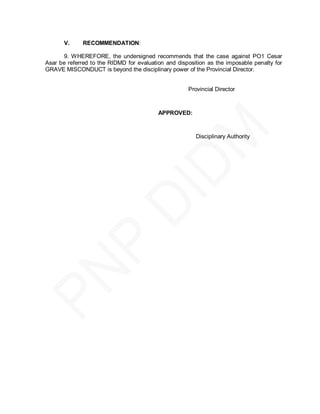
  • 123.
    Section 3. Service of Final Orders/Decisions/Resolutions. – Final orders, decisions, and resolutions shall be docketed after its release by the disciplinary authority, IAS or Appellate Body and copies thereof shall be served upon the parties personally or by registered mail. Section 4. Implementation of Final Orders/ Decisions, or Resolutions which Have Become Final and Executory. – Final orders, decisions, or resolutions which have become final and executory shall be referred to the PNP Regional Director or his equivalent supervisor or the Director, Directorate for Personnel and Records Management (DPRM) for implementation within five (5) days from receipt of the request or order of the disciplinary authority or appellate body to implement the same, copy furnished Director, PNP Finance Service; Directorate for Investigation and Detective Management (DIDM); and the respondent’s unit assignment. Any PNP officer charged with the implementation of a Decision which has become final and executory who fails to implement the same shall be liable for serious neglect of duty. RULE 20 APPEAL Section 1. How appeal is taken; time of filing – Appeals from the decisions of the disciplinary authority, Regional Appellate Board, National Appellate Board or recommendation of IAS which ripened into a decision due to inaction by the disciplinary authority, shall be taken by the party adversely affected by filing a notice of appeal and furnishing a copy thereof to the other party and the appellate body, with the deciding authority within ten (10) days from receipt of a copy of the decision. Section 2. Notice of Appeal and Memorandum on Appeal. – (a) A Notice of Appeal shall be filed in three (3) legible copies which shall contain the following: 1) the material dates showing that it was filed on time; 2) the assignment of the specific errors of fact or law, or both, allegedly committed by the disciplinary authority; and 3) the specific appellate body to which the appeal is being taken.
  • 124.
    The appellant shallsubmit a Memorandum on Appeal in three (3) legible copies not later than fifteen (15) days from the filing of the notice of appeal, copy furnished the other party. However, the memorandum on appeal maybe submitted upon filing the notice of appeal. Proof that copy of the memorandum on appeal was served to the other party must be submitted by the appellant. (b) In all appealed cases, the title of the case shall remain as it was before the disciplinary authority, but the party appealing the case shall be further referred to as the appellant and the prevailing party as the appellee. Section 3. Dismissal of the Appeal. – Failure of the appellant to comply with the requirements provided in Sections 1 and 2 (a) of this Rule shall be sufficient ground for the dismissal of the appeal. Section 4. Transmittal of the Records. – Within fifteen (15) days from receipt of the Notice of Appeal, the concerned disciplinary authority shall forward the complete original records of the case to the appellate body, which shall be systematically and chronologically arranged, paged and securely bound to prevent loss of any piece of document thereof. The transmittal of the records shall be a ministerial duty and failure to forward the same shall be a ground for administrative action against the concerned official or personnel for serious neglect of duty. Section 5. Docketing of Appealed Cases. – Upon receiving the complete original records, which shall include the exhibits and transcript of stenographic notes from the disciplinary authority, the appellate body shall immediately docket the same by stamping the time and date or receipt on its cover, assigning the appellate the case number and entering the same on the docket book which shall be purposely maintained for appealed cases only. Section 6. Period to Act on Appeal. – The Regional Appellate Board and the National Appellate Board shall decide the appeal within the period of sixty (60) days from receipt of the complete records of the case. Failure of the RAB to decide the appeal within sixty (60) days from receipt of the case records shall render the decision of the disciplinary authority final without prejudice to the filing of an appeal by the party adversely affected to the Secretary of the Department of the Interior and Local Government. Should the RAB fail to decide the appeal within the reglementary period provided in this Section, the concerned Board shall automatically make a written explanation to the Commission En Banc on its failure to do so.
  • 125.
    The Commission EnBanc shall order the conduct of investigation against the Chairman and the PNP representative of the concerned Board if it appears from the explanation that an evident neglect of duty was committed by the Board. Section 7. Withdrawal of Appeal. – At any time before the appellate body renders its decision finally resolving the appeal, the appellant, as a matter of right, can withdraw the same; which shall consequently, render the appealed decision final and executory. No motion to reinstate the appeal shall be allowed. PART III ADMINISTRATIVE OFFENSES AND PENALTIES RULE 21 OFFENSES Section 1. Offenses Punishable. – The following are the offenses punishable and defined as follows: 1) Neglect of Duty or Nonfeasance – is the omission or refusal, without sufficient excuse, to perform an act or duty, which it was the peace officer’s legal obligation to perform; implies a duty as well as its breach and the fact can never be found in the absence of duty. 2) Irregularities in the Performance of Duty or Misfeasance – is the improper performance of some act which might lawfully be done. 3) Misconduct or Malfeasance – is any wrongful, improper or unlawful conduct motivated by premeditated, obstinate or intentional purpose. It usually refers to transgression of some established and definite rule of action, where no discretion is left except where necessity may demand; it does not necessarily imply corruption or criminal intention. 4) Incompetence – is ignorance or the material lack of adequate ability and fitness for the satisfactory performance of police duties. This refers to any physical, intellectual, psychological and moral quality, the lack of which substantially incapacitates a person to perform the duties of a police officer. 5) Oppression – imports an act of cruelty, severity, unlawful exaction, domination, or excessive use of authority. The exercise of unlawful powers
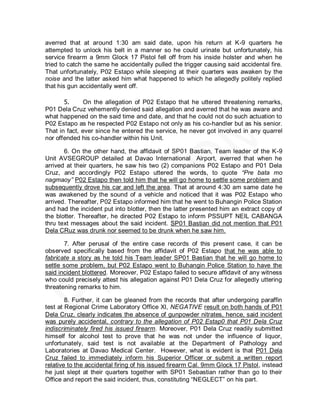
  • 126.
    or other means,in depriving an individual of his property or liberty against his will, is generally an act of oppression. 6) Dishonesty – is the concealment or distortion of truth in a matter of fact relevant to one’s office, or connected with the performance of his duties or connected with the performance of his duties; and 7) Disloyalty to the Government – consists of the abandonment or renunciation of one’s loyalty to the government of the Philippines, or advocating the overthrow of the government, through overt and covert acts. Section 2. Classification of Offenses. – For purposes of determining jurisdiction and applying the appropriate penalty, administrative offenses are classified into light, less grave and grave. A. LIGHT OFFENSES: 1) Simple Neglect of Duty – Shall include but not limited to the following: a) fail to supervise, inspect and control subordinates directly under his command as to their punctuality, attendance, prescribed attire, proper use and maintenance of equipment, preparation and submission of reports, efficient performance of their duties and responsibilities, and the observance of good order, conduct, behavior and discipline; b) fail to take corrective action by way of warning, advise, admonition, suggestion or disciplinary action to subordinate, or to report such conduct when such subordinate is committing or has already committed a dereliction, irregularity or violation of departmental rules and regulations; c) fail to order or cause the investigation of a subordinate reported to him as absent without leave; d) fail to disseminate any order, directive or instruction; e) fail to coordinate or cooperate with other law enforcement agencies and their personnel; f) Absent oneself from office without having filed the necessary application for leave or secured the approval of the superior officer for a period not exceeding three (3) days in a month; g) fail or refuse to give his name and badge number when properly requested;
  • 127.
    h) fail to report upon declaration of alert levels; i) fail to report on duty in prescribed uniforms with badge, identification card, service firearm and other required equipment, except those not required to wear the prescribed uniform by reason of the exigency of the service. j) fail to keep an official appointment with a complainant, informer or crime witnesses without lawful justification; k) fail to submit a written report to his superior officer immediately or within a reasonable time after accidental firing of his firearm, when time and circumstances would permit; l) fail to take custody of government issued property from a member under his supervision who is suspended, separated, retired or dead; m) fail to conduct within a reasonable period, proper, thorough and complete investigation when assigned to do so; n) fail to thoroughly search for, collect, preserve and identify evidence in any arrest or investigation conducted by him; o) fail to take proper custody, record, tag, and identify property entrusted to him as evidence; p) be delayed unnecessarily in attending to or in performing a duty; q) fail to report to his superior officer his inability or incapability to report for duty, attend a conference, general inspection, or participate in an operation; r) delay or fail to respond to a call for assistance; s) fail to inform his superior as to the result of action taken on a call or dispatch; t) fail to report to his superior officer a hazardous condition or dangerous situation; u) fail to prepare and submit properly written reports within the prescribed period of time, if required by standing regulations; v) fail to report to a new assignment within ten (10) days from the order of reassignment without sufficient reason; w) leave his post or beat before the end of tour of duty or leave without the required turn over to the incoming duty personnel.
  • 128.
    2) Simple Irregularityin the Performance of Duty - Shall include but not limited to the following: a) drive a marked police vehicle while not in prescribed uniform, except those who are not required to do so by reason of the exigency of the service; b) use siren and/or red blinker light while not responding to an emergency or not in hot pursuit of a fleeing criminal or law violator; c) malinger, loaf or consort with others while on duty or arrange with another member to take his place during his tour of duty, without prior approval of his superior; d) allow unauthorized member of the PNP to drive marked or unmarked police vehicles; e) interfere or obstruct the work of other members or change the assignment or tour of duty of subordinates not belonging to his unit/ offices; f) arrange with another member to take his post or tour of duty without superior’s approval. 3. Slight or Simple Misconduct - Shall include but not limited to the following: a) fail to salute officials, dignitaries, superior officers and other officials entitled thereto or the national colors during the playing of the national anthem; b) fight, threaten or quarrel with any member of the police force; provided, that when the member being challenged or threatened is one of higher rank, the charge shall be that of Grave Misconduct; c) read newspaper, books or periodicals while in uniform or in street duty; d) be untidy or couth in his personal appearance and behave in an ungentlemanly or undignified manner; e) fail to recognize and satisfy any just debt; f) engage in private business or practice his vocation or profession during off duty hours without approval of proper authority;
  • 129.
    g) solicit attorneys, bondsmen or guarantors for arrested or confined persons; h) fail to be home or to be at the place of confinement without legitimate reason after having been reported sick or suffering injuries; i) use rude or insulting language or exhibit similar rudeness to the public; j) fail to report for record with the Complaint or Desk Officer a case prior to its investigation; k) allow or tolerate idlers, fixers or persons of questionable character to stay or loiter in his office, post or place or assignment without any legitimate reason or purpose; l) fail to maintain cleanliness or orderliness in his office, premises, post or surroundings; m) use official forms, letterheads, seals and stamps privately or in violation of protocol; provided, that when they are used for committing fraud or dishonesty, the charge shall be Grave Misconduct; n) be found to have the odor or smell of alcohol on his breath while on duty, or processes alcoholic beverages on his person, police vehicle, post or office; o) make or conduct unauthorized solicitations of contributions from subordinates or private persons. B. LESS GRAVE OFFENSES: 1) Less Grave Neglect of Duty – Shall include but not limited to the following: a) Fail to execute lawful orders from higher authority or tolerate any subordinate to ignore or ridicule any order, rule or regulation; b) fail to make immediate correction or take appropriate action when a dereliction, irregularity or violation of law or duty is being committed or has been committed in his presence by a subordinate under his command, or fail to report the same to his commanding officer within twenty-four (24) hours; c) fail to prepare disciplinary or administrative complaint or take such other disciplinary action as may be necessary against a subordinate under his command who has committed a serious dereliction, violation or irregularity;
  • 130.
    d) fail to comply with any lawful order or instruction of a superior officer or the Chief of Police; e) fail to report immediately to his superior officer or to the Chief of Police the injury, illness, death or escape of a prisoner who is under his custody; f) fail to communicate to the Chief of Police, through channels, any valuable information that will lead to the apprehension of a wanted person, or furnish clues for the solution of a case, or for the recovery of stolen property; g) fail to issue a Traffic Citation Ticket (TCT) or Temporary Operator’s Permit (TOP) to an offending driver whose license is already confiscated; h) fail to turn in the used of Traffic Citation Ticket or Temporary Operator’s Permit together with the confiscated driver’s license at the end of his tour of duty or within twenty-four (24) hours, or fail to account for the TCT’s or TOP’s issued to and used by him; i) fail to report as a peace officer any incident, condition or occurrence witnessed by or reported to him which calls for immediate police action; j) fail to properly patrol his beat, sector or post or to leave or abandon the same without being properly relieved; fail to take appropriate action concerning vice conditions in his beat and/or give written report of the same to his superior; k) fail to report to his superior officer, within a reasonable period, injury inflicted by him to a person or animal, damage or loss of government property while on or off duty; l) fail to comply with the order of a court of competent jurisdiction; m) willfully violate office regulations and/or refuse or neglect to comply with said provisions; n) sleep on his post while performing patrol or guard duty; o) absent oneself from office without having filed the necessary application leave or secured the approval of the superior officer for a period of more than three (3) days but not exceeding fifteen (15) days. 2) Less Grave Irregularities in the Performance of Duties – Shall include but not limited to the following:
  • 131.
    a) apply for and serve a search or seizure warrant in any establishment or private house without the knowledge or approval of the Chief of Police or his superior officer; b) use traffic violation traffic reports which are not duly validated by the Land Transportation Office (LTO), the Metro Manila Development Authority (MMDA), or city or municipal government; c) use traffic violation reports duly validated by the LTO, MMDA, or city/municipal government but are not issued to him for traffic enforcement work; d) use the official insignia, markings and seal of the police force in any privately owned vehicle, without the authority of the Chief of the Police/superior officer; e) disregard or violate traffic rules and regulations while driving a police vehicle when not in hot pursuit and not responding to an emergency call. 3) Less Grave Misconduct – Shall include but not limited to the following: a) take advantage to his position by procuring goods and commodities at a losing price to an unwilling seller, or partake of food, drinks and cigarettes free of charge; b) engage in regulated gambling or games of chance while on duty; c) be drunk and disorderly while on off duty, or drunk while on duty and in uniform or in recognizable uniform of the force; d) maliciously intrigue against the honor of a co-officer, or indulge in idle gossip or spread rumors that tend to discredit member; e) exhibit marked discourtesy in the course of official duties or use profane or insulting language to any superior officer; f) serve as escort or security officer, whether on foot or by motor vehicle, for any private individual regardless of his status in social or religious circles on any occasion, unless authorized by the chief of police or the appropriate officials authorized to do so; g) take a trip abroad without approved leave and approval of the authorities concerned; h) borrow or solicit money or any valuable from his subordinates unless the latter is engaged in the lending business.
  • 132.
    C. GRAVE OFFENSES: 1) Serious Neglect of Duty – Shall include but not limited to the following: a) fail or refuse to take command in an emergency in order to carry out police duty, being the officer present with the highest rank, grade or position; b) fail to prevent or suppress the criminal act of a subordinate being committed in his presence or fail to report the same to the Chief of Police within twenty-four (24) hours after discovery; c) fail to apprehend and/or arrest a person under circumstances where it is his duty to do so; d) fail to return personal effects of released prisoners or other property used in evidence the release of which is ordered by a competent authority or court; e) fail to perform his assigned mission or fail to participate in an operation for the security of the President, or other high ranking officials of the Philippines or foreign heads of state; f) fail to administer first aid when able and/or convey to the hospitals, victims of traffic accidents, persons shot or stabbed, persons electrocuted and other who are dying and in need of urgent medical or surgical attention; g) fail to quell a disturbance or to protect a person from death or injury when able to do so; h) fail to help a brother peace officer in apprehending or arresting a violator who resists, or in subduing one assaulting the arresting officer, or in disarming an armed violator or in coming to the succor of another officer who is wounded, injured or outnumbered; i) fail to appear and testify in court, prosecutor’s office, the PNP disciplinary authorities, appellate bodies, the IAS or any other quasi-judicial body when duly notified or subpoenaed as witness. If his non-appearance resulted in the dismissal of the case or the acquittal of the accused; or when he is the principle witness or the arresting officer, the penalty of dismissal from the service shall be imposed; j) Absent oneself from the office without having filed the necessary application for leave or secured approval of the authorized official for a period of more than fifteen (15) days prior to the enjoyment of the leave.
  • 133.
    2) Serious Irregularitiesin the Performance of Duties – Shall include but not limited to the following: a) act as a bodyguard or security guard for any public official or candidate for any elective public office or position or any other person within three (3) months immediately preceding any election and within one (1) month thereafter, without authority from the Commission on Election; b) acts as bodyguard or security guard for the person or property of any public official, or private person unless approved by proper authorities concerned; c) reveal secret or confidential police matters and information which jeopardize police mission and operations, or which cause injury or damage to citizens; d) Unauthorized establishment of checkpoints in any public thoroughfare for the purpose of stopping or searching vehicles or persons or if authorized does not comply with the Rules set by the PNP; e) unauthorized escorting of any vehicle carrying highly dutiable or taxable goods, merchandise, appliances or mechanism; f) failure to turn over to the police station within a reasonable period any apprehended or arrested person; g) countermand any lawful order of the mayor, chief of police, or his superior officer; h) perform the duties and functions of customs or immigration authorities without proper deputation in accordance with law; i) escort or allow other members to escort detention prisoners outside the jail in order to attend a funeral, visit a sick relative, or solicit a bond without an order of the court or proper jurisdiction. 3) Grave Misconduct – Shall include but not limited to the following: a) maltreat or abuse any prisoner or detained person under his custody; b) receive for personal use of a fee, gift or other valuable thing in the course of official duties or in connection therewith when such fee, gift or other valuable thing is given by any person in the hope or expectation of receiving a favor or better treatment than that accorded to other persons, or committing acts punishable under the anti-graft laws;
  • 134.
    c) join a strike or refuse to report for duty in order to secure changes in terms and conditions of his employment, or to oust the chief of police or any other officer from office; d) contract loans of money or other property from persons with whom the PNP office has business relations; e) solicit or accept directly or indirectly, any gift, gratuity, favor, entertainment, loan or anything of monetary value which in the course of his official duties or in connection with any operation being regulated by, or any transaction which may be affected by the functions of his office. The propriety or impropriety of the foregoing shall be determined by its value, kinship, or relationship between the giver and receiver and the motivation. A thing of monetary value is one which is evidently or materially excessive by its very nature; f) directly or indirectly have financial and material interest in any transaction requiring the approval of his office. Financial and material interest is defined as pecuniary or proprietary interest by which a person will gain or lose something; g) own, control, manage or accept employment as officer, employee, consultant, counsel, broker, agent, trustee, nominee in any private enterprise regulated, supervised or licensed by his office, unless expressly allowed by law; h) publicly consort with women of ill repute and/or scandalously cohabit with or maintain a wife other than his legitimate spouse; i) fail or refuse to surrender or deposit his service firearm, badge, identification card and police vehicle, if any, to his superior officer upon demand during the period of suspension; j) willful failure to pay just debts or obligation due to the government; k) appropriate for his or allow another person the beneficial use any stolen property that is recovered, found or abandoned; l) solicit money, valuable or favor for the amicable settlement of cases under investigation; m) engage directly or indirectly in partisan political activities or take part in any election except to vote;
  • 135.
    n) deliberately or through gross negligence, destroy, damage or lose government property entrusted to him for official use; o) mutilate, deface or destroy any driver’s license, traffic citation ticket or temporary operator’s permit issued in lieu thereof; p) inflict physical injuries upon a suspect to force the latter to give a confession; q) act as a mediator or fixer for the return of any stolen vehicle or property whether held for ransom or not; and r) commit any act or omission that constitutes a crime punishable under the Revised Penal Code or Special Laws. 4) Oppression – Any member of the police force who shall abuse his authority in a tyrannical, cruel and high-handed manner shall be guilty of Oppression. 5) Gross Incompetence – When the offense or negligence is committed by reason of manifest lack of adequate ability and fitness on the part of the respondent member for the satisfactory performance of police duties, the erring member shall be guilty of Gross Incompetence. 6) Disloyalty to the Government – Any member of the PNP who shall abandon or renounce his loyalty to the government of the Republic of the Philippines or who shall advocate the overthrow of the government, through covert or overt acts, shall be guilty of Disloyalty to the Government. He shall be punished with the maximum penalty of dismissal from the service. 7) Dishonesty – Any member of the police force who shall conceal, alter, or distort the truth in a matter of fact relevant to his office, or connected with the performance of his duties shall be guilty of Dishonesty. It shall include but not limited to the following: a) any member who shall knowingly enter in his Information Sheet or CSC 212 Form, or in his Individual Police Profile, facts which are not true, or conceal or distort material facts; b) makes a false report or entry in the police blotter or any department record; c) gives deliberate false testimony against or in favor of a person facing a criminal or administrative charge;
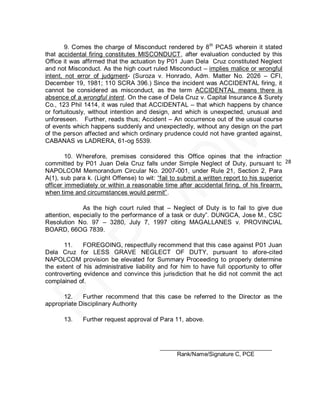
  • 136.
    d) destroy, conceal,or tamper physical evidence to be presented in court or any office conducting an investigation by exchanging, altering, damaging or diluting as to affect its original appearance, composition and content; e) Intentionally provide the public with false information affecting public interest. RULE 22 PENALTIES Section 1. Imposable Penalties. – The following are the penalties that may be imposed in police administrative cases: a) Withholding of privileges b) Restriction of specified limits c) Restrictive custody d) Forfeiture of salary e) Suspension f) any combination of penalties under section 1, subparagraphs (a) to (e) g) One (1) rank demotion h) Dismissal from the service Section 2. Range of penalties. – The penalties for light, less grave and grave offenses shall be made in accordance with the following ranges: For Light Offenses: 1) Withholding of privileges; restriction to specified limits; restrictive custody, suspension or forfeiture of salary; or any combination thereof from one (1) day to ten (10) days (minimum period);
  • 137.
    2) Withholding of privileges; restriction to specified limits; restrictive custody, suspension or forfeiture of salary; or any combination thereof from eleven (11) days to twenty (20) days (medium period); 3) Withholding of privileges; restriction to specified limits; restrictive custody, suspension or forfeiture of salary; or any combination thereof from twenty one (21) days to thirty (30) days (maximum period); For Less Grave Offenses: 1) Withholding of privileges; restriction to specified limits; restrictive custody, suspension or forfeiture of salary; or any combination thereof from thirty one (31) days to forty (40) days (minimum period); 2) Withholding of privileges; restriction to specified limits; suspension or forfeiture of salary; or any combination thereof from forty one (41) days to fifty (50) days (medium period); 3) Withholding of privileges; restriction to specified limits; restrictive custody; suspension or forfeiture of salary; or any combination thereof from fifty one (51) days to fifty nine (59) days (maximum period); For Grave Offenses: 1) Sixty (60) days to Six (6) months suspension (minimum period); 2) One (1) rank demotion (medium period); 3) Dismissal from the service (maximum period). Section 3. Limitation in the Imposition of Penalties. – In case of forfeiture of salary the amount shall not exceed the equivalent of one (1) month salary. The penalty of ―Withholding of Privileges‖ shall be confined to deferment of vacation leave privileges, participation in training grants or programs and such other similar privileges normally enjoyed by civil service employees. Section 4. Qualifying Circumstances. – In the determination of penalties to be imposed, mitigating and aggravating circumstances attendant to the commission of the offense/s shall be considered. a) The following are mitigating circumstances: 1) illness; 2) good faith;
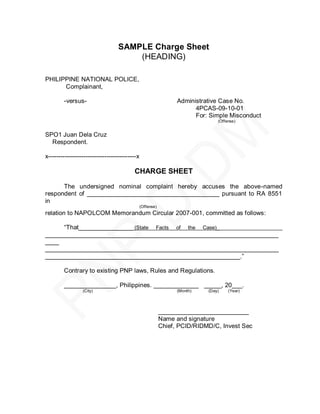
  • 138.
    3) length of service in the government; 4) awards and commendations; 5) analogous circumstances. b) The following are aggravating circumstances: 1) taking advantage of official position; 2) taking undue advantage of subordinate; 3) use of government property in the commission of the offense; 4) repeatedly charged; 5) offense is committed during office hours and/or within the premises of the government office or building; 6) employment of fraudulent means to commit or conceal the offense; 7) intoxication; 8) being a recidivist 9) offense committed in consideration of a price or reward; 10) when the victim is a minor, feeble minded, or physically disabled; 11) when offense is committed in cooperation with two (2) or more persons; 12) utilizing minor in the commission of the offense; and 13) analogous circumstances. Section 5. Guidelines in the Application of Penalties. – The imposition of the penalty shall be made in accordance with the manner herein below provided: a) Like penalties shall be imposed for like offenses and only one penalty shall be imposed for each case. ―Each case” means one administrative case which may involve one or more charges or counts.
  • 139.
    b) The minimum period of the penalty shall be imposed where only mitigating and no aggravating circumstances are present. c) The medium period of the penalty shall be imposed where no mitigating and aggravating circumstances are present. d) The maximum period of the penalty shall be imposed where only aggravating and no mitigating circumstances are present. e) Where aggravating and mitigating circumstances are present, rule (b) shall be applied where there are more mitigating circumstances present; rule (c) shall be applied where the circumstances equally off-set each other; rule (d) shall be applied when there are more aggravating circumstances. f) If the respondent is found guilty of two (2) or more charges or counts, the penalty to be imposed should be that corresponding to the most serious charge or count and the rest shall be considered as aggravating circumstances. g) In the appreciation of any mitigating circumstance in favor of the respondent or of any aggravating circumstance against him, the same must be invoked or pleaded by the party concerned, otherwise, such circumstances shall not be considered in the determination of the penalty to be imposed. Section 6. Administrative Disability Inherent in Certain Penalties. – The following are the administrative disabilities inherent in certain penalties: a) The penalty of dismissal, which results in the separation of the respondent from the service, shall carry with it that of cancellation of eligibility, forfeiture of retirement benefits, and the disqualification for re-employment in the government service; b) The penalty of suspension, which consists in the temporary separation or cessation of work of the respondent for the duration of the sanction, shall carry with it that of disqualification for promotion and withholding of privileges corresponding to the period of suspension. c) The penalty of forfeiture of salary, which consists of an amount not exceeding one (1) month salary, shall carry with it that of disqualification for promotion corresponding to the period of the penalty imposed.
  • 140.
    RULE 23 MISCELLANEOUS PROVISIONS Section 1. Authority to Administer Oath. – In addition to the officials who, under the existing laws, are authorized to administer oaths, officers designated to conduct pre-charged evaluation and hearing officers of the Commission, PNP, IAS, the Chairmen and members of the PLEB and Regional Appellate Boards have the authority to administer oaths on matters connected with the performance of their duties. Section 2. Authority to Issue Subpoena Ad Testificandum and Subpoena Duces Tecum. – The disciplinary authorities, IAS and their hearing officers shall have the authority to issue subpoena ad testificandum and subpoena duces tecum. Section 3. Monthly Report. – Within the first week of each month all disciplinary authorities, IAS and appellate bodies are required to submit a report to the regional office of the NAPOLCOM or the Commission en Banc, furnishing a copy thereof their respective heads of office, indicating the following data/information: a) List of newly filed / received or raffled cases, revived, reinstated case, or cases transferred/reffered or re-raffled from other office /officers; b) List if investigated, heard, resolved / decided, or pending cases; c) List of cases transferred/ referred or re-raffled to other offices/ officers stating clearly the reason for such transfer /referral or re-raffle; and d) List of cases with suspended proceedings stating clearly the reason for its suspension. Section 4. Effect of a Pending Case. – Pendency of an administrative case before any of the administrative disciplinary authorities, IAS or appellate body shall be a bar to promotion. Section 5. Issuance of Clearance / Certification. – Any disciplinary authority, IAS or appellate body or its authorized official upon written request and payment of legal fee shall issue a clearance or certification indicating the pendency or non- pendency of an administrative case against any PNP member. The request shall contain the name of the requesting party, name of the police officer subject of the verification and the purpose of the request. A disciplinary authority, IAS or appellate body shall not require personal appearance of the police officer and other clearance or document from him or the
  • 141.
    requesting party exceptfor NAPOLCOM, PNP and IAS national offices which may require clearances or certification from their lower units or offices. RULE 24 TRANSITORY PROVISIONS Section 1. Repealing Clause. – Memorandum Circular Numbers 93-024, 96-010, 98-014, 99-006, 99-014, 2002-010, 2002-013 are repealed. All other NAPOLCOM issuances or portions thereof inconsistent with this Memorandum Circular are hereby superseded or modified accordingly. Section 2. Application to Pending Cases. – These Rules shall apply to pending cases with the different disciplinary authorities, appellate bodies and IAS, Provided however, that the offenses and penalties reclassified under these Rules shall have retroactive effect insofar as they are favorable to the respondent. Section 3. Separability Clause – Any portion of this memorandum circular inconsistent with the organic law or declared unconstitutional shall not affect the validity of the other provisions. Section 4. Effectivity Clause. – This Memorandum Circular shall be effective after fifteen (15) days following the completion of its publication in at least two (2) newspapers of general circulation nationwide. Issued this 6th day of March 2007 at Makati City. (Original signed) RONALD V PUNO Chairperson (Original signed) LINDA L. MALENAB-HORNILLA OIC-Office of the Vice-Chairperson & Executive Officer (Original signed) CECELIA V. SANIDAD-LEONES Commissioner
  • 142.
    (Original signed) (Original signed) MIGUEL G.CORONEL OSCAR C. CALDERON Commissioner Commissioner Attested by: (Original signed) ADEMALYN A. MUTIEZA Chief, Secretariat
  • 143.
    Appendix “B” Republic of the Philippines Department of the Interior and Local Government NATIONAL POLICE COMMISSION NATIONAL HEADQUARTERS, PHILIPPINE NATIONAL POLICE OFFICE OF THE CHIEF, PNP Camp Crame, Quezon City PNP MEMORANDUM CIRCULAR NUMBER 2010-021 November 3, 2010 DEFINING AND DELINEATING THE FUNCTIONS OF DIRECTORATES/OFFICES INVOLVED IN THE DISPOSITION OF ADMINISTRATIVE/DISCIPLINARY CASES AGAINST MEMBERS OF THE PNP I. REFERENCES: a. Sections 41 (b)(3) and 42, RA No. 6975, as amended by Sections 52 and 53, RA No. 8551; b. Section 26, RA 6975; c. NAPOLCOM Memorandum Circular (NMC) No. 2007-001 entitled: ―Uniform Rules of Procedure before the Administrative Disciplinary Authorities and the Internal Affairs Service of the Philippine National Police‖; d. Revised Uniform Rules in the Disposition of Administrative Cases in the Civil Service (Revised URACCS [CSC Resolution No. 991936]); e. Supreme Court Decisions on Administrative Cases; and f. LOI Patnubay II. II. PURPOSE: This Circular aims to clearly define and delineate the functions of the different Directorates and Offices involved in the disposition of information/reports and administrative/disciplinary cases filed against members of the PNP to avoid overlapping or duplication of functions and to improve coordination and feedback mechanism with the end view of ensuring the expeditious administration of discipline within PNP ranks without ignoring however, the basic requirements of due process of law.
  • 144.
    III. SCOPE OF APPLICATION: This Circular shall apply to and govern the disposition of information/reports and administrative complaints received or filed against uniformed and non-uniformed personnel of the PNP. IV. DEFINITION OF TERMS: a. Terms applicable to PNP Uniformed Personnel: 1. Appellate Authorities - refers to the Regional Appellate Board, from decisions ordering the demotion or dismissal of the respondent rendered by the Police Regional Directors or Equivalent Supervisors; The National Appellate Board, from decisions rendered by the Chief, PNP ordering the demotion or dismissal of the respondent; The Secretary of the Department of the Interior and Local Governments, from decisions rendered by the NAB and RAB; and the Civil Service Commission, in summary dismissal proceedings instituted before the National Police Commission en banc. 2. Motion for Reconsideration - is an application submitted by the respondent or the party adversely affected to the Disciplinary Authority to set aside or modify the decision within ten (10) days from receipt of the copy of the decision based on the following grounds: 2a. Newly discovered evidence which if presented would materially affect the decision rendered; and 2b. Errors of law or irregularities have been committed prejudicial to the substantial rights and interests of the movant. 3. Notice of Appeal - is a written notification filed by the respondent or the party adversely affected with the Disciplinary Authority who rendered the adverse decision that he/she is elevating the case on appeal to the NAPOLCOM appellate board based on the grounds specified thereon and which shall state the material dates showing the timeliness of the appeal. A copy of notice of appeal should also be furnished to the other party and to the appellate body. 4. PNP Disciplinary Authorities - refer to the Chiefs of Police or their equivalent supervisors; the Provincial Directors or their equivalent supervisors; the Regional Directors or their equivalent supervisors; the Chief, PNP; and the NAPOLCOM en banc.
  • 145.
    5. Pre-Charge Evaluation - is a process to determine the existence of probable cause based on the allegations on the complaint and supporting evidence. 6. Probable Cause - refers to the existence of such facts and circumstances as would excite the belief, in a reasonable mind, acting on the facts within the knowledge of investigating officer, that the PNP member complained of is liable for the administrative offense for which he should be investigated. 7. Summary Dismissal Case - is one where the maximum imposable penalty is dismissal from the service and the offense falls under the following cases: 7a. Where the charge is serious and the evidence of guilt is strong; 7b. When the respondent is a recidivist or has been repeatedly charged and there are reasonable grounds to believe that he is guilty of the charge; 7c. When the respondent is guilty of a serious offense involving conduct unbecoming of a police officer; and 7d. When any member or officer has been absent without official leave for continuous period of 30 days or more; Provided, that where dropping from the rolls is resorted to as mode of separation from the service, the police officer can no longer be charged for Serious Neglect of Duty arising from absence without official leave (AWOL) and vice versa. b. Terms applicable to PNP Non-Uniformed Personnel: 1. Finality of Decision – the decision against PNP Non-Uniformed Personnel becomes final after the lapse of fifteen (15) working days without motion or appeal filed. 2. Motion for Reconsideration - is an application submitted by the respondent PNP Non-Uniformed Personnel or the party adversely affected to the Disciplinary Authority to set aside or modify the decision based on: 2a. Newly discovered evidence which materially affects the decision rendered thereof;
  • 146.
    2b. The decision is not supported by evidence on record; and 2c. Errors of law or irregularities committed prejudicial to the substantial rights and interests of the movant. 3. Notice of Appeal - is a written notification filed by the respondent PNP Non-Uniformed Personnel or the party adversely affected with the Disciplinary Authority who rendered the adverse decision that he/she is elevating the case on appeal to the Commission (Civil Service) proper based on the grounds specified thereon and which shall state the material dates showing the timeliness of the appeal. 4. Preliminary Investigation – it involves the ex-parte examination of the records and documents submitted by the complainant and the person complained of, as well as documents readily available from other government offices. During the said investigation, the parties are given the opportunity to submit affidavits and counter-affidavits. Failure of the person complained of to submit his/her counter- affidavit shall be considered as a waiver thereof. Thereafter, if necessary, the parties may be summoned to a conference where the investigator may propound clarificatory and other relevant questions. Upon receipt of the counter-affidavit or comment under oath, the disciplining authority may now determine whether a prima facie case exist to warrant the issuance of a formal charge. A fact-finding investigation may be conducted further or prior to the preliminary investigation for the purpose of ascertaining the truth. A preliminary investigation necessarily includes a fact-finding investigation. 5. Prima Facie Case – is a degree or quantum of proof greater than probable cause. It denotes evidence which, if unexplained or uncontradicted, is sufficient to sustain a prosecution or establish the facts, as to counterbalance the presumption of innocence and warrant the conviction of the accused. c. Common provisions: 1. Complaint – is a written and sworn statement regarding a wrong, grievance or injury sustained by a person.
  • 147.
    2. Complaint Sheet – is an accomplished form of complaint written in a clear, simple and concise language and in a systematic manner as to apprise the respondent concerned of the nature and cause of the accusation against him/her and to enable him/her to intelligently prepare his defense or answer. It shall contain the full name and address of the complainant; full name and address of the person complained of as well as his position and office of employment; narration of the relevant and material facts which shows the acts or omissions allegedly committed by the respondent; certified true copies of documentary evidence and affidavits of complainant’s witnesses, if any; and certification or statement of non-forum shopping. 3. Charge Sheet – is a written information containing specific allegation of every facts and circumstances necessary to constitute the offense charged. 4. Decision - is the written disposition of the case signed by the Disciplining Authority stating clearly the findings of facts and the provisions of the law, applicable rules and regulations. 5. Information/Reports – pieces of information, reports received or gathered including, among others, accounts from the tri-media, text messages, and other sources. 6. Nominal Complainant – the one who initiates a complaint against any member of the PNP representing the Disciplinary Authorities as active prosecutor. 7. Private Complainant – the one who initiates a complaint against any member of the PNP acting as complaining witness/es. 8. Proof of Service - is evidence submitted by a process server that he/she has furnished the parties to an administrative case, particularly the respondent, of the decision or resolution rendered by the Disciplinary Authority. 9. Public Complainant – the one who initiates a complaint against any member of the PNP as concerned government agency or office. 10. Respondent – refer to any PNP personnel who were formally charged by the Disciplinary Authority. 11. Sensational Case – refers to a widely-publicized case involving PNP personnel as shown and heard either in print media or broadcast media (i.e.
  • 148.
    radio, television, internetand others) arousing or intended to arouse strong curiosity, interest, or reaction, especially by exaggerated or lurid details. 12. Summary Hearing Officer or Board - is the designated representative/s of the Disciplinary Authority who is tasked to hear, conduct the necessary proceedings, receive and evaluate the evidence presented and prepare the appropriate report for reconsideration by the Disciplinary Authority. 13. Summary Administrative Proceedings – refers to administrative proceeding conducted consistent with due process to determine the culpability or innocence of the respondent. 14. Venue - the administrative complaints or cases against any PNP member shall be filed before the Disciplinary Authority or IAS having territorial jurisdiction where the offense was committed, except citizen’s complaints falling under Rule 3 Section 1 (d) of NAPOLCOM Memorandum Circular No. 2007-001. V. DELINEATION OF FUNCTIONS: a. The DIDM or RIDMD or its equivalent office in the NSU shall: 1. Initiate investigation and evaluation of information/reports, particularly on sensational cases involving PNP personnel and involving Third Level Officers (PSSUPT and above) in close coordination with the IAS/RIAS. 2. Receive and act on all complaints against PNP personnel and conduct pre-charge evaluation as warranted in accordance with Rules 13 and 14, NMC No. 2007-001 and Rule II of the Revised URACCS. 3. Initiate the filing of corresponding administrative case against personnel who committed acts or omissions punishable by the Revised Penal Code and Special Laws as provided in Section 2, Paragraph C (3) (r), Rule 21 of NAPOLCOM Memorandum Circular No. 2007-001, and shall be the repository of records on criminal cases filed against all personnel. 4. In case probable cause is established, transmit the complete records of the case to the DPRM or its counterpart in the PROs or NSUs for Summary Hearing. In cases when PCE was conducted by the DIDM itself, venue of the summary hearing must be indicated in the PCE report.
  • 149.
    5. Recommend appropriate actions such as issuance of preventive suspension, restrictive custody or filing of criminal cases in court against the erring PNP personnel. 6. Actively prosecute administrative cases forwarded to the DPRM or RPHRDD or its counterpart in the PROs or NSUs especially those grave and sensational in nature before the Summary Hearing Officer by appearing for the prosecution in all stages of summary administrative procedure. 7. Supervise all Court Process Officer [CPO] who shall be responsible for the service of notices, subpoenas and other legal processes and ensure timely delivery of such process to the parties concerned. 8. Initiate appellate actions for and in behalf of the PNP on any adverse decision rendered by an appellate body such as the RAB, NAB, SILG, and CSC. 9. Perform other functions as may be required. b. The DPRM or RPHRDD or its equivalent office in the NSU shall: 1. Upon receipt of the pre-charge evaluation report and the complete records of the complaint, the DPRM or its equivalent Office in the PROs and NSUs shall enter the case into its official docket by stamping on the face of the report or complaint the time and date of receipt and assign an administrative case number to it. The PCE docket number shall not be omitted for monitoring purposes. The DPRM or its equivalent Office in the PROs and NSUs shall inform the DIDM or its equivalent Office in the PROs and NSUs of the pending cases, as well as the PNP Unit where the respondent is assigned. 2. Ensure the timely disposition of cases through summary administrative proceedings and monitor the progress of each case. If warranted, call the attention of the SHO concerned to resolve his/her designated case within the prescribed period. 3. Report SHOs who failed to resolve their designated cases beyond prescribed period without any justifiable reasons and submit same to the DLOD or counterpart for PCE. 4. Transmit the report of summary hearing to the Disciplinary Authority concerned, along with complete records of the case.
  • 150.
    5. Resolve Motions for Reconsideration or Appeal, as the case may be and submit recommendation to the Disciplinary Authority. A copy of the MR or Appeal be furnished the DIDM for comment or opposition before resolving the same. 6. Furnish the offices concerned with a copy of the order implementing the decision and require these offices to submit report of action taken on the said order. 7. Initiate and dispose termination of case/s against PNP personnel in temporary appointment status. 8. Maintain a pool of qualified SHO and conduct appropriate training on quarterly basis in order to develop their skills in the conduct of summary hearing as well as refresh their knowledge on amended or newly issued laws, rules, regulations, and current Supreme Court jurisprudence pertaining to administrative cases. 9. Serve as repository of records and implementer of the decisions rendered by the Disciplinary Authority. 10. Issue Clearance of Non-Pending Case to PNP personnel applying for: leave abroad; UN mission; personal loan; promotion; transfer to other units; retirement, and resignation. The Clearance shall also be issued to any public or private personality requesting to verify, when deemed appropriate, the good standing of any PNP personnel on records that is subject for scrutiny. 11. Ensure efficient discharge of above function through formulation of detailed or specific policy and procedures for the purpose in accordance with NMC 2007-001, Revised URACCS and other issuances. 12. Act as repository of all administrative cases involving PNP personnel and perform other functions as may be required. c. The NHQ or Regional Internal Affairs Service shall: 1. Initiate necessary investigation on cases in the exercise of its motu proprio mandate. 2. Investigate complaints and gather evidence in support of an open investigation in coordination with the DIDM/RIDMD. 3. Conduct summary hearing on PNP members facing administrative charges.
  • 151.
    4. Submit a periodic report on the assessment, analysis and evaluation of the character and behavior of PNP personnel and units to the Chief, PNP and the Commission. 5. File appropriate criminal cases against PNP members before the court as evidence warrants and assist in the prosecution of the case. . 6. Provide assistance to the Office of the Ombudsman in cases involving the personnel of the PNP. d. The NHQ or PRO Legal Service or Legal Officer, NSU shall: 1. Act on referrals made by the DPRM or RPHRDD or its equivalent office in the NSU regarding the draft decisions prepared by the designated SHOs only on matters involving the application of laws, rules and regulations. 2. Act on referrals or instructions made by the members of the Command Group or the Disciplinary Authority concerned. 3. Perform other functions as may be required. VI. REPEALING CLAUSE: All PNP issuances which are contrary to or inconsistent with this Circular are hereby amended or repealed accordingly. VII. EFFECTIVITY: This Circular takes effect fifteen (15) days from the date of filing with a copy thereof with the University of the Philippines Law Center pursuant to Sections 3 and 4 of Chapter 2, Book VII of EO 292, otherwise known as the Administrative Code of 1987. (Original signed) ATTY RAUL M BACALZO, Ph.D. Police Director General Chief, PNP DLOD/TOBIAS/ACDLOD/BALIGNASAYSHS/ODIVER/101110 Desktop/PNP MC _____/nupgeneschap-as “To Serve and Protect." ISO 9001 : 2008 CERTIFICATE NUMBER AJA10/AN/1452
  • 152.
    Appendix “C” Republic of the Philippines Department of the Interior and Local Government NATIONAL POLICE COMMISSION NATIONAL HEADQUARTERS PHILIPPINE NATIONAL POLICE OFFICE OF THE CHIEF, PNP Camp Crame, Quezon City January 16, 2008 MEMORANDUM CIRCULAR NUMBER 2008-0116 POLICY AND GUIDELINES ON GRIEVANCE MECHANISM FOR PNP UNIFORMED PERSONNEL I. REFERENCES: a. NAPOLCOM Memorandum Circular No. 93-022 dated November 4, 1993 Entitled: ―Establishing a Complaint and Grievance Mechanism for PNP Uniformed Personnel‖; b. Civil Service Commission Resolution No. 010113 dated January 10, 2001and implemented through CSC Memorandum Circular NO. 02, s. 2001, and c. PNP Integrity Development Review Action Plan II. SCOPE: The Grievance Mechanism set forth in this policy and guidelines shall cover all matters that give rise to PNP uniformed personnel dissatisfaction and discontentment which include but are not limited to the following: a. Wrongful or non-implementation and/or violation of policies and procedures which affect PNP uniformed personnel from recruitment and/or appointment to promotion, transfer, detail/ designation/assignment/placement, termination, dismissal, and other related issues that affect them: b. Wrongful or non-implementation and/or violation of policies and procedures on economic and financial issues and other terms and conditions of employment fixed by law including salaries, incentives, working hours, leave benefits, and other related terms and conditions. c. Physical working conditions; and
  • 153.
    d. Interpersonal relationshipsand linkages However, the following cases shall not be acted upon through the grievance mechanism: a. Disciplinary cases which shall be resolved pursuant to the Uniform Rules on Administrative Cases; b. Complainants on official actions of Head of Offices pertaining to the exercise of disciplinary powers under the provisions of RA 6975 where specific procedures for relief through appeal are hereby already provided; c. An objection to the terms or provisions of a policy, procedure and regulations; d. Sexual harassment cases as provided for in RA 7877, and e. Anonymous grievances and/or complaints. III. PURPOSE: This policy and guidelines prescribed the procedures for the hearing and resolution of grievances and/or complaints filed by a PNP uniformed personnel or group and the composition of grievance committees at the different levels of offices in the PNP organization in order to have an efficient and effective process that is fair to all parties and to help every committee hear decide grievance in a manner that increases the likelihood that its decision will be upheld, the roles of the committee chair and members, complaint, respondent, and observers shall be defined. The establishment of this grievance mechanism intends to achieve the following objectives: a. To provide a system for the promotion of wholesome and harmonious relationships between and among employees and supervisors in the PNP organization; b. To encourage PNP members to exercise their rights in presenting grievance and have them fairly, equitably expeditiously adjudicated thus preventing discontentment and dissatisfaction among them. c. To discover interpersonal problems of employees and find ways in resolve them within the ambit of this policy and guidelines., and d. To improve employee morale through management response to the needs of personnel and employees and vice versa.
  • 154.
    IV. DEFINITION OF TERMS: a. Grievance – means an employee’s expressed (written or spoken) feelings of discontentment and dissatisfaction on any or all of the matters or issues enumerated in section II. For intents and purposes, grievance has only reached Stage 1 of the procedures, the Oral Discussions. b. Complaint – refers to a grievance in writing which has , in the first instance and in the employee’s opinion, had been ignored, overridden or dropped without due consideration at the lowest level of the office where the complainant as assigned and has been lodged or elevated to the next level of office. c. Grievance Procedure – refers to the method prescribed in this policy and guidelines to resolve a grievance and/or complaint. d. Modes of Setting disputes: 1. Conciliation – process whereby a third party (conciliator) brings the parties together, encourages them to discuss their differences and assists them in developing their own proposed solutions. 2. Mediation – a process whereby a third party (mediator) is more active assisting the parties reach acceptable solutions to the problem/s and helps the disputing parties develop or come out with an acceptable solution. The mediator can even submit his own proposal/s for the settlement of disputes. 3. Arbitration – a process whereby a third party who may be an individual arbitration, a heard of arbitrators of an arbitration could, is empowered to render decision which disposes of the dispute an his binding on both parties. (i) Voluntary – a method of settling dispute/s by submitting the ‖disputed facts‖ before an arbitrator or panel of arbitrators chosen by both parties. The voluntary arbitrators shall be render a decision alter proper hearing of the issues. Yhe decisions of the arbitrator shall be final and binding on the contending parties. (ii) Compulsory - a method of setting disputes which have become hardened and irreconcilable and remains unresolved after exhausting all available remedies and exploring all avenues for a peaceful settlement of the dispute under existing laws and procedures. For PNP Uniformed Personnel, a grievance may be elevated to the Civil Service Regional Office concerned only upon issuance of a Certification on the Final Action on Grievance(CFAG) issued by the grievance committee.
  • 155.
    e. Levels ofappointment - 1st – from PO1 to SPO1 Inspector to Police Superintendent 3 rd from Police Senior Superintendent under to Police Director General. f. Group – members of the PNP organization acting as complainants who are considered to have the locus standi or are party in interest to a grievance and/or complaint. g. Association – an organization of uniform and non unformed personnel having a common interest. It does not partake of a labor union. V. PRINCIPLES AND POLICIES The following shall be the guidelines in the conduct of the grievance and/or complaint proceeding a. Employees, individual or group, shall have the right to present their grievance(s) and/or complaint(s) to the management and have them settled as expeditiously as possible in the best interest of the employee or group concerned, the PNP organization, and the government as a whole; b. The complainant/aggrieved party shall first discuss his problem(s) with his immediate supervisor before considering the filling of a formal written complaint; c. The employee/subordinate presenting a grievance and/or complaint shall be assured freedom from coercion, discrimination, harassment or reprisal; d. Grievance(s) shall be settled al the lowest possible level of office. e. The grievance proceedings shall be aimed at determining ―What is right and Not ―who is right‖ f. The right to appeal action/decision on grievance and/or complaint shall not be curtailed; g. Grievance and/or complaint concerning promotion shall be given the due course. However the party aggrieved may elect to proceed either under the procedure or pursuant to any other applicable law/regulations; h. All proceeding shall be treated as confidential; i. Grievance proceedings shall not be bound by formal legal rules and technicalities.
  • 156.
    j. The service of the legal counsel for the parties in this dispute shall not be allowed during the hearing. The grievance committee however shall have a legal officer as member to guide the chair and the member on issues and procedures. k. In no case shall member of the PNP ventilate their grievance, direct to any forum outside of the PNP organization; and l. Supervisors and/or Head of Offices who refuse to take action on a grievance shall be liable for neglect of duty in accordance with existing civil service law, rules, regulations. At the instance of the complainant or the PNP, any personnel who shall be found violating the prescribed guidelines and procedures in violating or expressing complaints and/or grievances shall be held administratively liable and shall be meted with appropriate sanction. VI. PROCEDURES: a. Initiating and/or Filing a Grievance STAGE 1: Oral Discussion – a grievance shall be initially presented by the personnel orally to the complainant’s direct supervisor or Head of the Office as the case may be where the complainant/s is assigned, which will be considered the 1st level of office or venue. The supervisors or the Head of the Office shall take the following actions: (i) Discuss with the complainant/aggrieved party his/her complaint in private; (ii) Keep the complainant/aggrieved party at ease and encourage him to talk freely; (iii) Refrain from expressing his/her views and opinions until after the complainant or aggrieved party has given or explained his/her side; (iv) At the end of discussion, the direct supervisor or Head of Office must state his/her stand clearly, accurately, and without any display of affection or ill feeling towards the employee/subordinate. He/She may not immediately give a definite decision but shall inform orally the employee/subordinate of his/her decision within three (3) days from the date of presentation.
  • 157.
    STAGE II: 1. Grievance in Writing – If the grievance is not settled at the lowest level of office, the complainant shall submit his/her grievance in writing to the Head of Office, who shall personally decide on the matter or form an ad hoc Grievance Committee to hear the issue and give its recommendation from which the Head of Office will decide and inform the complainant of his/her decision in writing within five (5) days from date of receipt of the committee’s recommendation through the direct supervisor/superior(of the complainant) if the complainant is not satisfied with the decision, the Head of Office shall forward the written complaint with his comments to the next level Head of Office within 48 hours. The succeeding Head of Office shall follow the prescription at the lower level of office. If the grievance reaches the Office where the Grievance Committee is organized {PRO, NCRPO, NSU, National Office, PNP NHQ}, the Head of Office may forthwith within fifteen (15) days decide the case or refer it to the Grievance Committee. At the Police Regional Office (PRO) – NCRPO excluded – the Police station (PS); City Police Station (CPS); Provincial Mobile Groups; Companies of the Regional Mobile Groups (RMG); and Police Stations of City Police Offices (CPO) are considered the lowest level offices. A grievance emanating from a group shall be presented through the following scheme: Members assigned at different offices Grievance Presented to: Within: City Police Office City Director Police Provincial Office Provincial Director Regional Mobile Group Group Director Police Regional Office Regional Director At the National Support Unit (NASU/NOSU), the regional office is considered the lowest level of office. As to grievance and/or complaint presented by a group which members are assigned at the different regional offices within a NSU, it shall be first presented to the Director, NSU. At NCRPO, the Numbered Precincts of CPS, and the CPS without numbered precincts are the lowest level of offices. A grievance emanating from a group shall be presented through the following scheme: Members assigned at different offices Grievance Presented to; Within CPS with numbered precincts Chief of Police, CPS NCRPO Regional Director
  • 158.
    At the NHQDirectorate, the Division is the lowest level of offices. As to grievance presented by a group which members are assigned at the different divisions within a Directorial Staff, it shall be first presented to the Director of the Directorate concerned. If the grievance emanates from a group which members are assigned at the different Directorial Staff, it shall be presented to the C, PNP Where the object of the grievance is the Grievance Committee, the complainant shall present the grievance to next level Head of Office. As the grievance presented by a group which members are assigned in the different offices of the PNP organization (PROs/NSUs/Directorates) and the implication of which transcends the offices where they are assigned, it shall be presented to the C, PNP. Grievance Resolution Flow Chart Oral Discussion Grievance in Writing Respondent with Submitted to: Direct of higher 1st Level Head of Individual or Peer supervisor Office Group Complainant Direct of higher 1st Level Head of Office 2nd Level Head of supervisor Office 1st Level Head of 2nd Level Head of 3rd Level Head of Office/Grievance Office Office Committee CSC Regional Office 2. Activation of the Grievance Committee – upon the referral of the appropriate Head of Office of a grievance and/or complaint to the Grievance Committee. (i) Initial meeting of the Committee The work of the Committee begins with an initial meeting of committee members convened by the Chairman. The Chairman shall conduct a brief orientation to ensure that the members of the committee have receive the grievance, that they are familiar with the grievance procedures and that no member has no any conflict of the interest that would prevent him/her from serving in the Grievance Committee. After the orientation, the Committee’s task is to review the grievance to determine whether it is to go forward or be dismissed.
  • 159.
    (ii) The Pre-hearing Conference The purpose of pre-hearing conference is to discuss the procedures that will be followed in hearing the grievance. It also gives the committee the opportunity to review the grievance, to resolved any jurisdiction issue, and to handle any question of potential conflict of interest that may have been identified and remained unresolved. (iii) The Grievance Hearing The purpose of the grievance hearing is to provide the complainant and respondent the opportunity to present their respective evidence, points, and arguments to the committee. The hearing is composed of four discrete segments: 1) opening statements of each party; 2) presentation of the complainant’s case; 3) presentation of the respondent’s case; and 4) closing arguments of each party. (iv) Deliberations The Committee deliberations take place in closed session after the hearing has been recessed. The deliberative phase allows the committee to discuss all the issues that have been raised during the hearing and evidence presented by each party in support of their respective case or in rebuttal to the case presented by the other party. Conflicting the evidence is evaluated and the committee determines which facts have been proven. The facts are then applied to the issued and the committee determines what recommendations it should make regarding the grievance. (v) Writing the Decision The written report of the Committee’s decision must set forth the committee’s findings and recommendations. Specifically, ―the report shall state a separate finding for each particular issue of the grievance, shall make findings that resolved the material issues of fact of that have been disputed, address any minority views, and provide a recommendation for disposition of the grievance.‖ The Committee’s report shall contain sufficient information to permit the Head of Office/unit understand t he issue in the grievance, the facts as determined by the committee based upon the credible evidence submitted by the parties during the grievance hearing, and the rationale for the committee’s decision and recommendations. (vi) The Official Record The Chairman is responsible for transmitting the record of the proceeding along with the Committee’s final report and recommendations to the Head of Office/Unit. The official record of a grievance hearing consists of ―all correspondence pertaining to the grievance and every item, piece of information, document and exhibit that was either submitted to or given consideration by the Committee, along with transcript of the hearing. All information relevant to the committee’s procedural rulings, factual findings, recommendations, and any other aspects of its final report shall be included in the Official Record.‖
  • 160.
    The Committee willdetermine the most appropriate manner to proceed with the case. Options include the examination of written evidence, a hearing, or further investigation, if needed. When a hearing is scheduled, the following guidelines serve to protect the rights of both parties and to assure the fairness of the process: - The Chairman shall schedule a hearing after giving notice to the parties concerned within five(5) days upon the activation of the committee; - The respondent shall receive a copy of the complainants written statement in advance of the first meeting of the Committee; - Both parties shall received notice of the time and place of the hearing in order to prepare for the hearing; - Both parties have the right to be present when the case is heard; - Both parties have the right to question all witnesses; - All members of the committee shall be present during the hearings and all proceedings shall be recorded; - The complainant/aggrieved party shall be given not more than three(3) days for an oral exposition of his grievance/s and to present witness/es and evidence/s to support his allegations. He shall not be allowed to dwell on aspects not covered by his written grievance/s. - The respondent shall be allowed three (3) days within whichto express his side, present witness/es on his behalf, and submit evidence/s; - The Grievance Committee may invite or subpoena any official or employee of the PNP to clarify or shed light on certain matters covered by or related to the grievance; and, - Upon termination of the hearing, the Grievance Committee shall immediately deliberate and decide without delay or adjournment and submits its findings and recommendations to Head of Office/Unit not later than three (3) days after the investigation. - The Head of Office/Unit upon receipt of the records of the proceedings submitted by the committee shall render his decision in writing within three (3) days. Simultaneously, a copy of the records of the proceeding including the certification on the Final Action on Grievance (CFAG) issued by the Grievance Committee and the decision rendered by the Head of Office shall be furnished to the complainant. The CFAG shall contain, among others, the history and final action taken by the agency on the grievance. The decision
  • 161.
    of the Headof Office shall take effect immediately unless appealed/referred within 15 days to the CSC Regional Office concerned. STAGE III: Referral to the CSC Regional Office If the complainant is still not satisfied with recommendation of the Grievance Committee that became the basis of the decision of the 3 rd level Head of Office, at the instance of the complainant, the case shall be then referred within 15 days to the Civil Services Regional Office concerned reckoning from the issuance of a certification on the Final Action On Grievance (CFAG) by the Grievance Committee. b. Roles of the Participants to a Grievance Hearing The grievance process is initiated by any member or group of thePNP organization who must file a written appeal or position with the head of office or unit if he/she is not satisfied with prior decisions relative to his/her grievance. The written petition must provide the following information: (i) Name of the Complainant; (ii) Rank; (iii) Designation (if needed); (iv) Present Section or Division of Assignment; (v) Immediate Supervisor; (vi) Present Department or Unit of Assignment; (vii) Higher Supervisor; (viii) Nature of Grievance; (ix) Settlement Desired; (x) Signature of Complainant; (xi) Signature of Association Official/Representative (if applicable); and (xii) Date of Filing from the Lowest Level in the Agency. 1. The complainant must follow certain preliminary steps as pre-requisite to the formation of the grievance committee. No grievance may be entertained unless earlier attempts to resolve the grievance with his/her immediate superior and the next higher officer or supervisor were without success. The matter must also be within the scope of the grievance procedure the complainant bears the burden of establishing the grounds for the grievance and the burden of proving by a preponderance of the evidence grounds for the grievance. A preponderance of evidence id defined as that evidence which when fairly considered produce the stronger impression and is more convincing as to the truth when weighed against other opposing evidence. Preponderance of evidence is not determined by the number of witnesses or the quantity of documentation but rather by the greater weight of all the evidence when considering the opportunity for knowledge, the information possessed and the
  • 162.
    manner of testifying.If the complainant does not follow the pre-requisite burden of proof, the committee may dismiss the grievance. 2. The Respondent A grievance may be brought against a superior, supervisor, or a colleague (referred to as the ―respondent‖) for any action or omission adversely affecting an individual’s professionals or personal capacity, standing, or position. Once the grievance committee is constituted to hear the grievance, the respondent is provided the opportunity to respond in writing to the grievance. The response joins the issue and other with the grievance statement outlines the respective issues in dispute between the two parties. 3. Observers The grievance procedure permits each party to have a third party observer who may attend the pre-hearing and hearing. An observer has no active role in the process and is not allowed to advise a party during the hearing. As observer may be a member of the organization, an association, a friend or relative, or an attorney. The grievance procedure, has no limitations on who may an observer. Under the grievance procedure, attorney’s for the parties have no active role in the process. If a party is represented by an attorney, the attorney may attend the hearing but may do so only in the capacity of an observer/attorney may provide advice to a party, prepare correspondence and other documents for a party, and may be present during the proceedings so long as their presence does not disrupt the hearing process. 4. The Grievance Committee (i) Composition Only permanent officials and employees, whenever applicable, shall be appointed or elected as members of the grievance. In the appointment or election of the committee members, their integrity, probity, sincerity, and credibility shall be considered. At all levels of office, the Chief of Personnel Office shall be designated as the Chairman. Depending on the office level, the Division/section Chiefs or their equivalent positions as committee members are chosen from among the different division’s/section’s chiefs by themselves, while members from the rank-and-file of two years and chosen through a general assembly or any other mode selections be conducted for the purpose; one each from the three levels (1 st, 2nd and 3rd) of appointment who shall participate in the resolution of the grievance of personnel with his/her corresponding level. However, in case where the grievance is against one of the members of the committee, the person who garnered the second highest votes shall sit as alternate of the of the member being complained of, and in case where the chairman is the subject of the grievance, any of the members of the Command Group starting from the Chief of the Directorial Staff or its equivalent at any level of office concerned shall act as the chairman.
  • 163.
    PNP NHQ The Director for Personnel and Records Management - Chairman Two (2) from the Directorial Staff - Members Director, Legal Service - Member Rank and file - Member PRO Chief, RPHRDD - Chairman Two (2) Division Chiefs - Member Chief, Regional Legal Services - Member Rank and file - Member National Support Unit Chief, Personnel Division - Chairman Two (2) Division Chiefs - Member Legal Officer - Member Rank and file - Member Lower Level of Office Ad hoc Committee (equivalent personalities as above) The Head of Office of any given level of Office shall ensure equal opportunity for men and women to be responded in the grievance committee. The personnel section/division of the PNP office/unit shall extend secretariat services to the grievance committee. (ii) Role of the Committee and its Members The grievance committee is a hearing body with the delegated authority to hear grievances. The committee’s role is to determine whether or not the grievance presents a matter that is within the purview of the grievance mechanism, and if so, to hear the grievance. The Committee is responsible for making written findings of facts and recommendations with regard to the grievance. A grievance committee has no power to reverse the Head of Office’s decision. Its authority is only to recommend a reassessment of the decision if it finds that the decision was reached improperly on unfairly. The grievance committee acts as the agent of the PNP organization at the different levels of Command to hear grievances brought by a complainant and recommend by the Head of Office appropriate action appertaining to the grievance. As a result of their delegated authority, members of the committee must at all times maintain a neutral status vis-à-vis the parties to the grievance. Indeed, as a matter of due process, committee member’s conduct or attitude in serving the grievance
  • 164.
    committee. To bea fair and impartial decision maker, a committee member should keep an open mind and not presume that either party to the grievance is right or wrong. The Committee’s role is to make a decision based on the evidence presented by each party. To maintain appropriate neutrality and to accord due process to both complainant and respondent, ex parte communications on matters of substance related to the grievance must never take place between the committee and a complainant and/or respondent. (Ex parte communications are those that involve only one party without the presence or knowledge of the other party.) Neither the Committee Chairman nor Committee members may solicit or hear evidence sans the presence of both parties, and all communications (oral) between any of the contending parties and the chairman or committee members must take place in scheduled meetings where in both parties have been informed through any form of correspondence and given the opportunity to be present. Pursuant to this Grievance Procedure, Committee members shall have the following responsibilities: (i) Attend the orientation meeting, pre-conference hearing, and all scheduled hearing dates; (ii) Make preliminary determinations whether or not the complainant has presented a matter within the purview of the grievance mechanism, and if not, whether or not the complainant should be dismissed at once; (iii) Carefully listen and review all testimony and documentary evidence presented during the hearing; (iv) Weigh the credibility of evidence , make specific findings of fact, and determine whether the complainant has established the charges; and; (v) Assist the chairman in finalizing the written report of the committee’s decision submitting a minority report if necessary. Every grievance committee shall develop and implement pro-active measures that would prevent grievance, such as employee assembly which shall be c onducted at least once every quarter, ―talakayan‖ counseling HRD interventions and other similar activities. Every grievance committee shall establish its own internal procedures and strategies . Membership in the grievance committee shall be considered part of the members regular duties. The Grievance Committees (PRO, NSU National Office and PNP NHQ) shall submit a report of their respective accomplishments and status report of pending
  • 165.
    cases quarterly tothe concerned Civil Service Regional Office and the PNP Resident Ombudsman. The personnel section/division in collaboration with the PNP office’s/unit’s grievance committee shall conduct a continuing information drive on grievance mechanism among its officials and employees. 5. The Grievance Committee Chairman The Grievance Committee Chairman has the following responsibilities: (i) Convene and chair all meetings of the committee and the grievance hearings (ii) Provides information to the committee and participants about the grievance and grievance process; (iii)Handle all logistics related to the grievance process (arrange for recording and/or transcriptions of the hearing, counsel for the committee, conference rooms for the hearing, etc) (iv) Schedule committee meeting and grievance hearings and notify parties, committee members and committee counsel of location and dates (the first date not later than four weeks after receipt of the respondent’s response): (v) Exercises complete control over all stages of the hearing process; (vi) Draft all correspondence in behalf of the committee; (vii) Forward to the Office of Legal Services amended grievances and notices of all scheduled meetings; (viii) Ensure the timely and orderly process of the grievances and notices of all scheduled meetings; (ix) Instruct the committee on jurisdictional and other related matters and make all procedural rulings (including number of witnesses who may be called by a party, the length of each party’s presentation, the admissibility of evidence, etc.) (x) Keep a record of all meetings held and communications and correspondence with the parties and members of the committee; (xi) Prepare and submit a written report of the committee’s findings and recommendations to the Head of Office or Unit;
  • 166.
    (xii) Compile the Official record and transmit the record and Committee’s decision as specified in the procedure; and (xiii) Convene and chair any meetings or hearing required by a remand of the grievance. 6. The Grievance Committee Counsel The Committee shall have a legal counsel who comes from the Legal Service to advise the committee on procedural matters related to the grievance. In the absence of a Legal Service Officer especially at lower units, the Chairman of the Committee shall make arrangement for the assignment of a committee c ounsel who shall be present at all stages of the process , including committee deliberations. VII. Effectivity This Memorandum Circular shall take effect upon approval. AVELINO L RAZON Police Director General Chief, PNP “When I hear, I forget; When I see, I remember; When I do, I understand.” Confucius