

REJO JACOB JOSEPH
CAMS- QASSIM UNIVERSITY
REJO – CAMS, QU
CULTURE
METHODS
Culture methods helps to multiply the micro-organisms by
letting them reproduce in predetermined culture media
under controlled laboratory conditions. The Purpose includes;
- To Grow and isolate all the bacteria present in an infection.
- To study the colony morphology and characterization
of bacteria.
- To obtain enough growth for the preparation of
antigen and other tests.
- To test for antibiotic sensitivity , bacteriophage and
bacteriocin susceptibility.
- To stock bacterial strains for future use.
- To estimate viable count.
REJO – CAMS, QU
REJO – CAMS, QU
General
rules
during
Inoculation
All the inoculation procedure must follow aseptic
technique.
During inoculation, culture media should be
uncovered only for few seconds.
The area of medium used must be adequately used to
give separate colonies.
Before inoculating a culture media plate, check the
surface the medium is dry. Moist surfaces will not yield
single colonies.
The caps of the bottles and plugs of the tubes should
be loosened for easy removal during inoculation.
Uninoculated culture media plate kept with the lid
touching the bench and the plate with media on the
top. REJO – CAMS, QU
REJO – CAMS, QU
General
rules
during
Inoculation
Media to be inoculated should be labelled with glass
marker pen or self-adhesive label indicating the lab
number of the sample and date.
Labelling should be done on the bottom of the
petridishes and tubes rather than the lids or caps;
because there is a chance of misplacing the lids and
caps.
Labels should be checked again at the time of
inoculation.
For a right-handed person, the inoculating loop or
swab should be placed on the right hand and the
culture medium should be placed in the left hand.
REJO – CAMS, QU
REJO – CAMS, QU
Types of
Culture
methods:
Streak culture
Lawn culture
Stroke culture
Stab culture
Liquid culture
Pour plate method
Anaerobic culture method
REJO – CAMS, QU
REJO – CAMS, QU
STREAK
CULTURE
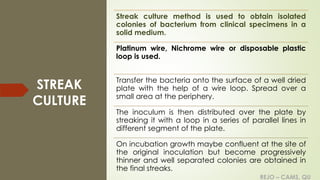
Streak culture method is used to obtain isolated
colonies of bacterium from clinical specimens in a
solid medium.
Platinum wire, Nichrome wire or disposable plastic
loop is used.
Transfer the bacteria onto the surface of a well dried
plate with the help of a wire loop. Spread over a
small area at the periphery.
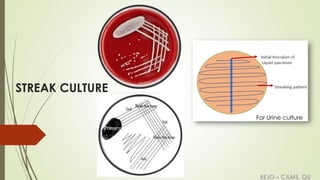
The inoculum is then distributed over the plate by
streaking it with a loop in a series of parallel lines in
different segment of the plate.
On incubation growth maybe confluent at the site of
the original inoculation but become progressively
thinner and well separated colonies are obtained in
the final streaks.
REJO – CAMS, QU
REJO – CAMS, QU
STREAK CULTURE
REJO – CAMS, QU
For Urine culture
REJO – CAMS, QU
LAWN
CULTURE
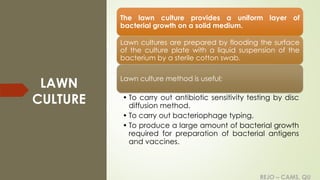
The lawn culture provides a uniform layer of
bacterial growth on a solid medium.
Lawn cultures are prepared by flooding the surface
of the culture plate with a liquid suspension of the
bacterium by a sterile cotton swab.
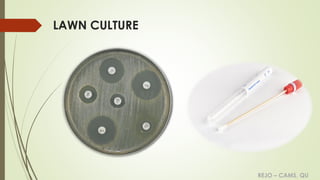
Lawn culture method is useful;
• To carry out antibiotic sensitivity testing by disc
diffusion method.
• To carry out bacteriophage typing.
• To produce a large amount of bacterial growth
required for preparation of bacterial antigens
and vaccines.
REJO – CAMS, QU
REJO – CAMS, QU
LAWN CULTURE
REJO – CAMS, QU
STROKE
CULTURE
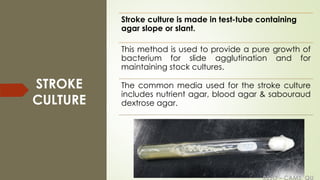
Stroke culture is made in test-tube containing
agar slope or slant.
This method is used to provide a pure growth of
bacterium for slide agglutination and for
maintaining stock cultures.
The common media used for the stroke culture
includes nutrient agar, blood agar & sabouraud
dextrose agar.
REJO – CAMS, QU
STAB
CULTURE
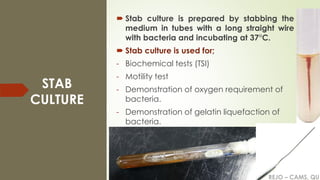
 Stab culture is prepared by stabbing the
medium in tubes with a long straight wire
with bacteria and incubating at 37°C.
 Stab culture is used for;
- Biochemical tests (TSI)
- Motility test
- Demonstration of oxygen requirement of
bacteria.
- Demonstration of gelatin liquefaction of
bacteria.
REJO – CAMS, QU
REJO – CAMS, QU
LIQUID
CULTURE
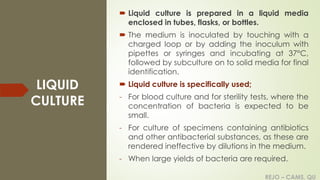
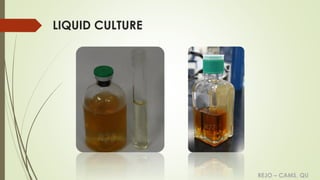
 Liquid culture is prepared in a liquid media
enclosed in tubes, flasks, or bottles.
 The medium is inoculated by touching with a
charged loop or by adding the inoculum with
pipettes or syringes and incubating at 37°C,
followed by subculture on to solid media for final
identification.
 Liquid culture is specifically used;
- For blood culture and for sterility tests, where the
concentration of bacteria is expected to be
small.
- For culture of specimens containing antibiotics
and other antibacterial substances, as these are
rendered ineffective by dilutions in the medium.
- When large yields of bacteria are required.
REJO – CAMS, QU
REJO – CAMS, QU
LIQUID CULTURE
R
J
J
REJO – CAMS, QU
POUR
PLATE
METHOD:
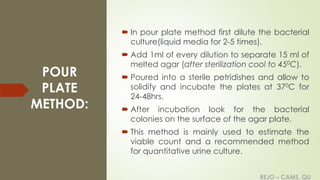
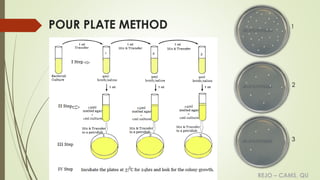
 In pour plate method first dilute the bacterial
culture(liquid media for 2-5 times).
 Add 1ml of every dilution to separate 15 ml of
melted agar (after sterilization cool to 450C).
 Poured into a sterile petridishes and allow to
solidify and incubate the plates at 370C for
24-48hrs.
 After incubation look for the bacterial
colonies on the surface of the agar plate.
 This method is mainly used to estimate the
viable count and a recommended method
for quantitative urine culture.
REJO – CAMS, QU
REJO – CAMS, QU
POUR PLATE METHOD 1
2
3
0
REJO – CAMS, QU
ANAEROBIC
CULTURE
METHOD
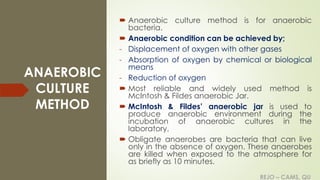
 Anaerobic culture method is for anaerobic
bacteria.
 Anaerobic condition can be achieved by;
- Displacement of oxygen with other gases
- Absorption of oxygen by chemical or biological
means
- Reduction of oxygen
 Most reliable and widely used method is
McIntosh & Fildes anaerobic Jar.
 McIntosh & Fildes’ anaerobic jar is used to
produce anaerobic environment during the
incubation of anaerobic cultures in the
laboratory.
 Obligate anaerobes are bacteria that can live
only in the absence of oxygen. These anaerobes
are killed when exposed to the atmosphere for
as briefly as 10 minutes.
REJO – CAMS, QU
REJO – CAMS, QU
ANAEROBIC CULTURE
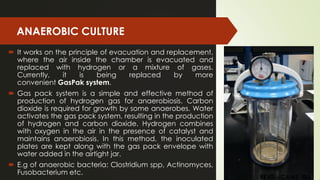
 It works on the principle of evacuation and replacement,
where the air inside the chamber is evacuated and
replaced with hydrogen or a mixture of gases.
Currently, it is being replaced by more
convenient GasPak system.
 Gas pack system is a simple and effective method of
production of hydrogen gas for anaerobiosis. Carbon
dioxide is required for growth by some anaerobes. Water
activates the gas pack system, resulting in the production
of hydrogen and carbon dioxide. Hydrogen combines
with oxygen in the air in the presence of catalyst and
maintains anaerobiosis. In this method, the inoculated
plates are kept along with the gas pack envelope with
water added in the airtight jar.
 E.g of anaerobic bacteria: Clostridium spp, Actinomyces,
Fusobacterium etc.
REJO – CAMS, QU
REJO – CAMS, QUR J J

Bacterial Culture methods

  • 1.
    REJO JACOB JOSEPH CAMS-QASSIM UNIVERSITY
  • 2.
    REJO – CAMS,QU CULTURE METHODS Culture methods helps to multiply the micro-organisms by letting them reproduce in predetermined culture media under controlled laboratory conditions. The Purpose includes; - To Grow and isolate all the bacteria present in an infection. - To study the colony morphology and characterization of bacteria. - To obtain enough growth for the preparation of antigen and other tests. - To test for antibiotic sensitivity , bacteriophage and bacteriocin susceptibility. - To stock bacterial strains for future use. - To estimate viable count. REJO – CAMS, QU
  • 3.
    REJO – CAMS,QU General rules during Inoculation All the inoculation procedure must follow aseptic technique. During inoculation, culture media should be uncovered only for few seconds. The area of medium used must be adequately used to give separate colonies. Before inoculating a culture media plate, check the surface the medium is dry. Moist surfaces will not yield single colonies. The caps of the bottles and plugs of the tubes should be loosened for easy removal during inoculation. Uninoculated culture media plate kept with the lid touching the bench and the plate with media on the top. REJO – CAMS, QU
  • 4.
    REJO – CAMS,QU General rules during Inoculation Media to be inoculated should be labelled with glass marker pen or self-adhesive label indicating the lab number of the sample and date. Labelling should be done on the bottom of the petridishes and tubes rather than the lids or caps; because there is a chance of misplacing the lids and caps. Labels should be checked again at the time of inoculation. For a right-handed person, the inoculating loop or swab should be placed on the right hand and the culture medium should be placed in the left hand. REJO – CAMS, QU
  • 5.
    REJO – CAMS,QU Types of Culture methods: Streak culture Lawn culture Stroke culture Stab culture Liquid culture Pour plate method Anaerobic culture method REJO – CAMS, QU
  • 6.
    REJO – CAMS,QU STREAK CULTURE Streak culture method is used to obtain isolated colonies of bacterium from clinical specimens in a solid medium. Platinum wire, Nichrome wire or disposable plastic loop is used. Transfer the bacteria onto the surface of a well dried plate with the help of a wire loop. Spread over a small area at the periphery. The inoculum is then distributed over the plate by streaking it with a loop in a series of parallel lines in different segment of the plate. On incubation growth maybe confluent at the site of the original inoculation but become progressively thinner and well separated colonies are obtained in the final streaks. REJO – CAMS, QU
  • 7.
    REJO – CAMS,QU STREAK CULTURE REJO – CAMS, QU For Urine culture
  • 8.
    REJO – CAMS,QU LAWN CULTURE The lawn culture provides a uniform layer of bacterial growth on a solid medium. Lawn cultures are prepared by flooding the surface of the culture plate with a liquid suspension of the bacterium by a sterile cotton swab. Lawn culture method is useful; • To carry out antibiotic sensitivity testing by disc diffusion method. • To carry out bacteriophage typing. • To produce a large amount of bacterial growth required for preparation of bacterial antigens and vaccines. REJO – CAMS, QU
  • 9.
    REJO – CAMS,QU LAWN CULTURE
  • 10.
    REJO – CAMS,QU STROKE CULTURE Stroke culture is made in test-tube containing agar slope or slant. This method is used to provide a pure growth of bacterium for slide agglutination and for maintaining stock cultures. The common media used for the stroke culture includes nutrient agar, blood agar & sabouraud dextrose agar.
  • 11.
    REJO – CAMS,QU STAB CULTURE  Stab culture is prepared by stabbing the medium in tubes with a long straight wire with bacteria and incubating at 37°C.  Stab culture is used for; - Biochemical tests (TSI) - Motility test - Demonstration of oxygen requirement of bacteria. - Demonstration of gelatin liquefaction of bacteria. REJO – CAMS, QU
  • 12.
    REJO – CAMS,QU LIQUID CULTURE  Liquid culture is prepared in a liquid media enclosed in tubes, flasks, or bottles.  The medium is inoculated by touching with a charged loop or by adding the inoculum with pipettes or syringes and incubating at 37°C, followed by subculture on to solid media for final identification.  Liquid culture is specifically used; - For blood culture and for sterility tests, where the concentration of bacteria is expected to be small. - For culture of specimens containing antibiotics and other antibacterial substances, as these are rendered ineffective by dilutions in the medium. - When large yields of bacteria are required. REJO – CAMS, QU
  • 13.
    REJO – CAMS,QU LIQUID CULTURE R J J
  • 14.
    REJO – CAMS,QU POUR PLATE METHOD:  In pour plate method first dilute the bacterial culture(liquid media for 2-5 times).  Add 1ml of every dilution to separate 15 ml of melted agar (after sterilization cool to 450C).  Poured into a sterile petridishes and allow to solidify and incubate the plates at 370C for 24-48hrs.  After incubation look for the bacterial colonies on the surface of the agar plate.  This method is mainly used to estimate the viable count and a recommended method for quantitative urine culture. REJO – CAMS, QU
  • 15.
    REJO – CAMS,QU POUR PLATE METHOD 1 2 3 0
  • 16.
    REJO – CAMS,QU ANAEROBIC CULTURE METHOD  Anaerobic culture method is for anaerobic bacteria.  Anaerobic condition can be achieved by; - Displacement of oxygen with other gases - Absorption of oxygen by chemical or biological means - Reduction of oxygen  Most reliable and widely used method is McIntosh & Fildes anaerobic Jar.  McIntosh & Fildes’ anaerobic jar is used to produce anaerobic environment during the incubation of anaerobic cultures in the laboratory.  Obligate anaerobes are bacteria that can live only in the absence of oxygen. These anaerobes are killed when exposed to the atmosphere for as briefly as 10 minutes. REJO – CAMS, QU
  • 17.
    REJO – CAMS,QU ANAEROBIC CULTURE  It works on the principle of evacuation and replacement, where the air inside the chamber is evacuated and replaced with hydrogen or a mixture of gases. Currently, it is being replaced by more convenient GasPak system.  Gas pack system is a simple and effective method of production of hydrogen gas for anaerobiosis. Carbon dioxide is required for growth by some anaerobes. Water activates the gas pack system, resulting in the production of hydrogen and carbon dioxide. Hydrogen combines with oxygen in the air in the presence of catalyst and maintains anaerobiosis. In this method, the inoculated plates are kept along with the gas pack envelope with water added in the airtight jar.  E.g of anaerobic bacteria: Clostridium spp, Actinomyces, Fusobacterium etc. REJO – CAMS, QU
  • 18.