CULTURE
METHODS
G.HARIPRASAD M.Sc.Med Micro M.Phil
LECTURER
THOOTHUKUDI GOVT. MEDICAL COLLEGE
THOOTHUKUDI
PURPOSE OF CULTURE
 To isolate bacteria in pure culture.
 Demonstrate their properties.
 Obtain sufficient growth for
preparation of antigens and for
other tests.
 Type isolates by methods such as
bacteriophage and bacteriocin
susceptibility.
 Determine sensitivity to
antibiotics.
 Estimate viable counts and
 Maintain stock cultures.
METHODS
Streak culture.
Lawn culture.
Stroke culture.
Stab culture.
Pour plate culture.
Liquid culture.
STREAK CULTURE
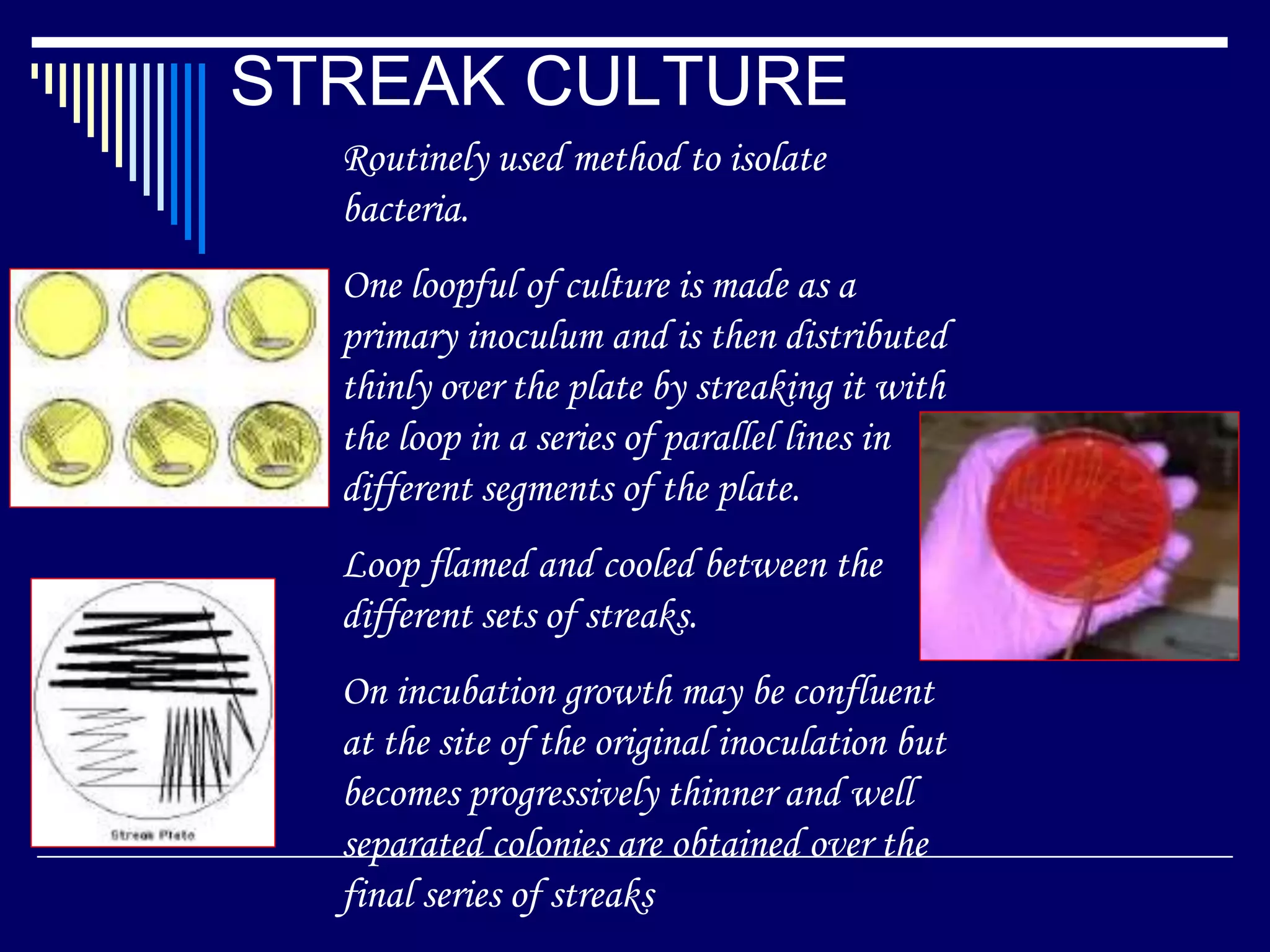
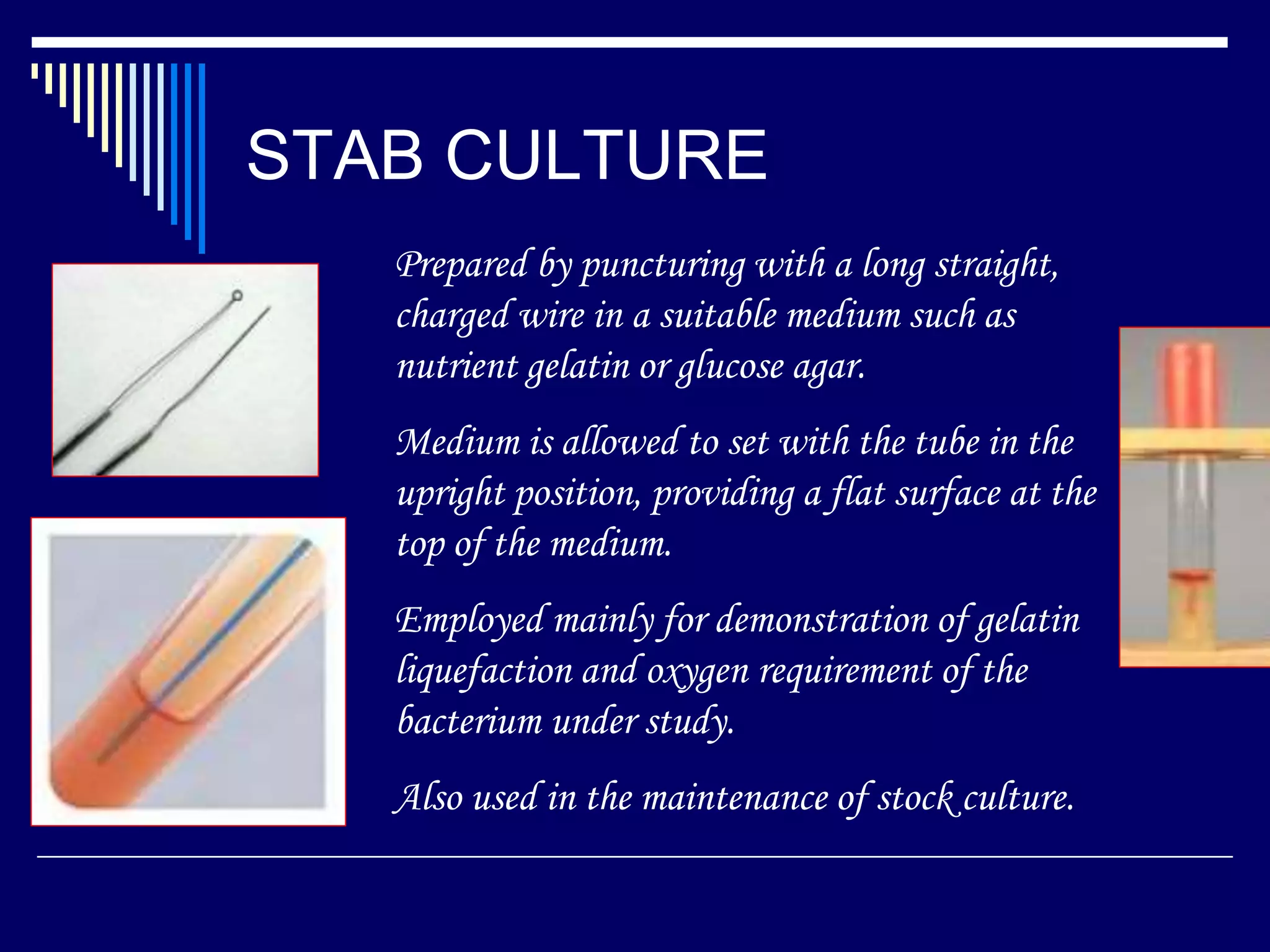
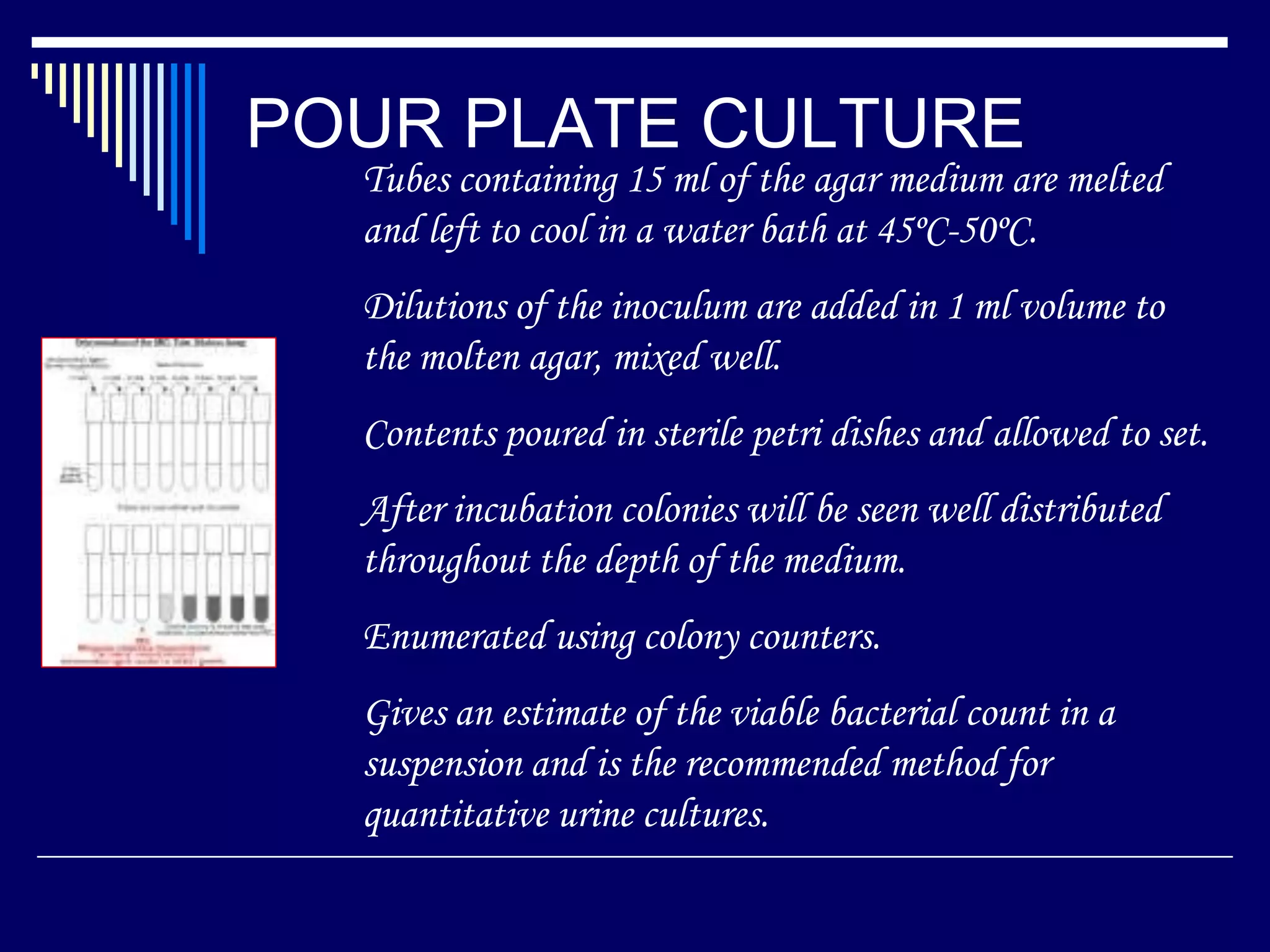
Routinely used method to isolate
bacteria.
One loopful of culture is made as a
primary inoculum and is then distributed
thinly over the plate by streaking it with
the loop in a series of parallel lines in
different segments of the plate.
Loop flamed and cooled between the
different sets of streaks.
On incubation growth may be confluent
at the site of the original inoculation but
becomes progressively thinner and well
separated colonies are obtained over the
final series of streaks
LAWN CULTURE
Also called as carpet culture.
Provides a uniform, growth of the bacterium.
Useful for bacteriophage typing and antibiotic sensitivity testing.
Also used in the preparation of bacterial antigens and vaccines.
Prepared by flooding the surface of the plate with a liquid culture or
suspension of the bacterium, pipetting off the excess inoculum and
incubating the plate.
Alternatively the surface of the plate may be inoculated by applying a
swab soaked in the bacterial culture or suspension.
COTTON SWAB IS DIPPED IN
CULTURE NEAR FLAME
SWAB CHARGED WITH
CULTURE IS SWABBED ON
PLATE
ANTIBIOTIC SENSITIVITY TESTING
STROKE CULTURE
Made in tubes containing
agar slopes (slant).
Employed for providing a
pure growth of the bacterium
for slide agglutination and
other diagnostic tests.
STAB CULTURE
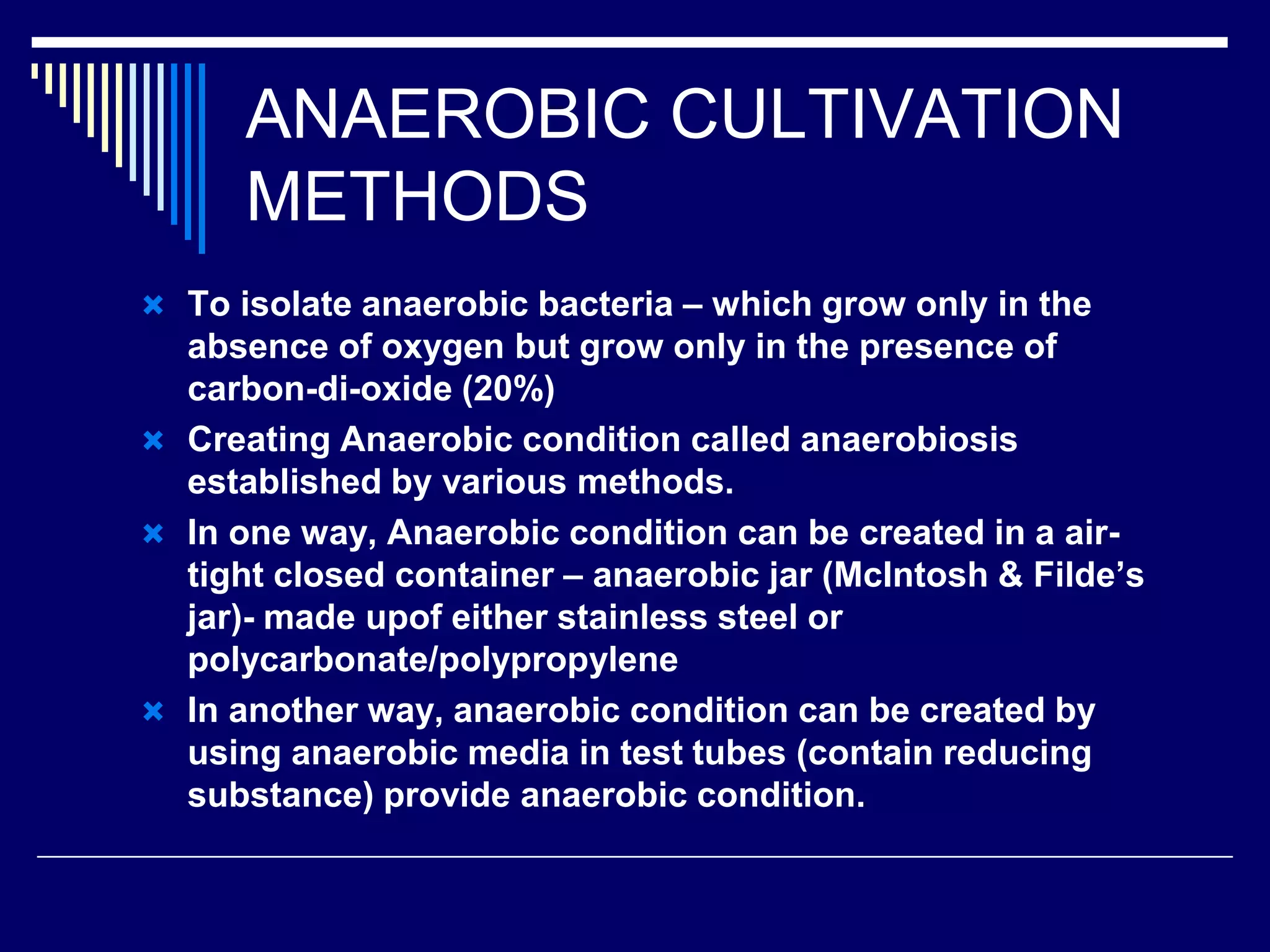
Prepared by puncturing with a long straight,
charged wire in a suitable medium such as
nutrient gelatin or glucose agar.
Medium is allowed to set with the tube in the
upright position, providing a flat surface at the
top of the medium.
Employed mainly for demonstration of gelatin
liquefaction and oxygen requirement of the
bacterium under study.
Also used in the maintenance of stock culture.
POUR PLATE CULTURE
Tubes containing 15 ml of the agar medium are melted
and left to cool in a water bath at 45ºC-50ºC.
Dilutions of the inoculum are added in 1 ml volume to
the molten agar, mixed well.
Contents poured in sterile petri dishes and allowed to set.
After incubation colonies will be seen well distributed
throughout the depth of the medium.
Enumerated using colony counters.
Gives an estimate of the viable bacterial count in a
suspension and is the recommended method for
quantitative urine cultures.
COLONY NUMBERS DECREASES WITH SERIAL DILUTION
COLONY COUNTER
LIQUID CULTURES
 Inoculated by touching with a charged
loop or by adding the inoculum with
pipettes or syringes.
 Method employed for blood culture &
for sterility tests.
 Preferable for inocula containing
antibiotics and other antibacterial
substances.
 Preferred when large yields are desired.
ANAEROBIC CULTIVATION
METHODS
 To isolate anaerobic bacteria – which grow only in the
absence of oxygen but grow only in the presence of
carbon-di-oxide (20%)
 Creating Anaerobic condition called anaerobiosis
established by various methods.
 In one way, Anaerobic condition can be created in a air-
tight closed container – anaerobic jar (McIntosh & Filde’s
jar)- made upof either stainless steel or
polycarbonate/polypropylene
 In another way, anaerobic condition can be created by
using anaerobic media in test tubes (contain reducing
substance) provide anaerobic condition.
Methods establishing anaerobic condition
in anaerobic jar
 Anaerobic gaspak method
 Evacuation – replacement method
Anaerobic gaspak method
 Gas pak is commercially used and never be used again
 Gas-pak is a disposable packet containing pellets of
sodium borohydride, cobalt chloride, citric acid and sodium
bicarbonate.
 These chemicals generate hydrogen and carbon dioxide
when water is added (about 10 ml) ( some gaspak do not
need water)
 Hydrogen combines with oxygen in the presence of a
catalyst.
 After the inoculated plates are placed inside an air-tight jar,
the packet of “Gas-pak” with water added, is kept inside
and the lid is tightly closed.
METAL JAR PLASTIC JAR
McIntosh jar
GAS PAK CATALYST
EVACUATION-
REPLACEMENT METHOD
 This is performed by evacuating preexisting air from
jar and filling of hydrogen and carbon dioxide.
 The anaerobic jar is provided with inlet and outlet
and pressure gauze
 Through inlet gases are passed inside the jar – but
through outlet gas is evacuated.
 After placing the plates and palladium catalyst the jar
is tightly closed
 The remaining air (preexisting oxygen) is evacuated
by vacuum pump
 First Hydrogen gas (90%) is passed, followed by
passing carbon dioxide(10%) and incubated.
ANAEROBIC SETUP
ANAEROBIC MEDIA
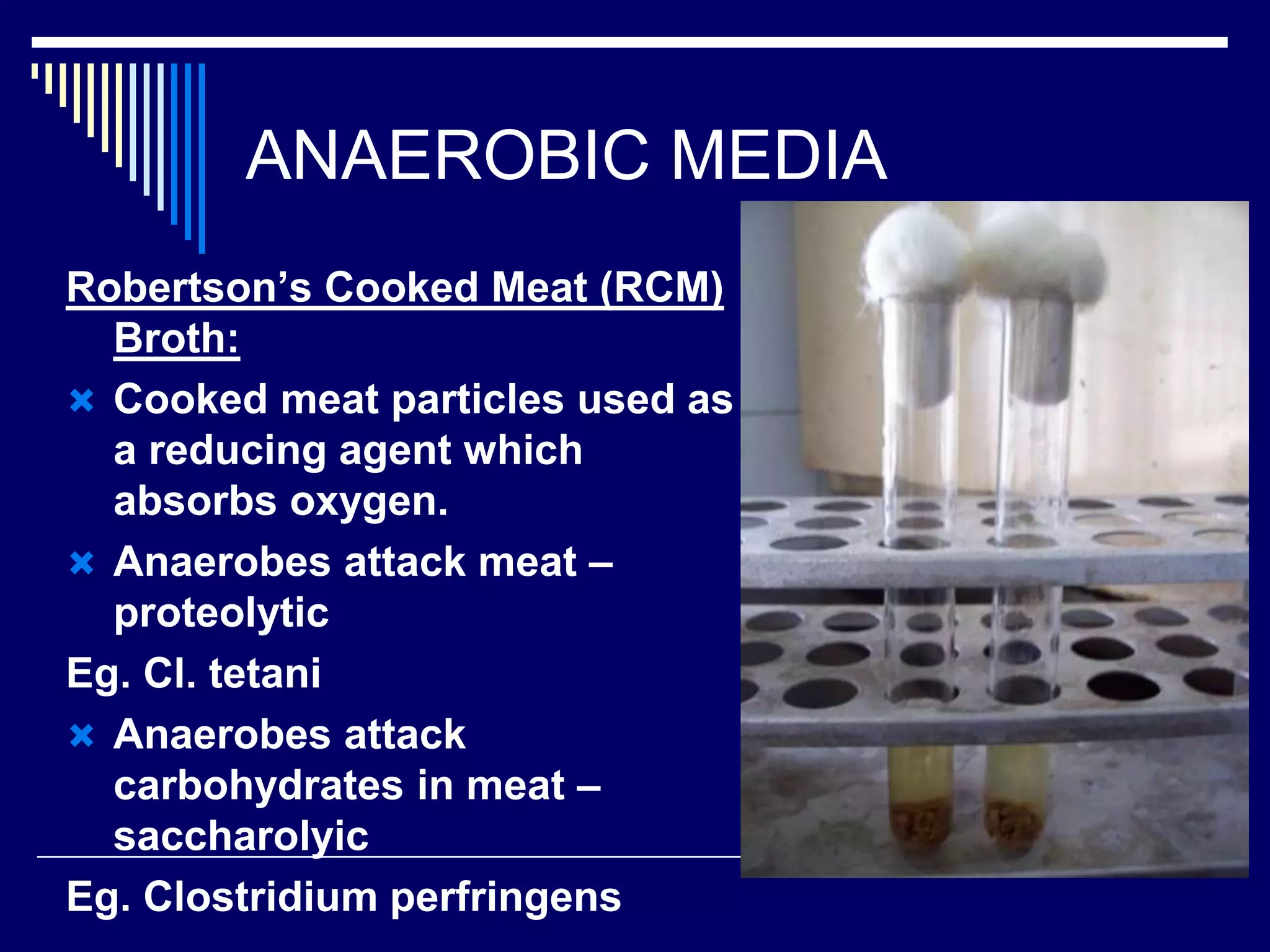
Robertson’s Cooked Meat (RCM)
Broth:
 Cooked meat particles used as
a reducing agent which
absorbs oxygen.
 Anaerobes attack meat –
proteolytic
Eg. Cl. tetani
 Anaerobes attack
carbohydrates in meat –
saccharolyic
Eg. Clostridium perfringens
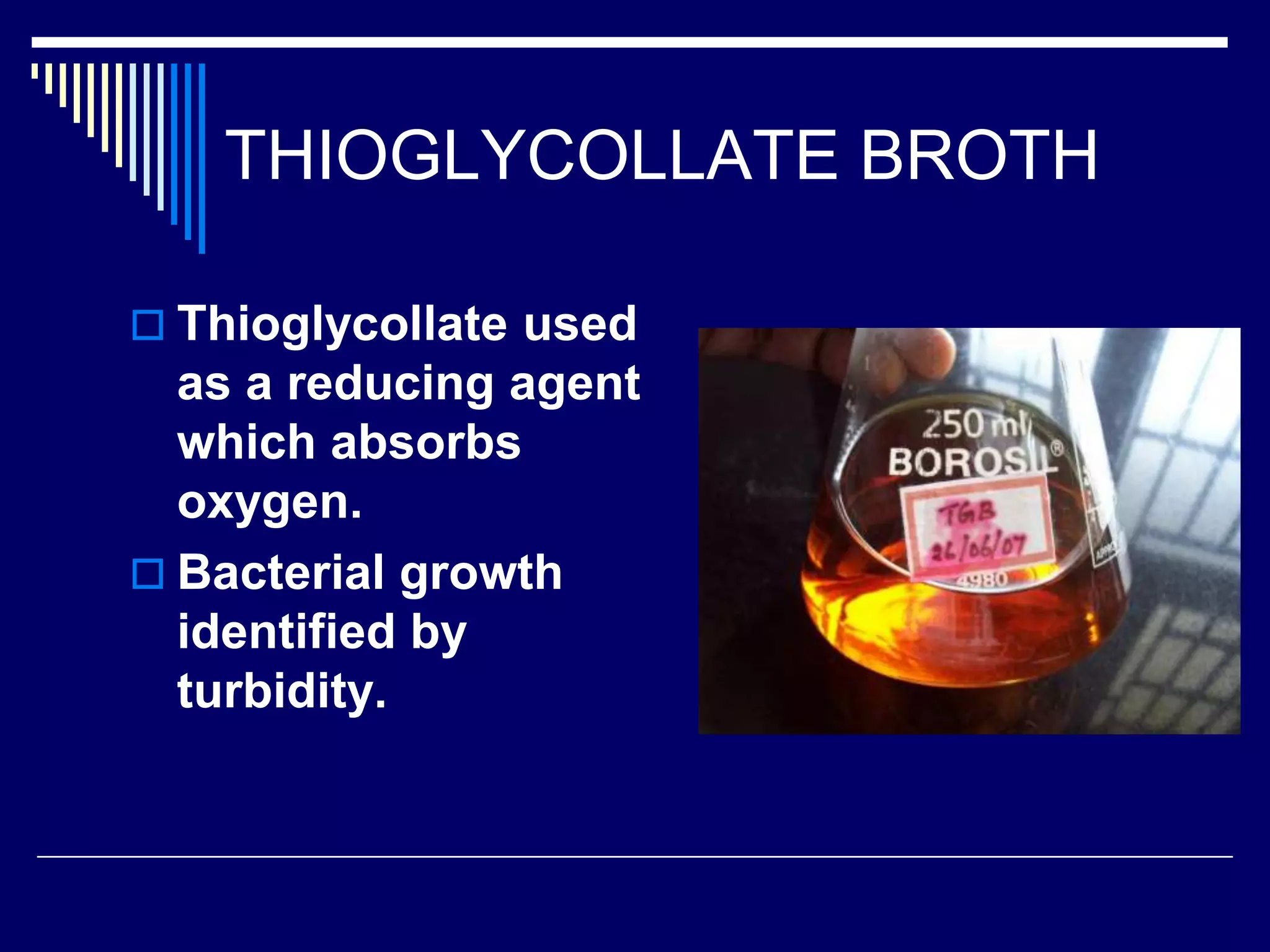
THIOGLYCOLLATE BROTH
 Thioglycollate used
as a reducing agent
which absorbs
oxygen.
 Bacterial growth
identified by
turbidity.
ANAEROBIC CULTURE METHODS
3.ABSORPTION OF CHEMICALS WITH CHEMICALS
Alkaline pyrogallol – absorbs oxygen.
Pyrogallic acid added to a solution of
sodim hydroxide in a large test tube
placed inside an air-tight jar – provides
anerobiosis.
QUALITY ASSURANCE
 Checking whether the process is working
properly or not.
Chemical indicators:
 Methylene blue indicator – turns white when
reduced i.e.during anaerobiosis.
Biological indicators:
 Pseudomonas aeruginosa ( aerobic
bacteria) will grow if anaerobiosis is not
maintained.
 CANDLE JAR METHOD:-
inoculated plates are placed inside a
large air-tight container and a
lighted candle kept in it before the
lid is sealed – provides a
concentration of carbondioxide
which stimulates the growth of most
bacteria.
References:
www.slideshare.net

CULTURING METHODS.ppt

  • 1.
    CULTURE METHODS G.HARIPRASAD M.Sc.Med MicroM.Phil LECTURER THOOTHUKUDI GOVT. MEDICAL COLLEGE THOOTHUKUDI
  • 2.
    PURPOSE OF CULTURE To isolate bacteria in pure culture.  Demonstrate their properties.  Obtain sufficient growth for preparation of antigens and for other tests.  Type isolates by methods such as bacteriophage and bacteriocin susceptibility.  Determine sensitivity to antibiotics.  Estimate viable counts and  Maintain stock cultures.
  • 3.
    METHODS Streak culture. Lawn culture. Strokeculture. Stab culture. Pour plate culture. Liquid culture.
  • 4.
    STREAK CULTURE Routinely usedmethod to isolate bacteria. One loopful of culture is made as a primary inoculum and is then distributed thinly over the plate by streaking it with the loop in a series of parallel lines in different segments of the plate. Loop flamed and cooled between the different sets of streaks. On incubation growth may be confluent at the site of the original inoculation but becomes progressively thinner and well separated colonies are obtained over the final series of streaks
  • 5.
    LAWN CULTURE Also calledas carpet culture. Provides a uniform, growth of the bacterium. Useful for bacteriophage typing and antibiotic sensitivity testing. Also used in the preparation of bacterial antigens and vaccines. Prepared by flooding the surface of the plate with a liquid culture or suspension of the bacterium, pipetting off the excess inoculum and incubating the plate. Alternatively the surface of the plate may be inoculated by applying a swab soaked in the bacterial culture or suspension.
  • 6.
    COTTON SWAB ISDIPPED IN CULTURE NEAR FLAME SWAB CHARGED WITH CULTURE IS SWABBED ON PLATE
  • 7.
  • 8.
    STROKE CULTURE Made intubes containing agar slopes (slant). Employed for providing a pure growth of the bacterium for slide agglutination and other diagnostic tests.
  • 9.
    STAB CULTURE Prepared bypuncturing with a long straight, charged wire in a suitable medium such as nutrient gelatin or glucose agar. Medium is allowed to set with the tube in the upright position, providing a flat surface at the top of the medium. Employed mainly for demonstration of gelatin liquefaction and oxygen requirement of the bacterium under study. Also used in the maintenance of stock culture.
  • 10.
    POUR PLATE CULTURE Tubescontaining 15 ml of the agar medium are melted and left to cool in a water bath at 45ºC-50ºC. Dilutions of the inoculum are added in 1 ml volume to the molten agar, mixed well. Contents poured in sterile petri dishes and allowed to set. After incubation colonies will be seen well distributed throughout the depth of the medium. Enumerated using colony counters. Gives an estimate of the viable bacterial count in a suspension and is the recommended method for quantitative urine cultures.
  • 11.
    COLONY NUMBERS DECREASESWITH SERIAL DILUTION
  • 12.
  • 13.
    LIQUID CULTURES  Inoculatedby touching with a charged loop or by adding the inoculum with pipettes or syringes.  Method employed for blood culture & for sterility tests.  Preferable for inocula containing antibiotics and other antibacterial substances.  Preferred when large yields are desired.
  • 14.
    ANAEROBIC CULTIVATION METHODS  Toisolate anaerobic bacteria – which grow only in the absence of oxygen but grow only in the presence of carbon-di-oxide (20%)  Creating Anaerobic condition called anaerobiosis established by various methods.  In one way, Anaerobic condition can be created in a air- tight closed container – anaerobic jar (McIntosh & Filde’s jar)- made upof either stainless steel or polycarbonate/polypropylene  In another way, anaerobic condition can be created by using anaerobic media in test tubes (contain reducing substance) provide anaerobic condition.
  • 15.
    Methods establishing anaerobiccondition in anaerobic jar  Anaerobic gaspak method  Evacuation – replacement method
  • 16.
    Anaerobic gaspak method Gas pak is commercially used and never be used again  Gas-pak is a disposable packet containing pellets of sodium borohydride, cobalt chloride, citric acid and sodium bicarbonate.  These chemicals generate hydrogen and carbon dioxide when water is added (about 10 ml) ( some gaspak do not need water)  Hydrogen combines with oxygen in the presence of a catalyst.  After the inoculated plates are placed inside an air-tight jar, the packet of “Gas-pak” with water added, is kept inside and the lid is tightly closed.
  • 17.
    METAL JAR PLASTICJAR McIntosh jar
  • 18.
  • 19.
    EVACUATION- REPLACEMENT METHOD  Thisis performed by evacuating preexisting air from jar and filling of hydrogen and carbon dioxide.  The anaerobic jar is provided with inlet and outlet and pressure gauze  Through inlet gases are passed inside the jar – but through outlet gas is evacuated.  After placing the plates and palladium catalyst the jar is tightly closed  The remaining air (preexisting oxygen) is evacuated by vacuum pump  First Hydrogen gas (90%) is passed, followed by passing carbon dioxide(10%) and incubated.
  • 20.
  • 21.
    ANAEROBIC MEDIA Robertson’s CookedMeat (RCM) Broth:  Cooked meat particles used as a reducing agent which absorbs oxygen.  Anaerobes attack meat – proteolytic Eg. Cl. tetani  Anaerobes attack carbohydrates in meat – saccharolyic Eg. Clostridium perfringens
  • 22.
    THIOGLYCOLLATE BROTH  Thioglycollateused as a reducing agent which absorbs oxygen.  Bacterial growth identified by turbidity.
  • 23.
    ANAEROBIC CULTURE METHODS 3.ABSORPTIONOF CHEMICALS WITH CHEMICALS Alkaline pyrogallol – absorbs oxygen. Pyrogallic acid added to a solution of sodim hydroxide in a large test tube placed inside an air-tight jar – provides anerobiosis.
  • 24.
    QUALITY ASSURANCE  Checkingwhether the process is working properly or not. Chemical indicators:  Methylene blue indicator – turns white when reduced i.e.during anaerobiosis. Biological indicators:  Pseudomonas aeruginosa ( aerobic bacteria) will grow if anaerobiosis is not maintained.
  • 25.
     CANDLE JARMETHOD:- inoculated plates are placed inside a large air-tight container and a lighted candle kept in it before the lid is sealed – provides a concentration of carbondioxide which stimulates the growth of most bacteria.
  • 26.