CLUBFOOT
 VAGUETERM USEDTO DESCRIBE A
NUMBER OF DIFFERENTABNORMALITIES
INTHE SHAPE OFTHE FOOT
 NOW IT HAS COMETO BE SYNONYMOUS
WITH THE COMMONEST CONGENITAL
FOOTABNORMALITY i.e., CTEV
ANATOMY
ANATOMY-JOINTS
 ANKLE JOINT :TIBIA ANDTALUS
 SUBTALAR JOINT :TALUS AND CALCANEUM
 TALONAVICULAR JOINT
 CALCANEO- CUBOID JOINTS
ANATOMY
 TENDONS
 TIBIALIS POST
 FLEXOR DIG. LONGUS
 FLEXOR HALLUSIS LONGUS
ANATOMY
 LIGAMENTS
 DELTOID L. : MEDIAL COLLATERAL LIG. OF ANKLE
 SPRING L. : CALCANIUM – NAVICULAR
 CAPSULAR L. :T – N , N – C , C – M
 PLANTAR L. :LONGITUDINAL ARCH OF FOOT
NOMENCLATURE
Planus: flatfoot
Cavus: highly arched foot
Varus: heal going towards
the midline
Valgus: heel going away
from the midline
Adduction: forefoot going
towards the midline
Abduction: forefoot going away
From the midline
CLUB FOOT
CLUB FOOT
Definitions
Talipes: Talus = ankle
Pes = foot
Equinus: (Latin = horse)
Foot that is in a position of
planter flexion at the ankle,
looks like that of the horse.
Calcaneus: Full dorsiflexion at the ankle
CLUB FOOT
Types
 Idiopathic (Unknown Etiology) :
 CongenitalTalipes Equino-Varus CTEV
 Acquired, Secondary to :
 CNS Disease : Spina bifida, Poliomyelitis
 Arthrogryposis Multiplex Congenita
 Absent Bone : fibula / tibia
CTEV
 MOST COMMON CONGENITAL FOOT DISORDER
 MALES
 1/1000 LIVES BIRTHS
TYPES
 OSSEOUS : absent tibia / fibula
 MUSCULAR : AMC
 NEUROPATHIC : spina bifida
 IDIOPATHIC
 CLASSIFICATION : Ponsetti
 Supple
 Rigid
 Teratologic
CLASSIFICATION
 EXTRINSIC
 FLEXIBLEWITH ABNORMAL BONE RELATION
 WITHOUT MARKED FIBROSIS
 CONSERVATIVETREATMENT
 INTRINSIC
 RIGIDWITH ABNORMAL BONE RELATION
 MARKED FIBROSIS
 OPERATIVETREATMENT
THEORIES OF CTEV
 TURCO’S : medial displacement of navicular and
calcaneous around talus
 BROCKMAN’S : congenital atresia of theT – N joint
 Mc- KAY’s :3-D bony deformity of the subtalar complex
 INTRAUTERINE:compression by malpositon of fetus in utero
 Germ plasm theory
 Soft tissue theory
 Prenatal muscle imbalance theory
PATHO-ANATOMY
 BONES AND JOINTS
 CALCANEUS : INVARUS POSITION
 TALUS : DISPLACED MEDIAL AND PLANTARWARDS
 NAVICULAR : MEDIALLY DISPLACED AND ROTATED
 CUBOID : DISPLACED MEDIALLY AND ARTICULATES
WITHTHE NON-ARTICULAR SURFACE
OF CALCANEUM ( CUBOID SIGN /
LOCKED CUBOID )
 METATARSALS : DEVIATES MEDIALLY ATT-M JOINTS
 DISLOCATION OFTALOCALCANEAL ARTICULATION
 TIBIA – MEDIALTORSION
PATHO-ANATOMY
 BONESAND JOINTS
 EQUINUS - ANKLE JOINT
 INVERSION - SUBTALAR JOINT
 FOREFOOT ADDUCTION - MIDTARSAL JOINTS
 FOREFOOT CAVUS – EXCESSIVE ARCHING
AT MIDTARSAL JNTS
PATHO-ANATOMY
 MUSCLES CAPSULESAND LIGAMENTS
STRCTURES CONTRACTED ONTHE MEDIAL SIDE
3 MUSCLES
• AHL
• TP
• FHL
3 LIGAMENTS
• DELTOID
• SPRING
• PLANTAR
3 CAPSULES OF
• SUBTALAR
• TARSAL
• TARSOMETATARSAL
2 MUSCLES
• TIBIALIS POST.
• TENDO-ACHILLES
2 LIGAMENTS
• TALOFIBULAR
• CALCANEOFIBULAR
2 CAPSULES OF
• ANKLE JNT
• SUBTALAR JNT
PATHO-ANATOMY
 MUSCLES CAPSULESAND LIGAMENTS
STRCTURES CONTRACTED ONTHE POSTERIOR SIDE
1 MUSCLE
• TIBIALIS ANT.
1 LIGAMENT
• SUPERIOR
PARONEAL
RETINACULA
1 CAPSULES
• CALCANEO-
CUBOID JNT
PATHO-ANATOMY
 MUSCLES CAPSULESAND LIGAMENTS
STRCTURES CONTRACTED ONTHE ANTERIOR SIDE
PATHO-ANATOMY
 SKIN
 Adapts shortening on the medial side
 Deep creases on the medial side
 Dimples on the lateral aspect
 SECONDARY CHANGES
 Occurs when the child starts walking-exaggerates the
deformity
 Callosities and bursae
CLINICAL FEATURES
 COMMON PRESENTATIONS
 Detected at birth
 Infancy and early child hood
 Late childhood
CLINICAL FEATURES
 Short Achilles tendon
 High and small heel
 No creases behind Heel
 Abnormal crease in middle of the foot
 Foot is smaller in unilateral affection
 Callosities at abnormal pressure areas
 Internal torsion of the leg
 Calf muscles wasting
 Deformities don’t prevent walking
CLINICAL FEATURES
 Seek a detailed family history of clubfoot or
neuromuscular disorders, and perform a general
examination to identify any other abnormalities.
 Similar deformities are seen with myelomeningocele
and arthrogryposis.Therefore, always examine for
these associated conditions.
CLINICAL FEATURES
 DORSIFLEXION TEST :
 PLUMBLINETEST : tibial torsion
 child is made to sit on a table with both LL hanging from the
edge.
 Line drawn from the centre of the patella to the tibial tubercle
when extended down should cut the foot at 1st or 2nd
intermetatarsal space normally.- PLUMBLINE
 In CTEV , with medial rotation of tibia it cuts through 4th or 5th
space
 SCRATCHTEST – INFANTS
 MEDIAL SCRACTHTEST : FOOT EVERTS - PERONEALS
 LATERAL SCRACTHTEST: FOOT INVERTS - INVERTORS
INVESTIGATIONS
 RADIOGRAPHY
 APVIEW :angle formed b/w
 talus and calcaneum ( NORMAL 30-35) REDUCED
 Talus and metatarsals ( NORMAL 5 -15 )  -VE
Helps to asses angle of varus and forefoot adduction
RADIOGRAPHY
 LATERALVIEW - ANGLE FORMED B/W
 TIBIA AND CALCANEUM ( NORMAL 5- 15 )  -VE
 TALUS AND CALCANEUM ( NORMAL 20- 50) 
TO KNOWTHE EXTENTOF EQINUSANDVARUS DEFORMITY
 CT , MRI , ARTHROGRAPHY
MANAGEMENT
The goal of treatment for clubfoot is to obtain a plantigrade foot
that is functional, painless, and stable
A cosmetically pleasing appearance is also an important goal
 CONSERVATIVE
 SURGICAL
 EXTERNAL FIXATORS
CONSERVATIVE
 INFANTS (< 6 MONTHS)
 1ST 6WEEKS : SERIAL MANIPULATION AND CASTING
 Corrective casting
 First correction of adductus of midfoot
 Folowed by correction of inversion
 Finally correction of the equinus
Conservative management
Weekly serial manipulation and casting
Every weekly for 1st 6 week
Fortnightly till 6 months
Correction acheived Correction not achieved
Splint
day time
Phelp’s Brace
night time
Dennis Brown Splint
For 6 – 18 mothhs
CTEV shoes
( upto 4 years )
SURGERY EXT. FIXATOR
<4YRS STR
>4YRS STR+BONY
PROCEDURE
SURGICAL TRATMENT
Indications
 Late presentation, after 6 months of age
 Complementary to conservative treatment
 Failure of conservative treatment
 Residual deformities after conservative treatment
 Recurrence after conservative treatment
SURGICAL TREATMENT
 Soft tissue operations
 Release of contractures
 Tendon elongation
 Tendon transfer
 Restoration of normal bony relationship
 Bony operations
Usually accompanied with soft tissue operation
Types:
 - Osteotomy, to correct foot deformity or int. tibial torsion
 - Wedge excision
 - Arthrodesis (usually after bone maturity)
 one or several joints
 - Salvage operation to restore shape
P M S R
POSTERO MEDIAL SOFTTISSUE RELEASE ( 6-12 months )
 TURCO’S PROCEDURE
 On the posterior Side
 Z- plasty of tendo – Achilles
 Posterior capsulotomy of ankle and subtalar jnt
 Release of posterior talo-fibular and calcaneo-fibular lig
 On the medial side
 Lenghtening ofTP , FHL, FDL
 Release of talonavicular lig., spring lig., superficial part of
deltoid lig.
 Release of interossious talocalcaneal lig, capsules of naviculo-
cuniform and 1st metatarsao-cuniform jnts
P M S R
 On the plantar side
 Plantar fascia release
 Release of AH , FDB
 Post – op regimen
 Change cast at 2 weeks
 Remove K wire at 6 weeks
 Long leg cast for 3 months
 Ankle foot orthoses for 6- 9 months
LIMITED SOFT TISSUE RELEASE
 When only one component present
 Equinus – posterior release
 Adduction – medial release
 Cavus – plantar release
CIRCUMFERENTIAL RELEASE
 McKAY’s
 All structures on PMSR + lateral structures
 Superior peroneal retinaculam
 Inferior extensor retinaculam
 Dorsal calcaneo-cuboid lig.
 12 – 36 months
 Passively correctable deformity resulting from muscle
imbalance
RESISTANT CLUBFOOT
• >5YR. METATARSAL OSTEOTOMY
METATARSUS
ADDUCTUS
• <2- 3YR .modified McKey”s procedure
• 3- 10 yr
• Dwyer osteotomy
• Dilwyn –Evans operation
• 10-12 yr tripple arthrodesis
HIND FOOT
VARUS
• TendoAchillus lengthening + posterior capsulotomy sub
talar and ankle joint
• Lambrunidis triple arthrodesis
EQINUS
OPERATIONS
 TRIPPLE ARTHRODESIS(>10YRS)
 Lateral closed wedge osteotomy through subtalar and
midtarsal joints is done to fuse
 SUBTALAR
 TALONAVICULAR
 CALCANEOCUBOID
 TALECTOMY
 Severe uncorrected club-foot
 SURGERY FOR CORRECTION OFTIBIALTORSION
 >15deg should be corrected by derotation osteotomy
DILWYN-EVANS OPERATION
 Soft tissue release and calcaneocuboid fusion
 1st three stages : extensive soft tissue release
 Finally calcaneaocuboid wedge is excised
 Neglected or recurred foot in children of 4-8 yrs
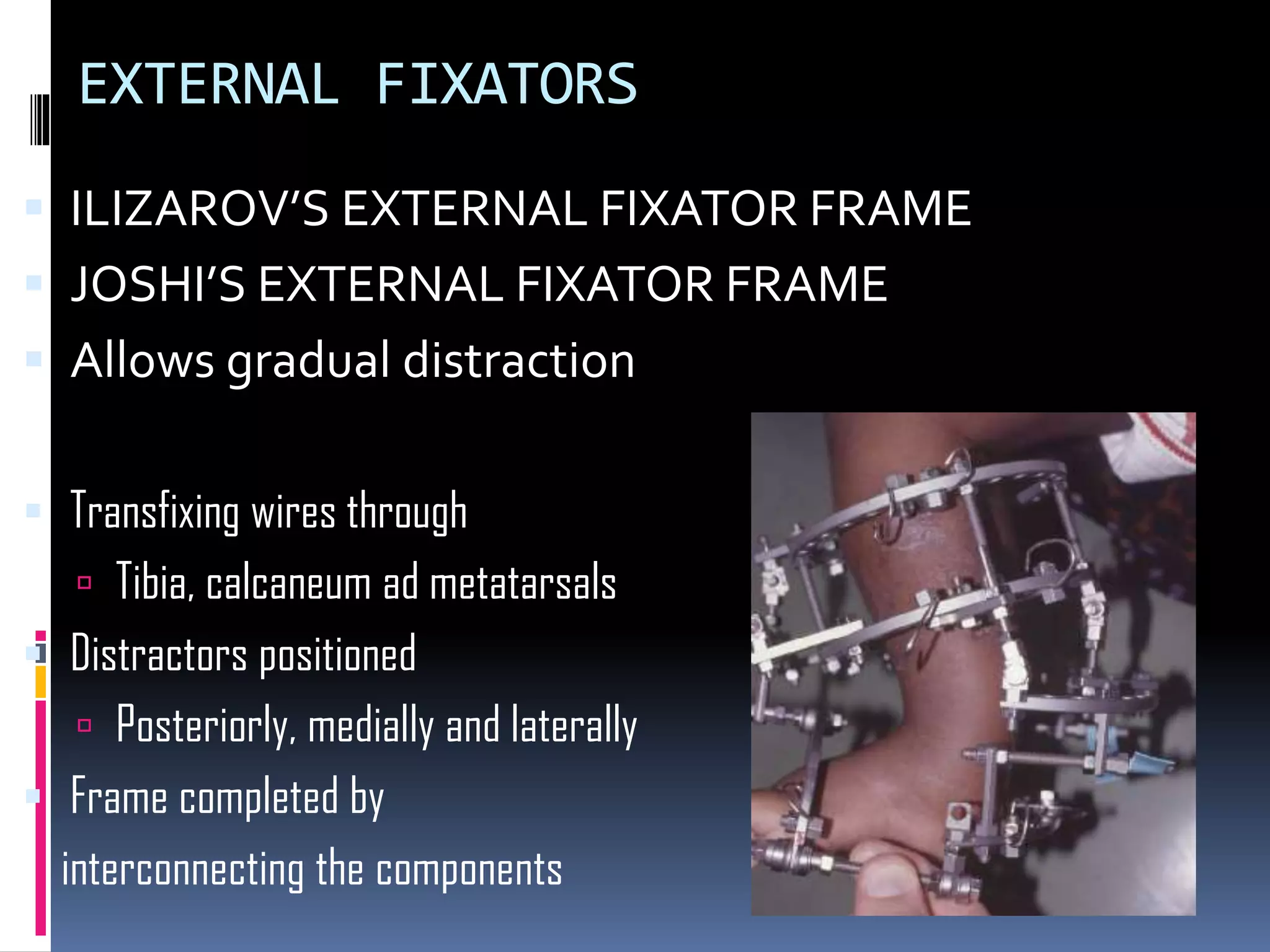
EXTERNAL FIXATORS
 ILIZAROV’S EXTERNAL FIXATOR FRAME
 JOSHI’S EXTERNAL FIXATOR FRAME
 Allows gradual distraction
 Transfixing wires through
 Tibia, calcaneum ad metatarsals
 Distractors positioned
 Posteriorly, medially and laterally
 Frame completed by
interconnecting the components
TREATMENT IN ADULT PATIENT
 CUNIFORMTARSECTOMY
 Vertical wedge of bone , with its base laterally is
removed from
 Calcaneus – behind the metatarsal joints
 Cuboid – infront of the joint
 Curved wedge , with its base upwards and laterally
 from head and neck of talus
RETENSION OF CTEV CORRECTION
 DENIS BROWN SPLINT
 PHELP’S BRACE
 BELOW KNEEWALKING CALIPERS
 CTEV SHOES
Club foot

Club foot

  • 2.
    CLUBFOOT  VAGUETERM USEDTODESCRIBE A NUMBER OF DIFFERENTABNORMALITIES INTHE SHAPE OFTHE FOOT  NOW IT HAS COMETO BE SYNONYMOUS WITH THE COMMONEST CONGENITAL FOOTABNORMALITY i.e., CTEV
  • 3.
  • 5.
    ANATOMY-JOINTS  ANKLE JOINT:TIBIA ANDTALUS  SUBTALAR JOINT :TALUS AND CALCANEUM  TALONAVICULAR JOINT  CALCANEO- CUBOID JOINTS
  • 6.
    ANATOMY  TENDONS  TIBIALISPOST  FLEXOR DIG. LONGUS  FLEXOR HALLUSIS LONGUS
  • 7.
    ANATOMY  LIGAMENTS  DELTOIDL. : MEDIAL COLLATERAL LIG. OF ANKLE  SPRING L. : CALCANIUM – NAVICULAR  CAPSULAR L. :T – N , N – C , C – M  PLANTAR L. :LONGITUDINAL ARCH OF FOOT
  • 8.
    NOMENCLATURE Planus: flatfoot Cavus: highlyarched foot Varus: heal going towards the midline Valgus: heel going away from the midline Adduction: forefoot going towards the midline Abduction: forefoot going away From the midline
  • 9.
  • 10.
    CLUB FOOT Definitions Talipes: Talus= ankle Pes = foot Equinus: (Latin = horse) Foot that is in a position of planter flexion at the ankle, looks like that of the horse. Calcaneus: Full dorsiflexion at the ankle
  • 11.
    CLUB FOOT Types  Idiopathic(Unknown Etiology) :  CongenitalTalipes Equino-Varus CTEV  Acquired, Secondary to :  CNS Disease : Spina bifida, Poliomyelitis  Arthrogryposis Multiplex Congenita  Absent Bone : fibula / tibia
  • 12.
    CTEV  MOST COMMONCONGENITAL FOOT DISORDER  MALES  1/1000 LIVES BIRTHS
  • 13.
    TYPES  OSSEOUS :absent tibia / fibula  MUSCULAR : AMC  NEUROPATHIC : spina bifida  IDIOPATHIC  CLASSIFICATION : Ponsetti  Supple  Rigid  Teratologic
  • 14.
    CLASSIFICATION  EXTRINSIC  FLEXIBLEWITHABNORMAL BONE RELATION  WITHOUT MARKED FIBROSIS  CONSERVATIVETREATMENT  INTRINSIC  RIGIDWITH ABNORMAL BONE RELATION  MARKED FIBROSIS  OPERATIVETREATMENT
  • 15.
    THEORIES OF CTEV TURCO’S : medial displacement of navicular and calcaneous around talus  BROCKMAN’S : congenital atresia of theT – N joint  Mc- KAY’s :3-D bony deformity of the subtalar complex  INTRAUTERINE:compression by malpositon of fetus in utero  Germ plasm theory  Soft tissue theory  Prenatal muscle imbalance theory
  • 16.
    PATHO-ANATOMY  BONES ANDJOINTS  CALCANEUS : INVARUS POSITION  TALUS : DISPLACED MEDIAL AND PLANTARWARDS  NAVICULAR : MEDIALLY DISPLACED AND ROTATED  CUBOID : DISPLACED MEDIALLY AND ARTICULATES WITHTHE NON-ARTICULAR SURFACE OF CALCANEUM ( CUBOID SIGN / LOCKED CUBOID )  METATARSALS : DEVIATES MEDIALLY ATT-M JOINTS  DISLOCATION OFTALOCALCANEAL ARTICULATION  TIBIA – MEDIALTORSION
  • 17.
    PATHO-ANATOMY  BONESAND JOINTS EQUINUS - ANKLE JOINT  INVERSION - SUBTALAR JOINT  FOREFOOT ADDUCTION - MIDTARSAL JOINTS  FOREFOOT CAVUS – EXCESSIVE ARCHING AT MIDTARSAL JNTS
  • 18.
    PATHO-ANATOMY  MUSCLES CAPSULESANDLIGAMENTS STRCTURES CONTRACTED ONTHE MEDIAL SIDE 3 MUSCLES • AHL • TP • FHL 3 LIGAMENTS • DELTOID • SPRING • PLANTAR 3 CAPSULES OF • SUBTALAR • TARSAL • TARSOMETATARSAL
  • 19.
    2 MUSCLES • TIBIALISPOST. • TENDO-ACHILLES 2 LIGAMENTS • TALOFIBULAR • CALCANEOFIBULAR 2 CAPSULES OF • ANKLE JNT • SUBTALAR JNT PATHO-ANATOMY  MUSCLES CAPSULESAND LIGAMENTS STRCTURES CONTRACTED ONTHE POSTERIOR SIDE
  • 20.
    1 MUSCLE • TIBIALISANT. 1 LIGAMENT • SUPERIOR PARONEAL RETINACULA 1 CAPSULES • CALCANEO- CUBOID JNT PATHO-ANATOMY  MUSCLES CAPSULESAND LIGAMENTS STRCTURES CONTRACTED ONTHE ANTERIOR SIDE
  • 21.
    PATHO-ANATOMY  SKIN  Adaptsshortening on the medial side  Deep creases on the medial side  Dimples on the lateral aspect  SECONDARY CHANGES  Occurs when the child starts walking-exaggerates the deformity  Callosities and bursae
  • 22.
    CLINICAL FEATURES  COMMONPRESENTATIONS  Detected at birth  Infancy and early child hood  Late childhood
  • 23.
    CLINICAL FEATURES  ShortAchilles tendon  High and small heel  No creases behind Heel  Abnormal crease in middle of the foot  Foot is smaller in unilateral affection  Callosities at abnormal pressure areas  Internal torsion of the leg  Calf muscles wasting  Deformities don’t prevent walking
  • 24.
    CLINICAL FEATURES  Seeka detailed family history of clubfoot or neuromuscular disorders, and perform a general examination to identify any other abnormalities.  Similar deformities are seen with myelomeningocele and arthrogryposis.Therefore, always examine for these associated conditions.
  • 25.
    CLINICAL FEATURES  DORSIFLEXIONTEST :  PLUMBLINETEST : tibial torsion  child is made to sit on a table with both LL hanging from the edge.  Line drawn from the centre of the patella to the tibial tubercle when extended down should cut the foot at 1st or 2nd intermetatarsal space normally.- PLUMBLINE  In CTEV , with medial rotation of tibia it cuts through 4th or 5th space  SCRATCHTEST – INFANTS  MEDIAL SCRACTHTEST : FOOT EVERTS - PERONEALS  LATERAL SCRACTHTEST: FOOT INVERTS - INVERTORS
  • 26.
    INVESTIGATIONS  RADIOGRAPHY  APVIEW:angle formed b/w  talus and calcaneum ( NORMAL 30-35) REDUCED  Talus and metatarsals ( NORMAL 5 -15 )  -VE Helps to asses angle of varus and forefoot adduction
  • 27.
    RADIOGRAPHY  LATERALVIEW -ANGLE FORMED B/W  TIBIA AND CALCANEUM ( NORMAL 5- 15 )  -VE  TALUS AND CALCANEUM ( NORMAL 20- 50)  TO KNOWTHE EXTENTOF EQINUSANDVARUS DEFORMITY  CT , MRI , ARTHROGRAPHY
  • 28.
    MANAGEMENT The goal oftreatment for clubfoot is to obtain a plantigrade foot that is functional, painless, and stable A cosmetically pleasing appearance is also an important goal  CONSERVATIVE  SURGICAL  EXTERNAL FIXATORS
  • 29.
    CONSERVATIVE  INFANTS (<6 MONTHS)  1ST 6WEEKS : SERIAL MANIPULATION AND CASTING  Corrective casting  First correction of adductus of midfoot  Folowed by correction of inversion  Finally correction of the equinus
  • 30.
    Conservative management Weekly serialmanipulation and casting Every weekly for 1st 6 week Fortnightly till 6 months Correction acheived Correction not achieved Splint day time Phelp’s Brace night time Dennis Brown Splint For 6 – 18 mothhs CTEV shoes ( upto 4 years ) SURGERY EXT. FIXATOR <4YRS STR >4YRS STR+BONY PROCEDURE
  • 31.
    SURGICAL TRATMENT Indications  Latepresentation, after 6 months of age  Complementary to conservative treatment  Failure of conservative treatment  Residual deformities after conservative treatment  Recurrence after conservative treatment
  • 32.
    SURGICAL TREATMENT  Softtissue operations  Release of contractures  Tendon elongation  Tendon transfer  Restoration of normal bony relationship  Bony operations Usually accompanied with soft tissue operation Types:  - Osteotomy, to correct foot deformity or int. tibial torsion  - Wedge excision  - Arthrodesis (usually after bone maturity)  one or several joints  - Salvage operation to restore shape
  • 33.
    P M SR POSTERO MEDIAL SOFTTISSUE RELEASE ( 6-12 months )  TURCO’S PROCEDURE  On the posterior Side  Z- plasty of tendo – Achilles  Posterior capsulotomy of ankle and subtalar jnt  Release of posterior talo-fibular and calcaneo-fibular lig  On the medial side  Lenghtening ofTP , FHL, FDL  Release of talonavicular lig., spring lig., superficial part of deltoid lig.  Release of interossious talocalcaneal lig, capsules of naviculo- cuniform and 1st metatarsao-cuniform jnts
  • 34.
    P M SR  On the plantar side  Plantar fascia release  Release of AH , FDB  Post – op regimen  Change cast at 2 weeks  Remove K wire at 6 weeks  Long leg cast for 3 months  Ankle foot orthoses for 6- 9 months
  • 35.
    LIMITED SOFT TISSUERELEASE  When only one component present  Equinus – posterior release  Adduction – medial release  Cavus – plantar release
  • 36.
    CIRCUMFERENTIAL RELEASE  McKAY’s All structures on PMSR + lateral structures  Superior peroneal retinaculam  Inferior extensor retinaculam  Dorsal calcaneo-cuboid lig.  12 – 36 months  Passively correctable deformity resulting from muscle imbalance
  • 37.
    RESISTANT CLUBFOOT • >5YR.METATARSAL OSTEOTOMY METATARSUS ADDUCTUS • <2- 3YR .modified McKey”s procedure • 3- 10 yr • Dwyer osteotomy • Dilwyn –Evans operation • 10-12 yr tripple arthrodesis HIND FOOT VARUS • TendoAchillus lengthening + posterior capsulotomy sub talar and ankle joint • Lambrunidis triple arthrodesis EQINUS
  • 38.
    OPERATIONS  TRIPPLE ARTHRODESIS(>10YRS) Lateral closed wedge osteotomy through subtalar and midtarsal joints is done to fuse  SUBTALAR  TALONAVICULAR  CALCANEOCUBOID  TALECTOMY  Severe uncorrected club-foot  SURGERY FOR CORRECTION OFTIBIALTORSION  >15deg should be corrected by derotation osteotomy
  • 39.
    DILWYN-EVANS OPERATION  Softtissue release and calcaneocuboid fusion  1st three stages : extensive soft tissue release  Finally calcaneaocuboid wedge is excised  Neglected or recurred foot in children of 4-8 yrs
  • 40.
    EXTERNAL FIXATORS  ILIZAROV’SEXTERNAL FIXATOR FRAME  JOSHI’S EXTERNAL FIXATOR FRAME  Allows gradual distraction  Transfixing wires through  Tibia, calcaneum ad metatarsals  Distractors positioned  Posteriorly, medially and laterally  Frame completed by interconnecting the components
  • 41.
    TREATMENT IN ADULTPATIENT  CUNIFORMTARSECTOMY  Vertical wedge of bone , with its base laterally is removed from  Calcaneus – behind the metatarsal joints  Cuboid – infront of the joint  Curved wedge , with its base upwards and laterally  from head and neck of talus
  • 42.
    RETENSION OF CTEVCORRECTION  DENIS BROWN SPLINT  PHELP’S BRACE  BELOW KNEEWALKING CALIPERS  CTEV SHOES