Phylum Entoprocta Dr. Muhammad Moosa Abro
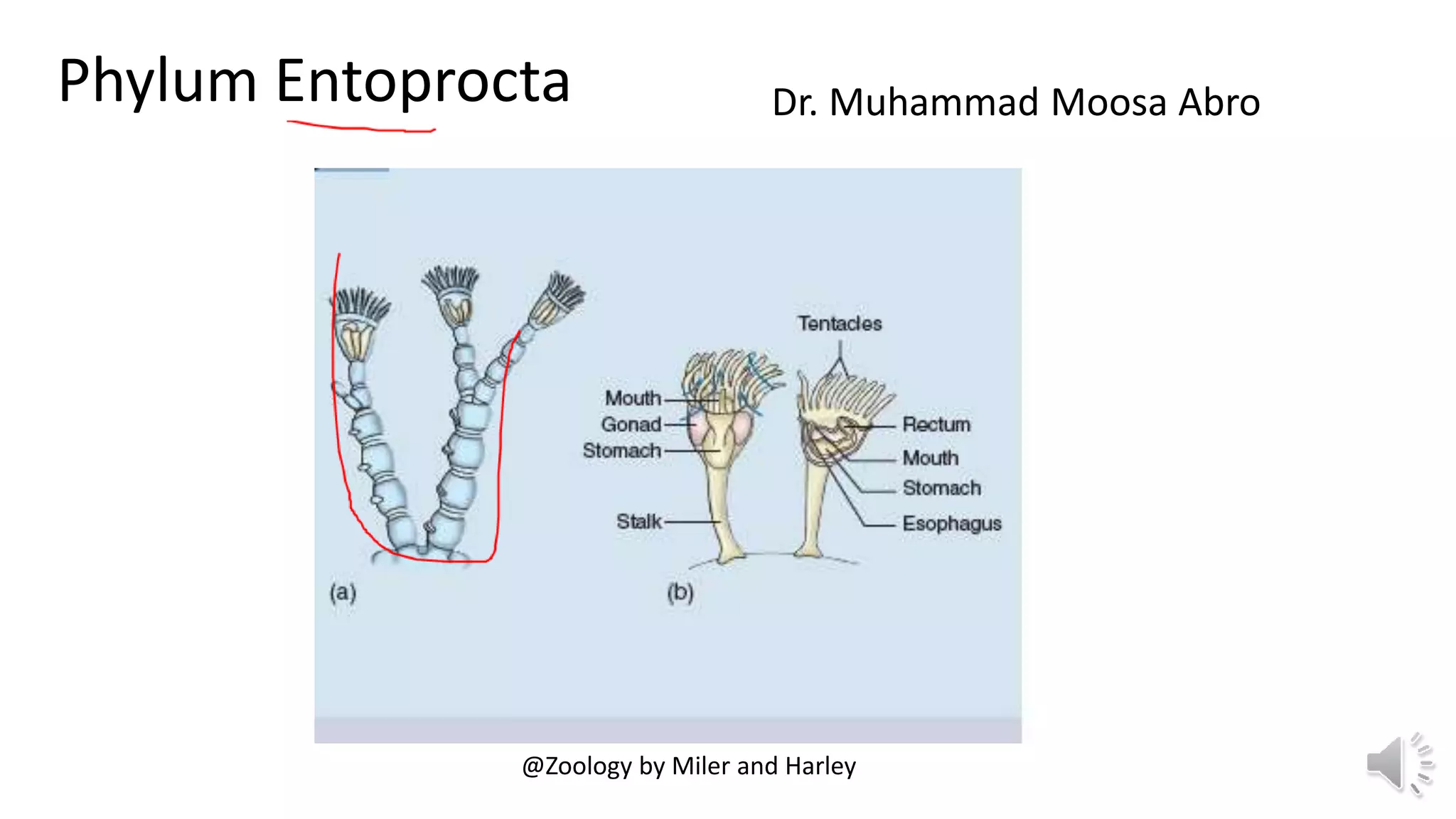
@Zoology by Miler and Harley
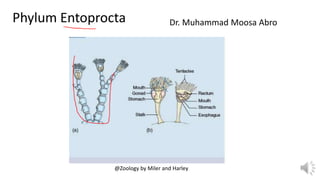
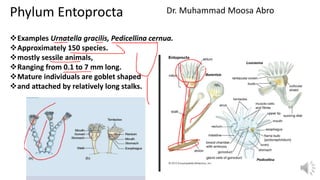
Examples Urnatella gracilis, Pedicellina cernua.
Approximately 150 species.
mostly sessile animals,
Ranging from 0.1 to 7 mm long.
Mature individuals are goblet shaped
and attached by relatively long stalks.
Phylum Entoprocta Dr. Muhammad Moosa Abro
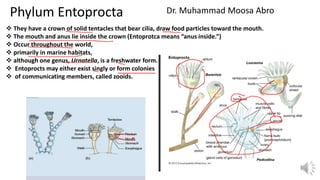
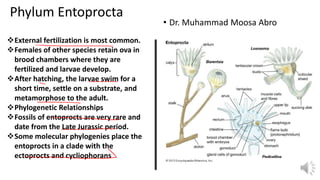
 They have a crown of solid tentacles that bear cilia, draw food particles toward the mouth.
 The mouth and anus lie inside the crown (Entoprotca means “anus inside.”)
 Occur throughout the world,
 primarily in marine habitats,
 although one genus, Urnatella, is a freshwater form.
 Entoprocts may either exist singly or form colonies
 of communicating members, called zooids.
Phylum Entoprocta Dr. Muhammad Moosa Abro
External fertilization is most common.
Females of other species retain ova in
brood chambers where they are
fertilized and larvae develop.
After hatching, the larvae swim for a
short time, settle on a substrate, and
metamorphose to the adult.
Phylogenetic Relationships
Fossils of entoprocts are very rare and
date from the Late Jurassic period.
Some molecular phylogenies place the
entoprocts in a clade with the
ectoprocts and cycliophorans
Phylum Entoprocta
• Dr. Muhammad Moosa Abro
References
5
1. Miller, A.S. and Harley, J.B. ; 1999 , 2002., 2007, 2009, 2012 & 2016 Zoology, 4th , 5th, 6th, 7th,
8th , 9th& 10th Edition (International), Singapore : McGraw Hill.
2. Hickman, C.P., Roberts, L.C/, AND Larson, A., 2018. INTEGRATED PRINCIPLES OF ZOOLOGY,
15th Edition (International), Singapore: McGRAW-Hill

Phylum Entoprocta.pptx

  • 1.
    Phylum Entoprocta Dr.Muhammad Moosa Abro @Zoology by Miler and Harley
  • 2.
    Examples Urnatella gracilis,Pedicellina cernua. Approximately 150 species. mostly sessile animals, Ranging from 0.1 to 7 mm long. Mature individuals are goblet shaped and attached by relatively long stalks. Phylum Entoprocta Dr. Muhammad Moosa Abro
  • 3.
     They havea crown of solid tentacles that bear cilia, draw food particles toward the mouth.  The mouth and anus lie inside the crown (Entoprotca means “anus inside.”)  Occur throughout the world,  primarily in marine habitats,  although one genus, Urnatella, is a freshwater form.  Entoprocts may either exist singly or form colonies  of communicating members, called zooids. Phylum Entoprocta Dr. Muhammad Moosa Abro
  • 4.
    External fertilization ismost common. Females of other species retain ova in brood chambers where they are fertilized and larvae develop. After hatching, the larvae swim for a short time, settle on a substrate, and metamorphose to the adult. Phylogenetic Relationships Fossils of entoprocts are very rare and date from the Late Jurassic period. Some molecular phylogenies place the entoprocts in a clade with the ectoprocts and cycliophorans Phylum Entoprocta • Dr. Muhammad Moosa Abro
  • 5.
    References 5 1. Miller, A.S.and Harley, J.B. ; 1999 , 2002., 2007, 2009, 2012 & 2016 Zoology, 4th , 5th, 6th, 7th, 8th , 9th& 10th Edition (International), Singapore : McGraw Hill. 2. Hickman, C.P., Roberts, L.C/, AND Larson, A., 2018. INTEGRATED PRINCIPLES OF ZOOLOGY, 15th Edition (International), Singapore: McGRAW-Hill