By
Dr. Akshymaa Moustafa
Ophthalmology specialist
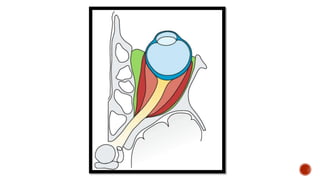
Globe Optic nerve
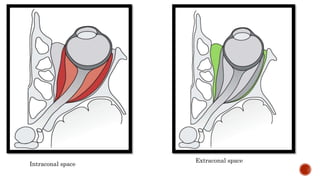
Intraconal space
Extraconal space
Sagital Rt CT Sagital LT CT
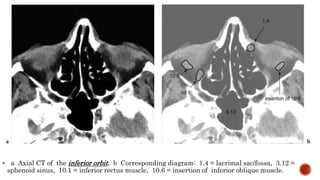
 a Axial CT of the inferior orbit. b Corresponding diagram: 1.4 = lacrimal sac/fossa, 3.12 =
sphenoid sinus, 10.1 = inferior rectus muscle, 10.6 = insertion of inferior oblique muscle.
 c Corresponding bone window, d corresponding diagram: 2.1 = nasal septum, 2.5 =
ethmoid sinus, 2.6 = middle turbinate (concha), 4 = zygomatic bone, 3.10 = oval
foramen (foramen ovale), 3.12 = sphenoid sinus, 3.13 = pterygo-palatine fossa, 11.4 =
temporal bone, 14.1 = carotid canal
 a Axial CT at the inferior region of the orbit. b Corresponding diagram: 3.7 =
inferior orbital fi ssure, 3.12 = sphenoid sinus, 4.2 = temporal fossa, 9.1 = lens,
9.3 = sclera, 10.1 = inferior rectus muscle, 14.2 = internal carotid artery (ICA).
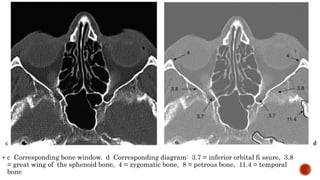
 c Corresponding bone window. d Corresponding diagram: 3.7 = inferior orbital fi ssure, 3.8
= great wing of the sphenoid bone, 4 = zygomatic bone, 8 = petrous bone, 11.4 = temporal
bone
 a Axial midorbital CT. b Corresponding diagram: 9.3 = sclera, 9.7 = vitreous body, 10.2 =
medial rectus muscle, 10.4 = lateral rectus muscle, 10.11 = optic nerve, 10.15 = lacrimal
gland, 13.1 = temporal lobe, 13.11 = pituitary gland.
 c Corresponding bone window, d corresponding diagram: 3.4 =dorsum sellae, 3.6 =
superior orbital fi ssure, 3.8 = great wing, 3.12 = sphenoid sinus, 4 = zygomatic bone.
 a Axial CT at the level of the optic nerve. b Corresponding diagram: 10.2 = medial rectus
muscle, 10.4 = lateral rectus muscle, 10.11 = optic nerve, 10.15 =lacrimal gland, 13.11 =
pituitary gland, 13.28 = mesencephalic (ambient) cistern.
 c Corresponding bone window, d corresponding diagram: 3.1 = anterior clinoid process, 3.2
= optic canal, 3.6 = superior orbital f i ssure, 3.8 = great wing of the sphenoid bone, 3.12=
sphenoid sinus, 4 = zygomatic bone.
 a Axial CT of the superior region of the orbit. b Corresponding diagram: 7.6 = olfactory
groove, 10.8 = trochlea, 10.11 = optic nerve (in 3.2 = optic canal), 10.13 = superior ophthalmic
vein, 10.15 = lacrimal gland, 13.1 = temporal lobe, 14.2 = ICA (internal carotid artery).
 c Corresponding bone window. d Corresponding diagram: 2.4 = crista galli, 3.1 = anterior
clinoid process, 3.2 = optic canal, 3.4 = dorsum sellae, 3.12 = sphenoid sinus, 7.2 = frontal
sinus.
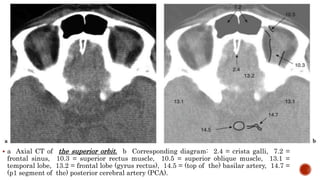
 a Axial CT of the superior orbit. b Corresponding diagram: 2.4 = crista galli, 7.2 =
frontal sinus, 10.3 = superior rectus muscle, 10.5 = superior oblique muscle, 13.1 =
temporal lobe, 13.2 = frontal lobe (gyrus rectus), 14.5 = (top of the) basilar artery, 14.7 =
(p1 segment of the) posterior cerebral artery (PCA).
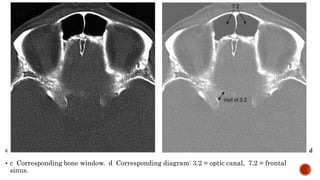
 c Corresponding bone window. d Corresponding diagram: 3.2 = optic canal, 7.2 = frontal
sinus.
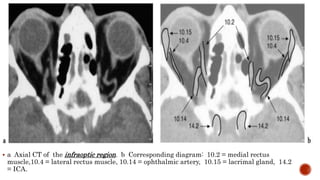
 a Axial CT of the infraoptic region. b Corresponding diagram: 10.2 = medial rectus
muscle,10.4 = lateral rectus muscle, 10.14 = ophthalmic artery, 10.15 = lacrimal gland, 14.2
= ICA.
 Coronal CT (bone window) at the dorsal opening of the optic canal. b Corresponding
diagram: 2.1 = nasal septum, 2.6 = middle turbinate, 2.7 = inferior turbinate, 3.1 = anterior
clinoid process, 3.9 = round foramen, 3.12 = sphenoid sinus, 3.13 = pterygopalatine fossa,
3.14 = pterygopalatine canal, 4 = zygomatic bone, 6 = mandibular bone.
 a Coronal CT at the level of the optic canal. b Corresponding diagram: 1.2 = maxillary sinus, 3.2
= optic canal with optic nerve, 3.6 = superior orbital fi ssure, 3.13 = pterygopalatine fossa.
 c Corresponding bone window. d Corresponding diagram: 1.2 = maxillary sinus, 2.6 = middle
turbinate, 2.7 = inferior turbinate, 3.1 = anterior clinoid process, 3.2 = optic canal, 3.11 =
sphenoid plane, 3.12 = sphenoid sinus, 3.14 = pterigopalatine canal, 3.16 = sphenopalatine
foramen, 11.4 = temporal bone.
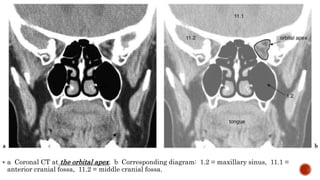
 a Coronal CT at the orbital apex. b Corresponding diagram: 1.2 = maxillary sinus, 11.1 =
anterior cranial fossa, 11.2 = middle cranial fossa.
 c Corresponding bone window. d Corresponding diagram: 1.2 = maxillary sinus, 2.5 =
ethmoid sinus, 3.7 = inferior orbital fi ssure, 11.2 = temporal lobe.
 a Coronal CT at the midorbital region. b Corresponding diagram: 10.1 = inferior rectus muscle,
10.2 = medial rectus muscle, 10.3 = superior rectus muscle, 10.4 = lateral rectus muscle, 10.5 =
superior oblique muscle, 10.7 = levator palpebrae muscle, 10.11 = optic nerve, 10.14 = ophthalmic
artery.
 c Corresponding bone window. d Corresponding diagram: 1.2 = maxillary sinus, 2.5 =
ethmoid sinus, 2.6 = middle turbinate, 2.7 = inferior turbinate, 3.8 = great wing of the
sphenoid sinus, 4 = zygomatic bone, 7 = frontal bone, 7.1 = orbital roof, 11.1 = anterior
cranial fossa
 Coronal CT at the level of the posterior globe. b Corresponding diagram: 1.2 = maxillary sinus,
2.6 = middle turbinate, 2.7 = inferior turbinate, 9.3 = sclera, 9.7 = vitreous body, 10.2 = medial
rectus muscle, 10.3 = superior rectus muscle, 10.5 = superior oblique muscle, 10.7 = levator
palpebrae muscle, 10.15 = lacrimal gland, 10.16 = intermuscular septum.
 c Corresponding bone window. d Corresponding diagram: 1.1 = infraorbital foramen (NV2),
2.1 = nasal septum, 2.5 = ethmoid sinus, 4.1 = fronto-zygomatic suture, 7.1 = orbital roof,
7.6 = olfactory groove.
 a Coronal CT at the region anterior orbit. b Corresponding diagram: 1.4 = lacrimal sac/fossa,
9.1 = lens (partial volume), 9.3 = sclera, 9.7 = vitreous body, 10.1 = inferior rectus muscle, 10.2
= (tendon of the) medial rectus muscle, 10.6 = inferior oblique muscle, 10.15 = lacrimal gland.
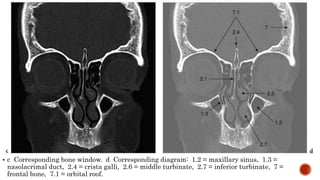
 c Corresponding bone window. d Corresponding diagram: 1.2 = maxillary sinus, 1.3 =
nasolacrimal duct, 2.4 = crista galli, 2.6 = middle turbinate, 2.7 = inferior turbinate, 7 =
frontal bone, 7.1 = orbital roof.
Ct orbit

Ct orbit

  • 1.
  • 4.
  • 5.
  • 9.
    Sagital Rt CTSagital LT CT
  • 12.
     a AxialCT of the inferior orbit. b Corresponding diagram: 1.4 = lacrimal sac/fossa, 3.12 = sphenoid sinus, 10.1 = inferior rectus muscle, 10.6 = insertion of inferior oblique muscle.
  • 13.
     c Correspondingbone window, d corresponding diagram: 2.1 = nasal septum, 2.5 = ethmoid sinus, 2.6 = middle turbinate (concha), 4 = zygomatic bone, 3.10 = oval foramen (foramen ovale), 3.12 = sphenoid sinus, 3.13 = pterygo-palatine fossa, 11.4 = temporal bone, 14.1 = carotid canal
  • 14.
     a AxialCT at the inferior region of the orbit. b Corresponding diagram: 3.7 = inferior orbital fi ssure, 3.12 = sphenoid sinus, 4.2 = temporal fossa, 9.1 = lens, 9.3 = sclera, 10.1 = inferior rectus muscle, 14.2 = internal carotid artery (ICA).
  • 15.
     c Correspondingbone window. d Corresponding diagram: 3.7 = inferior orbital fi ssure, 3.8 = great wing of the sphenoid bone, 4 = zygomatic bone, 8 = petrous bone, 11.4 = temporal bone
  • 16.
     a Axialmidorbital CT. b Corresponding diagram: 9.3 = sclera, 9.7 = vitreous body, 10.2 = medial rectus muscle, 10.4 = lateral rectus muscle, 10.11 = optic nerve, 10.15 = lacrimal gland, 13.1 = temporal lobe, 13.11 = pituitary gland.
  • 17.
     c Correspondingbone window, d corresponding diagram: 3.4 =dorsum sellae, 3.6 = superior orbital fi ssure, 3.8 = great wing, 3.12 = sphenoid sinus, 4 = zygomatic bone.
  • 18.
     a AxialCT at the level of the optic nerve. b Corresponding diagram: 10.2 = medial rectus muscle, 10.4 = lateral rectus muscle, 10.11 = optic nerve, 10.15 =lacrimal gland, 13.11 = pituitary gland, 13.28 = mesencephalic (ambient) cistern.
  • 19.
     c Correspondingbone window, d corresponding diagram: 3.1 = anterior clinoid process, 3.2 = optic canal, 3.6 = superior orbital f i ssure, 3.8 = great wing of the sphenoid bone, 3.12= sphenoid sinus, 4 = zygomatic bone.
  • 20.
     a AxialCT of the superior region of the orbit. b Corresponding diagram: 7.6 = olfactory groove, 10.8 = trochlea, 10.11 = optic nerve (in 3.2 = optic canal), 10.13 = superior ophthalmic vein, 10.15 = lacrimal gland, 13.1 = temporal lobe, 14.2 = ICA (internal carotid artery).
  • 21.
     c Correspondingbone window. d Corresponding diagram: 2.4 = crista galli, 3.1 = anterior clinoid process, 3.2 = optic canal, 3.4 = dorsum sellae, 3.12 = sphenoid sinus, 7.2 = frontal sinus.
  • 22.
     a AxialCT of the superior orbit. b Corresponding diagram: 2.4 = crista galli, 7.2 = frontal sinus, 10.3 = superior rectus muscle, 10.5 = superior oblique muscle, 13.1 = temporal lobe, 13.2 = frontal lobe (gyrus rectus), 14.5 = (top of the) basilar artery, 14.7 = (p1 segment of the) posterior cerebral artery (PCA).
  • 23.
     c Correspondingbone window. d Corresponding diagram: 3.2 = optic canal, 7.2 = frontal sinus.
  • 24.
     a AxialCT of the infraoptic region. b Corresponding diagram: 10.2 = medial rectus muscle,10.4 = lateral rectus muscle, 10.14 = ophthalmic artery, 10.15 = lacrimal gland, 14.2 = ICA.
  • 26.
     Coronal CT(bone window) at the dorsal opening of the optic canal. b Corresponding diagram: 2.1 = nasal septum, 2.6 = middle turbinate, 2.7 = inferior turbinate, 3.1 = anterior clinoid process, 3.9 = round foramen, 3.12 = sphenoid sinus, 3.13 = pterygopalatine fossa, 3.14 = pterygopalatine canal, 4 = zygomatic bone, 6 = mandibular bone.
  • 27.
     a CoronalCT at the level of the optic canal. b Corresponding diagram: 1.2 = maxillary sinus, 3.2 = optic canal with optic nerve, 3.6 = superior orbital fi ssure, 3.13 = pterygopalatine fossa.
  • 28.
     c Correspondingbone window. d Corresponding diagram: 1.2 = maxillary sinus, 2.6 = middle turbinate, 2.7 = inferior turbinate, 3.1 = anterior clinoid process, 3.2 = optic canal, 3.11 = sphenoid plane, 3.12 = sphenoid sinus, 3.14 = pterigopalatine canal, 3.16 = sphenopalatine foramen, 11.4 = temporal bone.
  • 29.
     a CoronalCT at the orbital apex. b Corresponding diagram: 1.2 = maxillary sinus, 11.1 = anterior cranial fossa, 11.2 = middle cranial fossa.
  • 30.
     c Correspondingbone window. d Corresponding diagram: 1.2 = maxillary sinus, 2.5 = ethmoid sinus, 3.7 = inferior orbital fi ssure, 11.2 = temporal lobe.
  • 31.
     a CoronalCT at the midorbital region. b Corresponding diagram: 10.1 = inferior rectus muscle, 10.2 = medial rectus muscle, 10.3 = superior rectus muscle, 10.4 = lateral rectus muscle, 10.5 = superior oblique muscle, 10.7 = levator palpebrae muscle, 10.11 = optic nerve, 10.14 = ophthalmic artery.
  • 32.
     c Correspondingbone window. d Corresponding diagram: 1.2 = maxillary sinus, 2.5 = ethmoid sinus, 2.6 = middle turbinate, 2.7 = inferior turbinate, 3.8 = great wing of the sphenoid sinus, 4 = zygomatic bone, 7 = frontal bone, 7.1 = orbital roof, 11.1 = anterior cranial fossa
  • 33.
     Coronal CTat the level of the posterior globe. b Corresponding diagram: 1.2 = maxillary sinus, 2.6 = middle turbinate, 2.7 = inferior turbinate, 9.3 = sclera, 9.7 = vitreous body, 10.2 = medial rectus muscle, 10.3 = superior rectus muscle, 10.5 = superior oblique muscle, 10.7 = levator palpebrae muscle, 10.15 = lacrimal gland, 10.16 = intermuscular septum.
  • 34.
     c Correspondingbone window. d Corresponding diagram: 1.1 = infraorbital foramen (NV2), 2.1 = nasal septum, 2.5 = ethmoid sinus, 4.1 = fronto-zygomatic suture, 7.1 = orbital roof, 7.6 = olfactory groove.
  • 35.
     a CoronalCT at the region anterior orbit. b Corresponding diagram: 1.4 = lacrimal sac/fossa, 9.1 = lens (partial volume), 9.3 = sclera, 9.7 = vitreous body, 10.1 = inferior rectus muscle, 10.2 = (tendon of the) medial rectus muscle, 10.6 = inferior oblique muscle, 10.15 = lacrimal gland.
  • 36.
     c Correspondingbone window. d Corresponding diagram: 1.2 = maxillary sinus, 1.3 = nasolacrimal duct, 2.4 = crista galli, 2.6 = middle turbinate, 2.7 = inferior turbinate, 7 = frontal bone, 7.1 = orbital roof.