Assuring Quality Education for ALL
A Techno-Management Framework covering Content
development, Faculty interaction, Delivery and
Governance Using Open source
Technology is an Enabler for Sustainable
Development India 2014

Prof. K Subramanian
SM(IEEE), SMACM, FIETE, FNTF SMCSI,MAIMA,MAIS,MCFE,MISACA(USA)
Vice chair, IEEE Delhi section
Chair, Technology Management Council, Delhi Section
Vice chair, IEEE Computer Society, Delhi Section
Vice chair, IEEE Education Society, Delhi Section
Member, IEEE Consultant Affinity Group, Delhi section
Academic Advocate, ISACA(USA), India
Former Professor & Founder Director, Advanced center for Informatics & Innovative
Learning, IGNOU
EX SR. DDG(NIC), Ministry of Communications & IT AND IT Adviser to CAG of India
Former President, Cyber society of India
Emeritus President, eInformation systems, security audit association, India
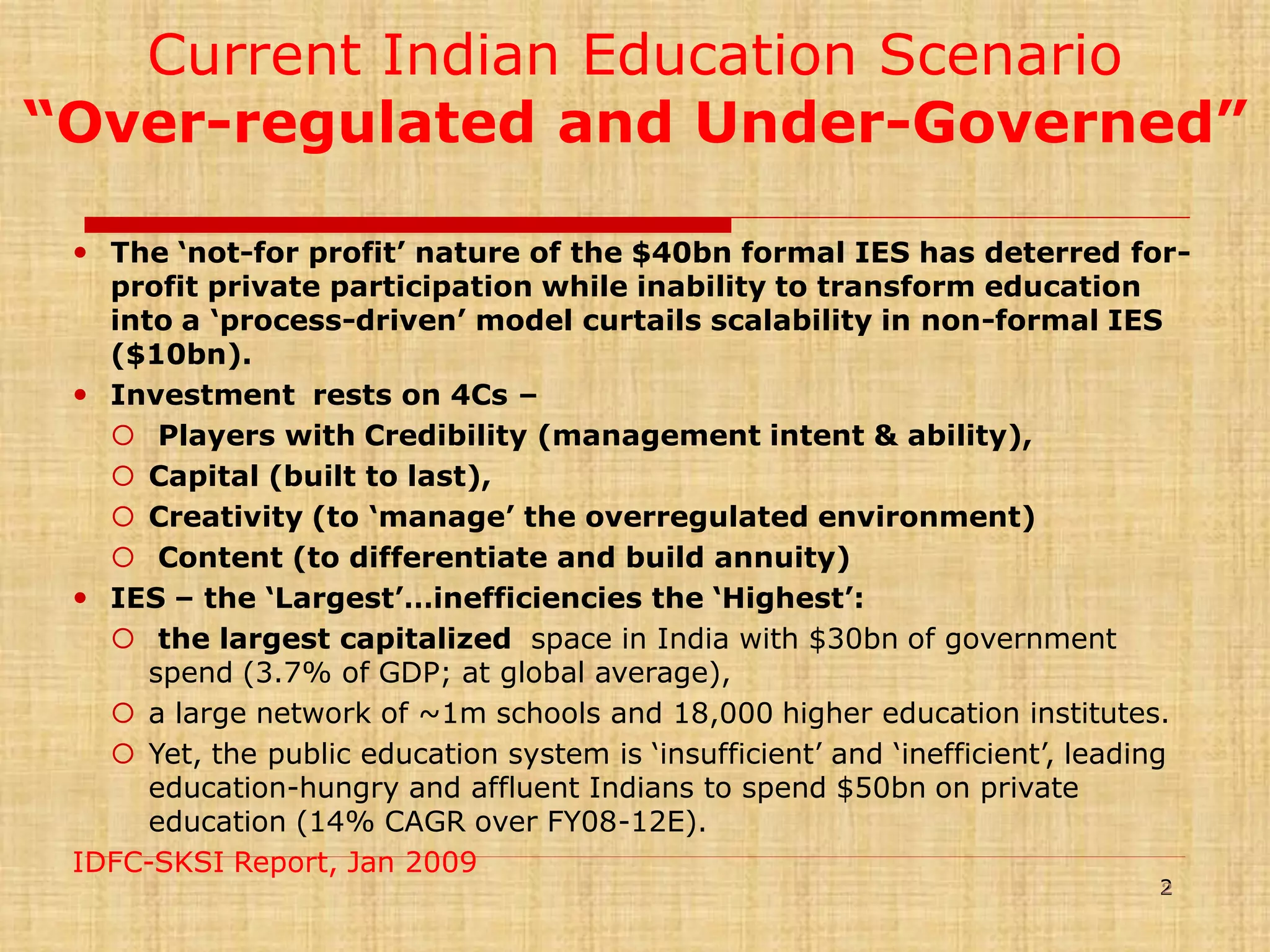
Current Indian Education Scenario
“Over-regulated and Under-Governed”
 The ‘not-for profit’ nature of the $40bn formal IES has deterred forprofit private participation while inability to transform education
into a ‘process-driven’ model curtails scalability in non-formal IES
($10bn).
 Investment rests on 4Cs –
 Players with Credibility (management intent & ability),
 Capital (built to last),
 Creativity (to ‘manage’ the overregulated environment)
 Content (to differentiate and build annuity)
 IES – the ‘Largest’…inefficiencies the ‘Highest’:
 the largest capitalized space in India with $30bn of government
spend (3.7% of GDP; at global average),
 a large network of ~1m schools and 18,000 higher education institutes.
 Yet, the public education system is ‘insufficient’ and ‘inefficient’, leading
education-hungry and affluent Indians to spend $50bn on private
education (14% CAGR over FY08-12E).
IDFC-SKSI Report, Jan 2009
2
Current Indian Education Scenario
“Over-regulated and Under-Governed”
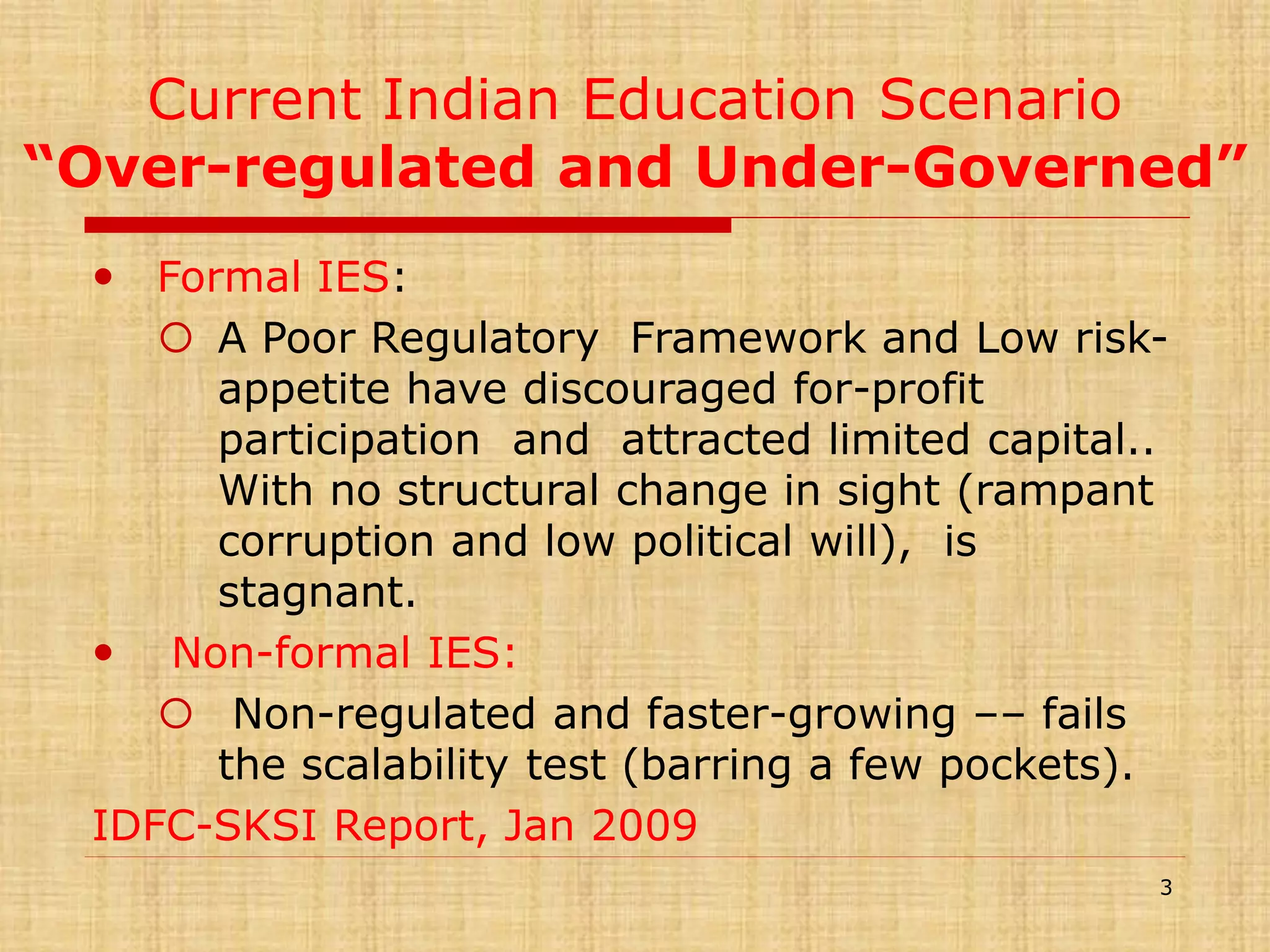
 Formal IES:
 A Poor Regulatory Framework and Low riskappetite have discouraged for-profit
participation and attracted limited capital..
With no structural change in sight (rampant
corruption and low political will), is
stagnant.
 Non-formal IES:
 Non-regulated and faster-growing –– fails
the scalability test (barring a few pockets).
IDFC-SKSI Report, Jan 2009
3
TEN NEW COMMANDMENTS/LAWS IN
DIGITAL/NETWORK ECONOMY
(e-Economy))

1. Law of Connections - Embrace Dumb power
2. Law of Plentitude - More gives more
3. Law of Exponential Value - Success is non-linear
4. Law of increasing returns - make virtuous circles
5. Law of Tripping Points - Significance precedes momentum
contd..

10/11/2013

Prof.KS@2013 Lecture @GBU,
Greater NOIDA

4
TEN NEW COMMANDMENTS/LAWS IN
DIGITAL/NETWORK ECONOMY
(e-Economy)

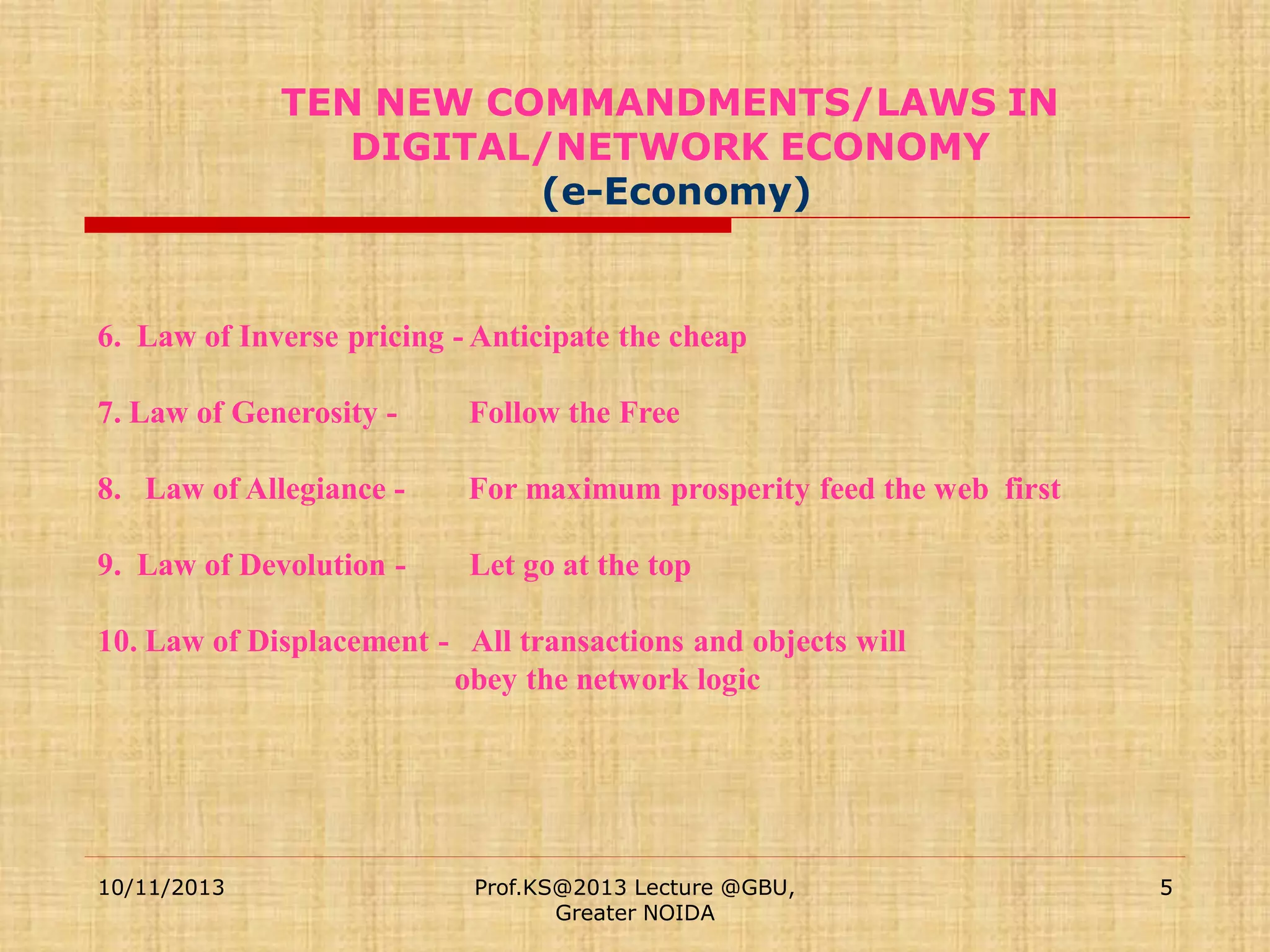
6. Law of Inverse pricing - Anticipate the cheap
7. Law of Generosity -

Follow the Free

8. Law of Allegiance -

For maximum prosperity feed the web first

9. Law of Devolution -

Let go at the top

10. Law of Displacement - All transactions and objects will
obey the network logic

10/11/2013

Prof.KS@2013 Lecture @GBU,
Greater NOIDA

5
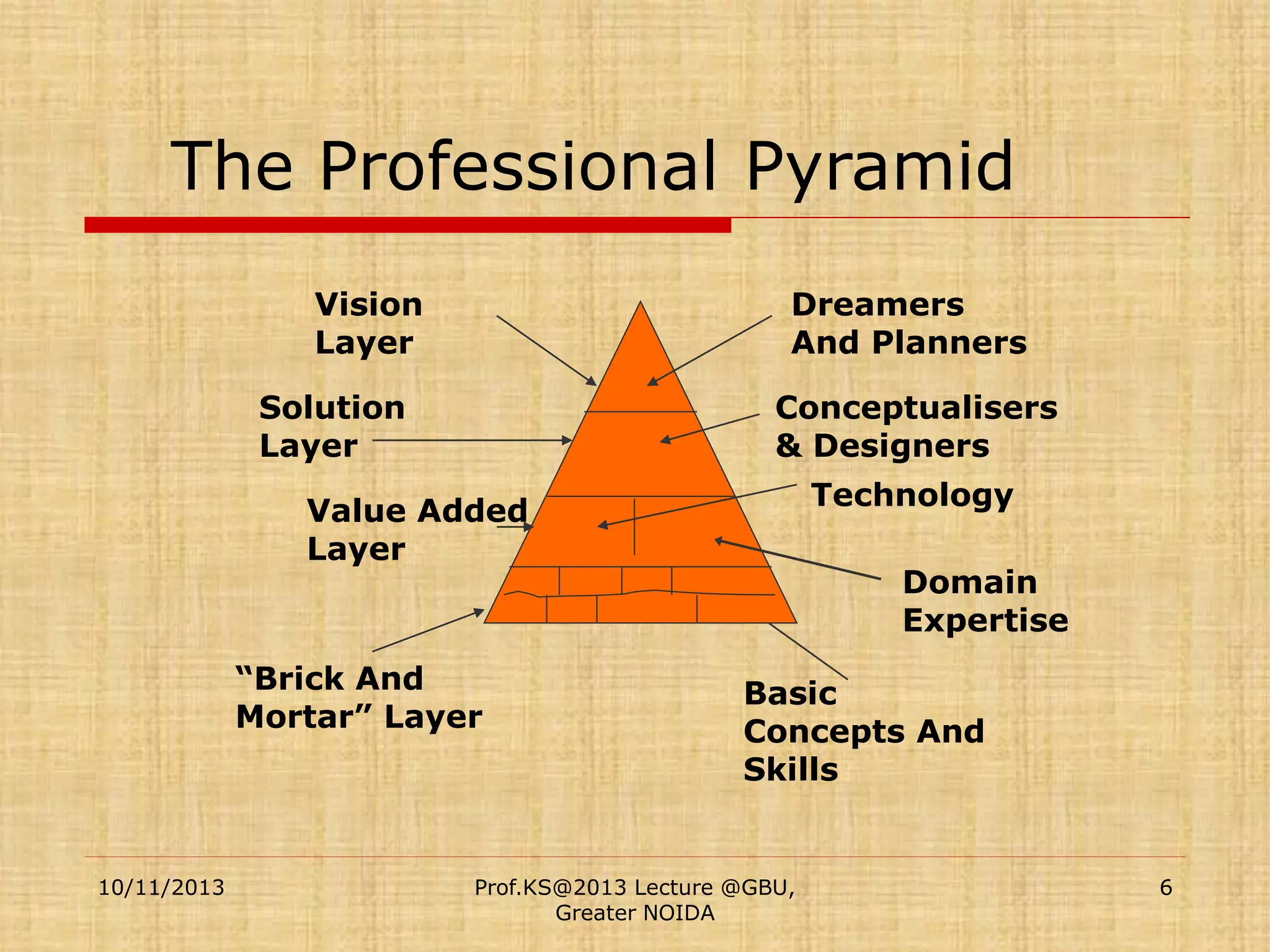
The Professional Pyramid
Vision
Layer

Dreamers
And Planners

Solution
Layer

Conceptualisers
& Designers
Technology

Value Added
Layer

“Brick And
Mortar” Layer

10/11/2013

Domain
Expertise

Basic
Concepts And
Skills

Prof.KS@2013 Lecture @GBU,
Greater NOIDA

6
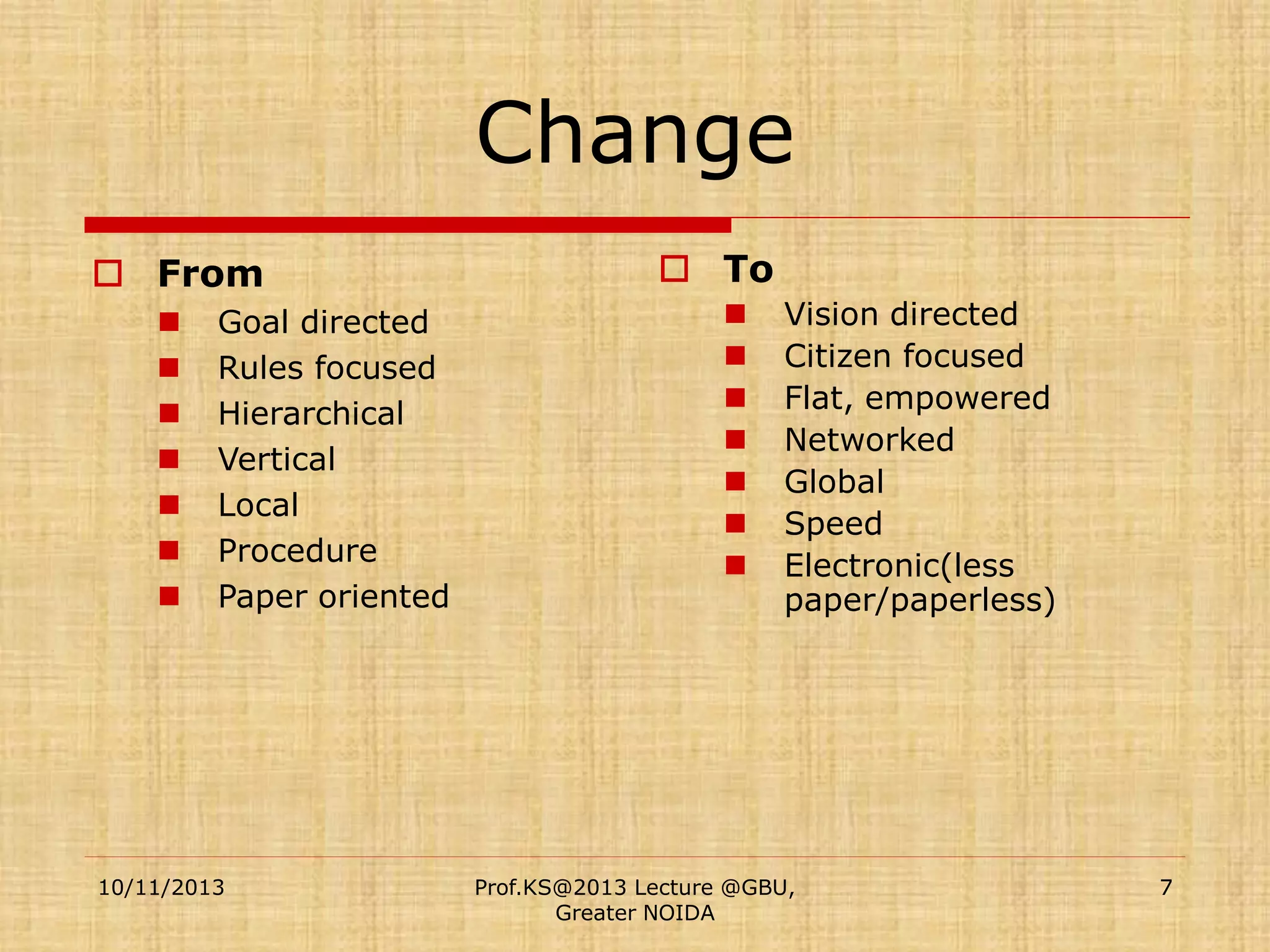
Change
 From








Goal directed
Rules focused
Hierarchical
Vertical
Local
Procedure
Paper oriented

10/11/2013

 To








Vision directed
Citizen focused
Flat, empowered
Networked
Global
Speed
Electronic(less
paper/paperless)

Prof.KS@2013 Lecture @GBU,
Greater NOIDA

7
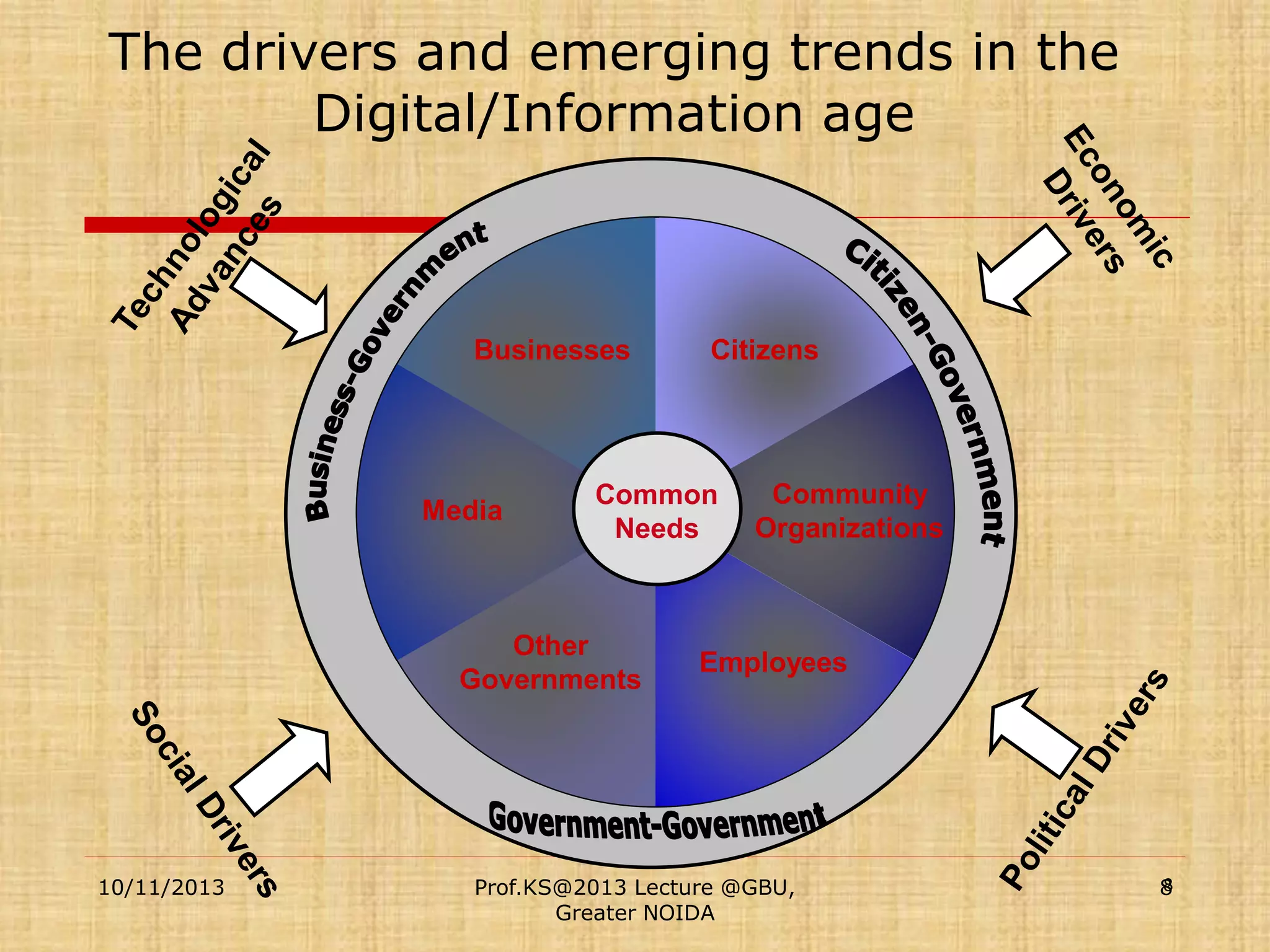
The drivers and emerging trends in the
Digital/Information age

Businesses

Media

Common
Needs

Other
Governments

10/11/2013

Citizens

Community
Organizations

Employees

Prof.KS@2013 Lecture @GBU,
Greater NOIDA

8
8
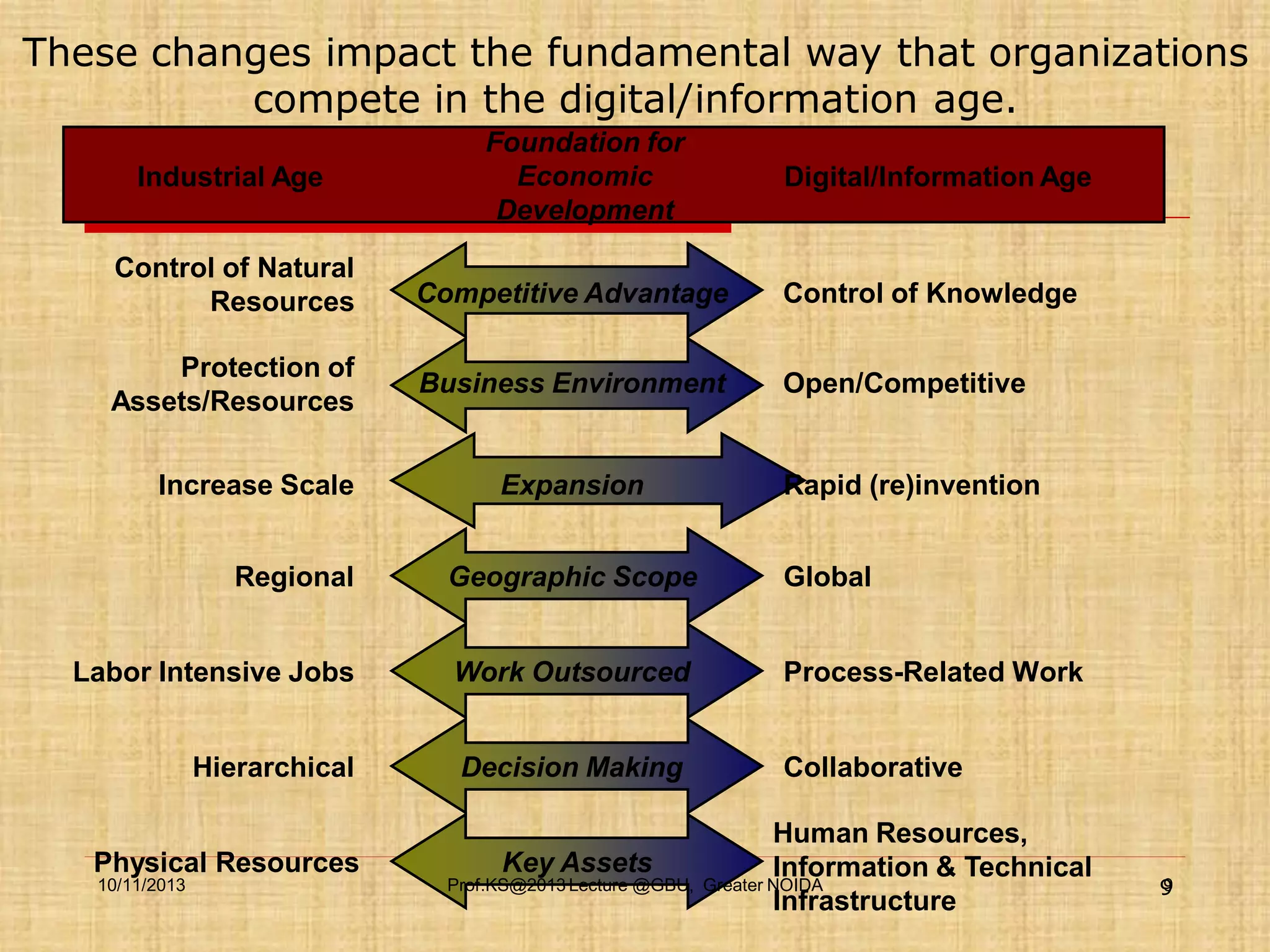
These changes impact the fundamental way that organizations
compete in the digital/information age.
Industrial Age

Foundation for
Economic
Development

Digital/Information Age

Control of Natural
Resources

Competitive Advantage

Control of Knowledge

Protection of
Assets/Resources

Business Environment

Open/Competitive

Expansion

Rapid (re)invention

Increase Scale
Regional

Geographic Scope

Global

Labor Intensive Jobs

Work Outsourced

Process-Related Work

Hierarchical

Decision Making

Collaborative

Physical Resources
10/11/2013

Key Assets
Prof.KS@2013 Lecture @GBU,

Human Resources,
Information & Technical
Greater NOIDA
Infrastructure

9
9
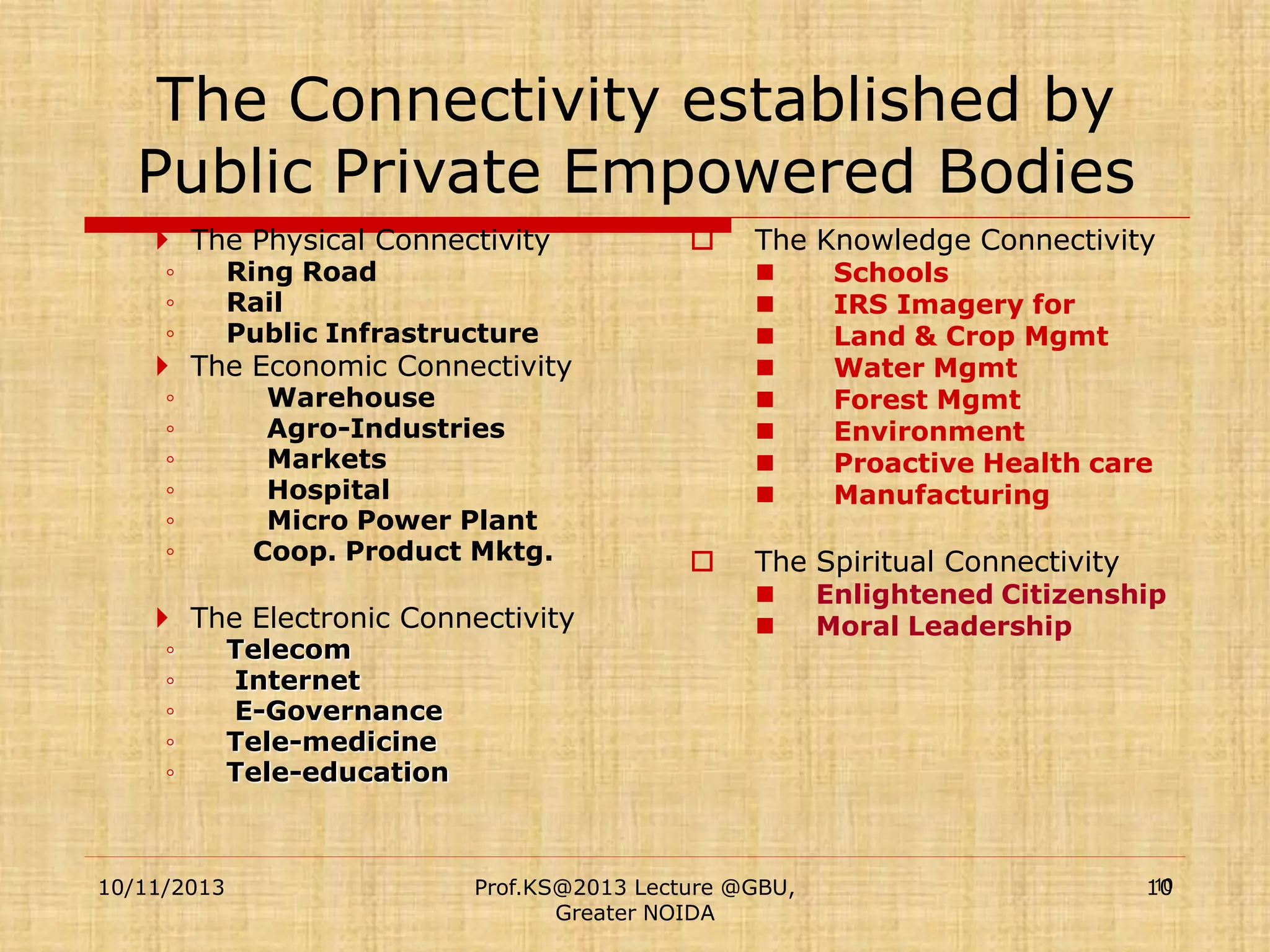
The Connectivity established by
Public Private Empowered Bodies
 The Physical Connectivity
◦
◦
◦

Ring Road
Rail
Public Infrastructure












 The Economic Connectivity
◦
◦
◦
◦
◦
◦

Warehouse
Agro-Industries
Markets
Hospital
Micro Power Plant
Coop. Product Mktg.

 The Electronic Connectivity
◦
◦
◦
◦
◦

10/11/2013

Telecom
Internet
E-Governance
Tele-medicine
Tele-education

The Knowledge Connectivity



Schools
IRS Imagery for
Land & Crop Mgmt
Water Mgmt
Forest Mgmt
Environment
Proactive Health care
Manufacturing

The Spiritual Connectivity



Prof.KS@2013 Lecture @GBU,
Greater NOIDA

Enlightened Citizenship
Moral Leadership

10
10
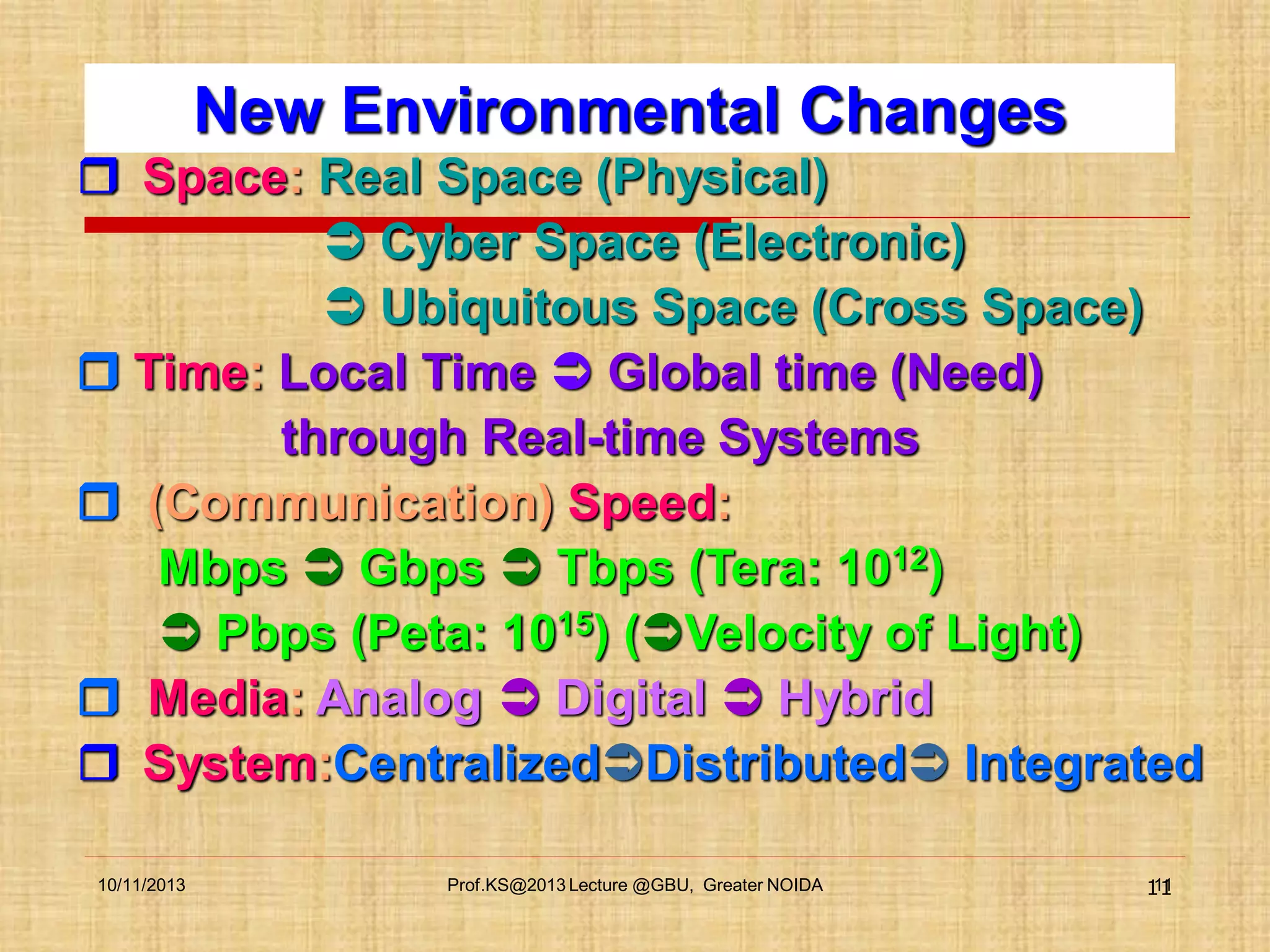
New Environmental Changes
 Space: Real Space (Physical)
 Cyber Space (Electronic)
 Ubiquitous Space (Cross Space)
 Time: Local Time  Global time (Need)
through Real-time Systems
 (Communication) Speed:
Mbps  Gbps  Tbps (Tera: 1012)
 Pbps (Peta: 1015) (Velocity of Light)
 Media: Analog  Digital  Hybrid
 System:CentralizedDistributed Integrated
10/11/2013

Prof.KS@2013 Lecture @GBU, Greater NOIDA

11
11
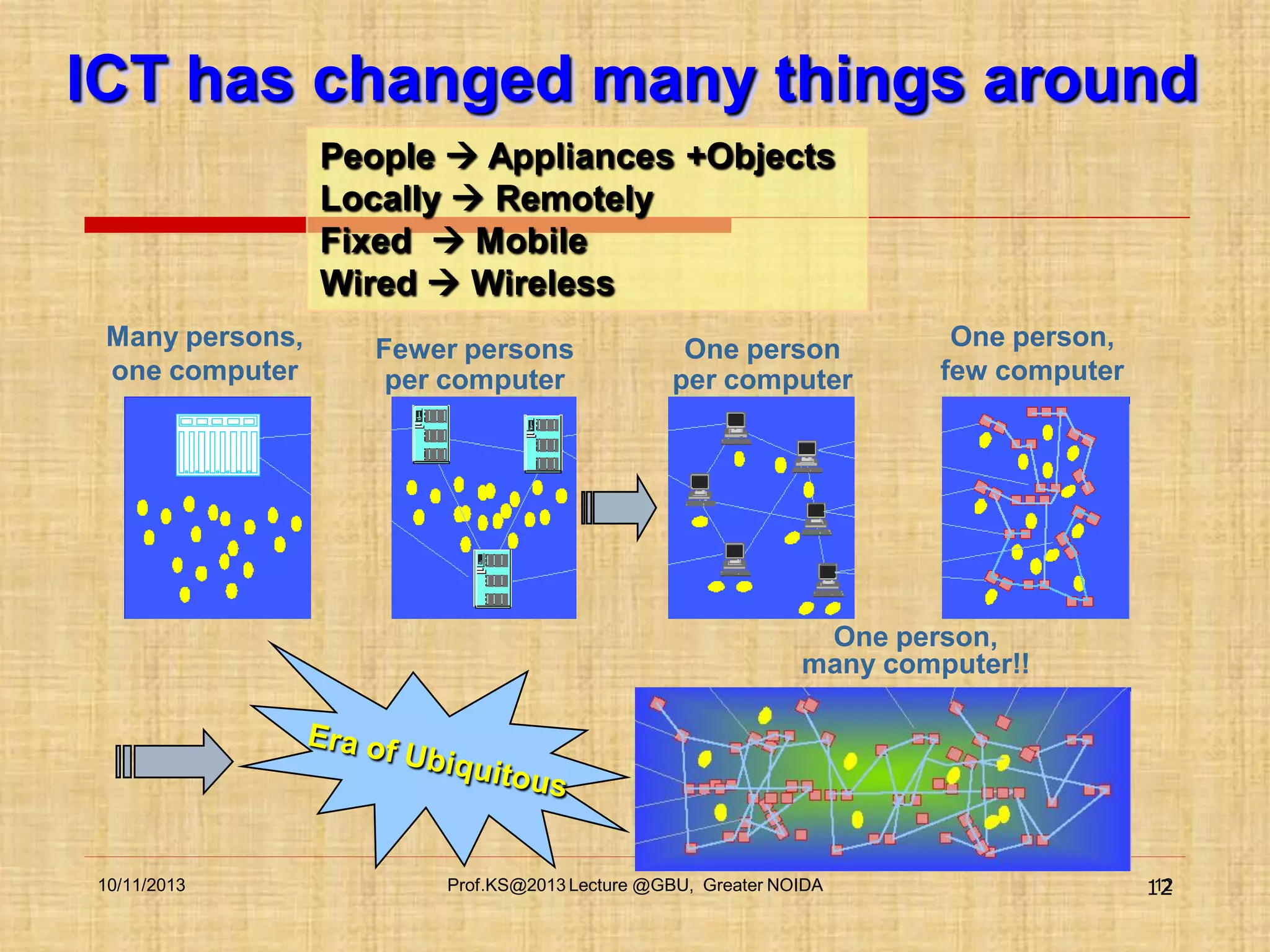
ICT has changed many things around
People  Appliances +Objects
Locally  Remotely
Fixed  Mobile
Wired  Wireless
Many persons,
one computer

Fewer persons
per computer

One person
per computer

One person,
few computer

One person,
many computer!!

10/11/2013

Prof.KS@2013 Lecture @GBU, Greater NOIDA

12
12
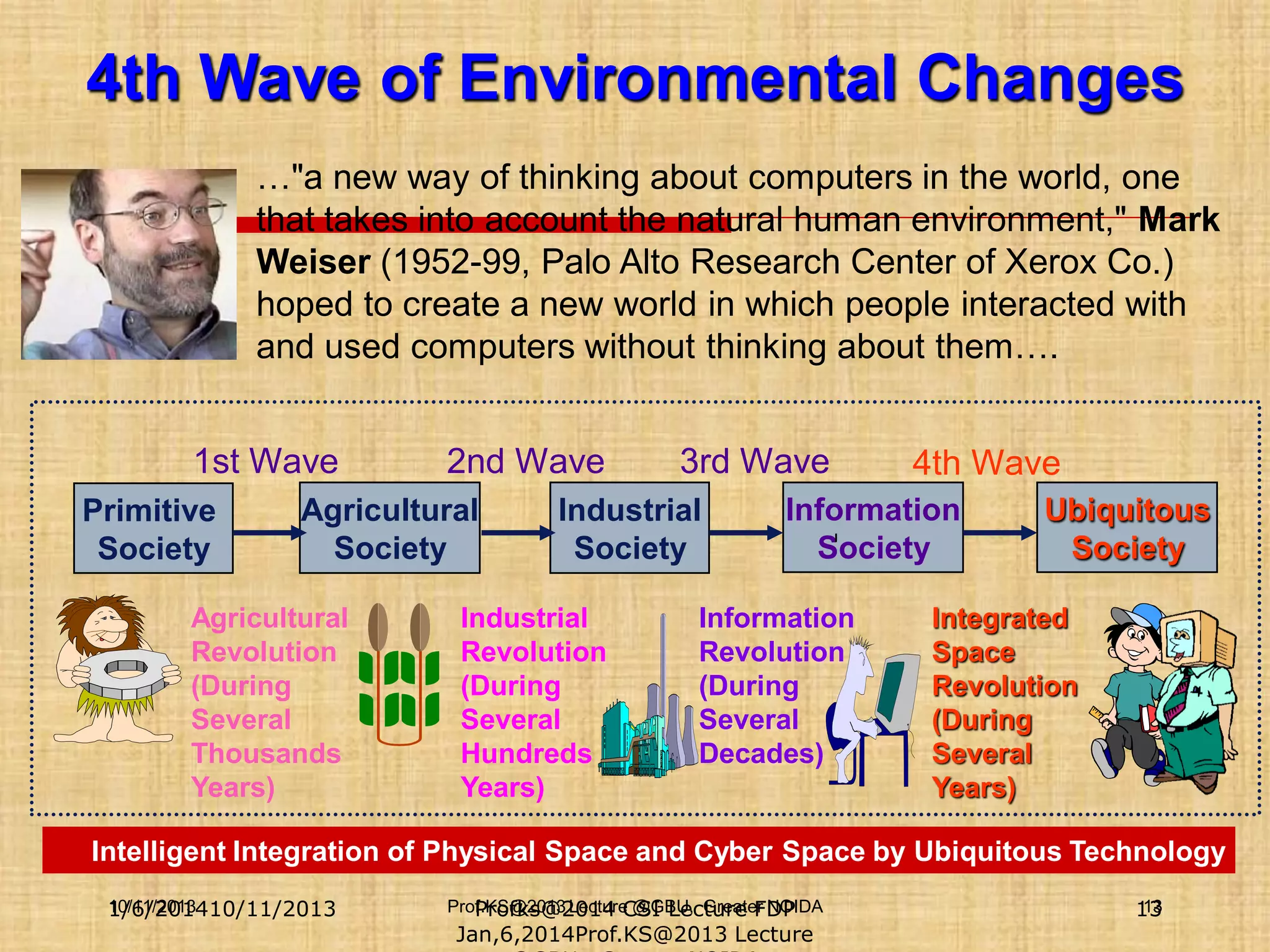
4th Wave of Environmental Changes
…"a new way of thinking about computers in the world, one
that takes into account the natural human environment," Mark
Weiser (1952-99, Palo Alto Research Center of Xerox Co.)
hoped to create a new world in which people interacted with
and used computers without thinking about them….

1st Wave
Primitive
Society

2nd Wave

Agricultural
Society

Agricultural
Revolution
(During
Several
Thousands
Years)

3rd Wave

Industrial
Society

Industrial
Revolution
(During
Several
Hundreds
Years)

4th Wave

Information
Society

Information
Revolution
(During
Several
Decades)

Ubiquitous
Society

Integrated
Space
Revolution
(During
Several
Years)

Intelligent Integration of Physical Space and Cyber Space by Ubiquitous Technology
10/11/2013
1/6/201410/11/2013

Prof.KS@2013 Lecture @GBU, Greater NOIDA
Profks@2014 CSI Lecture FDP

Jan,6,2014Prof.KS@2013 Lecture

13
13
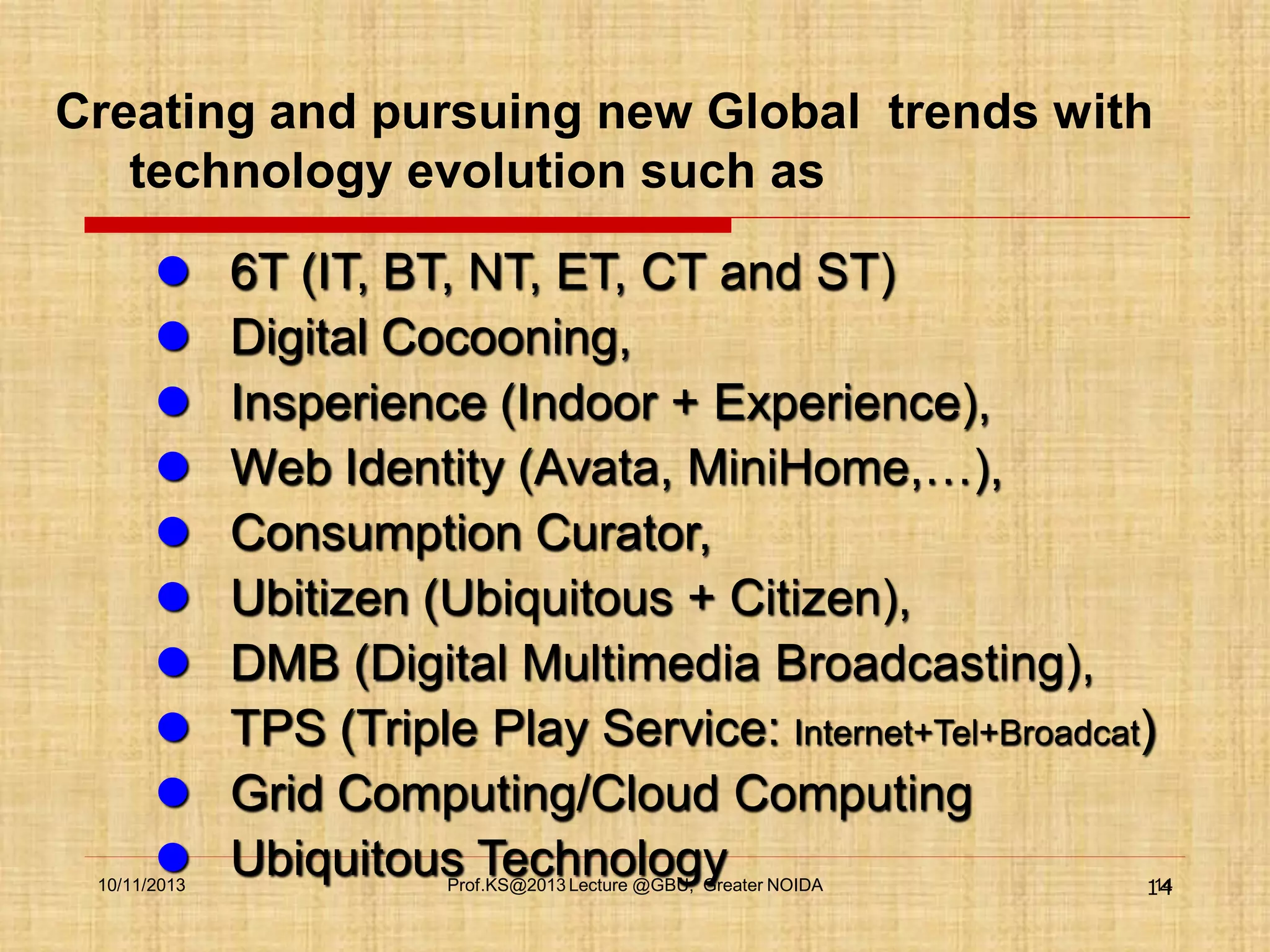
Creating and pursuing new Global trends with
technology evolution such as











10/11/2013

6T (IT, BT, NT, ET, CT and ST)
Digital Cocooning,
Insperience (Indoor + Experience),
Web Identity (Avata, MiniHome,…),
Consumption Curator,
Ubitizen (Ubiquitous + Citizen),
DMB (Digital Multimedia Broadcasting),
TPS (Triple Play Service: Internet+Tel+Broadcat)
Grid Computing/Cloud Computing
Ubiquitous Technology
14
Prof.KS@2013 Lecture @GBU, Greater NOIDA

14
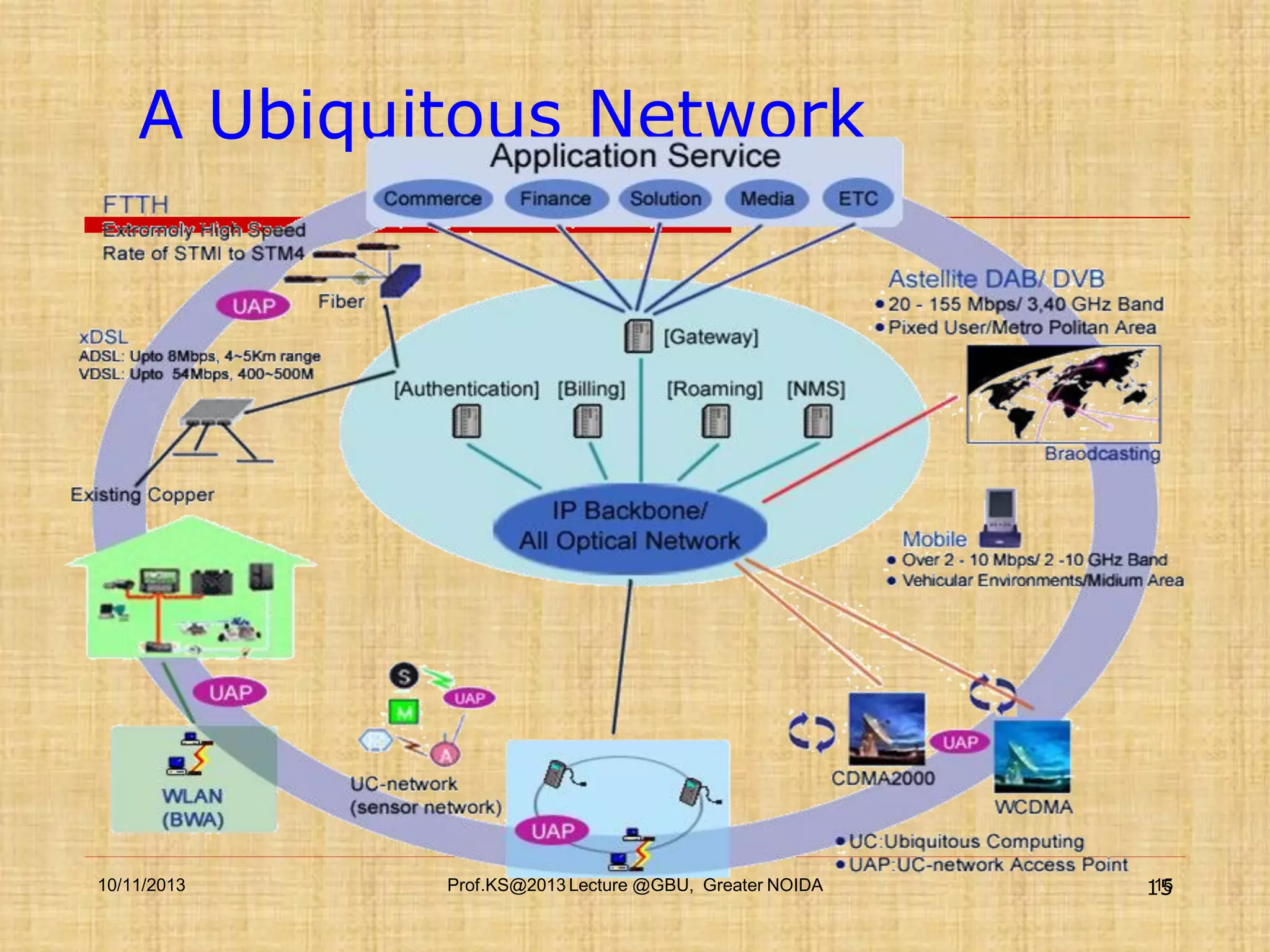
A Ubiquitous Network

10/11/2013

Prof.KS@2013 Lecture @GBU, Greater NOIDA

15
15
Creating and pursuing new Global trends in
Works, Workforce and Workplace such as






Freeter (Free + Arbeiter),
Increasing freelancers as telecommuters
Unstable professionals :MD, Lawyers, CPA,
Mobilization of workforce across national borders
Advent Pan-Asia as a Super Growth Block

 Japan: Global Leadership with Future-based High-tech in Media,
Robot, Biotech
 Rep. of Korea: Electronics, Car Manufacturing, Steel Production,
Semiconductors with strong IT infra
 Taiwan: Strong Small Medium Industry
 China: Rapid Growth Rate[9%], Right Wing of Super Growth Block
 India: Rapid Growth Rate[7-8%], Left Wing of Super Growth Block
 ASEAN: Singapore, Malaysia, Vietnam, Thailand, Indonesia,
Philippines, …….
10/11/2013

Prof.KS@2013 Lecture @GBU, Greater NOIDA

16
16
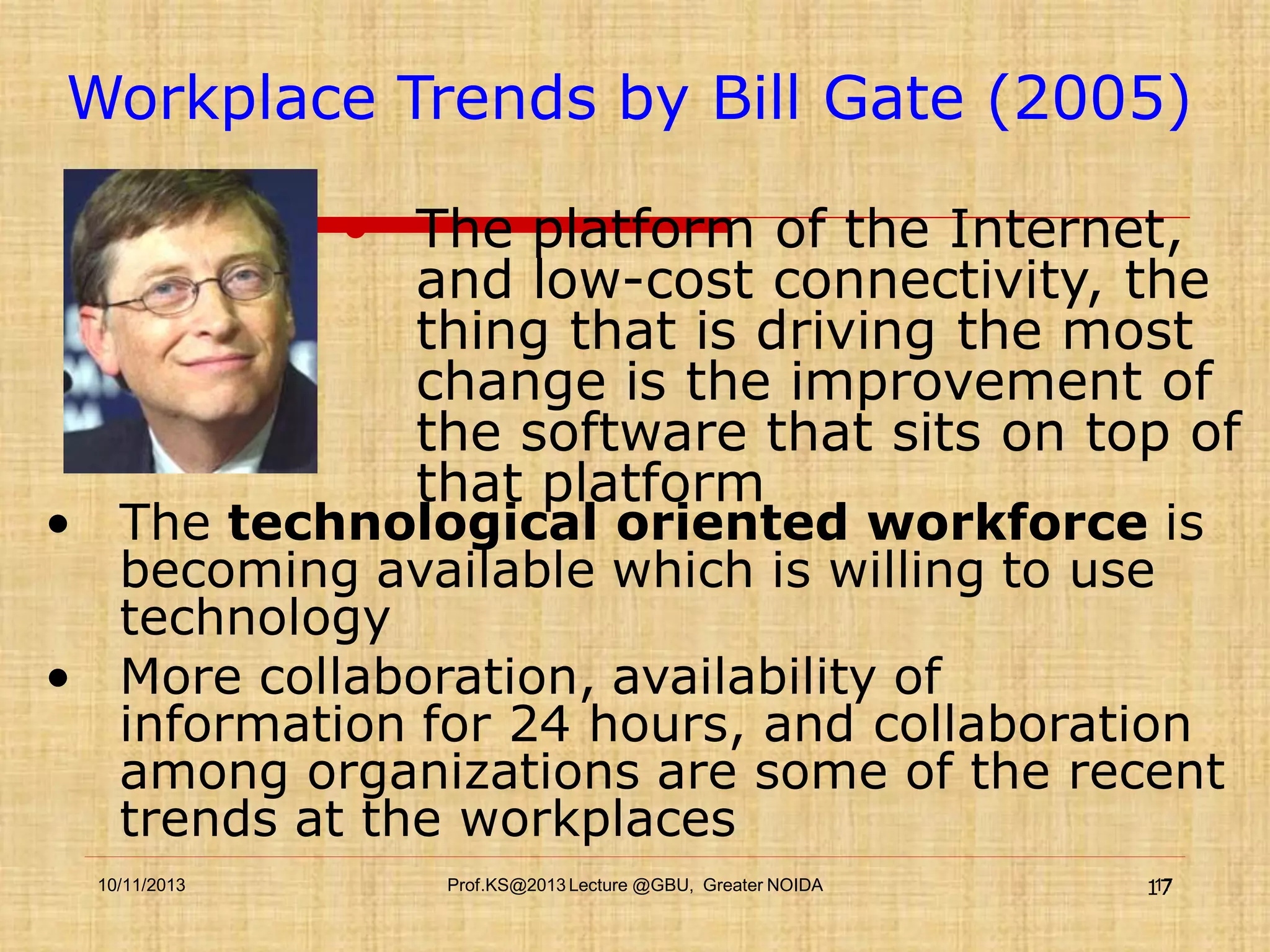
Workplace Trends by Bill Gate (2005)
 The platform of the Internet,
and low-cost connectivity, the
thing that is driving the most
change is the improvement of
the software that sits on top of
that platform

• The technological oriented workforce is
becoming available which is willing to use
technology
• More collaboration, availability of
information for 24 hours, and collaboration
among organizations are some of the recent
trends at the workplaces
10/11/2013

Prof.KS@2013 Lecture @GBU, Greater NOIDA

17
17
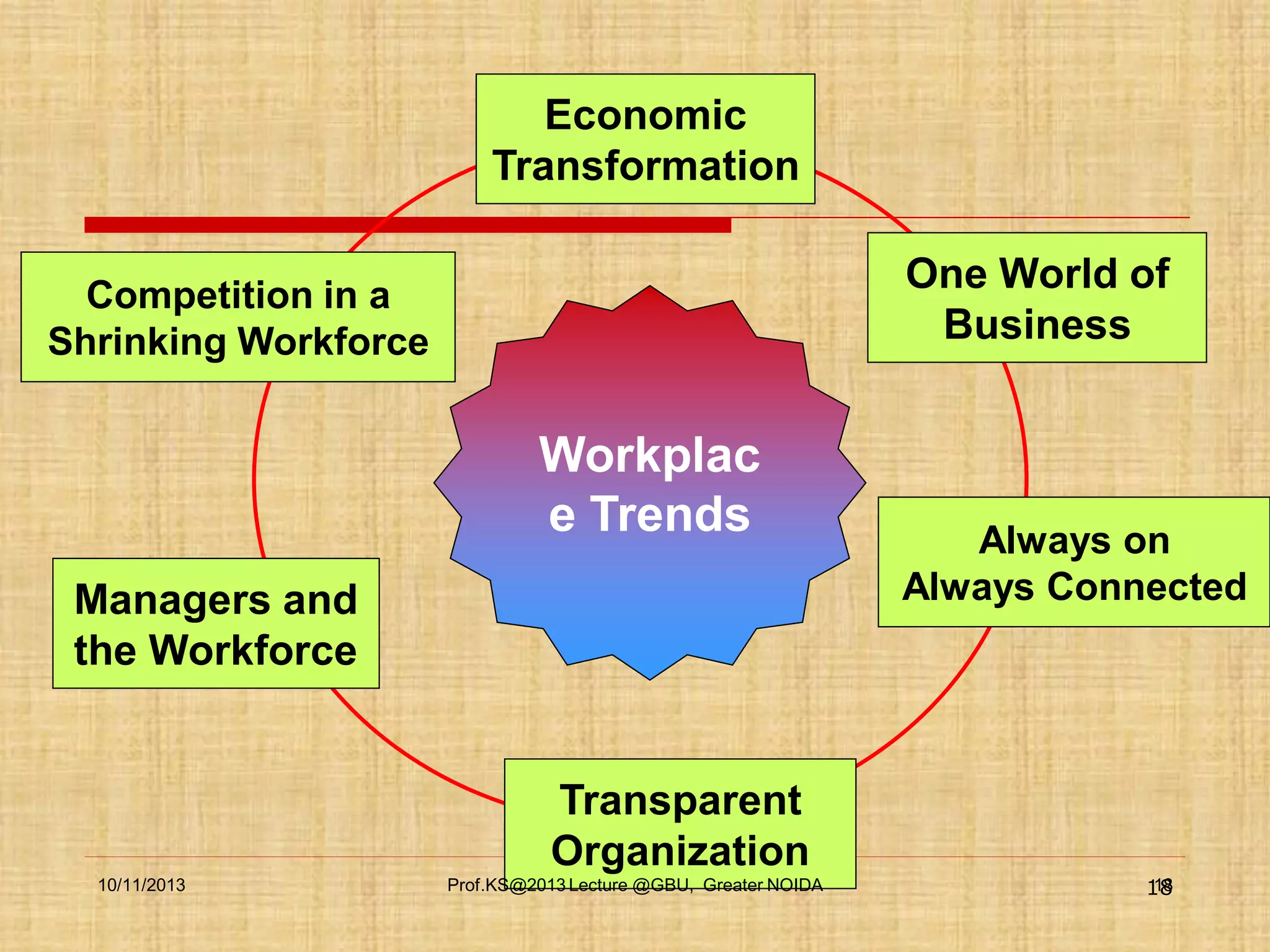
Economic
Transformation
One World of
Business

Competition in a
Shrinking Workforce

Workplac
e Trends
Managers and
the Workforce

Transparent
Organization
10/11/2013

Prof.KS@2013 Lecture @GBU, Greater NOIDA

Always on
Always Connected

18
18
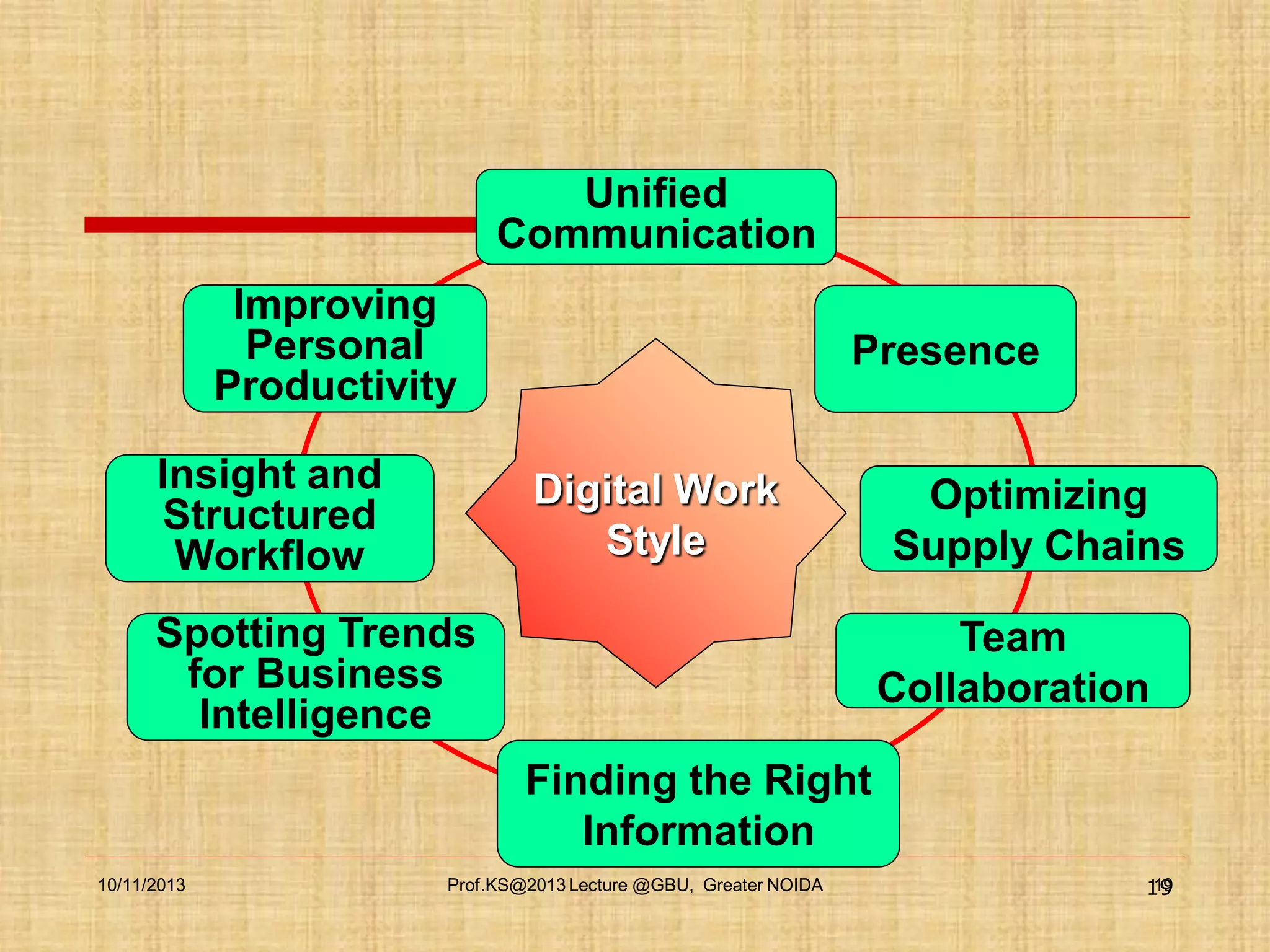
Unified
Communication

Improving
Personal
Productivity
Insight and
Structured
Workflow

Presence
Digital Work
Style

Spotting Trends
for Business
Intelligence

Optimizing
Supply Chains

Team
Collaboration
Finding the Right
Information

10/11/2013

Prof.KS@2013 Lecture @GBU, Greater NOIDA

19
19
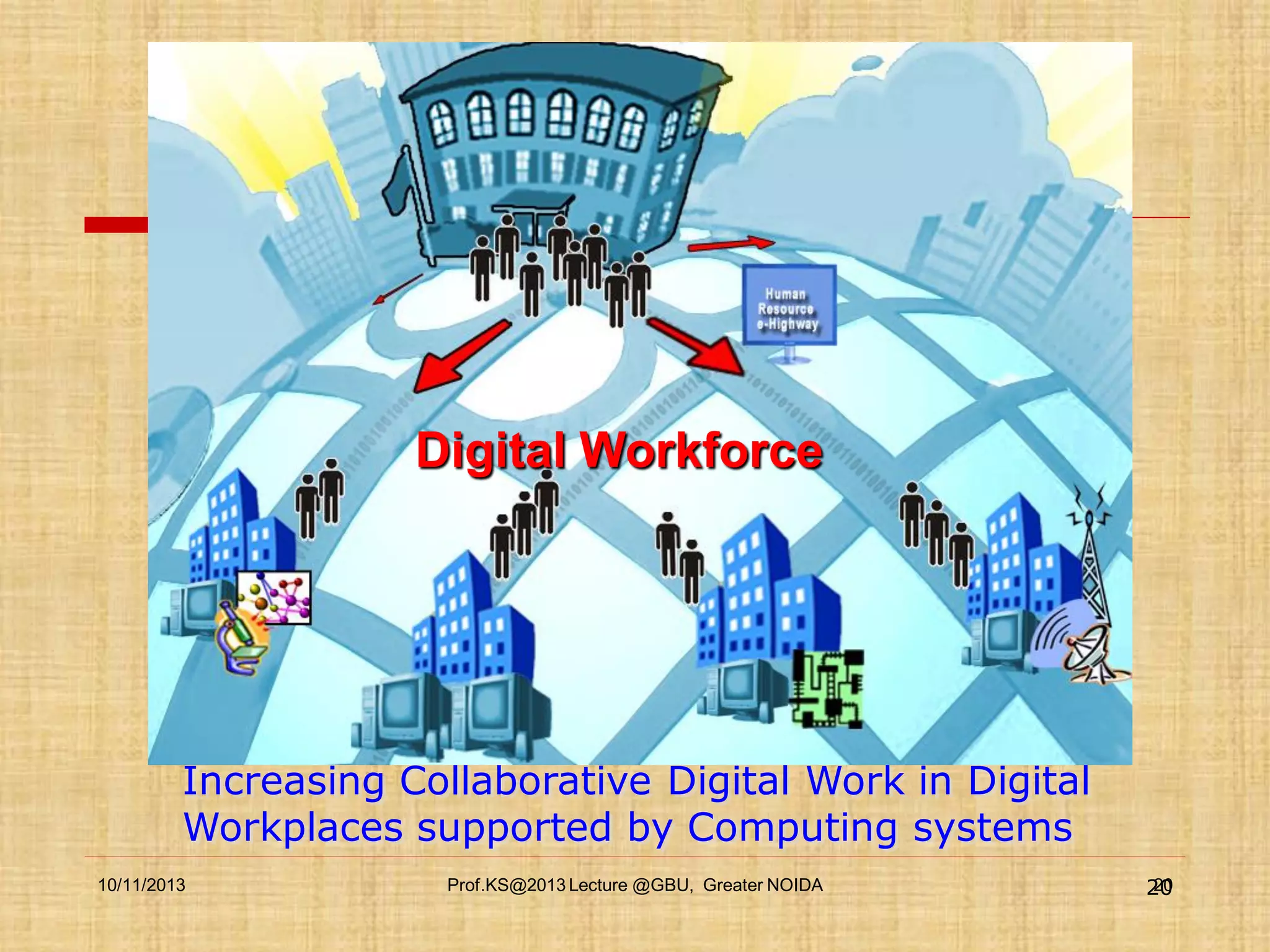
Digital Workforce

Increasing Collaborative Digital Work in Digital
Workplaces supported by Computing systems
10/11/2013

Prof.KS@2013 Lecture @GBU, Greater NOIDA

20
20
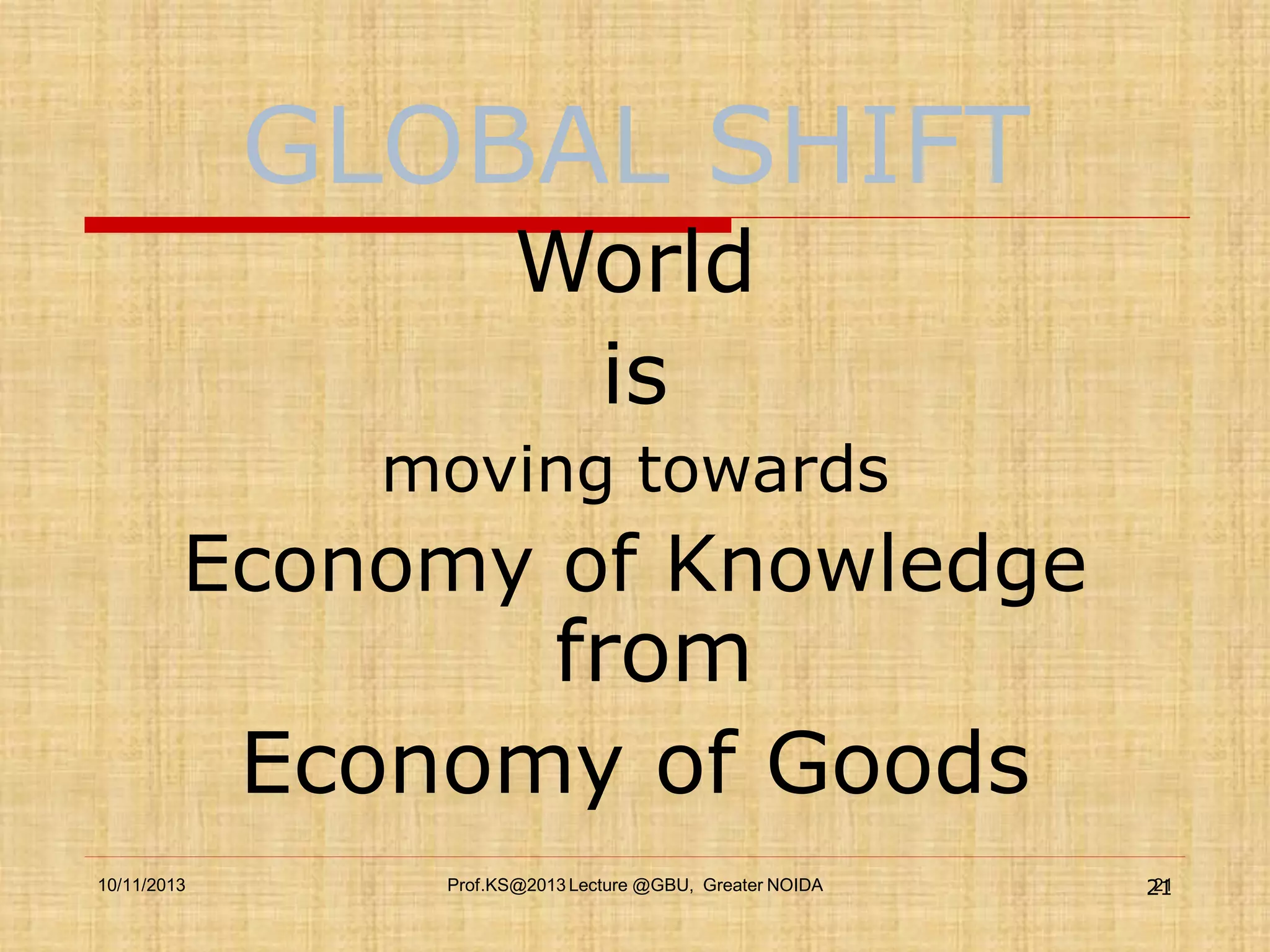
GLOBAL SHIFT
World
is
moving towards

Economy of Knowledge

from
Economy of Goods

10/11/2013

Prof.KS@2013 Lecture @GBU, Greater NOIDA

21
21
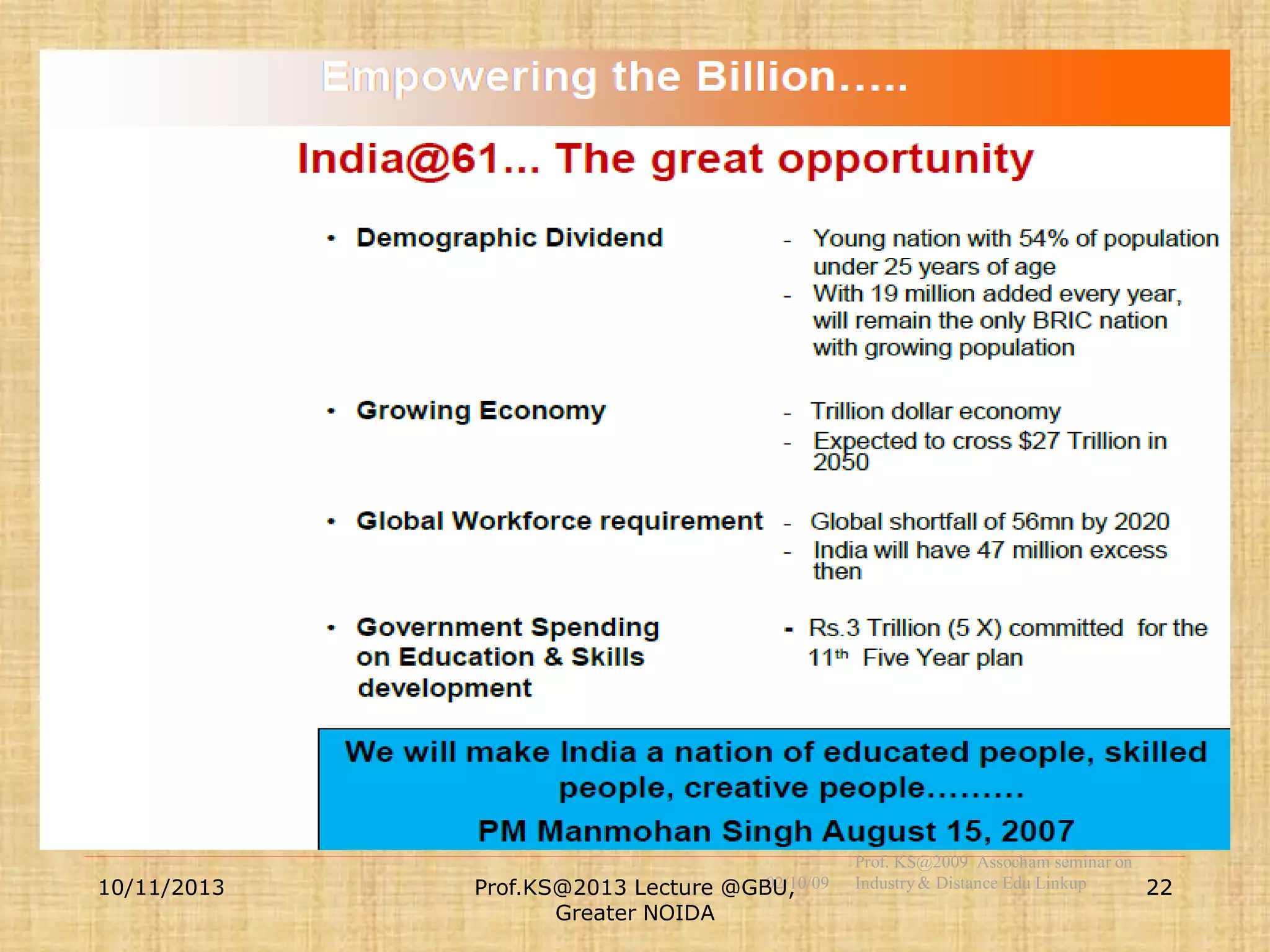
10/11/2013

02/10/09
Prof.KS@2013 Lecture @GBU,
Greater NOIDA

Prof. KS@2009 Assocham seminar on
Industry & Distance Edu Linkup
22
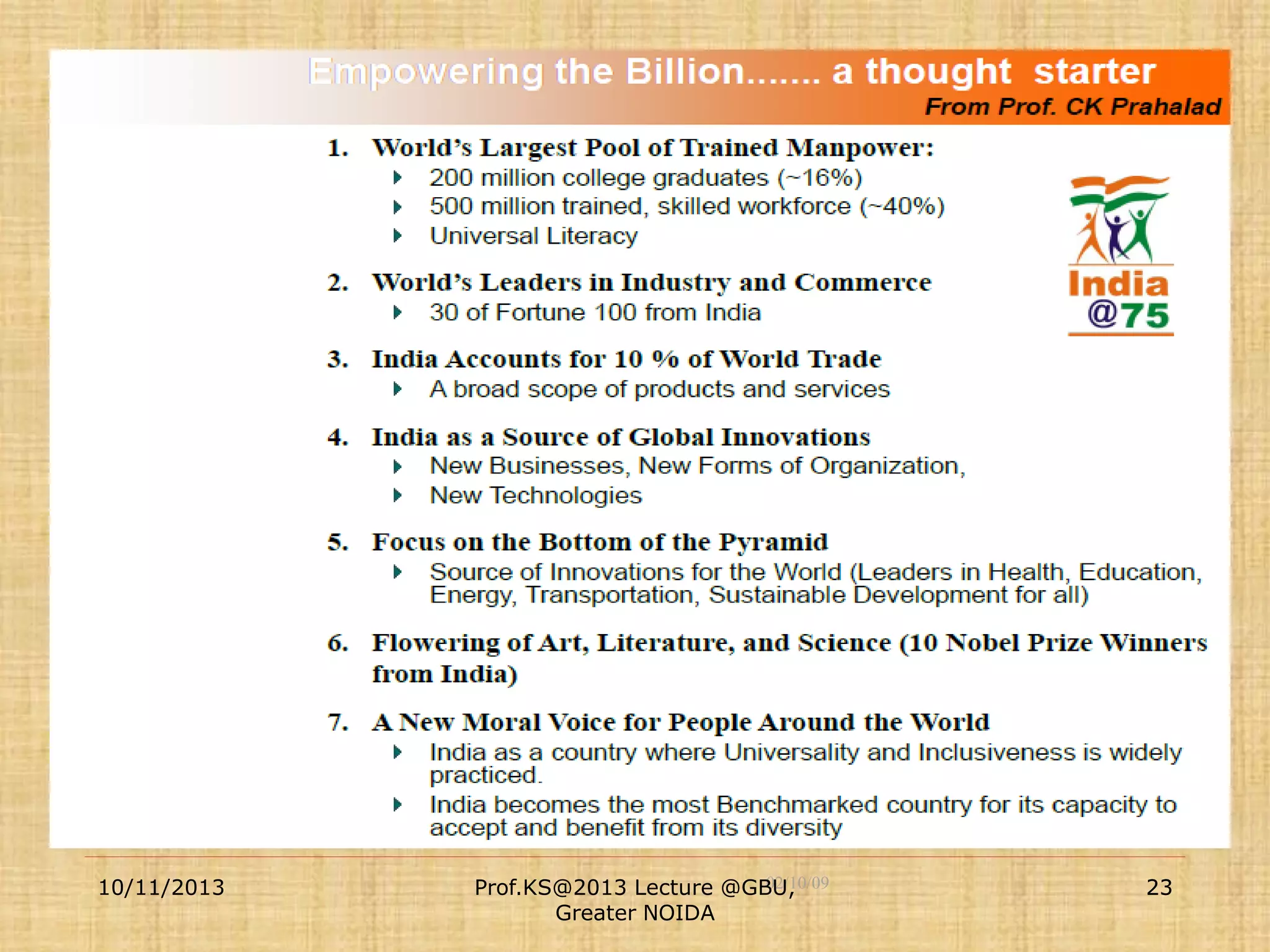
10/11/2013

02/10/09
Prof.KS@2013 Lecture @GBU,
Greater NOIDA

23
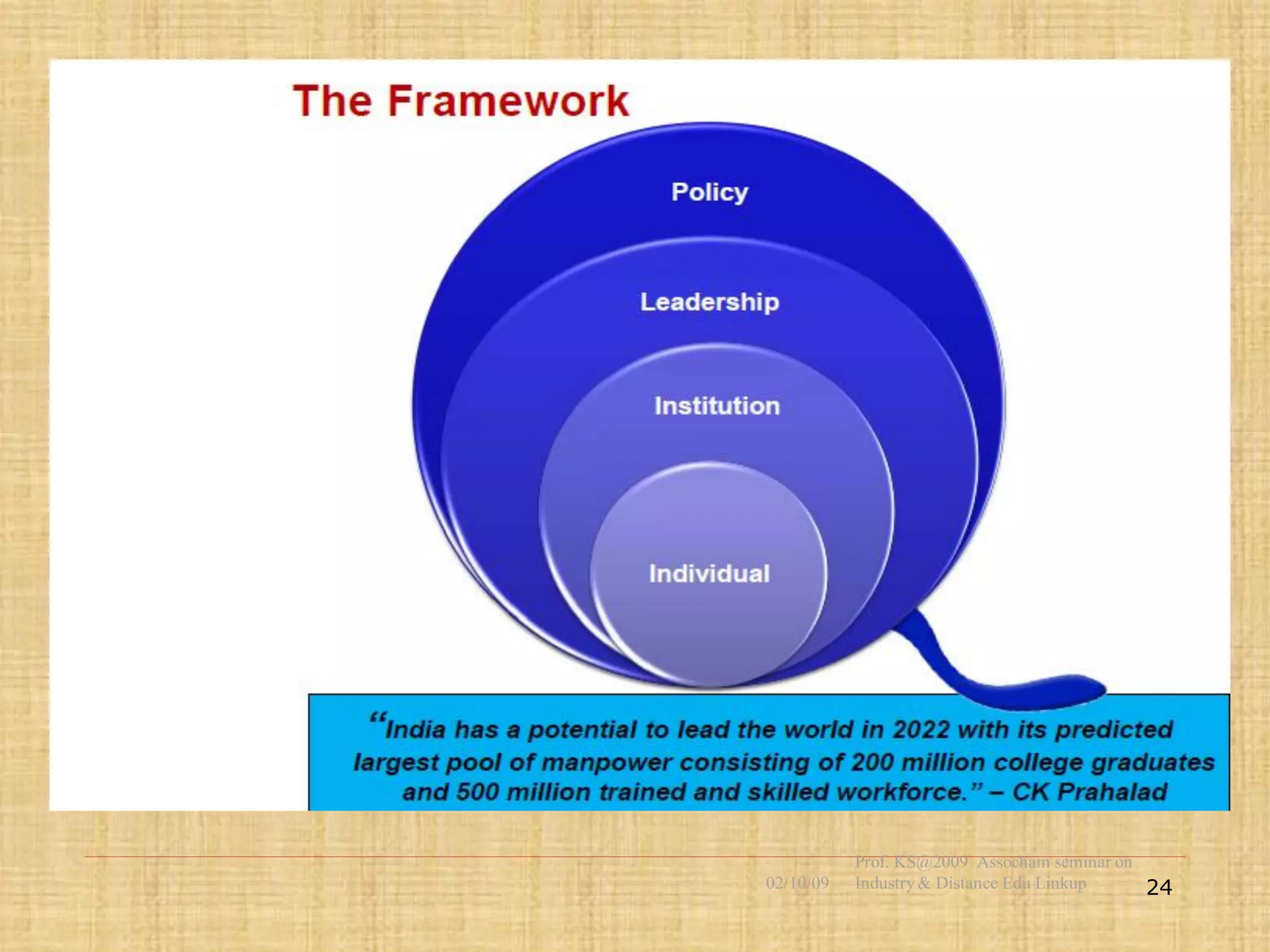
02/10/09

Prof. KS@2009 Assocham seminar on
Industry & Distance Edu Linkup
24











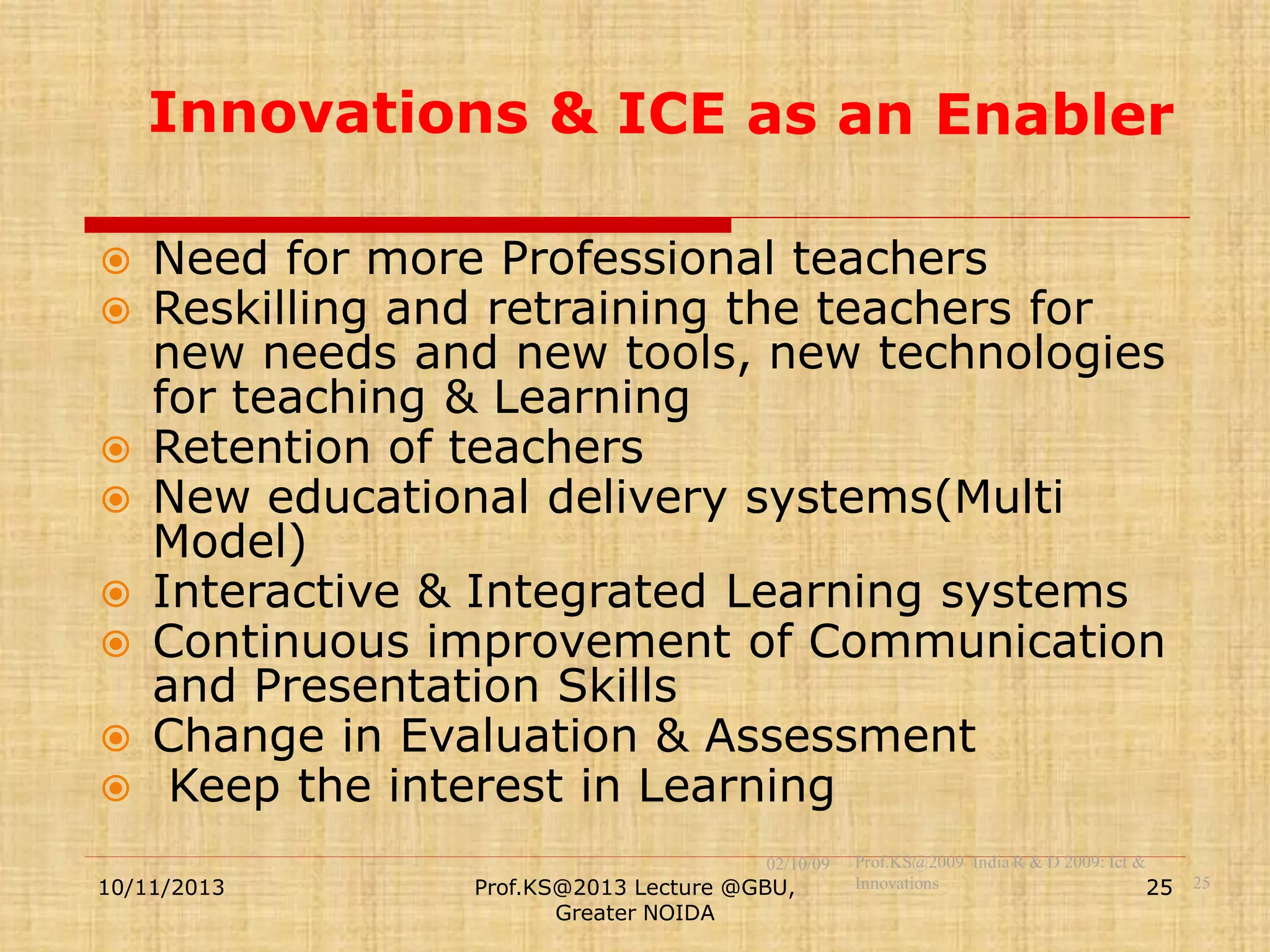
Need for more Professional teachers
Reskilling and retraining the teachers for
new needs and new tools, new technologies
for teaching & Learning
Retention of teachers
New educational delivery systems(Multi
Model)
Interactive & Integrated Learning systems
Continuous improvement of Communication
and Presentation Skills
Change in Evaluation & Assessment
Keep the interest in Learning
02/10/09

10/11/2013

Prof.KS@2013 Lecture @GBU,
Greater NOIDA

Prof.KS@2009 India R & D 2009: Ict &
Innovations
25

25
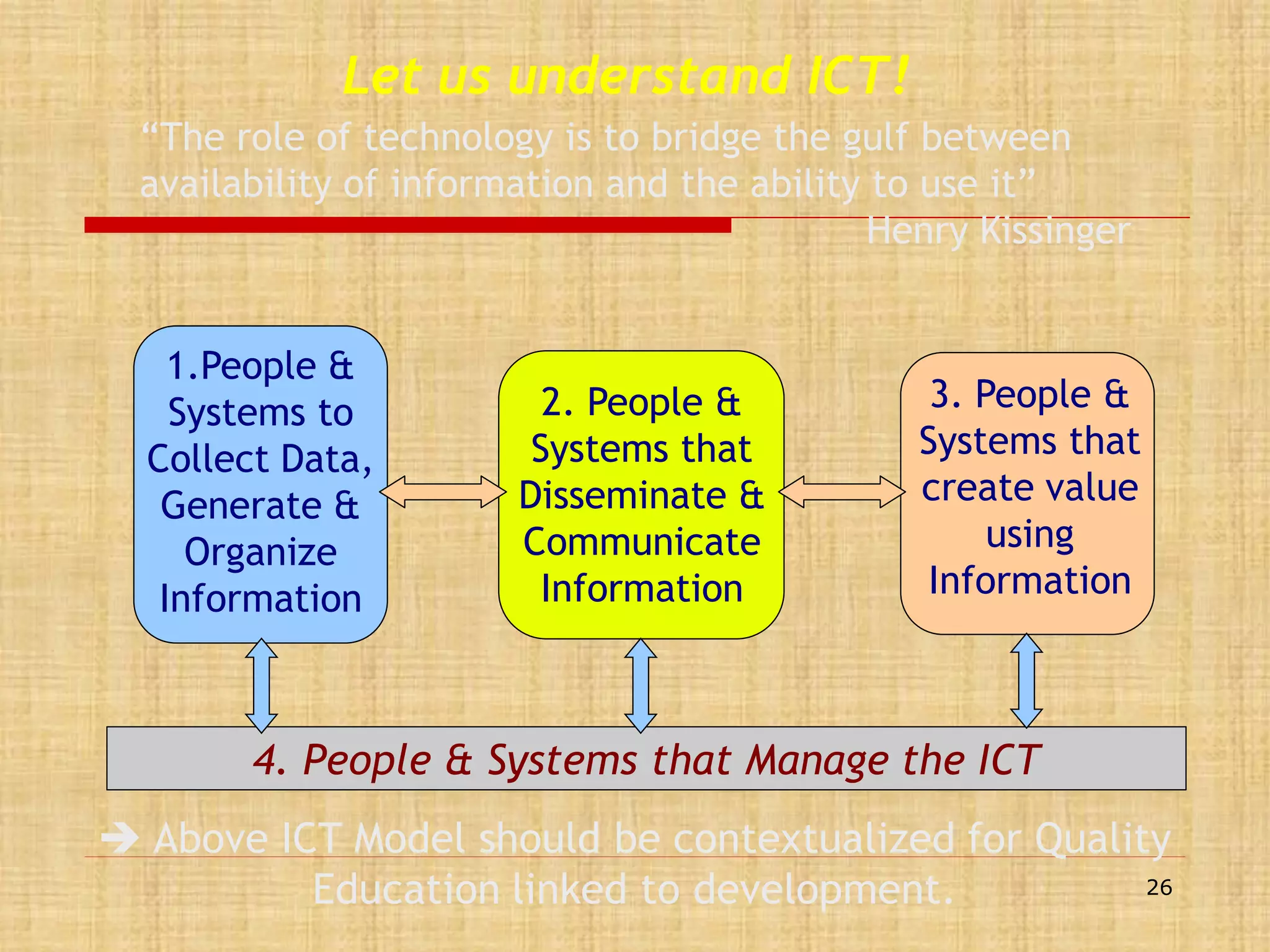
Let us understand ICT!
“The role of technology is to bridge the gulf between
availability of information and the ability to use it”
Henry Kissinger
1.People &
Systems to
Collect Data,
Generate &
Organize
Information

2. People &
Systems that
Disseminate &
Communicate
Information

3. People &
Systems that
create value
using
Information

4. People & Systems that Manage the ICT
 Above ICT Model should be contextualized for Quality
26
Education linked to development.
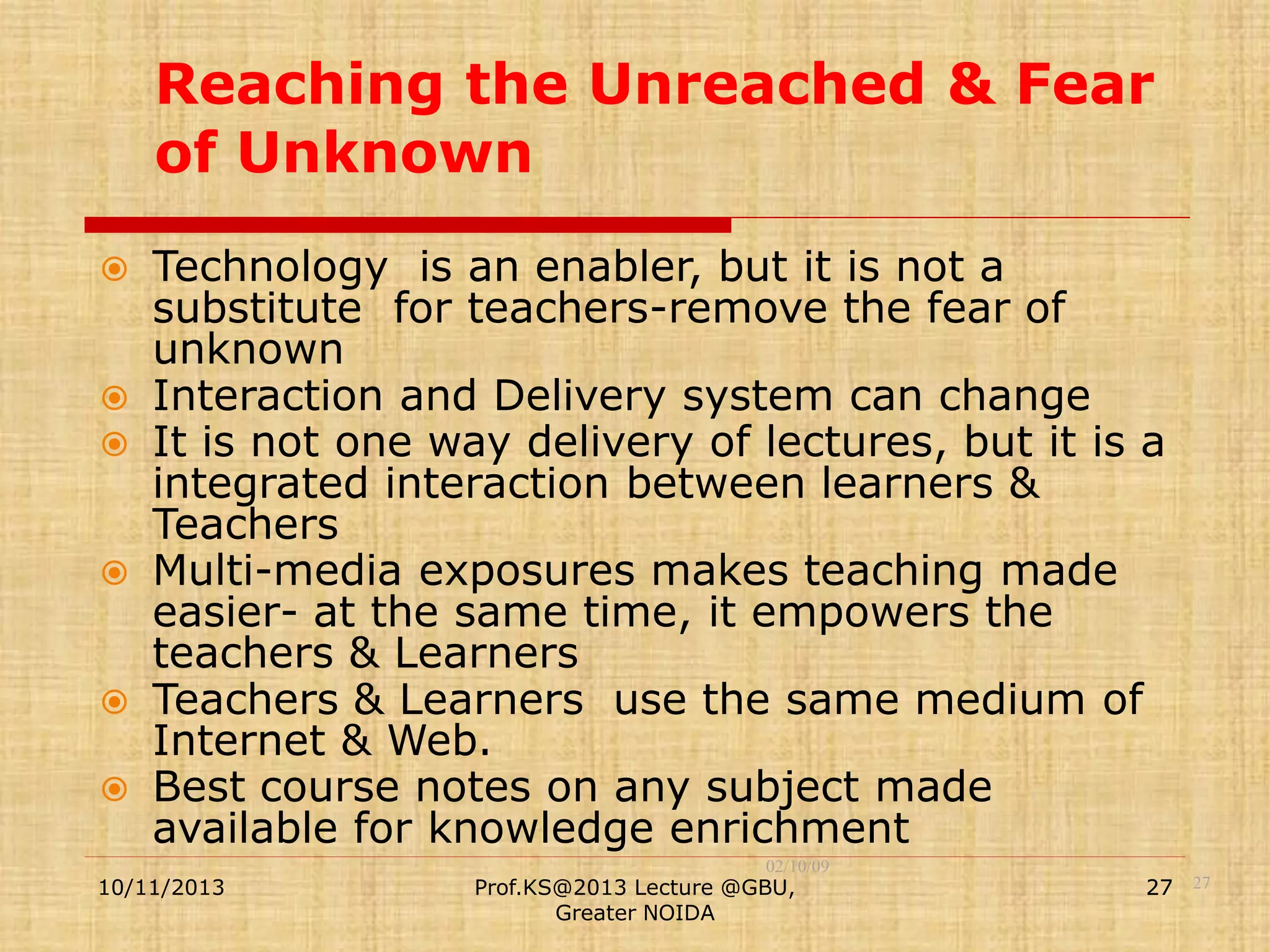
Reaching the Unreached & Fear
of Unknown
Technology is an enabler, but it is not a
substitute for teachers-remove the fear of
unknown
 Interaction and Delivery system can change
 It is not one way delivery of lectures, but it is a
integrated interaction between learners &
Teachers
 Multi-media exposures makes teaching made
easier- at the same time, it empowers the
teachers & Learners
 Teachers & Learners use the same medium of
Internet & Web.
 Best course notes on any subject made
available for knowledge enrichment


10/11/2013

02/10/09

Prof.KS@2013 Lecture @GBU,
Greater NOIDA

27 27
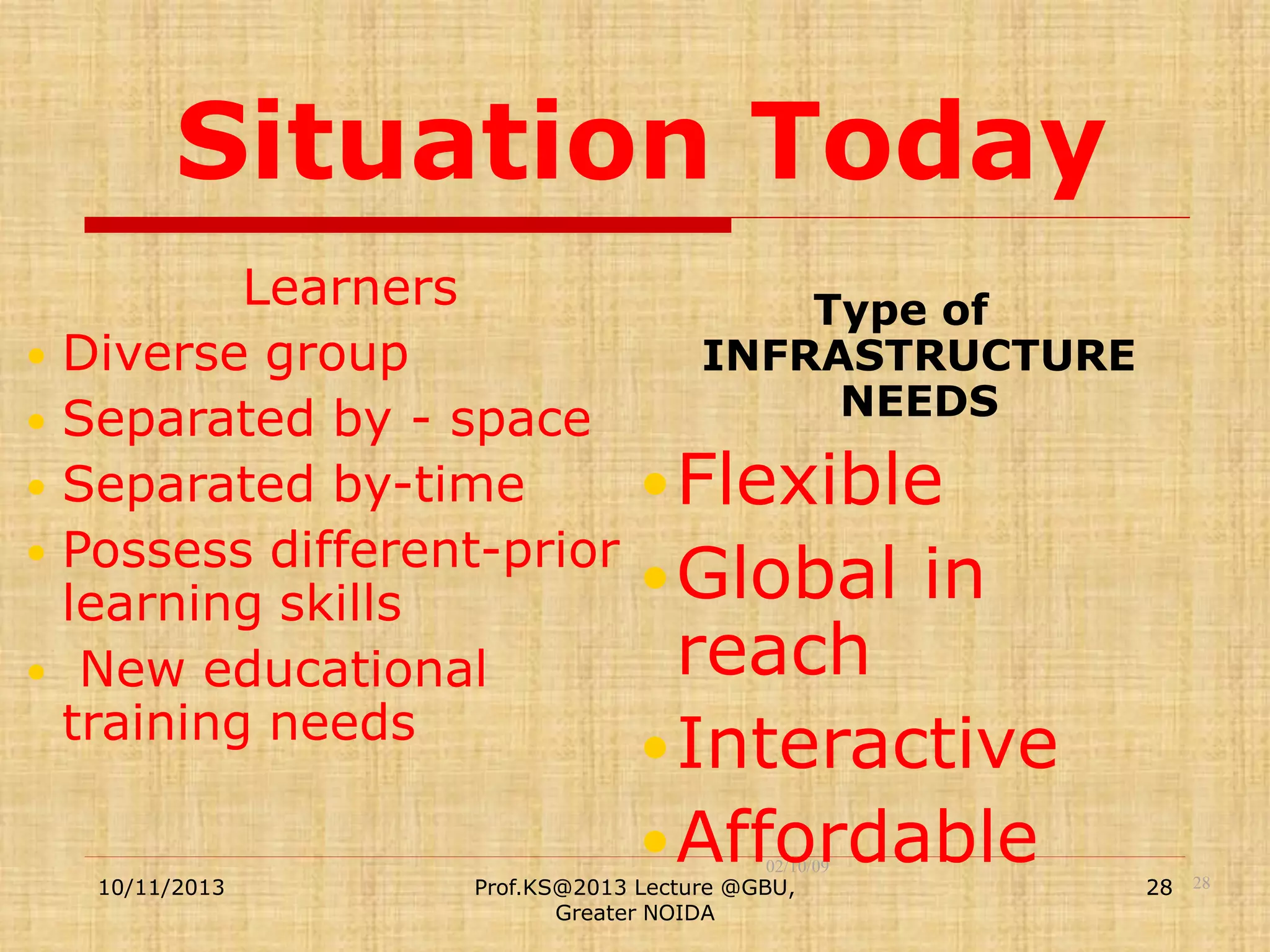
Situation Today
Learners
Type of
 Diverse group
INFRASTRUCTURE
NEEDS
 Separated by - space
 Separated by-time
 Flexible
 Possess different-prior
 Global in
learning skills
reach
 New educational
training needs

 Interactive

10/11/2013

 Affordable
02/10/09

Prof.KS@2013 Lecture @GBU,
Greater NOIDA

28 28
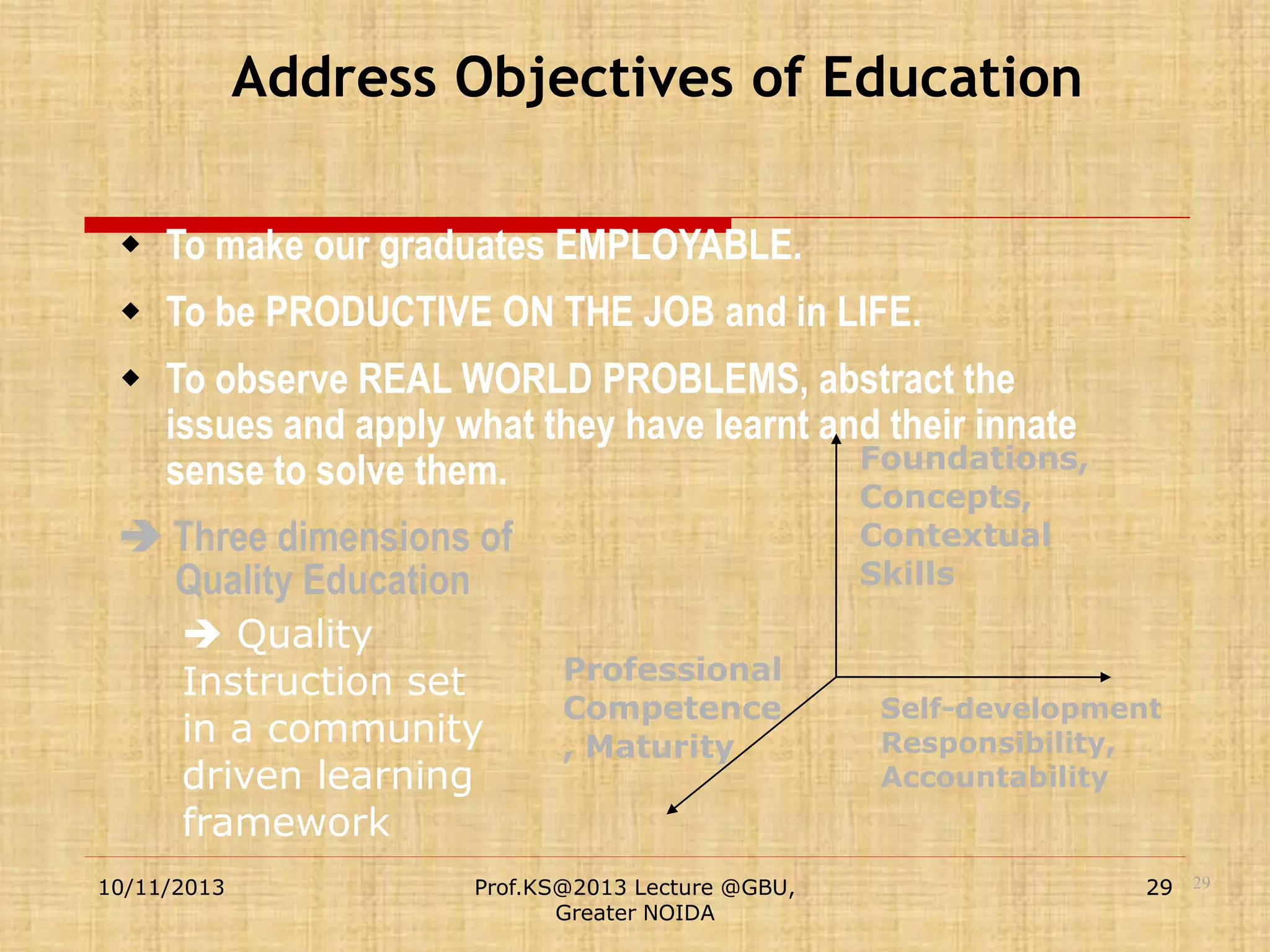
Address Objectives of Education
 To make our graduates EMPLOYABLE.
 To be PRODUCTIVE ON THE JOB and in LIFE.
 To observe REAL WORLD PROBLEMS, abstract the
issues and apply what they have learnt and their innate
Foundations,
sense to solve them.
Concepts,
Contextual
Skills

 Three dimensions of
Quality Education
 Quality
Instruction set
in a community
driven learning
framework
10/11/2013

Professional
Competence
, Maturity

Prof.KS@2013 Lecture @GBU,
Greater NOIDA

Self-development
Responsibility,
Accountability

29 29
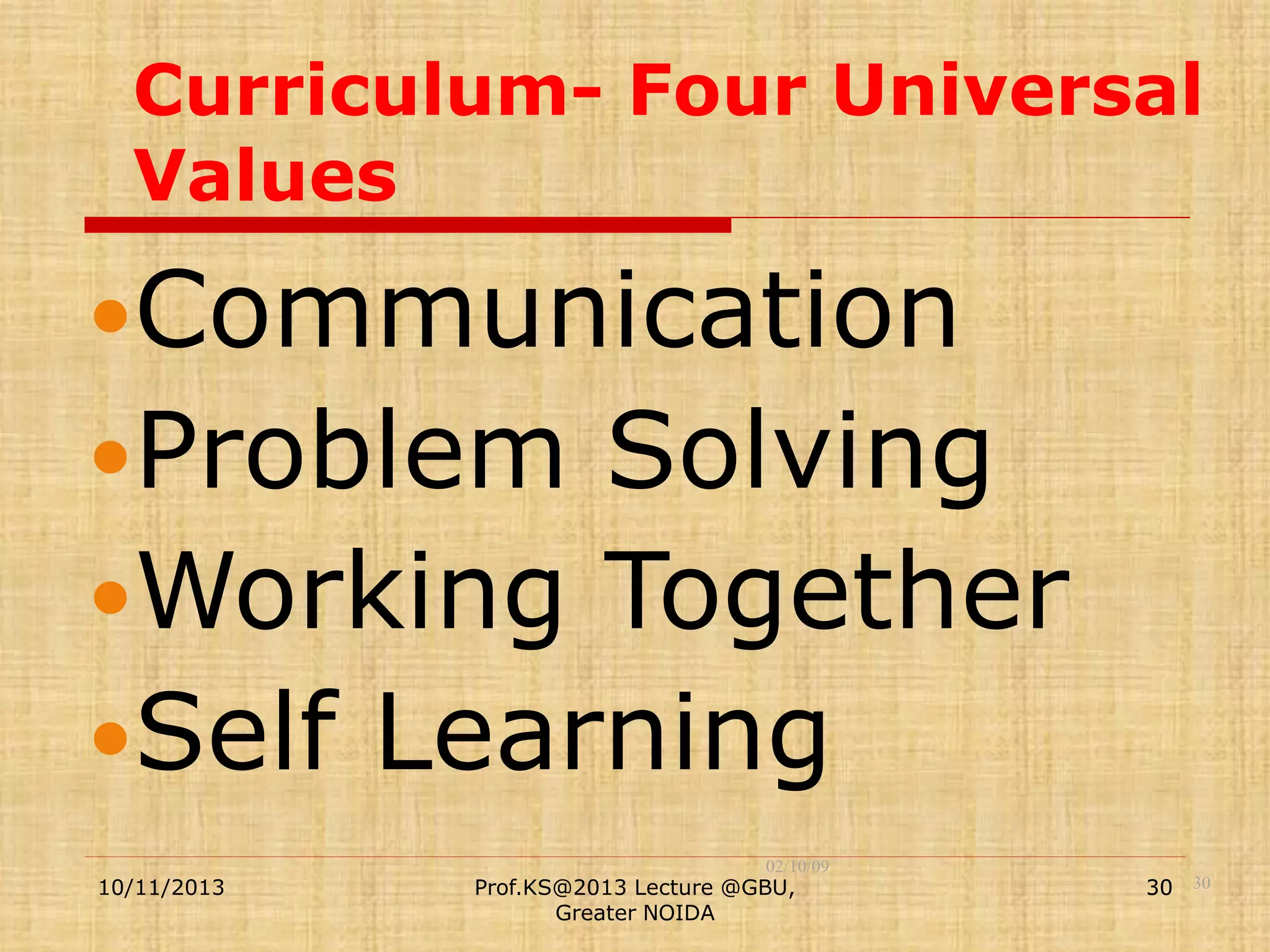
Curriculum- Four Universal
Values

Communication
Problem

Solving
Working Together
Self Learning
10/11/2013

02/10/09

Prof.KS@2013 Lecture @GBU,
Greater NOIDA

30 30
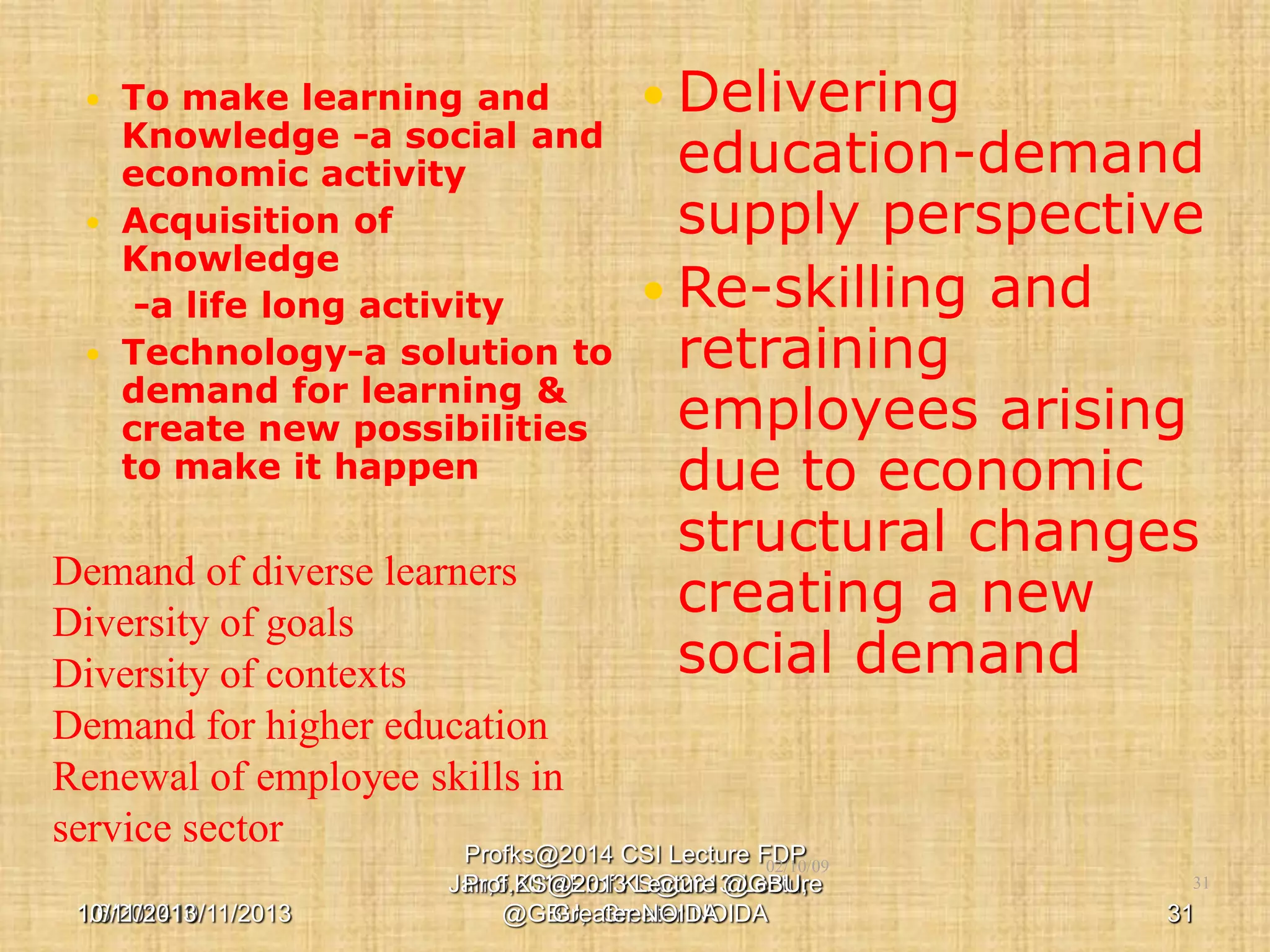
To make learning and
Knowledge -a social and
economic activity
 Acquisition of
Knowledge
-a life long activity
 Technology-a solution to
demand for learning &
create new possibilities
to make it happen


 Delivering

education-demand
supply perspective
 Re-skilling and
retraining
employees arising
due to economic
structural changes
creating a new
social demand

Demand of diverse learners
Diversity of goals
Diversity of contexts
Demand for higher education
Renewal of employee skills in
service sector
Profks@2014 CSI Lecture FDP

02/10/09

10/11/2013
1/6/201410/11/2013

Jan,6,2014Prof.KS@2013 Lecture
Prof.KS@2013 Lecture @GBU,
@GBU, Greater NOIDA
Greater NOIDA

31

31
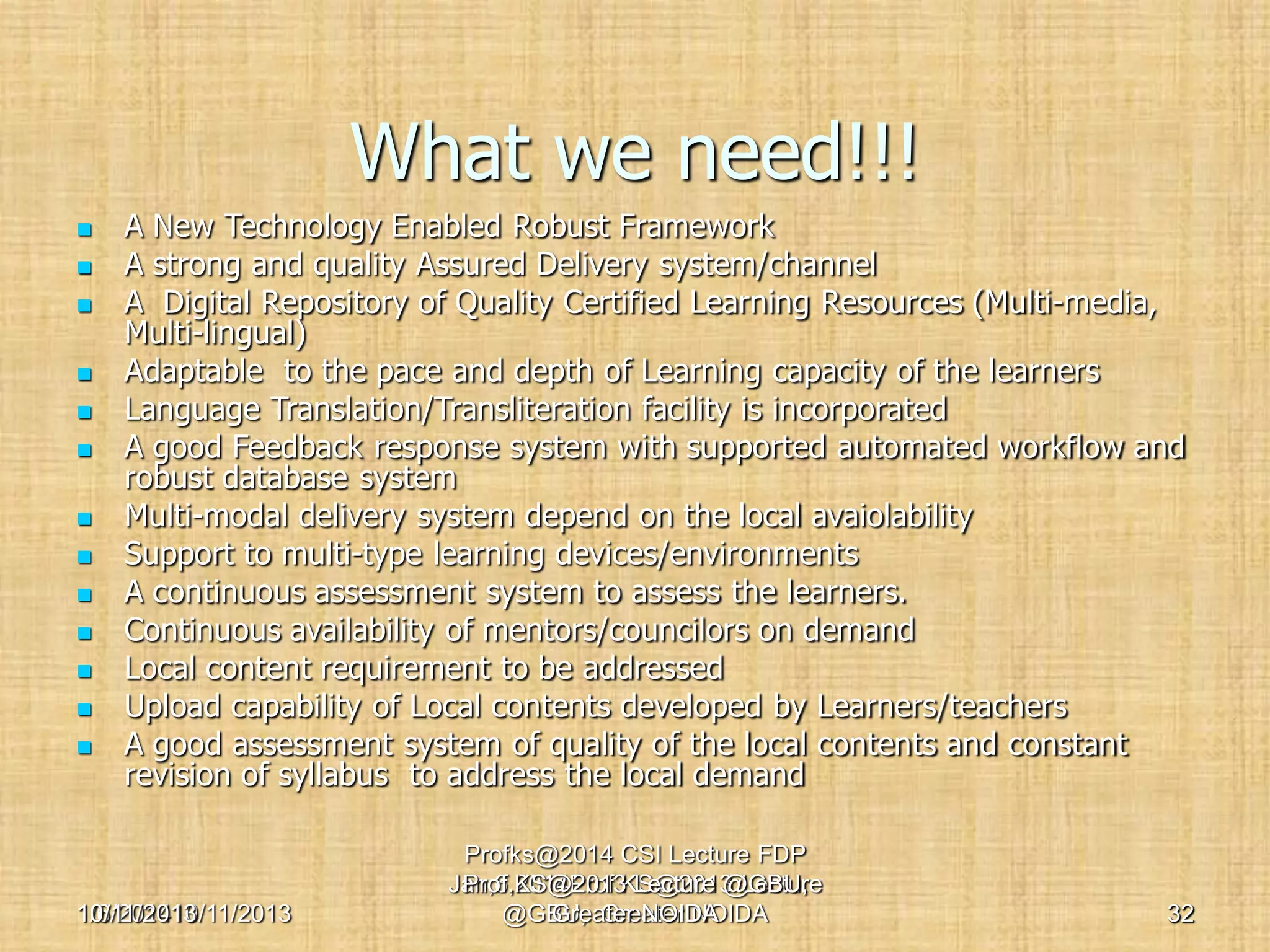
What we need!!!

















A New Technology Enabled Robust Framework
A strong and quality Assured Delivery system/channel
A Digital Repository of Quality Certified Learning Resources (Multi-media,
Multi-lingual)
Adaptable to the pace and depth of Learning capacity of the learners
Language Translation/Transliteration facility is incorporated
A good Feedback response system with supported automated workflow and
robust database system
Multi-modal delivery system depend on the local avaiolability
Support to multi-type learning devices/environments
A continuous assessment system to assess the learners.
Continuous availability of mentors/councilors on demand
Local content requirement to be addressed
Upload capability of Local contents developed by Learners/teachers
A good assessment system of quality of the local contents and constant
revision of syllabus to address the local demand

10/11/2013
1/6/201410/11/2013

Profks@2014 CSI Lecture FDP
Jan,6,2014Prof.KS@2013 Lecture
Prof.KS@2013 Lecture @GBU,
@GBU, Greater NOIDA
Greater NOIDA

32
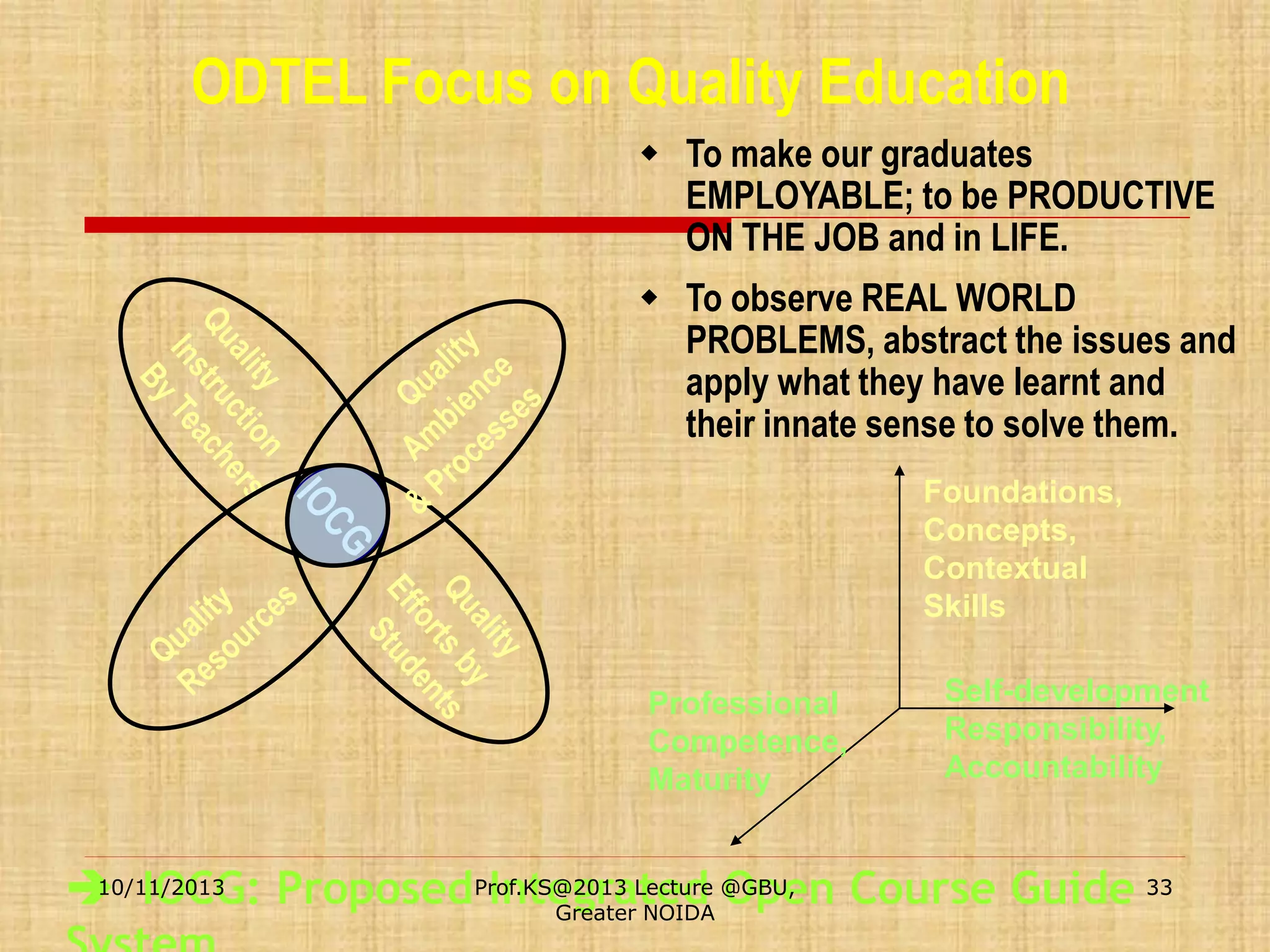
ODTEL Focus on Quality Education
 To make our graduates
EMPLOYABLE; to be PRODUCTIVE
ON THE JOB and in LIFE.
 To observe REAL WORLD
PROBLEMS, abstract the issues and
apply what they have learnt and
their innate sense to solve them.
Foundations,
Concepts,
Contextual
Skills
Professional
Competence,
Maturity

Self-development
Responsibility,
Accountability

10/11/2013
 IOCG: ProposedProf.KS@2013 Lecture @GBU, Course Guide 33
Integrated Open
Greater NOIDA
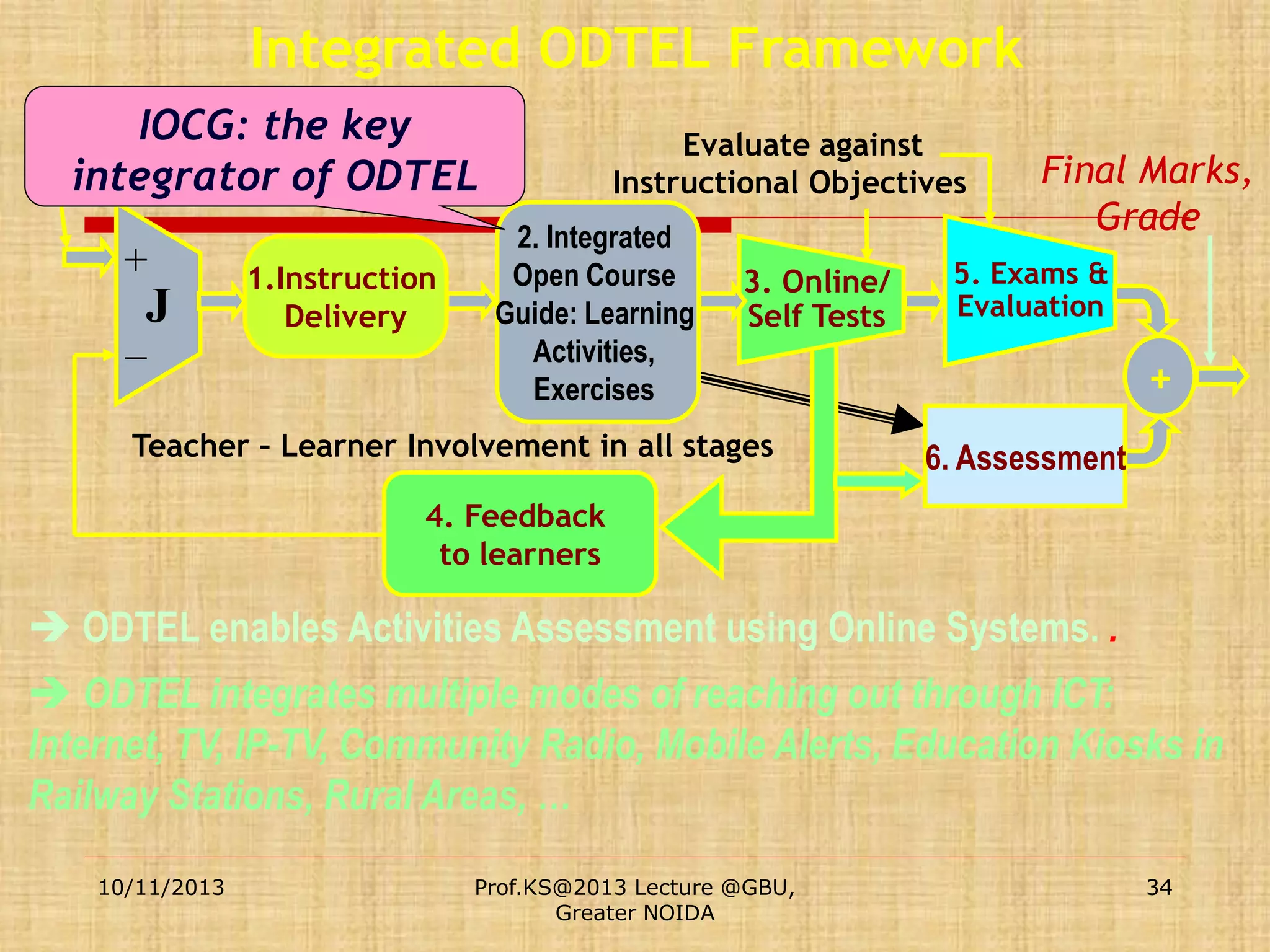
Integrated ODTEL Framework
IOCG: the key
integrator of ODTEL

Set Instructional objectives

+

J

_

1.Instruction
Delivery

Evaluate against
Instructional Objectives
2. Integrated
Open Course
Guide: Learning
Activities,
Exercises

3. Online/
Self Tests

Teacher – Learner Involvement in all stages

Final Marks,
Grade

5. Exams &
Evaluation

+
6. Assessment

4. Feedback
to learners

 ODTEL enables Activities Assessment using Online Systems. .

 ODTEL integrates multiple modes of reaching out through ICT:
Internet, TV, IP-TV, Community Radio, Mobile Alerts, Education Kiosks in
Railway Stations, Rural Areas, …
10/11/2013

Prof.KS@2013 Lecture @GBU,
Greater NOIDA

34
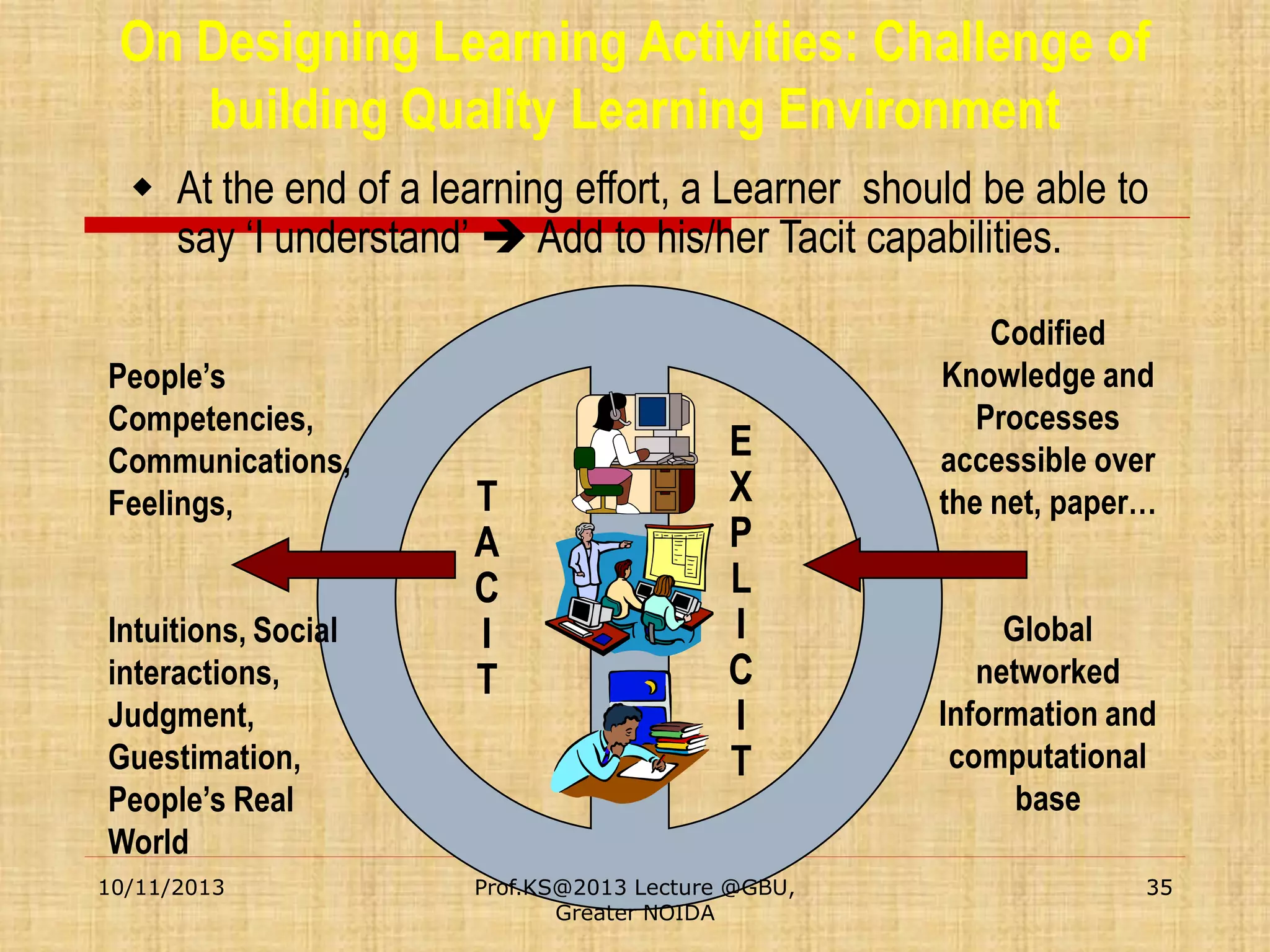
On Designing Learning Activities: Challenge of
building Quality Learning Environment
 At the end of a learning effort, a Learner should be able to
say ‘I understand’  Add to his/her Tacit capabilities.
People’s
Competencies,
Communications,
Feelings,

Intuitions, Social
interactions,
Judgment,
Guestimation,
People’s Real
World
10/11/2013

T
A
C
I
T

E
X
P
L
I
C
I
T

Prof.KS@2013 Lecture @GBU,
Greater NOIDA

Codified
Knowledge and
Processes
accessible over
the net, paper…
Global
networked
Information and
computational
base
35
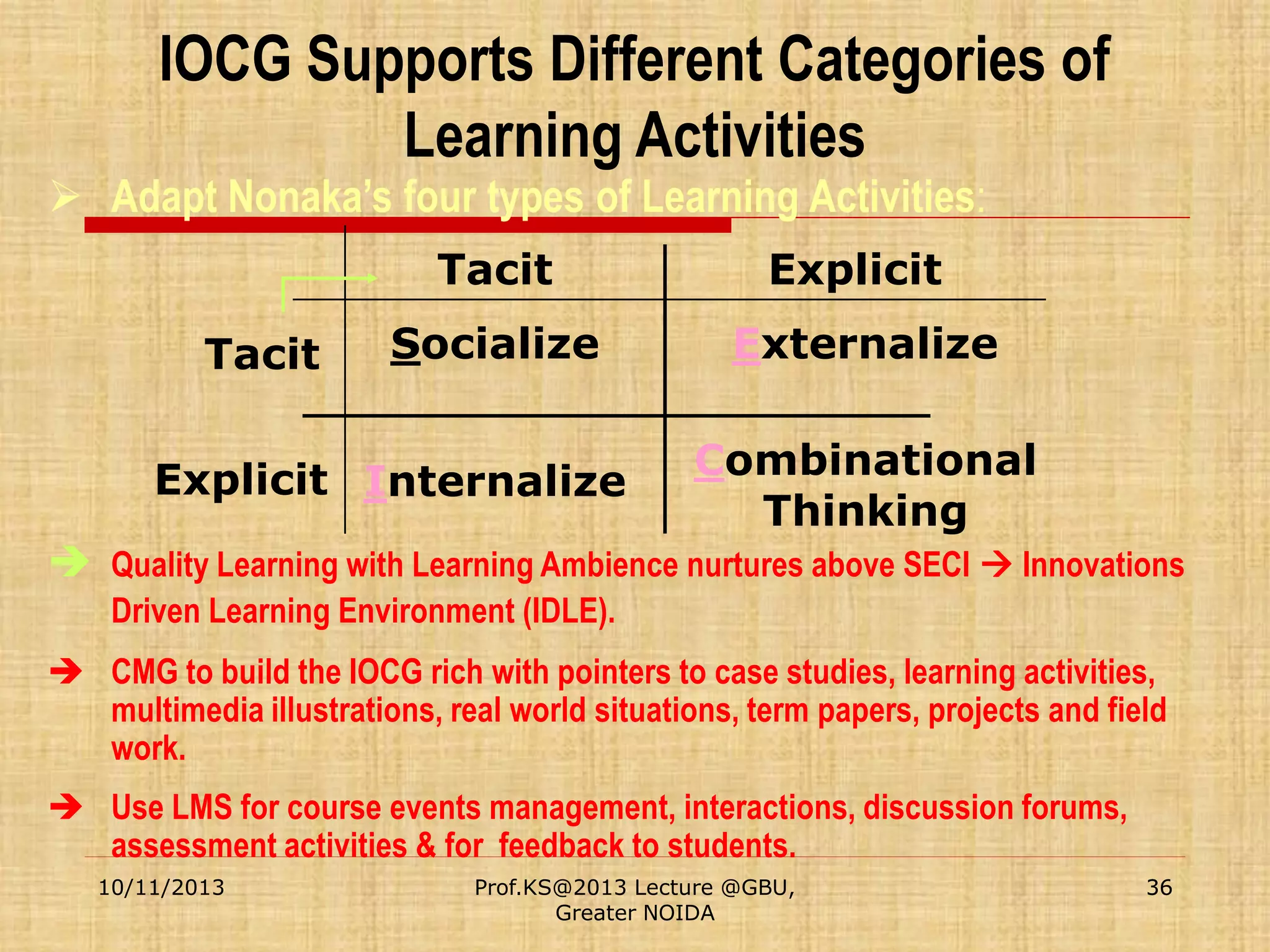
IOCG Supports Different Categories of
Learning Activities

 Adapt Nonaka’s four types of Learning Activities:
Tacit
Tacit

Explicit

Socialize

Externalize

Explicit Internalize

Combinational
Thinking

 Quality Learning with Learning Ambience nurtures above SECI  Innovations
Driven Learning Environment (IDLE).
 CMG to build the IOCG rich with pointers to case studies, learning activities,
multimedia illustrations, real world situations, term papers, projects and field
work.

 Use LMS for course events management, interactions, discussion forums,
assessment activities & for feedback to students.
10/11/2013

Prof.KS@2013 Lecture @GBU,
Greater NOIDA

36
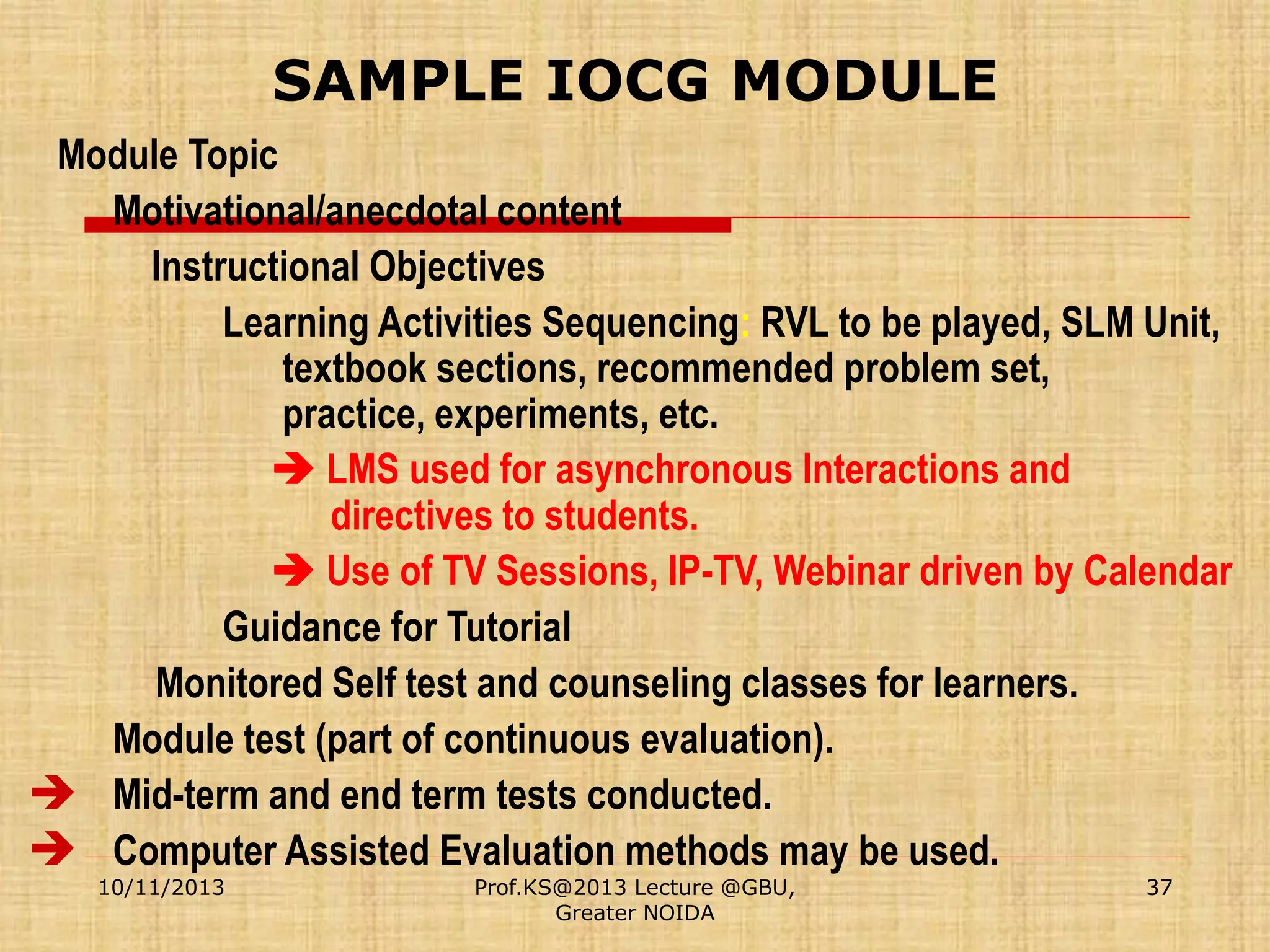
SAMPLE IOCG MODULE
Module Topic
Motivational/anecdotal content
Instructional Objectives
Learning Activities Sequencing: RVL to be played, SLM Unit,
textbook sections, recommended problem set,
practice, experiments, etc.
 LMS used for asynchronous Interactions and
directives to students.
 Use of TV Sessions, IP-TV, Webinar driven by Calendar
Guidance for Tutorial
Monitored Self test and counseling classes for learners.
Module test (part of continuous evaluation).
 Mid-term and end term tests conducted.
 Computer Assisted Evaluation methods may be used.
10/11/2013

Prof.KS@2013 Lecture @GBU,
Greater NOIDA

37
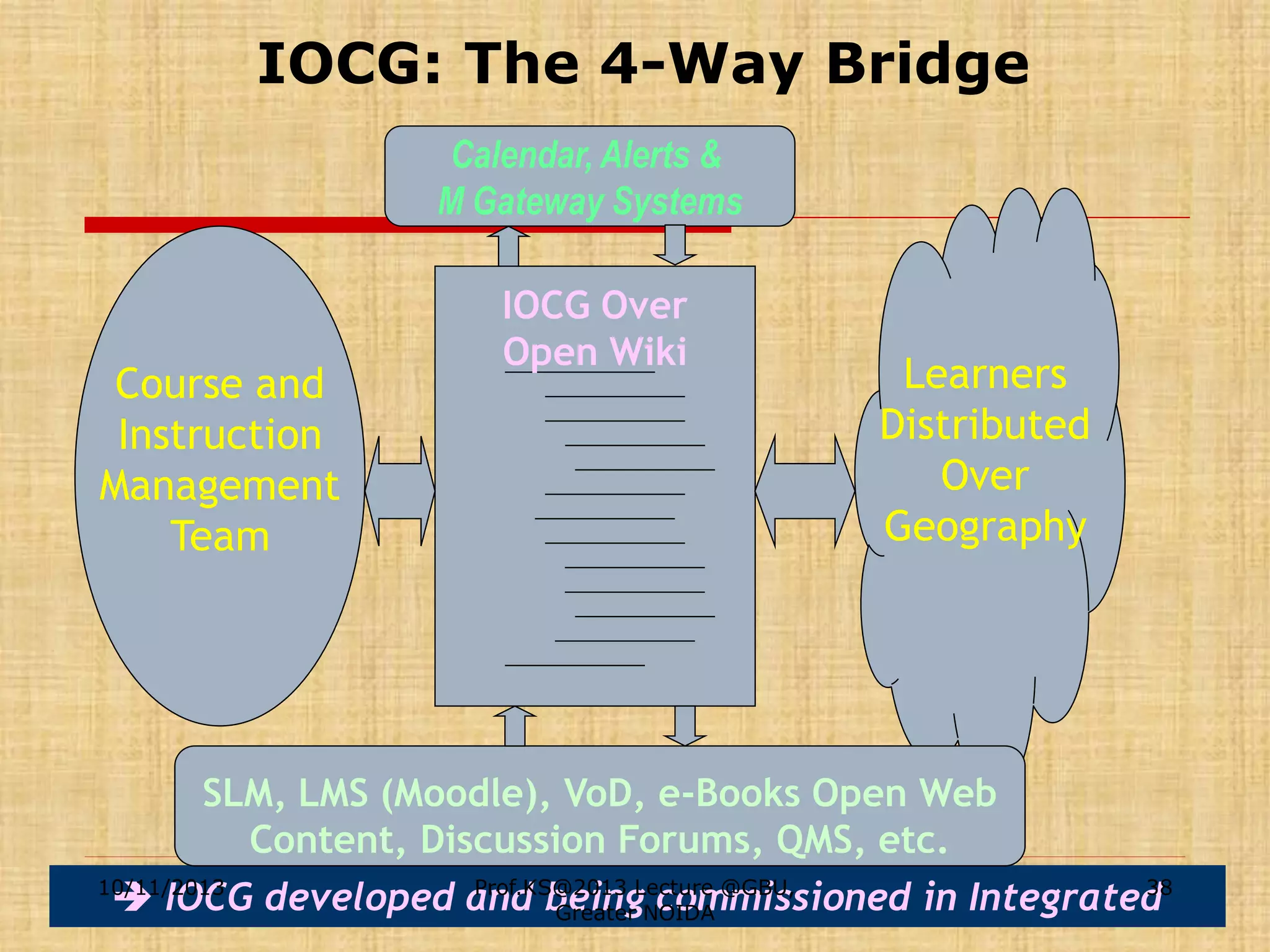
IOCG: The 4-Way Bridge
Calendar, Alerts &
M Gateway Systems

Course and
Instruction
Management
Team

IOCG Over
Open Wiki

Learners
Distributed
Over
Geography

SLM, LMS (Moodle), VoD, e-Books Open Web
Content, Discussion Forums, QMS, etc.
10/11/2013
Prof.KS@2013 Lecture
38
 IOCG developed and beingNOIDA @GBU,
commissioned in Integrated
Greater
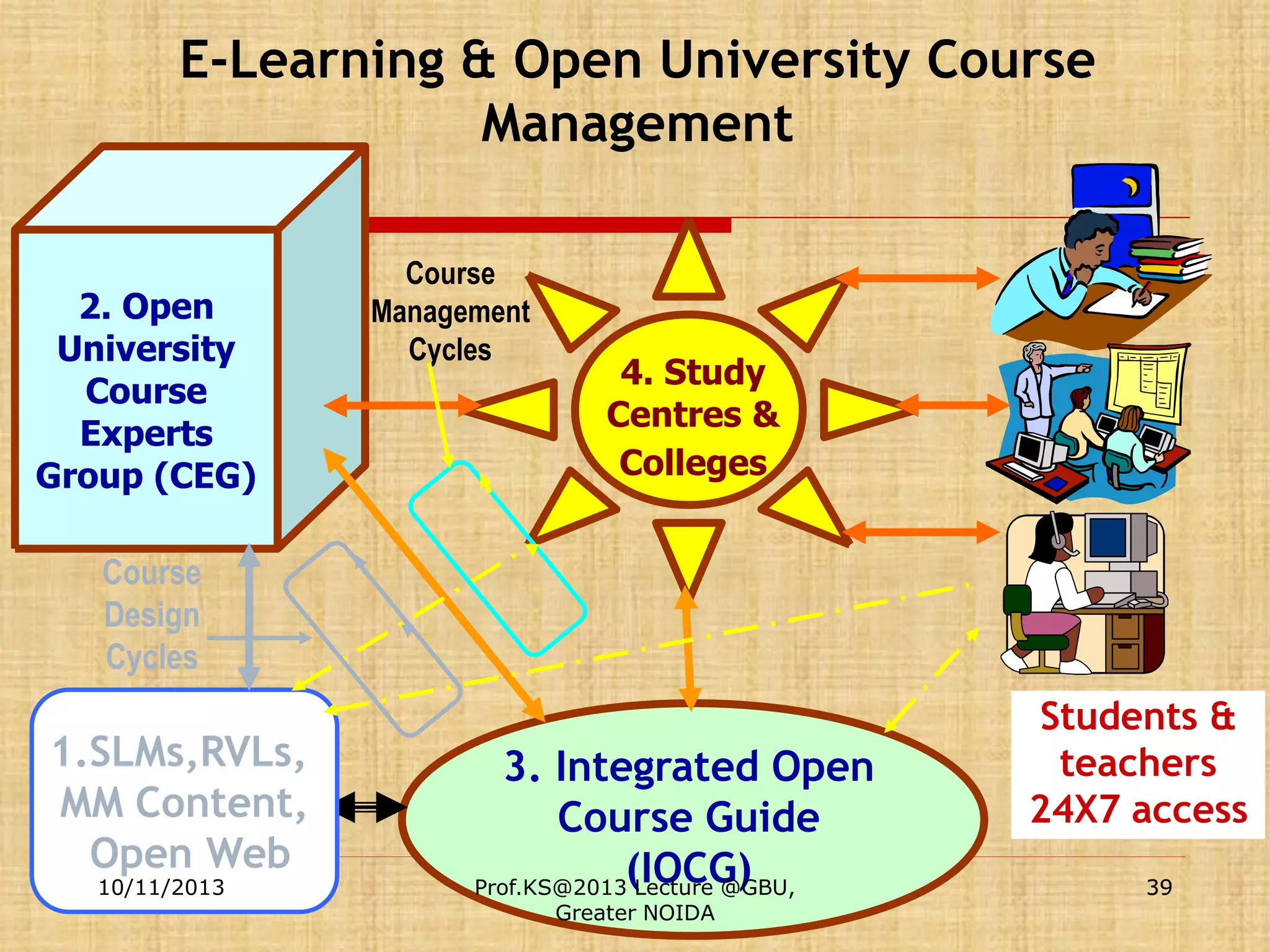
E-Learning & Open University Course
Management
2. Open
University
Course
Experts
Group (CEG)

Course
Management
Cycles

4. Study
Centres &
Colleges

Course
Design
Cycles

1.SLMs,RVLs,
MM Content,
Open Web
10/11/2013

3. Integrated Open
Course Guide
(IOCG)
Prof.KS@2013 Lecture @GBU,
Greater NOIDA

Students &
teachers
24X7 access
39
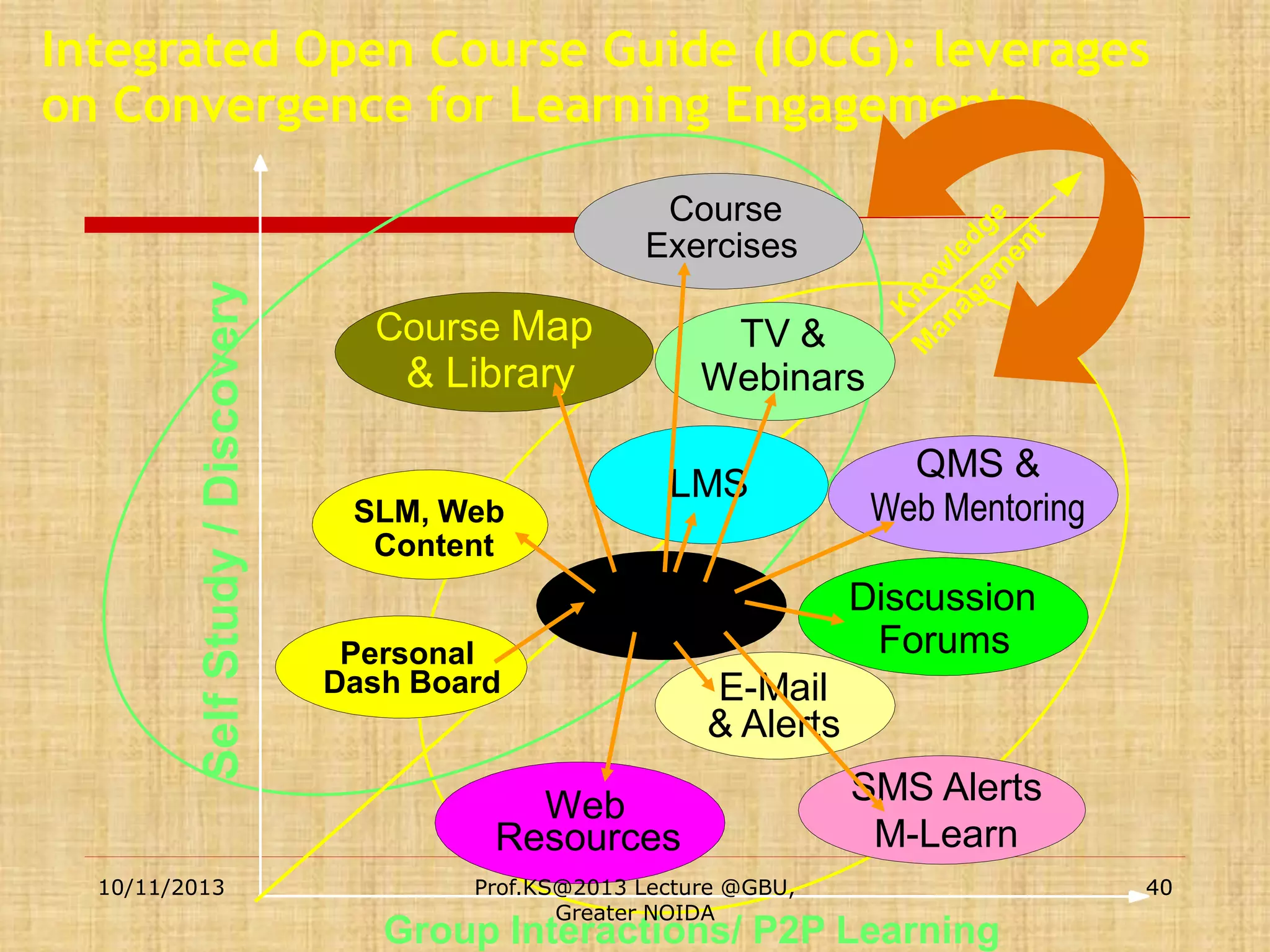
Integrated Open Course Guide (IOCG): leverages
on Convergence for Learning Engagements

Self Study / Discovery

Course
Exercises

Course Map

TV &
Webinars

& Library
SLM, Web
Content

LMS
IOCG

Personal
Dash Board

Discussion
Forums

E-Mail
& Alerts

Web
Resources
10/11/2013

QMS &
Web Mentoring

Prof.KS@2013 Lecture @GBU,
Greater NOIDA

SMS Alerts
M-Learn

Group Interactions/ P2P Learning

40
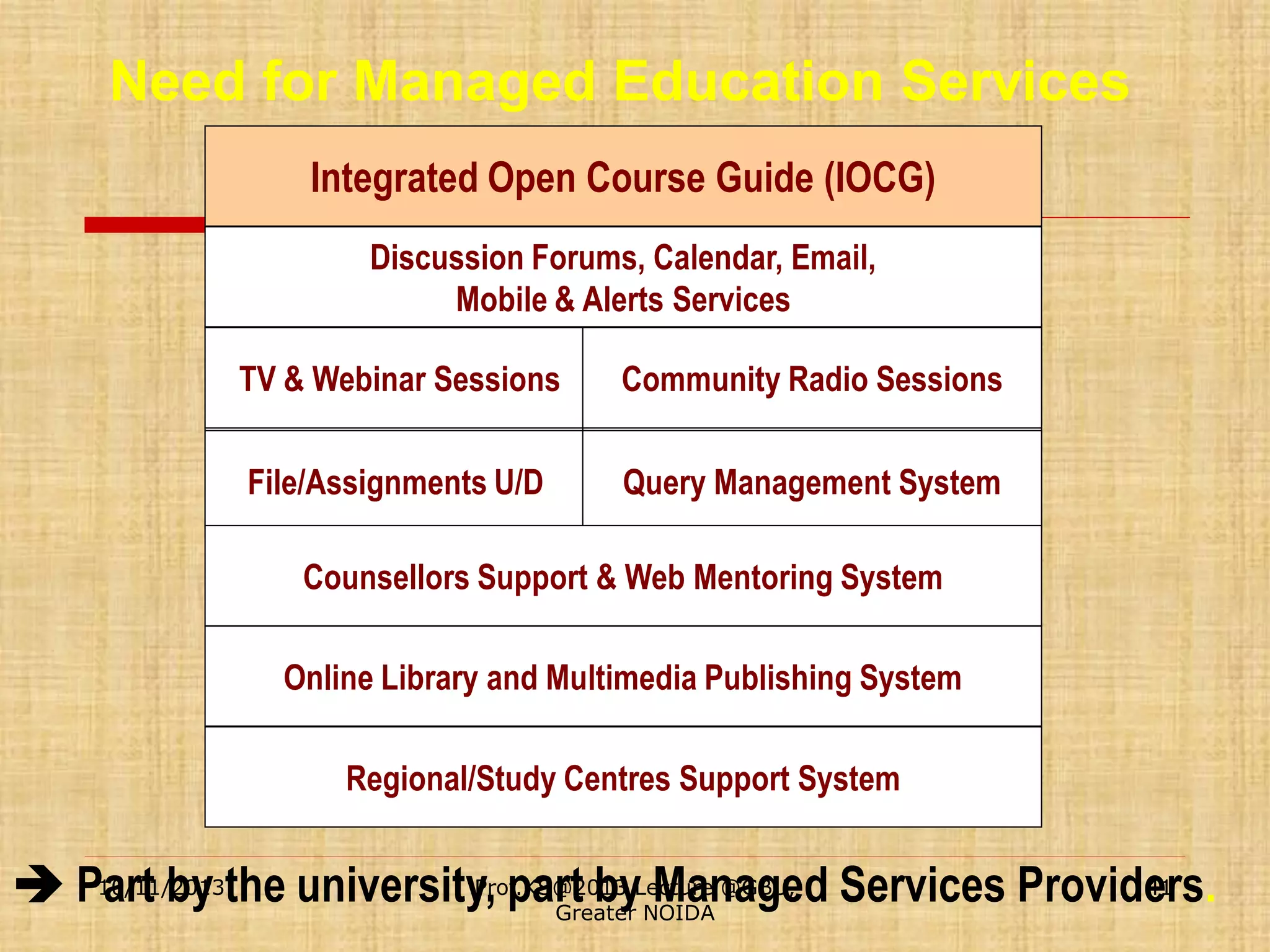
Need for Managed Education Services
Integrated Open Course Guide (IOCG)
Discussion Forums, Calendar, Email,
Mobile & Alerts Services
TV & Webinar Sessions
TV & WebinarSessions

Community Radio Sessions

TV & Webinar Sessions
File/Assignments U/D

Community Radio Sessions
Query Management System

Counsellors Support & Web Mentoring System

Online Library and Multimedia Publishing System
Regional/Study Centres Support System
10/11/2013
Prof.KS@2013 Managed
41
 Part by the university, part byLecture @GBU, Services Providers.
Greater NOIDA
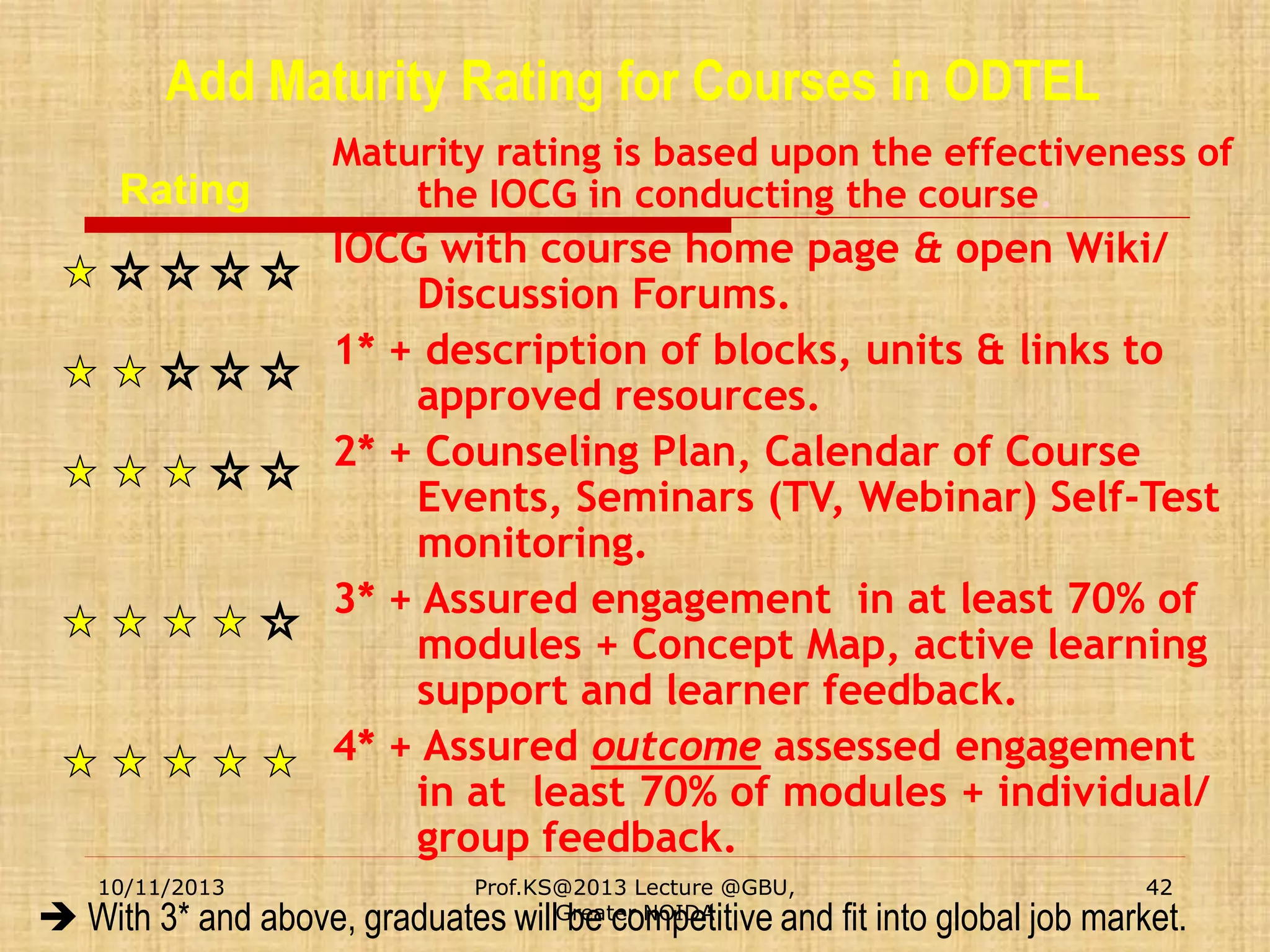
Add Maturity Rating for Courses in ODTEL
Rating

Maturity rating is based upon the effectiveness of
the IOCG in conducting the course.

IOCG with course home page & open Wiki/
Discussion Forums.
1* + description of blocks, units & links to
approved resources.
2* + Counseling Plan, Calendar of Course
Events, Seminars (TV, Webinar) Self-Test
monitoring.
3* + Assured engagement in at least 70% of
modules + Concept Map, active learning
support and learner feedback.
4* + Assured outcome assessed engagement
in at least 70% of modules + individual/
group feedback.
10/11/2013

Prof.KS@2013 Lecture @GBU,
Greater NOIDA

42

 With 3* and above, graduates will be competitive and fit into global job market.
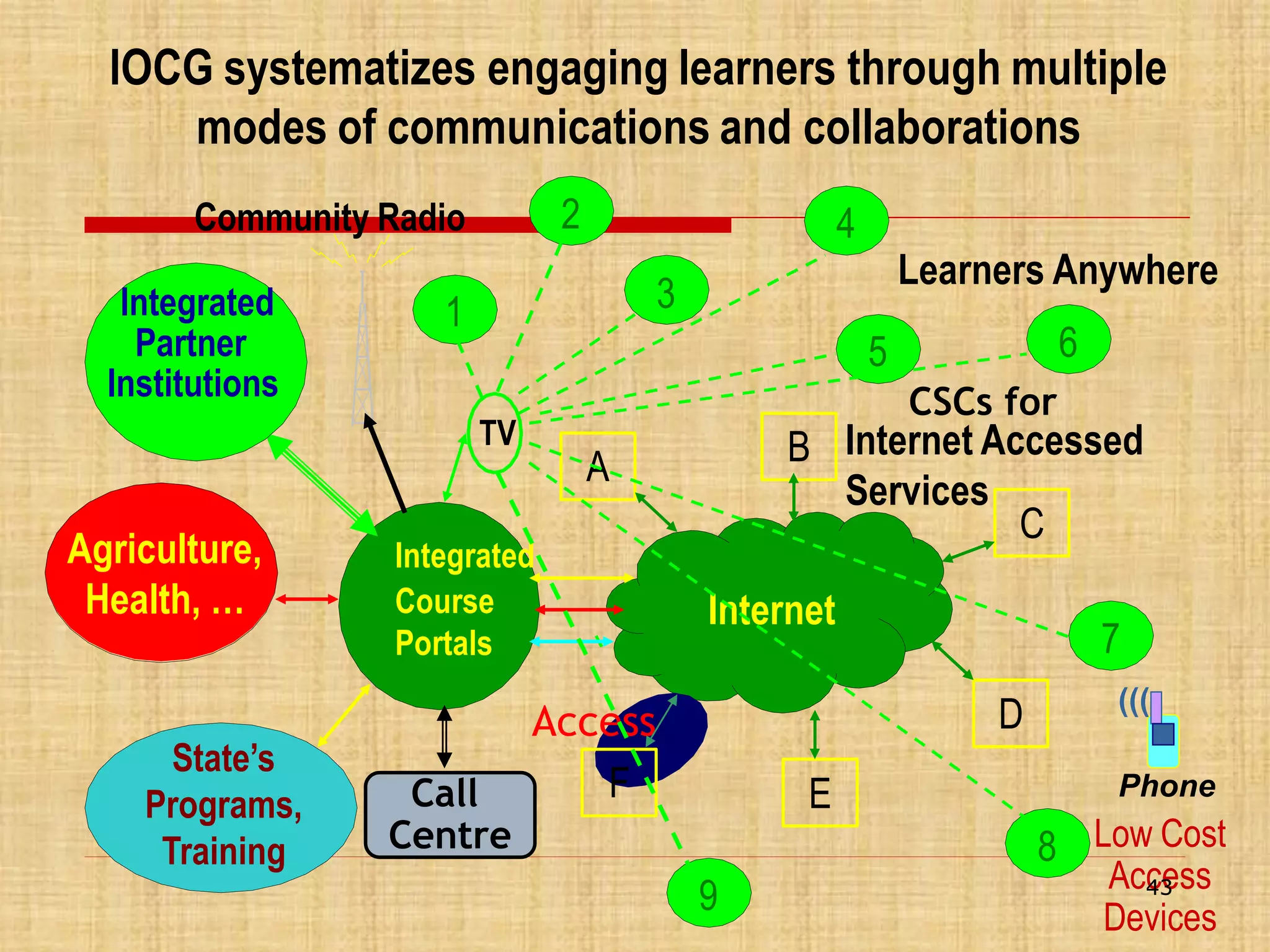
IOCG systematizes engaging learners through multiple
modes of communications and collaborations
2

Community Radio

Integrated
Partner
Institutions

State’s
Programs,
Training

Learners Anywhere

3

1

6

5
CSCs for

TV

Agriculture,
Health, …

4

A

Integrated
Course
Portals

Call
Centre

B Internet Accessed
Services
C

Internet

7

D

Access
F

E
9

(((
Phone

8 Low Cost
Access
43
Devices
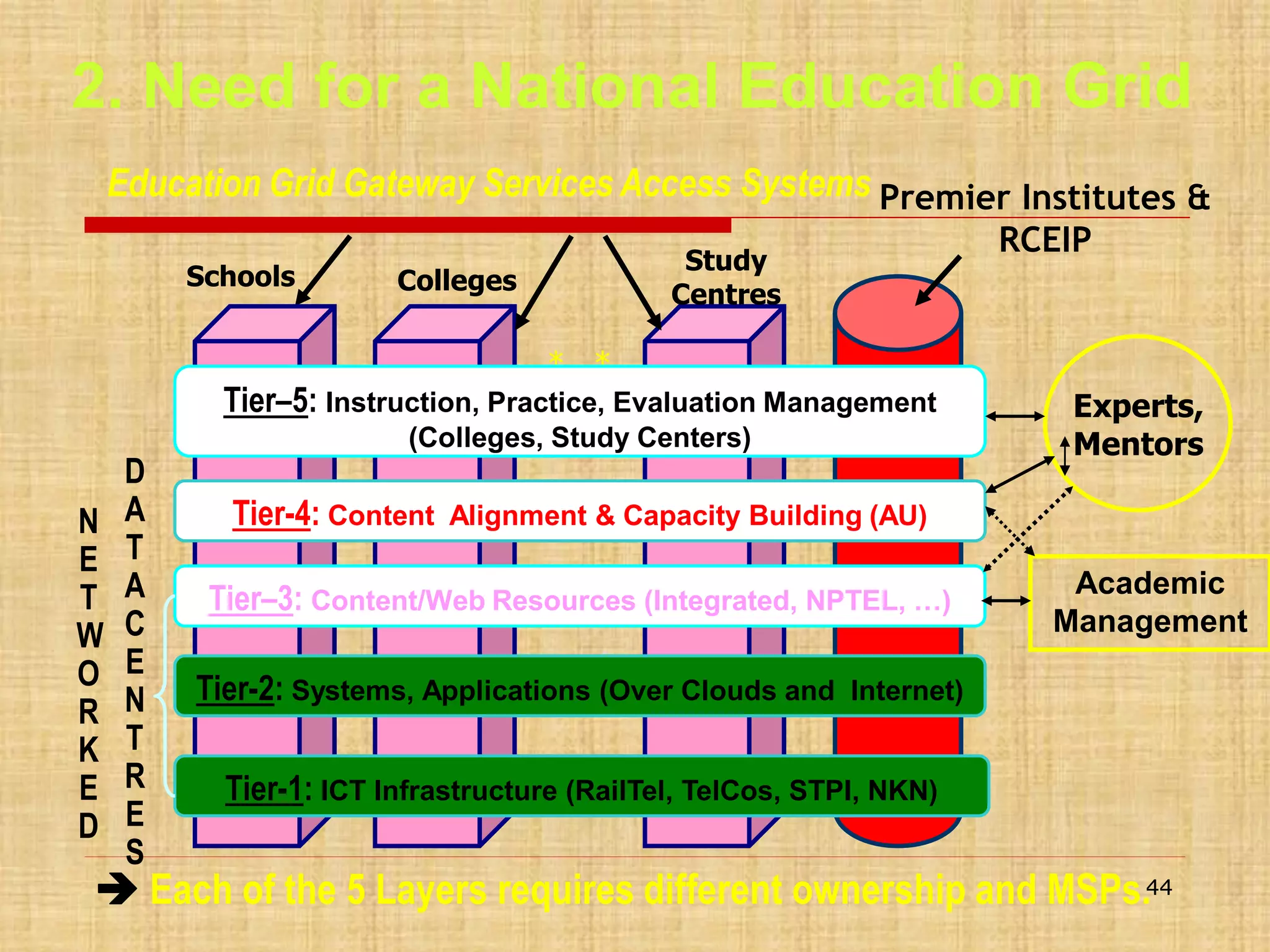
2. Need for a National Education Grid
Education Grid Gateway Services Access Systems Premier Institutes &
Schools

Study
Centres

Colleges

RCEIP

* *

Tier–5: Instruction, Practice, Evaluation Management

N
E
T
W
O
R
K
E
D

D
A
T
A
C
E
N
T
R
E
S

(Colleges, Study Centers)

Experts,
Mentors

Tier-4: Content Alignment & Capacity Building (AU)
Tier–3: Content/Web Resources (Integrated, NPTEL, …)

Academic
Management

Tier-2: Systems, Applications (Over Clouds and Internet)
Tier-1: ICT Infrastructure (RailTel, TelCos, STPI, NKN)

 Each of the 5 Layers requires different ownership and MSPs.44
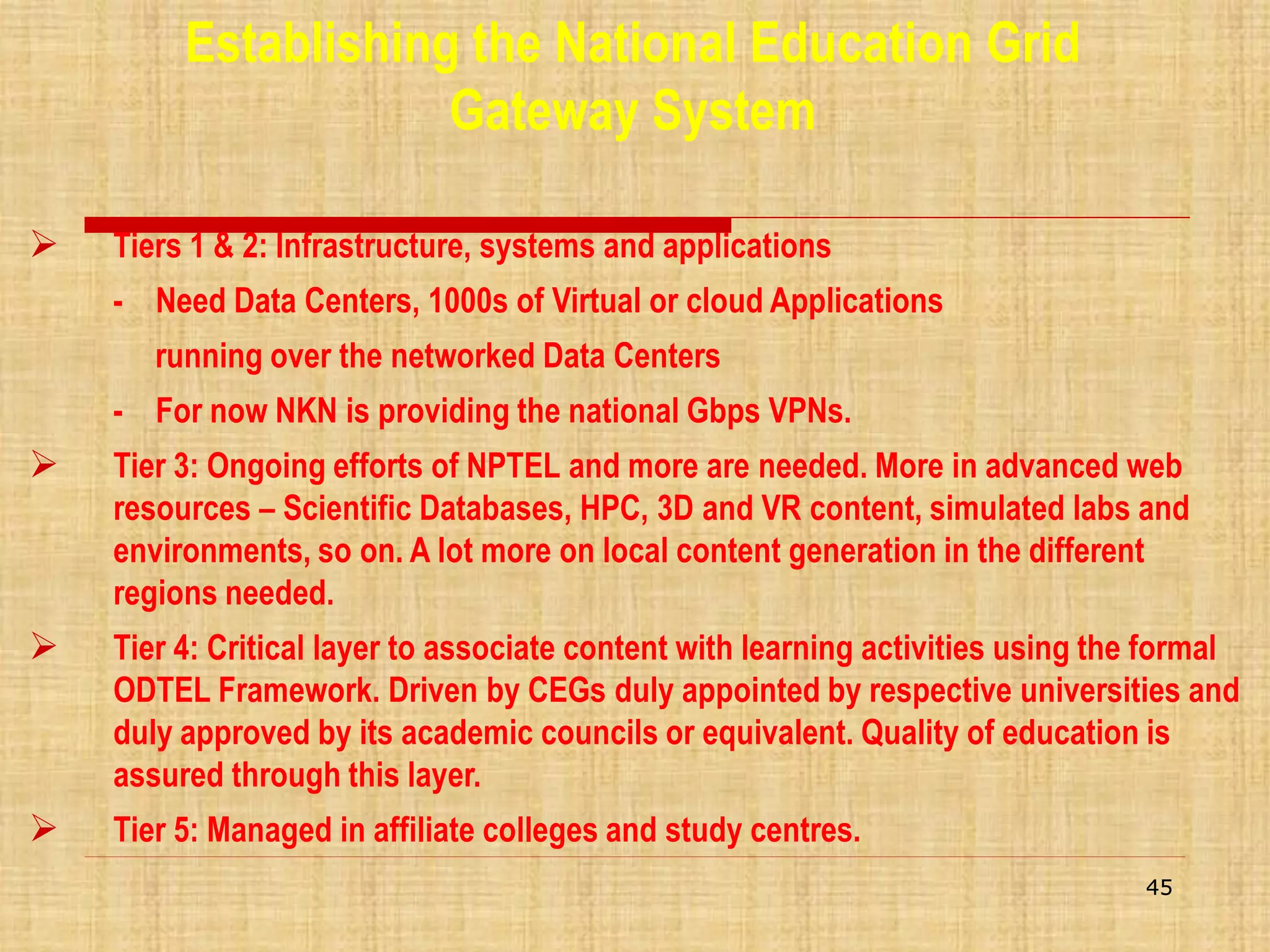
Establishing the National Education Grid
Gateway System


Tiers 1 & 2: Infrastructure, systems and applications

- Need Data Centers, 1000s of Virtual or cloud Applications
running over the networked Data Centers

- For now NKN is providing the national Gbps VPNs.



Tier 3: Ongoing efforts of NPTEL and more are needed. More in advanced web
resources – Scientific Databases, HPC, 3D and VR content, simulated labs and
environments, so on. A lot more on local content generation in the different
regions needed.



Tier 4: Critical layer to associate content with learning activities using the formal
ODTEL Framework. Driven by CEGs duly appointed by respective universities and
duly approved by its academic councils or equivalent. Quality of education is
assured through this layer.



Tier 5: Managed in affiliate colleges and study centres.
45
Infrastructure for the Education Grid:
Leveraging the NKN and NME
SOU/Integrated/Regiona
R&D
l Educational
RCEIS: Regional Orgn.
Centres for
Institutions
One

Educational
Innovations &
Practices

RBAN (NME)
In each Region

RCEIP
Datacentre
& Gateway

Asymmetric
Broadband

Scientific
Databases
[ICAR, DOS,
CSIR, etc...]
Premier
Institutes

Core Network:
National Gigabits VPNs
over OFC Networks

National
Programs

Integrated SSA, RMSA
[Open e- Sakshat, …
Learning]

University
Centres

Advanced
Computing
Resources
Computational
Portals
ERNET
As MSP

46
Regional Broadband Access Networks
Colleges

Scientific*
Databases
Local Dev.
Programs

Regional Centre for
Educational
Innovations & Practices

National
Knowledge
Network
[NKN]

*Run in RCEIP
Datacentre

NGOs
Vocational
Training

Regional Broadband
Access Network
[RBAN under NME?]
RCEIP
Datacentre
& Gateway
Local eCommunity
Learning
Colleges
Programs*

Heritage *
Portal
Services

Schools

 Each College, Study Centre to get Asymmetric Broadband.
47
 Their portals in the cloud facility at the RCEIS.
 Results in lower cost per leaf node with assured quality of services
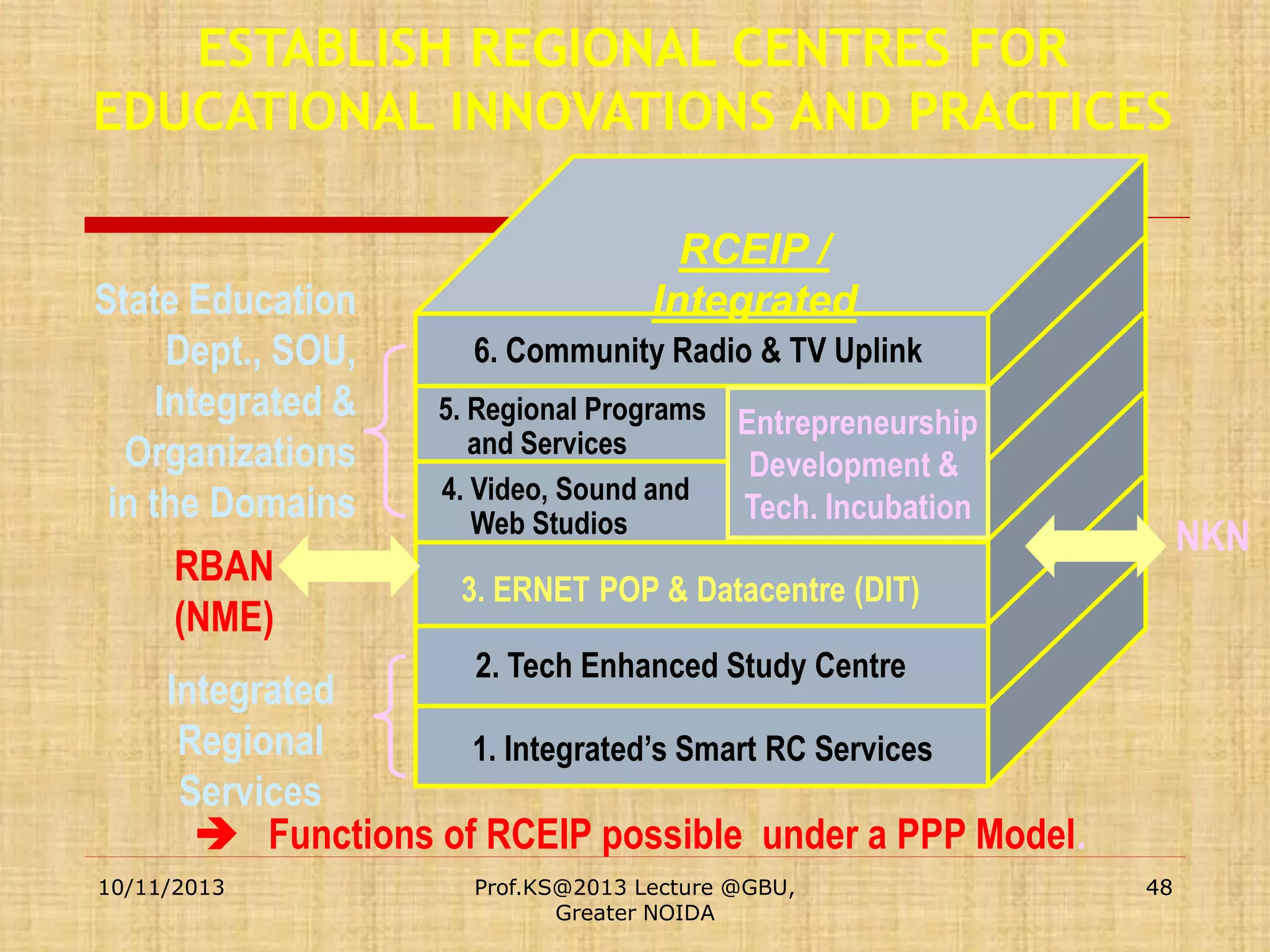
ESTABLISH REGIONAL CENTRES FOR
EDUCATIONAL INNOVATIONS AND PRACTICES

State Education
Dept., SOU,
Integrated &
Organizations
in the Domains
RBAN
(NME)

RCEIP /
Integrated
6. Community Radio & TV Uplink
5. Regional Programs Entrepreneurship
and Services
Development &
4. Video, Sound and
Tech. Incubation
Web Studios

NKN

3. ERNET POP & Datacentre (DIT)

2. Tech Enhanced Study Centre

Integrated
Regional
1. Integrated’s Smart RC Services
Services
 Functions of RCEIP possible under a PPP Model.
10/11/2013

Prof.KS@2013 Lecture @GBU,
Greater NOIDA

48
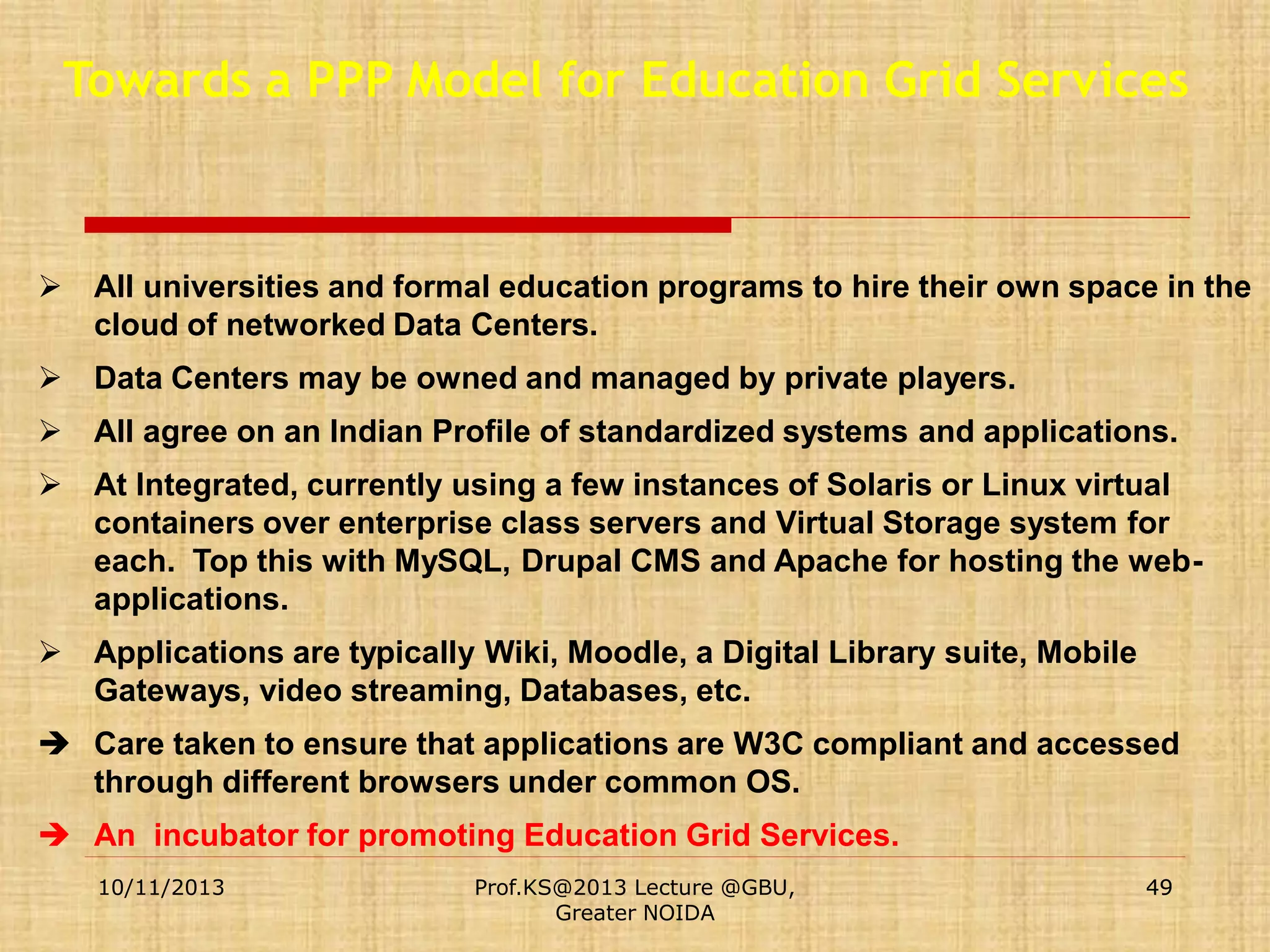
Towards a PPP Model for Education Grid Services

 All universities and formal education programs to hire their own space in the
cloud of networked Data Centers.

 Data Centers may be owned and managed by private players.
 All agree on an Indian Profile of standardized systems and applications.
 At Integrated, currently using a few instances of Solaris or Linux virtual
containers over enterprise class servers and Virtual Storage system for
each. Top this with MySQL, Drupal CMS and Apache for hosting the webapplications.

 Applications are typically Wiki, Moodle, a Digital Library suite, Mobile
Gateways, video streaming, Databases, etc.
 Care taken to ensure that applications are W3C compliant and accessed
through different browsers under common OS.
 An incubator for promoting Education Grid Services.
10/11/2013

Prof.KS@2013 Lecture @GBU,
Greater NOIDA

49
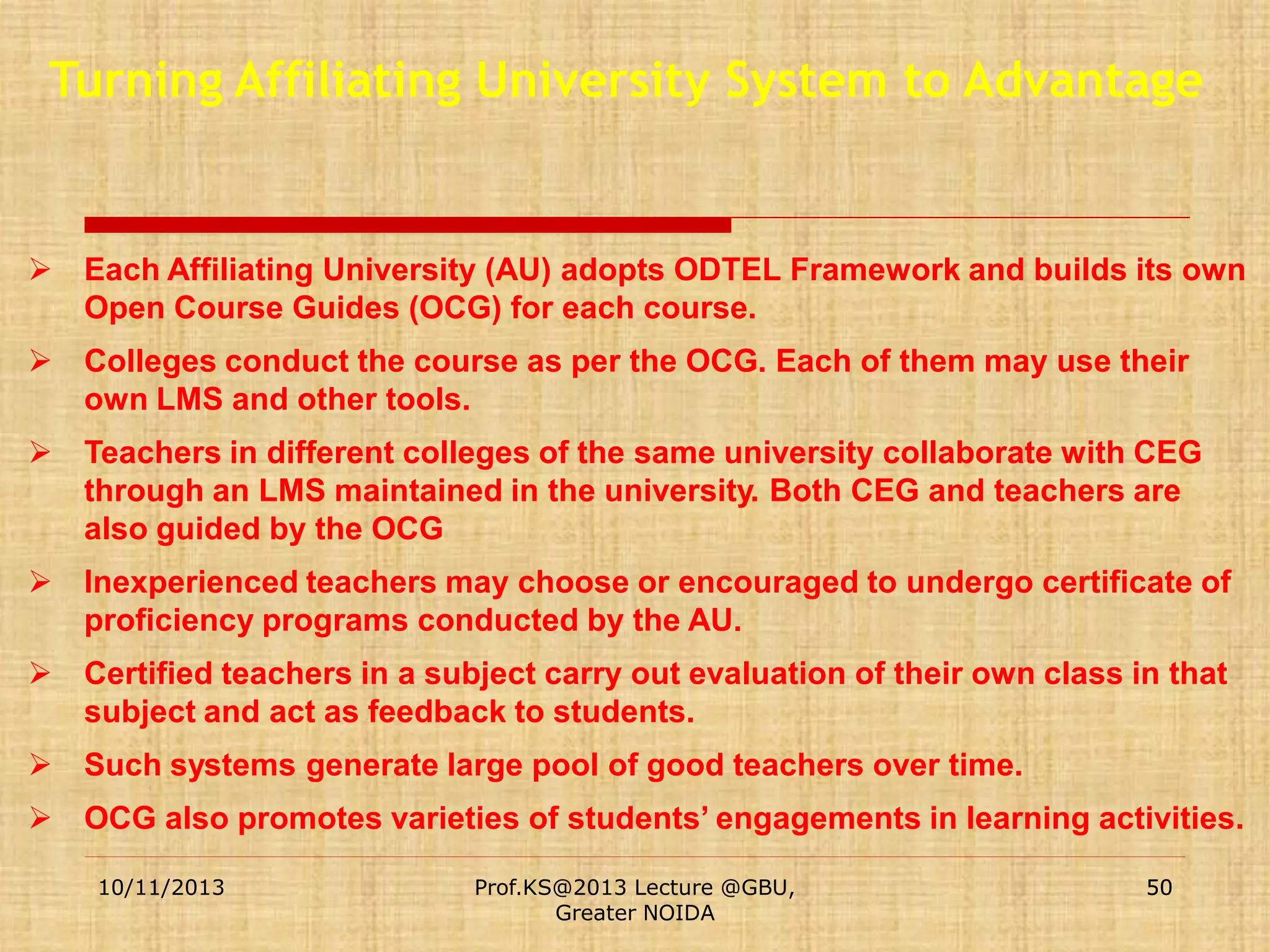
Turning Affiliating University System to Advantage

 Each Affiliating University (AU) adopts ODTEL Framework and builds its own
Open Course Guides (OCG) for each course.
 Colleges conduct the course as per the OCG. Each of them may use their
own LMS and other tools.
 Teachers in different colleges of the same university collaborate with CEG
through an LMS maintained in the university. Both CEG and teachers are
also guided by the OCG
 Inexperienced teachers may choose or encouraged to undergo certificate of
proficiency programs conducted by the AU.
 Certified teachers in a subject carry out evaluation of their own class in that
subject and act as feedback to students.
 Such systems generate large pool of good teachers over time.

 OCG also promotes varieties of students’ engagements in learning activities.
10/11/2013

Prof.KS@2013 Lecture @GBU,
Greater NOIDA

50
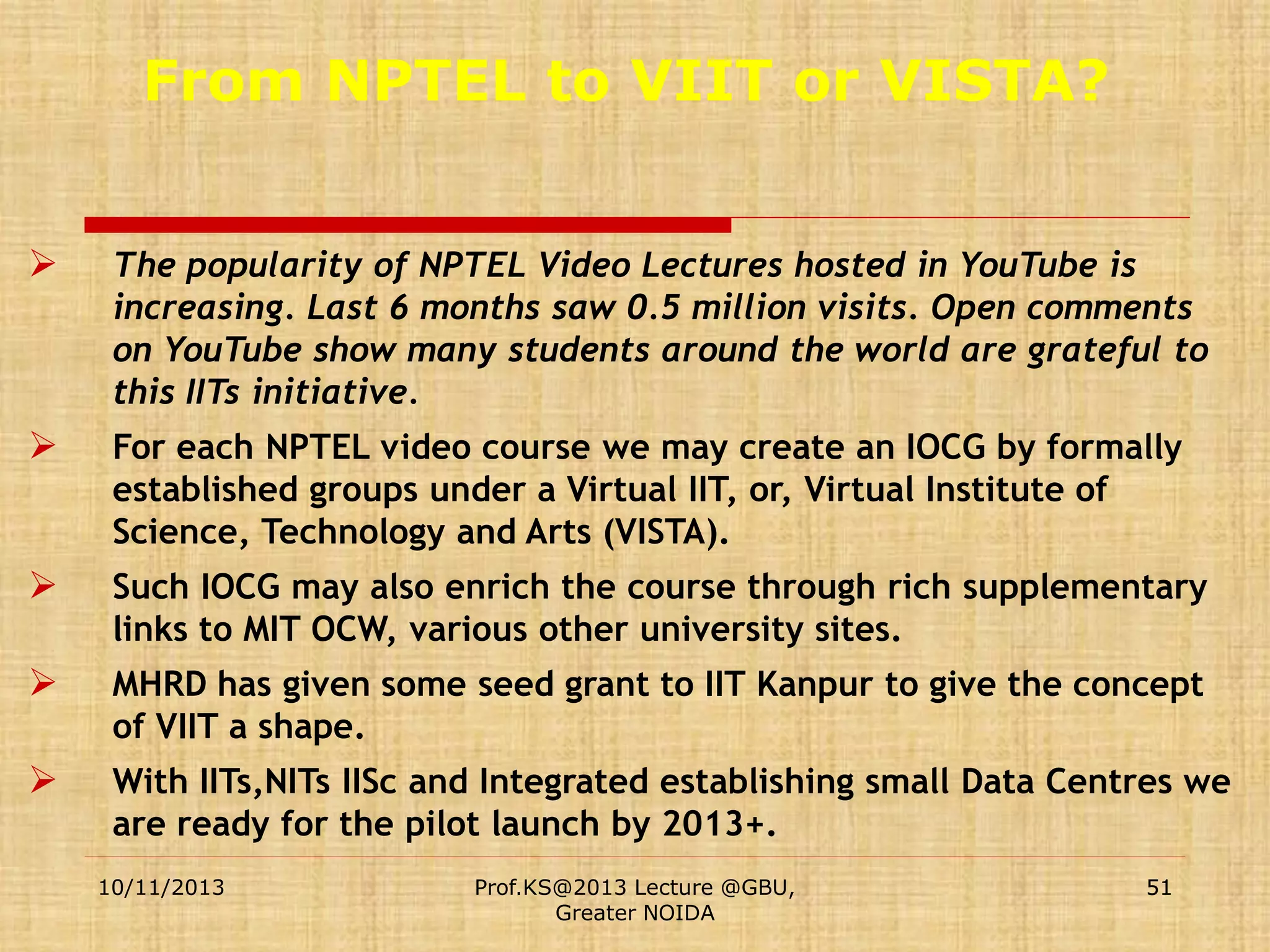
From NPTEL to VIIT or VISTA?


The popularity of NPTEL Video Lectures hosted in YouTube is
increasing. Last 6 months saw 0.5 million visits. Open comments
on YouTube show many students around the world are grateful to
this IITs initiative.



For each NPTEL video course we may create an IOCG by formally
established groups under a Virtual IIT, or, Virtual Institute of
Science, Technology and Arts (VISTA).



Such IOCG may also enrich the course through rich supplementary
links to MIT OCW, various other university sites.



MHRD has given some seed grant to IIT Kanpur to give the concept
of VIIT a shape.



With IITs,NITs IISc and Integrated establishing small Data Centres we
are ready for the pilot launch by 2013+.
10/11/2013

Prof.KS@2013 Lecture @GBU,
Greater NOIDA

51
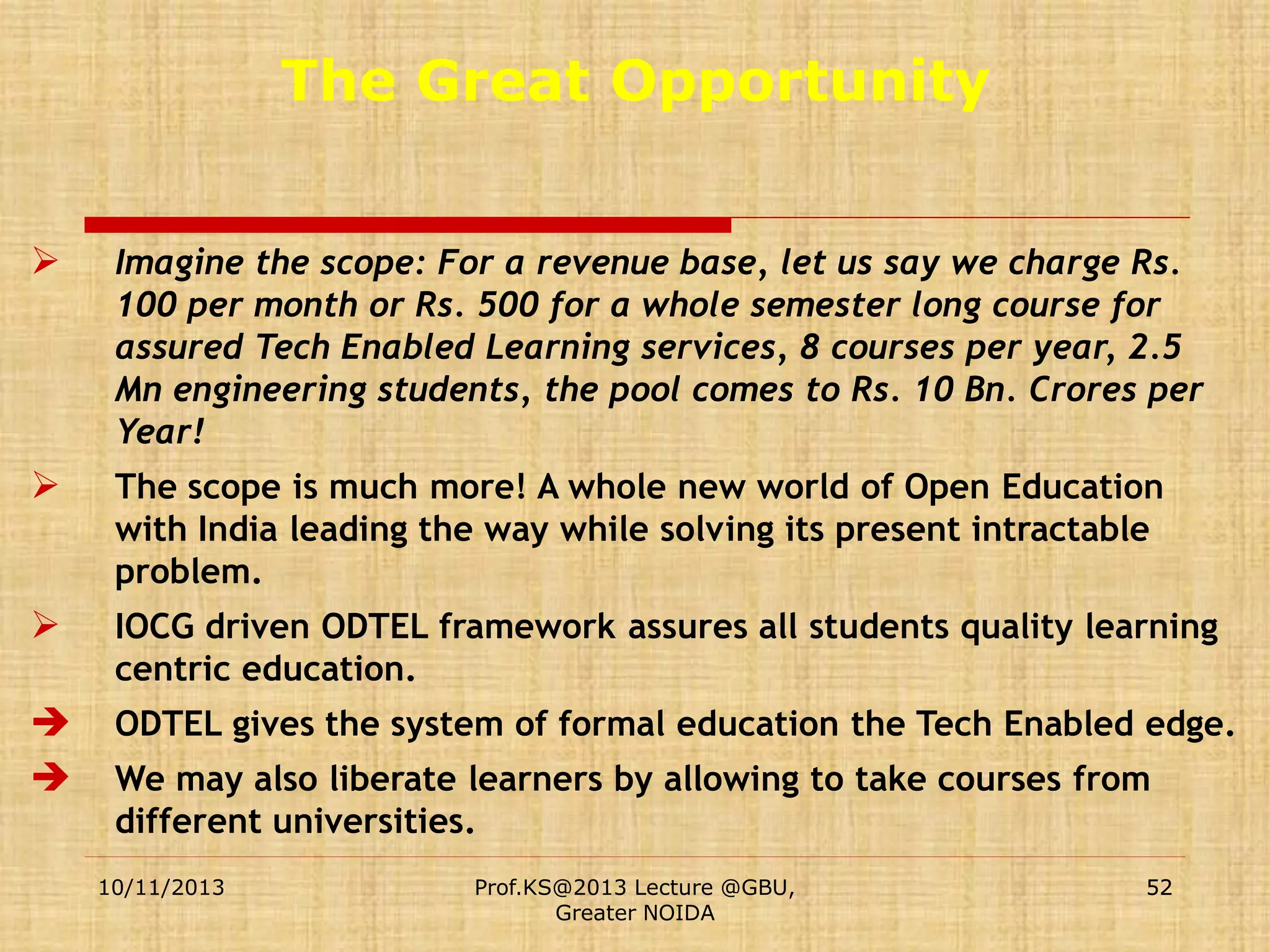
The Great Opportunity


Imagine the scope: For a revenue base, let us say we charge Rs.
100 per month or Rs. 500 for a whole semester long course for
assured Tech Enabled Learning services, 8 courses per year, 2.5
Mn engineering students, the pool comes to Rs. 10 Bn. Crores per
Year!



The scope is much more! A whole new world of Open Education
with India leading the way while solving its present intractable
problem.



IOCG driven ODTEL framework assures all students quality learning
centric education.




ODTEL gives the system of formal education the Tech Enabled edge.
We may also liberate learners by allowing to take courses from
different universities.
10/11/2013

Prof.KS@2013 Lecture @GBU,
Greater NOIDA

52
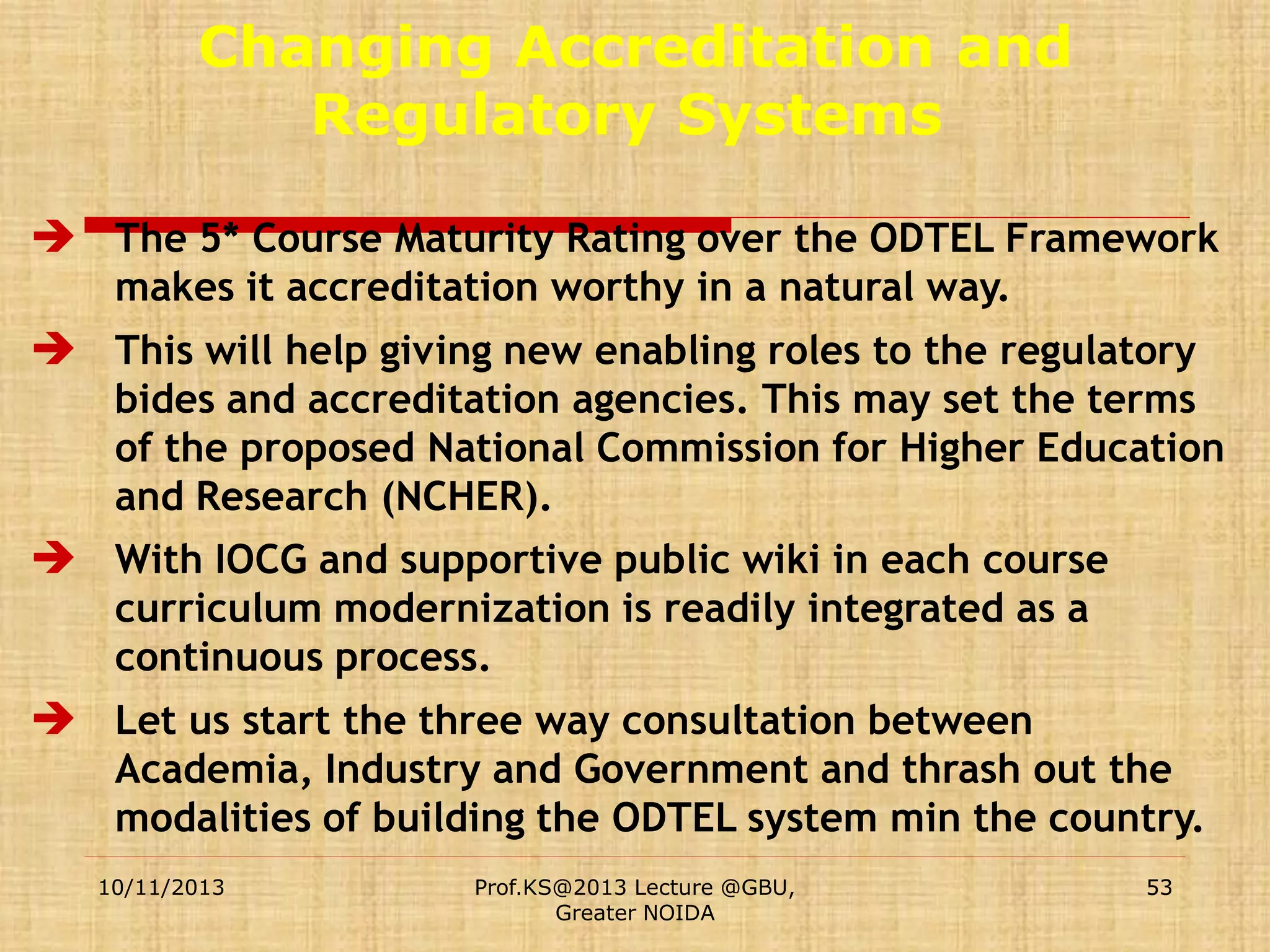
Changing Accreditation and
Regulatory Systems
 The 5* Course Maturity Rating over the ODTEL Framework
makes it accreditation worthy in a natural way.

 This will help giving new enabling roles to the regulatory
bides and accreditation agencies. This may set the terms
of the proposed National Commission for Higher Education
and Research (NCHER).

 With IOCG and supportive public wiki in each course
curriculum modernization is readily integrated as a
continuous process.

 Let us start the three way consultation between
Academia, Industry and Government and thrash out the
modalities of building the ODTEL system min the country.
10/11/2013

Prof.KS@2013 Lecture @GBU,
Greater NOIDA

53
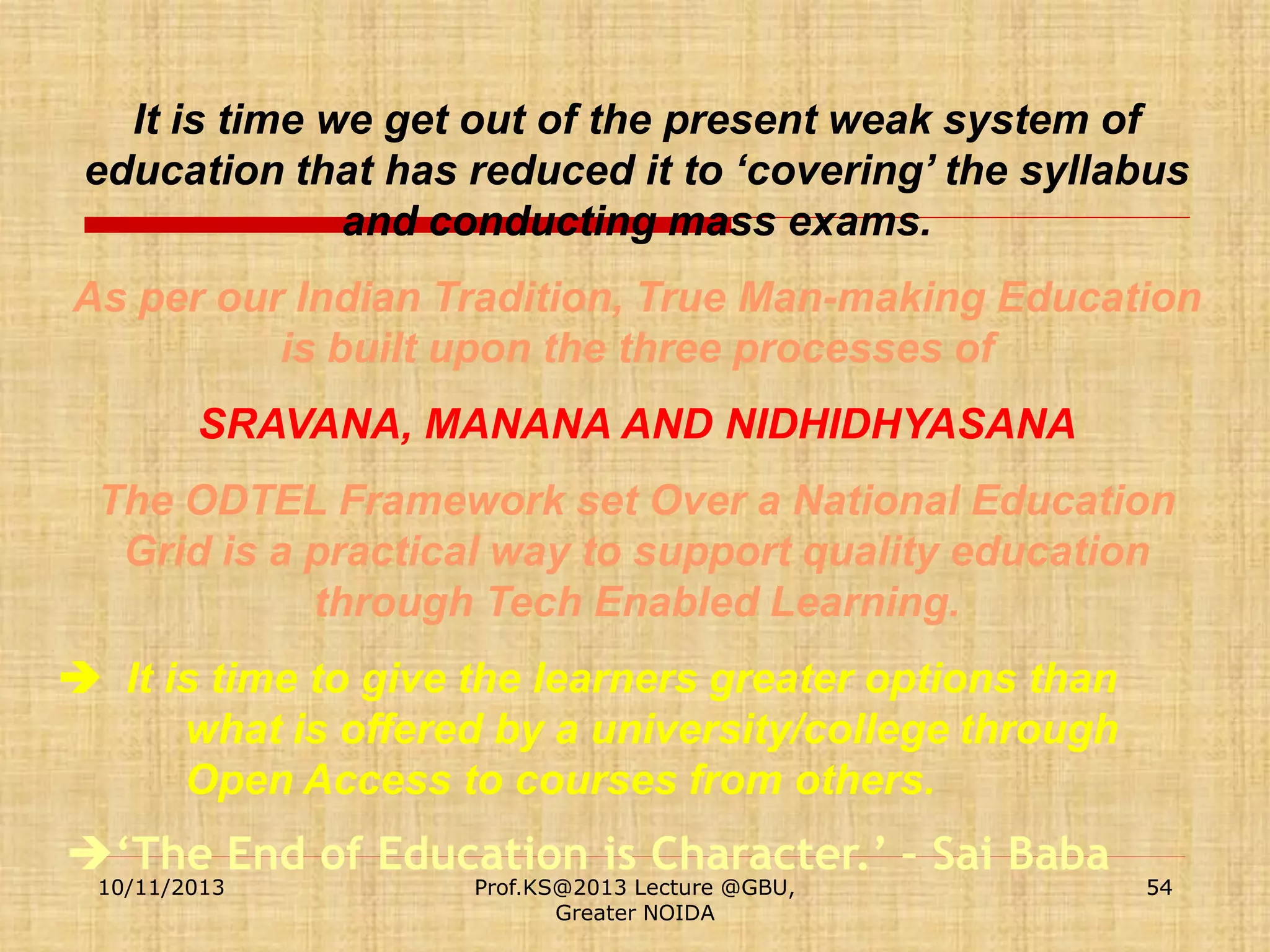
It is time we get out of the present weak system of
education that has reduced it to ‘covering’ the syllabus
and conducting mass exams.
As per our Indian Tradition, True Man-making Education
is built upon the three processes of
SRAVANA, MANANA AND NIDHIDHYASANA

The ODTEL Framework set Over a National Education
Grid is a practical way to support quality education
through Tech Enabled Learning.
 It is time to give the learners greater options than
what is offered by a university/college through
Open Access to courses from others.

‘The End of Education is Character.’ – Sai Baba
10/11/2013

Prof.KS@2013 Lecture @GBU,
Greater NOIDA

54
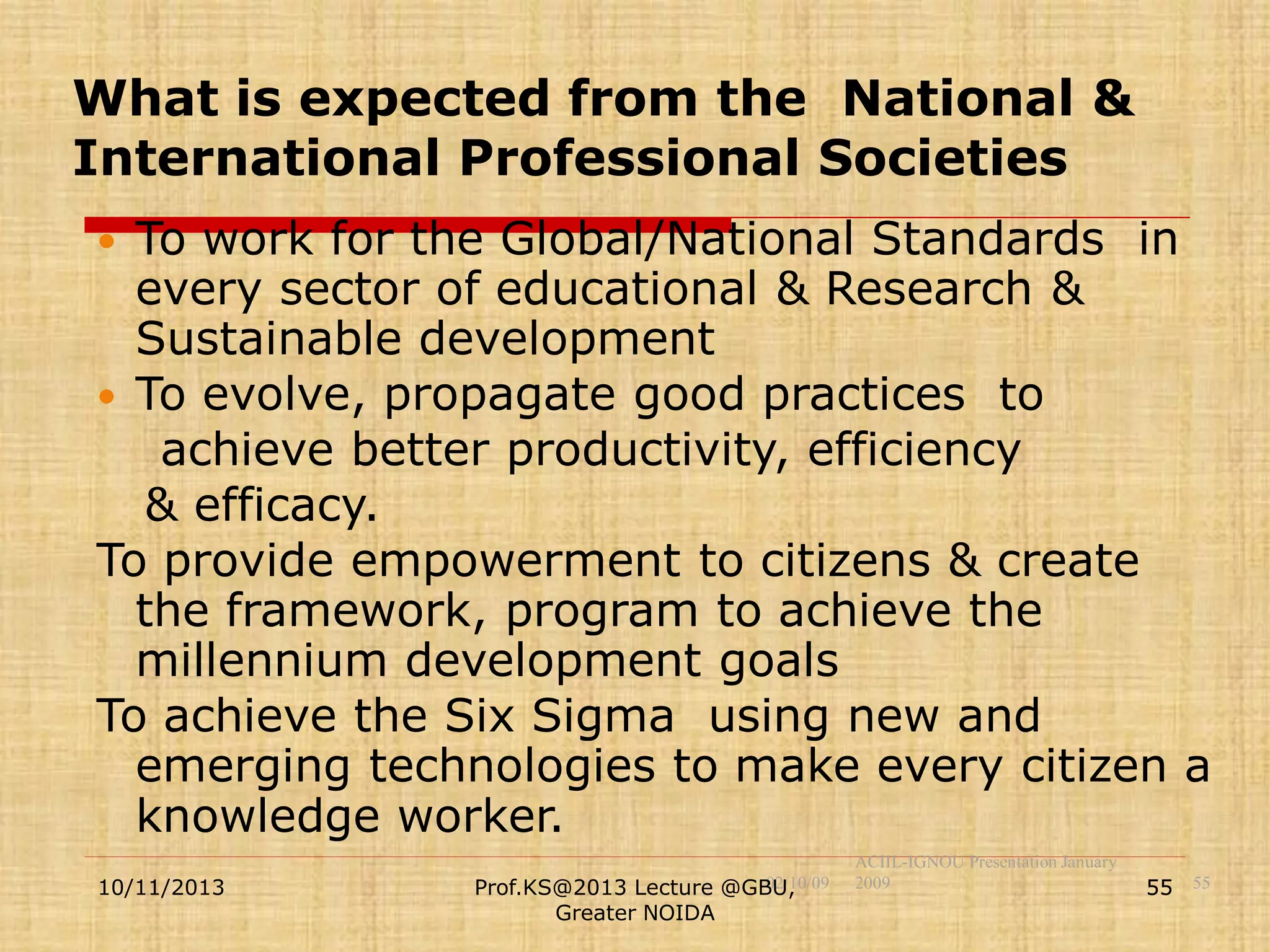
What is expected from the National &
International Professional Societies
To work for the Global/National Standards in
every sector of educational & Research &
Sustainable development
 To evolve, propagate good practices to
achieve better productivity, efficiency
& efficacy.
To provide empowerment to citizens & create
the framework, program to achieve the
millennium development goals
To achieve the Six Sigma using new and
emerging technologies to make every citizen a
knowledge worker.


10/11/2013

02/10/09
Prof.KS@2013 Lecture @GBU,
Greater NOIDA

ACIIL-IGNOU Presentation January
2009

55 55
Joint contribution to National knowledge
Digital Ware House
 Mutually agreeable Quality Norms for
Digital Multi media Contents, Evaluation,
& Assessment
 Joint ownership for shareable course wares to cover Quality Education for All
 To establish A Referral National Open
Knowledge University.
What is Expected by Partnering
Educational Institutions/Universities
National/Global


10/11/2013

02/10/09
Prof.KS@2013 Lecture @GBU,
Greater NOIDA

ACIIL-IGNOU Presentation January
2009

56 56
Need of the Hour
Mix of all the three functions
Facilitating a Learning
Environment
Support to Learners as a Broker
Coordinating the Process and
Development of Materials
10/11/2013

02/10/09

Prof.KS@2013 Lecture @GBU,
Greater NOIDA

57 57
Learner Centred-Flexible-Technology driven
system-Need for Alliances
Cost Sharing Economy
-Learning resources development, establishment of learner
support centres, infrastructure for course delivery

Changing Enrolment patterns
-flexible and modular learning to fulfill learner demands

Cross sharing courses
- Cost& Risk reduction & Funding patterns change

Curricula demands
-variety of academic talents for short period of time-Sharing
staff resources
10/11/2013

02/10/09

Prof.KS@2013 Lecture @GBU,
Greater NOIDA

58 58
And more to be done ...

“If the poor cannot come to education, education must reach them,
at the plough, in the factory, everywhere.”
.. Swami Vivekananda

 With CKE, we must integrate quality and inclusive
education opportunities for all aspiring youth and any
one who wish to
learn further.
 Such education should be vertically integrated to provide
opportunities for everyone who is competent and
aspires to study
further.
 Slogan: 'Place no bar, age no bar, time no
bar' and offer 'Quality
Education to All Independent of Geography.'
59
Where the mind is without fear and the head is held high
Where knowledge is free
Where the world has not been broken up into fragments
By narrow domestic walls
Where words come out from the depth of truth
Where tireless striving stretches its arms towards perfection
Where the clear stream of reason has not lost its way
Into the dreary desert sand of dead habit
Where the mind is led forward by thee
Into ever-widening thought and action
Into that heaven of freedom, my Father, let my country awake.
- Rabindranath Tagore
60
10/11/2013

02/10/09
Prof.KS@2013 Lecture @GBU,
Greater NOIDA

Prof. KS@2009 Assocham seminar on
Industry & Distance Edu Linkup
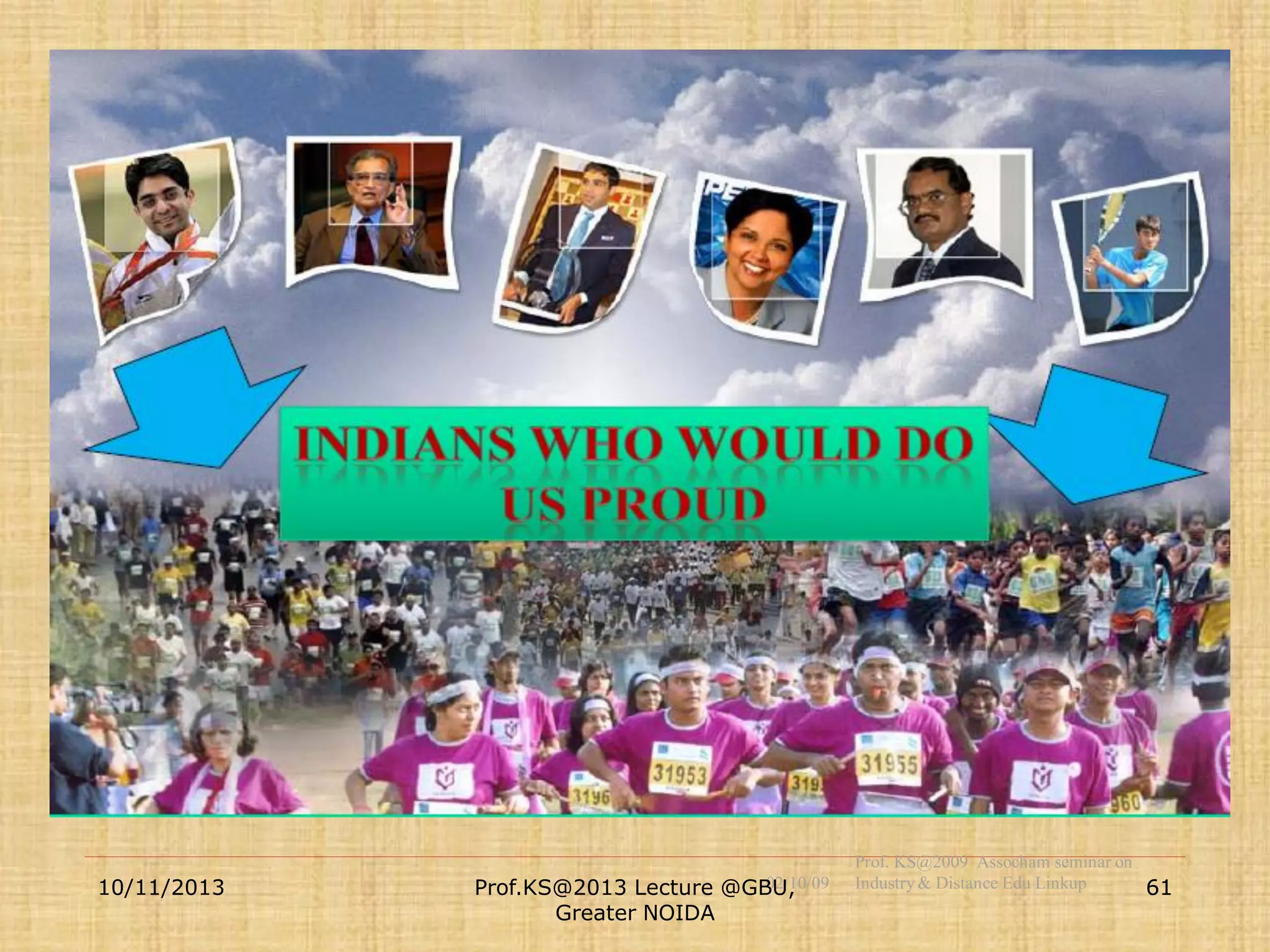
61
10/11/2013

02/10/09
Prof.KS@2013 Lecture @GBU,
Greater NOIDA

Prof. KS@2009 Assocham seminar on
Industry & Distance Edu Linkup
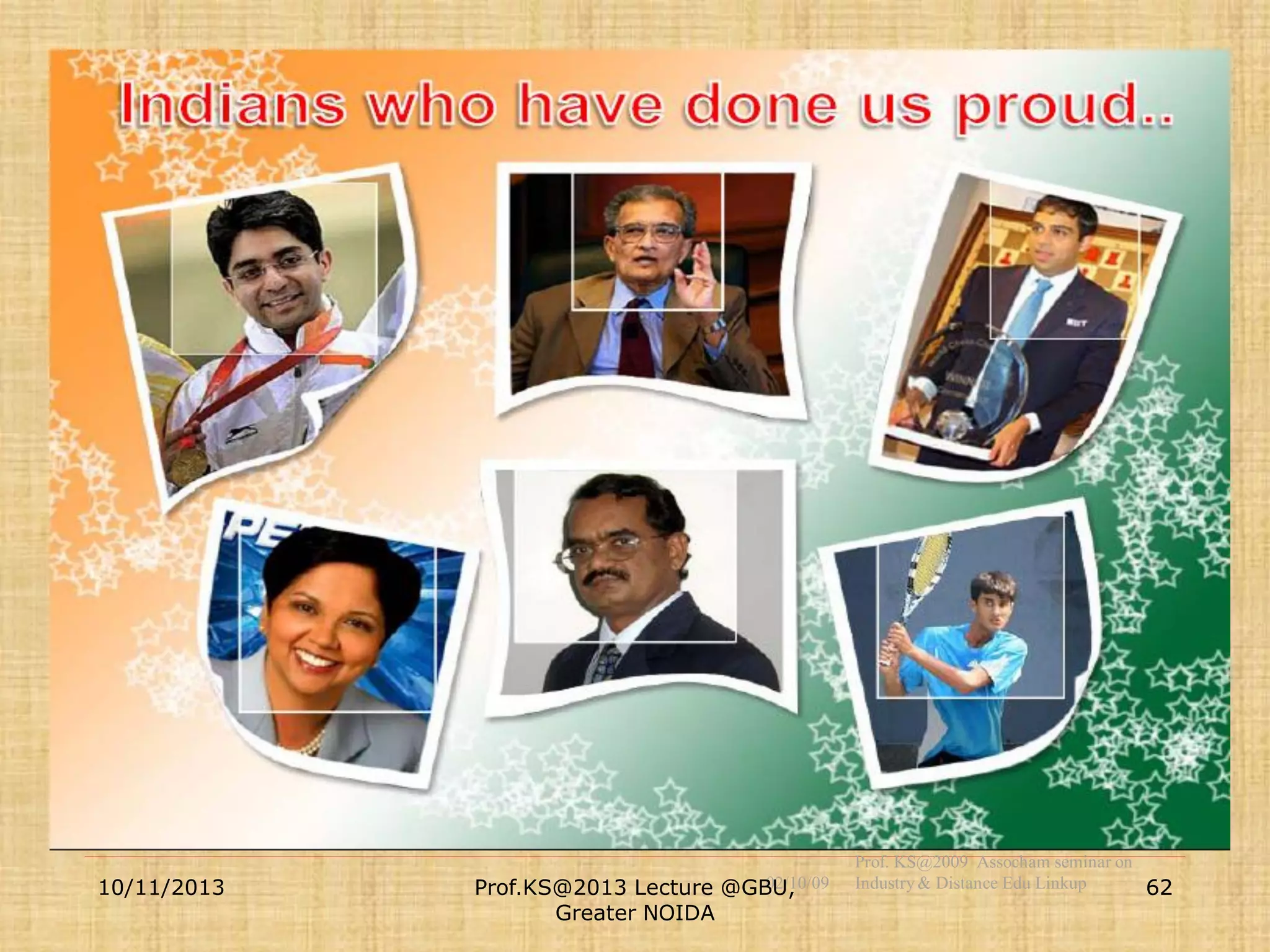
62
10/11/2013

02/10/09
Prof.KS@2013 Lecture @GBU,
Greater NOIDA

Prof. KS@2009 Assocham seminar on
Industry & Distance Edu Linkup
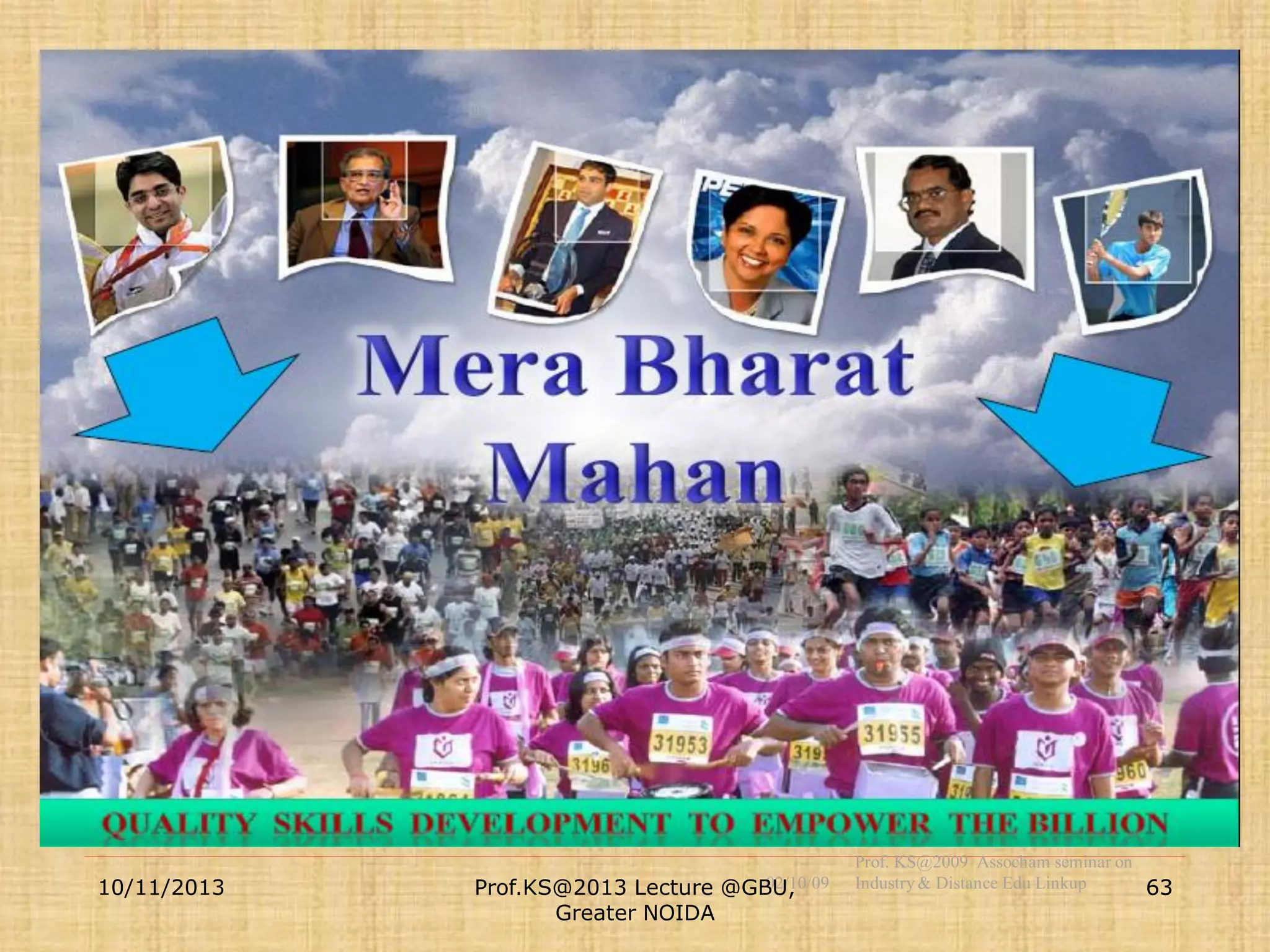
63
Build India Campaign

An Ideal Professional Graduate

10/11/2013

Prof.KS@2013 Lecture @GBU,
Greater NOIDA

?
64
Build India Campaign

Which Framework
•
•
•
•
•
•
•
•
•
•
•

Sri Aurobindo
Swami Vivekananda
Swami Dayananda Saraswati
Rabindranath
Mahatma Gandhi
The Gita Paradigm
Constitution of India
Delor’s Report
Multiple Intelligence
WHO’s Life Skills Framework or
An eclectic one?

10/11/2013

Prof.KS@2013 Lecture @GBU,
Greater NOIDA

65
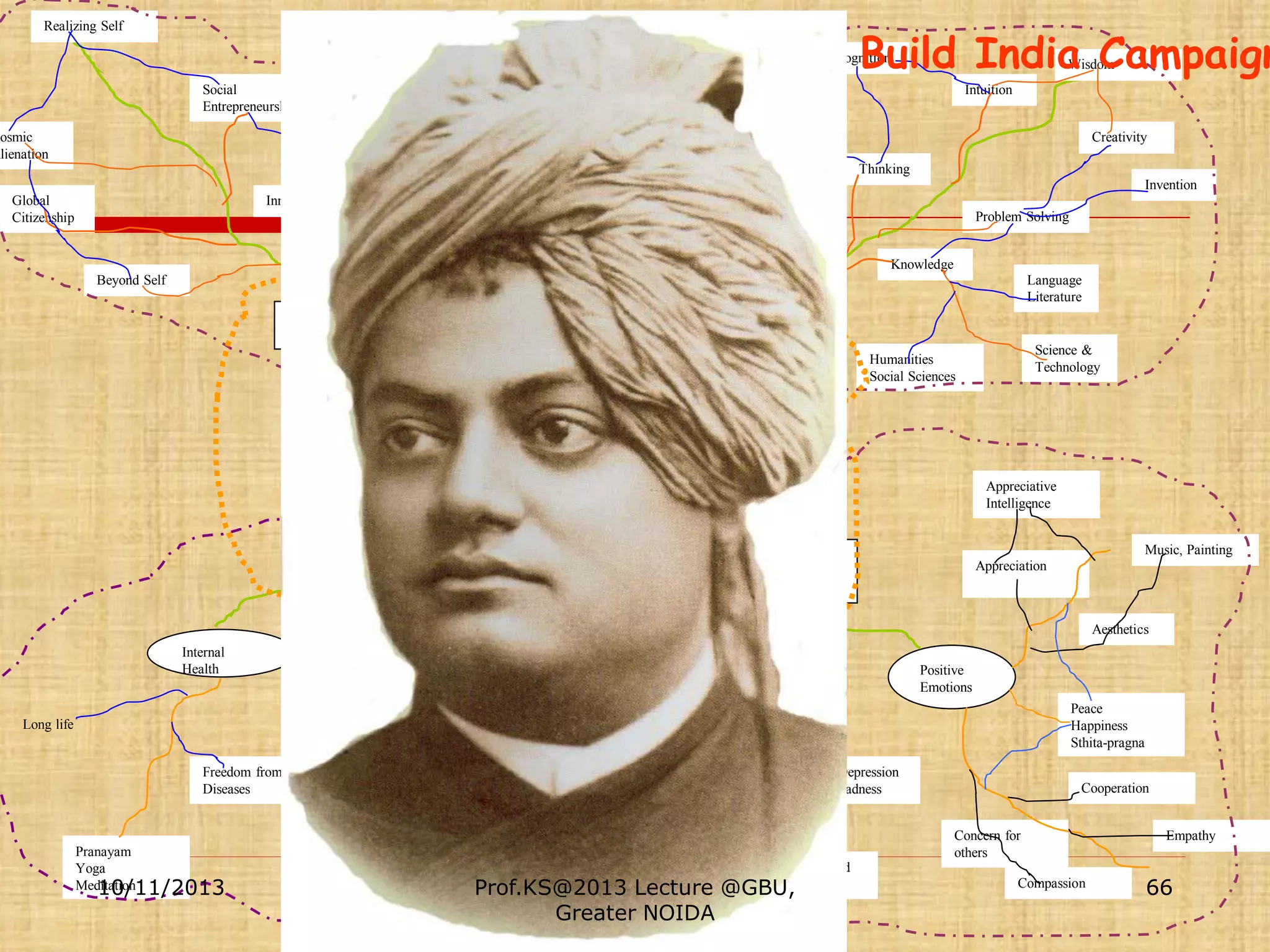
Realizing Self

Build India Campaign

Meta-cognition
Social
Entrepreneurship

Wisdom

Intuition
Multi-layer
Cognition

Cosmic
Alienation

Creativity
Experimentation
Permanent

Thinking
Invention

Global
Citizenship

Innovation
Temporary

Problem Solving

Memory
Exploration
Knowledge
Beyond Self

Language
Literature

Intellectual

Spiritual

Science &
Technology

Humanities
Social Sciences

Child
Human
Being

Appreciative
Intelligence

Physical

Music, Painting

Mental

Appreciation

Aesthetics
Internal
Health

External
Health

Negative
Emotions

Positive
Emotions
Peace
Happiness
Sthita-pragna

Long life
Kinaesthetic
Skills
Freedom from
Diseases

Pranayam
Yoga
Meditation
10/11/2013

Physical Strength

Anger
Violence

Sports
Dance
Games
Dram
Gymnastics
a
Prof.KS@2013

Lecture @GBU,
Greater NOIDA

Depression
Sadness

Cooperation

Concern for
others
Greed
Lust

Compassion

Empathy

66
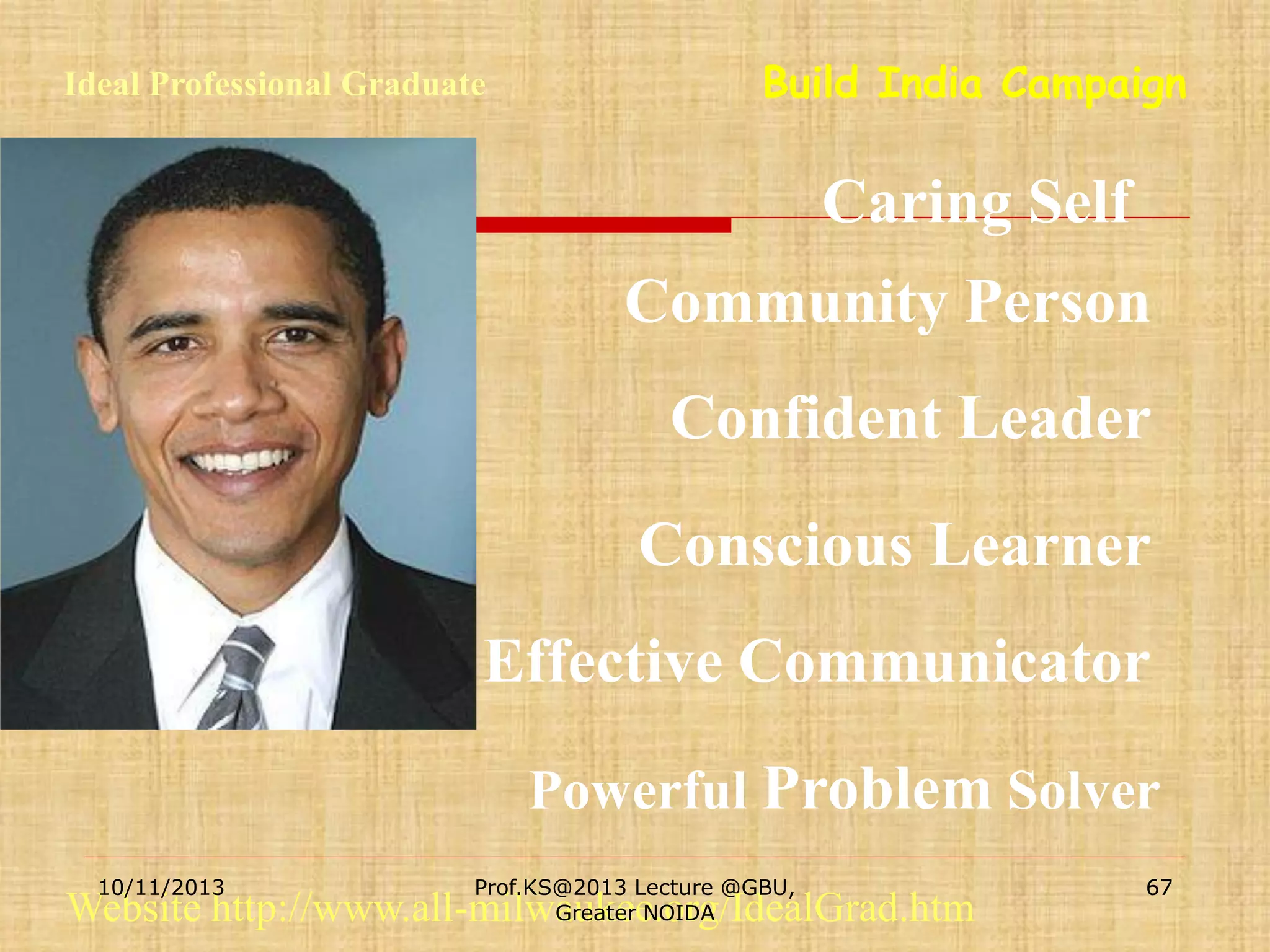
Ideal Professional Graduate

Build India Campaign

Caring Self

Community Person
Confident Leader
Conscious Learner
Effective Communicator
Powerful Problem Solver
10/11/2013

Prof.KS@2013 Lecture @GBU,
Greater NOIDA

Website http://www.all-milwaukee.org/IdealGrad.htm

67
Build India Campaign

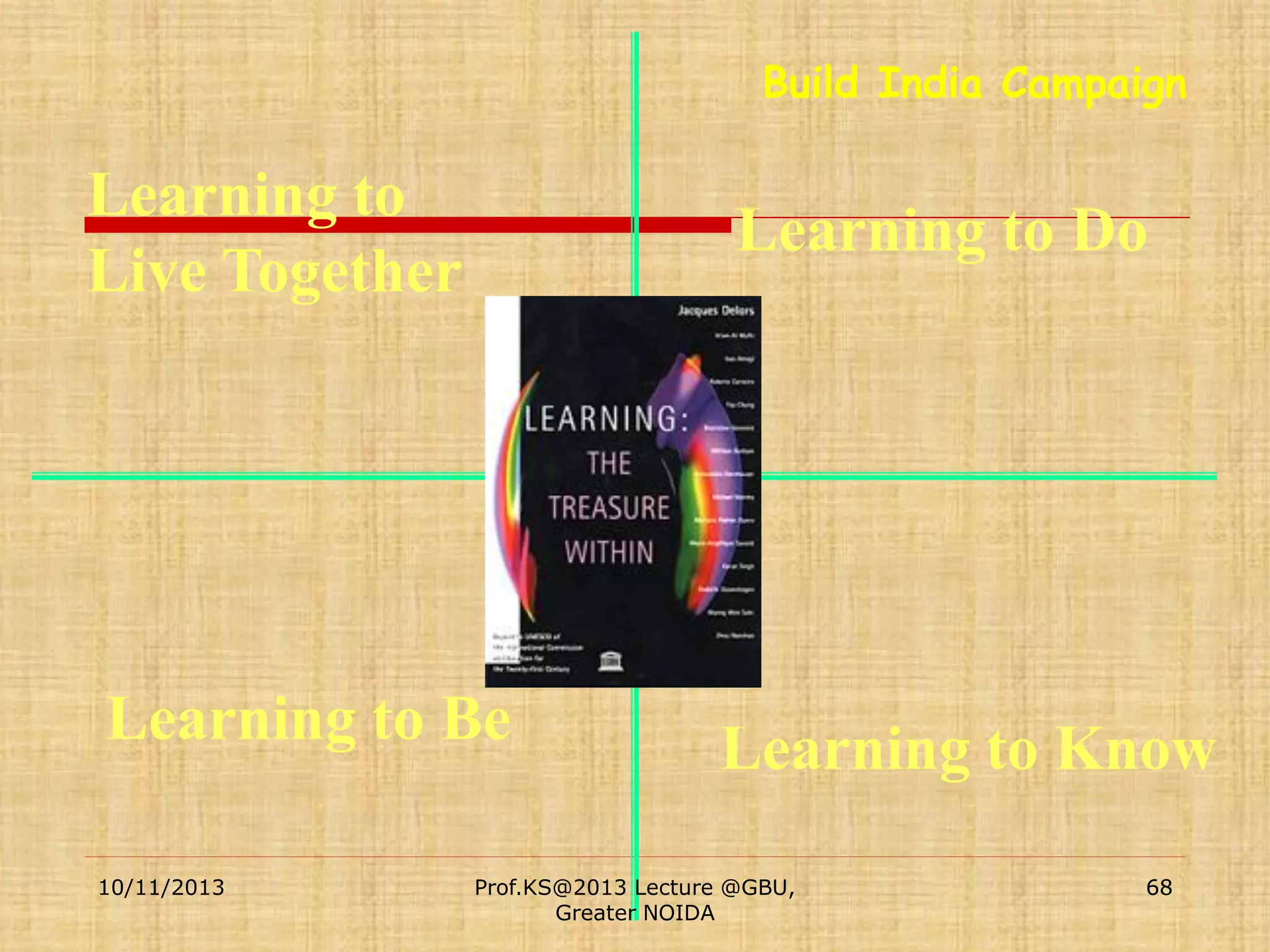
Learning to
Live Together

Learning to Do

Learning to Be

Learning to Know

10/11/2013

Prof.KS@2013 Lecture @GBU,
Greater NOIDA

68
Build India Campaign

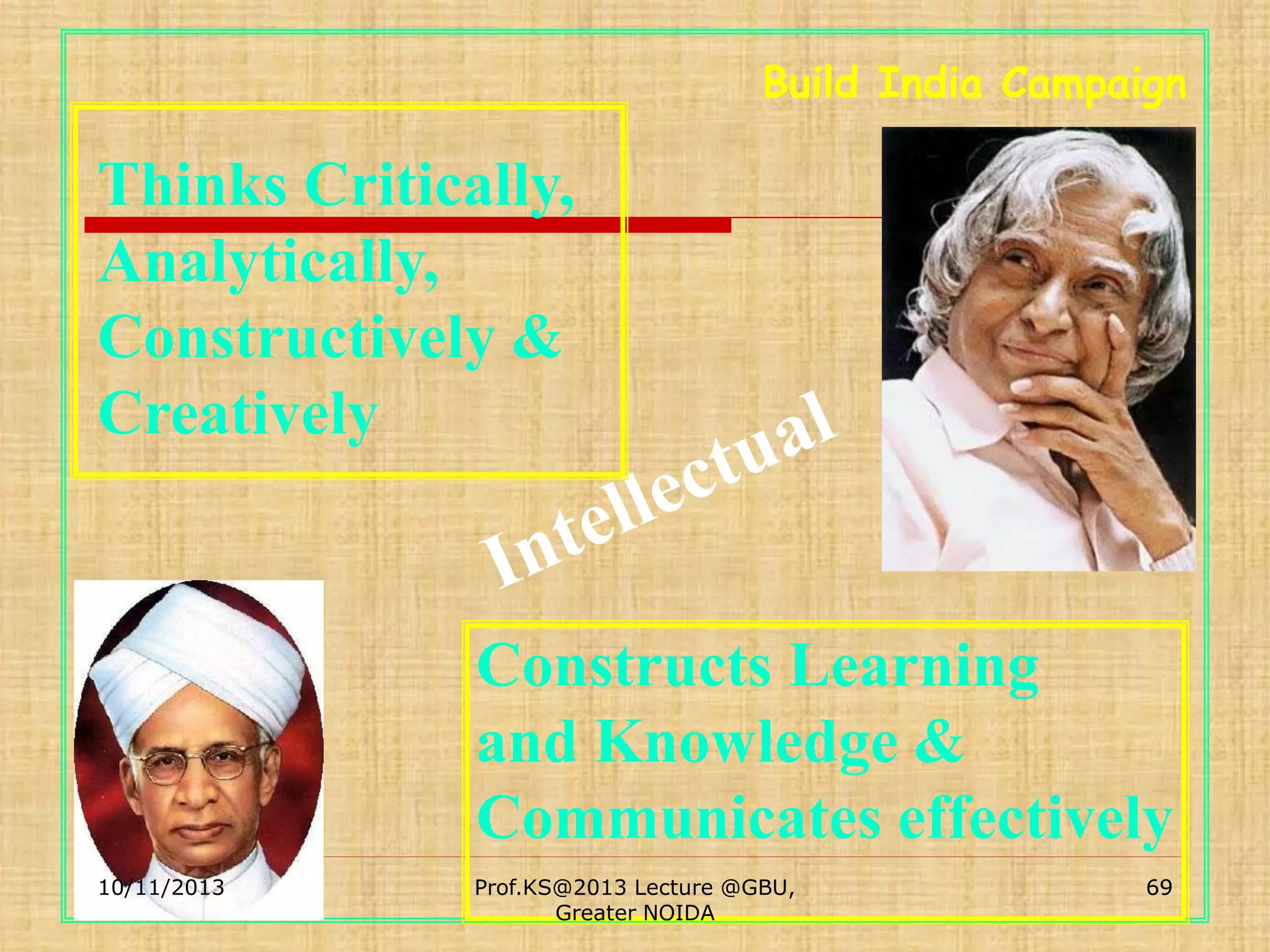
Thinks Critically,
Analytically,
Constructively &
Creatively

Constructs Learning
and Knowledge &
Communicates effectively
10/11/2013

Prof.KS@2013 Lecture @GBU,
Greater NOIDA

69
Build India Campaign

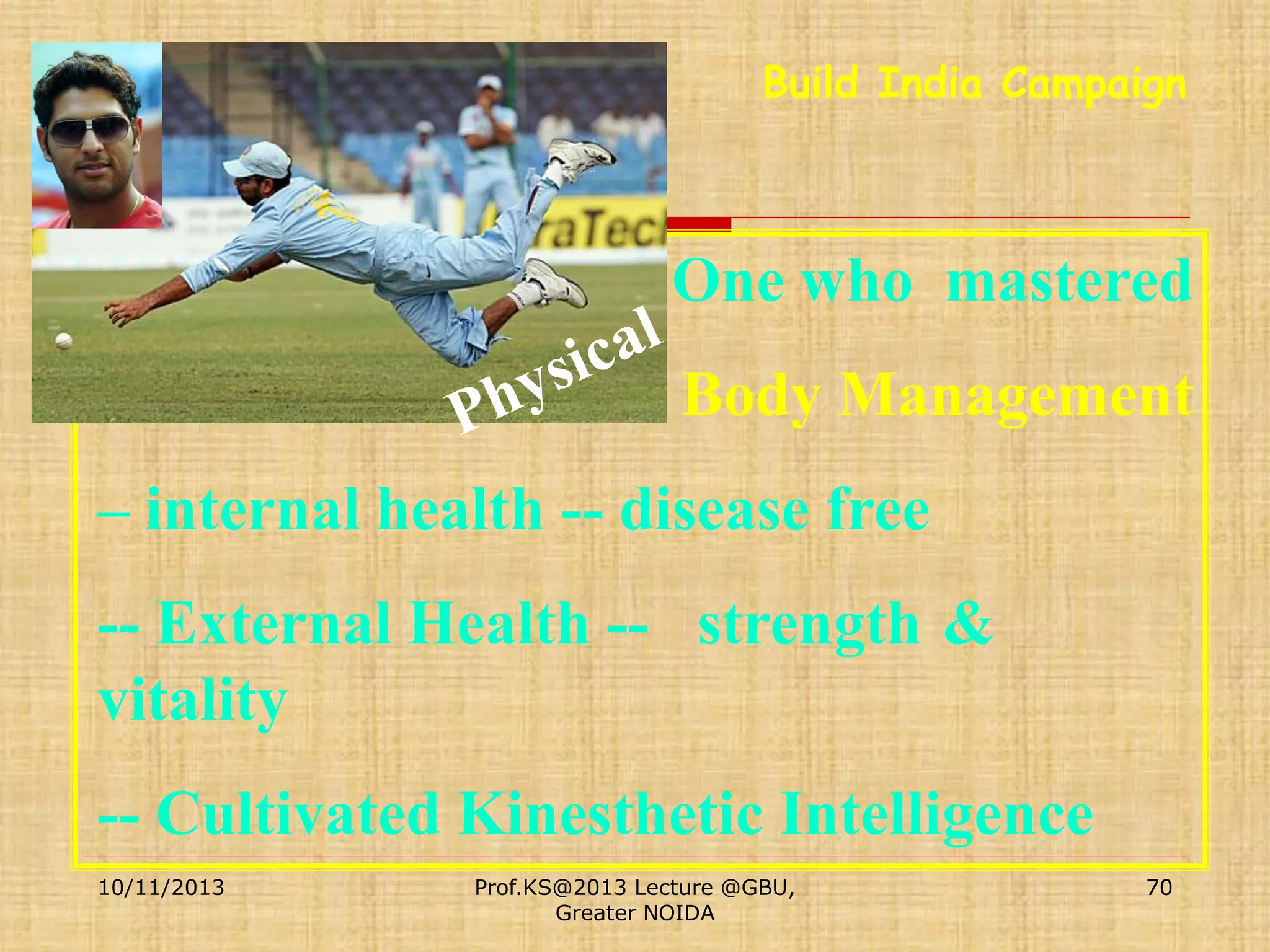
One who mastered

Body Management
– internal health -- disease free

-- External Health -- strength &
vitality
-- Cultivated Kinesthetic Intelligence
10/11/2013

Prof.KS@2013 Lecture @GBU,
Greater NOIDA

70
Build India Campaign

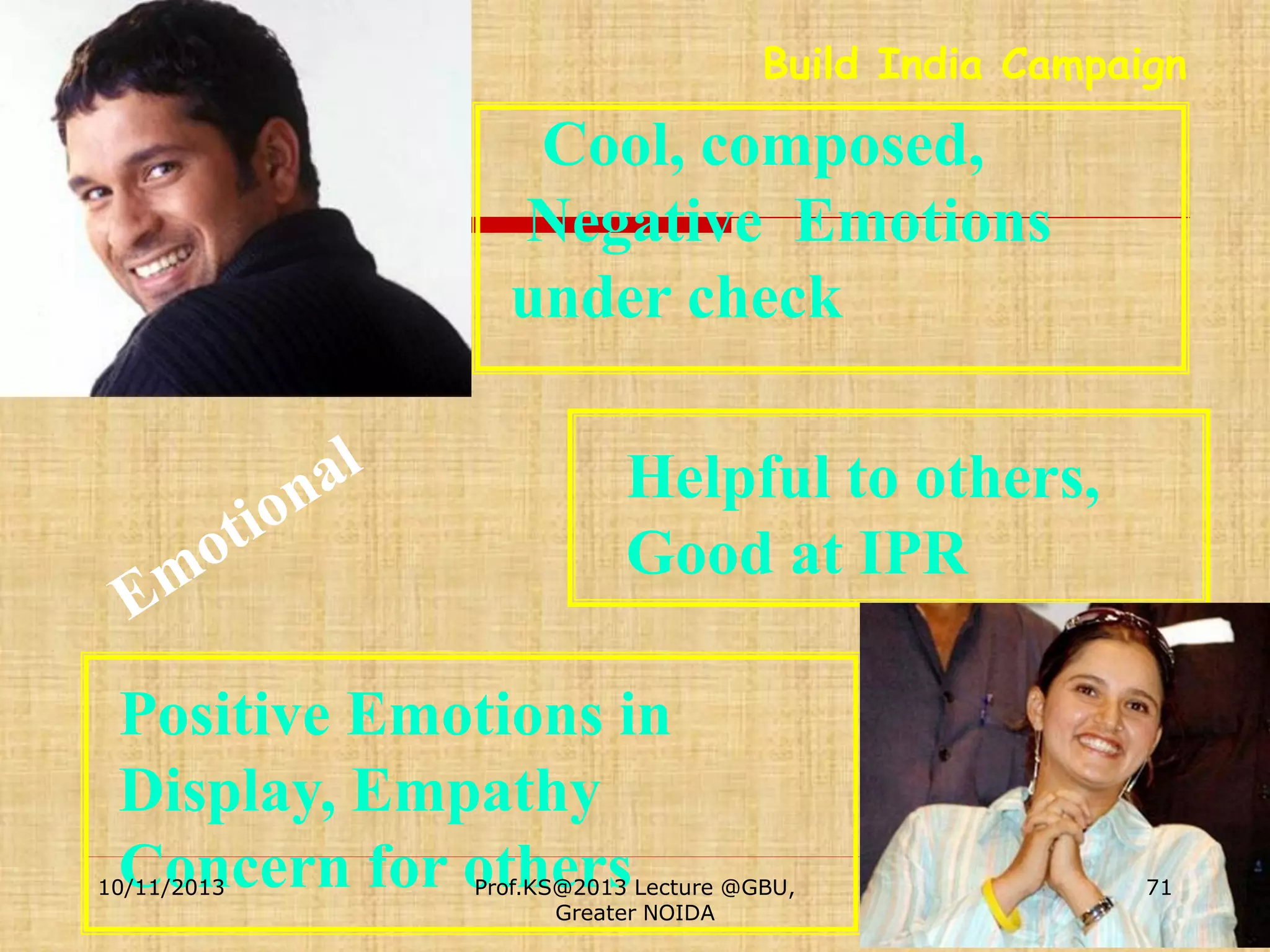
Cool, composed,
Negative Emotions
under check
Helpful to others,
Good at IPR

Positive Emotions in
Display, Empathy
Concern for others

10/11/2013

Prof.KS@2013 Lecture @GBU,
Greater NOIDA

71
Build India Campaign

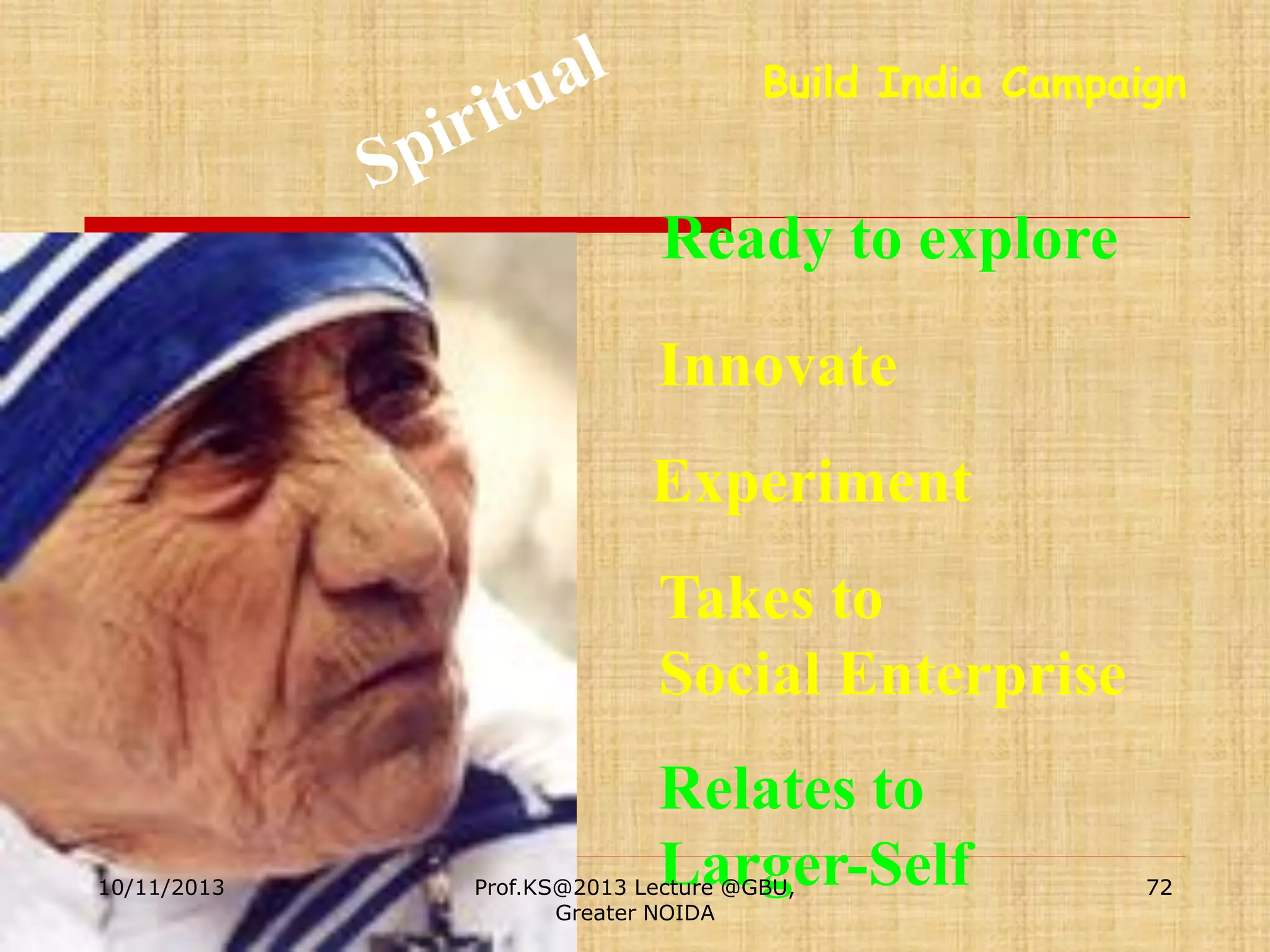
Ready to explore
Innovate
Experiment

Takes to
Social Enterprise

10/11/2013

Relates to
Larger-Self

Prof.KS@2013 Lecture @GBU,
Greater NOIDA

72
Build India Campaign

10/11/2013

Prof.KS@2013 Lecture @GBU,
Greater NOIDA

73
It shall be the duty of every citizens of India

•To abide by the Constitution and respect its
ideals and institutions, the National Flag and the
National Anthem;
•To cherish and follow the noble ideals which
inspired our national struggle for freedom;
•To uphold and protect the sovereignty, unity and
integrity of India;
10/11/2013

Prof.KS@2013 Lecture @GBU,
Greater NOIDA

74
•To defend the country and render
national service when called upon to do
so;
•To promote harmony and the spirit of
common brotherhood amongst all the
people of India transcending religious,
linguistic and regional or sectional
diversities;
to renounce practices derogatory to the
dignity of women;
10/11/2013

Prof.KS@2013 Lecture @GBU,
Greater NOIDA

75
•To value and preserve the rich heritage of our
composite culture;

•To protect and improve the natural
environment including forests, lakes, rivers
and wild life, and to have compassion for
living creatures;
•To develop the scientific temper, humanism
and the spirit of inquiry and reform;

10/11/2013

Prof.KS@2013 Lecture @GBU,
Greater NOIDA

76
•To safeguard public property and to
abjure violence;
•To strive towards excellence in all spheres of
individual and collective activity so that the

nation constantly rises to higher levels
of endeavour and achievement.

10/11/2013

Prof.KS@2013 Lecture @GBU,
Greater NOIDA

77
Core competencies
For The Seven

Attributes of Highly Effective
People
Attributes 1
Be Proactive®
Take initiative,
Manage change,
Respond proactively,
Keep commitments,
Take responsibility and practice
accountability,
 Create positive business results.






10/11/2013

Prof.KS@2013 Lecture @GBU,
Greater NOIDA

79
Attributes 2
Begin With the End in Mind®
 Define vision and values,
 Create a mission statement,
 Set measurable team and personal
Goals
 Start projects successfully,
 Align goals to priorities,
 Focus on desired outcomes.
10/11/2013

Prof.KS@2013 Lecture @GBU,
Greater NOIDA

80
Attributes 3
Put First Things First®
Execute strategy,
Apply effective delegation skills,
Focus on important activities,
Apply effective planning and
prioritization skills,
 Balance key priorities,
 Eliminate low priorities and timewasters,
 Use planning tools effectively,
 Use effective time-management skills.
10/11/2013
Prof.KS@2013 Lecture @GBU,





Greater NOIDA

81
Attributes 4
Think Win-Win






Build high-trust relationships,
Build effective teams,
Apply successful negotiation skills,
Use effective collaboration,
Build productive business
relationships.

10/11/2013

Prof.KS@2013 Lecture @GBU,
Greater NOIDA

82
Attributes 5

Seek First to Understand Then to Be
Understood

1. Apply effective interpersonal

communication,
2. Overcome communication pitfalls,
3. Apply effective listening skills,
4.Understand others,
5.Reach mutual understanding,
6.Communicate viewpoints effectively,
7.Apply productive input and feedback,
10/11/2013
Prof.KS@2013 Lecture @GBU,
83
Greater NOIDA
8. Apply effective persuasion techniques.
Attributes 6
Synergize








Leverage diversity,
Apply effective problem solving,
Apply collaborative decision making,
Value differences,
Build on divergent strengths,
Leverage creative collaboration,
Embrace and leverage innovation.

10/11/2013

Prof.KS@2013 Lecture @GBU,
Greater NOIDA

84
Attributes 7
Sharpen the Saw
 Achieve life balance,
 Apply continuous improvement,
 Seek continuous learning

10/11/2013

Prof.KS@2013 Lecture @GBU,
Greater NOIDA

85
T OGETHER
E VERYONE
A CHIEVES
M ORE
Thank You
10/11/2013

Prof.KS@2013 Lecture @GBU,
Greater NOIDA

86
ACKNOWLEDGEMENTS
Prof. K R Srivathsan Former Pro VC & ACIIL
Team

For the Vision & Dream Reality
Prof. Rajasekaran Pillai, Former VC,IGNOU
& Others
For their support & Development of the Multitier framework using Open Source
10/11/2013

Prof.KS@2013 Lecture @GBU,
Greater NOIDA

87
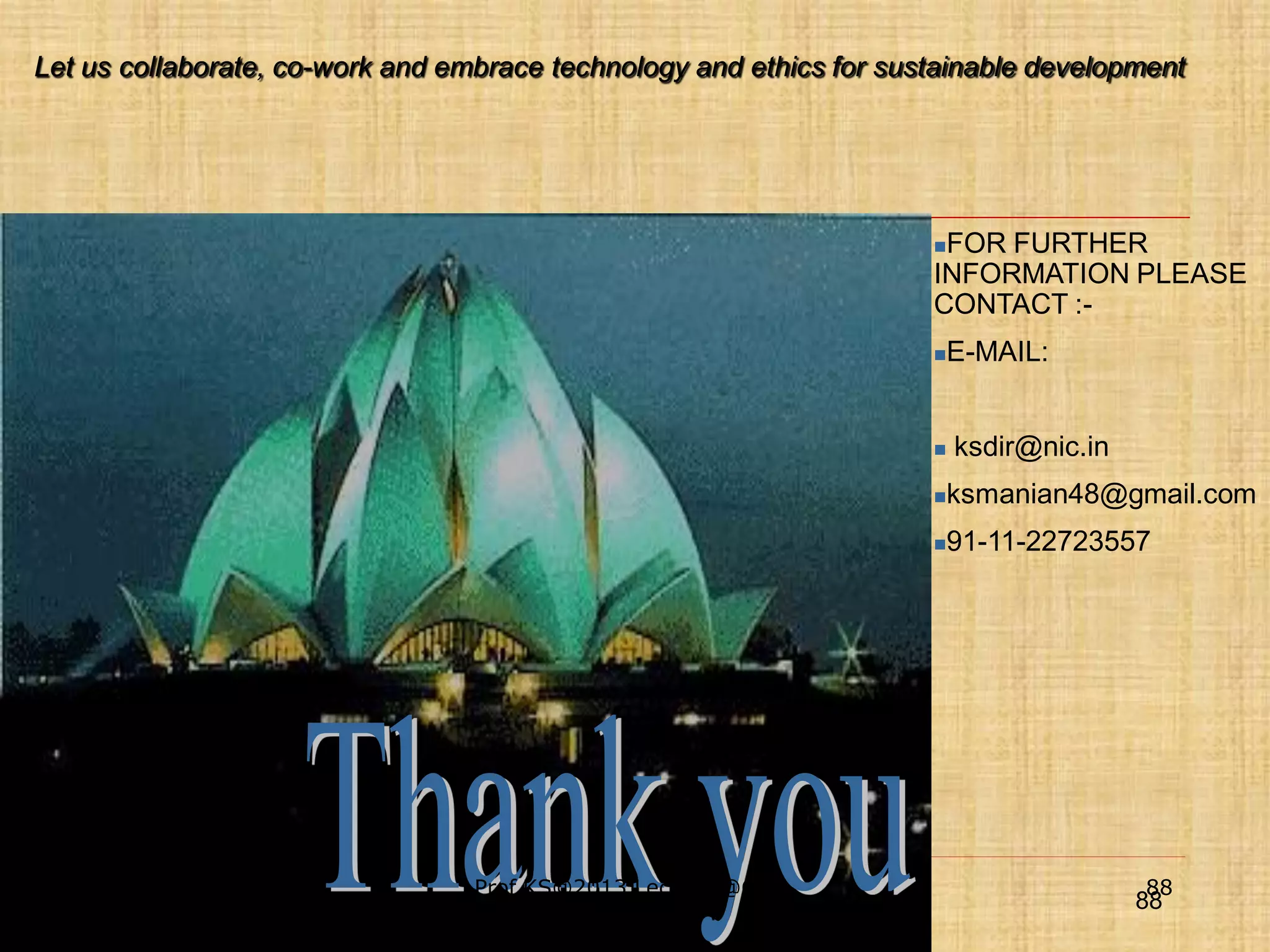
Let us collaborate, co-work and embrace technology and ethics for sustainable development

FOR FURTHER
INFORMATION PLEASE
CONTACT :





E-MAIL:
ksdir@nic.in




10/11/2013

April 20, 2011

Prof.KS@2013 Lecture @GBU,
secure IT 2011 New Delhi
Greater NOIDA

ksmanian48@gmail.com
91-11-22723557

88

88

Csi taramani lecture jan 14 quality assurance in education

  • 1.
    Assuring Quality Educationfor ALL A Techno-Management Framework covering Content development, Faculty interaction, Delivery and Governance Using Open source Technology is an Enabler for Sustainable Development India 2014 Prof. K Subramanian SM(IEEE), SMACM, FIETE, FNTF SMCSI,MAIMA,MAIS,MCFE,MISACA(USA) Vice chair, IEEE Delhi section Chair, Technology Management Council, Delhi Section Vice chair, IEEE Computer Society, Delhi Section Vice chair, IEEE Education Society, Delhi Section Member, IEEE Consultant Affinity Group, Delhi section Academic Advocate, ISACA(USA), India Former Professor & Founder Director, Advanced center for Informatics & Innovative Learning, IGNOU EX SR. DDG(NIC), Ministry of Communications & IT AND IT Adviser to CAG of India Former President, Cyber society of India Emeritus President, eInformation systems, security audit association, India
  • 2.
    Current Indian EducationScenario “Over-regulated and Under-Governed”  The ‘not-for profit’ nature of the $40bn formal IES has deterred forprofit private participation while inability to transform education into a ‘process-driven’ model curtails scalability in non-formal IES ($10bn).  Investment rests on 4Cs –  Players with Credibility (management intent & ability),  Capital (built to last),  Creativity (to ‘manage’ the overregulated environment)  Content (to differentiate and build annuity)  IES – the ‘Largest’…inefficiencies the ‘Highest’:  the largest capitalized space in India with $30bn of government spend (3.7% of GDP; at global average),  a large network of ~1m schools and 18,000 higher education institutes.  Yet, the public education system is ‘insufficient’ and ‘inefficient’, leading education-hungry and affluent Indians to spend $50bn on private education (14% CAGR over FY08-12E). IDFC-SKSI Report, Jan 2009 2
  • 3.
    Current Indian EducationScenario “Over-regulated and Under-Governed”  Formal IES:  A Poor Regulatory Framework and Low riskappetite have discouraged for-profit participation and attracted limited capital.. With no structural change in sight (rampant corruption and low political will), is stagnant.  Non-formal IES:  Non-regulated and faster-growing –– fails the scalability test (barring a few pockets). IDFC-SKSI Report, Jan 2009 3
  • 4.
    TEN NEW COMMANDMENTS/LAWSIN DIGITAL/NETWORK ECONOMY (e-Economy)) 1. Law of Connections - Embrace Dumb power 2. Law of Plentitude - More gives more 3. Law of Exponential Value - Success is non-linear 4. Law of increasing returns - make virtuous circles 5. Law of Tripping Points - Significance precedes momentum contd.. 10/11/2013 Prof.KS@2013 Lecture @GBU, Greater NOIDA 4
  • 5.
    TEN NEW COMMANDMENTS/LAWSIN DIGITAL/NETWORK ECONOMY (e-Economy) 6. Law of Inverse pricing - Anticipate the cheap 7. Law of Generosity - Follow the Free 8. Law of Allegiance - For maximum prosperity feed the web first 9. Law of Devolution - Let go at the top 10. Law of Displacement - All transactions and objects will obey the network logic 10/11/2013 Prof.KS@2013 Lecture @GBU, Greater NOIDA 5
  • 6.
    The Professional Pyramid Vision Layer Dreamers AndPlanners Solution Layer Conceptualisers & Designers Technology Value Added Layer “Brick And Mortar” Layer 10/11/2013 Domain Expertise Basic Concepts And Skills Prof.KS@2013 Lecture @GBU, Greater NOIDA 6
  • 7.
    Change  From        Goal directed Rulesfocused Hierarchical Vertical Local Procedure Paper oriented 10/11/2013  To        Vision directed Citizen focused Flat, empowered Networked Global Speed Electronic(less paper/paperless) Prof.KS@2013 Lecture @GBU, Greater NOIDA 7
  • 8.
    The drivers andemerging trends in the Digital/Information age Businesses Media Common Needs Other Governments 10/11/2013 Citizens Community Organizations Employees Prof.KS@2013 Lecture @GBU, Greater NOIDA 8 8
  • 9.
    These changes impactthe fundamental way that organizations compete in the digital/information age. Industrial Age Foundation for Economic Development Digital/Information Age Control of Natural Resources Competitive Advantage Control of Knowledge Protection of Assets/Resources Business Environment Open/Competitive Expansion Rapid (re)invention Increase Scale Regional Geographic Scope Global Labor Intensive Jobs Work Outsourced Process-Related Work Hierarchical Decision Making Collaborative Physical Resources 10/11/2013 Key Assets Prof.KS@2013 Lecture @GBU, Human Resources, Information & Technical Greater NOIDA Infrastructure 9 9
  • 10.
    The Connectivity establishedby Public Private Empowered Bodies  The Physical Connectivity ◦ ◦ ◦ Ring Road Rail Public Infrastructure           The Economic Connectivity ◦ ◦ ◦ ◦ ◦ ◦ Warehouse Agro-Industries Markets Hospital Micro Power Plant Coop. Product Mktg.  The Electronic Connectivity ◦ ◦ ◦ ◦ ◦ 10/11/2013 Telecom Internet E-Governance Tele-medicine Tele-education The Knowledge Connectivity  Schools IRS Imagery for Land & Crop Mgmt Water Mgmt Forest Mgmt Environment Proactive Health care Manufacturing The Spiritual Connectivity   Prof.KS@2013 Lecture @GBU, Greater NOIDA Enlightened Citizenship Moral Leadership 10 10
  • 11.
    New Environmental Changes Space: Real Space (Physical)  Cyber Space (Electronic)  Ubiquitous Space (Cross Space)  Time: Local Time  Global time (Need) through Real-time Systems  (Communication) Speed: Mbps  Gbps  Tbps (Tera: 1012)  Pbps (Peta: 1015) (Velocity of Light)  Media: Analog  Digital  Hybrid  System:CentralizedDistributed Integrated 10/11/2013 Prof.KS@2013 Lecture @GBU, Greater NOIDA 11 11
  • 12.
    ICT has changedmany things around People  Appliances +Objects Locally  Remotely Fixed  Mobile Wired  Wireless Many persons, one computer Fewer persons per computer One person per computer One person, few computer One person, many computer!! 10/11/2013 Prof.KS@2013 Lecture @GBU, Greater NOIDA 12 12
  • 13.
    4th Wave ofEnvironmental Changes …"a new way of thinking about computers in the world, one that takes into account the natural human environment," Mark Weiser (1952-99, Palo Alto Research Center of Xerox Co.) hoped to create a new world in which people interacted with and used computers without thinking about them…. 1st Wave Primitive Society 2nd Wave Agricultural Society Agricultural Revolution (During Several Thousands Years) 3rd Wave Industrial Society Industrial Revolution (During Several Hundreds Years) 4th Wave Information Society Information Revolution (During Several Decades) Ubiquitous Society Integrated Space Revolution (During Several Years) Intelligent Integration of Physical Space and Cyber Space by Ubiquitous Technology 10/11/2013 1/6/201410/11/2013 Prof.KS@2013 Lecture @GBU, Greater NOIDA Profks@2014 CSI Lecture FDP Jan,6,2014Prof.KS@2013 Lecture 13 13
  • 14.
    Creating and pursuingnew Global trends with technology evolution such as           10/11/2013 6T (IT, BT, NT, ET, CT and ST) Digital Cocooning, Insperience (Indoor + Experience), Web Identity (Avata, MiniHome,…), Consumption Curator, Ubitizen (Ubiquitous + Citizen), DMB (Digital Multimedia Broadcasting), TPS (Triple Play Service: Internet+Tel+Broadcat) Grid Computing/Cloud Computing Ubiquitous Technology 14 Prof.KS@2013 Lecture @GBU, Greater NOIDA 14
  • 15.
    A Ubiquitous Network 10/11/2013 Prof.KS@2013Lecture @GBU, Greater NOIDA 15 15
  • 16.
    Creating and pursuingnew Global trends in Works, Workforce and Workplace such as      Freeter (Free + Arbeiter), Increasing freelancers as telecommuters Unstable professionals :MD, Lawyers, CPA, Mobilization of workforce across national borders Advent Pan-Asia as a Super Growth Block  Japan: Global Leadership with Future-based High-tech in Media, Robot, Biotech  Rep. of Korea: Electronics, Car Manufacturing, Steel Production, Semiconductors with strong IT infra  Taiwan: Strong Small Medium Industry  China: Rapid Growth Rate[9%], Right Wing of Super Growth Block  India: Rapid Growth Rate[7-8%], Left Wing of Super Growth Block  ASEAN: Singapore, Malaysia, Vietnam, Thailand, Indonesia, Philippines, ……. 10/11/2013 Prof.KS@2013 Lecture @GBU, Greater NOIDA 16 16
  • 17.
    Workplace Trends byBill Gate (2005)  The platform of the Internet, and low-cost connectivity, the thing that is driving the most change is the improvement of the software that sits on top of that platform • The technological oriented workforce is becoming available which is willing to use technology • More collaboration, availability of information for 24 hours, and collaboration among organizations are some of the recent trends at the workplaces 10/11/2013 Prof.KS@2013 Lecture @GBU, Greater NOIDA 17 17
  • 18.
    Economic Transformation One World of Business Competitionin a Shrinking Workforce Workplac e Trends Managers and the Workforce Transparent Organization 10/11/2013 Prof.KS@2013 Lecture @GBU, Greater NOIDA Always on Always Connected 18 18
  • 19.
    Unified Communication Improving Personal Productivity Insight and Structured Workflow Presence Digital Work Style SpottingTrends for Business Intelligence Optimizing Supply Chains Team Collaboration Finding the Right Information 10/11/2013 Prof.KS@2013 Lecture @GBU, Greater NOIDA 19 19
  • 20.
    Digital Workforce Increasing CollaborativeDigital Work in Digital Workplaces supported by Computing systems 10/11/2013 Prof.KS@2013 Lecture @GBU, Greater NOIDA 20 20
  • 21.
    GLOBAL SHIFT World is moving towards Economyof Knowledge from Economy of Goods 10/11/2013 Prof.KS@2013 Lecture @GBU, Greater NOIDA 21 21
  • 22.
    10/11/2013 02/10/09 Prof.KS@2013 Lecture @GBU, GreaterNOIDA Prof. KS@2009 Assocham seminar on Industry & Distance Edu Linkup 22
  • 23.
  • 24.
    02/10/09 Prof. KS@2009 Assochamseminar on Industry & Distance Edu Linkup 24
  • 25.
            Need for moreProfessional teachers Reskilling and retraining the teachers for new needs and new tools, new technologies for teaching & Learning Retention of teachers New educational delivery systems(Multi Model) Interactive & Integrated Learning systems Continuous improvement of Communication and Presentation Skills Change in Evaluation & Assessment Keep the interest in Learning 02/10/09 10/11/2013 Prof.KS@2013 Lecture @GBU, Greater NOIDA Prof.KS@2009 India R & D 2009: Ict & Innovations 25 25
  • 26.
    Let us understandICT! “The role of technology is to bridge the gulf between availability of information and the ability to use it” Henry Kissinger 1.People & Systems to Collect Data, Generate & Organize Information 2. People & Systems that Disseminate & Communicate Information 3. People & Systems that create value using Information 4. People & Systems that Manage the ICT  Above ICT Model should be contextualized for Quality 26 Education linked to development.
  • 27.
    Reaching the Unreached& Fear of Unknown Technology is an enabler, but it is not a substitute for teachers-remove the fear of unknown  Interaction and Delivery system can change  It is not one way delivery of lectures, but it is a integrated interaction between learners & Teachers  Multi-media exposures makes teaching made easier- at the same time, it empowers the teachers & Learners  Teachers & Learners use the same medium of Internet & Web.  Best course notes on any subject made available for knowledge enrichment  10/11/2013 02/10/09 Prof.KS@2013 Lecture @GBU, Greater NOIDA 27 27
  • 28.
    Situation Today Learners Type of Diverse group INFRASTRUCTURE NEEDS  Separated by - space  Separated by-time  Flexible  Possess different-prior  Global in learning skills reach  New educational training needs  Interactive 10/11/2013  Affordable 02/10/09 Prof.KS@2013 Lecture @GBU, Greater NOIDA 28 28
  • 29.
    Address Objectives ofEducation  To make our graduates EMPLOYABLE.  To be PRODUCTIVE ON THE JOB and in LIFE.  To observe REAL WORLD PROBLEMS, abstract the issues and apply what they have learnt and their innate Foundations, sense to solve them. Concepts, Contextual Skills  Three dimensions of Quality Education  Quality Instruction set in a community driven learning framework 10/11/2013 Professional Competence , Maturity Prof.KS@2013 Lecture @GBU, Greater NOIDA Self-development Responsibility, Accountability 29 29
  • 30.
    Curriculum- Four Universal Values Communication Problem Solving WorkingTogether Self Learning 10/11/2013 02/10/09 Prof.KS@2013 Lecture @GBU, Greater NOIDA 30 30
  • 31.
    To make learningand Knowledge -a social and economic activity  Acquisition of Knowledge -a life long activity  Technology-a solution to demand for learning & create new possibilities to make it happen   Delivering education-demand supply perspective  Re-skilling and retraining employees arising due to economic structural changes creating a new social demand Demand of diverse learners Diversity of goals Diversity of contexts Demand for higher education Renewal of employee skills in service sector Profks@2014 CSI Lecture FDP 02/10/09 10/11/2013 1/6/201410/11/2013 Jan,6,2014Prof.KS@2013 Lecture Prof.KS@2013 Lecture @GBU, @GBU, Greater NOIDA Greater NOIDA 31 31
  • 32.
    What we need!!!              ANew Technology Enabled Robust Framework A strong and quality Assured Delivery system/channel A Digital Repository of Quality Certified Learning Resources (Multi-media, Multi-lingual) Adaptable to the pace and depth of Learning capacity of the learners Language Translation/Transliteration facility is incorporated A good Feedback response system with supported automated workflow and robust database system Multi-modal delivery system depend on the local avaiolability Support to multi-type learning devices/environments A continuous assessment system to assess the learners. Continuous availability of mentors/councilors on demand Local content requirement to be addressed Upload capability of Local contents developed by Learners/teachers A good assessment system of quality of the local contents and constant revision of syllabus to address the local demand 10/11/2013 1/6/201410/11/2013 Profks@2014 CSI Lecture FDP Jan,6,2014Prof.KS@2013 Lecture Prof.KS@2013 Lecture @GBU, @GBU, Greater NOIDA Greater NOIDA 32
  • 33.
    ODTEL Focus onQuality Education  To make our graduates EMPLOYABLE; to be PRODUCTIVE ON THE JOB and in LIFE.  To observe REAL WORLD PROBLEMS, abstract the issues and apply what they have learnt and their innate sense to solve them. Foundations, Concepts, Contextual Skills Professional Competence, Maturity Self-development Responsibility, Accountability 10/11/2013  IOCG: ProposedProf.KS@2013 Lecture @GBU, Course Guide 33 Integrated Open Greater NOIDA
  • 34.
    Integrated ODTEL Framework IOCG:the key integrator of ODTEL Set Instructional objectives + J _ 1.Instruction Delivery Evaluate against Instructional Objectives 2. Integrated Open Course Guide: Learning Activities, Exercises 3. Online/ Self Tests Teacher – Learner Involvement in all stages Final Marks, Grade 5. Exams & Evaluation + 6. Assessment 4. Feedback to learners  ODTEL enables Activities Assessment using Online Systems. .  ODTEL integrates multiple modes of reaching out through ICT: Internet, TV, IP-TV, Community Radio, Mobile Alerts, Education Kiosks in Railway Stations, Rural Areas, … 10/11/2013 Prof.KS@2013 Lecture @GBU, Greater NOIDA 34
  • 35.
    On Designing LearningActivities: Challenge of building Quality Learning Environment  At the end of a learning effort, a Learner should be able to say ‘I understand’  Add to his/her Tacit capabilities. People’s Competencies, Communications, Feelings, Intuitions, Social interactions, Judgment, Guestimation, People’s Real World 10/11/2013 T A C I T E X P L I C I T Prof.KS@2013 Lecture @GBU, Greater NOIDA Codified Knowledge and Processes accessible over the net, paper… Global networked Information and computational base 35
  • 36.
    IOCG Supports DifferentCategories of Learning Activities  Adapt Nonaka’s four types of Learning Activities: Tacit Tacit Explicit Socialize Externalize Explicit Internalize Combinational Thinking  Quality Learning with Learning Ambience nurtures above SECI  Innovations Driven Learning Environment (IDLE).  CMG to build the IOCG rich with pointers to case studies, learning activities, multimedia illustrations, real world situations, term papers, projects and field work.  Use LMS for course events management, interactions, discussion forums, assessment activities & for feedback to students. 10/11/2013 Prof.KS@2013 Lecture @GBU, Greater NOIDA 36
  • 37.
    SAMPLE IOCG MODULE ModuleTopic Motivational/anecdotal content Instructional Objectives Learning Activities Sequencing: RVL to be played, SLM Unit, textbook sections, recommended problem set, practice, experiments, etc.  LMS used for asynchronous Interactions and directives to students.  Use of TV Sessions, IP-TV, Webinar driven by Calendar Guidance for Tutorial Monitored Self test and counseling classes for learners. Module test (part of continuous evaluation).  Mid-term and end term tests conducted.  Computer Assisted Evaluation methods may be used. 10/11/2013 Prof.KS@2013 Lecture @GBU, Greater NOIDA 37
  • 38.
    IOCG: The 4-WayBridge Calendar, Alerts & M Gateway Systems Course and Instruction Management Team IOCG Over Open Wiki Learners Distributed Over Geography SLM, LMS (Moodle), VoD, e-Books Open Web Content, Discussion Forums, QMS, etc. 10/11/2013 Prof.KS@2013 Lecture 38  IOCG developed and beingNOIDA @GBU, commissioned in Integrated Greater
  • 39.
    E-Learning & OpenUniversity Course Management 2. Open University Course Experts Group (CEG) Course Management Cycles 4. Study Centres & Colleges Course Design Cycles 1.SLMs,RVLs, MM Content, Open Web 10/11/2013 3. Integrated Open Course Guide (IOCG) Prof.KS@2013 Lecture @GBU, Greater NOIDA Students & teachers 24X7 access 39
  • 40.
    Integrated Open CourseGuide (IOCG): leverages on Convergence for Learning Engagements Self Study / Discovery Course Exercises Course Map TV & Webinars & Library SLM, Web Content LMS IOCG Personal Dash Board Discussion Forums E-Mail & Alerts Web Resources 10/11/2013 QMS & Web Mentoring Prof.KS@2013 Lecture @GBU, Greater NOIDA SMS Alerts M-Learn Group Interactions/ P2P Learning 40
  • 41.
    Need for ManagedEducation Services Integrated Open Course Guide (IOCG) Discussion Forums, Calendar, Email, Mobile & Alerts Services TV & Webinar Sessions TV & WebinarSessions Community Radio Sessions Community Radio Sessions TV & Webinar Sessions File/Assignments U/D Community Radio Sessions Query Management System Counsellors Support & Web Mentoring System Online Library and Multimedia Publishing System Regional/Study Centres Support System 10/11/2013 Prof.KS@2013 Managed 41  Part by the university, part byLecture @GBU, Services Providers. Greater NOIDA
  • 42.
    Add Maturity Ratingfor Courses in ODTEL Rating Maturity rating is based upon the effectiveness of the IOCG in conducting the course. IOCG with course home page & open Wiki/ Discussion Forums. 1* + description of blocks, units & links to approved resources. 2* + Counseling Plan, Calendar of Course Events, Seminars (TV, Webinar) Self-Test monitoring. 3* + Assured engagement in at least 70% of modules + Concept Map, active learning support and learner feedback. 4* + Assured outcome assessed engagement in at least 70% of modules + individual/ group feedback. 10/11/2013 Prof.KS@2013 Lecture @GBU, Greater NOIDA 42  With 3* and above, graduates will be competitive and fit into global job market.
  • 43.
    IOCG systematizes engaginglearners through multiple modes of communications and collaborations 2 Community Radio Integrated Partner Institutions State’s Programs, Training Learners Anywhere 3 1 6 5 CSCs for TV Agriculture, Health, … 4 A Integrated Course Portals Call Centre B Internet Accessed Services C Internet 7 D Access F E 9 ((( Phone 8 Low Cost Access 43 Devices
  • 44.
    2. Need fora National Education Grid Education Grid Gateway Services Access Systems Premier Institutes & Schools Study Centres Colleges RCEIP * * Tier–5: Instruction, Practice, Evaluation Management N E T W O R K E D D A T A C E N T R E S (Colleges, Study Centers) Experts, Mentors Tier-4: Content Alignment & Capacity Building (AU) Tier–3: Content/Web Resources (Integrated, NPTEL, …) Academic Management Tier-2: Systems, Applications (Over Clouds and Internet) Tier-1: ICT Infrastructure (RailTel, TelCos, STPI, NKN)  Each of the 5 Layers requires different ownership and MSPs.44
  • 45.
    Establishing the NationalEducation Grid Gateway System  Tiers 1 & 2: Infrastructure, systems and applications - Need Data Centers, 1000s of Virtual or cloud Applications running over the networked Data Centers - For now NKN is providing the national Gbps VPNs.  Tier 3: Ongoing efforts of NPTEL and more are needed. More in advanced web resources – Scientific Databases, HPC, 3D and VR content, simulated labs and environments, so on. A lot more on local content generation in the different regions needed.  Tier 4: Critical layer to associate content with learning activities using the formal ODTEL Framework. Driven by CEGs duly appointed by respective universities and duly approved by its academic councils or equivalent. Quality of education is assured through this layer.  Tier 5: Managed in affiliate colleges and study centres. 45
  • 46.
    Infrastructure for theEducation Grid: Leveraging the NKN and NME SOU/Integrated/Regiona R&D l Educational RCEIS: Regional Orgn. Centres for Institutions One Educational Innovations & Practices RBAN (NME) In each Region RCEIP Datacentre & Gateway Asymmetric Broadband Scientific Databases [ICAR, DOS, CSIR, etc...] Premier Institutes Core Network: National Gigabits VPNs over OFC Networks National Programs Integrated SSA, RMSA [Open e- Sakshat, … Learning] University Centres Advanced Computing Resources Computational Portals ERNET As MSP 46
  • 47.
    Regional Broadband AccessNetworks Colleges Scientific* Databases Local Dev. Programs Regional Centre for Educational Innovations & Practices National Knowledge Network [NKN] *Run in RCEIP Datacentre NGOs Vocational Training Regional Broadband Access Network [RBAN under NME?] RCEIP Datacentre & Gateway Local eCommunity Learning Colleges Programs* Heritage * Portal Services Schools  Each College, Study Centre to get Asymmetric Broadband. 47  Their portals in the cloud facility at the RCEIS.  Results in lower cost per leaf node with assured quality of services
  • 48.
    ESTABLISH REGIONAL CENTRESFOR EDUCATIONAL INNOVATIONS AND PRACTICES State Education Dept., SOU, Integrated & Organizations in the Domains RBAN (NME) RCEIP / Integrated 6. Community Radio & TV Uplink 5. Regional Programs Entrepreneurship and Services Development & 4. Video, Sound and Tech. Incubation Web Studios NKN 3. ERNET POP & Datacentre (DIT) 2. Tech Enhanced Study Centre Integrated Regional 1. Integrated’s Smart RC Services Services  Functions of RCEIP possible under a PPP Model. 10/11/2013 Prof.KS@2013 Lecture @GBU, Greater NOIDA 48
  • 49.
    Towards a PPPModel for Education Grid Services  All universities and formal education programs to hire their own space in the cloud of networked Data Centers.  Data Centers may be owned and managed by private players.  All agree on an Indian Profile of standardized systems and applications.  At Integrated, currently using a few instances of Solaris or Linux virtual containers over enterprise class servers and Virtual Storage system for each. Top this with MySQL, Drupal CMS and Apache for hosting the webapplications.  Applications are typically Wiki, Moodle, a Digital Library suite, Mobile Gateways, video streaming, Databases, etc.  Care taken to ensure that applications are W3C compliant and accessed through different browsers under common OS.  An incubator for promoting Education Grid Services. 10/11/2013 Prof.KS@2013 Lecture @GBU, Greater NOIDA 49
  • 50.
    Turning Affiliating UniversitySystem to Advantage  Each Affiliating University (AU) adopts ODTEL Framework and builds its own Open Course Guides (OCG) for each course.  Colleges conduct the course as per the OCG. Each of them may use their own LMS and other tools.  Teachers in different colleges of the same university collaborate with CEG through an LMS maintained in the university. Both CEG and teachers are also guided by the OCG  Inexperienced teachers may choose or encouraged to undergo certificate of proficiency programs conducted by the AU.  Certified teachers in a subject carry out evaluation of their own class in that subject and act as feedback to students.  Such systems generate large pool of good teachers over time.  OCG also promotes varieties of students’ engagements in learning activities. 10/11/2013 Prof.KS@2013 Lecture @GBU, Greater NOIDA 50
  • 51.
    From NPTEL toVIIT or VISTA?  The popularity of NPTEL Video Lectures hosted in YouTube is increasing. Last 6 months saw 0.5 million visits. Open comments on YouTube show many students around the world are grateful to this IITs initiative.  For each NPTEL video course we may create an IOCG by formally established groups under a Virtual IIT, or, Virtual Institute of Science, Technology and Arts (VISTA).  Such IOCG may also enrich the course through rich supplementary links to MIT OCW, various other university sites.  MHRD has given some seed grant to IIT Kanpur to give the concept of VIIT a shape.  With IITs,NITs IISc and Integrated establishing small Data Centres we are ready for the pilot launch by 2013+. 10/11/2013 Prof.KS@2013 Lecture @GBU, Greater NOIDA 51
  • 52.
    The Great Opportunity  Imaginethe scope: For a revenue base, let us say we charge Rs. 100 per month or Rs. 500 for a whole semester long course for assured Tech Enabled Learning services, 8 courses per year, 2.5 Mn engineering students, the pool comes to Rs. 10 Bn. Crores per Year!  The scope is much more! A whole new world of Open Education with India leading the way while solving its present intractable problem.  IOCG driven ODTEL framework assures all students quality learning centric education.   ODTEL gives the system of formal education the Tech Enabled edge. We may also liberate learners by allowing to take courses from different universities. 10/11/2013 Prof.KS@2013 Lecture @GBU, Greater NOIDA 52
  • 53.
    Changing Accreditation and RegulatorySystems  The 5* Course Maturity Rating over the ODTEL Framework makes it accreditation worthy in a natural way.  This will help giving new enabling roles to the regulatory bides and accreditation agencies. This may set the terms of the proposed National Commission for Higher Education and Research (NCHER).  With IOCG and supportive public wiki in each course curriculum modernization is readily integrated as a continuous process.  Let us start the three way consultation between Academia, Industry and Government and thrash out the modalities of building the ODTEL system min the country. 10/11/2013 Prof.KS@2013 Lecture @GBU, Greater NOIDA 53
  • 54.
    It is timewe get out of the present weak system of education that has reduced it to ‘covering’ the syllabus and conducting mass exams. As per our Indian Tradition, True Man-making Education is built upon the three processes of SRAVANA, MANANA AND NIDHIDHYASANA The ODTEL Framework set Over a National Education Grid is a practical way to support quality education through Tech Enabled Learning.  It is time to give the learners greater options than what is offered by a university/college through Open Access to courses from others. ‘The End of Education is Character.’ – Sai Baba 10/11/2013 Prof.KS@2013 Lecture @GBU, Greater NOIDA 54
  • 55.
    What is expectedfrom the National & International Professional Societies To work for the Global/National Standards in every sector of educational & Research & Sustainable development  To evolve, propagate good practices to achieve better productivity, efficiency & efficacy. To provide empowerment to citizens & create the framework, program to achieve the millennium development goals To achieve the Six Sigma using new and emerging technologies to make every citizen a knowledge worker.  10/11/2013 02/10/09 Prof.KS@2013 Lecture @GBU, Greater NOIDA ACIIL-IGNOU Presentation January 2009 55 55
  • 56.
    Joint contribution toNational knowledge Digital Ware House  Mutually agreeable Quality Norms for Digital Multi media Contents, Evaluation, & Assessment  Joint ownership for shareable course wares to cover Quality Education for All  To establish A Referral National Open Knowledge University. What is Expected by Partnering Educational Institutions/Universities National/Global  10/11/2013 02/10/09 Prof.KS@2013 Lecture @GBU, Greater NOIDA ACIIL-IGNOU Presentation January 2009 56 56
  • 57.
    Need of theHour Mix of all the three functions Facilitating a Learning Environment Support to Learners as a Broker Coordinating the Process and Development of Materials 10/11/2013 02/10/09 Prof.KS@2013 Lecture @GBU, Greater NOIDA 57 57
  • 58.
    Learner Centred-Flexible-Technology driven system-Needfor Alliances Cost Sharing Economy -Learning resources development, establishment of learner support centres, infrastructure for course delivery Changing Enrolment patterns -flexible and modular learning to fulfill learner demands Cross sharing courses - Cost& Risk reduction & Funding patterns change Curricula demands -variety of academic talents for short period of time-Sharing staff resources 10/11/2013 02/10/09 Prof.KS@2013 Lecture @GBU, Greater NOIDA 58 58
  • 59.
    And more tobe done ... “If the poor cannot come to education, education must reach them, at the plough, in the factory, everywhere.” .. Swami Vivekananda  With CKE, we must integrate quality and inclusive education opportunities for all aspiring youth and any one who wish to learn further.  Such education should be vertically integrated to provide opportunities for everyone who is competent and aspires to study further.  Slogan: 'Place no bar, age no bar, time no bar' and offer 'Quality Education to All Independent of Geography.' 59
  • 60.
    Where the mindis without fear and the head is held high Where knowledge is free Where the world has not been broken up into fragments By narrow domestic walls Where words come out from the depth of truth Where tireless striving stretches its arms towards perfection Where the clear stream of reason has not lost its way Into the dreary desert sand of dead habit Where the mind is led forward by thee Into ever-widening thought and action Into that heaven of freedom, my Father, let my country awake. - Rabindranath Tagore 60
  • 61.
    10/11/2013 02/10/09 Prof.KS@2013 Lecture @GBU, GreaterNOIDA Prof. KS@2009 Assocham seminar on Industry & Distance Edu Linkup 61
  • 62.
    10/11/2013 02/10/09 Prof.KS@2013 Lecture @GBU, GreaterNOIDA Prof. KS@2009 Assocham seminar on Industry & Distance Edu Linkup 62
  • 63.
    10/11/2013 02/10/09 Prof.KS@2013 Lecture @GBU, GreaterNOIDA Prof. KS@2009 Assocham seminar on Industry & Distance Edu Linkup 63
  • 64.
    Build India Campaign AnIdeal Professional Graduate 10/11/2013 Prof.KS@2013 Lecture @GBU, Greater NOIDA ? 64
  • 65.
    Build India Campaign WhichFramework • • • • • • • • • • • Sri Aurobindo Swami Vivekananda Swami Dayananda Saraswati Rabindranath Mahatma Gandhi The Gita Paradigm Constitution of India Delor’s Report Multiple Intelligence WHO’s Life Skills Framework or An eclectic one? 10/11/2013 Prof.KS@2013 Lecture @GBU, Greater NOIDA 65
  • 66.
    Realizing Self Build IndiaCampaign Meta-cognition Social Entrepreneurship Wisdom Intuition Multi-layer Cognition Cosmic Alienation Creativity Experimentation Permanent Thinking Invention Global Citizenship Innovation Temporary Problem Solving Memory Exploration Knowledge Beyond Self Language Literature Intellectual Spiritual Science & Technology Humanities Social Sciences Child Human Being Appreciative Intelligence Physical Music, Painting Mental Appreciation Aesthetics Internal Health External Health Negative Emotions Positive Emotions Peace Happiness Sthita-pragna Long life Kinaesthetic Skills Freedom from Diseases Pranayam Yoga Meditation 10/11/2013 Physical Strength Anger Violence Sports Dance Games Dram Gymnastics a Prof.KS@2013 Lecture @GBU, Greater NOIDA Depression Sadness Cooperation Concern for others Greed Lust Compassion Empathy 66
  • 67.
    Ideal Professional Graduate BuildIndia Campaign Caring Self Community Person Confident Leader Conscious Learner Effective Communicator Powerful Problem Solver 10/11/2013 Prof.KS@2013 Lecture @GBU, Greater NOIDA Website http://www.all-milwaukee.org/IdealGrad.htm 67
  • 68.
    Build India Campaign Learningto Live Together Learning to Do Learning to Be Learning to Know 10/11/2013 Prof.KS@2013 Lecture @GBU, Greater NOIDA 68
  • 69.
    Build India Campaign ThinksCritically, Analytically, Constructively & Creatively Constructs Learning and Knowledge & Communicates effectively 10/11/2013 Prof.KS@2013 Lecture @GBU, Greater NOIDA 69
  • 70.
    Build India Campaign Onewho mastered Body Management – internal health -- disease free -- External Health -- strength & vitality -- Cultivated Kinesthetic Intelligence 10/11/2013 Prof.KS@2013 Lecture @GBU, Greater NOIDA 70
  • 71.
    Build India Campaign Cool,composed, Negative Emotions under check Helpful to others, Good at IPR Positive Emotions in Display, Empathy Concern for others 10/11/2013 Prof.KS@2013 Lecture @GBU, Greater NOIDA 71
  • 72.
    Build India Campaign Readyto explore Innovate Experiment Takes to Social Enterprise 10/11/2013 Relates to Larger-Self Prof.KS@2013 Lecture @GBU, Greater NOIDA 72
  • 73.
    Build India Campaign 10/11/2013 Prof.KS@2013Lecture @GBU, Greater NOIDA 73
  • 74.
    It shall bethe duty of every citizens of India •To abide by the Constitution and respect its ideals and institutions, the National Flag and the National Anthem; •To cherish and follow the noble ideals which inspired our national struggle for freedom; •To uphold and protect the sovereignty, unity and integrity of India; 10/11/2013 Prof.KS@2013 Lecture @GBU, Greater NOIDA 74
  • 75.
    •To defend thecountry and render national service when called upon to do so; •To promote harmony and the spirit of common brotherhood amongst all the people of India transcending religious, linguistic and regional or sectional diversities; to renounce practices derogatory to the dignity of women; 10/11/2013 Prof.KS@2013 Lecture @GBU, Greater NOIDA 75
  • 76.
    •To value andpreserve the rich heritage of our composite culture; •To protect and improve the natural environment including forests, lakes, rivers and wild life, and to have compassion for living creatures; •To develop the scientific temper, humanism and the spirit of inquiry and reform; 10/11/2013 Prof.KS@2013 Lecture @GBU, Greater NOIDA 76
  • 77.
    •To safeguard publicproperty and to abjure violence; •To strive towards excellence in all spheres of individual and collective activity so that the nation constantly rises to higher levels of endeavour and achievement. 10/11/2013 Prof.KS@2013 Lecture @GBU, Greater NOIDA 77
  • 78.
    Core competencies For TheSeven Attributes of Highly Effective People
  • 79.
    Attributes 1 Be Proactive® Takeinitiative, Manage change, Respond proactively, Keep commitments, Take responsibility and practice accountability,  Create positive business results.      10/11/2013 Prof.KS@2013 Lecture @GBU, Greater NOIDA 79
  • 80.
    Attributes 2 Begin Withthe End in Mind®  Define vision and values,  Create a mission statement,  Set measurable team and personal Goals  Start projects successfully,  Align goals to priorities,  Focus on desired outcomes. 10/11/2013 Prof.KS@2013 Lecture @GBU, Greater NOIDA 80
  • 81.
    Attributes 3 Put FirstThings First® Execute strategy, Apply effective delegation skills, Focus on important activities, Apply effective planning and prioritization skills,  Balance key priorities,  Eliminate low priorities and timewasters,  Use planning tools effectively,  Use effective time-management skills. 10/11/2013 Prof.KS@2013 Lecture @GBU,     Greater NOIDA 81
  • 82.
    Attributes 4 Think Win-Win      Buildhigh-trust relationships, Build effective teams, Apply successful negotiation skills, Use effective collaboration, Build productive business relationships. 10/11/2013 Prof.KS@2013 Lecture @GBU, Greater NOIDA 82
  • 83.
    Attributes 5 Seek Firstto Understand Then to Be Understood 1. Apply effective interpersonal communication, 2. Overcome communication pitfalls, 3. Apply effective listening skills, 4.Understand others, 5.Reach mutual understanding, 6.Communicate viewpoints effectively, 7.Apply productive input and feedback, 10/11/2013 Prof.KS@2013 Lecture @GBU, 83 Greater NOIDA 8. Apply effective persuasion techniques.
  • 84.
    Attributes 6 Synergize        Leverage diversity, Applyeffective problem solving, Apply collaborative decision making, Value differences, Build on divergent strengths, Leverage creative collaboration, Embrace and leverage innovation. 10/11/2013 Prof.KS@2013 Lecture @GBU, Greater NOIDA 84
  • 85.
    Attributes 7 Sharpen theSaw  Achieve life balance,  Apply continuous improvement,  Seek continuous learning 10/11/2013 Prof.KS@2013 Lecture @GBU, Greater NOIDA 85
  • 86.
    T OGETHER E VERYONE ACHIEVES M ORE Thank You 10/11/2013 Prof.KS@2013 Lecture @GBU, Greater NOIDA 86
  • 87.
    ACKNOWLEDGEMENTS Prof. K RSrivathsan Former Pro VC & ACIIL Team For the Vision & Dream Reality Prof. Rajasekaran Pillai, Former VC,IGNOU & Others For their support & Development of the Multitier framework using Open Source 10/11/2013 Prof.KS@2013 Lecture @GBU, Greater NOIDA 87
  • 88.
    Let us collaborate,co-work and embrace technology and ethics for sustainable development FOR FURTHER INFORMATION PLEASE CONTACT :   E-MAIL: ksdir@nic.in   10/11/2013 April 20, 2011 Prof.KS@2013 Lecture @GBU, secure IT 2011 New Delhi Greater NOIDA ksmanian48@gmail.com 91-11-22723557 88 88