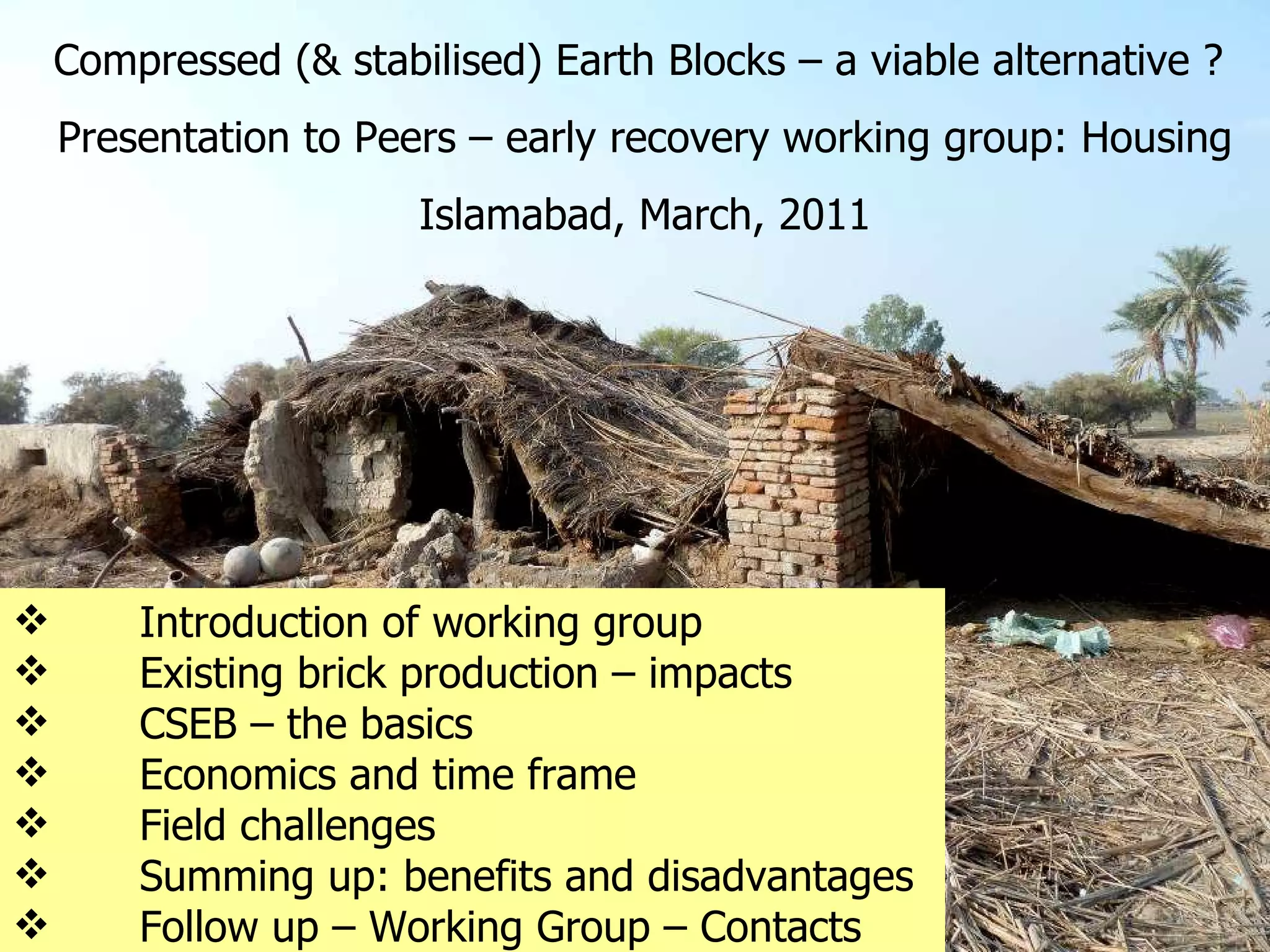
Introduction of working group  Existing brick production – impacts  CSEB – the basics  Economics and time frame  Field challenges  Summing up: benefits and disadvantages Follow up – Working Group – Contacts   Compressed (& stabilised) Earth Blocks – a viable alternative ?  Presentation to Peers – early recovery working group: Housing Islamabad, March, 2011
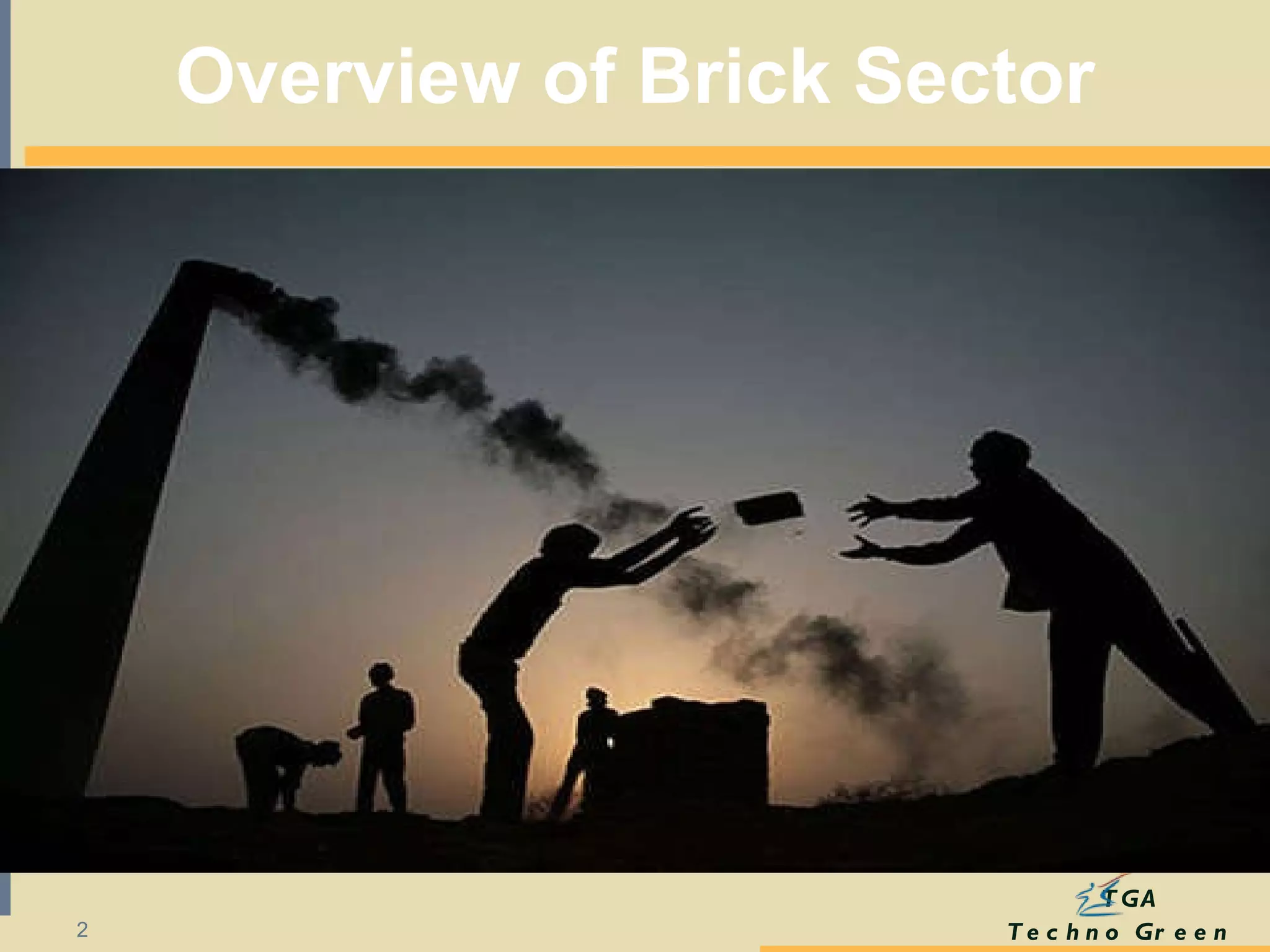
Overview of Brick Sector
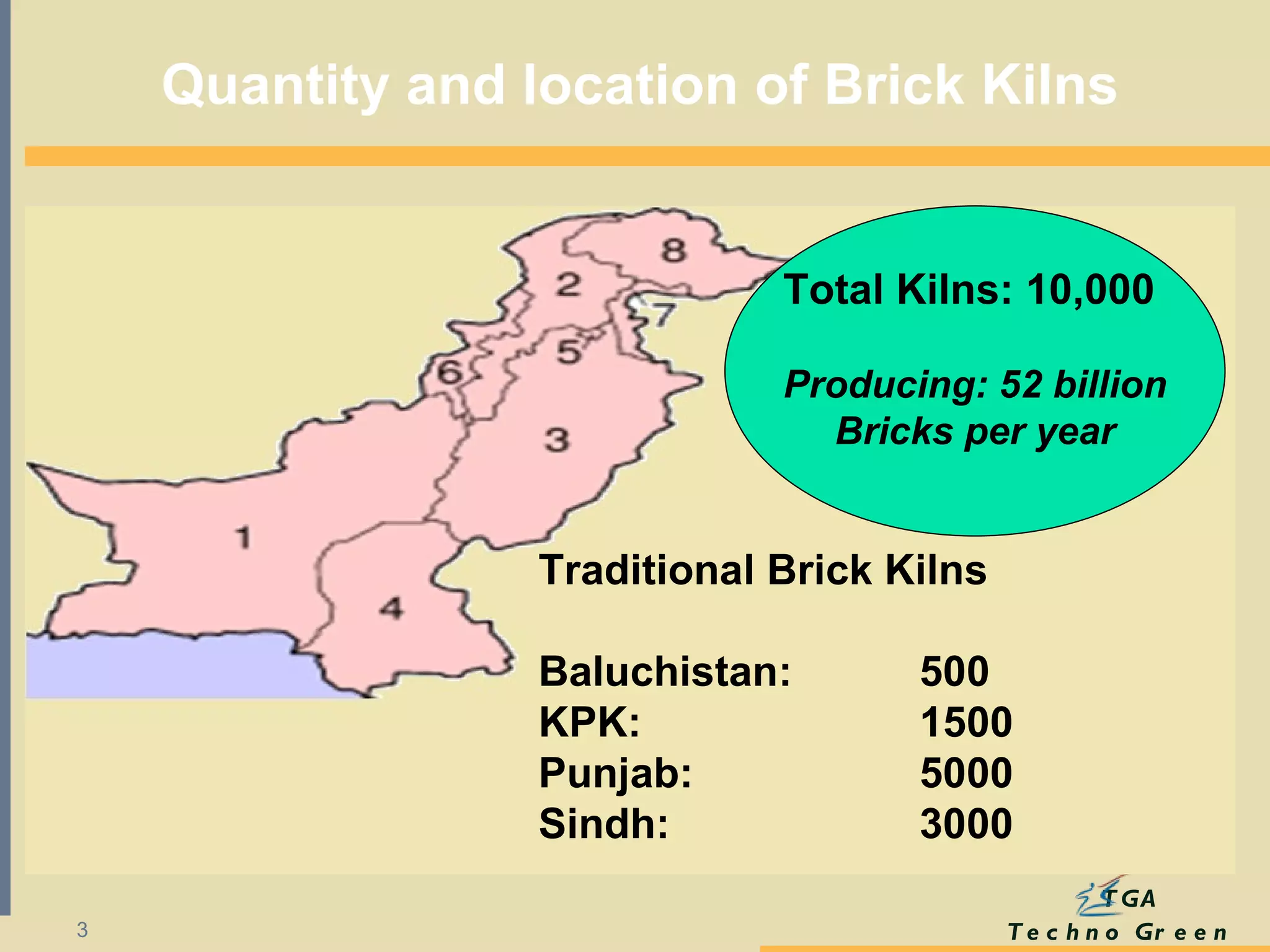
Quantity and location of Brick Kilns Total Kilns: 10,000  Producing: 52 billion Bricks per year Traditional Brick Kilns Baluchistan:  500  KPK: 1500  Punjab: 5000 Sindh: 3000
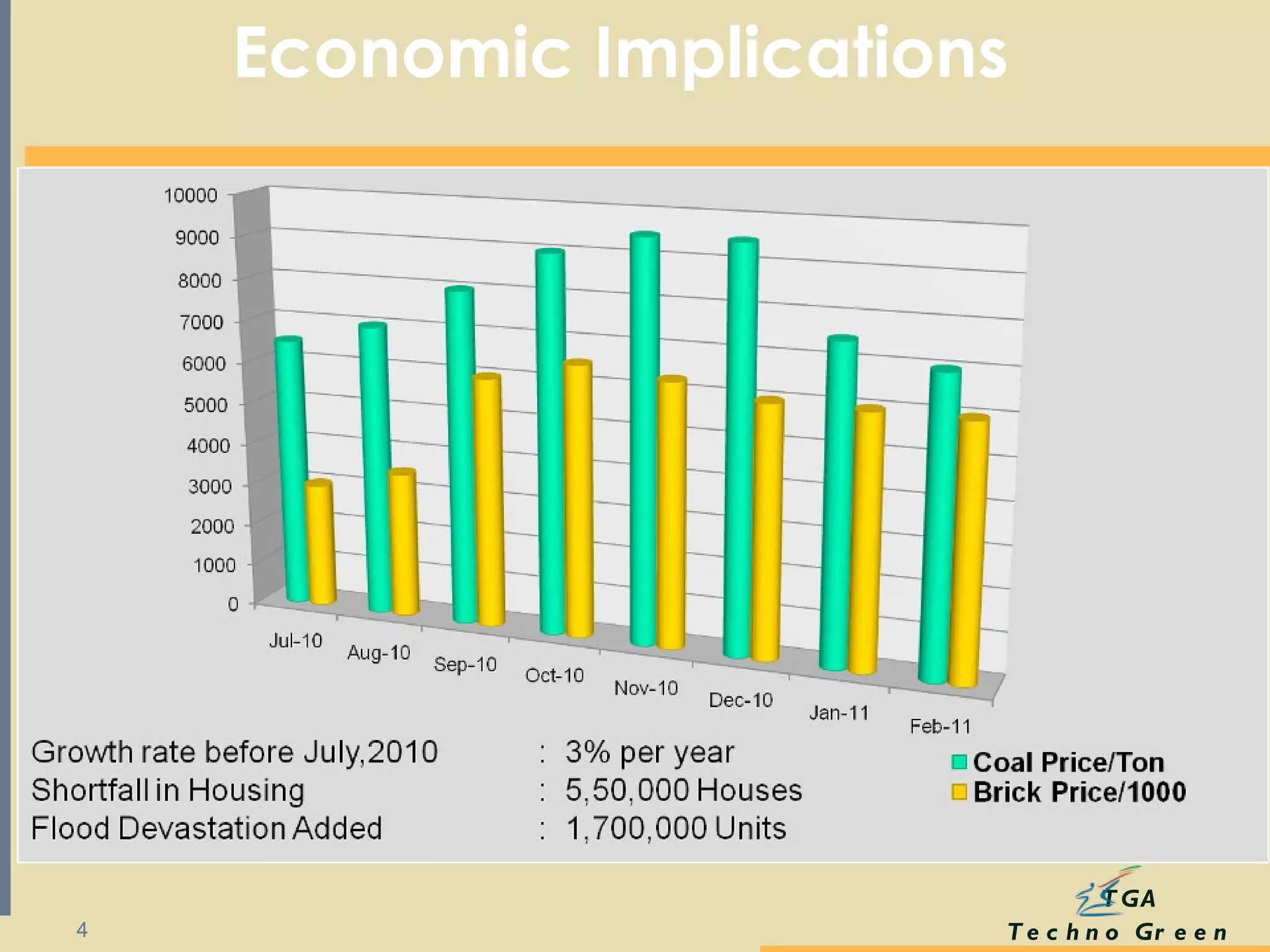
Economic Implications
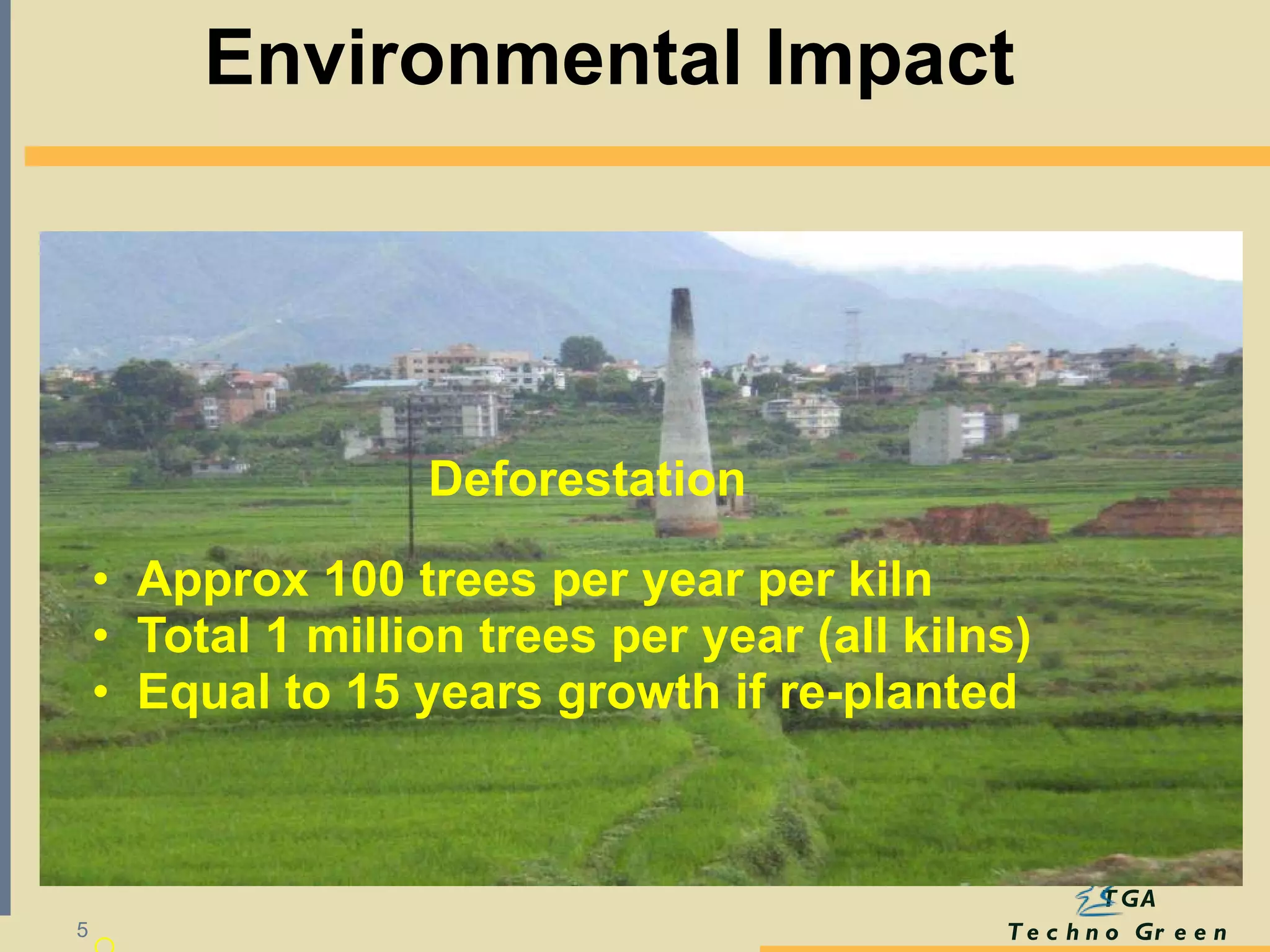
Deforestation Approx 100 trees per year per kiln Total 1 million trees per year (all kilns)  Equal to 15 years growth if re-planted Environmental Impact
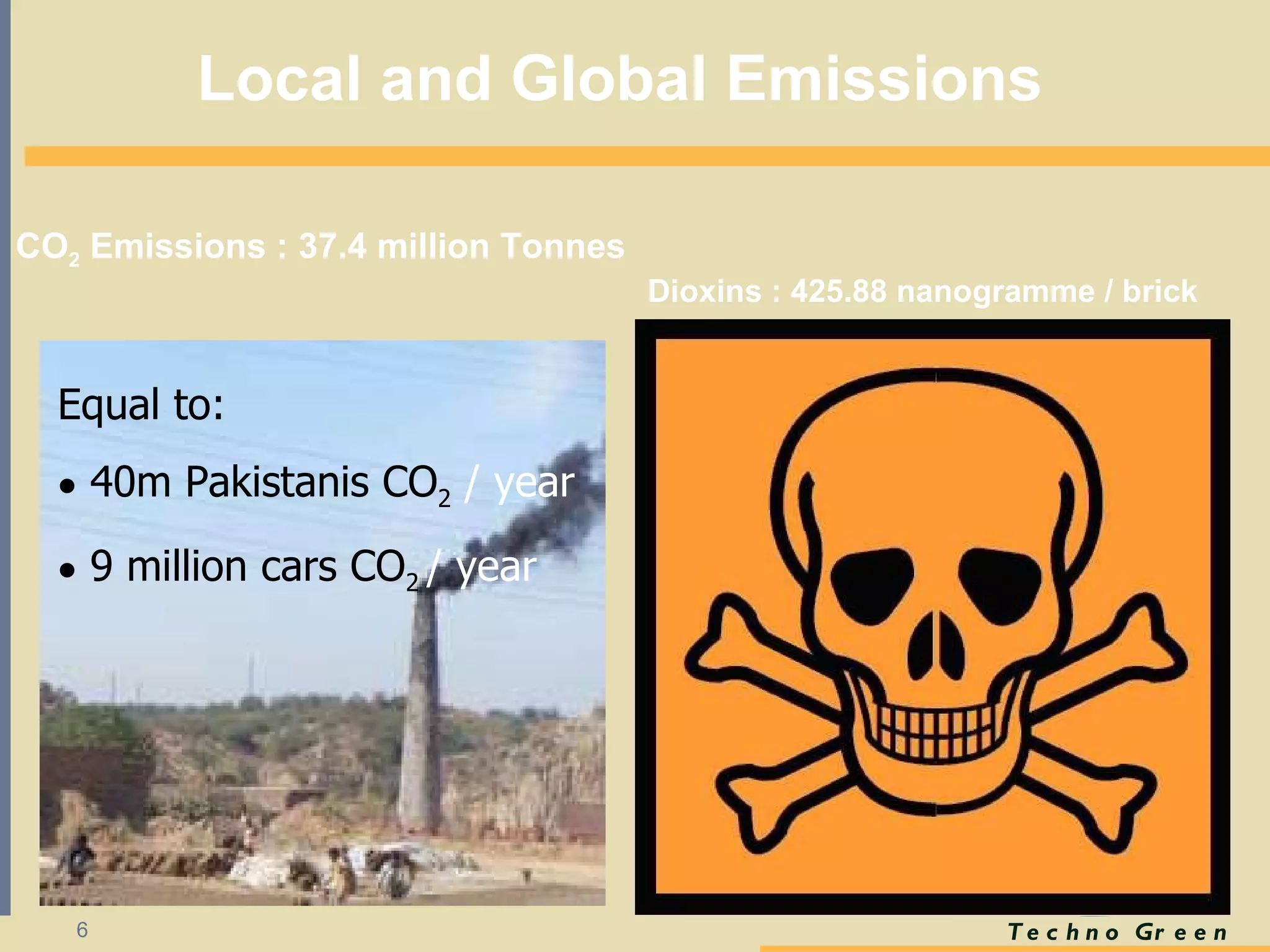
Local and Global Emissions   Dioxins : 425.88 nanogramme / brick CO 2  Emissions :   37.4 million Tonnes Equal to: 40m Pakistanis CO 2   / year 9 million cars CO 2  / year
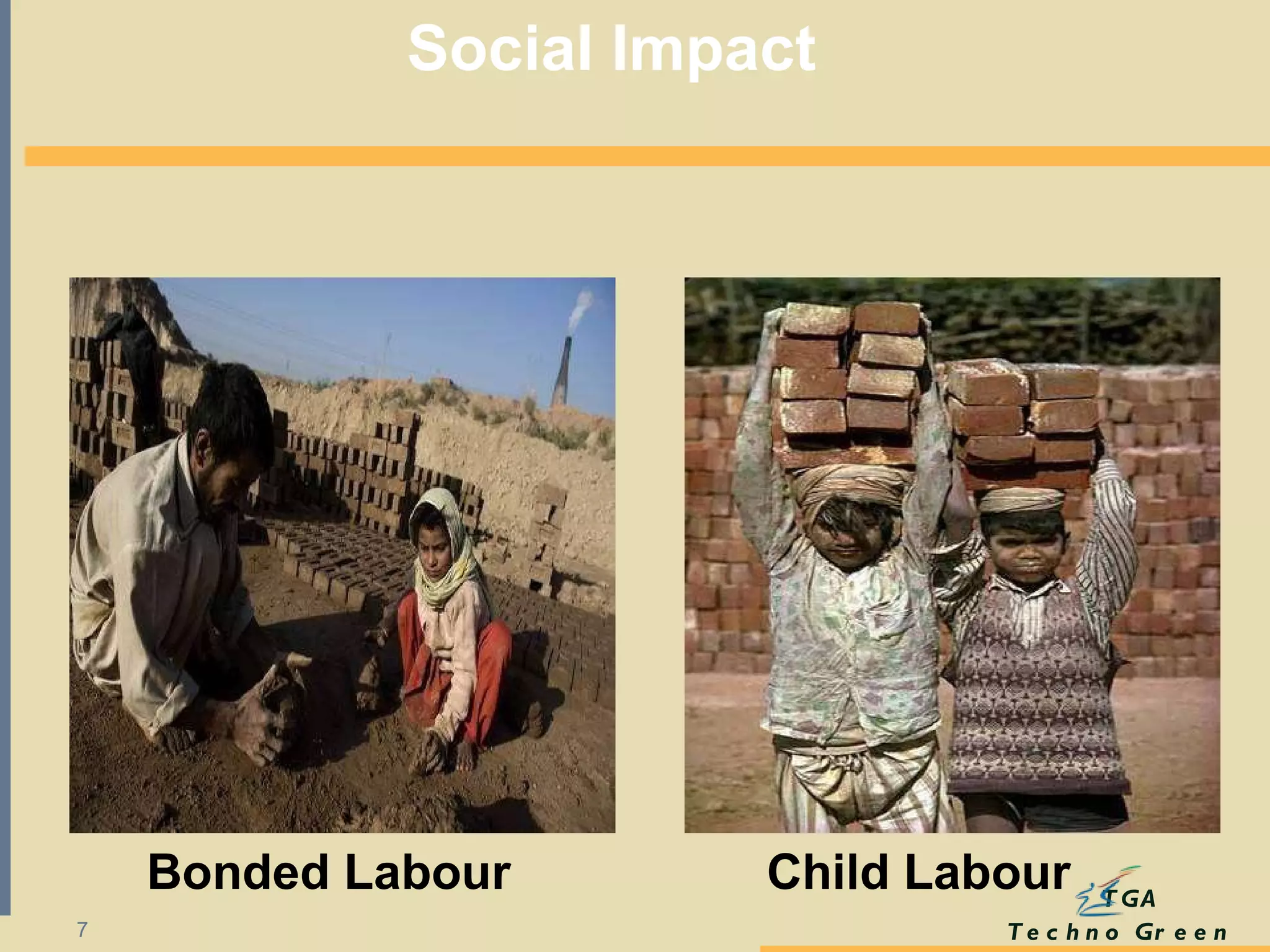
Social Impact   Child Labour Bonded Labour
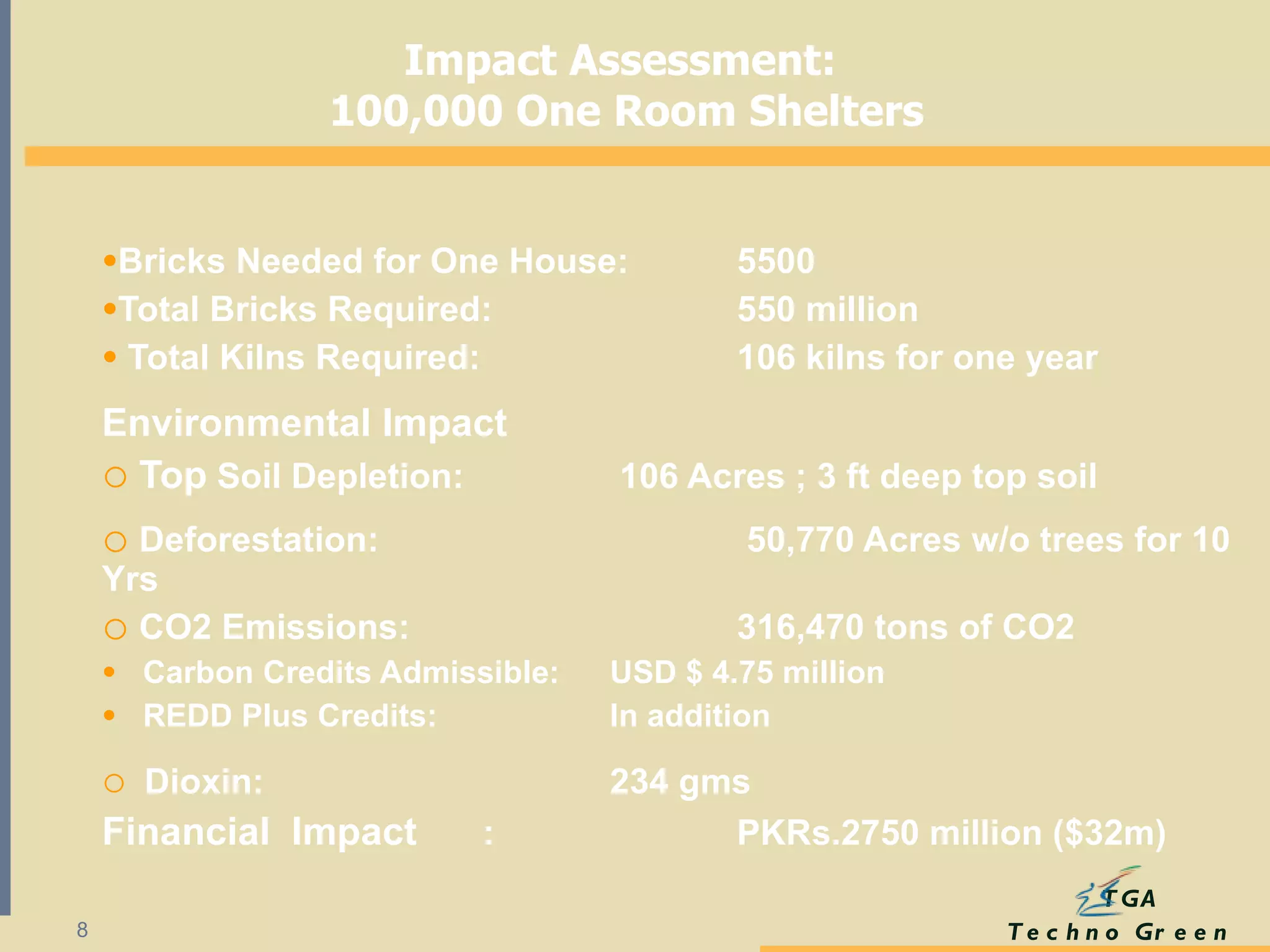
Bricks Needed for One House:  5500 Total Bricks Required:   550 million Total Kilns Required:   106 kilns for one year  Environmental Impact Top  Soil Depletion:   106 Acres ; 3 ft deep top soil Deforestation:  50,770 Acres w/o trees for 10 Yrs CO2 Emissions:  316,470 tons of CO2 Carbon Credits Admissible:  USD $ 4.75 million REDD Plus Credits: In addition  Dioxin:   234 gms Financial  Impact : PKRs.2750 million ($32m) Impact Assessment: 100,000 One Room Shelters
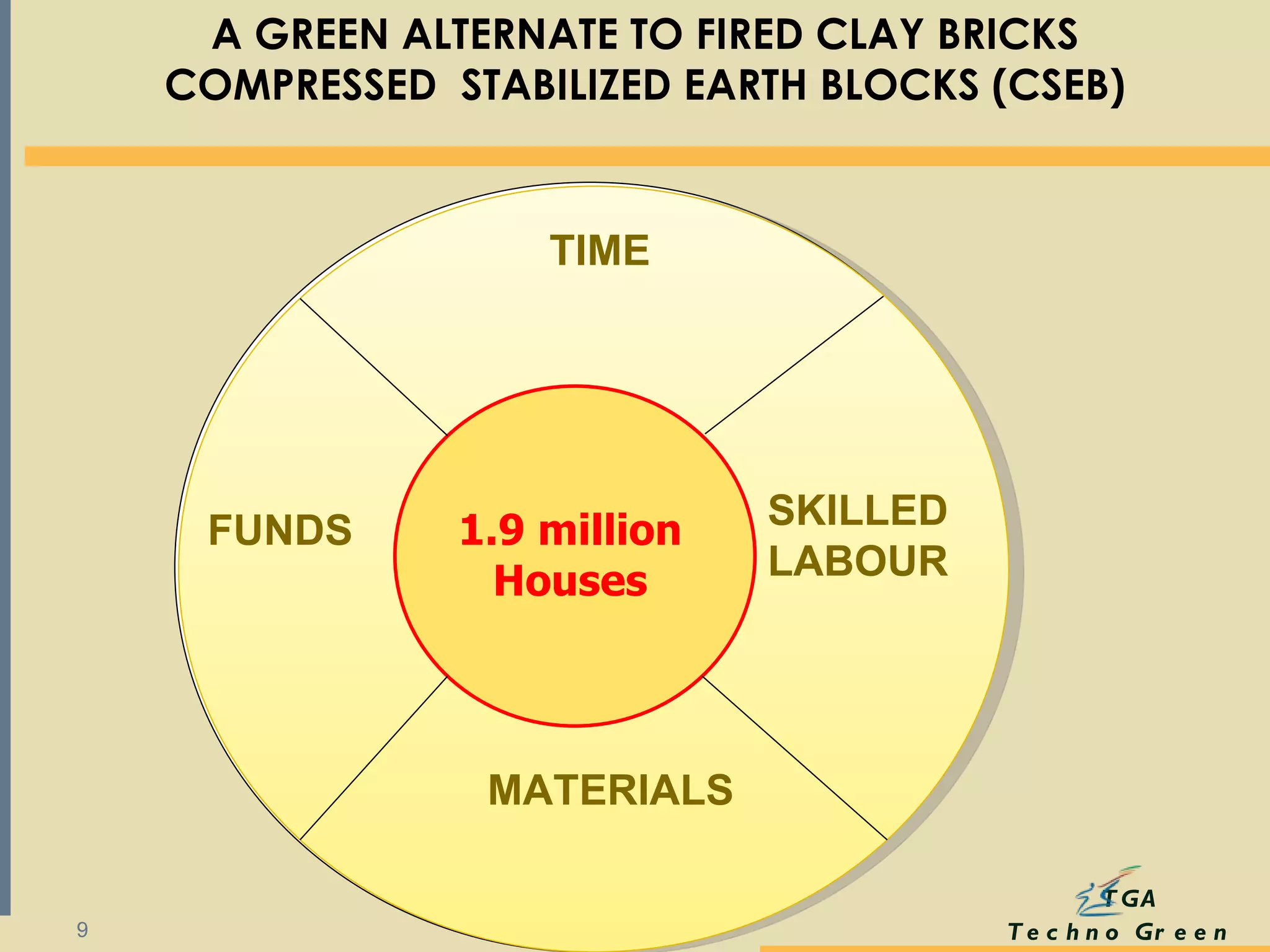
1.9 million Houses TIME SKILLED LABOUR MATERIALS FUNDS A GREEN ALTERNATE TO FIRED CLAY BRICKS COMPRESSED  STABILIZED EARTH BLOCKS (CSEB)
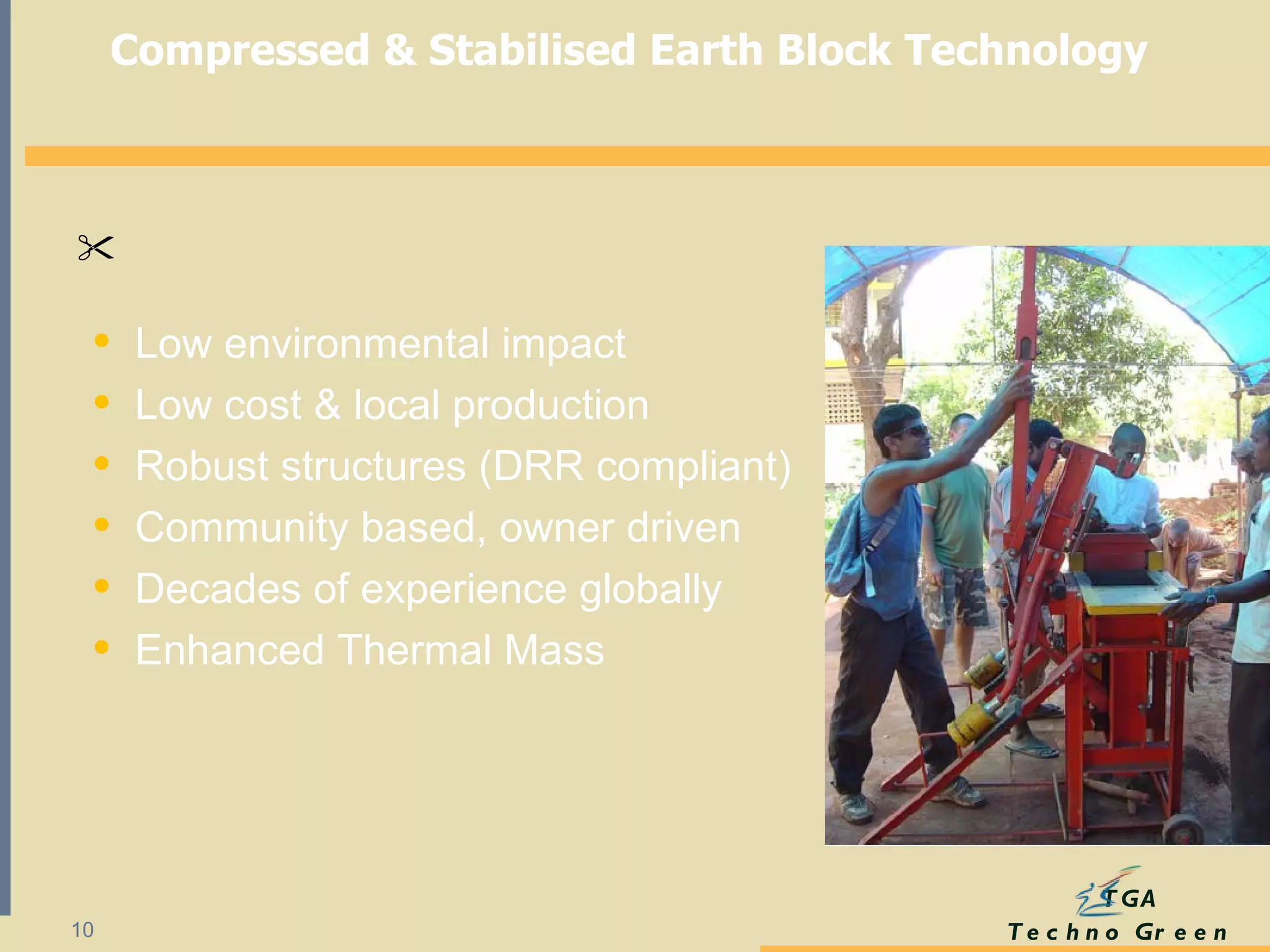
Low environmental impact  Low cost & local production  Robust structures (DRR compliant)  Community based, owner driven  Decades of experience globally Enhanced Thermal Mass  Compressed & Stabilised Earth Block Technology
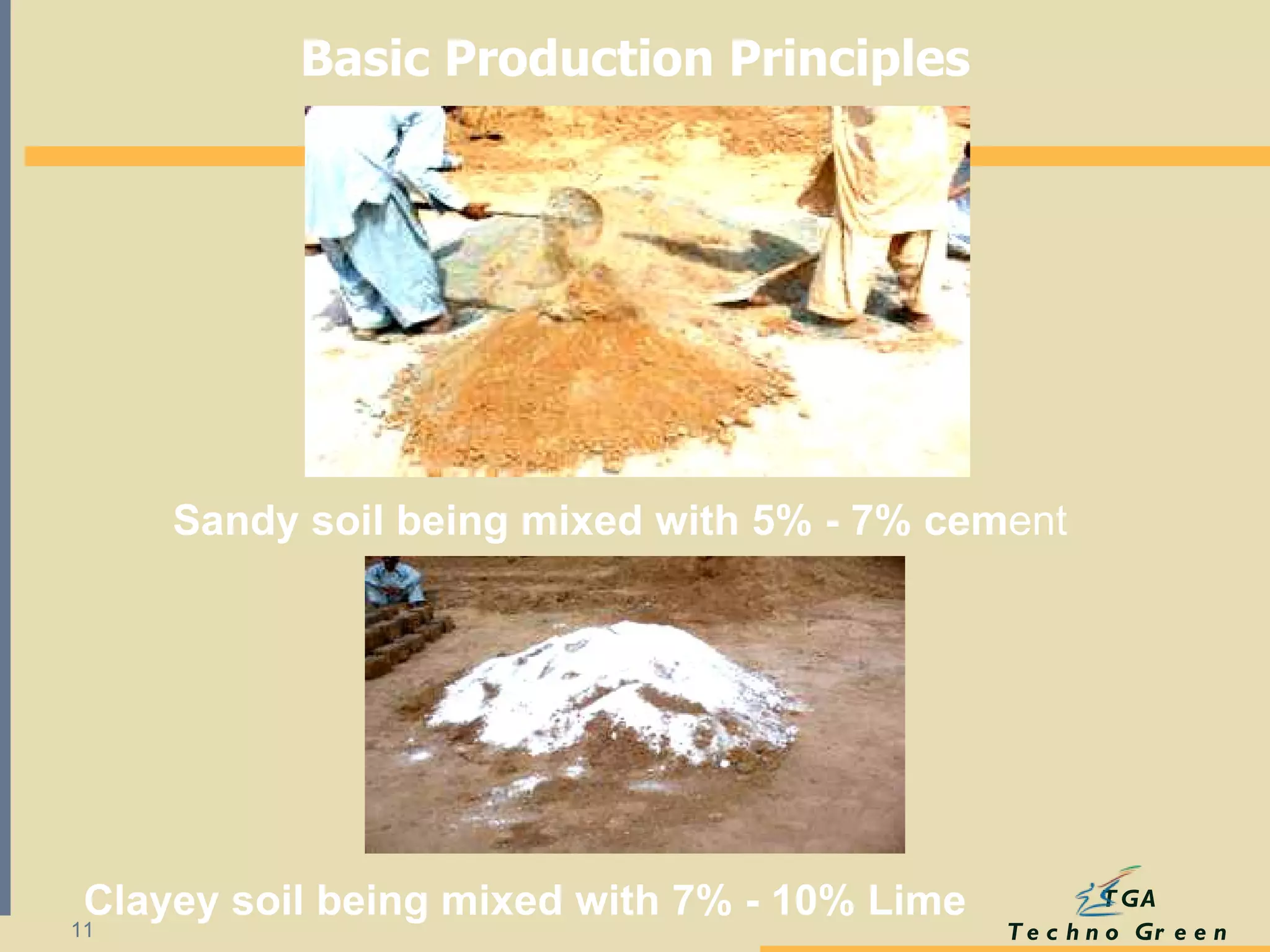
Sandy soil being mixed with 5% - 7% cem ent Clayey soil being mixed with 7% - 10% Lime Basic Production Principles
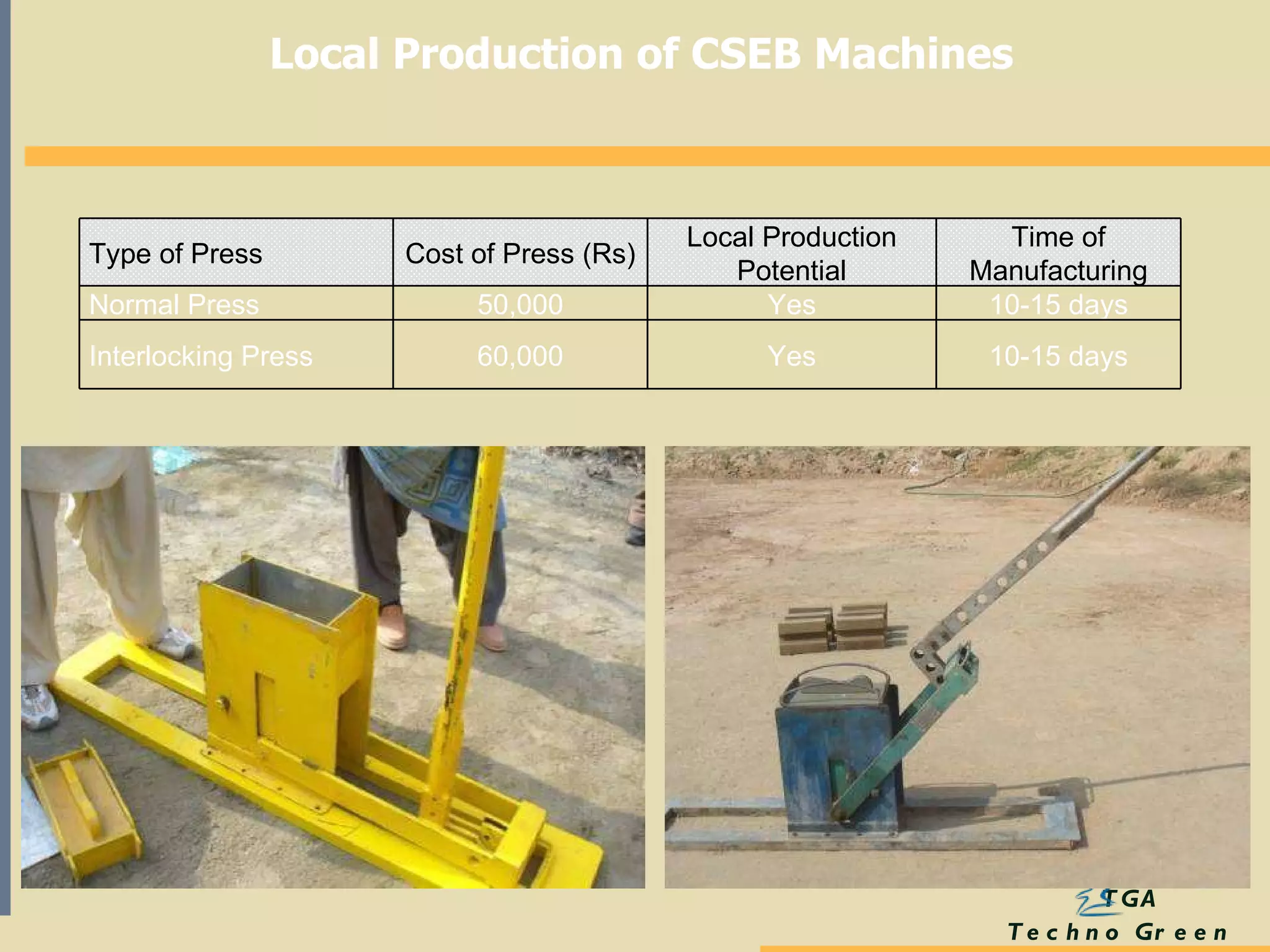
Local Production of CSEB Machines Type of Press Cost of Press (Rs) Local Production Potential Time of Manufacturing Normal Press 50,000 Yes 10-15 days Interlocking Press 60,000 Yes 10-15 days
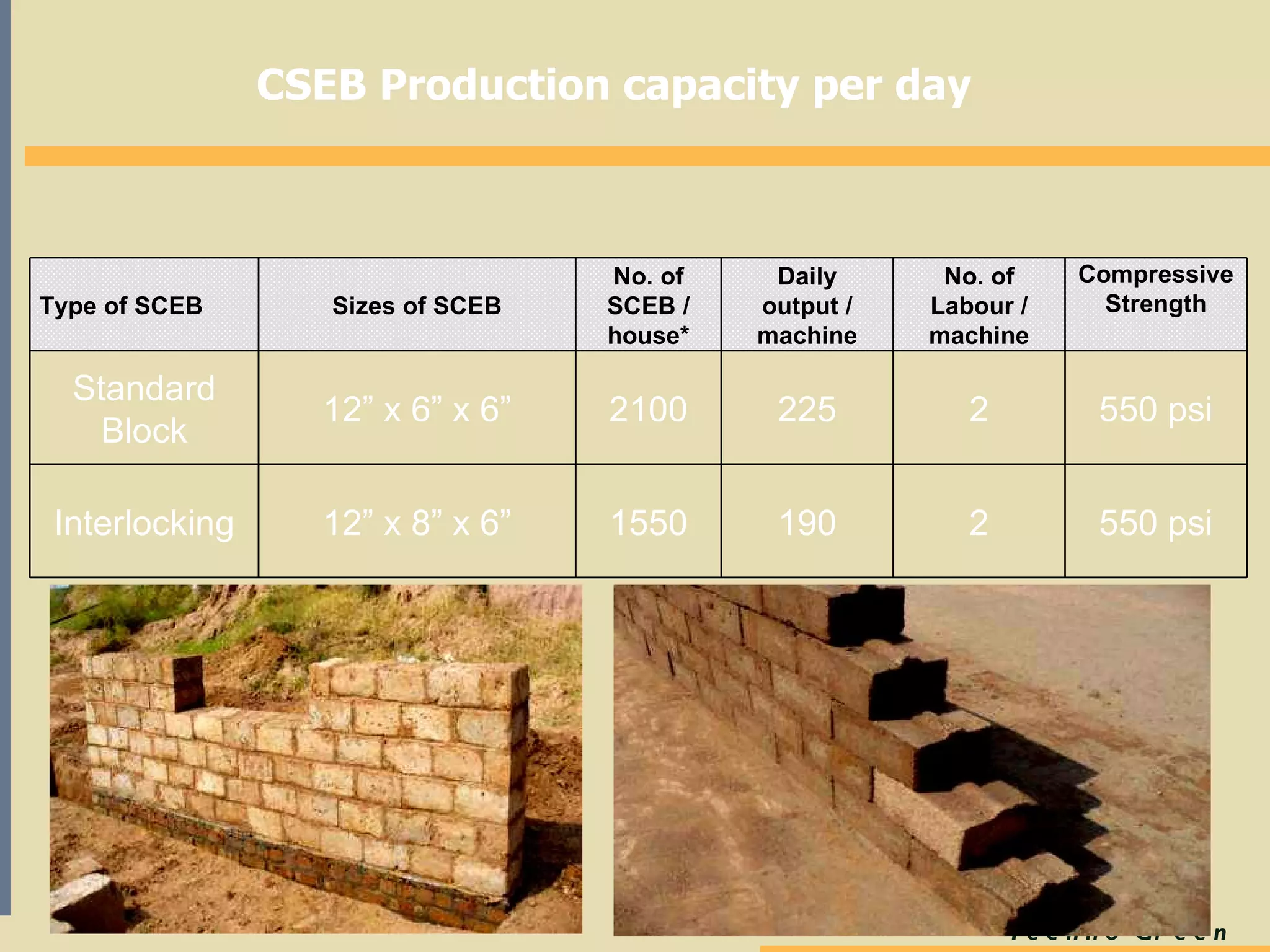
CSEB Production  capacity per day  Type of SCEB Sizes of SCEB No. of SCEB / house* Daily output / machine No. of Labour / machine Compressive Strength Standard Block 12 ”  x 6 ”  x 6 ” 2100 225 2 550 psi Interlocking 12 ”  x 8 ”  x 6 ” 1550 190 2 550 psi
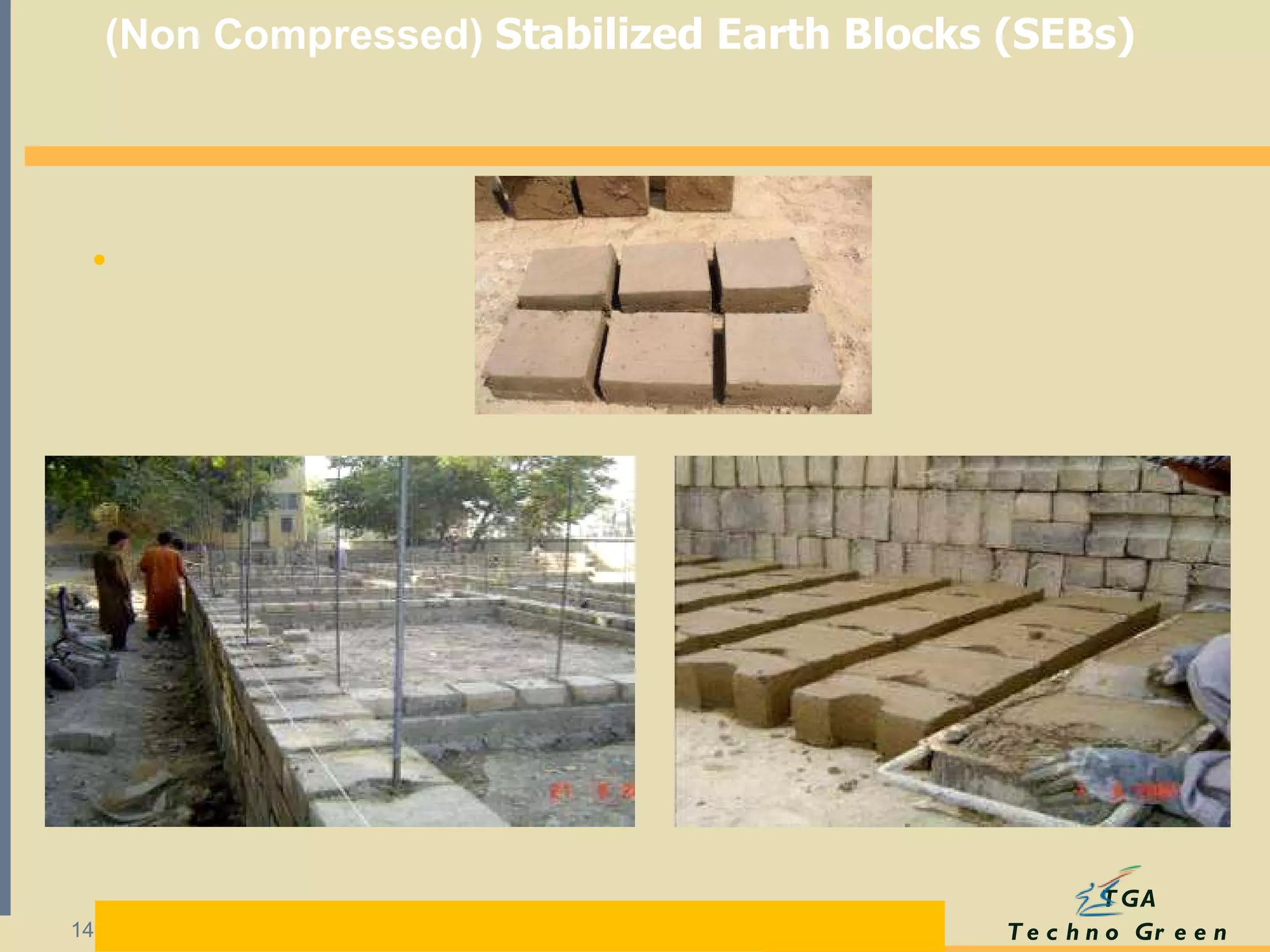
(Non Compressed)  Stabilized Earth Blocks (SEBs)
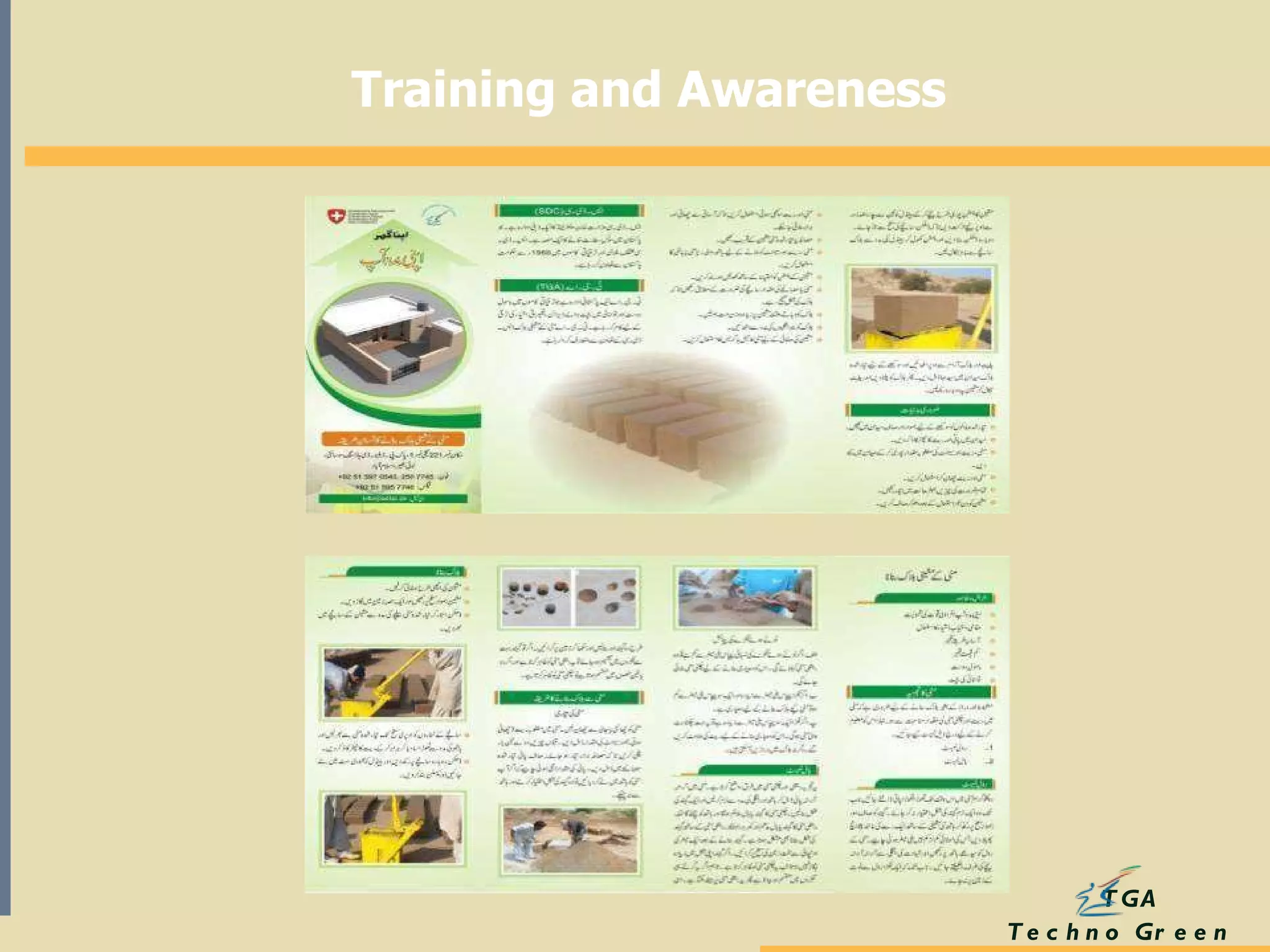
Training and Awareness
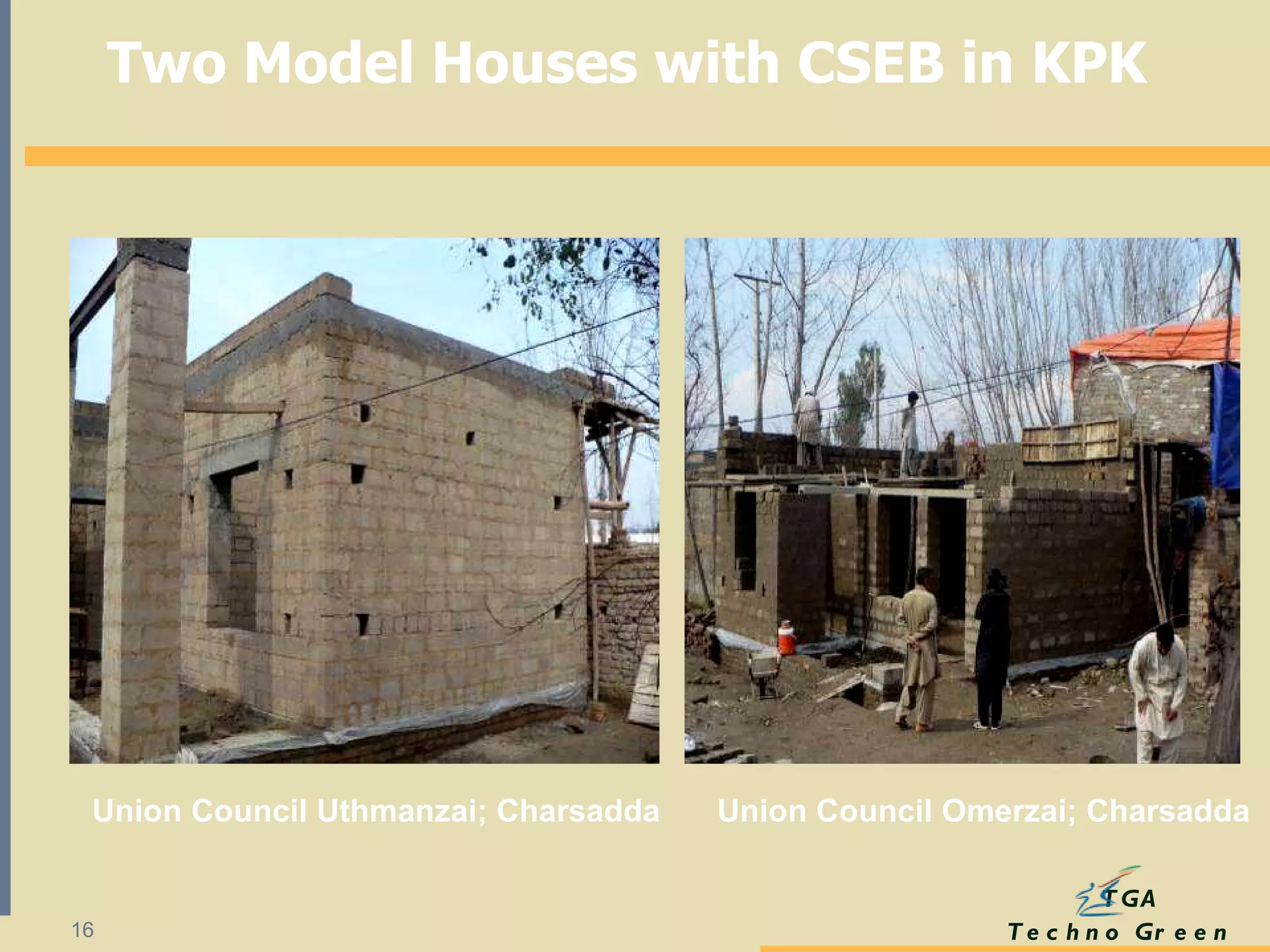
Two Model Houses with CSEB in KPK  Union Council Uthmanzai; Charsadda Union Council Omerzai; Charsadda
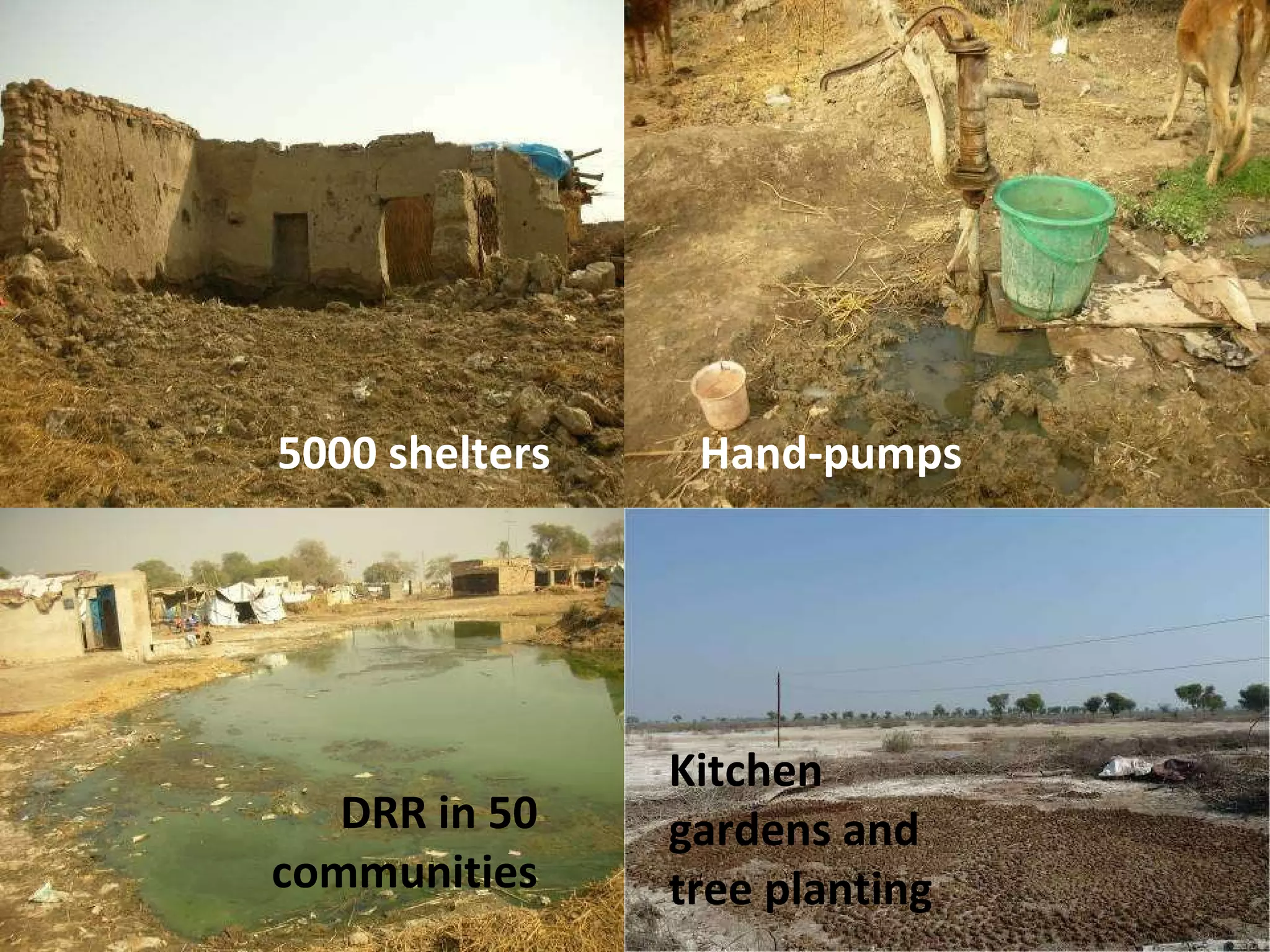
Practical implementation  in Sindh –  50 villages in Jacobabad and Kashmore 5000 shelters Hand-pumps DRR in 50 communities Kitchen gardens and tree planting
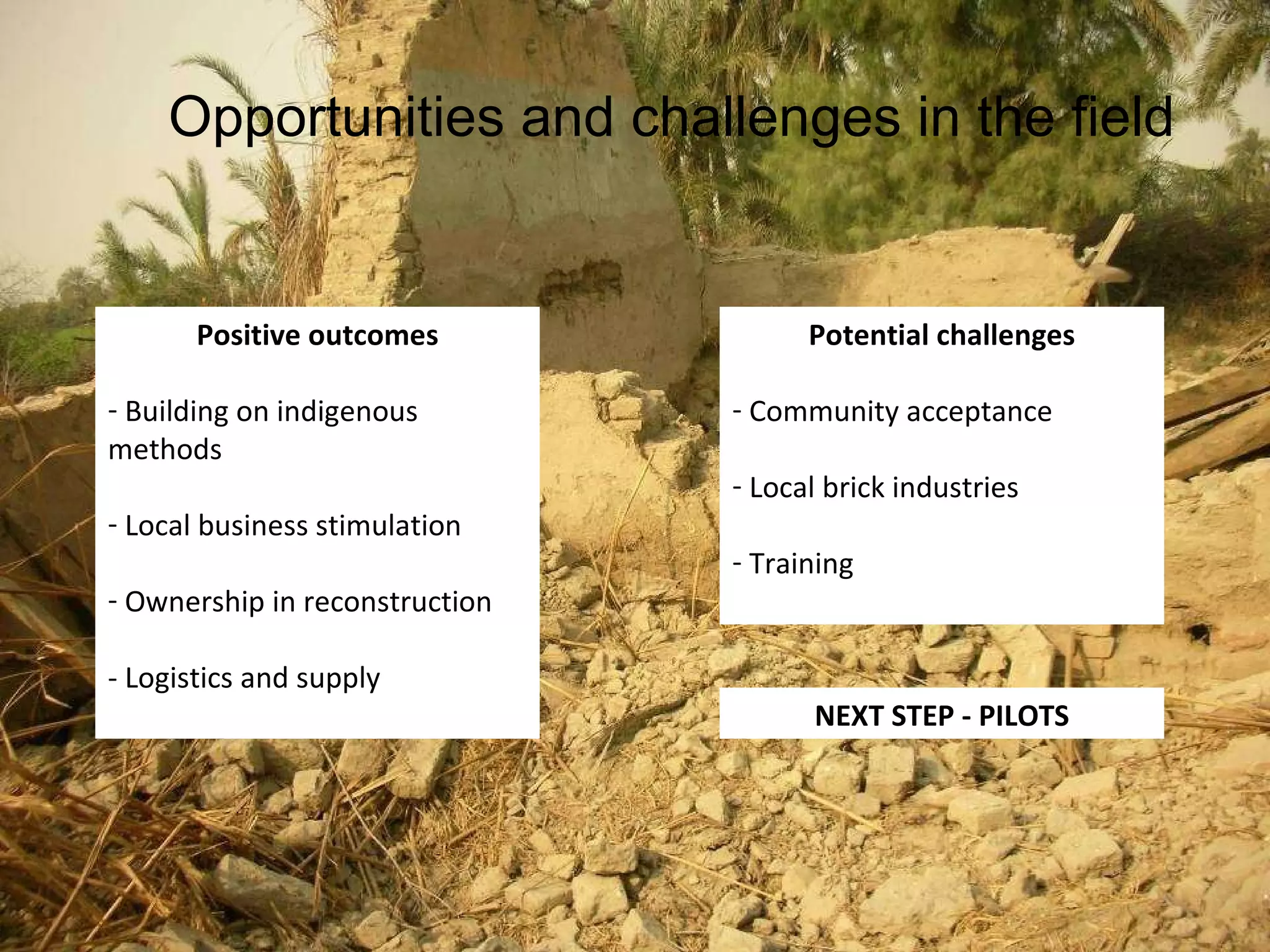
Opportunities and challenges in the field Positive outcomes Building on indigenous methods Local business stimulation Ownership in reconstruction - Logistics and supply Potential challenges Community acceptance Local brick industries Training NEXT STEP - PILOTS
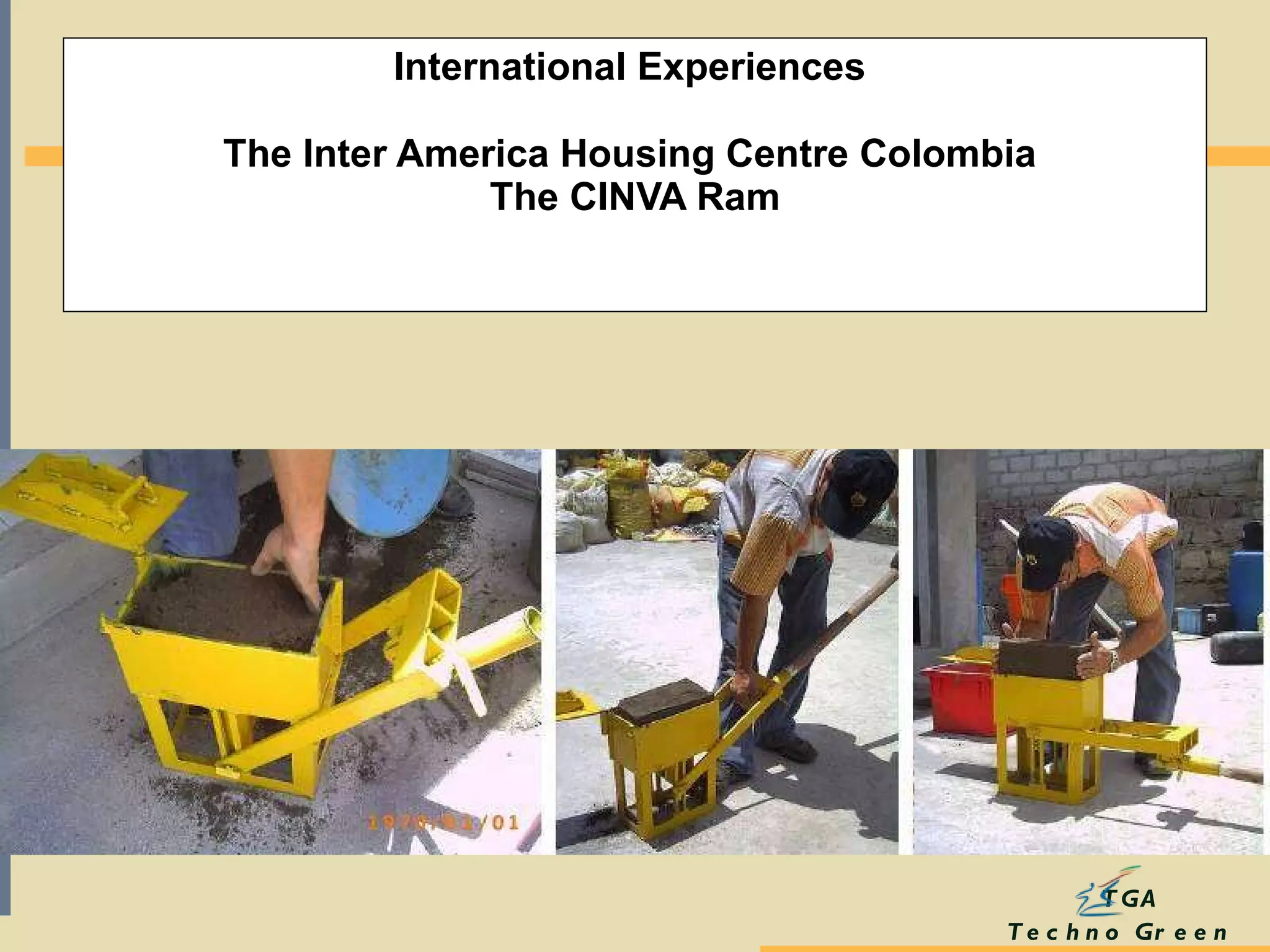
International Experiences  The Inter America Housing Centre Colombia  The CINVA Ram
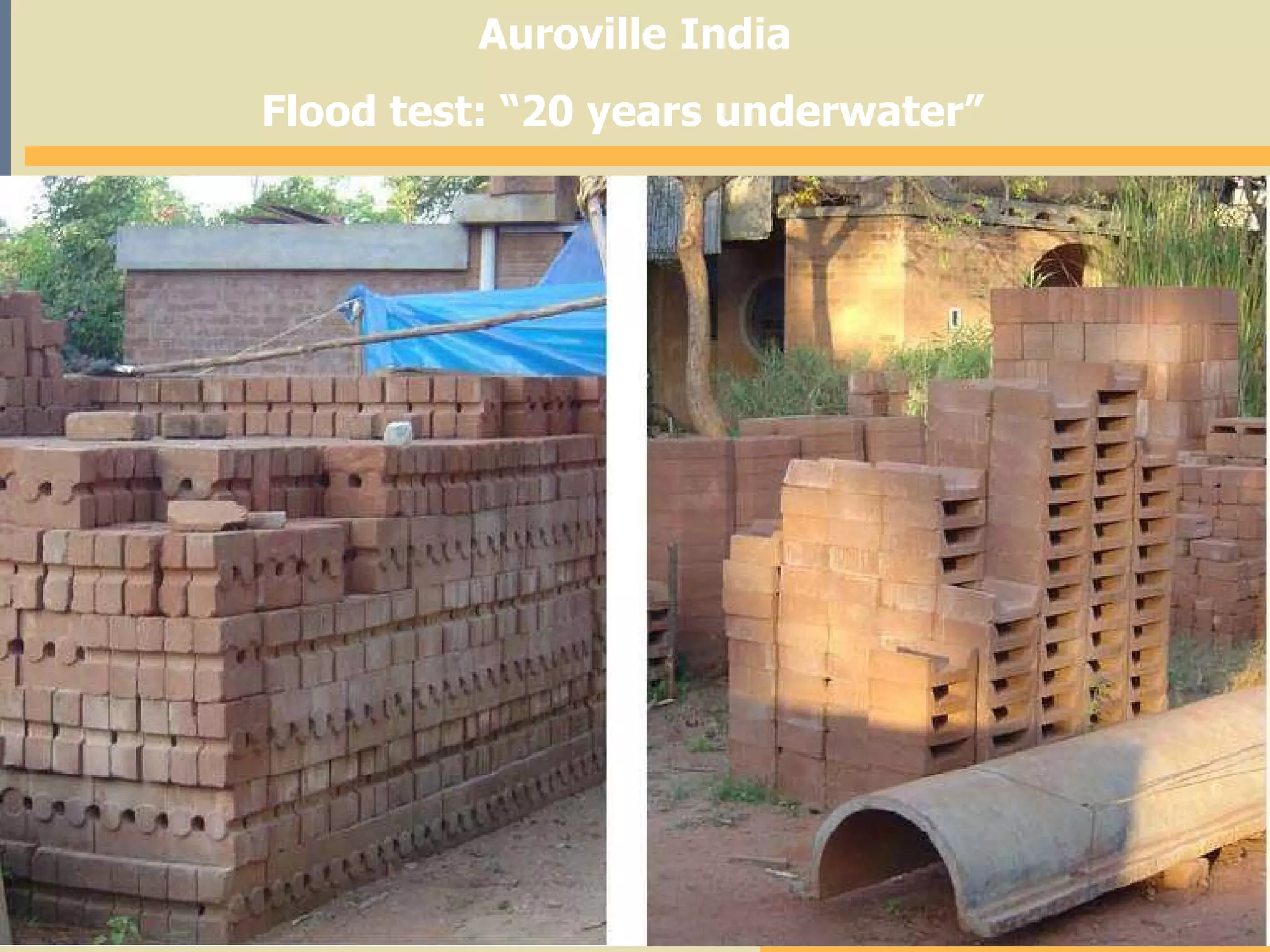
Auroville India Flood test:  “ 20 years underwater ”
Pros and Cons   Benefits  Environmental  Social  Economic  Logistics  Possible Disadvantages Access to Soil  Soil Quality  Landlords (?)  Machine ownership Quality Control
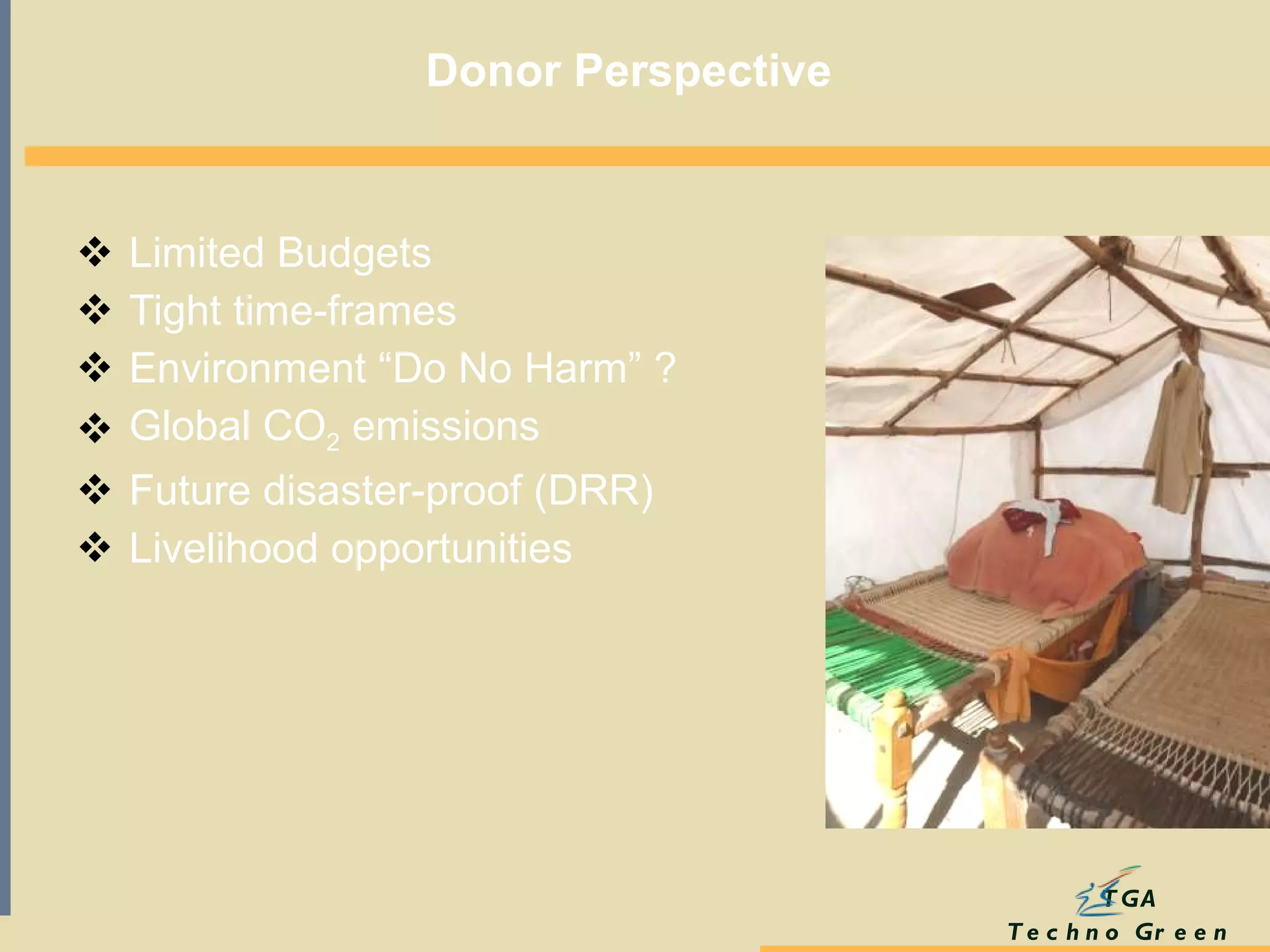
Donor Perspective   Limited Budgets Tight time-frames  Environment  “ Do No Harm ”  ? Global CO 2  emissions Future disaster-proof (DRR) Livelihood opportunities
Follow up & More Info   Technical working group possible  Online wiki-site under development  Focal Point:  Tahir Dar  Tel: 0333 515 9090 Email:  [email_address]

Cseb presentation 2nd march 2011 compressed

  • 1.
    Introduction of workinggroup Existing brick production – impacts CSEB – the basics Economics and time frame Field challenges Summing up: benefits and disadvantages Follow up – Working Group – Contacts Compressed (& stabilised) Earth Blocks – a viable alternative ? Presentation to Peers – early recovery working group: Housing Islamabad, March, 2011
  • 2.
  • 3.
    Quantity and locationof Brick Kilns Total Kilns: 10,000 Producing: 52 billion Bricks per year Traditional Brick Kilns Baluchistan: 500 KPK: 1500 Punjab: 5000 Sindh: 3000
  • 4.
  • 5.
    Deforestation Approx 100trees per year per kiln Total 1 million trees per year (all kilns) Equal to 15 years growth if re-planted Environmental Impact
  • 6.
    Local and GlobalEmissions Dioxins : 425.88 nanogramme / brick CO 2 Emissions : 37.4 million Tonnes Equal to: 40m Pakistanis CO 2 / year 9 million cars CO 2 / year
  • 7.
    Social Impact Child Labour Bonded Labour
  • 8.
    Bricks Needed forOne House: 5500 Total Bricks Required: 550 million Total Kilns Required: 106 kilns for one year Environmental Impact Top Soil Depletion: 106 Acres ; 3 ft deep top soil Deforestation: 50,770 Acres w/o trees for 10 Yrs CO2 Emissions: 316,470 tons of CO2 Carbon Credits Admissible: USD $ 4.75 million REDD Plus Credits: In addition Dioxin: 234 gms Financial Impact : PKRs.2750 million ($32m) Impact Assessment: 100,000 One Room Shelters
  • 9.
    1.9 million HousesTIME SKILLED LABOUR MATERIALS FUNDS A GREEN ALTERNATE TO FIRED CLAY BRICKS COMPRESSED STABILIZED EARTH BLOCKS (CSEB)
  • 10.
    Low environmental impact Low cost & local production Robust structures (DRR compliant) Community based, owner driven Decades of experience globally Enhanced Thermal Mass Compressed & Stabilised Earth Block Technology
  • 11.
    Sandy soil beingmixed with 5% - 7% cem ent Clayey soil being mixed with 7% - 10% Lime Basic Production Principles
  • 12.
    Local Production ofCSEB Machines Type of Press Cost of Press (Rs) Local Production Potential Time of Manufacturing Normal Press 50,000 Yes 10-15 days Interlocking Press 60,000 Yes 10-15 days
  • 13.
    CSEB Production capacity per day Type of SCEB Sizes of SCEB No. of SCEB / house* Daily output / machine No. of Labour / machine Compressive Strength Standard Block 12 ” x 6 ” x 6 ” 2100 225 2 550 psi Interlocking 12 ” x 8 ” x 6 ” 1550 190 2 550 psi
  • 14.
    (Non Compressed) Stabilized Earth Blocks (SEBs)
  • 15.
  • 16.
    Two Model Houseswith CSEB in KPK Union Council Uthmanzai; Charsadda Union Council Omerzai; Charsadda
  • 17.
    Practical implementation in Sindh – 50 villages in Jacobabad and Kashmore 5000 shelters Hand-pumps DRR in 50 communities Kitchen gardens and tree planting
  • 18.
    Opportunities and challengesin the field Positive outcomes Building on indigenous methods Local business stimulation Ownership in reconstruction - Logistics and supply Potential challenges Community acceptance Local brick industries Training NEXT STEP - PILOTS
  • 19.
    International Experiences The Inter America Housing Centre Colombia The CINVA Ram
  • 20.
    Auroville India Floodtest: “ 20 years underwater ”
  • 21.
    Pros and Cons Benefits Environmental Social Economic Logistics Possible Disadvantages Access to Soil Soil Quality Landlords (?) Machine ownership Quality Control
  • 22.
    Donor Perspective Limited Budgets Tight time-frames Environment “ Do No Harm ” ? Global CO 2 emissions Future disaster-proof (DRR) Livelihood opportunities
  • 23.
    Follow up &More Info Technical working group possible Online wiki-site under development Focal Point: Tahir Dar Tel: 0333 515 9090 Email: [email_address]