
SOLAR PASSIVE ARCHITECTURE
&
BUILDING PERFORMANCE STIMULATION TOOLS
AKANKSHA SINGH, ARCHITECT
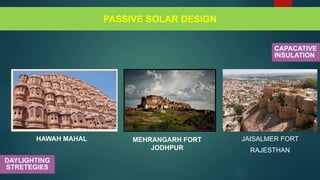
PASSIVE SOLAR DESIGN
MEHRANGARH FORT
JODHPUR
HAWAH MAHAL JAISALMER FORT
RAJESTHAN
CAPACATIVE
INSULATION
DAYLIGHTING
STRETEGIES
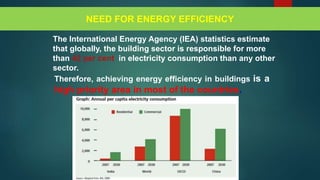
The International Energy Agency (IEA) statistics estimate
that globally, the building sector is responsible for more
than 42 per cent in electricity consumption than any other
sector.
Therefore, achieving energy efficiency in buildings is a
high priority area in most of the countries.
NEED FOR ENERGY EFFICIENCY
 Energy-efficient buildings are designed to use as little
energy as possible. Buildings can be made energy-
efficient by using quality building and insulation
materials which help prevent heat loss and make the
building airtight. High-quality design and
craftsmanship are prerequisites in energy-efficient
building. Minimising thermal bridges is the key.
ENERGY EFFICIENT BUILDINGS
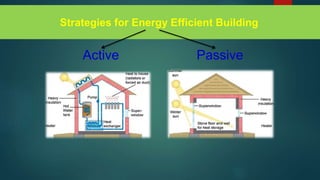
Strategies for Energy Efficient Building
Active Passive
THREE PRINCIPLE OF PASSIVE SOLAR DESIGN
 1. SITE OF DESIGN AND SUN POSITION
 2. WINDOW DESIGN
 3. OVERHANGS AND SHADING
Passive solar design
Passive solar design refers to the use of the sun's energy for the
heating and cooling of living spaces by exposure to the sun. When
sunlight strikes a building, the building materials can reflect, transmit, or
absorb the solar radiation.
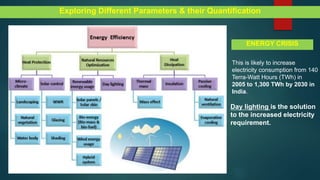
Exploring Different Parameters & their QuantificationExploring Different Parameters & their Quantification
ENERGY CRISIS
This is likely to increase
electricity consumption from 140
Terra-Watt Hours (TWh) in
2005 to 1,300 TWh by 2030 in
India.
Day lighting is the solution
to the increased electricity
requirement.
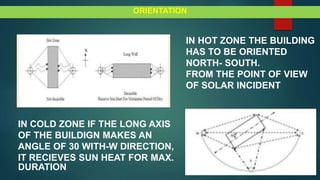
ORIENTATION
IN HOT ZONE THE BUILDING
HAS TO BE ORIENTED
NORTH- SOUTH.
FROM THE POINT OF VIEW
OF SOLAR INCIDENT
IN COLD ZONE IF THE LONG AXIS
OF THE BUILDIGN MAKES AN
ANGLE OF 30 WITH-W DIRECTION,
IT RECIEVES SUN HEAT FOR MAX.
DURATION
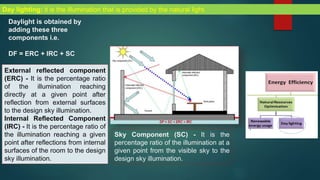
Daylight is obtained by
adding these three
components i.e.
DF = ERC + IRC + SC
External reflected component
(ERC) - It is the percentage ratio
of the illumination reaching
directly at a given point after
reflection from external surfaces
to the design sky illumination.
Internal Reflected Component
(IRC) - It is the percentage ratio of
the illumination reaching a given
point after reflections from internal
surfaces of the room to the design
sky illumination.
Sky Component (SC) - It is the
percentage ratio of the illumination at a
given point from the visible sky to the
design sky illumination.
Day lighting: it is the illumination that is provided by the natural light.
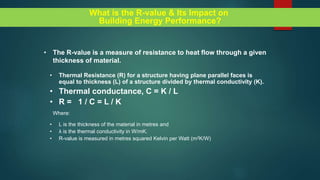
• The R-value is a measure of resistance to heat flow through a given
thickness of material.
What is the R-value & Its Impact on
Building Energy Performance?
• Thermal Resistance (R) for a structure having plane parallel faces is
equal to thickness (L) of a structure divided by thermal conductivity (K).
• Thermal conductance, C = K / L
• R = 1 / C = L / K
Where:
• L is the thickness of the material in metres and
• λ is the thermal conductivity in W/mK.
• R-value is measured in metres squared Kelvin per Watt (m2K/W)
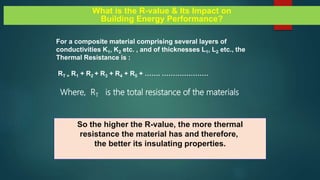
For a composite material comprising several layers of
conductivities K1, K2 etc. , and of thicknesses L1, L2 etc., the
Thermal Resistance is :
RT = R1 + R2 + R3 + R4 + R5 + ……. …………………
Where, RT is the total resistance of the materials
What is the R-value & Its Impact on
Building Energy Performance?
So the higher the R-value, the more thermal
resistance the material has and therefore,
the better its insulating properties.
THERMAL PROPERTYOF MATERIAL
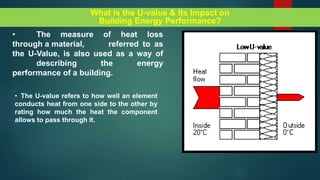
• The measure of heat loss
through a material, referred to as
the U-Value, is also used as a way of
describing the energy
performance of a building.
What is the U-value & Its Impact on
Building Energy Performance?
• The U-value refers to how well an element
conducts heat from one side to the other by
rating how much the heat the component
allows to pass through it.
• U-values also rate the energy efficiency of the
combined materials in a building component or
section.
• Low U-value indicates good energy efficiency.
• Windows, doors, walls and skylights can gain or
lose heat, thereby increasing the energy required
for cooling or heating.
- For this reason most building codes have
set minimum standards for the energy
efficiency of these components.
What is the U-value & Its Impact on
Building Energy Performance?
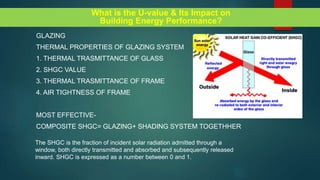
GLAZING
THERMAL PROPERTIES OF GLAZING SYSTEM
1. THERMAL TRASMITTANCE OF GLASS
2. SHGC VALUE
3. THERMAL TRASMITTANCE OF FRAME
4. AIR TIGHTNESS OF FRAME
MOST EFFECTIVE-
COMPOSITE SHGC= GLAZING+ SHADING SYSTEM TOGETHHER
The SHGC is the fraction of incident solar radiation admitted through a
window, both directly transmitted and absorbed and subsequently released
inward. SHGC is expressed as a number between 0 and 1.
What is the U-value & Its Impact on
Building Energy Performance?
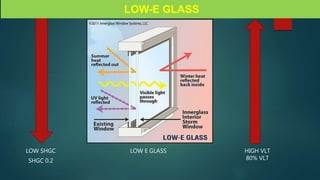
LOW E GLASS HIGH VLT
80% VLTSHGC 0.2
LOW SHGC
LOW-E GLASS
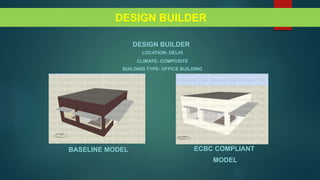
BASELINE MODEL ECBC COMPLIANT
MODEL
LOCATION- DELHI
CLIMATE- COMPOSITE
BUILDING TYPE- OFFICE BUILDING
DESIGN BUILDER
DESIGN BUILDER
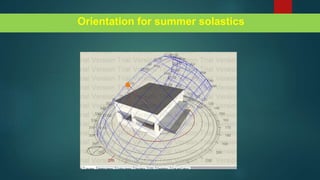
Orientation for summer solastics
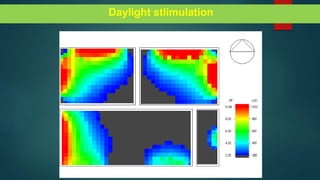
Daylight stlimulation
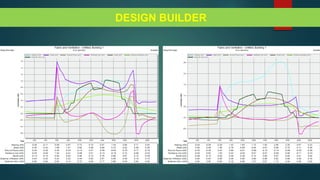
DESIGN BUILDER
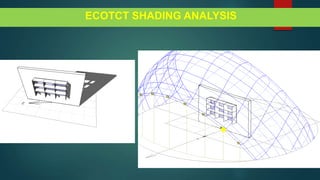
ECOTCT SHADING ANALYSIS
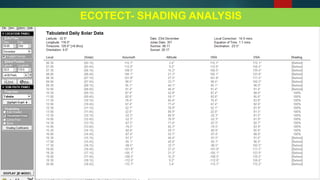
ECOTECT- SHADING ANALYSIS

Building Energy Efficiency

  • 1.
    SOLAR PASSIVE ARCHITECTURE & BUILDINGPERFORMANCE STIMULATION TOOLS AKANKSHA SINGH, ARCHITECT
  • 2.
    PASSIVE SOLAR DESIGN MEHRANGARHFORT JODHPUR HAWAH MAHAL JAISALMER FORT RAJESTHAN CAPACATIVE INSULATION DAYLIGHTING STRETEGIES
  • 3.
    The International EnergyAgency (IEA) statistics estimate that globally, the building sector is responsible for more than 42 per cent in electricity consumption than any other sector. Therefore, achieving energy efficiency in buildings is a high priority area in most of the countries. NEED FOR ENERGY EFFICIENCY
  • 4.
     Energy-efficient buildingsare designed to use as little energy as possible. Buildings can be made energy- efficient by using quality building and insulation materials which help prevent heat loss and make the building airtight. High-quality design and craftsmanship are prerequisites in energy-efficient building. Minimising thermal bridges is the key. ENERGY EFFICIENT BUILDINGS
  • 5.
    Strategies for EnergyEfficient Building Active Passive
  • 6.
    THREE PRINCIPLE OFPASSIVE SOLAR DESIGN  1. SITE OF DESIGN AND SUN POSITION  2. WINDOW DESIGN  3. OVERHANGS AND SHADING Passive solar design Passive solar design refers to the use of the sun's energy for the heating and cooling of living spaces by exposure to the sun. When sunlight strikes a building, the building materials can reflect, transmit, or absorb the solar radiation.
  • 7.
    Exploring Different Parameters& their QuantificationExploring Different Parameters & their Quantification ENERGY CRISIS This is likely to increase electricity consumption from 140 Terra-Watt Hours (TWh) in 2005 to 1,300 TWh by 2030 in India. Day lighting is the solution to the increased electricity requirement.
  • 8.
    ORIENTATION IN HOT ZONETHE BUILDING HAS TO BE ORIENTED NORTH- SOUTH. FROM THE POINT OF VIEW OF SOLAR INCIDENT IN COLD ZONE IF THE LONG AXIS OF THE BUILDIGN MAKES AN ANGLE OF 30 WITH-W DIRECTION, IT RECIEVES SUN HEAT FOR MAX. DURATION
  • 9.
    Daylight is obtainedby adding these three components i.e. DF = ERC + IRC + SC External reflected component (ERC) - It is the percentage ratio of the illumination reaching directly at a given point after reflection from external surfaces to the design sky illumination. Internal Reflected Component (IRC) - It is the percentage ratio of the illumination reaching a given point after reflections from internal surfaces of the room to the design sky illumination. Sky Component (SC) - It is the percentage ratio of the illumination at a given point from the visible sky to the design sky illumination. Day lighting: it is the illumination that is provided by the natural light.
  • 10.
    • The R-valueis a measure of resistance to heat flow through a given thickness of material. What is the R-value & Its Impact on Building Energy Performance? • Thermal Resistance (R) for a structure having plane parallel faces is equal to thickness (L) of a structure divided by thermal conductivity (K). • Thermal conductance, C = K / L • R = 1 / C = L / K Where: • L is the thickness of the material in metres and • λ is the thermal conductivity in W/mK. • R-value is measured in metres squared Kelvin per Watt (m2K/W)
  • 11.
    For a compositematerial comprising several layers of conductivities K1, K2 etc. , and of thicknesses L1, L2 etc., the Thermal Resistance is : RT = R1 + R2 + R3 + R4 + R5 + ……. ………………… Where, RT is the total resistance of the materials What is the R-value & Its Impact on Building Energy Performance? So the higher the R-value, the more thermal resistance the material has and therefore, the better its insulating properties.
  • 12.
  • 13.
    • The measureof heat loss through a material, referred to as the U-Value, is also used as a way of describing the energy performance of a building. What is the U-value & Its Impact on Building Energy Performance? • The U-value refers to how well an element conducts heat from one side to the other by rating how much the heat the component allows to pass through it.
  • 14.
    • U-values alsorate the energy efficiency of the combined materials in a building component or section. • Low U-value indicates good energy efficiency. • Windows, doors, walls and skylights can gain or lose heat, thereby increasing the energy required for cooling or heating. - For this reason most building codes have set minimum standards for the energy efficiency of these components. What is the U-value & Its Impact on Building Energy Performance?
  • 15.
    GLAZING THERMAL PROPERTIES OFGLAZING SYSTEM 1. THERMAL TRASMITTANCE OF GLASS 2. SHGC VALUE 3. THERMAL TRASMITTANCE OF FRAME 4. AIR TIGHTNESS OF FRAME MOST EFFECTIVE- COMPOSITE SHGC= GLAZING+ SHADING SYSTEM TOGETHHER The SHGC is the fraction of incident solar radiation admitted through a window, both directly transmitted and absorbed and subsequently released inward. SHGC is expressed as a number between 0 and 1. What is the U-value & Its Impact on Building Energy Performance?
  • 16.
    LOW E GLASSHIGH VLT 80% VLTSHGC 0.2 LOW SHGC LOW-E GLASS
  • 17.
    BASELINE MODEL ECBCCOMPLIANT MODEL LOCATION- DELHI CLIMATE- COMPOSITE BUILDING TYPE- OFFICE BUILDING DESIGN BUILDER DESIGN BUILDER
  • 18.
  • 19.
  • 20.
  • 21.
  • 22.