CS304PC:Computer Organization
and Architecture (R18 II(I sem))
Department of computer science and engineering
(AI/ML)
Session 14
by
Asst.Prof.M.Gokilavani
VITS
1/12/2023 Department of CSE (AI/ML) 1
TEXTBOOK:
• 1. Computer System Architecture – M. Moris Mano, Third Edition,
Pearson/PHI.
REFERENCES:
• Computer Organization – Car Hamacher, Zvonks Vranesic, Safea
Zaky, Vth Edition, McGraw Hill.
• Computer Organization and Architecture – William Stallings Sixth
Edition, Pearson/PHI.
• Structured Computer Organization – Andrew S. Tanenbaum, 4th
Edition, PHI/Pearson.
1/12/2023 Department of CSE (AI/ML) 2
Unit II
Microprogrammed Control: Control memory, Address sequencing,
micro program example, Design of Control unit .
Central Processing Unit : General Register Organization, Stack
organization, Instruction formats, Addressing modes, Data Transfer and
Manipulation, Program Control.
1/12/2023 Department of CSE (AI/ML) 3
Topics covered in session 14
1/12/2023 Department of CSE (AI/ML) 4
• General Register Organization
• Instruction formats
• Addressing modes
• Data Transfer and Manipulation
• Program Control.
Data transfer and manipulation
• Computers provide an extensive set of instructions to give the user the
flexibility to carry out various computational tasks.
• Most computer instructions can be classified into three categories:
1. Data transfer instructions
2. Data manipulation instructions
3. Program control instructions
• Data transfer instructions cause transfer of data from one location to
another without changing the binary information content.
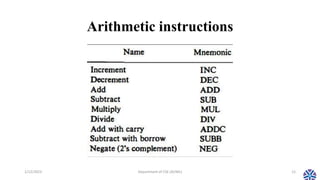
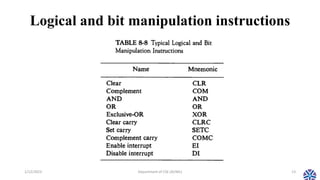
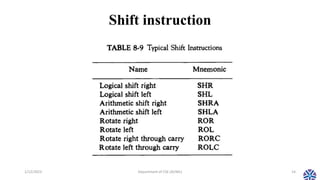
• Data manipulation instructions are those that perform arithmetic, logic,
and shift operations.
• Program control instructions provide decision-making capabilities and
change the path taken by the program when executed in the computer.
1/12/2023 Department of CSE (AI/ML) 5
Data transfer instruction
• Data transfer instructions move data from one place in the computer to
another without changing the data content.
• The most common transfers are between memory and processor registers,
between processor registers and input or output, and between the processor
registers themselves.
1/12/2023 Department of CSE (AI/ML) 6
Data transfer instruction
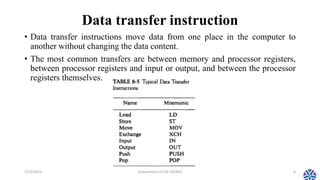
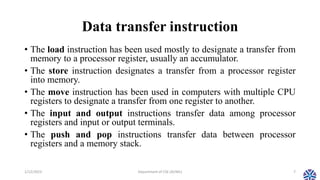
• The load instruction has been used mostly to designate a transfer from
memory to a processor register, usually an accumulator.
• The store instruction designates a transfer from a processor register
into memory.
• The move instruction has been used in computers with multiple CPU
registers to designate a transfer from one register to another.
• The input and output instructions transfer data among processor
registers and input or output terminals.
• The push and pop instructions transfer data between processor
registers and a memory stack.
1/12/2023 Department of CSE (AI/ML) 7
Data transfer instruction
1/12/2023 Department of CSE (AI/ML) 8
Data transfer instruction
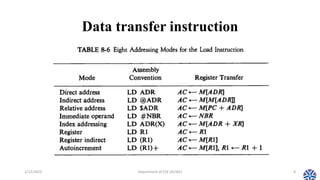
• The immediate mode is recognized from a pound sign # placed before the
operand.
• ADR stands for an address, NBR is a number or operand, X is an index
register, XI is a processor register, and AC is the accumulator register.
• The @ character symbolizes an indirect address.
• The $ character before an address makes the address relative to the program
counter PC.
• The # character precedes the operand in an immediate-mode instruction.
1/12/2023 Department of CSE (AI/ML) 9
• An indexed mode instruction is recognized by a register that is placed in
parentheses after the symbolic address.
• The register mode is symbolized by giving the name of a processor register. In
the register indirect mode, the name of the register that holds the memory
address is enclosed in parentheses.
• The autoincrement mode is distinguished from the register indirect mode by
placing a plus after the parenthesized register.
• The autodecrement mode would use a minus instead.
• To be able to write assembly language programs for a computer, it is necessary
to know the type of instructions available and to be familiar with the
addressing modes used in the particular computer.
1/12/2023 Department of CSE (AI/ML) 10
Data transfer instruction
Data Manipulation Instructions
• Data manipulation instructions perform operations on data and provide the
computational capabilities for the computer. The data manipulation
instructions in a typical computer are usually divided into three basic types:
1. Arithmetic instructions
2. Logical and bit manipulation instructions
3. Shift instructions
1/12/2023 Department of CSE (AI/ML) 11
Arithmetic instructions
1/12/2023 Department of CSE (AI/ML) 12
Logical and bit manipulation instructions
1/12/2023 Department of CSE (AI/ML) 13
Shift instruction
1/12/2023 Department of CSE (AI/ML) 14
Topics to be covered in next session 15
• Program control
1/12/2023 Department of CSE (AI/ML) 15
Thank you!!!

CS304PC:Computer Organization and Architecture Session 14 data transfer and manipulation .pptx

  • 1.
    CS304PC:Computer Organization and Architecture(R18 II(I sem)) Department of computer science and engineering (AI/ML) Session 14 by Asst.Prof.M.Gokilavani VITS 1/12/2023 Department of CSE (AI/ML) 1
  • 2.
    TEXTBOOK: • 1. ComputerSystem Architecture – M. Moris Mano, Third Edition, Pearson/PHI. REFERENCES: • Computer Organization – Car Hamacher, Zvonks Vranesic, Safea Zaky, Vth Edition, McGraw Hill. • Computer Organization and Architecture – William Stallings Sixth Edition, Pearson/PHI. • Structured Computer Organization – Andrew S. Tanenbaum, 4th Edition, PHI/Pearson. 1/12/2023 Department of CSE (AI/ML) 2
  • 3.
    Unit II Microprogrammed Control:Control memory, Address sequencing, micro program example, Design of Control unit . Central Processing Unit : General Register Organization, Stack organization, Instruction formats, Addressing modes, Data Transfer and Manipulation, Program Control. 1/12/2023 Department of CSE (AI/ML) 3
  • 4.
    Topics covered insession 14 1/12/2023 Department of CSE (AI/ML) 4 • General Register Organization • Instruction formats • Addressing modes • Data Transfer and Manipulation • Program Control.
  • 5.
    Data transfer andmanipulation • Computers provide an extensive set of instructions to give the user the flexibility to carry out various computational tasks. • Most computer instructions can be classified into three categories: 1. Data transfer instructions 2. Data manipulation instructions 3. Program control instructions • Data transfer instructions cause transfer of data from one location to another without changing the binary information content. • Data manipulation instructions are those that perform arithmetic, logic, and shift operations. • Program control instructions provide decision-making capabilities and change the path taken by the program when executed in the computer. 1/12/2023 Department of CSE (AI/ML) 5
  • 6.
    Data transfer instruction •Data transfer instructions move data from one place in the computer to another without changing the data content. • The most common transfers are between memory and processor registers, between processor registers and input or output, and between the processor registers themselves. 1/12/2023 Department of CSE (AI/ML) 6
  • 7.
    Data transfer instruction •The load instruction has been used mostly to designate a transfer from memory to a processor register, usually an accumulator. • The store instruction designates a transfer from a processor register into memory. • The move instruction has been used in computers with multiple CPU registers to designate a transfer from one register to another. • The input and output instructions transfer data among processor registers and input or output terminals. • The push and pop instructions transfer data between processor registers and a memory stack. 1/12/2023 Department of CSE (AI/ML) 7
  • 8.
    Data transfer instruction 1/12/2023Department of CSE (AI/ML) 8
  • 9.
    Data transfer instruction •The immediate mode is recognized from a pound sign # placed before the operand. • ADR stands for an address, NBR is a number or operand, X is an index register, XI is a processor register, and AC is the accumulator register. • The @ character symbolizes an indirect address. • The $ character before an address makes the address relative to the program counter PC. • The # character precedes the operand in an immediate-mode instruction. 1/12/2023 Department of CSE (AI/ML) 9
  • 10.
    • An indexedmode instruction is recognized by a register that is placed in parentheses after the symbolic address. • The register mode is symbolized by giving the name of a processor register. In the register indirect mode, the name of the register that holds the memory address is enclosed in parentheses. • The autoincrement mode is distinguished from the register indirect mode by placing a plus after the parenthesized register. • The autodecrement mode would use a minus instead. • To be able to write assembly language programs for a computer, it is necessary to know the type of instructions available and to be familiar with the addressing modes used in the particular computer. 1/12/2023 Department of CSE (AI/ML) 10 Data transfer instruction
  • 11.
    Data Manipulation Instructions •Data manipulation instructions perform operations on data and provide the computational capabilities for the computer. The data manipulation instructions in a typical computer are usually divided into three basic types: 1. Arithmetic instructions 2. Logical and bit manipulation instructions 3. Shift instructions 1/12/2023 Department of CSE (AI/ML) 11
  • 12.
  • 13.
    Logical and bitmanipulation instructions 1/12/2023 Department of CSE (AI/ML) 13
  • 14.
  • 15.
    Topics to becovered in next session 15 • Program control 1/12/2023 Department of CSE (AI/ML) 15 Thank you!!!