Download to read offline
![Advanced Computer Architecture-CS501
________________________________________________________
Last Modified: 01-Nov-06 Page 315
Advanced Computer Architecture
Lecture No. 31
Reading Material
Vincent P. Heuring & Harry F. Jordan Chapter 8
Computer Systems Design and Architecture 8.4
Summary
• Direct Memory Access (DMA):
Direct Memory Access (DMA):
Introduction
Direct Memory Access is a technique which allows a peripheral to read from and/or write
to memory without intervention by the CPU. It is a simple form of bus mastering where
the I/O device is set up by the CPU to transfer one or more contiguous blocks of memory.
After the transfer is complete, the I/O device gives control back to the CPU.
The following DMA transfer combinations are possible:
• Memory to memory
• Memory to peripheral
• Peripheral to memory
• Peripheral to peripheral
The DMA approach is to "turn off" (i.e., tri-state and electrically disconnect from the
system buses) the CPU and let a peripheral device (or memory - another module or
another block of the same module) communicate directly with the memory (or another
peripheral).
ADVANTAGE: Higher transfer rates (approaching that of the memory) can be achieved.
DISADVANTAGE: A DMA Controller, or a DMAC, is needed, making the system
complex and expensive.
Generally, DMA requests have priority over all other bus activities, including interrupts.
No interrupts may be recognized during a DMA cycle.
Reason for DMA:
The instruction load [2], [9] is illegal. The symbols [2] and [9] represent memory
locations. This transfer has to be done in two steps:
• load r1,[9]
• store r1,bx
Thus, it is not possible to transfer from one memory location to another without involving
the CPU. The same applies to transfer between memory and peripherals connected to I/O
ports. e.g., we cannot have out [6], datap. It has to be done in two steps:](https://image.slidesharecdn.com/computerarchitecture-150504112724-conversion-gate01/75/Computer-architecture-1-2048.jpg)
![Advanced Computer Architecture-CS501
________________________________________________________
Last Modified: 01-Nov-06 Page 316
• load r1,[6]
• out r1, datap
Similar comments apply to the in instruction.
Thus, the real cause of the limited transfer rate is the CPU itself. It acts as an
unnecessary "middleman". The above discussion also implies that, in general, every
data word travels over the system bus twice.
Some Definitions:
• MASTER COMPONENT: A component connected to the system bus and
having control of it during a particular bus cycle.
• SLAVE COMPONENT: A component connected to the system bus and with
which the master component can communicate during a particular bus cycle.
Normally the CPU with its bus control logic is the master component.
• QUALIFICATIONS TO BECOME A MASTER: A Master must have the
capability to place addresses on the address bus and direct the bus activity during
a bus cycle.
• QUALIFIED COMPONENTS:
o Processors with their associated bus control logic.
o DMA controllers.
• CYCLE STEALING: Taking control of the system bus for a few bus cycles.
Data Transfer using DMA:
Data transfer using DMA takes place in three steps.
1st
Step:
in this step when the processor has to transfer data it issues a command to the DMA
controller with the following information:
Operation to be performed i.e., read or write operation.
Address of I/O device.
Address of memory block.
Size of data to be transferred.
After this, the processor becomes free and it may be able to perform other tasks.
2nd
Step:
In this step the entire block of data is transferred directly to or from memory by the DMA
controller.
3rd
Step:
In this, at the end of the transfer, tthhee DDMMAA ccoonnttrroolllleerr iinnffoorrmmss tthhee pprroocceessssoorr bbyy sseennddiinngg aann
iinntteerrrruupptt ssiiggnnaall..
See figure 8.18 on the page number 400 of text book.
The DMA Transfer Protocol:
Most processors have a separate line over which an external device can send a request
for DMA. There are various names in use for such a line. HOLD, RQ, or Bus Request
(BR), etc. are examples of these names.](https://image.slidesharecdn.com/computerarchitecture-150504112724-conversion-gate01/75/Computer-architecture-2-2048.jpg)
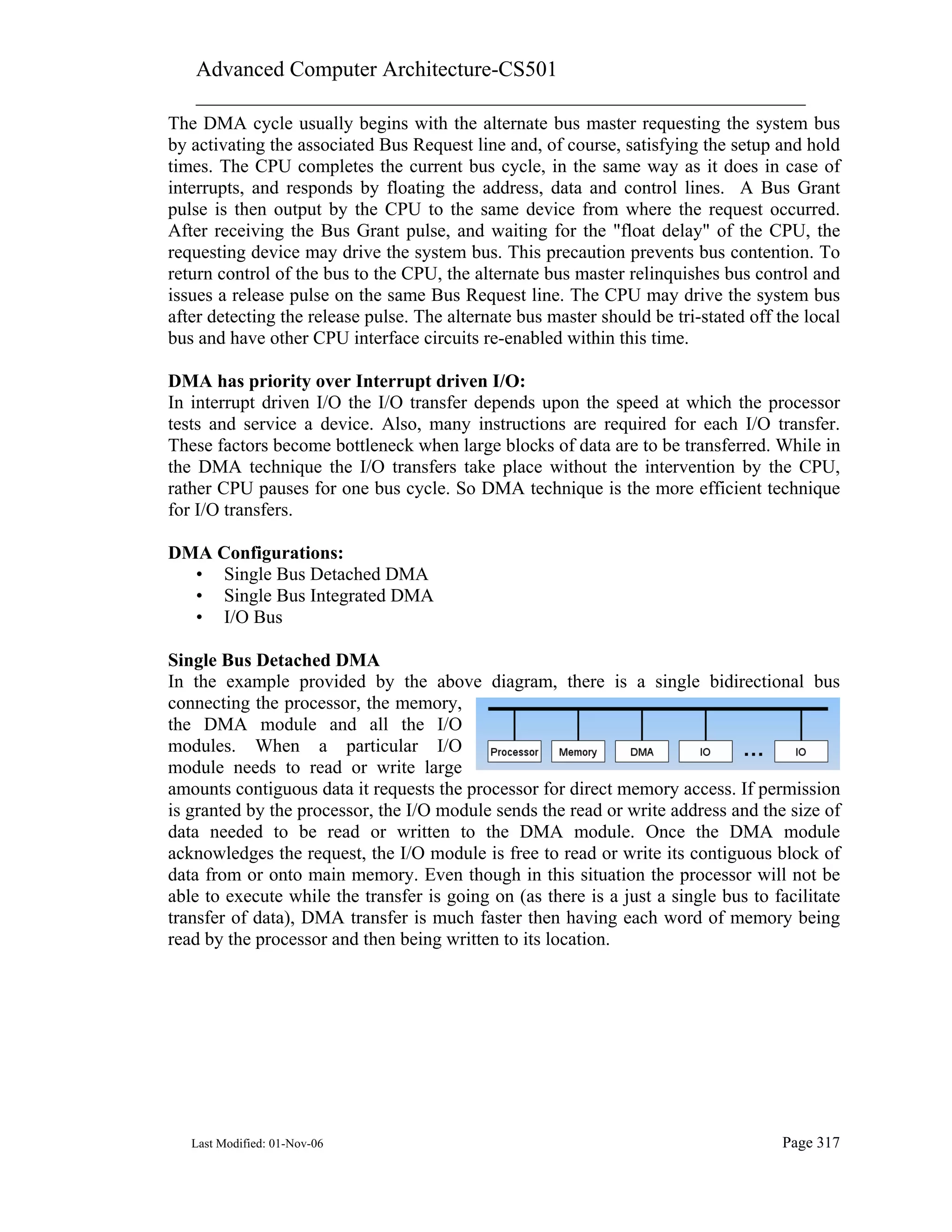
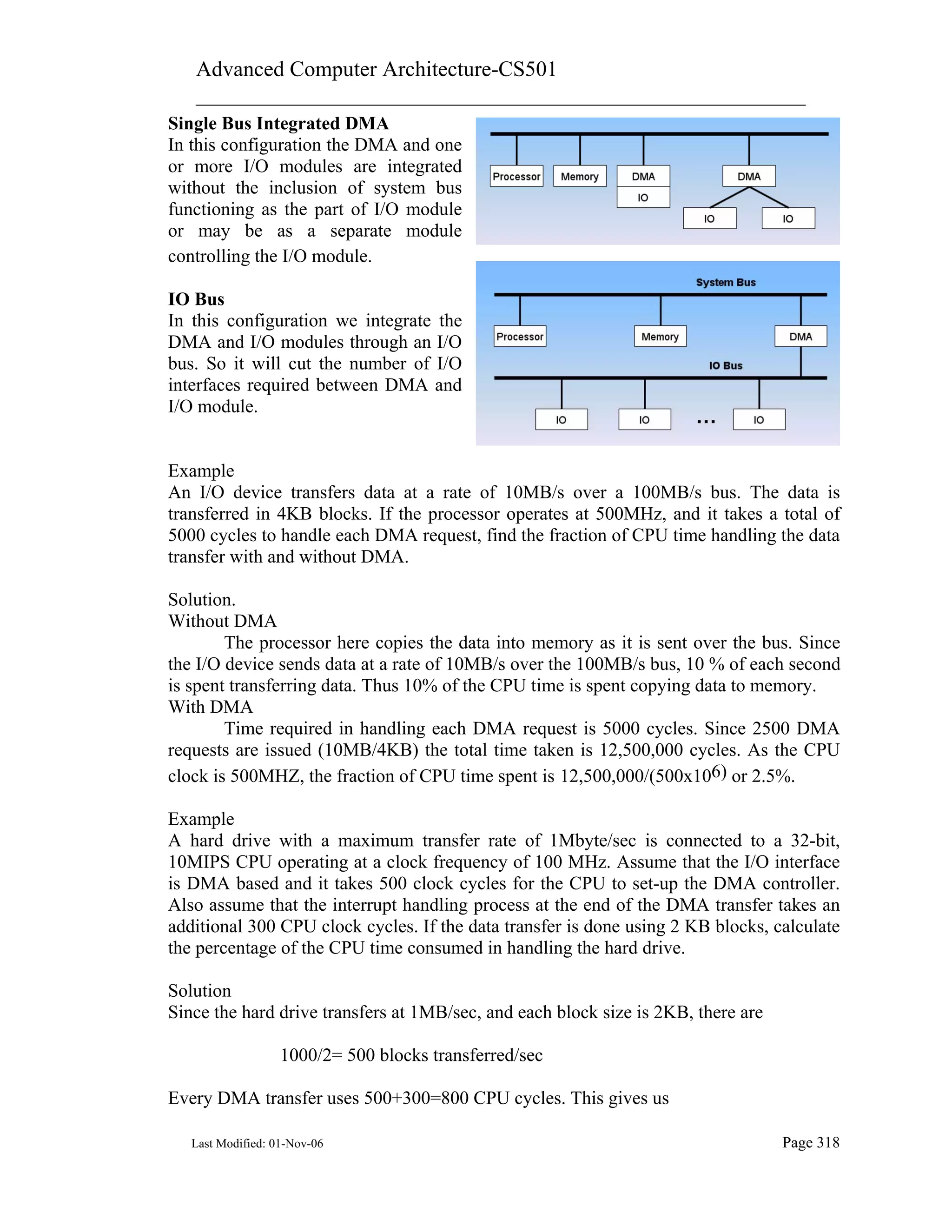
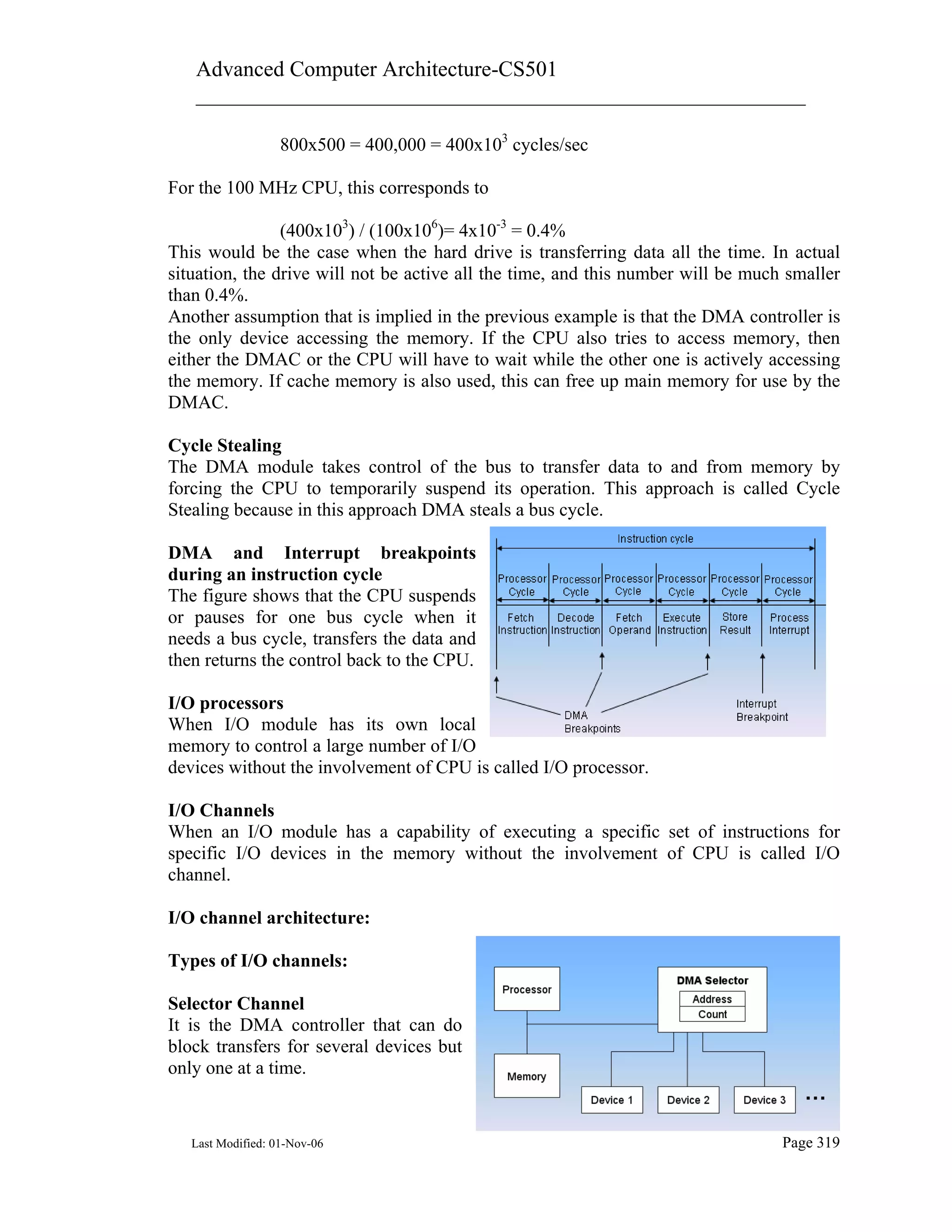
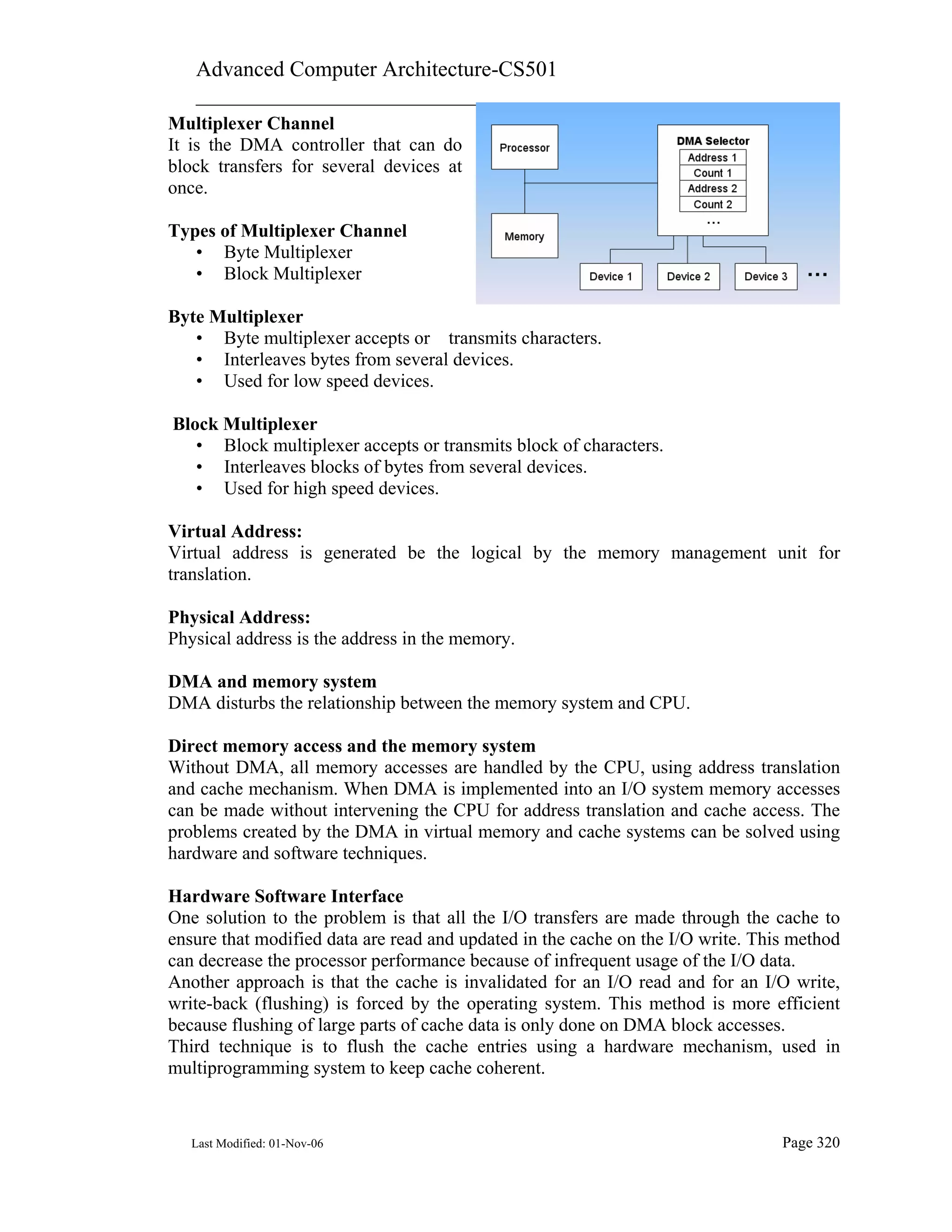

Direct Memory Access (DMA) allows peripheral devices to access memory independently of the CPU. This improves data transfer rates by bypassing the CPU and allowing the peripheral to communicate directly with memory. DMA transfers take place in three steps - the CPU initiates the transfer by providing transfer parameters to the DMA controller, the DMA controller performs the direct transfer between memory and peripheral, and an interrupt signals the CPU when the transfer is complete. DMA is useful for high-speed transfers of large blocks of data like those involving hard drives or network cards.


![DMA presentation [By- Digvijay]](https://cdn.slidesharecdn.com/ss_thumbnails/digvijay-dmapresentation-131231041837-phpapp02-thumbnail.jpg?width=640&height=640&fit=bounds)


