


CRYOTHERAPY
KEERTHI PRIYA MPT NEURO,
ASSISTANT PROFESSOR
CONTENTS
INTRODUCTION
TYPES
TECHNIQUE OF
APPLICATION
PHYSIOLOGICAL
EFFECTS
THERAPEUTIC
EFFECTS
INDICATIONS
CONTRAINDICATIONS
DANGERS
Cryotherapy refers to use of cold in acute trauma & sub acute
injury for therapeutic effects.
PRINCIPLE:
LATENT HEAT OF FUSION: Amount of energy required to
convert
1gm of ice at 0OC to 1gm of water at 37oC is 491J.
1gm of water at 0OC to 1gm of water at 37oC is 155J
INTRODUCTION
Cryo
cold/freezing.
Therapy cure
TYPES1.Local Immersion
2.Cold Packs
3.Ice Towels
4.Ice Massage
5.Cold Compression
6.Evaporating
TYPES
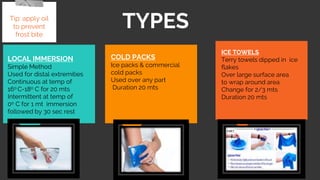
ICE TOWELS
Terry towels dipped in ice
flakes
Over large surface area
to wrap around area
Change for 2/3 mts
Duration 20 mts
LOCAL IMMERSION
Simple Method
Used for distal extremities
Continuous at temp of
16o C-18o C for 20 mts
Intermittent at temp of
0o C for 1 mt immersion
followed by 30 sec rest
COLD PACKS
Ice packs & commercial
cold packs
Used over any part
Duration 20 mts
Tip: apply oil
to prevent
frost bite
TYPES
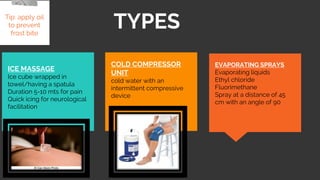
EVAPORATING SPRAYS
Evaporating liquids
Ethyl chloride
Fluorimethane
Spray at a distance of 45
cm with an angle of 90
ICE MASSAGE
Ice cube wrapped in
towel/having a spatula
Duration 5-10 mts for pain
Quick icing for neurological
facilitation
COLD COMPRESSOR
UNIT
cold water with an
intermittent compressive
device
Tip: apply oil
to prevent
frost bite
TECHNIQUE OF APPLICATION
August 2015
October 2015
Preparation of patient
Explain the procedure
to the patient.
Check for skin
sensations
Preparation of
apparatus
Select any one type
based on patients
need.
Check the temperature
Keep towels & Oil
Preparation of part
Positioning of part to be
treated.
Use pillows if elevation
is needed.
Apply oil before
treatment
TECHNIQUE OF APPLICATION
August 2015
October 2015
Instructions to patient
Patient is instructed to
inform if there is any
discomfort during
treatment
Application
Check the treatment
area.
Inspect the skin
Note down the duration
of vasoconstriction &
dilation
Termination
Application is removed
and wipe the area
PHYSIOLOGICAL EFFECTS
1. Circulatory system
2. Cell metabolism
3. Nervous System
4. Muscular System
Circulatory System
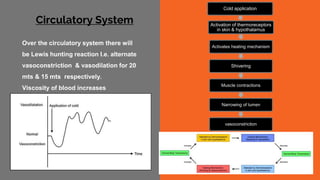
Over the circulatory system there will
be Lewis hunting reaction I.e. alternate
vasoconstriction & vasodilation for 20
mts & 15 mts respectively.
Viscosity of blood increases
Cold application
Activation of thermoreceptors
in skin & hypothalamus
Activates heating mechanism
Shivering
Muscle contractions
Narrowing of lumen
vasoconstriction
Cell Metabolism
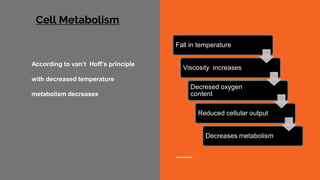
According to van’t Hoff’s principle
with decreased temperature
metabolism decreases
Fall in temperature
Viscosity increases
Decresed oxygen
content
Reduced cellular output
Decreases metabolism
Nervous System
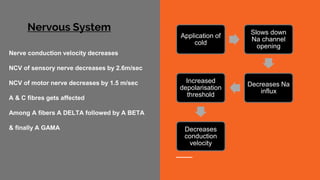
Nerve conduction velocity decreases
NCV of sensory nerve decreases by 2.6m/sec
NCV of motor nerve decreases by 1.5 m/sec
A & C fibres gets affected
Among A fibers A DELTA followed by A BETA
& finally A GAMA
Application of
cold
Slows down
Na channel
opening
Decreases Na
influx
Increased
depolarisation
threshold
Decreases
conduction
velocity
Muscular System
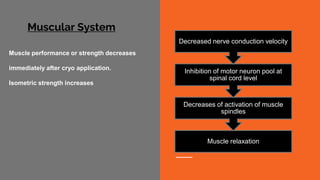
Muscle performance or strength decreases
immediately after cryo application.
Isometric strength increases
Muscle relaxation
Decreases of activation of muscle
spindles
Inhibition of motor neuron pool at
spinal cord level
Decreased nerve conduction velocity
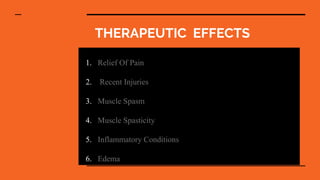
THERAPEUTIC EFFECTS
1. Relief Of Pain
2. Recent Injuries
3. Muscle Spasm
4. Muscle Spasticity
5. Inflammatory Conditions
6. Edema
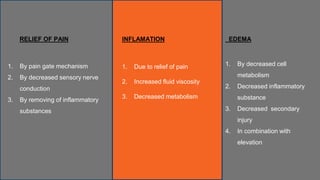
RELIEF OF PAIN
1. By pain gate mechanism
2. By decreased sensory nerve
conduction
3. By removing of inflammatory
substances
INFLAMATION
1. Due to relief of pain
2. Increased fluid viscosity
3. Decreased metabolism
EDEMA
1. By decreased cell
metabolism
2. Decreased inflammatory
substance
3. Decreased secondary
injury
4. In combination with
elevation
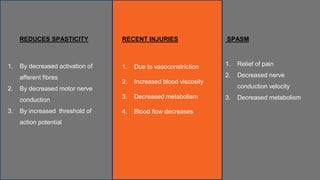
REDUCES SPASTICITY
1. By decreased activation of
afferent fibres
2. By decreased motor nerve
conduction
3. By increased threshold of
action potential
RECENT INJURIES
1. Due to vasoconstriction
2. Increased blood viscosity
3. Decreased metabolism
4. Blood flow decreases
SPASM
1. Relief of pain
2. Decreased nerve
conduction velocity
3. Decreased metabolism
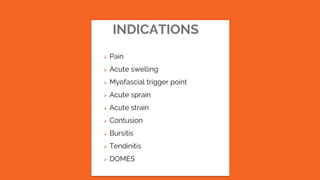
INDICATIONS
 Pain
 Acute swelling
 Myofascial trigger point
 Acute sprain
 Acute strain
 Contusion
 Bursitis
 Tendinitis
 DOMES
CONTRAINDICATIONS
&
DANGERS
 Cardiac disease
 Peripheral vascular disease
 Impaired sensation
 Cryoglobinaemia
 Cold utricaria
 Vasospasm
 uncooperated patients
REFERENCES
 PHYSICAL AGENTSTHEORY AND PRACTICE ,THIRD
EDITION, BARBARA J. BEHRENS, PTA, MS
 THERAPEUTIC FOR SPORTS MEDICINE AND ATHLETIC
TRAINING MODALITIES, SIXTH EDITION, W I L L I A M E . P
R E N T I C E
 ELECTROTHERAPY EXPLAINED, LOW & REED
 CLAYTON’S ELECTROTHERAPY THEORY & PRACTICE
? ANY QUERY
Cryotherapy

Cryotherapy

  • 1.
    CRYOTHERAPY KEERTHI PRIYA MPTNEURO, ASSISTANT PROFESSOR
  • 2.
  • 3.
    Cryotherapy refers touse of cold in acute trauma & sub acute injury for therapeutic effects. PRINCIPLE: LATENT HEAT OF FUSION: Amount of energy required to convert 1gm of ice at 0OC to 1gm of water at 37oC is 491J. 1gm of water at 0OC to 1gm of water at 37oC is 155J INTRODUCTION Cryo cold/freezing. Therapy cure
  • 4.
    TYPES1.Local Immersion 2.Cold Packs 3.IceTowels 4.Ice Massage 5.Cold Compression 6.Evaporating
  • 5.
    TYPES ICE TOWELS Terry towelsdipped in ice flakes Over large surface area to wrap around area Change for 2/3 mts Duration 20 mts LOCAL IMMERSION Simple Method Used for distal extremities Continuous at temp of 16o C-18o C for 20 mts Intermittent at temp of 0o C for 1 mt immersion followed by 30 sec rest COLD PACKS Ice packs & commercial cold packs Used over any part Duration 20 mts Tip: apply oil to prevent frost bite
  • 6.
    TYPES EVAPORATING SPRAYS Evaporating liquids Ethylchloride Fluorimethane Spray at a distance of 45 cm with an angle of 90 ICE MASSAGE Ice cube wrapped in towel/having a spatula Duration 5-10 mts for pain Quick icing for neurological facilitation COLD COMPRESSOR UNIT cold water with an intermittent compressive device Tip: apply oil to prevent frost bite
  • 7.
    TECHNIQUE OF APPLICATION August2015 October 2015 Preparation of patient Explain the procedure to the patient. Check for skin sensations Preparation of apparatus Select any one type based on patients need. Check the temperature Keep towels & Oil Preparation of part Positioning of part to be treated. Use pillows if elevation is needed. Apply oil before treatment
  • 8.
    TECHNIQUE OF APPLICATION August2015 October 2015 Instructions to patient Patient is instructed to inform if there is any discomfort during treatment Application Check the treatment area. Inspect the skin Note down the duration of vasoconstriction & dilation Termination Application is removed and wipe the area
  • 9.
    PHYSIOLOGICAL EFFECTS 1. Circulatorysystem 2. Cell metabolism 3. Nervous System 4. Muscular System
  • 10.
    Circulatory System Over thecirculatory system there will be Lewis hunting reaction I.e. alternate vasoconstriction & vasodilation for 20 mts & 15 mts respectively. Viscosity of blood increases Cold application Activation of thermoreceptors in skin & hypothalamus Activates heating mechanism Shivering Muscle contractions Narrowing of lumen vasoconstriction
  • 11.
    Cell Metabolism According tovan’t Hoff’s principle with decreased temperature metabolism decreases Fall in temperature Viscosity increases Decresed oxygen content Reduced cellular output Decreases metabolism
  • 12.
    Nervous System Nerve conductionvelocity decreases NCV of sensory nerve decreases by 2.6m/sec NCV of motor nerve decreases by 1.5 m/sec A & C fibres gets affected Among A fibers A DELTA followed by A BETA & finally A GAMA Application of cold Slows down Na channel opening Decreases Na influx Increased depolarisation threshold Decreases conduction velocity
  • 13.
    Muscular System Muscle performanceor strength decreases immediately after cryo application. Isometric strength increases Muscle relaxation Decreases of activation of muscle spindles Inhibition of motor neuron pool at spinal cord level Decreased nerve conduction velocity
  • 14.
    THERAPEUTIC EFFECTS 1. ReliefOf Pain 2. Recent Injuries 3. Muscle Spasm 4. Muscle Spasticity 5. Inflammatory Conditions 6. Edema
  • 15.
    RELIEF OF PAIN 1.By pain gate mechanism 2. By decreased sensory nerve conduction 3. By removing of inflammatory substances INFLAMATION 1. Due to relief of pain 2. Increased fluid viscosity 3. Decreased metabolism EDEMA 1. By decreased cell metabolism 2. Decreased inflammatory substance 3. Decreased secondary injury 4. In combination with elevation
  • 16.
    REDUCES SPASTICITY 1. Bydecreased activation of afferent fibres 2. By decreased motor nerve conduction 3. By increased threshold of action potential RECENT INJURIES 1. Due to vasoconstriction 2. Increased blood viscosity 3. Decreased metabolism 4. Blood flow decreases SPASM 1. Relief of pain 2. Decreased nerve conduction velocity 3. Decreased metabolism
  • 17.
    INDICATIONS  Pain  Acuteswelling  Myofascial trigger point  Acute sprain  Acute strain  Contusion  Bursitis  Tendinitis  DOMES
  • 18.
    CONTRAINDICATIONS & DANGERS  Cardiac disease Peripheral vascular disease  Impaired sensation  Cryoglobinaemia  Cold utricaria  Vasospasm  uncooperated patients
  • 19.
    REFERENCES  PHYSICAL AGENTSTHEORYAND PRACTICE ,THIRD EDITION, BARBARA J. BEHRENS, PTA, MS  THERAPEUTIC FOR SPORTS MEDICINE AND ATHLETIC TRAINING MODALITIES, SIXTH EDITION, W I L L I A M E . P R E N T I C E  ELECTROTHERAPY EXPLAINED, LOW & REED  CLAYTON’S ELECTROTHERAPY THEORY & PRACTICE
  • 20.