DR. SHWETA PANCHBUDHE
(ASSISTANT PROFESSOR)
(B.P.Th, M.P.Th) GMC
(CARDIO-RESPIRATORY SCIENCES)
Purpose statement
๏‚— At the end of the class the students will be able to,
understand the skin resistance, factors affecting the skin
resistance, methods to reduce the skin resistanceโ€ฆ..
Learning Objectives
SR.NO LEARNING
OBJECTIVES
DOMAIN LEVEL CRITERIA
1 Write down the
types of
electrode
Cognitive &
psychomotor
Must know All
2 Which are the
factors affecting
the skin
resistance?
Cognitive &
psychomotor
Must know All
3 Which are the
methods to
reduce the skin
resistance?
Cognitive &
psychomotor
Must know All
4 Cognitive &
psychomotor
KEY POINTS
๏‚— Skin Resistance
๏‚— Factors affecting Skin resistance
๏‚— Types of electrodes used
๏‚— Electrode gels
๏‚— Skin threshold
๏‚— Skin type & Skin temperature
exercises
๏‚—Methods to reduce skin resistance
SKIN AS A BARRIER
๏‚— The skin is the largest organ of human body with
an area in the adult of about 2mm it serves a
number of important roles:
๏‚— As a first line of defence against infection, very few
microorganisms can penetrate the skin and various
glands secrete antimicrobial molecules.
๏‚— To protect against water loss. The significance of
the skins role in restricting water loss is seen in
burns victims who need intravenous fluid
replacement.
๏‚— As a key element of body temperature regulation
mechanisms, heat gain and loss are controlled by blood
flow in the skin and immediate subcutaneous tissue and
also by perspiration.
๏‚— To shield deeper tissue from electromagnetic radiation
๏‚— To protect against mechanical injury of the underlying soft
tissue.
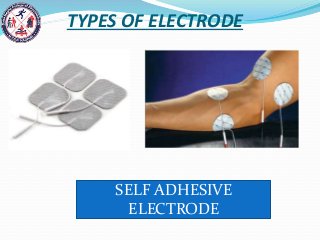
TYPES OF ELECTRODE
SELF ADHESIVE
ELECTRODE
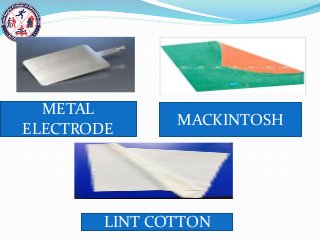
METAL
ELECTRODE
MACKINTOSH
LINT COTTON
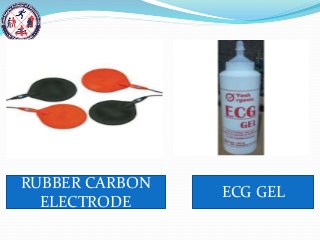
RUBBER CARBON
ELECTRODE
ECG GEL
๏‚— Mackintosh is kept under the patients treatment part to
prevent earth shock and to prevent dripping of water.
๏‚— Lint pad is made up of lint cloth is to prevent
accumulation of chemicals in the tissue formed during the
treatment.
๏‚— It must be 8 or 16 layers, more the layers less the
chance of accumulation of chemicals , less the burns.
๏‚— To stimulate more number of motor points two
different electrode covered with lint pad are used.
๏‚— If stimulation of individual muscle is required pen
electrode is used (active).
๏‚— Always to use indifferent pad proximally and active
pad distally.
๏‚— Active pad is place where electrons enter the
circuit, it is smaller than indifferent pad, it should
be placed on motor points distally.
๏‚— Indifferent pad place where electrons leave the
circuit, it is place proximally and it helps to
complete the circuit.
๏‚— Cotton is used to prevent dripping of water and for
cleaning the surface.
๏‚— Powder is used to apply over the skin if there is any
redness after treatment, Redness occur due to erythema.
๏‚— Gel is used for proper contact of electrode with the
patient surface.
๏‚— Electrode could be plate, pad or pen. Pad or plate electrode are
kept in between the lints pad for even distribution of current.
๏‚— The edges of plate electrode should be blunt, it should be
smaller than lint pad so that it cannot come in contact with skin
๏‚— Pen electrode is used for smaller muscles.
๏‚— Leads used to connect the electrode with
stimulator
๏‚— Rubber strap are used to fix the electrode.
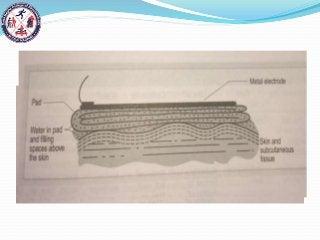
๏‚— The pad and lint covering the electrode are soaked in warm
1 percent saline.
๏‚— Tap water can be used, but the addition of salt reduces the
resistance of the wetting solution
๏‚— 1 percent saline having a rather lower resistance than the
tissue fluids.
๏‚— Electrodes should be 1cm smaller all round than the
pads to reduce the danger of coming contact with the
skin.
๏‚— And causing uncomfortable concentration of current
and damage of tissue from chemical action.
๏‚— The skin has high electrical resistance as the
superficial layer being dry contain few ion.
๏‚— The resistance is reduced by washing with soap and
water to remove natural oil & moistening with saline
immediately before the pads are applied in order to
provide ions.
๏‚— Breaks in the skin cause a marked reduction in
resistance which results in concentration of
current & discomfort to the patient.
๏‚— To avoid this broken skin is protected by a little
petroleum jelly.
SIZE OF ELECTRODE
๏‚— Electrode size is very important and has to be
considered in conjuction with the types of electrodes
available where they are to be located.
๏‚— Larger electrodes results in more comfortable
stimulation when being used for sensory stimulation,
for pain control, a greater level of stimulation is
possible with larger electrodes.
๏‚— Larger electrodes results in lower densities, when
current passes through the body the total current
at each of the two electrodes will be equal but an
important factor is that if the two electrodes are
unequal size the current density at each will be
different.
๏‚— The larger electrode is called the indifferent or
dispersive electrode and is positioned so as to
avoid direct stimulation of excitable tissue.
๏‚— Small electrodes have a higher current density
than larger and are more likely to cause pain.
๏‚— The more nerve fibres are likely to be stimulated
as more will be in the path of the current,
similarly if for pain control a larger electrode will
stimulate more cutaneous nerve fibres than a
smaller electrode.
๏‚— The effects of an applied current will be evident where the current
density, the intensity of current per unit area is highest.
๏‚— Because of current spreading the current density is highest close to
the electrode and decreases rather dramatically with distance (
inverse square law).
๏‚—
๏‚— In the fig the area show at depth is about three times
that of the electrode so the current density is about
one third.
๏‚— This means that the cutaneous sensory nerves which
are close to the electrode will be affected most readily
and the more deeply placed motor nerves less so.
๏‚— When low current density stimulation is applied to the skin
the sensory nerve which normally respond to touch,
temperature, and pressure are the first to be stimulated.
๏‚— This causes a mild tingling or tapping sensation , as the
current is increased, greater sensory stimulation is
produced and motor nerve fibres located more deeply are
recruited producing muscle contraction.
๏‚— Further increases in the current produce rather
large increases in the force of muscle contraction
as recruitment increases rapidly.
๏‚— More motor units are recruited as action potential
occur in more of the small branches of nerves in
the area where current is flowing.
๏‚— This results in both stronger and more
widespread muscle contraction, still further
increases of current will eventually cause pain
nerve fibres to be stimulated.
LOCATION OF ELECTRODE
๏‚— The third aspect is to be considered where to
locate the electrode on the skin.
๏‚— In order to stimulate a normally innervated
muscle effectively but painlessly the active
electrode is applied to the motor point.
๏‚— This is a point on the skin surface at which
maximum muscle contraction can be achieved.
๏‚— Motor points are usually close to the point where
the motor nerve enter the muscle.
๏‚— Current applied at this point at the junction of the
proximal third with the distal two third of the muscle
belly will activate large number of motor units.
๏‚— If the aim is to stimulate an innervated muscle, I t is
important to ensure the nerve supplying that muscle
is in the current path that indicates two main
options:
๏‚— -over the nerve trunk or motor point of the muscle.
๏‚— -at either end of the muscle so the nerve must be in
the current path.
๏‚— The first option is to stimulate the nerve supply
directly by placement and sizing of the electrode.
๏‚— To concentrate the current to the one area
requires using different sized electrode.
๏‚— This means the current density will be higher under the
electrode with a small surface area in contact with the
skin than under the other larger electrode.
๏‚— The area of indifferent electrode is 25cmsq and that of
active electrode is 1cmsq, the current density of
indifferent electrode will be 0.4MAcmsq while that of
active electrode will be 10MA cmsq
QUESTIONS??
๏‚— What are the types of electrode used in
electrotherapy?
๏‚— Write down factors affecting skin resistance?
REFERENCE
๏‚— LOW AND REED
๏‚— CLAYTON
Electrical skin resistance

Electrical skin resistance

  • 1.
    DR. SHWETA PANCHBUDHE (ASSISTANTPROFESSOR) (B.P.Th, M.P.Th) GMC (CARDIO-RESPIRATORY SCIENCES)
  • 2.
    Purpose statement ๏‚— Atthe end of the class the students will be able to, understand the skin resistance, factors affecting the skin resistance, methods to reduce the skin resistanceโ€ฆ..
  • 3.
    Learning Objectives SR.NO LEARNING OBJECTIVES DOMAINLEVEL CRITERIA 1 Write down the types of electrode Cognitive & psychomotor Must know All 2 Which are the factors affecting the skin resistance? Cognitive & psychomotor Must know All 3 Which are the methods to reduce the skin resistance? Cognitive & psychomotor Must know All 4 Cognitive & psychomotor
  • 4.
    KEY POINTS ๏‚— SkinResistance ๏‚— Factors affecting Skin resistance ๏‚— Types of electrodes used ๏‚— Electrode gels ๏‚— Skin threshold ๏‚— Skin type & Skin temperature exercises ๏‚—Methods to reduce skin resistance
  • 5.
    SKIN AS ABARRIER ๏‚— The skin is the largest organ of human body with an area in the adult of about 2mm it serves a number of important roles: ๏‚— As a first line of defence against infection, very few microorganisms can penetrate the skin and various glands secrete antimicrobial molecules.
  • 6.
    ๏‚— To protectagainst water loss. The significance of the skins role in restricting water loss is seen in burns victims who need intravenous fluid replacement.
  • 7.
    ๏‚— As akey element of body temperature regulation mechanisms, heat gain and loss are controlled by blood flow in the skin and immediate subcutaneous tissue and also by perspiration. ๏‚— To shield deeper tissue from electromagnetic radiation ๏‚— To protect against mechanical injury of the underlying soft tissue.
  • 8.
    TYPES OF ELECTRODE SELFADHESIVE ELECTRODE
  • 9.
  • 10.
  • 11.
    ๏‚— Mackintosh iskept under the patients treatment part to prevent earth shock and to prevent dripping of water. ๏‚— Lint pad is made up of lint cloth is to prevent accumulation of chemicals in the tissue formed during the treatment.
  • 12.
    ๏‚— It mustbe 8 or 16 layers, more the layers less the chance of accumulation of chemicals , less the burns. ๏‚— To stimulate more number of motor points two different electrode covered with lint pad are used.
  • 13.
    ๏‚— If stimulationof individual muscle is required pen electrode is used (active). ๏‚— Always to use indifferent pad proximally and active pad distally.
  • 14.
    ๏‚— Active padis place where electrons enter the circuit, it is smaller than indifferent pad, it should be placed on motor points distally. ๏‚— Indifferent pad place where electrons leave the circuit, it is place proximally and it helps to complete the circuit.
  • 15.
    ๏‚— Cotton isused to prevent dripping of water and for cleaning the surface. ๏‚— Powder is used to apply over the skin if there is any redness after treatment, Redness occur due to erythema. ๏‚— Gel is used for proper contact of electrode with the patient surface.
  • 16.
    ๏‚— Electrode couldbe plate, pad or pen. Pad or plate electrode are kept in between the lints pad for even distribution of current. ๏‚— The edges of plate electrode should be blunt, it should be smaller than lint pad so that it cannot come in contact with skin
  • 17.
    ๏‚— Pen electrodeis used for smaller muscles. ๏‚— Leads used to connect the electrode with stimulator ๏‚— Rubber strap are used to fix the electrode.
  • 18.
    ๏‚— The padand lint covering the electrode are soaked in warm 1 percent saline. ๏‚— Tap water can be used, but the addition of salt reduces the resistance of the wetting solution ๏‚— 1 percent saline having a rather lower resistance than the tissue fluids.
  • 19.
    ๏‚— Electrodes shouldbe 1cm smaller all round than the pads to reduce the danger of coming contact with the skin. ๏‚— And causing uncomfortable concentration of current and damage of tissue from chemical action.
  • 20.
    ๏‚— The skinhas high electrical resistance as the superficial layer being dry contain few ion. ๏‚— The resistance is reduced by washing with soap and water to remove natural oil & moistening with saline immediately before the pads are applied in order to provide ions.
  • 21.
    ๏‚— Breaks inthe skin cause a marked reduction in resistance which results in concentration of current & discomfort to the patient. ๏‚— To avoid this broken skin is protected by a little petroleum jelly.
  • 23.
    SIZE OF ELECTRODE ๏‚—Electrode size is very important and has to be considered in conjuction with the types of electrodes available where they are to be located. ๏‚— Larger electrodes results in more comfortable stimulation when being used for sensory stimulation, for pain control, a greater level of stimulation is possible with larger electrodes.

  • 24.

    ๏‚— Larger electrodesresults in lower densities, when current passes through the body the total current at each of the two electrodes will be equal but an important factor is that if the two electrodes are unequal size the current density at each will be different.
  • 25.
    ๏‚— The largerelectrode is called the indifferent or dispersive electrode and is positioned so as to avoid direct stimulation of excitable tissue. ๏‚— Small electrodes have a higher current density than larger and are more likely to cause pain.
  • 26.
    ๏‚— The morenerve fibres are likely to be stimulated as more will be in the path of the current, similarly if for pain control a larger electrode will stimulate more cutaneous nerve fibres than a smaller electrode.
  • 27.
    ๏‚— The effectsof an applied current will be evident where the current density, the intensity of current per unit area is highest. ๏‚— Because of current spreading the current density is highest close to the electrode and decreases rather dramatically with distance ( inverse square law). ๏‚—
  • 28.
    ๏‚— In thefig the area show at depth is about three times that of the electrode so the current density is about one third. ๏‚— This means that the cutaneous sensory nerves which are close to the electrode will be affected most readily and the more deeply placed motor nerves less so.
  • 29.
    ๏‚— When lowcurrent density stimulation is applied to the skin the sensory nerve which normally respond to touch, temperature, and pressure are the first to be stimulated. ๏‚— This causes a mild tingling or tapping sensation , as the current is increased, greater sensory stimulation is produced and motor nerve fibres located more deeply are recruited producing muscle contraction.
  • 30.
    ๏‚— Further increasesin the current produce rather large increases in the force of muscle contraction as recruitment increases rapidly. ๏‚— More motor units are recruited as action potential occur in more of the small branches of nerves in the area where current is flowing.
  • 31.
    ๏‚— This resultsin both stronger and more widespread muscle contraction, still further increases of current will eventually cause pain nerve fibres to be stimulated.
  • 32.
    LOCATION OF ELECTRODE ๏‚—The third aspect is to be considered where to locate the electrode on the skin. ๏‚— In order to stimulate a normally innervated muscle effectively but painlessly the active electrode is applied to the motor point.
  • 33.
    ๏‚— This isa point on the skin surface at which maximum muscle contraction can be achieved. ๏‚— Motor points are usually close to the point where the motor nerve enter the muscle.
  • 34.
    ๏‚— Current appliedat this point at the junction of the proximal third with the distal two third of the muscle belly will activate large number of motor units. ๏‚— If the aim is to stimulate an innervated muscle, I t is important to ensure the nerve supplying that muscle is in the current path that indicates two main options: ๏‚— -over the nerve trunk or motor point of the muscle. ๏‚— -at either end of the muscle so the nerve must be in the current path.
  • 35.
    ๏‚— The firstoption is to stimulate the nerve supply directly by placement and sizing of the electrode. ๏‚— To concentrate the current to the one area requires using different sized electrode.
  • 36.
    ๏‚— This meansthe current density will be higher under the electrode with a small surface area in contact with the skin than under the other larger electrode. ๏‚— The area of indifferent electrode is 25cmsq and that of active electrode is 1cmsq, the current density of indifferent electrode will be 0.4MAcmsq while that of active electrode will be 10MA cmsq
  • 37.
    QUESTIONS?? ๏‚— What arethe types of electrode used in electrotherapy? ๏‚— Write down factors affecting skin resistance?
  • 38.
    REFERENCE ๏‚— LOW ANDREED ๏‚— CLAYTON