CRYOGENIC ROCKET ENGINE
By
Manikandan S
 It is the study of production and behavior of materials at
low temperature
 In rockets fuel are in the form of compressed gas , if prope
llants had been stored as pressurized gas , the size and mass of f
uel tanks themselves would severely decrease rocket efficien
cy. Therefore, to get the required mass flow rate, the only optio
n was to cool the propellants down to cryo-genic temperatures
(below −183 °C [90 K], −253 °C [20 K]), converting them to li
quid form.
Cryogenics ⇛ Here it is derived form a Greek word meaning production
at low temperature
Cryogenic Fuel: LH2-LOX
 Various cryogenic fuel oxidizer combination has been developed (like Liquid Helium,
Liquid natural gas, Liquid methane) and tried but Liquid hydrogen and liquid oxygen is
most widely used in the world because this combination is one of the best and highly
efficient combination than others
 Countries which are successfully developed this combination are shown below
Engine used Engine used
USA J-2 Russia KVD-1
France Vinci India CE-20
China YF-77 Japan LE-5
Rocket Engines with Helium Oxygen Oxidizer
J-2 (Rocketdyne)
It was a liquid fuel cryogenic engine which
was Suggested by silverstein committee in the
year of 1959 and occurred in the Saturn IB an
d Saturn V program in the year of 1960 a
nd it has two upgrades J-2S with nozzle chan
ge and J-2T with aerospike afterwards Apollo
program it was dropped
KVD-1
It is also a liquid fuel cryogenic
engine which was developed by Isayev
Design Bureau in Russia it was used
in Russia’s moon mission it’s first flight
was on 20-04-2001 and last flight on
25-12-2010 it is a developed version of
FD-56
Vinci
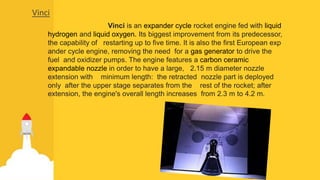
Vinci is an expander cycle rocket engine fed with liquid
hydrogen and liquid oxygen. Its biggest improvement from its predecessor,
the capability of restarting up to five time. It is also the first European exp
ander cycle engine, removing the need for a gas generator to drive the
fuel and oxidizer pumps. The engine features a carbon ceramic
expandable nozzle in order to have a large, 2.15 m diameter nozzle
extension with minimum length: the retracted nozzle part is deployed
only after the upper stage separates from the rest of the rocket; after
extension, the engine's overall length increases from 2.3 m to 4.2 m.
CE-20
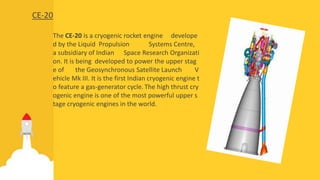
The CE-20 is a cryogenic rocket engine develope
d by the Liquid Propulsion Systems Centre,
a subsidiary of Indian Space Research Organizati
on. It is being developed to power the upper stag
e of the Geosynchronous Satellite Launch V
ehicle Mk III. It is the first Indian cryogenic engine t
o feature a gas-generator cycle. The high thrust cry
ogenic engine is one of the most powerful upper s
tage cryogenic engines in the world.
Advantages of cryogenic engine
 High Energy per unit mass: Propellants like oxygen and hydrogen i
n liquid form give very high amounts of energy per unit mass due to whic
h the amount of fuel to be carried aboard the rockets decreases.
 Cryogenic rocket engines are much efficient than solid propellant based e
ngines. They can deliver more thrust for a given mass of propellant.
 The cryogenics are also essential requirements for the manned space
flight
Thank you

Cryogenic rocket engine

  • 1.
  • 2.
     It isthe study of production and behavior of materials at low temperature  In rockets fuel are in the form of compressed gas , if prope llants had been stored as pressurized gas , the size and mass of f uel tanks themselves would severely decrease rocket efficien cy. Therefore, to get the required mass flow rate, the only optio n was to cool the propellants down to cryo-genic temperatures (below −183 °C [90 K], −253 °C [20 K]), converting them to li quid form. Cryogenics ⇛ Here it is derived form a Greek word meaning production at low temperature
  • 3.
    Cryogenic Fuel: LH2-LOX Various cryogenic fuel oxidizer combination has been developed (like Liquid Helium, Liquid natural gas, Liquid methane) and tried but Liquid hydrogen and liquid oxygen is most widely used in the world because this combination is one of the best and highly efficient combination than others  Countries which are successfully developed this combination are shown below Engine used Engine used USA J-2 Russia KVD-1 France Vinci India CE-20 China YF-77 Japan LE-5
  • 4.
    Rocket Engines withHelium Oxygen Oxidizer J-2 (Rocketdyne) It was a liquid fuel cryogenic engine which was Suggested by silverstein committee in the year of 1959 and occurred in the Saturn IB an d Saturn V program in the year of 1960 a nd it has two upgrades J-2S with nozzle chan ge and J-2T with aerospike afterwards Apollo program it was dropped
  • 5.
    KVD-1 It is alsoa liquid fuel cryogenic engine which was developed by Isayev Design Bureau in Russia it was used in Russia’s moon mission it’s first flight was on 20-04-2001 and last flight on 25-12-2010 it is a developed version of FD-56
  • 6.
    Vinci Vinci is anexpander cycle rocket engine fed with liquid hydrogen and liquid oxygen. Its biggest improvement from its predecessor, the capability of restarting up to five time. It is also the first European exp ander cycle engine, removing the need for a gas generator to drive the fuel and oxidizer pumps. The engine features a carbon ceramic expandable nozzle in order to have a large, 2.15 m diameter nozzle extension with minimum length: the retracted nozzle part is deployed only after the upper stage separates from the rest of the rocket; after extension, the engine's overall length increases from 2.3 m to 4.2 m.
  • 7.
    CE-20 The CE-20 isa cryogenic rocket engine develope d by the Liquid Propulsion Systems Centre, a subsidiary of Indian Space Research Organizati on. It is being developed to power the upper stag e of the Geosynchronous Satellite Launch V ehicle Mk III. It is the first Indian cryogenic engine t o feature a gas-generator cycle. The high thrust cry ogenic engine is one of the most powerful upper s tage cryogenic engines in the world.
  • 8.
    Advantages of cryogenicengine  High Energy per unit mass: Propellants like oxygen and hydrogen i n liquid form give very high amounts of energy per unit mass due to whic h the amount of fuel to be carried aboard the rockets decreases.  Cryogenic rocket engines are much efficient than solid propellant based e ngines. They can deliver more thrust for a given mass of propellant.  The cryogenics are also essential requirements for the manned space flight
  • 9.