CRT Display Devices
 DVST (Direct View Storage Tube)
 Random Scan Display System
 Raster Scan Display System
DVST
• Storage Tube –It is a CRT with a long persistence
phosphor
• Provides flicker free display
• No refreshing necessary
• A slow moving electron beam draws a line on the
screen
• Screen has a storage mesh in which the phosphor is
embedded
• Image is stored has a distribution of charges on the
inside surface of the screen
• Limited interactive support
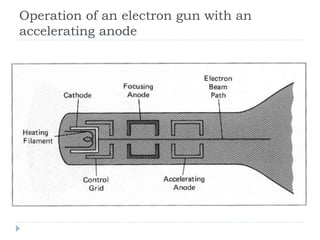
Operation of an electron gun with an
accelerating anode
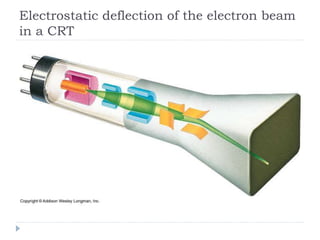
Electrostatic deflection of the electron beam
in a CRT
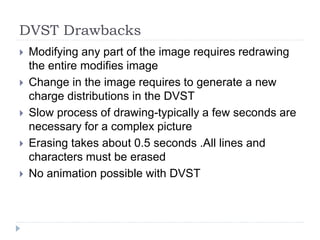
DVST Drawbacks
 Modifying any part of the image requires redrawing
the entire modifies image
 Change in the image requires to generate a new
charge distributions in the DVST
 Slow process of drawing-typically a few seconds are
necessary for a complex picture
 Erasing takes about 0.5 seconds .All lines and
characters must be erased
 No animation possible with DVST
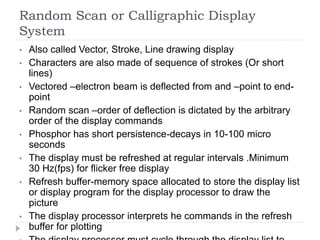
Random Scan or Calligraphic Display
System
• Also called Vector, Stroke, Line drawing display
• Characters are also made of sequence of strokes (Or short
lines)
• Vectored –electron beam is deflected from and –point to end-
point
• Random scan –order of deflection is dictated by the arbitrary
order of the display commands
• Phosphor has short persistence-decays in 10-100 micro
seconds
• The display must be refreshed at regular intervals .Minimum
30 Hz(fps) for flicker free display
• Refresh buffer-memory space allocated to store the display list
or display program for the display processor to draw the
picture
• The display processor interprets he commands in the refresh
buffer for plotting
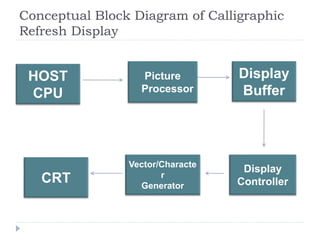
Conceptual Block Diagram of Calligraphic
Refresh Display
Picture
Processor
HOST
CPU
Display
Buffer
Display
Controller
Vector/Characte
r
Generator
CRT
• The display processor sends digital and point
coordinates to a vector generator
• The vector generator converts the digital coordinates
to analog voltages for the beam deflection circuits
• The beam deflection ciruits desplace the electron
beam for writing on the CRT’s phosphor coating
• Recommended refresh rate is 40-50 Hz.
• Scope of animation with segmentation mixture of
static and dynamic parts of a picture
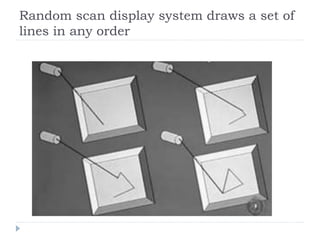
Random scan display system draws a set of
lines in any order
 Phosphor's Fluorescence is the light emitted as
electrons lose their excess energy while the
phosphor is being struck by electrons
 Phosphorescence is the light given off by the return
of the relatively more stable excited electrons to
their unexcited state once the electron beam
excitation is removed
 phosphor's persistence is defined as the time from
the removal of excitation to the moment when
phosphorescence has decayed to 10% of the initial
light output
Refresh and Raster Scan display System
 Used in TV screens
 Unlike DVST and Calligraphic display which wee line
drawing , these are point-plotting
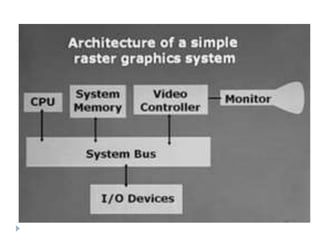
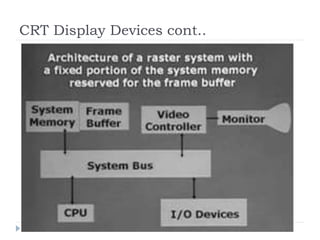
 Raster displays store the display primitives in a
refresh buffer
 Refresh (Frame) buffer stores the drawing primitives
in terms of points and pixel components
CRT Display Devices cont..
CRT Display Devices Cont..
Refresh and Raster Scan Display
Systems..
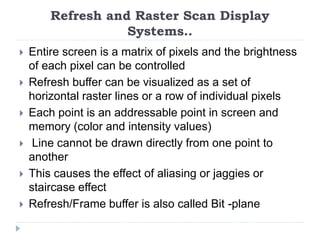
 Entire screen is a matrix of pixels and the brightness
of each pixel can be controlled
 Refresh buffer can be visualized as a set of
horizontal raster lines or a row of individual pixels
 Each point is an addressable point in screen and
memory (color and intensity values)
 Line cannot be drawn directly from one point to
another
 This causes the effect of aliasing or jaggies or
staircase effect
 Refresh/Frame buffer is also called Bit -plane
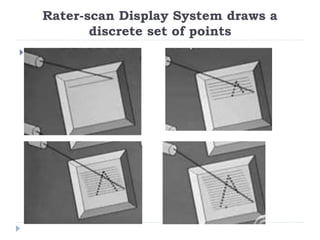
Rater-scan Display System draws a
discrete set of points

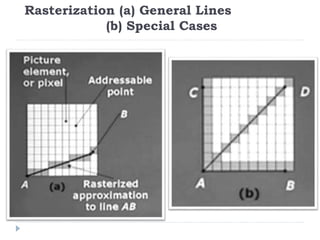
Rasterization (a) General Lines
(b) Special Cases
Refresh Rate, Video Basics and Scan
Conversion
 Entire image is scanned out sequentially by the
video controller (one raster line at a time)
 The raster lines are scanned from top to bottom and
then back to the top
 At least one memory bit for each pixel called bit-
plane
Crt display devices
Crt display devices

Crt display devices

  • 1.
    CRT Display Devices DVST (Direct View Storage Tube)  Random Scan Display System  Raster Scan Display System
  • 2.
    DVST • Storage Tube–It is a CRT with a long persistence phosphor • Provides flicker free display • No refreshing necessary • A slow moving electron beam draws a line on the screen • Screen has a storage mesh in which the phosphor is embedded • Image is stored has a distribution of charges on the inside surface of the screen • Limited interactive support
  • 3.
    Operation of anelectron gun with an accelerating anode
  • 4.
    Electrostatic deflection ofthe electron beam in a CRT
  • 5.
    DVST Drawbacks  Modifyingany part of the image requires redrawing the entire modifies image  Change in the image requires to generate a new charge distributions in the DVST  Slow process of drawing-typically a few seconds are necessary for a complex picture  Erasing takes about 0.5 seconds .All lines and characters must be erased  No animation possible with DVST
  • 6.
    Random Scan orCalligraphic Display System • Also called Vector, Stroke, Line drawing display • Characters are also made of sequence of strokes (Or short lines) • Vectored –electron beam is deflected from and –point to end- point • Random scan –order of deflection is dictated by the arbitrary order of the display commands • Phosphor has short persistence-decays in 10-100 micro seconds • The display must be refreshed at regular intervals .Minimum 30 Hz(fps) for flicker free display • Refresh buffer-memory space allocated to store the display list or display program for the display processor to draw the picture • The display processor interprets he commands in the refresh buffer for plotting
  • 7.
    Conceptual Block Diagramof Calligraphic Refresh Display Picture Processor HOST CPU Display Buffer Display Controller Vector/Characte r Generator CRT
  • 8.
    • The displayprocessor sends digital and point coordinates to a vector generator • The vector generator converts the digital coordinates to analog voltages for the beam deflection circuits • The beam deflection ciruits desplace the electron beam for writing on the CRT’s phosphor coating • Recommended refresh rate is 40-50 Hz. • Scope of animation with segmentation mixture of static and dynamic parts of a picture
  • 9.
    Random scan displaysystem draws a set of lines in any order
  • 10.
     Phosphor's Fluorescenceis the light emitted as electrons lose their excess energy while the phosphor is being struck by electrons  Phosphorescence is the light given off by the return of the relatively more stable excited electrons to their unexcited state once the electron beam excitation is removed  phosphor's persistence is defined as the time from the removal of excitation to the moment when phosphorescence has decayed to 10% of the initial light output
  • 11.
    Refresh and RasterScan display System  Used in TV screens  Unlike DVST and Calligraphic display which wee line drawing , these are point-plotting  Raster displays store the display primitives in a refresh buffer  Refresh (Frame) buffer stores the drawing primitives in terms of points and pixel components
  • 13.
  • 14.
  • 15.
    Refresh and RasterScan Display Systems..  Entire screen is a matrix of pixels and the brightness of each pixel can be controlled  Refresh buffer can be visualized as a set of horizontal raster lines or a row of individual pixels  Each point is an addressable point in screen and memory (color and intensity values)  Line cannot be drawn directly from one point to another  This causes the effect of aliasing or jaggies or staircase effect  Refresh/Frame buffer is also called Bit -plane
  • 16.
    Rater-scan Display Systemdraws a discrete set of points 
  • 17.
    Rasterization (a) GeneralLines (b) Special Cases
  • 18.
    Refresh Rate, VideoBasics and Scan Conversion  Entire image is scanned out sequentially by the video controller (one raster line at a time)  The raster lines are scanned from top to bottom and then back to the top  At least one memory bit for each pixel called bit- plane