1 
The Evolution of CRM
2 
Is CRM really a new concept? 
 Relationship with the customer has existed since 
the advent of trade and business. 
 Barter Age 
Customized product Age 
Mass Production Age 
Customer: Purchaser of goods/Service and not necessarily the one 
consuming them, e.g. dealer / retailer/ wholesaler 
Consumer: One who utilizes the goods/services to fulfill his need 
Customization Age 
.
3 
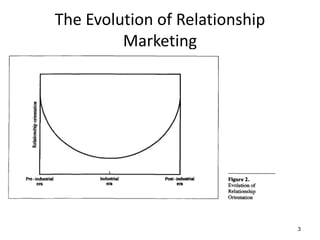
The Evolution of Relationship 
Marketing
4 
The Evolution of Relationship Marketing 
Pre-Industrial Era: 
 practiced by merchant and traders. 
 business was build on trust. 
 interactions transcended the commercial 
transaction and involved social interaction 
 relationship exists in pre-industrial 
market(traditional, small).
5 
Industrial era 
Mass production, mass distribution and mass 
communication 
Intermediaries took on the responsibilities of 
warehousing, transportation, distribution and 
final sale to the customer. 
Greater efficiencies' and lower cost. 
Reduced direct contacts and negative impact 
on the relationship.
6 
information era 
JAGDISH SETH and ATUL PARVATIYAR has identified the 
following factors for this shift in orientation: 
 Advances in technology 
 Intensive competition 
 Growing importance of service sector 
 Adoption of TQM programs

Evolution of crm

  • 1.
  • 2.
    2 Is CRMreally a new concept?  Relationship with the customer has existed since the advent of trade and business.  Barter Age Customized product Age Mass Production Age Customer: Purchaser of goods/Service and not necessarily the one consuming them, e.g. dealer / retailer/ wholesaler Consumer: One who utilizes the goods/services to fulfill his need Customization Age .
  • 3.
    3 The Evolutionof Relationship Marketing
  • 4.
    4 The Evolutionof Relationship Marketing Pre-Industrial Era:  practiced by merchant and traders.  business was build on trust.  interactions transcended the commercial transaction and involved social interaction  relationship exists in pre-industrial market(traditional, small).
  • 5.
    5 Industrial era Mass production, mass distribution and mass communication Intermediaries took on the responsibilities of warehousing, transportation, distribution and final sale to the customer. Greater efficiencies' and lower cost. Reduced direct contacts and negative impact on the relationship.
  • 6.
    6 information era JAGDISH SETH and ATUL PARVATIYAR has identified the following factors for this shift in orientation:  Advances in technology  Intensive competition  Growing importance of service sector  Adoption of TQM programs

Editor's Notes

  • #5 Merchants and traders have been practicing CRM for centuries. Their business was build on trust. They could customise the products, paid personal attention to customers, knew details regarding their customers tastes and preferences an had personal rapport with most of them Industrial era: : The industrial revolution changed the relationship orientation practices. Manufacturers focused on manufacturing and efficient operations to cut cost. Intermediaries like distributors, whole sales and retailers took on the responsibilities of warehousing, transportation, distribution and sale to the final customers.