My Reflection Process using Gibbs model
                 Barbara Nicolls
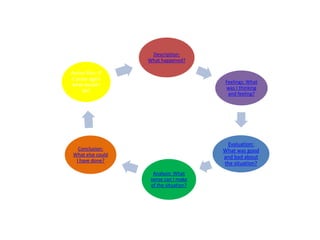
Description:
                   What happened?

Action Plan: If
it arose again
                                        Feelings: What
what would I
                                        was I thinking
      do?
                                         and feeling?


                                         Evaluation:
   Conclusion:                          What was good
 What else could                        and bad about
  I have done?
                                        the situation?
                     Analysis: What
                    sense can I make
                    of the situation?
What happened?
As participants of Reflect and Connect, we were required to evaluate a Web
2.0 Tool for its usefulness to our own personal development and to those we
teach.

We in Team A agreed to evaluate Twitter which was the tool that most of us
were curious about. The session booklet also suggested that we “Start with
Twitter”! And we did. By the way Twitter is the most used social networking
tool this decade and is fast becoming the tool of choice for keeping up-to-date
with people in my personal learning networks.
Feelings: What was I thinking and feeling?

Why use Twitter my professional development? As far as I know Twitter is
used by teenagers to send messages to their friends about the minutiae of
their lives. We professionals find it difficult to find the time for this let alone
keeping up with our normal work! Is it another of those tech things I learn to
use by myself as my colleagues will frown on me for introducing yet another
new tool!

Nevertheless, I was eager to learn from my team and share our experiences. I
looked forward to completing the task through Twitter sending messages
@..... Followed by #reflectandconnect. I was confident that he moderators
and Carole were experts in the field and that they wouldn’t have suggested
Twitter if they hadn’t discovered the positive contributions of Twitter to our
professional development.
Evaluation: What was good and bad about
the situation?
In addition to tweeting with Team A using our newly
created #rcteama. No one dominated the scene but
everyone pooled the knowledge and experience they had
with Twitter and shared with all of us. We started
following one another and from internal followers we
extended externally and found CoPs working on common
themes such as PDP, CDP, Action Research etc. I also
discovered Tweetdeck and have installed it on my desktop.

Sometimes people could get carried away learning new
stuff and at one point there was so much information –
people sending information and links about everything. I
still haven’t finished looking at them Hope I am not missing
out on anything valuable.
Analysis: What sense can I make of the situation?
Twitter is useful for creating a PLN as I can use the Find People icon
and type in their Twitter identity to locate them. The I click on their
Twitter page and click the Follow icon.

If I don't know their Twitter identity, I can Find on Other Networks
or Invite by Email. This way I can be come one of the large number of
educationalists across the world who now switch on to Twitter to keep
abreast of what's happening, who's doing what, and where to go for
educational news as it happens. This type of social networking
enables a 'viral' like spread of news, faster than ever, creating
 a 'learning community' of its own.
Conclusion: What else could I have done?

Perhaps I could have made an effort to meet my team on Elluminate.

to discuss some of the points that have passed over my head.

For example, find out Tweets to glossy ebook...create PDF
http://bit.ly/ok7Xt then ebook
http://bit.ly/gkHdqQ#vicpln #reflect and connect
6 hours agoFavoriteRetweetReply

        I could also learn to manage the information overload by
        filtering out and selecting the bits that would be useful and
         helpful to my learning.
Action Plan: If it arose again what would I do?


1. Be clear about the task
2. Be clear about what you wish to get out of
   the task
3. Focus on the process of achieving it
4. Try and build in a dialogue in order to
   ensure that
    everyone gets what they
    expect to get out of the task

My reflection process

  • 1.
    My Reflection Processusing Gibbs model Barbara Nicolls
  • 2.
    Description: What happened? Action Plan: If it arose again Feelings: What what would I was I thinking do? and feeling? Evaluation: Conclusion: What was good What else could and bad about I have done? the situation? Analysis: What sense can I make of the situation?
  • 3.
    What happened? As participantsof Reflect and Connect, we were required to evaluate a Web 2.0 Tool for its usefulness to our own personal development and to those we teach. We in Team A agreed to evaluate Twitter which was the tool that most of us were curious about. The session booklet also suggested that we “Start with Twitter”! And we did. By the way Twitter is the most used social networking tool this decade and is fast becoming the tool of choice for keeping up-to-date with people in my personal learning networks.
  • 4.
    Feelings: What wasI thinking and feeling? Why use Twitter my professional development? As far as I know Twitter is used by teenagers to send messages to their friends about the minutiae of their lives. We professionals find it difficult to find the time for this let alone keeping up with our normal work! Is it another of those tech things I learn to use by myself as my colleagues will frown on me for introducing yet another new tool! Nevertheless, I was eager to learn from my team and share our experiences. I looked forward to completing the task through Twitter sending messages @..... Followed by #reflectandconnect. I was confident that he moderators and Carole were experts in the field and that they wouldn’t have suggested Twitter if they hadn’t discovered the positive contributions of Twitter to our professional development.
  • 5.
    Evaluation: What wasgood and bad about the situation? In addition to tweeting with Team A using our newly created #rcteama. No one dominated the scene but everyone pooled the knowledge and experience they had with Twitter and shared with all of us. We started following one another and from internal followers we extended externally and found CoPs working on common themes such as PDP, CDP, Action Research etc. I also discovered Tweetdeck and have installed it on my desktop. Sometimes people could get carried away learning new stuff and at one point there was so much information – people sending information and links about everything. I still haven’t finished looking at them Hope I am not missing out on anything valuable.
  • 6.
    Analysis: What sensecan I make of the situation? Twitter is useful for creating a PLN as I can use the Find People icon and type in their Twitter identity to locate them. The I click on their Twitter page and click the Follow icon. If I don't know their Twitter identity, I can Find on Other Networks or Invite by Email. This way I can be come one of the large number of educationalists across the world who now switch on to Twitter to keep abreast of what's happening, who's doing what, and where to go for educational news as it happens. This type of social networking enables a 'viral' like spread of news, faster than ever, creating a 'learning community' of its own.
  • 7.
    Conclusion: What elsecould I have done? Perhaps I could have made an effort to meet my team on Elluminate. to discuss some of the points that have passed over my head. For example, find out Tweets to glossy ebook...create PDF http://bit.ly/ok7Xt then ebook http://bit.ly/gkHdqQ#vicpln #reflect and connect 6 hours agoFavoriteRetweetReply I could also learn to manage the information overload by filtering out and selecting the bits that would be useful and helpful to my learning.
  • 8.
    Action Plan: Ifit arose again what would I do? 1. Be clear about the task 2. Be clear about what you wish to get out of the task 3. Focus on the process of achieving it 4. Try and build in a dialogue in order to ensure that everyone gets what they expect to get out of the task