THE MISSING LINK
Librarians and the Teaching Identity

Sarah Faye Cohen
Champlain College, Burlington, Vermont
• Why focus on developing
Session
Goals                       the teaching identity?
What are we here to talk
about today?               • How can we cultivate the
                            teaching identity?
                           • What are   obstacles to
                            cultivating the teaching
                            identity, said and unsaid?
                           • What are the   results of this
                            work?
Why focus on developing
the teaching identity?
In two parts.
1. Professionally and logistically
• Combats burnout and
  isolation.
• Improves effectiveness
  in the classroom.
• Facilitates
  collaboration and
  “groupthink” for more
  diversity of ideas.


                           http://www.flickr.com/photos/catheroo/1474795920
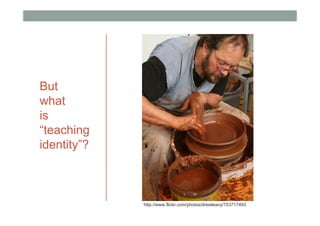
But
what
is
“teaching
identity”?


             http://www.flickr.com/photos/drewleavy/753717493
“We rarely talk with each other about
teaching at any depth—and why should we
when we have nothing more than ‘tips,
tricks, and techniques’ to discuss? That kind
of talk fails to touch the heart of the teacher’s
experience.”
                        (The Courage to Teach, 13)
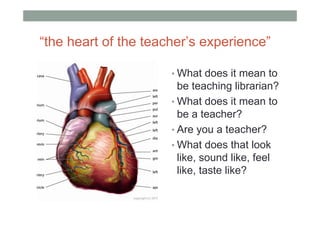
“the heart of the teacher’s experience”

                      • What does it mean to
                        be teaching librarian?
                      • What does it mean to
                        be a teacher?
                      • Are you a teacher?
                      • What does that look
                        like, sound like, feel
                        like, taste like?
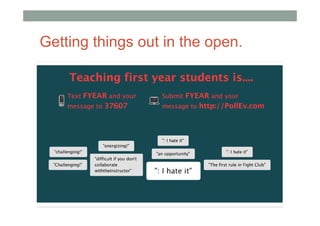
Getting things out in the open.
Exposing the truth behind our
challenges


http://collegeteachingtips.com/wp-
content/uploads/2011/01/PonderingInstructor.jpg
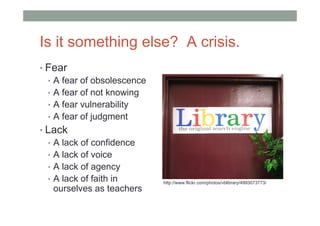
Is it something else? A crisis.
• Fear
  • A fear of obsolescence
  • A fear of not knowing
  • A fear vulnerability
  • A fear of judgment
• Lack
  • A lack of confidence
  • A lack of voice
  • A lack of agency
  • A lack of faith in       http://www.flickr.com/photos/vblibrary/4993073773/
    ourselves as teachers
A clean start to a difficult topic.


http://www.flickr.com/photos/phipag/6839447970
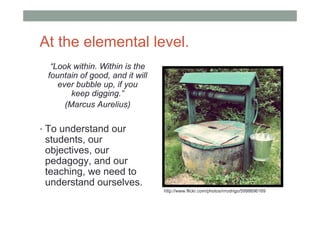
At the elemental level.
  “Look within. Within is the
 fountain of good, and it will
    ever bubble up, if you
        keep digging.”
      (Marcus Aurelius)

• To understand our
 students, our
 objectives, our
 pedagogy, and our
 teaching, we need to
 understand ourselves.
                                 http://www.flickr.com/photos/rrrodrigo/5998696169
HOW DO WE DO THAT?
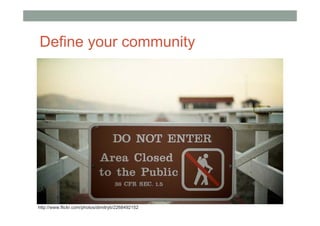
Define your community


http://www.flickr.com/photos/dimitryb/2268492152
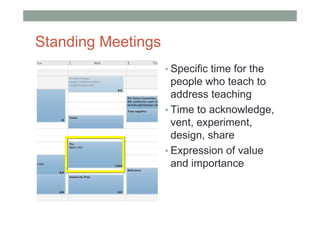
Standing Meetings
                    • Specific time for the
                      people who teach to
                      address teaching
                    • Time to acknowledge,
                      vent, experiment,
                      design, share
                    • Expression of value
                      and importance
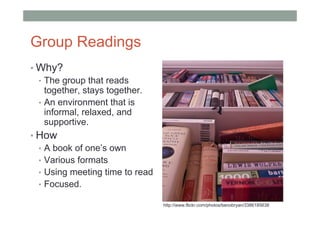
Group Readings
• Why?
  • The group that reads
    together, stays together.
  • An environment that is
    informal, relaxed, and
    supportive.
• How
  • A book of one’s own
  • Various formats
  • Using meeting time to read
  • Focused.

                                 http://www.flickr.com/photos/benobryan/3386185638
What to read:
• Pieces that address our
 challenges, not reinforce
 our expertise.
 • Exploring yourself as a
   teacher: The Courage to
   Teach
 • Who are today’s students?
   Born Digital
 • Helping students to “get it”
   Made to Stick
 • Unplugging: Hamlet’s
   Blackberry                     http://www.flickr.com/photos/anna/199723292
Developing a Teaching Philosophy
                                                 • Motivation.
                                                   • What is your “modus
                                                     operandi” for being in the
                                                     classroom?
                                                 • Vision for the
                                                   classroom and
                                                   teaching experience.
                                                 • A focus on you, not the
                                                   students.

http://www.flickr.com/photos/apc33/2445600596/
Debrief sessions
• Designing sessions are
  a process, not a product.
• Before
  • What is our “CI” and our
    “takeaway”?
  • What learning styles are
    we addressing?
  • What problems can we
    anticipate?
• After
  • What worked? What
    didn’t?
  • What will I do differently?
  • What will I do again?
                                  http://www.flickr.com/photos/johnji/6907148829
Peer to Peer Observations

• An opportunity to learn
 about the physical
 • Non-verbal
   communication
 • Intonation
• Back of the room view
  of students
• What will I try from      http://www.flickr.com/photos/ulfbodin/4404742562

  their way of teaching?
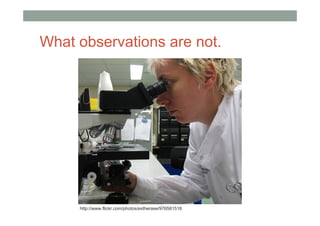
What observations are not.


     http://www.flickr.com/photos/estherase/976581518
My own learning experience


http://www.flickr.com/photos/30571787@N00/307814064/
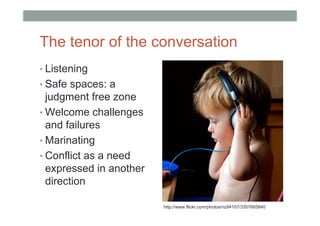
The tenor of the conversation
• Listening
• Safe spaces: a
  judgment free zone
• Welcome challenges
  and failures
• Marinating
• Conflict as a need
  expressed in another
  direction

                         http://www.flickr.com/photos/riz94107/3357665840
USING INQUIRY TO
BUILD THAT TONE AND
SPACE
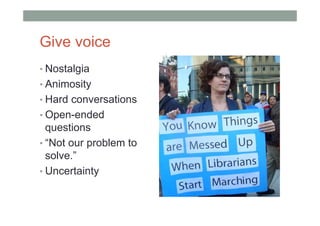
Give voice
• Nostalgia
• Animosity
• Hard conversations
• Open-ended
  questions
• “Not our problem to
  solve.”
• Uncertainty
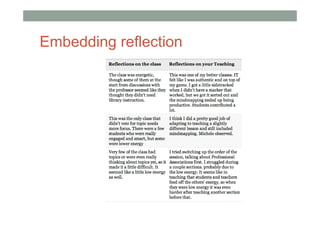
Embedding reflection
WHAT ARE OBSTACLES
TO CULTIVATING THE
TEACHING IDENTITY,
EXPLICIT AND IMPLICIT?
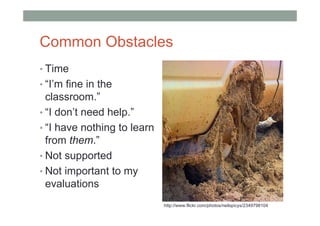
Common Obstacles
• Time
• “I’m fine in the
  classroom.”
• “I don’t need help.”
• “I have nothing to learn
  from them.”
• Not supported
• Not important to my
  evaluations
                             http://www.flickr.com/photos/neilspicys/2349798104
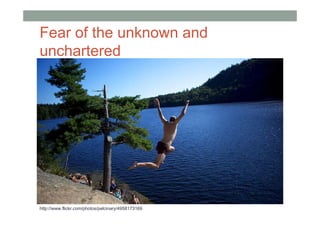
Fear of the unknown and
unchartered


http://www.flickr.com/photos/pelcinary/4958173169
IS IT WORTH IT?
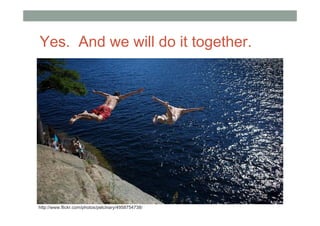
Yes. And we will do it together.


http://www.flickr.com/photos/pelcinary/4958754738/
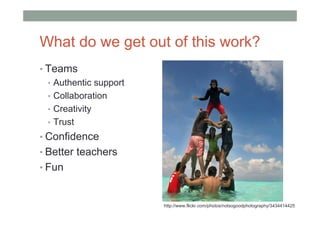
What do we get out of this work?
• Teams
  • Authentic support
  • Collaboration
  • Creativity
  • Trust
• Confidence
• Better teachers
• Fun


                        http://www.flickr.com/photos/notsogoodphotography/3434414425
How do you know?

• Word of mouth
• Statistics speak
• Reference
• Distributive leadership
• Stronger sense of
 teaching community
HOW CAN YOU BEGIN?
Start here


             http://www.flickr.com/photos/elmada/5416602201
Share your experience


   http://www.flickr.com/photos/ruminatrix/3755296805
Invite others


   http://www.flickr.com/photos/mintlipgloss/251326649
Persist


http://www.flickr.com/photos/mindwhisperings/4783343871
“We cannot know the great
things of the universe until we
know ourselves to be great
things.”
               (The Courage to Teach, 113)
THANK YOU.
     Always happy to talk further.
       thesheckspot@gmail.com
                     @thesheck
I’D LOVE YOUR HELP.
• What do you consider to be the obstacles to
  teaching identity work?
• What kinds of research would help shed light
  on this issue?
• What would support for teaching identity work
  look like at UK libraries?
• How can we demystify this work and how can
  we help it gain traction in the academy?

Cohen - The missing link: librarians and the teaching identity

  • 1.
    THE MISSING LINK Librariansand the Teaching Identity Sarah Faye Cohen Champlain College, Burlington, Vermont
  • 2.
    • Why focuson developing Session Goals the teaching identity? What are we here to talk about today? • How can we cultivate the teaching identity? • What are obstacles to cultivating the teaching identity, said and unsaid? • What are the results of this work?
  • 3.
    Why focus ondeveloping the teaching identity? In two parts.
  • 4.
    1. Professionally andlogistically • Combats burnout and isolation. • Improves effectiveness in the classroom. • Facilitates collaboration and “groupthink” for more diversity of ideas. http://www.flickr.com/photos/catheroo/1474795920
  • 5.
    But what is “teaching identity”? http://www.flickr.com/photos/drewleavy/753717493
  • 6.
    “We rarely talkwith each other about teaching at any depth—and why should we when we have nothing more than ‘tips, tricks, and techniques’ to discuss? That kind of talk fails to touch the heart of the teacher’s experience.” (The Courage to Teach, 13)
  • 7.
    “the heart ofthe teacher’s experience” • What does it mean to be teaching librarian? • What does it mean to be a teacher? • Are you a teacher? • What does that look like, sound like, feel like, taste like?
  • 8.
    Getting things outin the open.
  • 9.
    Exposing the truthbehind our challenges http://collegeteachingtips.com/wp- content/uploads/2011/01/PonderingInstructor.jpg
  • 10.
    Is it somethingelse? A crisis. • Fear • A fear of obsolescence • A fear of not knowing • A fear vulnerability • A fear of judgment • Lack • A lack of confidence • A lack of voice • A lack of agency • A lack of faith in http://www.flickr.com/photos/vblibrary/4993073773/ ourselves as teachers
  • 11.
    A clean startto a difficult topic. http://www.flickr.com/photos/phipag/6839447970
  • 12.
    At the elementallevel. “Look within. Within is the fountain of good, and it will ever bubble up, if you keep digging.” (Marcus Aurelius) • To understand our students, our objectives, our pedagogy, and our teaching, we need to understand ourselves. http://www.flickr.com/photos/rrrodrigo/5998696169
  • 13.
    HOW DO WEDO THAT?
  • 14.
  • 15.
    Standing Meetings • Specific time for the people who teach to address teaching • Time to acknowledge, vent, experiment, design, share • Expression of value and importance
  • 16.
    Group Readings • Why? • The group that reads together, stays together. • An environment that is informal, relaxed, and supportive. • How • A book of one’s own • Various formats • Using meeting time to read • Focused. http://www.flickr.com/photos/benobryan/3386185638
  • 17.
    What to read: •Pieces that address our challenges, not reinforce our expertise. • Exploring yourself as a teacher: The Courage to Teach • Who are today’s students? Born Digital • Helping students to “get it” Made to Stick • Unplugging: Hamlet’s Blackberry http://www.flickr.com/photos/anna/199723292
  • 18.
    Developing a TeachingPhilosophy • Motivation. • What is your “modus operandi” for being in the classroom? • Vision for the classroom and teaching experience. • A focus on you, not the students. http://www.flickr.com/photos/apc33/2445600596/
  • 19.
    Debrief sessions • Designingsessions are a process, not a product. • Before • What is our “CI” and our “takeaway”? • What learning styles are we addressing? • What problems can we anticipate? • After • What worked? What didn’t? • What will I do differently? • What will I do again? http://www.flickr.com/photos/johnji/6907148829
  • 20.
    Peer to PeerObservations • An opportunity to learn about the physical • Non-verbal communication • Intonation • Back of the room view of students • What will I try from http://www.flickr.com/photos/ulfbodin/4404742562 their way of teaching?
  • 21.
    What observations arenot. http://www.flickr.com/photos/estherase/976581518
  • 22.
    My own learningexperience http://www.flickr.com/photos/30571787@N00/307814064/
  • 23.
    The tenor ofthe conversation • Listening • Safe spaces: a judgment free zone • Welcome challenges and failures • Marinating • Conflict as a need expressed in another direction http://www.flickr.com/photos/riz94107/3357665840
  • 24.
    USING INQUIRY TO BUILDTHAT TONE AND SPACE
  • 25.
    Give voice • Nostalgia •Animosity • Hard conversations • Open-ended questions • “Not our problem to solve.” • Uncertainty
  • 26.
  • 27.
    WHAT ARE OBSTACLES TOCULTIVATING THE TEACHING IDENTITY, EXPLICIT AND IMPLICIT?
  • 28.
    Common Obstacles • Time •“I’m fine in the classroom.” • “I don’t need help.” • “I have nothing to learn from them.” • Not supported • Not important to my evaluations http://www.flickr.com/photos/neilspicys/2349798104
  • 29.
    Fear of theunknown and unchartered http://www.flickr.com/photos/pelcinary/4958173169
  • 30.
  • 31.
    Yes. And wewill do it together. http://www.flickr.com/photos/pelcinary/4958754738/
  • 32.
    What do weget out of this work? • Teams • Authentic support • Collaboration • Creativity • Trust • Confidence • Better teachers • Fun http://www.flickr.com/photos/notsogoodphotography/3434414425
  • 33.
    How do youknow? • Word of mouth • Statistics speak • Reference • Distributive leadership • Stronger sense of teaching community
  • 34.
  • 35.
    Start here http://www.flickr.com/photos/elmada/5416602201
  • 36.
    Share your experience http://www.flickr.com/photos/ruminatrix/3755296805
  • 37.
    Invite others http://www.flickr.com/photos/mintlipgloss/251326649
  • 38.
  • 39.
    “We cannot knowthe great things of the universe until we know ourselves to be great things.” (The Courage to Teach, 113)
  • 40.
    THANK YOU. Always happy to talk further. thesheckspot@gmail.com @thesheck
  • 41.
    I’D LOVE YOURHELP. • What do you consider to be the obstacles to teaching identity work? • What kinds of research would help shed light on this issue? • What would support for teaching identity work look like at UK libraries? • How can we demystify this work and how can we help it gain traction in the academy?