Behaviour Styles
Knowing your and other people’s preferences
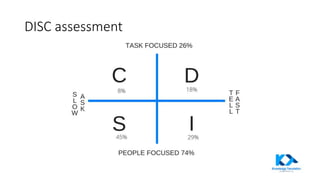
DISC assessment
D – Directing - Dominant
• Direct and decisive, sometimes described as dominant.
• Prefer to lead than follow, and tend towards leadership and management
positions.
• Usually have high self-confidence and are risk-takers and problem solvers,
which enables others to look to them for decisions and direction. They
tend to be self-starters.
• Direct and time conscious
• Be concise
• Answer what not how
• Bottom line “no fluff.”
I – Influencing
• Influential and inspiring
• Mot afraid to be the centre of attention.
• Enthusiastic, optimistic, talkative, persuasive, impulsive and emotional.
• They trust others naturally, truly enjoys being around others, and functions
best when around people and working in teams.
• Spare the detail, big picture
• Socialise
• Follow-up
• Show excitement/enthusiasm
• Socialise with them, be excited about what you are telling them
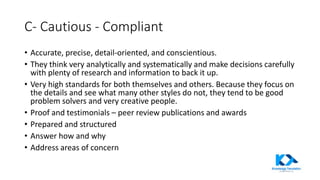
C- Cautious - Compliant
• Accurate, precise, detail-oriented, and conscientious.
• They think very analytically and systematically and make decisions carefully
with plenty of research and information to back it up.
• Very high standards for both themselves and others. Because they focus on
the details and see what many other styles do not, they tend to be good
problem solvers and very creative people.
• Proof and testimonials – peer review publications and awards
• Prepared and structured
• Answer how and why
• Address areas of concern
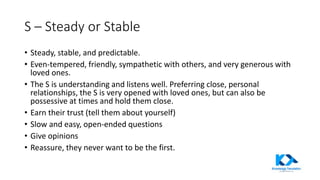
S – Steady or Stable
• Steady, stable, and predictable.
• Even-tempered, friendly, sympathetic with others, and very generous with
loved ones.
• The S is understanding and listens well. Preferring close, personal
relationships, the S is very opened with loved ones, but can also be
possessive at times and hold them close.
• Earn their trust (tell them about yourself)
• Slow and easy, open-ended questions
• Give opinions
• Reassure, they never want to be the first.
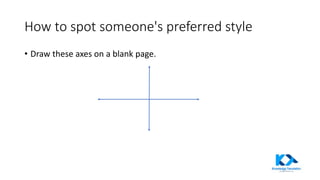
How to spot someone's preferred style
• Draw these axes on a blank page.
How to spot someone's preferred style
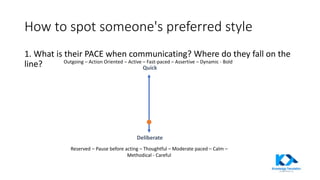
1. What is their PACE when communicating? Where do they fall on the
line? Quick
Deliberate
Outgoing – Action Oriented – Active – Fast-paced – Assertive – Dynamic - Bold
Reserved – Pause before acting – Thoughtful – Moderate paced – Calm –
Methodical - Careful
How to spot someone's preferred style
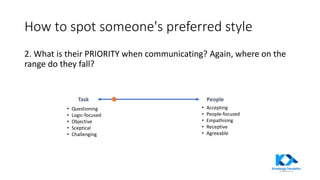
2. What is their PRIORITY when communicating? Again, where on the
range do they fall?
Task People
• Questioning
• Logic-focused
• Objective
• Sceptical
• Challenging
• Accepting
• People-focused
• Empathising
• Receptive
• Agreeable
How to spot someone's preferred style
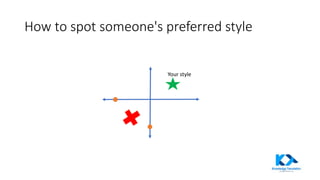
Your style
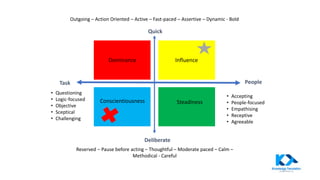
Dominance Influence
Conscientiousness Steadiness
• Questioning
• Logic-focused
• Objective
• Sceptical
• Challenging
• Accepting
• People-focused
• Empathising
• Receptive
• Agreeable
Task People
Quick
Deliberate
Outgoing – Action Oriented – Active – Fast-paced – Assertive – Dynamic - Bold
Reserved – Pause before acting – Thoughtful – Moderate paced – Calm –
Methodical - Careful
Self Reflection Questions
• How is this person’s style different or similar to you?
• Knowing this information, how might you interact with that person
differently?
• Consider how you might frame questions to this person?
DISC exercises and questions courtesy of Tammy Vetter,
MedStar Health USA

Behaviour styles for KT

  • 1.
    Behaviour Styles Knowing yourand other people’s preferences
  • 2.
  • 3.
    D – Directing- Dominant • Direct and decisive, sometimes described as dominant. • Prefer to lead than follow, and tend towards leadership and management positions. • Usually have high self-confidence and are risk-takers and problem solvers, which enables others to look to them for decisions and direction. They tend to be self-starters. • Direct and time conscious • Be concise • Answer what not how • Bottom line “no fluff.”
  • 4.
    I – Influencing •Influential and inspiring • Mot afraid to be the centre of attention. • Enthusiastic, optimistic, talkative, persuasive, impulsive and emotional. • They trust others naturally, truly enjoys being around others, and functions best when around people and working in teams. • Spare the detail, big picture • Socialise • Follow-up • Show excitement/enthusiasm • Socialise with them, be excited about what you are telling them
  • 5.
    C- Cautious -Compliant • Accurate, precise, detail-oriented, and conscientious. • They think very analytically and systematically and make decisions carefully with plenty of research and information to back it up. • Very high standards for both themselves and others. Because they focus on the details and see what many other styles do not, they tend to be good problem solvers and very creative people. • Proof and testimonials – peer review publications and awards • Prepared and structured • Answer how and why • Address areas of concern
  • 6.
    S – Steadyor Stable • Steady, stable, and predictable. • Even-tempered, friendly, sympathetic with others, and very generous with loved ones. • The S is understanding and listens well. Preferring close, personal relationships, the S is very opened with loved ones, but can also be possessive at times and hold them close. • Earn their trust (tell them about yourself) • Slow and easy, open-ended questions • Give opinions • Reassure, they never want to be the first.
  • 7.
    How to spotsomeone's preferred style • Draw these axes on a blank page.
  • 8.
    How to spotsomeone's preferred style 1. What is their PACE when communicating? Where do they fall on the line? Quick Deliberate Outgoing – Action Oriented – Active – Fast-paced – Assertive – Dynamic - Bold Reserved – Pause before acting – Thoughtful – Moderate paced – Calm – Methodical - Careful
  • 9.
    How to spotsomeone's preferred style 2. What is their PRIORITY when communicating? Again, where on the range do they fall? Task People • Questioning • Logic-focused • Objective • Sceptical • Challenging • Accepting • People-focused • Empathising • Receptive • Agreeable
  • 10.
    How to spotsomeone's preferred style Your style
  • 11.
    Dominance Influence Conscientiousness Steadiness •Questioning • Logic-focused • Objective • Sceptical • Challenging • Accepting • People-focused • Empathising • Receptive • Agreeable Task People Quick Deliberate Outgoing – Action Oriented – Active – Fast-paced – Assertive – Dynamic - Bold Reserved – Pause before acting – Thoughtful – Moderate paced – Calm – Methodical - Careful
  • 12.
    Self Reflection Questions •How is this person’s style different or similar to you? • Knowing this information, how might you interact with that person differently? • Consider how you might frame questions to this person? DISC exercises and questions courtesy of Tammy Vetter, MedStar Health USA

Editor's Notes

  • #3 Understand the people in your team to improve your relationships. Slow/Ask – Reserved and Tell/Fast - Outgoing One important point ... the main misuse of DISC or any personality model is to assume that a person only has ONE trait. That is not at all the case. Each person has all traits to varying degrees. Any such methodology that boxes people in with ONE trait will surely be unproductive and inaccurate. DISC is easy to apply and is less theoretical than other behavioral concepts. DISC is not just for self understanding, it gives you a framework to understand others and adjust how you relate.
  • #8 Think of someone that you have difficulty connecting with or you really haven’t hit it off, it could be at work or personal. Raise your hand when you have someone in mind. Think about what they say, how they behave, what they prefer or are comfortable with, to determine someones primary style you ask yourself these two questions: What is their pace when communicating?
  • #9 Think of someone that you have difficulty connecting with or you really haven’t hit it off, it could be at work or personal. Raise your hand when you have someone in mind. Think about what they say, how they behave, what they prefer or are comfortable with, to determine someone's primary style you ask yourself these two questions: What is their pace when communicating? Where you think the person is on the continuum, place a dot.
  • #10 Think of someone that you have difficulty connecting with or you really haven’t hit it off, it could be at work or personal. Raise your hand when you have someone in mind. Think about what they say, how they behave, what they prefer or are comfortable with, to determine someones primary style you ask yourself these two questions: What is their pace when communicating?
  • #11 Think of someone that you have difficulty connecting with or you really haven’t hit it off, it could be at work or personal. Raise your hand when you have someone in mind. Think about what they say, how they behave, what they prefer or are comfortable with, to determine someones primary style you ask yourself these two questions: What is their pace when communicating? You should now have the intersection and two dots, place an X between the two dots – this is the primary style of the person you are thinking of. Now put a star where your primary style is.
  • #13 Get someone to share their observations or thoughts about these questions. Knowing what you know, how do you need to adapt your style and how will you handle the situation, think about adding more prep time when planning to meet or work with this person. Big picture versus detail will change the way you approach someone and the types of questions that they will want answered