The Miniature Guide
to
The Foundation for Critical Thinking
www.criticalthinking.org
707-878-9100
[email protected]g.org
By Dr. Richard Paul
and
Dr. Linda Elder
Critical Thinking
C o n C e p t s a n d t o o l s
Client: FCT
Project
Title:
Concepts/Tools — Conf
©2008 (07-069)
Proof 5 Proof 6 Proof 7 Proof 8
12/3/07
11:35a
12/3/07
12:40p
12/3/07
3:20p
12/4/07
1:15p
Annou
ncing t
he
28th An
nual In
ternati
onal Co
nferen
ce on
Critica
l Think
ing
Near U
niversit
y of Ca
lifornia
at Berk
eley J
uly 19 –
24, 200
8
Specia
l edit
ion
Please join us for the
28th Annual International
Conference on Critical Thinking
Near University of California at Berkeley
July 19 – 24, 2008
For more than 25 years, the Foundation For Critical Thinking
has emphasized the importance of teaching for critical thinking
in a strong, rather than a weak, sense. We are committed to a
clear
and substantive concept of critical thinking (rather than one that
is ill-defined); a concept that interfaces well wwith the
disciplines,
that applies directly to the needs of everyday and professional
life,
that emphasizes the affective as well as the cognitive
dimensions of
thought. We advocate a concept of critical thinking that
organizes
instruction in every subject area at every educational level,
around
it, and on it, and through it. One implication of such an
emphasis is
this: that only through long-term planning can a substantive
concept
of critical thinking take root in instruction and learning. We
need
short-term strategies, of course. But without long-term planning
nothing substantial occurs. Deep learning does not result.
The 28th International Conference will focus on
The Art of Teaching for Intellectual Engagement.
Intellectually engaged students take ownership of content
through
actively thinking it through, value questions more than answers,
seek
understanding over rote memorization. As an integral part of
these
processes, students learn how to learn, using disciplined
reading,
writing, speaking, and listening as modalities in learning. In the
same spirit, all conference sessions will be interactive—
integrating
reading, writing, and teaching as modes for internalizing the
ideas.
To register, visit our website: www.criticalthinking.org
Or call toll-free 800.833.3645.
The Miniature Guide to Critical Thinking Concepts and Tools 1
Fifth Edition © 2008 Foundation for Critical Thinking Press
www.criticalthinking.org
contents
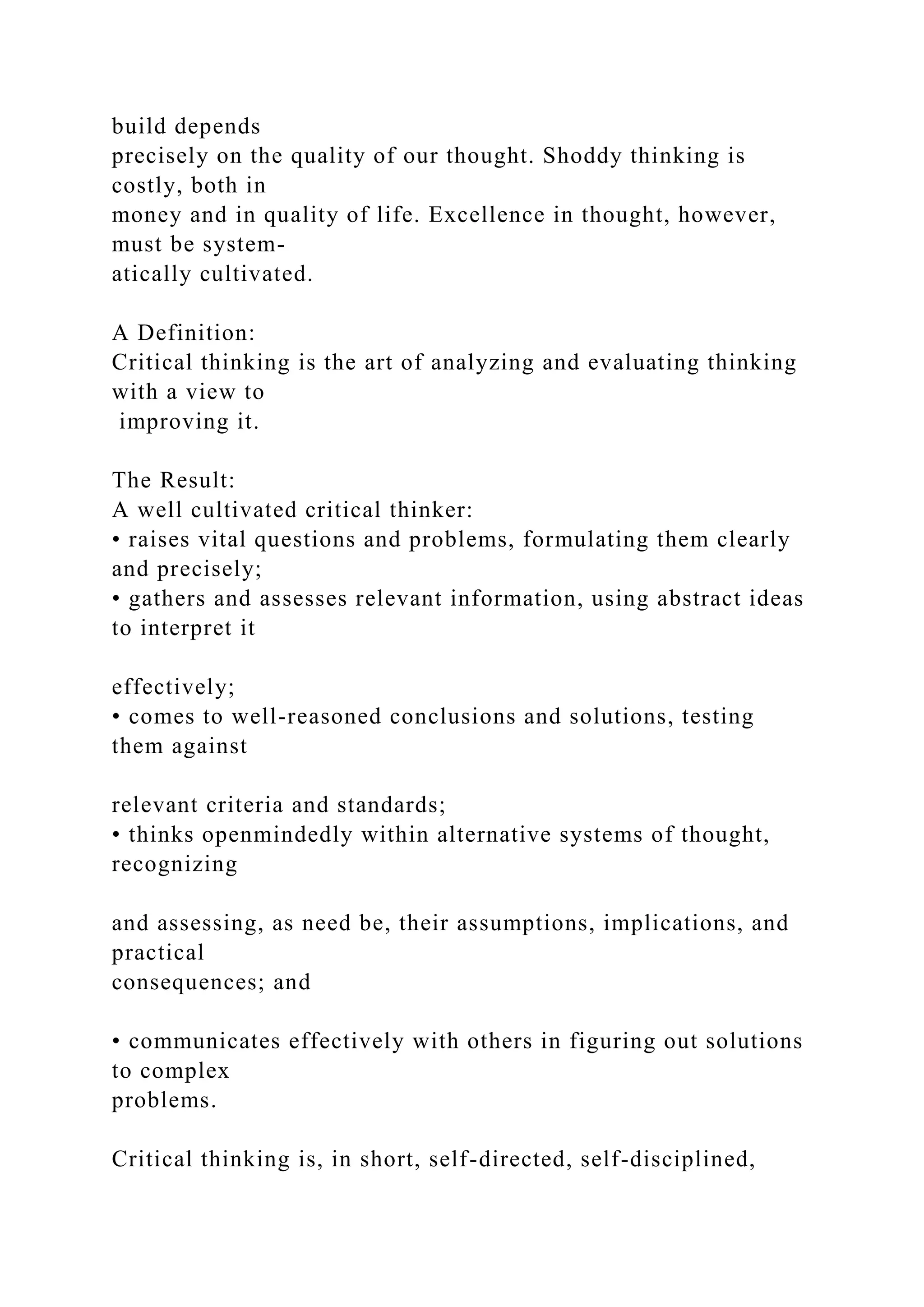
Why Critical Thinking? � � � � � � � � � � � � � � � �
� � � � � � � � � � � � � � � � � � � � � � � � � �
� � 2
The Elements of Thought � � � � � � � � � � � � � � �
� � � � � � � � � � � � � � � � � � � � � � � � � �
3
A Checklist for Reasoning� � � � � � � � � � � � � � �
� � � � � � � � � � � � � � � � � � � � � � � � � �
4
Questions Using the Elements of Thought � � � � � � � �
� � � � � � � � � � � � � � � � 6
Three Levels of Thought � � � � � � � � � � � � � � �
� � � � � � � � � � � � � � � � � � � � � � � � � �
� 7
Universal Intellectual Standards � � � � � � � � � � � �
� � � � � � � � � � � � � � � � � � � � � � 8
Template for Analyzing the Logic of Articles and Textbooks �
� � � � � 11
Criteria for Evaluating Reasoning � � � � � � � � � � � �
� � � � � � � � � � � � � � � � � � � � 12
Essential Intellectual Traits � � � � � � � � � � � � � �
� � � � � � � � � � � � � � � � � � � � � � � � �
13
Three Kinds of Questions � � � � � � � � � � � � � � �
� � � � � � � � � � � � � � � � � � � � � � � � �
16
A Template for Problem-Solving � � � � � � � � � � � �
� � � � � � � � � � � � � � � � � � � � � 17
Analyzing and Assessing Research � � � � � � � � � � �
� � � � � � � � � � � � � � � � � � � � 18
What Critical Thinkers Routinely Do � � � � � � � � � � �
� � � � � � � � � � � � � � � � � � � 19
Stages of Critical Thinking Development� � � � � � � � �
� � � � � � � � � � � � � � � � 20
The Problem of Egocentric Thinking � � � � � � � � � �
� � � � � � � � � � � � � � � � � � � 21
The Problem of Sociocentric Thinking � � � � � � � � � �
� � � � � � � � � � � � � � � � � 22
Envisioning Critical Societies� � � � � � � � � � � � � �
� � � � � � � � � � � � � � � � � � � � � � � 23
© 2008 Foundation for Critical Thinking Press
www.criticalthinking.org
2 The Miniature Guide to Critical Thinking Concepts and Tools
Why Critical Thinking?
The Problem:
Everyone thinks; it is our nature to do so. But much of our
thinking, left to
itself, is biased, distorted, partial, uninformed or down-right
prejudiced. Yet
the quality of our life and that of what we produce, make, or
build depends
precisely on the quality of our thought. Shoddy thinking is
costly, both in
money and in quality of life. Excellence in thought, however,
must be system-
atically cultivated.
A Definition:
Critical thinking is the art of analyzing and evaluating thinking
with a view to
improving it.
The Result:
A well cultivated critical thinker:
• raises vital questions and problems, formulating them clearly
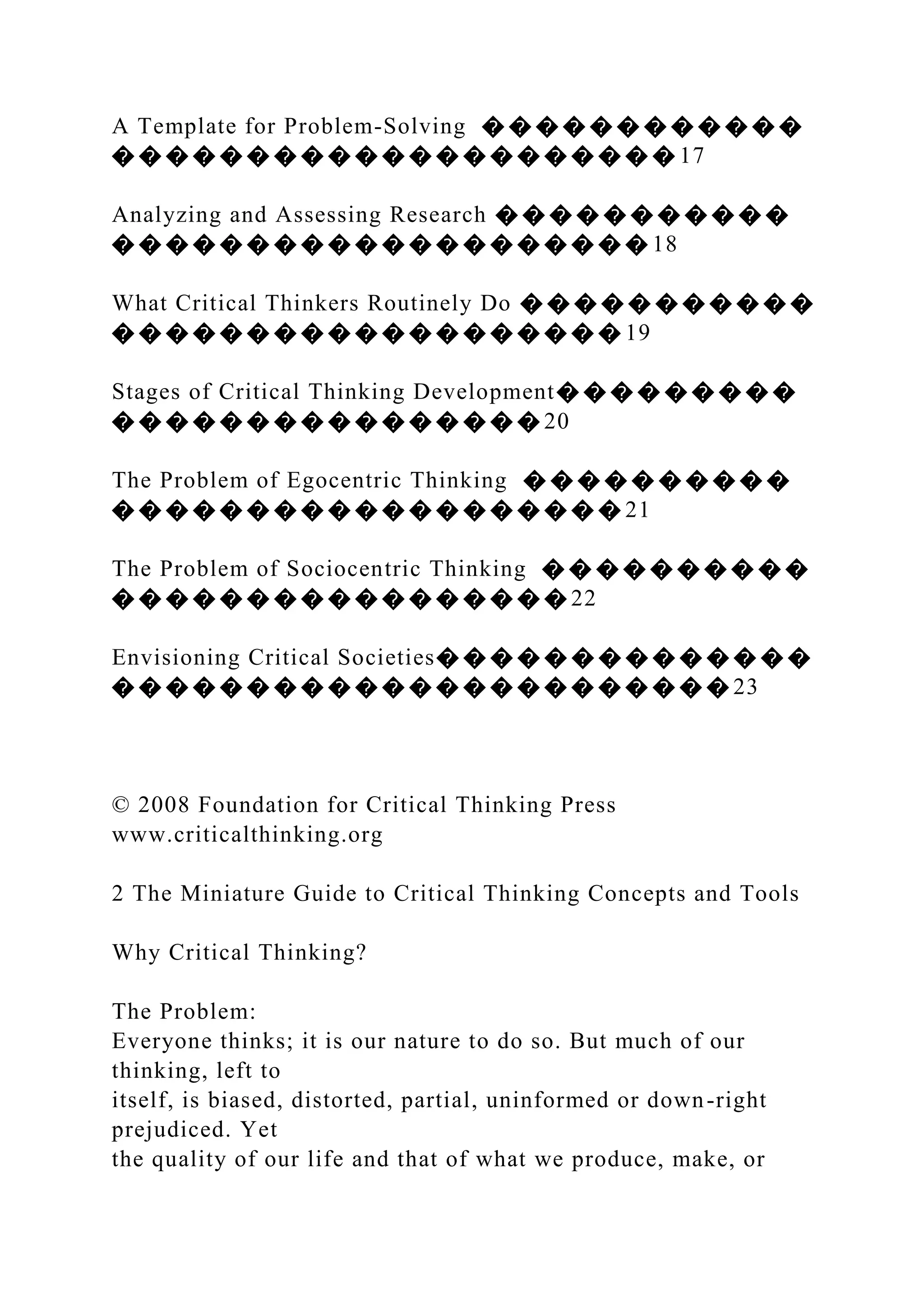
and precisely;
• gathers and assesses relevant information, using abstract ideas
to interpret it
effectively;
• comes to well-reasoned conclusions and solutions, testing
them against
relevant criteria and standards;
• thinks openmindedly within alternative systems of thought,
recognizing
and assessing, as need be, their assumptions, implications, and
practical
consequences; and
• communicates effectively with others in figuring out solutions
to complex
problems.
Critical thinking is, in short, self-directed, self-disciplined,
self-monitored,
and self- corrective thinking. It requires rigorous standards of
excellence
and mindful command of their use. It entails effective
communication and
problem solving abilities and a commitment to overcoming our
native egocen-
trism and sociocentrism.
© 2008 Foundation for Critical Thinking Press
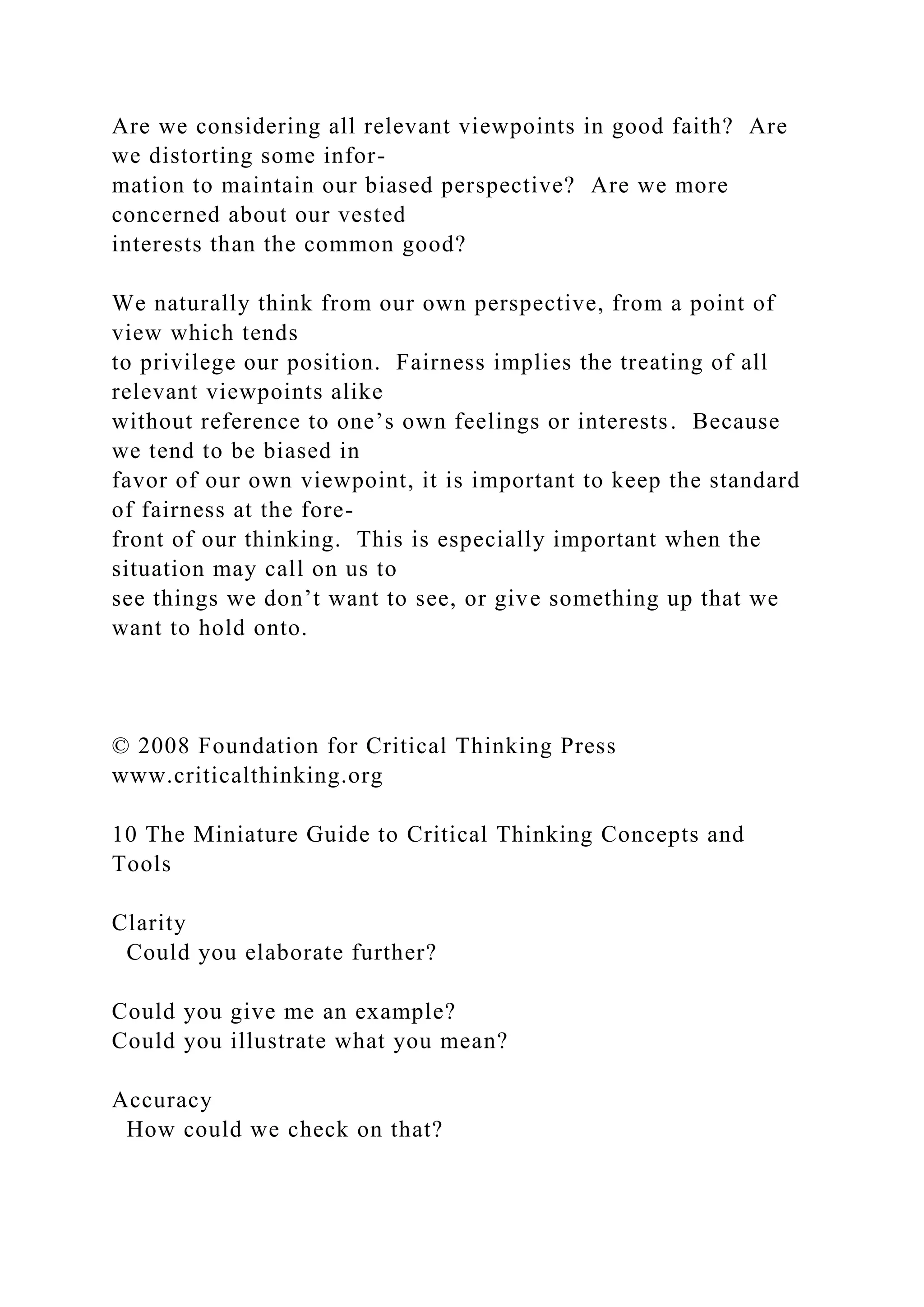
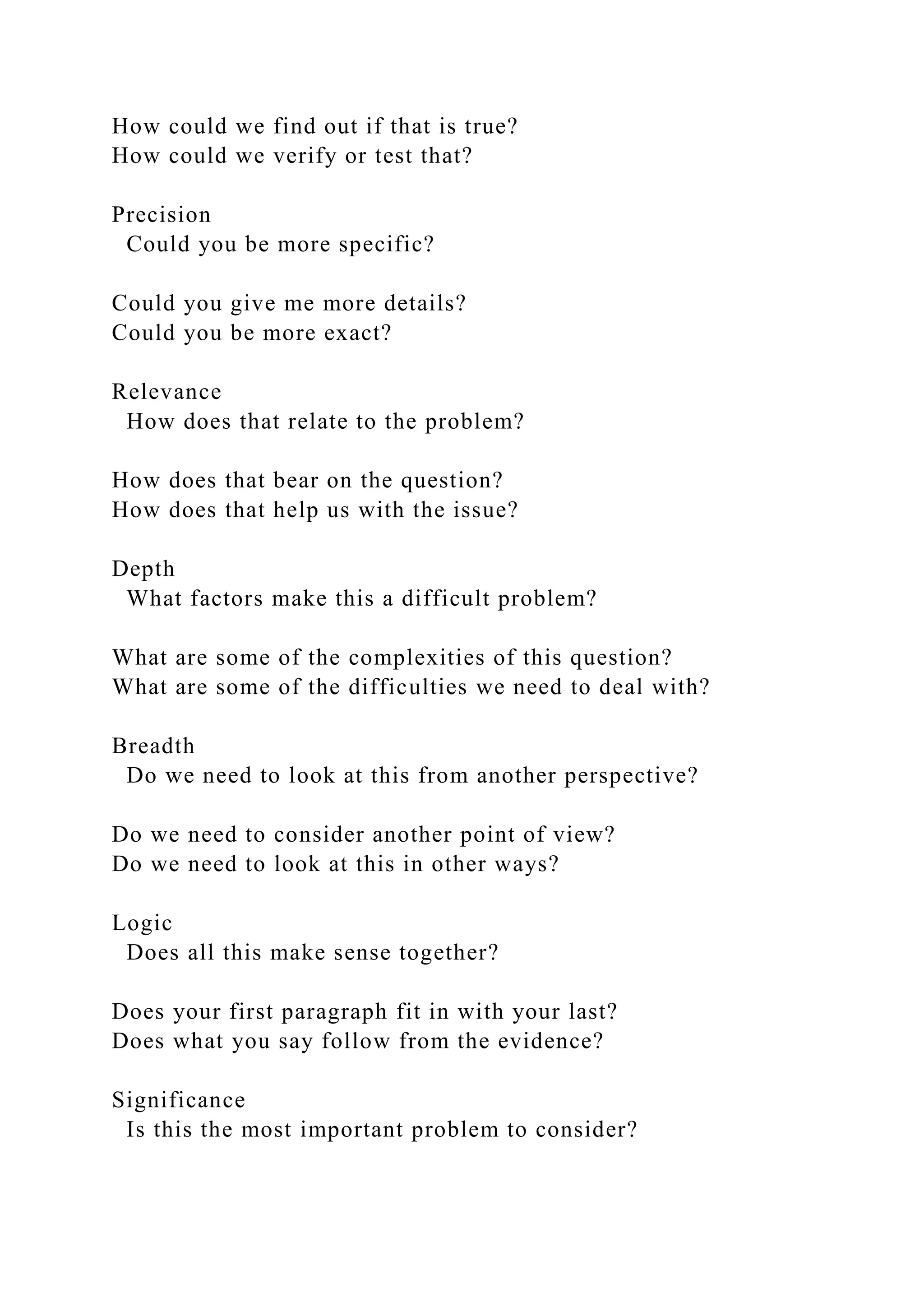
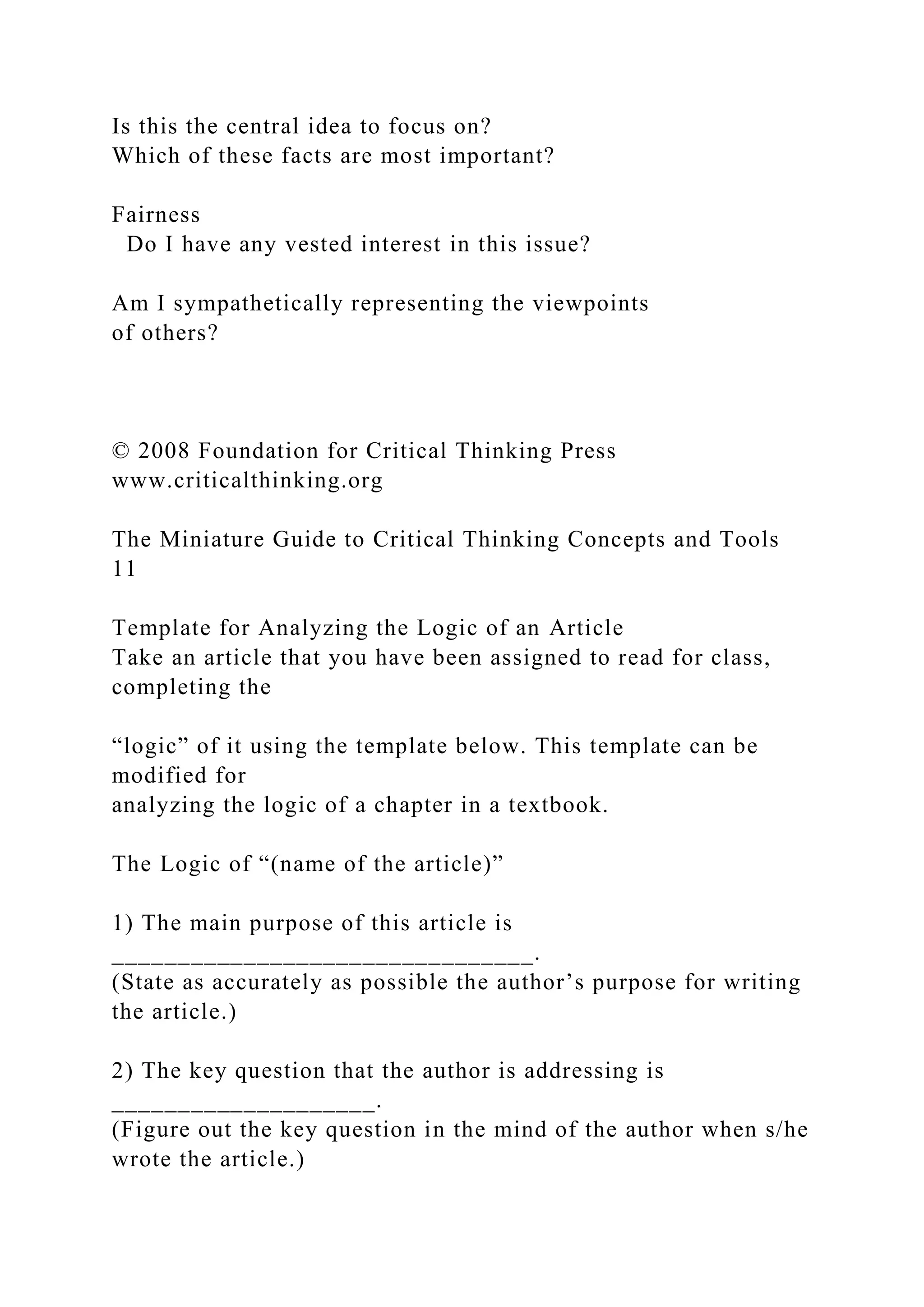
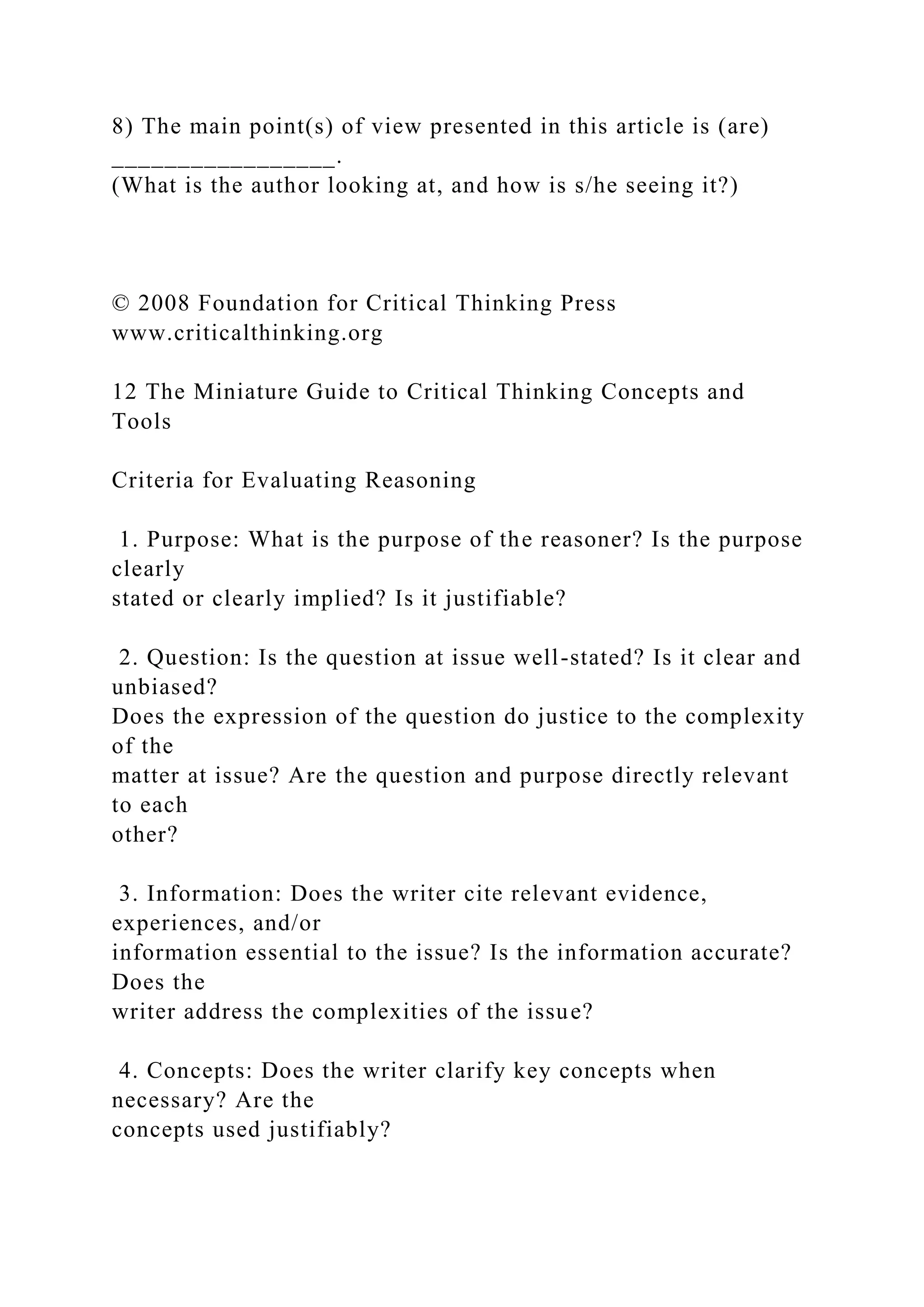
www.criticalthinking.org
The Miniature Guide to Critical Thinking Concepts and Tools 3
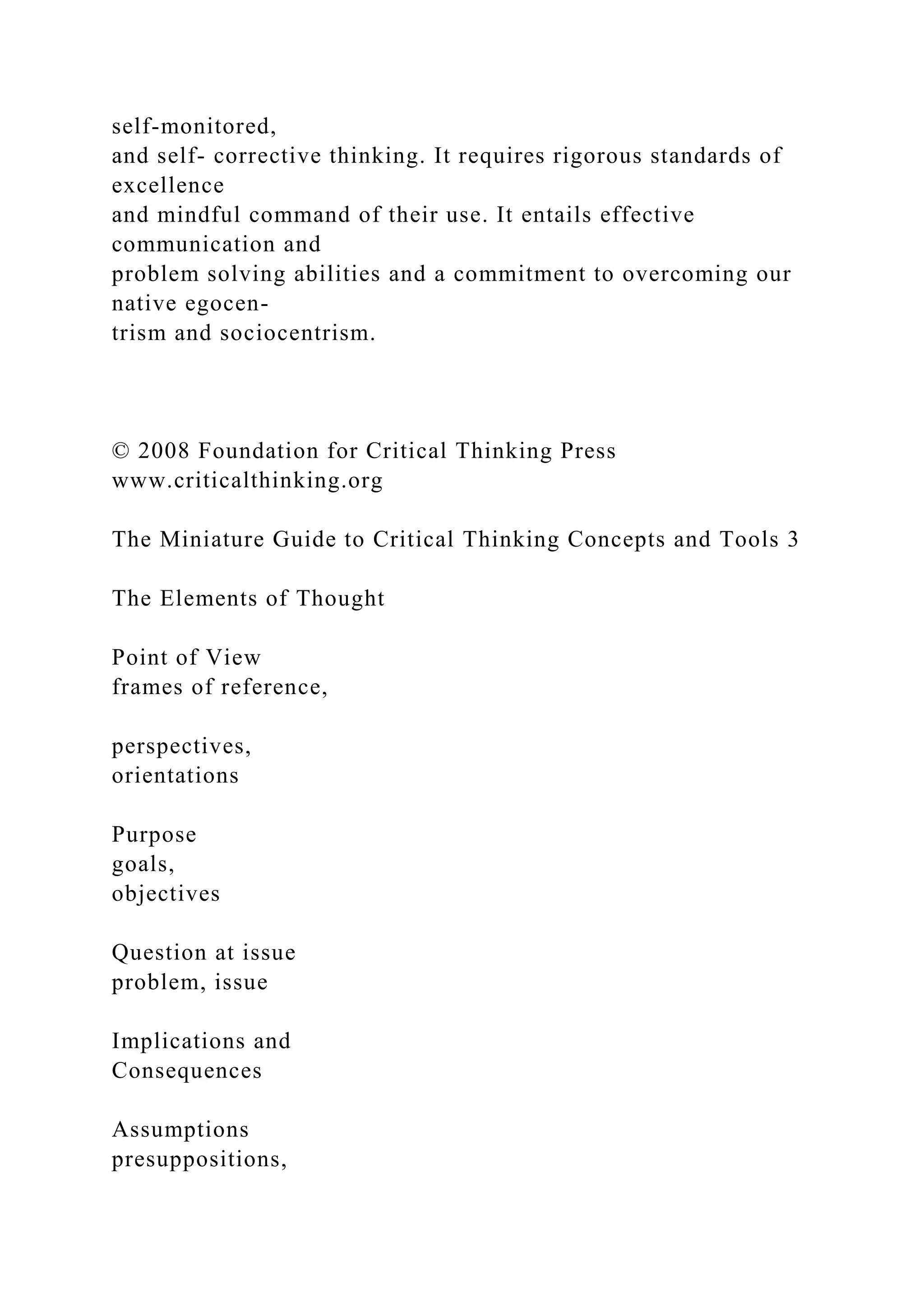
The Elements of Thought
Point of View
frames of reference,
perspectives,
orientations
Purpose
goals,
objectives
Question at issue
problem, issue
Implications and
Consequences
Assumptions
presuppositions,
axioms, taking for
granted
Information
data, facts,
observations,
experiences
Interpretation
and Inference
conclusions,
solutions
Concepts
theories,
definitions, laws,
principles, models
Elements
of
Thought
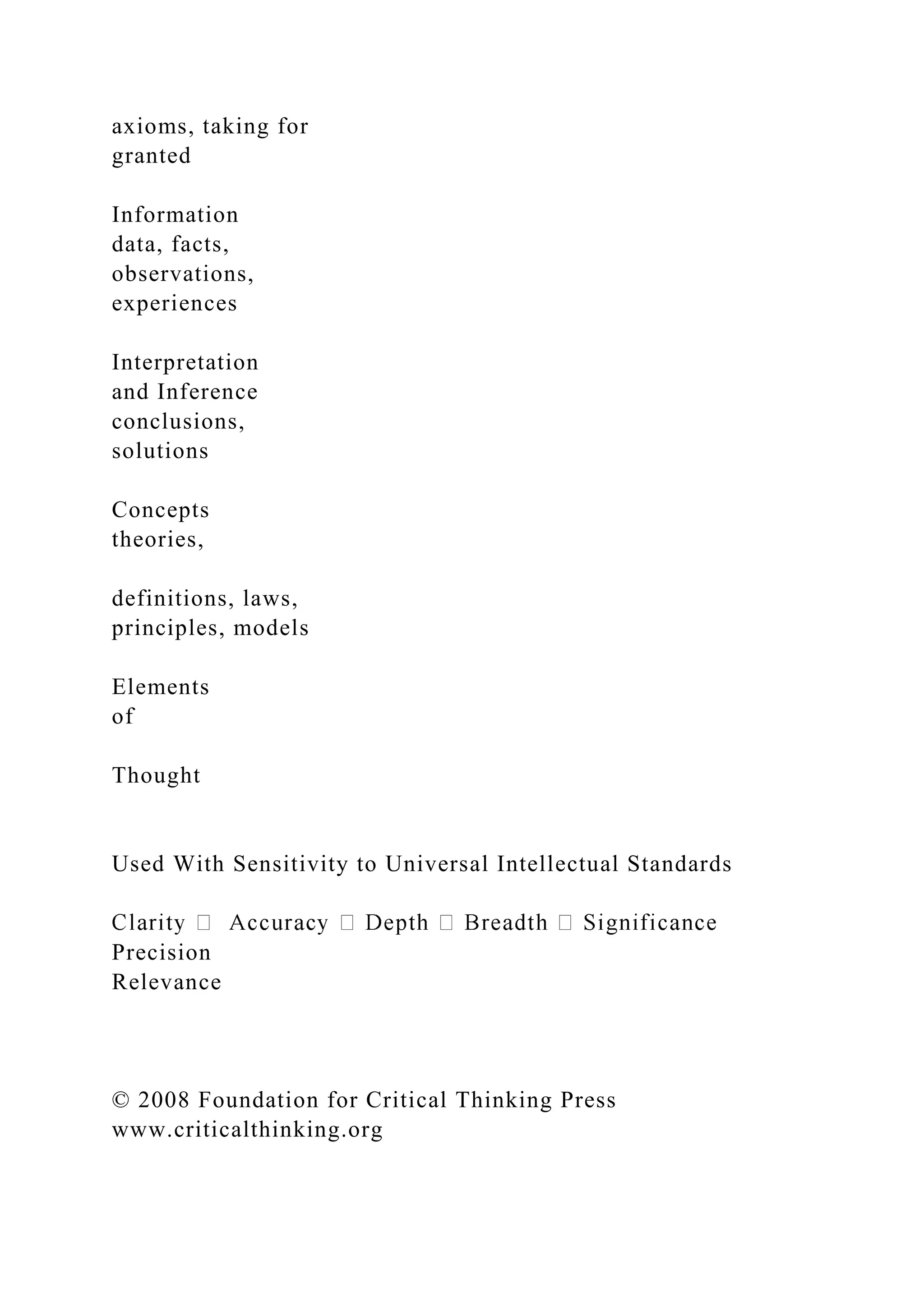
Used With Sensitivity to Universal Intellectual Standards
Precision
Relevance
© 2008 Foundation for Critical Thinking Press
www.criticalthinking.org
4 The Miniature Guide to Critical Thinking Concepts and Tools
A Checklist for Reasoning
1) All reasoning has a PURPOSE.
• State your purpose clearly.
• Distinguish your purpose from related purposes.
• Check periodically to be sure you are still on target.
• Choose significant and realistic purposes.
2) All reasoning is an attempt to FIGURE something out, to
settle some
QUESTION, solve some PROBLEM.
• State the question at issue clearly and precisely.
• Express the question in several ways to clarify its meaning
and scope.
• Break the question into sub-questions.
• Distinguish questions that have definitive answers from
those that
are a matter of opinion and from those that require
consideration of
multiple viewpoints.
3) All reasoning is based on ASSUMPTIONS.
• Clearly identify your assumptions and determine whether
they
are justifiable.
• Consider how your assumptions are shaping your point of
view.
4) All reasoning is done from some POINT OF VIEW.
• Identify your point of view.
• Seek other points of view and identify their strengths as
well
as weaknesses.
• Strive to be fairminded in evaluating all points of view.
© 2008 Foundation for Critical Thinking Press
www.criticalthinking.org
The Miniature Guide to Critical Thinking Concepts and Tools 5
5) All reasoning is based on DATA, INFORMATION and
EVIDENCE.
• Restrict your claims to those supported by the data you
have.
• Search for information that opposes your position as well
as
information that supports it.
• Make sure that all information used is clear, accurate, and
relevant
to the question at issue.
• Make sure you have gathered sufficient information.
6) All reasoning is expressed through, and shaped by,
CONCEPTS and
IDEAS.
• Identify key concepts and explain them clearly.
• Consider alternative concepts or alternative definitions of
concepts.
• Make sure you are using concepts with care and precision.
7) All reasoning contains INFERENCES or
INTERPRETATIONS by which we
draw CONCLUSIONS and give meaning to data.
• Infer only what the evidence implies.
• Check inferences for their consistency with each other.
• Identify assumptions that lead to inferences.
8) All reasoning leads somewhere or has IMPLICATIONS and
CONSEQUENCES.
• Trace the implications and consequences that follow from
your reasoning.
• Search for negative as well as positive implications.
• Consider all possible consequences.
© 2008 Foundation for Critical Thinking Press
www.criticalthinking.org
6 The Miniature Guide to Critical Thinking Concepts and Tools
Questions Using the Elements of Thought
(in a paper, an activity, a reading assignment...)
Purpose: What am I trying to accomplish?
What is my central aim? My purpose?
Questions: What question am I raising?
What question am I addressing?
Am I considering the complexities in the question?
Information: What information am I using in coming to that
conclusion?
What experience have I had to support this claim?
What information do I need to settle the question?
Inferences/
Conclusions:
How did I reach this conclusion?
Is there another way to interpret the information?
Concepts: What is the main idea here?
Can I explain this idea?
Assumptions: What am I taking for granted?
What assumption has led me to that conclusion?
Implications/
Consequences:
If someone accepted my position, what would be the
implications?
What am I implying?
Points of View: From what point of view am I looking at this
issue?
Is there another point of view I should consider?
© 2008 Foundation for Critical Thinking Press
www.criticalthinking.org
The Miniature Guide to Critical Thinking Concepts and Tools 7
Level 3:
Highest Order Thinking
analyzing and assessing thinking
Level 2:
Higher Order Thinking
skilled in sophistry
Level 1:
Lower Order Thinking
Three Levels of Thought
Lower order thinking is often distinguished from higher order
thinking. But higher order thinking can be inconsistent in
quality. It
can be fair or unfair. To think at the highest level of quality, we
need
not only intellectual skills, but intellectual traits as well.
© 2008 Foundation for Critical Thinking Press
www.criticalthinking.org
8 The Miniature Guide to Critical Thinking Concepts and Tools
Universal Intellectual Standards:
And questions that can be used to apply them
Universal intellectual standards are standards which should be
applied to thinking to
ensure its quality. To be learned they must be taught explicitly.
The ultimate goal, then, is
for these standards to become infused in the thinking of
students, forming part of their
inner voice, guiding them to reason better.
Clarity:
Could you elaborate further on that point? Could you express
that point in another way?
Could you give me an illustration? Could you give me an
example?
Clarity is a gateway standard. If a statement is unclear, we
cannot determine
whether it is accurate or relevant. In fact, we cannot tell
anything about it because we
don’t yet know what it is saying. For example, the question
“What can be done about the
education system in America?” is unclear. In order to
adequately address the question,
we would need to have a clearer understanding of what the
person asking the question is
considering the “problem” to be. A clearer question might be
“What can educators do to
ensure that students learn the skills and abilities which help
them function successfully
on the job and in their daily decision-making?”
Accuracy:
Is that really true? How could we check that? How could we
find out if that is true?
A statement can be clear but not accurate, as in “Most dogs are
over 300 pounds in
weight.”
Precision:
Could you give me more details? Could you be more specific?
A statement can be both clear and accurate, but not precise, as
in “Jack is over-
weight.” (We don’t know how overweight Jack is, one pound or
500 pounds.)
Relevance:
How is that connected to the question? How does that bear on
the issue?
A statement can be clear, accurate, and precise, but not relevant
to the question at
issue. For example, students often think that the amount of
effort they put into a course
should be used in raising their grade in a course. Often,
however, “effort” does not
measure the quality of student learning, and when that is so,
effort is irrelevant to their
appropriate grade.
© 2008 Foundation for Critical Thinking Press
www.criticalthinking.org
The Miniature Guide to Critical Thinking Concepts and Tools 9
Depth:
How does your answer address the complexities in the question?
How are you taking
into account the problems in the question? Are you dealing with
the most significant
factors?
A statement can be clear, accurate, precise, and relevant, but
superficial (that is, lack
depth). For example, the statement “Just Say No”, which is
often used to discourage chil-
dren and teens from using drugs, is clear, accurate, precise, and
relevant. Nevertheless, it
lacks depth because it treats an extremely complex issue, the
pervasive problem of drug
use among young people, superficially. It fails to deal with the
complexities of the issue.
Breadth:
Do we need to consider another point of view? Is there another
way to look at this ques-
tion? What would this look like from a conservative standpoint?
What would this look
like from the point of view of…?
A line of reasoning may be clear, accurate, precise, relevant,
and deep, but lack
breadth (as in an argument from either the conservative or
liberal standpoints which
gets deeply into an issue, but only recognizes the insights of
one side of the question).
Logic:
Does this really make sense? Does that follow from what you
said? How does that follow?
Before you implied this and now you are saying that, I don’t see
how both can be true.
When we think, we bring a variety of thoughts together into
some order. When the
combination of thoughts are mutually supporting and make
sense in combination, the
thinking is “logical.” When the combination is not mutually
supporting, is contradictory
in some sense, or does not “make sense,” the combination is
“not logical.”
Fairness:
Are we considering all relevant viewpoints in good faith? Are
we distorting some infor-
mation to maintain our biased perspective? Are we more
concerned about our vested
interests than the common good?
We naturally think from our own perspective, from a point of
view which tends
to privilege our position. Fairness implies the treating of all
relevant viewpoints alike
without reference to one’s own feelings or interests. Because
we tend to be biased in
favor of our own viewpoint, it is important to keep the standard
of fairness at the fore-
front of our thinking. This is especially important when the
situation may call on us to
see things we don’t want to see, or give something up that we
want to hold onto.
© 2008 Foundation for Critical Thinking Press
www.criticalthinking.org
10 The Miniature Guide to Critical Thinking Concepts and
Tools
Clarity
Could you elaborate further?
Could you give me an example?
Could you illustrate what you mean?
Accuracy
How could we check on that?
How could we find out if that is true?
How could we verify or test that?
Precision
Could you be more specific?
Could you give me more details?
Could you be more exact?
Relevance
How does that relate to the problem?
How does that bear on the question?
How does that help us with the issue?
Depth
What factors make this a difficult problem?
What are some of the complexities of this question?
What are some of the difficulties we need to deal with?
Breadth
Do we need to look at this from another perspective?
Do we need to consider another point of view?
Do we need to look at this in other ways?
Logic
Does all this make sense together?
Does your first paragraph fit in with your last?
Does what you say follow from the evidence?
Significance
Is this the most important problem to consider?
Is this the central idea to focus on?
Which of these facts are most important?
Fairness
Do I have any vested interest in this issue?
Am I sympathetically representing the viewpoints
of others?
© 2008 Foundation for Critical Thinking Press
www.criticalthinking.org
The Miniature Guide to Critical Thinking Concepts and Tools
11
Template for Analyzing the Logic of an Article
Take an article that you have been assigned to read for class,
completing the
“logic” of it using the template below. This template can be
modified for
analyzing the logic of a chapter in a textbook.
The Logic of “(name of the article)”
1) The main purpose of this article is
________________________________.
(State as accurately as possible the author’s purpose for writing
the article.)
2) The key question that the author is addressing is
____________________.
(Figure out the key question in the mind of the author when s/he
wrote the article.)
3) The most important information in this article is
___________________.
(Figure out the facts, experiences, data the author is using to
support her/his
conclusions.)
4) The main inferences/conclusions in this article are
__________________.
(Identify the key conclusions the author comes to and presents
in the article.)
5) The key concept(s) we need to understand in this article is
(are) ____________.
By these concepts the author means
_________________________.
(Figure out the most important ideas you would have to
understand in order to
understand the author’s line of reasoning.)
6) The main assumption(s) underlying the author’s thinking is
(are) ___________.
(Figure out what the author is taking for granted [that might be
questioned].)
7a) If we take this line of reasoning seriously, the implications
are ______________.
(What consequences are likely to follow if people take the
author’s line of reasoning
seriously?)
7b) If we fail to take this line of reasoning seriously, the
implications are __________.
(What consequences are likely to follow if people ignore the
author’s reasoning?)
8) The main point(s) of view presented in this article is (are)
_________________.
(What is the author looking at, and how is s/he seeing it?)
© 2008 Foundation for Critical Thinking Press
www.criticalthinking.org
12 The Miniature Guide to Critical Thinking Concepts and
Tools
Criteria for Evaluating Reasoning
1. Purpose: What is the purpose of the reasoner? Is the purpose
clearly
stated or clearly implied? Is it justifiable?
2. Question: Is the question at issue well-stated? Is it clear and
unbiased?
Does the expression of the question do justice to the complexity
of the
matter at issue? Are the question and purpose directly relevant
to each
other?
3. Information: Does the writer cite relevant evidence,
experiences, and/or
information essential to the issue? Is the information accurate?
Does the
writer address the complexities of the issue?
4. Concepts: Does the writer clarify key concepts when
necessary? Are the
concepts used justifiably?
5. Assumptions: Does the writer show a sensitivity to what he
or she is
taking for granted or assuming? (Insofar as those assumptions
might
reasonably be questioned?) Does the writer use questionable
assump-
tions without addressing problems which might be inherent in
those
assumptions?
6. Inferences: Does the writer develop a line of reasoning
explaining well
how s/he is arriving at her or his main conclusions?
7. Point of View: Does the writer show a sensitivity to
alternative relevant
points of view or lines of reasoning? Does s/he consider and
respond to
objections framed from other relevant points of view?
8. Implications: Does the writer show a sensitivity to the
implications and
consequences of the position s/he is taking?
© 2008 Foundation for Critical Thinking Press
www.criticalthinking.org
The Miniature Guide to Critical Thinking Concepts and Tools
13
Intellectual
Integrity
Confidence
in Reason
Intellectual
Autonomy
Intellectual
Humility
Intellectual
Courage
Intellectual
Perseverance
Intellectual
Empathy
Fairmindedness
Intellectual
Traits or Virtues
© 2008 Foundation for Critical Thinking Press
www.criticalthinking.org
14 The Miniature Guide to Critical Thinking Concepts and
Tools
Essential Intellectual Traits
Intellectual Humility vs Intellectual Arrogance
Having a consciousness of the limits of one’s knowledge,
including a sensitivity to
circumstances in which one’s native egocentrism is likely to
function self-deceptively;
sensitivity to bias, prejudice and limitations of one’s viewpoint.
Intellectual humility
depends on recognizing that one should not claim more than one
actually knows. It does
not imply spinelessness or submissiveness. It implies the lack of
intellectual pretentious-
ness, boastfulness, or conceit, combined with insight into the
logical foundations, or lack
of such foundations, of one’s beliefs.
Intellectual Courage vs Intellectual Cowardice
Having a consciousness of the need to face and fairly address
ideas, beliefs or viewpoints
toward which we have strong negative emotions and to which
we have not given a
serious hearing. This courage is connected with the recognition
that ideas considered
dangerous or absurd are sometimes rationally justified (in whole
or in part) and that
conclusions and beliefs inculcated in us are sometimes false or
misleading. To deter-
mine for ourselves which is which, we must not passively and
uncritically “accept” what
we have “learned.” Intellectual courage comes into play here,
because inevitably we will
come to see some truth in some ideas considered dangerous and
absurd, and distortion
or falsity in some ideas strongly held in our social group. We
need courage to be true to
our own thinking in such circumstances. The penalties for
nonconformity can be severe.
Intellectual Empathy vs Intellectual Narrow-mindedness
Having a consciousness of the need to imaginatively put oneself
in the place of others in
order to genuinely understand them, which requires the
consciousness of our egocentric
tendency to identify truth with our immediate perceptions of
long-standing thought or
belief. This trait correlates with the ability to reconstruct
accurately the viewpoints and
reasoning of others and to reason from premises, assumptions,
and ideas other than
our own. This trait also correlates with the willingness to
remember occasions when we
were wrong in the past despite an intense conviction that we
were right, and with the
ability to imagine our being similarly deceived in a case-at-
hand.
© 2008 Foundation for Critical Thinking Press
www.criticalthinking.org
The Miniature Guide to Critical Thinking Concepts and Tools
15
Intellectual Autonomy vs Intellectual Conformity
Having rational control of one’s beliefs, values, and inferences.
The ideal of critical
thinking is to learn to think for oneself, to gain command over
one’s thought processes.
It entails a commitment to analyzing and evaluating beliefs on
the basis of reason and
evidence, to question when it is rational to question, to believe
when it is rational to
believe, and to conform when it is rational to conform.
Intellectual Integrity vs Intellectual Hypocrisy
Recognition of the need to be true to one’s own thinking; to be
consistent in the
intellectual standards one applies; to hold one’s self to the same
rigorous standards of
evidence and proof to which one holds one’s antagonists; to
practice what one advocates
for others; and to honestly admit discrepancies and
inconsistencies in one’s own thought
and action.
Intellectual Perseverance vs Intellectual Laziness
Having a consciousness of the need to use intellectual insights
and truths in spite of
difficulties, obstacles, and frustrations; firm adherence to
rational principles despite
the irrational opposition of others; a sense of the need to
struggle with confusion and
unsettled questions over an extended period of time to achieve
deeper understanding
or insight.
Confidence In Reason vs Distrust of Reason and Evidence
Confidence that, in the long run, one’s own higher interests and
those of humankind
at large will be best served by giving the freest play to reason,
by encouraging people
to come to their own conclusions by developing their own
rational faculties; faith that,
with proper encouragement and cultivation, people can learn to
think for themselves, to
form rational viewpoints, draw reasonable conclusions, think
coherently and logically,
persuade each other by reason and become reasonable persons,
despite the deep-seated
obstacles in the native character of the human mind and in
society as we know it.
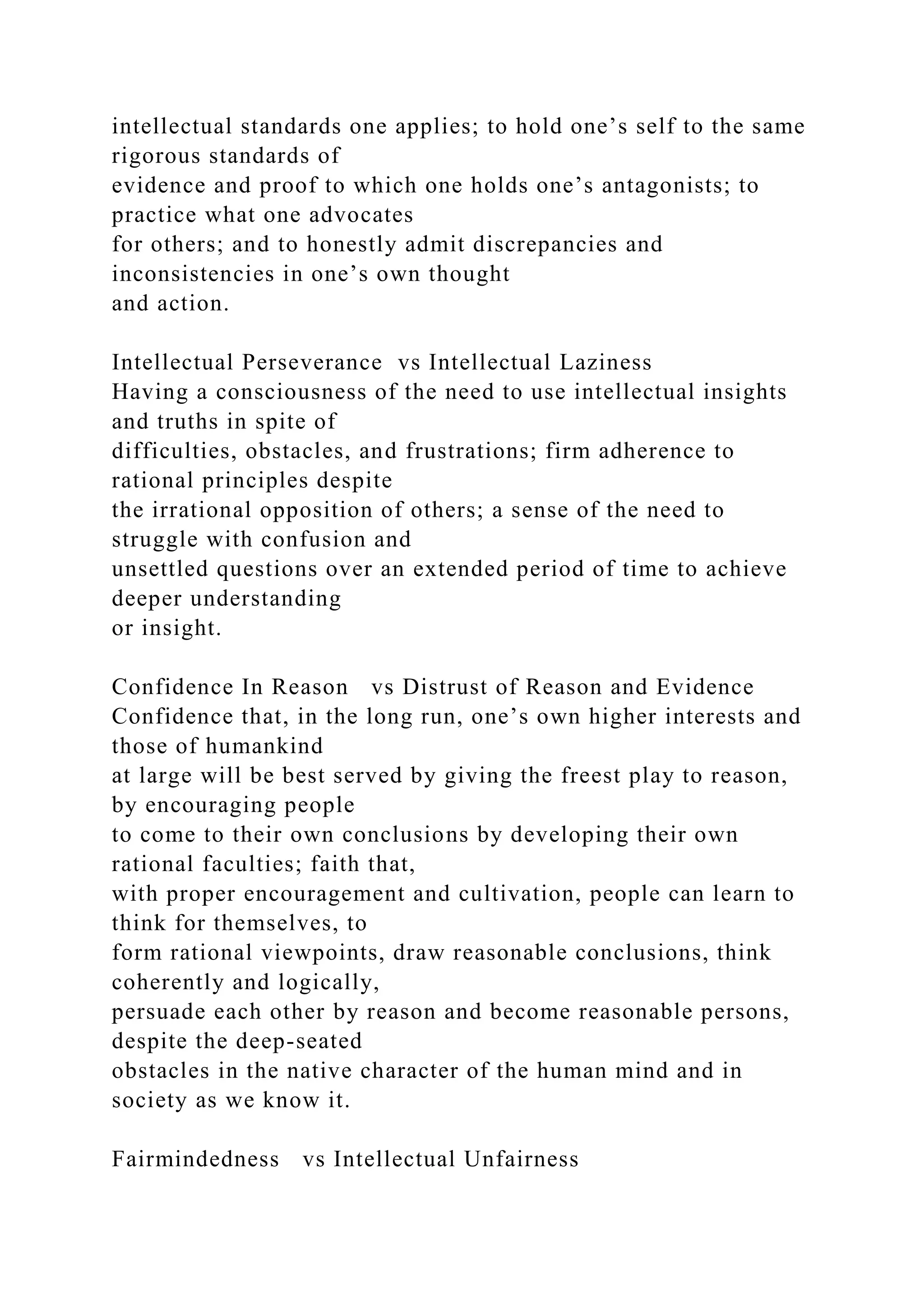
Fairmindedness vs Intellectual Unfairness
Having a consciousness of the need to treat all viewpoints alike,
without reference to
one’s own feelings or vested interests, or the feelings or vested
interests of one’s friends,
community or nation; implies adherence to intellectual
standards without reference to
one’s own advantage or the advantage of one’s group.
© 2008 Foundation for Critical Thinking Press
www.criticalthinking.org
16 The Miniature Guide to Critical Thinking Concepts and
Tools
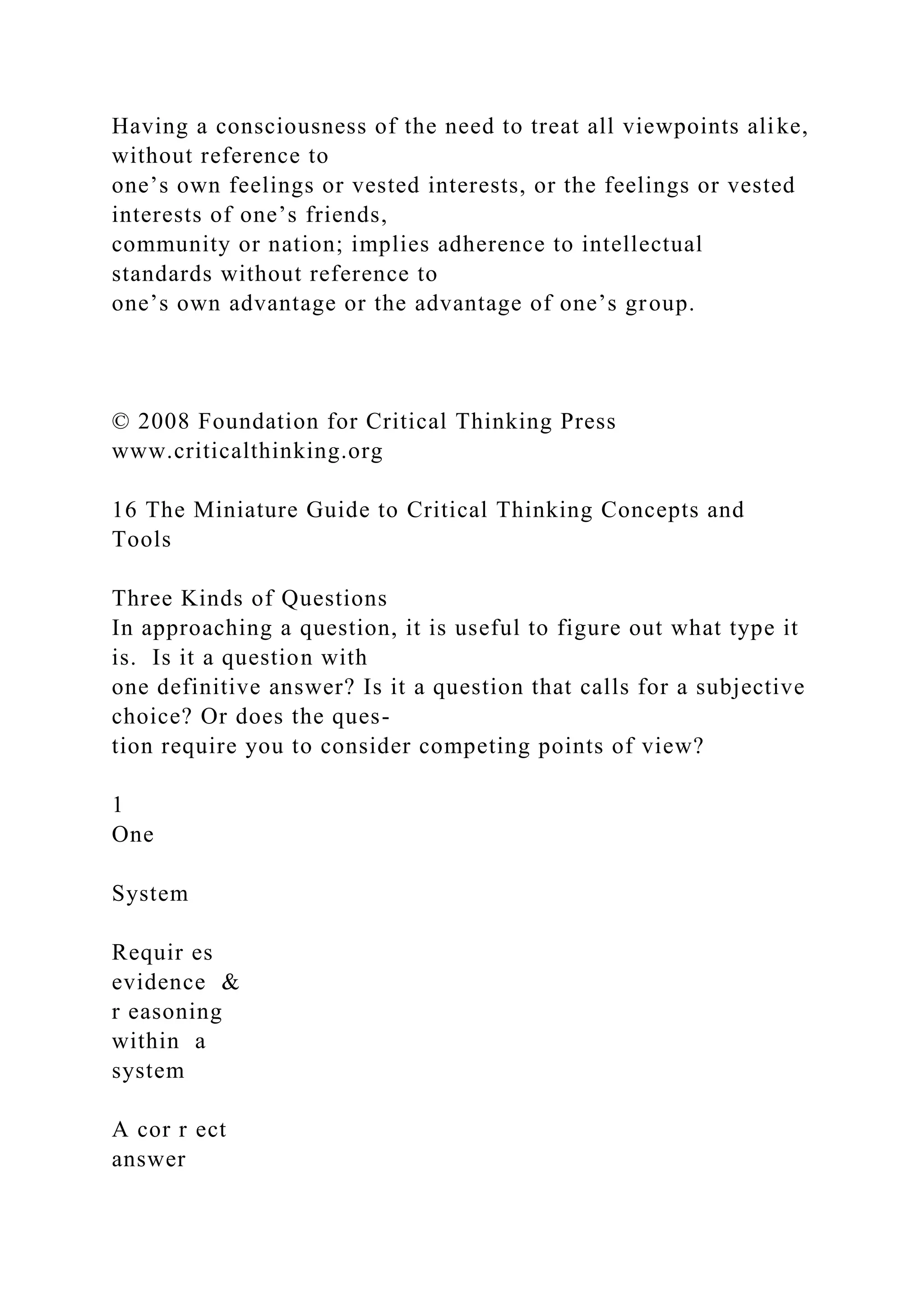
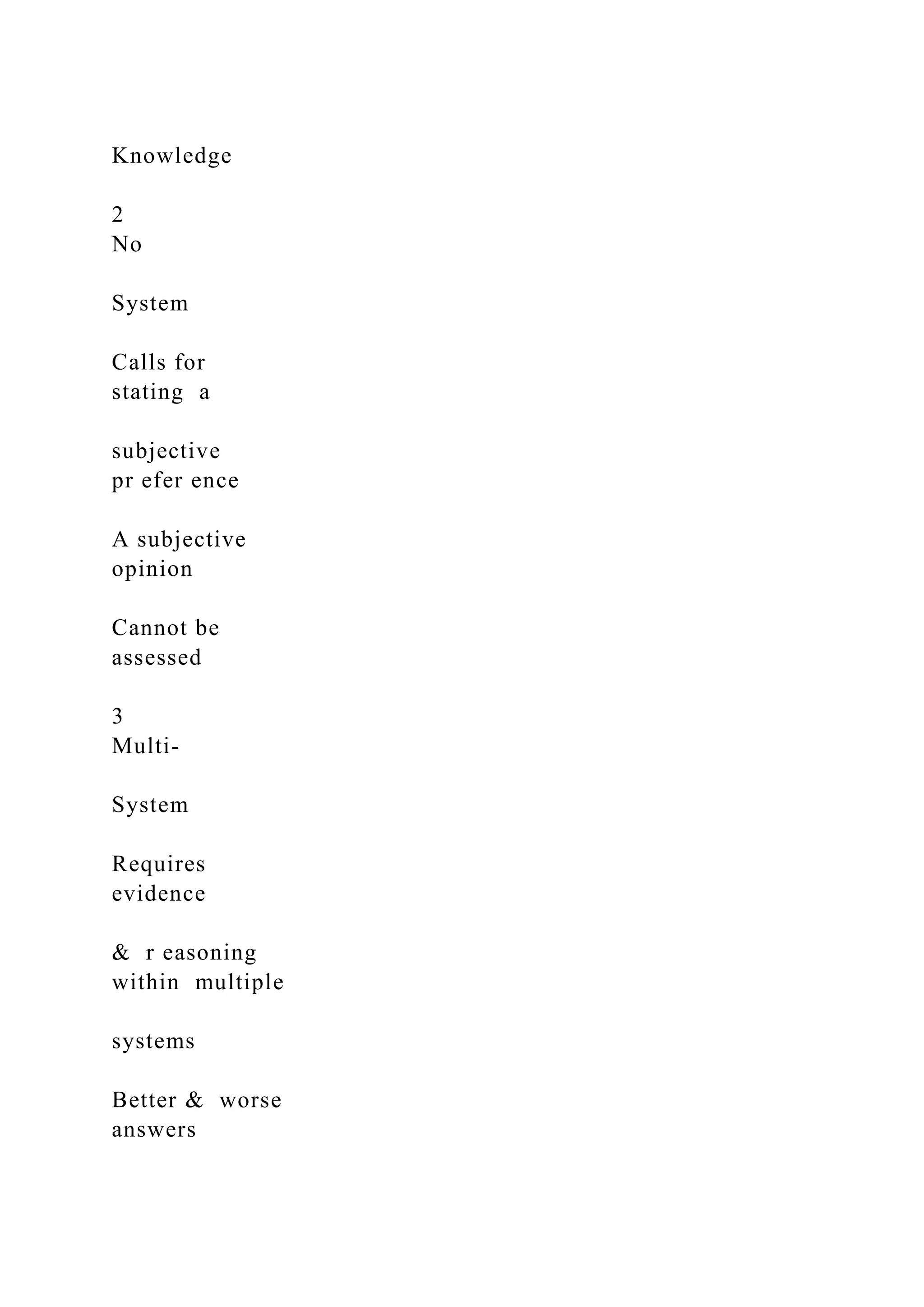
Three Kinds of Questions
In approaching a question, it is useful to figure out what type it
is. Is it a question with
one definitive answer? Is it a question that calls for a subjective
choice? Or does the ques-
tion require you to consider competing points of view?
1
One
System
Requir es
evidence &
r easoning
within a
system
A cor r ect
answer
Knowledge
2
No
System
Calls for
stating a
subjective
pr efer ence
A subjective
opinion
Cannot be
assessed
3
Multi-
System
Requires
evidence
& r easoning
within multiple
systems
Better & worse
answers
Judgment
© 2008 Foundation for Critical Thinking Press
www.criticalthinking.org
The Miniature Guide to Critical Thinking Concepts and Tools
17
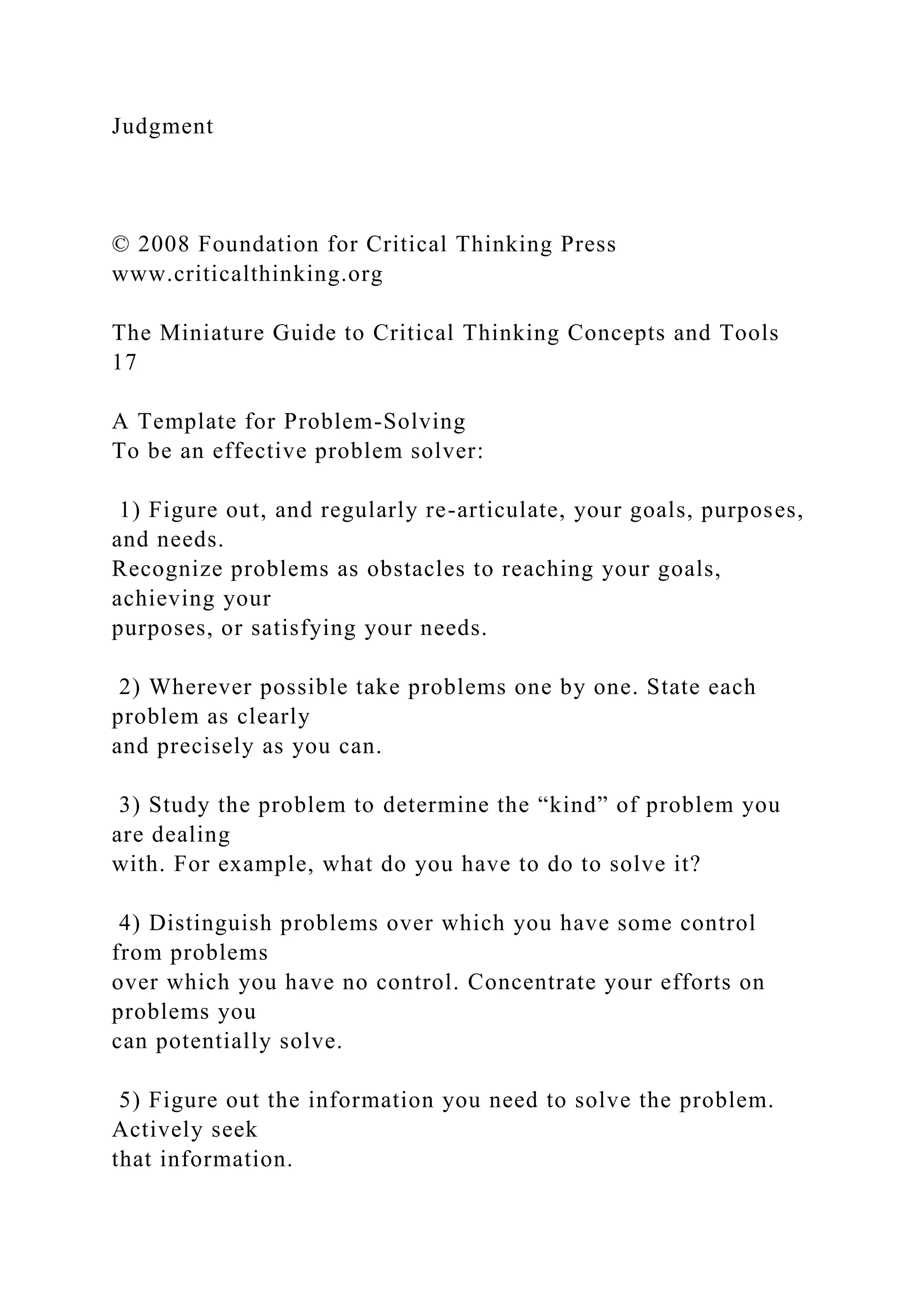
A Template for Problem-Solving
To be an effective problem solver:
1) Figure out, and regularly re-articulate, your goals, purposes,
and needs.
Recognize problems as obstacles to reaching your goals,
achieving your
purposes, or satisfying your needs.
2) Wherever possible take problems one by one. State each
problem as clearly
and precisely as you can.
3) Study the problem to determine the “kind” of problem you
are dealing
with. For example, what do you have to do to solve it?
4) Distinguish problems over which you have some control
from problems
over which you have no control. Concentrate your efforts on
problems you
can potentially solve.
5) Figure out the information you need to solve the problem.
Actively seek
that information.
6) Carefully analyze and interpret the information you collect,
drawing
reasonable inferences.
7) Determine your options for action. What can you do in the
short term? In
the long term? Recognize your limitations in terms of money,
time, and
power.
8) Evaluate your options, determining their advantages and
disadvantages.
9) Adopt a strategy. Follow through on it. This may involve
direct action or a
carefully thought-through wait-and-see approach.
10) When you act, monitor the implications of your action. Be
ready to revise
your strategy if the situation requires it. Be prepared to change
your analy-
sis or statement of the problem, as more information about the
problem
becomes available.
© 2008 Foundation for Critical Thinking Press
www.criticalthinking.org
18 The Miniature Guide to Critical Thinking Concepts and
Tools
Analyzing & Assessing Research
Use this template to assess the quality of any research project or
paper.
1) All research has a fundamental PURPOSE and goal.
• Research purposes and goals should be clearly stated.
• Related purposes should be explicitly distinguished.
• All segments of the research should be relevant to the purpose.
• All research purposes should be realistic and significant.
2) All research addresses a fundamental QUESTION, problem
or issue.
• The fundamental question at issue should be clearly and
precisely stated.
• Related questions should be articulated and distinguished.
• All segments of the research should be relevant to the central
question.
• All research questions should be realistic and significant.
• All research questions should define clearly stated intellectual
tasks that, being fulfilled, settle
the questions.
3) All research identifies data, INFORMATION, and evidence
relevant to its fundamental
question and purpose.
• All information used should be clear, accurate, and relevant to
the fundamental question at
issue.
• Information gathered must be sufficient to settle the question
at issue.
• Information contrary to the main conclusions of the research
should be explained.
4) All research contains INFERENCES or interpretations by
which conclusions are drawn.
• All conclusions should be clear, accurate, and relevant to the
key question at issue.
• Conclusions drawn should not go beyond what the data imply.
• Conclusions should be consistent and reconcile discrepancies
in the data.
• Conclusions should explain how the key questions at issue
have been settled.
5) All research is conducted from some POINT OF VIEW or
frame of reference.
• All points of view in the research should be identified.
• Objections from competing points of view should be identified
and fairly addressed.
6) All research is based on ASSUMPTIONS.
• Clearly identify and assess major assumptions in the research.
• Explain how the assumptions shape the research point of view.
7) All research is expressed through, and shaped by,
CONCEPTS and ideas.
• Assess for clarity the key concepts in the research.
• Assess the significance of the key concepts in the research.
8) All research leads somewhere (i.e., have IMPLICATIONS
and consequences).
• Trace the implications and consequences that follow from the
research.
• Search for negative as well as positive implications.
• Consider all significant implications and consequences.
© 2008 Foundation for Critical Thinking Press
www.criticalthinking.org
The Miniature Guide to Critical Thinking Concepts and Tools
19
Critical thinkers routinely apply intellectual standards to the
elements of reasoning in order to develop intellectual traits.
Clarity
Accuracy
Relevance
Logicalness
Breadth
Precision
Significance
Completeness
Fairness
Depth
T h e S Ta n d a r d S
Purposes
Questions
Points of view
Information
Inferences
Concepts
Implications
Assumptions
T h e e l e m e n T S
Intellectual Humility
Intellectual Autonomy
Intellectual Integrity
Intellectual Courage
Intellectual Perseverance
Confidence in Reason
Intellectual Empathy
Fairmindedness
I n T e l l e c T ua l T r a I T S
As we learn
to develop
Must be
applied to
© 2008 Foundation for Critical Thinking Press
www.criticalthinking.org
20 The Miniature Guide to Critical Thinking Concepts and
Tools
Stages of Critical Thinking Development
Master Thinker
(Good habits of
thought are becoming
second nature)
Advanced Thinker
(We advance in keeping
with our practice)
Practicing Thinker
(We recognize the need
for regular practice)
Beginning Thinker
(We try to improve but
without regular practice)
Challenged Thinker
(We are faced with significant
problems in our thinking)
Unreflective Thinker
(We are unaware of significant
problems in our thinking)
© 2008 Foundation for Critical Thinking Press
www.criticalthinking.org
The Miniature Guide to Critical Thinking Concepts and Tools
21
The Problem of Egocentric Thinking
Egocentric thinking results from the unfortunate fact that
humans do not naturally
consider the rights and needs of others. We do not naturally
appreciate the point of
view of others nor the limitations in our own point of view. We
become explicitly aware
of our egocentric thinking only if trained to do so. We do not
naturally recognize our
egocentric assumptions, the egocentric way we use information,
the egocentric way we
interpret data, the source of our egocentric concepts and ideas,
the implications of our
egocentric thought. We do not naturally recognize our self-
serving perspective.
As humans we live with the unrealistic but confident sense that
we have fundamentally
figured out the way things actually are, and that we have done
this objectively. We naturally
believe in our intuitive perceptions—however inaccurate.
Instead of using intellectual
standards in thinking, we often use self-centered psychological
standards to determine
what to believe and what to reject. Here are the most commonly
used psychological
standards in human thinking.
“IT’S TRUE BECAUSE I BELIEVE IT.” Innate egocentrism: I
assume that what I
believe is true even though I have never questioned the basis for
many of my beliefs.
“IT’S TRUE BECAUSE WE BELIEVE IT.” Innate
sociocentrism: I assume that the
dominant beliefs of the groups to which I belong are true even
though I have never
questioned the basis for those beliefs.
“IT’S TRUE BECAUSE I WANT TO BELIEVE IT.” Innate wish
fulfillment: I believe in
whatever puts me (or the groups to which I belong) in a positive
light. I believe what “feels
good,” what does not require me to change my thinking in any
significant way, what does
not require me to admit I have been wrong.
“IT’S TRUE BECAUSE I HAVE ALWAYS BELIEVED IT.”
Innate self-validation:
I have a strong desire to maintain beliefs that I have long held,
even though I have not
seriously considered the extent to which those beliefs are
justified by the evidence.
“IT’S TRUE BECAUSE IT IS IN MY SELFISH INTEREST TO
BELIEVE IT.” Innate
selfishness: I believe whatever justifies my getting more power,
money, or personal
advantage even though these beliefs are not grounded in sound
reasoning or evidence.
© 2008 Foundation for Critical Thinking Press
www.criticalthinking.org
22 The Miniature Guide to Critical Thinking Concepts and
Tools
The Problem of Sociocentric Thinking
Most people do not understand the degree to which they have
uncritically
internalized the dominant prejudices of their society or culture.
Sociologists
and anthropologists identify this as the state of being “culture
bound.” This
phenomenon is caused by sociocentric thinking, which includes:
■ The uncritical tendency to place one’s culture, nation,
religion above all others.
■ The uncritical tendency to select self-serving positive
descriptions of ourselves
and negative descriptions of those who think differently from
us.
■ The uncritical tendency to internalize group norms and
beliefs, take on group
identities, and act as we are expected to act—without the least
sense that what
we are doing might reasonably be questioned.
■ The tendency to blindly conform to group restrictions (many
of which are
arbitrary or coercive).
■ The failure to think beyond the traditional prejudices of one’s
culture.
■ The failure to study and internalize the insights of other
cultures (improving
thereby the breadth and depth of one’s thinking).
■ The failure to distinguish universal ethics from relativistic
cultural requirements
and taboos.
■ The failure to realize that mass media in every culture shapes
the news from the
point of view of that culture.
■ The failure to think historically and anthropologically (and
hence to be trapped
in current ways of thinking).
■ The failure to see sociocentric thinking as a significant
impediment to
intellectual development.
Sociocentric thinking is a hallmark of an uncritical society. It
can be
diminished only when replaced by cross-cultural, fairminded
thinking — critical
thinking in the strong sense.
© 2008 Foundation for Critical Thinking Press
www.criticalthinking.org
The Miniature Guide to Critical Thinking Concepts and Tools
23
Envisioning Critical Societies
The critical habit of thought, if usual in society, will pervade all
its
mores, because it is a way of taking up the problems of life.
Men
educated in it cannot be stampeded by stump orators ... They are
slow to believe. They can hold things as possible or probable in
all degrees, without certainty and without pain. They can wait
for evidence and weigh evidence, uninfluenced by the emphasis
or confidence with which assertions are made on one side or the
other. They can resist appeals to their dearest prejudices and
all kinds of cajolery. Education in the critical faculty is the only
education of which it can be truly said that it makes good
citizens.
William Graham Sumner, 1906
Humans have the capacity to be rational and fair. But this
capacity must be
developed. It will be significantly developed only if critical
societies emerge.
Critical societies will develop only to the extent that:
■ Critical thinking is viewed as essential to living a reasonable
and fairminded life.
■ Critical thinking is routinely taught; consistently fostered.
■ The problematics of thinking are an abiding concern.
■ Closed-mindedness is systemically discouraged; open-
mindedness
systematically encouraged.
■ Intellectual integrity, intellectual humility, intellectual
empathy, confidence in
reason, and intellectual courage are social values.
■ Egocentric and sociocentric thinking are recognized as a bane
in social life.
■ Children are routinely taught that the rights and needs of
others are equal to their own.
■ A multi-cultural world view is fostered.
■ People are encouraged to think for themselves and
discouraged from uncritically
accepting the thinking or behavior of others.
■ People routinely study and diminish irrational thought.
■ People internalize universal intellectual standards.
If we want critical societies we must create them.
Analytic Thinking—�This guide focuses
on the intellectual skills that enable
one to analyze anything one might
think about — questions, problems,
disciplines, subjects, etc. It provides the
common denominator between all forms
of analysis. #595m
Asking Essential Questions—�
Introduces the ar t of asking essential
questions. It is best used in conjunction
with the Miniature Guide to Critical
Thinking and the How to Study mini-
guide. #580m
How to Study & Learn—�A variety
of strategies—both simple and
complex—for becoming not just
a better student, but also a master
student. #530m
How to Read a Paragraph—�This
guide provides theor y and activities
necessar y for deep comprehension.
Imminently practical for students.
#525m
How to Write a Paragraph—�Focuses
on the ar t of substantive writing. How
to say something wor th saying about
something wor th saying something
about. #535m
The Human Mind—�Designed to
give the reader insight into the basic
functions of the human mind and to
how knowledge of these functions (and
their interrelations) can enable one to
use one’s intellect and emotions more
effectively. #570m
Foundations of Ethical Reasoning—�
Provides insights into the nature of
ethical reasoning, why it is so often
flawed, and how to avoid those flaws. It
lays out the function of ethics, its main
impediments, and its social counter feits.
#585m
How to Detect Media Bias and
Propaganda—�Designed to help
readers come to recognize bias in
their nation’s news and to recognize
propaganda so that they can reasonably
determine what media messages need
to be supplemented, counter-balanced
or thrown out entirely. It focuses on
the internal logic of the news as well as
societal influences on the media. #575m
Scientific Thinking—�The essence of
scientific thinking concepts and tools. It
focuses on the intellectual skills inherent
in the well-cultivated scientific thinker.
#590m
The Thinker ’s Guide Library
The Thinker’s Guide series provides convenient, inexpensive,
por table references that students
and faculty can use to improve the quality of studying, learning,
and teaching. Their modest cost
enables instructors to require them of all students (in addition to
a textbook). Their compactness
enables students to keep them at hand whenever they are
working in or out of class. Their
succinctness serves as a continual reminder of the most basic
principles of critical thinking.
For Students & Faculty
Fallacies: The Art of Mental Trickery
and Manipulation—�Introduces the
concept of fallacies and details 44 foul
ways to win an argument. #533m
Engineering Reasoning—�Contains
the essence of engineering reasoning
concepts and tools. For faculty it pro-
vides a shared concept and vocabular y.
For students it is a thinking supplement
to any textbook for any engineering
course. #573m
Critical Thinking for Children—�
Designed for K–6 classroom use.
Focuses on explaining basic critical
thinking principles to young children
using car toon characters. #540m
For Faculty
Active and Cooperative Learning—�
Provides 27 simple ideas for the
improvement of instruction. It lays the
foundation for the ideas found in the
mini-guide How to Improve Student
Learning. #550m
How to Improve Student Learning—�
Provides 30 practical ideas for the
improvement of instruction based on
critical thinking concepts and tools. It
cultivates student learning encouraged
in the How to Study and Learn mini-
guide. #560m
Critical and Creative Thinking—�
Focuses on the interrelationship
between critical and creative thinking
through the essential role of both in
learning. #565m
Critical Thinking Reading and
Writing Test—�Assesses the ability of
students to use reading and writing as
tools for acquiring knowledge. Provides
grading rubrics and outlines five levels
of close reading and substantive writing.
#563m
Socratic Questioning—�Focuses on the
mechanics of Socratic dialogue, on the
conceptual tools that critical thinking
brings to Socratic dialogue, and on the
impor tance of questioning in cultivating
the disciplined mind. #553m
Critical Thinking Competenc y
Standards—� Provides a framework
for assessing students’ critical thinking
abilities. #555m
Educational Fads—� Analyzes and
critiques educational trends and fads
from a critical thinking perspective,
providing the essential idea of each one,
its proper educational use, and its likely
misuse. #583m
“Concepts & Tools”
Mini-Guide Price List:
(+ shipping and handling)
1–24 copies � � � � � � � � � �$4�00 each
25–199 copies� � � � � � � �$2�00 each
200–499 copies � � � � � �$1�75 each
500–999 copies � � � � � �$1�50 each
1000–1499 copies � � � �$1�25 each
For More Information
(To order guides or to inquire
about other resources)
Phone: 707-878-9100
Fax: 707-878-9111
E-mail: [email protected]�org
Web site: www�criticalthinking�org
Mail: Foundation for Critical Thinking
P�O� Box 220
Dillon Beach, CA 94929
For pricing of other guides, please visit
our web site at www.criticalthinking.org
About the Authors:
D r. Li n d a El de r is an e duc at ional
p s y c h o l o g i s t w h o h a s t a u g h t
b o t h p s y c h o l o g y a n d c r i t i c a l
t hink ing at t he co lle ge level. She
is t he Pre sident of t he Foundat ion f or Cr i t ic al
T h i n k i n g a n d t h e E xe c u t i ve D i r e c t o r o f t h e
Ce n t e r f o r C r i t i c a l T h i n k i n g . D r. E l d e r h a s a
s p e c i a l i n t e r e s t i n t h e r e l a t i o n o f t h o u g h t
and emot ion, t he co gni t i ve and t he af f e c t i ve,
an d ha s d eve lo p e d an o r i g inal t h e o r y o f t h e
s t age s of c r i t ic al t hink ing deve lo p ment. She
has coauthored four books on critical thinking,
as well as eighteen thinkers’ guides. She is a
dynamic presenter with extensive experience in
leading seminars on critical thinking..
D r. R i c h a r d P a u l i s a m a j o r
l e a d e r i n t h e i n te r na t i o na l c r i t i -
c a l t h i n k i n g m o v e m e n t . H e i s
Dire c tor of Re s earc h at t he Center
f o r C r i t i c a l T h i n k i n g , a n d t h e C h a i r o f t h e
N a t i o n a l C o u n c i l f o r E x c e l l e n c e i n C r i t i c a
l
T h i n k i n g , a u t h o r o f o v e r 2 0 0 a r t i c l e s a n d
s even b o o k s on c r i t ic al t hink ing. D r. Paul has
g i v e n h u n d r e d s o f w o r k s h o p s o n c r i t i c a l
t hi n k i n g an d ma d e a s e r i e s o f ei g h t c r i t ic al
t h i n k i n g v i d e o p r o g r a m s f o r PBS. H i s v i e w s
o n c r i t i c a l t h i n k i n g h ave b e e n c a nv a s s e d i n
N e w Yo r k T i m e s , E d u c a t i o n W e e k , T h e
C h r o n i c l e o f H i g h e r E d u c a t i o n , A m e r i c a
n
Te a c h e r, Ed u ca t i o n a l Le a d e r sh i p, N e w s we e k ,
U. S . N e w s a n d Wo r l d R e p o r t, a n d R e a d e r ’s
D igest.
ISBN 0-944583-10-5
Item # 520m
The Foundation
for Critical Thinking
www.criticalthinking.org
707-878-9100 • 800-833-3645
[email protected]
M
ai
lin
g
In
d
ic
ia
F
o
u
n
d
at
io
n
fo
r C
ri
ti
ca
l T
h
in
ki
n
g
P�
O
� B
ox
2
20
D
ill
o
n
B
ea
ch
, C
A
9
49
29
NOTE: If the
Conference Edition
mails, I’d strongly
recommend printing
the indicia on the
piece.
Please advise of
indicia permit info
and how it is being
mailed (Non-profit,
First Class Presort, or
Presort Standard).
Discussion Questions Regarding Leviathan:
1. According to Hobbes in Leviathan, what is "the state of
nature" and why might human beings be adverse to living in it?
What is life in this state of nature like? There is a littany of
adjectives he uses to describe life in the state of nature, and
none of them are nice...
2. What kinds of freedoms (liberties) might a person enjoy in
the state of nature? What conventional (to us) freedoms would a
person likely NOT enjoy in the state of nature?
3. What two basic motivations exist for people in the state of
nature? Do these instincts continue in some way after the social
contract is formed? Is there innate good/evil/morality in the
state of nature, or are these constructs of civil societies?
4. What is a "social contract" and why would we need one?
What kinds of boundaries does it place on individual liberty?
What are the tradeoffs involved in choosing life in society over
life in "the state of nature"?
5. What type of government do you think Hobbes advocated?
Why?
Discussion Questions Regarding Second Treatise of
Government:
1. What was the style of government he felt best, and why?
2. What was Locke's position on human beings' ability to govern
themselves? Did he feel they were innately too selfish, as
Hobbes did? Did he feel that they needed God's guidance? Did
he feel that they needed an absolute sovereign?
3. What was Locke's understanding of basic human liberties and
natural rights? Which liberties did he feel were most
fundamental and should therefore by preserved and served by
government? Which liberties did he feel were worth giving up
in order to attain the stability of life in civil society?
4. Once the social contract is made and a government is formed,
does Locke believe that the people forfeit their influence on this
government forever? Why/why not?
5. How did Locke's views of human rights and purpose of
government differ from Hobbes?
This topic will remain open for one week. There may be more
than one unit covered during some weeks, with most units
including more than one primary source reading, so pace
yourself accordingly.
Contribute your answers, comments, and questions about the
material in your reply/replies. Everyone is required to
contribute at least one post to each discussion thread, no less
than 200 words of original content (preferably more). In other
words, don't just agree with other posters, fill up space with
quotes, copy/paste/paraphrase the book/my slides/a page on the
internet, or what have you. You don't necessarily have to
address every single question, but you do need to make a
concerted effort to think about and discuss the readings. You
must address each primary source reading in some way.
You will receive up to ten points for meeting this requirement
for each unit. :) You can post more for the sake of good
discussion, but you are only required to post one and you can
only earn up to ten points for what you post no matter how
many posts you make.
Remember, avoid chatspeak, use complete sentences, and save
your work as you go along!
The Miniature Guide  toThe Foundation for Critical Think.docx

The Miniature Guide toThe Foundation for Critical Think.docx

  • 1.
    The Miniature Guide to TheFoundation for Critical Thinking www.criticalthinking.org 707-878-9100 [email protected]g.org By Dr. Richard Paul and Dr. Linda Elder Critical Thinking C o n C e p t s a n d t o o l s Client: FCT Project Title: Concepts/Tools — Conf ©2008 (07-069) Proof 5 Proof 6 Proof 7 Proof 8 12/3/07 11:35a 12/3/07 12:40p
  • 2.
    12/3/07 3:20p 12/4/07 1:15p Annou ncing t he 28th An nualIn ternati onal Co nferen ce on Critica l Think ing Near U niversit y of Ca lifornia at Berk eley J uly 19 –
  • 3.
    24, 200 8 Specia l edit ion Pleasejoin us for the 28th Annual International Conference on Critical Thinking Near University of California at Berkeley July 19 – 24, 2008 For more than 25 years, the Foundation For Critical Thinking has emphasized the importance of teaching for critical thinking in a strong, rather than a weak, sense. We are committed to a clear and substantive concept of critical thinking (rather than one that is ill-defined); a concept that interfaces well wwith the disciplines, that applies directly to the needs of everyday and professional life, that emphasizes the affective as well as the cognitive dimensions of thought. We advocate a concept of critical thinking that organizes instruction in every subject area at every educational level, around it, and on it, and through it. One implication of such an emphasis is
  • 4.
    this: that onlythrough long-term planning can a substantive concept of critical thinking take root in instruction and learning. We need short-term strategies, of course. But without long-term planning nothing substantial occurs. Deep learning does not result. The 28th International Conference will focus on The Art of Teaching for Intellectual Engagement. Intellectually engaged students take ownership of content through actively thinking it through, value questions more than answers, seek understanding over rote memorization. As an integral part of these processes, students learn how to learn, using disciplined reading, writing, speaking, and listening as modalities in learning. In the same spirit, all conference sessions will be interactive— integrating reading, writing, and teaching as modes for internalizing the ideas. To register, visit our website: www.criticalthinking.org Or call toll-free 800.833.3645. The Miniature Guide to Critical Thinking Concepts and Tools 1 Fifth Edition © 2008 Foundation for Critical Thinking Press www.criticalthinking.org contents
  • 5.
    Why Critical Thinking?� � � � � � � � � � � � � � � � � � � � � � � � � � � � � � � � � � � � � � � � � � � � 2 The Elements of Thought � � � � � � � � � � � � � � � � � � � � � � � � � � � � � � � � � � � � � � � � � 3 A Checklist for Reasoning� � � � � � � � � � � � � � � � � � � � � � � � � � � � � � � � � � � � � � � � � 4 Questions Using the Elements of Thought � � � � � � � � � � � � � � � � � � � � � � � � 6 Three Levels of Thought � � � � � � � � � � � � � � � � � � � � � � � � � � � � � � � � � � � � � � � � � � 7 Universal Intellectual Standards � � � � � � � � � � � � � � � � � � � � � � � � � � � � � � � � � � 8 Template for Analyzing the Logic of Articles and Textbooks � � � � � � 11 Criteria for Evaluating Reasoning � � � � � � � � � � � � � � � � � � � � � � � � � � � � � � � � 12 Essential Intellectual Traits � � � � � � � � � � � � � � � � � � � � � � � � � � � � � � � � � � � � � � � 13 Three Kinds of Questions � � � � � � � � � � � � � � � � � � � � � � � � � � � � � � � � � � � � � � � � 16
  • 6.
    A Template forProblem-Solving � � � � � � � � � � � � � � � � � � � � � � � � � � � � � � � � � 17 Analyzing and Assessing Research � � � � � � � � � � � � � � � � � � � � � � � � � � � � � � � 18 What Critical Thinkers Routinely Do � � � � � � � � � � � � � � � � � � � � � � � � � � � � � � 19 Stages of Critical Thinking Development� � � � � � � � � � � � � � � � � � � � � � � � � 20 The Problem of Egocentric Thinking � � � � � � � � � � � � � � � � � � � � � � � � � � � � � 21 The Problem of Sociocentric Thinking � � � � � � � � � � � � � � � � � � � � � � � � � � � 22 Envisioning Critical Societies� � � � � � � � � � � � � � � � � � � � � � � � � � � � � � � � � � � � � 23 © 2008 Foundation for Critical Thinking Press www.criticalthinking.org 2 The Miniature Guide to Critical Thinking Concepts and Tools Why Critical Thinking? The Problem: Everyone thinks; it is our nature to do so. But much of our thinking, left to itself, is biased, distorted, partial, uninformed or down-right prejudiced. Yet the quality of our life and that of what we produce, make, or
  • 7.
    build depends precisely onthe quality of our thought. Shoddy thinking is costly, both in money and in quality of life. Excellence in thought, however, must be system- atically cultivated. A Definition: Critical thinking is the art of analyzing and evaluating thinking with a view to improving it. The Result: A well cultivated critical thinker: • raises vital questions and problems, formulating them clearly and precisely; • gathers and assesses relevant information, using abstract ideas to interpret it effectively; • comes to well-reasoned conclusions and solutions, testing them against relevant criteria and standards; • thinks openmindedly within alternative systems of thought, recognizing and assessing, as need be, their assumptions, implications, and practical consequences; and • communicates effectively with others in figuring out solutions to complex problems. Critical thinking is, in short, self-directed, self-disciplined,
  • 8.
    self-monitored, and self- correctivethinking. It requires rigorous standards of excellence and mindful command of their use. It entails effective communication and problem solving abilities and a commitment to overcoming our native egocen- trism and sociocentrism. © 2008 Foundation for Critical Thinking Press www.criticalthinking.org The Miniature Guide to Critical Thinking Concepts and Tools 3 The Elements of Thought Point of View frames of reference, perspectives, orientations Purpose goals, objectives Question at issue problem, issue Implications and Consequences Assumptions presuppositions,
  • 9.
    axioms, taking for granted Information data,facts, observations, experiences Interpretation and Inference conclusions, solutions Concepts theories, definitions, laws, principles, models Elements of Thought Used With Sensitivity to Universal Intellectual Standards Precision Relevance © 2008 Foundation for Critical Thinking Press www.criticalthinking.org
  • 10.
    4 The MiniatureGuide to Critical Thinking Concepts and Tools A Checklist for Reasoning 1) All reasoning has a PURPOSE. • State your purpose clearly. • Distinguish your purpose from related purposes. • Check periodically to be sure you are still on target. • Choose significant and realistic purposes. 2) All reasoning is an attempt to FIGURE something out, to settle some QUESTION, solve some PROBLEM. • State the question at issue clearly and precisely. • Express the question in several ways to clarify its meaning and scope. • Break the question into sub-questions. • Distinguish questions that have definitive answers from those that are a matter of opinion and from those that require consideration of multiple viewpoints. 3) All reasoning is based on ASSUMPTIONS. • Clearly identify your assumptions and determine whether they are justifiable. • Consider how your assumptions are shaping your point of view. 4) All reasoning is done from some POINT OF VIEW. • Identify your point of view. • Seek other points of view and identify their strengths as
  • 11.
    well as weaknesses. • Striveto be fairminded in evaluating all points of view. © 2008 Foundation for Critical Thinking Press www.criticalthinking.org The Miniature Guide to Critical Thinking Concepts and Tools 5 5) All reasoning is based on DATA, INFORMATION and EVIDENCE. • Restrict your claims to those supported by the data you have. • Search for information that opposes your position as well as information that supports it. • Make sure that all information used is clear, accurate, and relevant to the question at issue. • Make sure you have gathered sufficient information. 6) All reasoning is expressed through, and shaped by, CONCEPTS and IDEAS. • Identify key concepts and explain them clearly. • Consider alternative concepts or alternative definitions of concepts. • Make sure you are using concepts with care and precision. 7) All reasoning contains INFERENCES or
  • 12.
    INTERPRETATIONS by whichwe draw CONCLUSIONS and give meaning to data. • Infer only what the evidence implies. • Check inferences for their consistency with each other. • Identify assumptions that lead to inferences. 8) All reasoning leads somewhere or has IMPLICATIONS and CONSEQUENCES. • Trace the implications and consequences that follow from your reasoning. • Search for negative as well as positive implications. • Consider all possible consequences. © 2008 Foundation for Critical Thinking Press www.criticalthinking.org 6 The Miniature Guide to Critical Thinking Concepts and Tools Questions Using the Elements of Thought (in a paper, an activity, a reading assignment...) Purpose: What am I trying to accomplish? What is my central aim? My purpose? Questions: What question am I raising? What question am I addressing? Am I considering the complexities in the question? Information: What information am I using in coming to that conclusion? What experience have I had to support this claim?
  • 13.
    What information doI need to settle the question? Inferences/ Conclusions: How did I reach this conclusion? Is there another way to interpret the information? Concepts: What is the main idea here? Can I explain this idea? Assumptions: What am I taking for granted? What assumption has led me to that conclusion? Implications/ Consequences: If someone accepted my position, what would be the implications? What am I implying? Points of View: From what point of view am I looking at this issue? Is there another point of view I should consider? © 2008 Foundation for Critical Thinking Press www.criticalthinking.org The Miniature Guide to Critical Thinking Concepts and Tools 7 Level 3: Highest Order Thinking analyzing and assessing thinking
  • 14.
    Level 2: Higher OrderThinking skilled in sophistry Level 1: Lower Order Thinking Three Levels of Thought Lower order thinking is often distinguished from higher order thinking. But higher order thinking can be inconsistent in quality. It can be fair or unfair. To think at the highest level of quality, we need not only intellectual skills, but intellectual traits as well. © 2008 Foundation for Critical Thinking Press www.criticalthinking.org 8 The Miniature Guide to Critical Thinking Concepts and Tools Universal Intellectual Standards: And questions that can be used to apply them Universal intellectual standards are standards which should be applied to thinking to ensure its quality. To be learned they must be taught explicitly. The ultimate goal, then, is for these standards to become infused in the thinking of students, forming part of their inner voice, guiding them to reason better.
  • 15.
    Clarity: Could you elaboratefurther on that point? Could you express that point in another way? Could you give me an illustration? Could you give me an example? Clarity is a gateway standard. If a statement is unclear, we cannot determine whether it is accurate or relevant. In fact, we cannot tell anything about it because we don’t yet know what it is saying. For example, the question “What can be done about the education system in America?” is unclear. In order to adequately address the question, we would need to have a clearer understanding of what the person asking the question is considering the “problem” to be. A clearer question might be “What can educators do to ensure that students learn the skills and abilities which help them function successfully on the job and in their daily decision-making?” Accuracy: Is that really true? How could we check that? How could we find out if that is true? A statement can be clear but not accurate, as in “Most dogs are over 300 pounds in weight.” Precision: Could you give me more details? Could you be more specific? A statement can be both clear and accurate, but not precise, as in “Jack is over-
  • 16.
    weight.” (We don’tknow how overweight Jack is, one pound or 500 pounds.) Relevance: How is that connected to the question? How does that bear on the issue? A statement can be clear, accurate, and precise, but not relevant to the question at issue. For example, students often think that the amount of effort they put into a course should be used in raising their grade in a course. Often, however, “effort” does not measure the quality of student learning, and when that is so, effort is irrelevant to their appropriate grade. © 2008 Foundation for Critical Thinking Press www.criticalthinking.org The Miniature Guide to Critical Thinking Concepts and Tools 9 Depth: How does your answer address the complexities in the question? How are you taking into account the problems in the question? Are you dealing with the most significant factors? A statement can be clear, accurate, precise, and relevant, but superficial (that is, lack depth). For example, the statement “Just Say No”, which is often used to discourage chil- dren and teens from using drugs, is clear, accurate, precise, and
  • 17.
    relevant. Nevertheless, it lacksdepth because it treats an extremely complex issue, the pervasive problem of drug use among young people, superficially. It fails to deal with the complexities of the issue. Breadth: Do we need to consider another point of view? Is there another way to look at this ques- tion? What would this look like from a conservative standpoint? What would this look like from the point of view of…? A line of reasoning may be clear, accurate, precise, relevant, and deep, but lack breadth (as in an argument from either the conservative or liberal standpoints which gets deeply into an issue, but only recognizes the insights of one side of the question). Logic: Does this really make sense? Does that follow from what you said? How does that follow? Before you implied this and now you are saying that, I don’t see how both can be true. When we think, we bring a variety of thoughts together into some order. When the combination of thoughts are mutually supporting and make sense in combination, the thinking is “logical.” When the combination is not mutually supporting, is contradictory in some sense, or does not “make sense,” the combination is “not logical.” Fairness:
  • 18.
    Are we consideringall relevant viewpoints in good faith? Are we distorting some infor- mation to maintain our biased perspective? Are we more concerned about our vested interests than the common good? We naturally think from our own perspective, from a point of view which tends to privilege our position. Fairness implies the treating of all relevant viewpoints alike without reference to one’s own feelings or interests. Because we tend to be biased in favor of our own viewpoint, it is important to keep the standard of fairness at the fore- front of our thinking. This is especially important when the situation may call on us to see things we don’t want to see, or give something up that we want to hold onto. © 2008 Foundation for Critical Thinking Press www.criticalthinking.org 10 The Miniature Guide to Critical Thinking Concepts and Tools Clarity Could you elaborate further? Could you give me an example? Could you illustrate what you mean? Accuracy How could we check on that?
  • 19.
    How could wefind out if that is true? How could we verify or test that? Precision Could you be more specific? Could you give me more details? Could you be more exact? Relevance How does that relate to the problem? How does that bear on the question? How does that help us with the issue? Depth What factors make this a difficult problem? What are some of the complexities of this question? What are some of the difficulties we need to deal with? Breadth Do we need to look at this from another perspective? Do we need to consider another point of view? Do we need to look at this in other ways? Logic Does all this make sense together? Does your first paragraph fit in with your last? Does what you say follow from the evidence? Significance Is this the most important problem to consider?
  • 20.
    Is this thecentral idea to focus on? Which of these facts are most important? Fairness Do I have any vested interest in this issue? Am I sympathetically representing the viewpoints of others? © 2008 Foundation for Critical Thinking Press www.criticalthinking.org The Miniature Guide to Critical Thinking Concepts and Tools 11 Template for Analyzing the Logic of an Article Take an article that you have been assigned to read for class, completing the “logic” of it using the template below. This template can be modified for analyzing the logic of a chapter in a textbook. The Logic of “(name of the article)” 1) The main purpose of this article is ________________________________. (State as accurately as possible the author’s purpose for writing the article.) 2) The key question that the author is addressing is ____________________. (Figure out the key question in the mind of the author when s/he wrote the article.)
  • 21.
    3) The mostimportant information in this article is ___________________. (Figure out the facts, experiences, data the author is using to support her/his conclusions.) 4) The main inferences/conclusions in this article are __________________. (Identify the key conclusions the author comes to and presents in the article.) 5) The key concept(s) we need to understand in this article is (are) ____________. By these concepts the author means _________________________. (Figure out the most important ideas you would have to understand in order to understand the author’s line of reasoning.) 6) The main assumption(s) underlying the author’s thinking is (are) ___________. (Figure out what the author is taking for granted [that might be questioned].) 7a) If we take this line of reasoning seriously, the implications are ______________. (What consequences are likely to follow if people take the author’s line of reasoning seriously?) 7b) If we fail to take this line of reasoning seriously, the implications are __________. (What consequences are likely to follow if people ignore the author’s reasoning?)
  • 22.
    8) The mainpoint(s) of view presented in this article is (are) _________________. (What is the author looking at, and how is s/he seeing it?) © 2008 Foundation for Critical Thinking Press www.criticalthinking.org 12 The Miniature Guide to Critical Thinking Concepts and Tools Criteria for Evaluating Reasoning 1. Purpose: What is the purpose of the reasoner? Is the purpose clearly stated or clearly implied? Is it justifiable? 2. Question: Is the question at issue well-stated? Is it clear and unbiased? Does the expression of the question do justice to the complexity of the matter at issue? Are the question and purpose directly relevant to each other? 3. Information: Does the writer cite relevant evidence, experiences, and/or information essential to the issue? Is the information accurate? Does the writer address the complexities of the issue? 4. Concepts: Does the writer clarify key concepts when necessary? Are the concepts used justifiably?
  • 23.
    5. Assumptions: Doesthe writer show a sensitivity to what he or she is taking for granted or assuming? (Insofar as those assumptions might reasonably be questioned?) Does the writer use questionable assump- tions without addressing problems which might be inherent in those assumptions? 6. Inferences: Does the writer develop a line of reasoning explaining well how s/he is arriving at her or his main conclusions? 7. Point of View: Does the writer show a sensitivity to alternative relevant points of view or lines of reasoning? Does s/he consider and respond to objections framed from other relevant points of view? 8. Implications: Does the writer show a sensitivity to the implications and consequences of the position s/he is taking? © 2008 Foundation for Critical Thinking Press www.criticalthinking.org The Miniature Guide to Critical Thinking Concepts and Tools 13 Intellectual Integrity Confidence
  • 24.
    in Reason Intellectual Autonomy Intellectual Humility Intellectual Courage Intellectual Perseverance Intellectual Empathy Fairmindedness Intellectual Traits orVirtues © 2008 Foundation for Critical Thinking Press www.criticalthinking.org 14 The Miniature Guide to Critical Thinking Concepts and Tools Essential Intellectual Traits Intellectual Humility vs Intellectual Arrogance Having a consciousness of the limits of one’s knowledge, including a sensitivity to circumstances in which one’s native egocentrism is likely to function self-deceptively;
  • 25.
    sensitivity to bias,prejudice and limitations of one’s viewpoint. Intellectual humility depends on recognizing that one should not claim more than one actually knows. It does not imply spinelessness or submissiveness. It implies the lack of intellectual pretentious- ness, boastfulness, or conceit, combined with insight into the logical foundations, or lack of such foundations, of one’s beliefs. Intellectual Courage vs Intellectual Cowardice Having a consciousness of the need to face and fairly address ideas, beliefs or viewpoints toward which we have strong negative emotions and to which we have not given a serious hearing. This courage is connected with the recognition that ideas considered dangerous or absurd are sometimes rationally justified (in whole or in part) and that conclusions and beliefs inculcated in us are sometimes false or misleading. To deter- mine for ourselves which is which, we must not passively and uncritically “accept” what we have “learned.” Intellectual courage comes into play here, because inevitably we will come to see some truth in some ideas considered dangerous and absurd, and distortion or falsity in some ideas strongly held in our social group. We need courage to be true to our own thinking in such circumstances. The penalties for nonconformity can be severe. Intellectual Empathy vs Intellectual Narrow-mindedness Having a consciousness of the need to imaginatively put oneself in the place of others in order to genuinely understand them, which requires the
  • 26.
    consciousness of ouregocentric tendency to identify truth with our immediate perceptions of long-standing thought or belief. This trait correlates with the ability to reconstruct accurately the viewpoints and reasoning of others and to reason from premises, assumptions, and ideas other than our own. This trait also correlates with the willingness to remember occasions when we were wrong in the past despite an intense conviction that we were right, and with the ability to imagine our being similarly deceived in a case-at- hand. © 2008 Foundation for Critical Thinking Press www.criticalthinking.org The Miniature Guide to Critical Thinking Concepts and Tools 15 Intellectual Autonomy vs Intellectual Conformity Having rational control of one’s beliefs, values, and inferences. The ideal of critical thinking is to learn to think for oneself, to gain command over one’s thought processes. It entails a commitment to analyzing and evaluating beliefs on the basis of reason and evidence, to question when it is rational to question, to believe when it is rational to believe, and to conform when it is rational to conform. Intellectual Integrity vs Intellectual Hypocrisy Recognition of the need to be true to one’s own thinking; to be consistent in the
  • 27.
    intellectual standards oneapplies; to hold one’s self to the same rigorous standards of evidence and proof to which one holds one’s antagonists; to practice what one advocates for others; and to honestly admit discrepancies and inconsistencies in one’s own thought and action. Intellectual Perseverance vs Intellectual Laziness Having a consciousness of the need to use intellectual insights and truths in spite of difficulties, obstacles, and frustrations; firm adherence to rational principles despite the irrational opposition of others; a sense of the need to struggle with confusion and unsettled questions over an extended period of time to achieve deeper understanding or insight. Confidence In Reason vs Distrust of Reason and Evidence Confidence that, in the long run, one’s own higher interests and those of humankind at large will be best served by giving the freest play to reason, by encouraging people to come to their own conclusions by developing their own rational faculties; faith that, with proper encouragement and cultivation, people can learn to think for themselves, to form rational viewpoints, draw reasonable conclusions, think coherently and logically, persuade each other by reason and become reasonable persons, despite the deep-seated obstacles in the native character of the human mind and in society as we know it. Fairmindedness vs Intellectual Unfairness
  • 28.
    Having a consciousnessof the need to treat all viewpoints alike, without reference to one’s own feelings or vested interests, or the feelings or vested interests of one’s friends, community or nation; implies adherence to intellectual standards without reference to one’s own advantage or the advantage of one’s group. © 2008 Foundation for Critical Thinking Press www.criticalthinking.org 16 The Miniature Guide to Critical Thinking Concepts and Tools Three Kinds of Questions In approaching a question, it is useful to figure out what type it is. Is it a question with one definitive answer? Is it a question that calls for a subjective choice? Or does the ques- tion require you to consider competing points of view? 1 One System Requir es evidence & r easoning within a system A cor r ect answer
  • 29.
    Knowledge 2 No System Calls for stating a subjective prefer ence A subjective opinion Cannot be assessed 3 Multi- System Requires evidence & r easoning within multiple systems Better & worse answers
  • 30.
    Judgment © 2008 Foundationfor Critical Thinking Press www.criticalthinking.org The Miniature Guide to Critical Thinking Concepts and Tools 17 A Template for Problem-Solving To be an effective problem solver: 1) Figure out, and regularly re-articulate, your goals, purposes, and needs. Recognize problems as obstacles to reaching your goals, achieving your purposes, or satisfying your needs. 2) Wherever possible take problems one by one. State each problem as clearly and precisely as you can. 3) Study the problem to determine the “kind” of problem you are dealing with. For example, what do you have to do to solve it? 4) Distinguish problems over which you have some control from problems over which you have no control. Concentrate your efforts on problems you can potentially solve. 5) Figure out the information you need to solve the problem. Actively seek that information.
  • 31.
    6) Carefully analyzeand interpret the information you collect, drawing reasonable inferences. 7) Determine your options for action. What can you do in the short term? In the long term? Recognize your limitations in terms of money, time, and power. 8) Evaluate your options, determining their advantages and disadvantages. 9) Adopt a strategy. Follow through on it. This may involve direct action or a carefully thought-through wait-and-see approach. 10) When you act, monitor the implications of your action. Be ready to revise your strategy if the situation requires it. Be prepared to change your analy- sis or statement of the problem, as more information about the problem becomes available. © 2008 Foundation for Critical Thinking Press www.criticalthinking.org 18 The Miniature Guide to Critical Thinking Concepts and Tools Analyzing & Assessing Research Use this template to assess the quality of any research project or
  • 32.
    paper. 1) All researchhas a fundamental PURPOSE and goal. • Research purposes and goals should be clearly stated. • Related purposes should be explicitly distinguished. • All segments of the research should be relevant to the purpose. • All research purposes should be realistic and significant. 2) All research addresses a fundamental QUESTION, problem or issue. • The fundamental question at issue should be clearly and precisely stated. • Related questions should be articulated and distinguished. • All segments of the research should be relevant to the central question. • All research questions should be realistic and significant. • All research questions should define clearly stated intellectual tasks that, being fulfilled, settle the questions. 3) All research identifies data, INFORMATION, and evidence relevant to its fundamental question and purpose. • All information used should be clear, accurate, and relevant to the fundamental question at issue. • Information gathered must be sufficient to settle the question at issue. • Information contrary to the main conclusions of the research should be explained. 4) All research contains INFERENCES or interpretations by which conclusions are drawn. • All conclusions should be clear, accurate, and relevant to the
  • 33.
    key question atissue. • Conclusions drawn should not go beyond what the data imply. • Conclusions should be consistent and reconcile discrepancies in the data. • Conclusions should explain how the key questions at issue have been settled. 5) All research is conducted from some POINT OF VIEW or frame of reference. • All points of view in the research should be identified. • Objections from competing points of view should be identified and fairly addressed. 6) All research is based on ASSUMPTIONS. • Clearly identify and assess major assumptions in the research. • Explain how the assumptions shape the research point of view. 7) All research is expressed through, and shaped by, CONCEPTS and ideas. • Assess for clarity the key concepts in the research. • Assess the significance of the key concepts in the research. 8) All research leads somewhere (i.e., have IMPLICATIONS and consequences). • Trace the implications and consequences that follow from the research. • Search for negative as well as positive implications. • Consider all significant implications and consequences. © 2008 Foundation for Critical Thinking Press www.criticalthinking.org The Miniature Guide to Critical Thinking Concepts and Tools 19
  • 34.
    Critical thinkers routinelyapply intellectual standards to the elements of reasoning in order to develop intellectual traits. Clarity Accuracy Relevance Logicalness Breadth Precision Significance Completeness Fairness Depth T h e S Ta n d a r d S Purposes Questions Points of view Information Inferences Concepts Implications Assumptions T h e e l e m e n T S Intellectual Humility Intellectual Autonomy Intellectual Integrity Intellectual Courage Intellectual Perseverance
  • 35.
    Confidence in Reason IntellectualEmpathy Fairmindedness I n T e l l e c T ua l T r a I T S As we learn to develop Must be applied to © 2008 Foundation for Critical Thinking Press www.criticalthinking.org 20 The Miniature Guide to Critical Thinking Concepts and Tools Stages of Critical Thinking Development Master Thinker (Good habits of thought are becoming second nature) Advanced Thinker (We advance in keeping with our practice) Practicing Thinker (We recognize the need
  • 36.
    for regular practice) BeginningThinker (We try to improve but without regular practice) Challenged Thinker (We are faced with significant problems in our thinking) Unreflective Thinker (We are unaware of significant problems in our thinking) © 2008 Foundation for Critical Thinking Press www.criticalthinking.org The Miniature Guide to Critical Thinking Concepts and Tools 21 The Problem of Egocentric Thinking Egocentric thinking results from the unfortunate fact that humans do not naturally consider the rights and needs of others. We do not naturally appreciate the point of view of others nor the limitations in our own point of view. We become explicitly aware of our egocentric thinking only if trained to do so. We do not
  • 37.
    naturally recognize our egocentricassumptions, the egocentric way we use information, the egocentric way we interpret data, the source of our egocentric concepts and ideas, the implications of our egocentric thought. We do not naturally recognize our self- serving perspective. As humans we live with the unrealistic but confident sense that we have fundamentally figured out the way things actually are, and that we have done this objectively. We naturally believe in our intuitive perceptions—however inaccurate. Instead of using intellectual standards in thinking, we often use self-centered psychological standards to determine what to believe and what to reject. Here are the most commonly used psychological standards in human thinking. “IT’S TRUE BECAUSE I BELIEVE IT.” Innate egocentrism: I assume that what I believe is true even though I have never questioned the basis for many of my beliefs. “IT’S TRUE BECAUSE WE BELIEVE IT.” Innate sociocentrism: I assume that the dominant beliefs of the groups to which I belong are true even
  • 38.
    though I havenever questioned the basis for those beliefs. “IT’S TRUE BECAUSE I WANT TO BELIEVE IT.” Innate wish fulfillment: I believe in whatever puts me (or the groups to which I belong) in a positive light. I believe what “feels good,” what does not require me to change my thinking in any significant way, what does not require me to admit I have been wrong. “IT’S TRUE BECAUSE I HAVE ALWAYS BELIEVED IT.” Innate self-validation: I have a strong desire to maintain beliefs that I have long held, even though I have not seriously considered the extent to which those beliefs are justified by the evidence. “IT’S TRUE BECAUSE IT IS IN MY SELFISH INTEREST TO BELIEVE IT.” Innate selfishness: I believe whatever justifies my getting more power, money, or personal advantage even though these beliefs are not grounded in sound reasoning or evidence. © 2008 Foundation for Critical Thinking Press www.criticalthinking.org 22 The Miniature Guide to Critical Thinking Concepts and
  • 39.
    Tools The Problem ofSociocentric Thinking Most people do not understand the degree to which they have uncritically internalized the dominant prejudices of their society or culture. Sociologists and anthropologists identify this as the state of being “culture bound.” This phenomenon is caused by sociocentric thinking, which includes: ■ The uncritical tendency to place one’s culture, nation, religion above all others. ■ The uncritical tendency to select self-serving positive descriptions of ourselves and negative descriptions of those who think differently from us. ■ The uncritical tendency to internalize group norms and beliefs, take on group identities, and act as we are expected to act—without the least sense that what we are doing might reasonably be questioned. ■ The tendency to blindly conform to group restrictions (many of which are arbitrary or coercive). ■ The failure to think beyond the traditional prejudices of one’s culture. ■ The failure to study and internalize the insights of other cultures (improving thereby the breadth and depth of one’s thinking).
  • 40.
    ■ The failureto distinguish universal ethics from relativistic cultural requirements and taboos. ■ The failure to realize that mass media in every culture shapes the news from the point of view of that culture. ■ The failure to think historically and anthropologically (and hence to be trapped in current ways of thinking). ■ The failure to see sociocentric thinking as a significant impediment to intellectual development. Sociocentric thinking is a hallmark of an uncritical society. It can be diminished only when replaced by cross-cultural, fairminded thinking — critical thinking in the strong sense. © 2008 Foundation for Critical Thinking Press www.criticalthinking.org The Miniature Guide to Critical Thinking Concepts and Tools 23 Envisioning Critical Societies The critical habit of thought, if usual in society, will pervade all its mores, because it is a way of taking up the problems of life.
  • 41.
    Men educated in itcannot be stampeded by stump orators ... They are slow to believe. They can hold things as possible or probable in all degrees, without certainty and without pain. They can wait for evidence and weigh evidence, uninfluenced by the emphasis or confidence with which assertions are made on one side or the other. They can resist appeals to their dearest prejudices and all kinds of cajolery. Education in the critical faculty is the only education of which it can be truly said that it makes good citizens. William Graham Sumner, 1906 Humans have the capacity to be rational and fair. But this capacity must be developed. It will be significantly developed only if critical societies emerge. Critical societies will develop only to the extent that: ■ Critical thinking is viewed as essential to living a reasonable and fairminded life. ■ Critical thinking is routinely taught; consistently fostered. ■ The problematics of thinking are an abiding concern. ■ Closed-mindedness is systemically discouraged; open- mindedness systematically encouraged. ■ Intellectual integrity, intellectual humility, intellectual empathy, confidence in reason, and intellectual courage are social values. ■ Egocentric and sociocentric thinking are recognized as a bane in social life. ■ Children are routinely taught that the rights and needs of others are equal to their own. ■ A multi-cultural world view is fostered.
  • 42.
    ■ People areencouraged to think for themselves and discouraged from uncritically accepting the thinking or behavior of others. ■ People routinely study and diminish irrational thought. ■ People internalize universal intellectual standards. If we want critical societies we must create them. Analytic Thinking—�This guide focuses on the intellectual skills that enable one to analyze anything one might think about — questions, problems, disciplines, subjects, etc. It provides the common denominator between all forms of analysis. #595m Asking Essential Questions—� Introduces the ar t of asking essential questions. It is best used in conjunction with the Miniature Guide to Critical Thinking and the How to Study mini- guide. #580m How to Study & Learn—�A variety of strategies—both simple and complex—for becoming not just a better student, but also a master student. #530m How to Read a Paragraph—�This guide provides theor y and activities
  • 43.
    necessar y fordeep comprehension. Imminently practical for students. #525m How to Write a Paragraph—�Focuses on the ar t of substantive writing. How to say something wor th saying about something wor th saying something about. #535m The Human Mind—�Designed to give the reader insight into the basic functions of the human mind and to how knowledge of these functions (and their interrelations) can enable one to use one’s intellect and emotions more effectively. #570m Foundations of Ethical Reasoning—� Provides insights into the nature of ethical reasoning, why it is so often flawed, and how to avoid those flaws. It lays out the function of ethics, its main impediments, and its social counter feits. #585m How to Detect Media Bias and Propaganda—�Designed to help readers come to recognize bias in their nation’s news and to recognize propaganda so that they can reasonably determine what media messages need to be supplemented, counter-balanced or thrown out entirely. It focuses on the internal logic of the news as well as societal influences on the media. #575m
  • 44.
    Scientific Thinking—�The essenceof scientific thinking concepts and tools. It focuses on the intellectual skills inherent in the well-cultivated scientific thinker. #590m The Thinker ’s Guide Library The Thinker’s Guide series provides convenient, inexpensive, por table references that students and faculty can use to improve the quality of studying, learning, and teaching. Their modest cost enables instructors to require them of all students (in addition to a textbook). Their compactness enables students to keep them at hand whenever they are working in or out of class. Their succinctness serves as a continual reminder of the most basic principles of critical thinking. For Students & Faculty Fallacies: The Art of Mental Trickery and Manipulation—�Introduces the concept of fallacies and details 44 foul ways to win an argument. #533m Engineering Reasoning—�Contains the essence of engineering reasoning concepts and tools. For faculty it pro- vides a shared concept and vocabular y. For students it is a thinking supplement to any textbook for any engineering course. #573m
  • 45.
    Critical Thinking forChildren—� Designed for K–6 classroom use. Focuses on explaining basic critical thinking principles to young children using car toon characters. #540m For Faculty Active and Cooperative Learning—� Provides 27 simple ideas for the improvement of instruction. It lays the foundation for the ideas found in the mini-guide How to Improve Student Learning. #550m How to Improve Student Learning—� Provides 30 practical ideas for the improvement of instruction based on critical thinking concepts and tools. It cultivates student learning encouraged in the How to Study and Learn mini- guide. #560m Critical and Creative Thinking—� Focuses on the interrelationship between critical and creative thinking through the essential role of both in learning. #565m Critical Thinking Reading and Writing Test—�Assesses the ability of students to use reading and writing as tools for acquiring knowledge. Provides grading rubrics and outlines five levels of close reading and substantive writing. #563m
  • 46.
    Socratic Questioning—�Focuses onthe mechanics of Socratic dialogue, on the conceptual tools that critical thinking brings to Socratic dialogue, and on the impor tance of questioning in cultivating the disciplined mind. #553m Critical Thinking Competenc y Standards—� Provides a framework for assessing students’ critical thinking abilities. #555m Educational Fads—� Analyzes and critiques educational trends and fads from a critical thinking perspective, providing the essential idea of each one, its proper educational use, and its likely misuse. #583m “Concepts & Tools” Mini-Guide Price List: (+ shipping and handling) 1–24 copies � � � � � � � � � �$4�00 each 25–199 copies� � � � � � � �$2�00 each 200–499 copies � � � � � �$1�75 each 500–999 copies � � � � � �$1�50 each 1000–1499 copies � � � �$1�25 each For More Information (To order guides or to inquire about other resources) Phone: 707-878-9100
  • 47.
    Fax: 707-878-9111 E-mail: [emailprotected]�org Web site: www�criticalthinking�org Mail: Foundation for Critical Thinking P�O� Box 220 Dillon Beach, CA 94929 For pricing of other guides, please visit our web site at www.criticalthinking.org About the Authors: D r. Li n d a El de r is an e duc at ional p s y c h o l o g i s t w h o h a s t a u g h t b o t h p s y c h o l o g y a n d c r i t i c a l t hink ing at t he co lle ge level. She is t he Pre sident of t he Foundat ion f or Cr i t ic al T h i n k i n g a n d t h e E xe c u t i ve D i r e c t o r o f t h e Ce n t e r f o r C r i t i c a l T h i n k i n g . D r. E l d e r h a s a s p e c i a l i n t e r e s t i n t h e r e l a t i o n o f t h o u g h t and emot ion, t he co gni t i ve and t he af f e c t i ve, an d ha s d eve lo p e d an o r i g inal t h e o r y o f t h e s t age s of c r i t ic al t hink ing deve lo p ment. She has coauthored four books on critical thinking, as well as eighteen thinkers’ guides. She is a dynamic presenter with extensive experience in leading seminars on critical thinking.. D r. R i c h a r d P a u l i s a m a j o r l e a d e r i n t h e i n te r na t i o na l c r i t i - c a l t h i n k i n g m o v e m e n t . H e i s Dire c tor of Re s earc h at t he Center
  • 48.
    f o rC r i t i c a l T h i n k i n g , a n d t h e C h a i r o f t h e N a t i o n a l C o u n c i l f o r E x c e l l e n c e i n C r i t i c a l T h i n k i n g , a u t h o r o f o v e r 2 0 0 a r t i c l e s a n d s even b o o k s on c r i t ic al t hink ing. D r. Paul has g i v e n h u n d r e d s o f w o r k s h o p s o n c r i t i c a l t hi n k i n g an d ma d e a s e r i e s o f ei g h t c r i t ic al t h i n k i n g v i d e o p r o g r a m s f o r PBS. H i s v i e w s o n c r i t i c a l t h i n k i n g h ave b e e n c a nv a s s e d i n N e w Yo r k T i m e s , E d u c a t i o n W e e k , T h e C h r o n i c l e o f H i g h e r E d u c a t i o n , A m e r i c a n Te a c h e r, Ed u ca t i o n a l Le a d e r sh i p, N e w s we e k , U. S . N e w s a n d Wo r l d R e p o r t, a n d R e a d e r ’s D igest. ISBN 0-944583-10-5 Item # 520m The Foundation for Critical Thinking www.criticalthinking.org 707-878-9100 • 800-833-3645 [email protected] M ai lin g
  • 49.
  • 50.
    P� O � B ox 2 20 D ill o n B ea ch , C A 9 49 29 NOTE:If the Conference Edition mails, I’d strongly recommend printing the indicia on the piece.
  • 51.
    Please advise of indiciapermit info and how it is being mailed (Non-profit, First Class Presort, or Presort Standard). Discussion Questions Regarding Leviathan: 1. According to Hobbes in Leviathan, what is "the state of nature" and why might human beings be adverse to living in it? What is life in this state of nature like? There is a littany of adjectives he uses to describe life in the state of nature, and none of them are nice... 2. What kinds of freedoms (liberties) might a person enjoy in the state of nature? What conventional (to us) freedoms would a person likely NOT enjoy in the state of nature? 3. What two basic motivations exist for people in the state of nature? Do these instincts continue in some way after the social contract is formed? Is there innate good/evil/morality in the state of nature, or are these constructs of civil societies? 4. What is a "social contract" and why would we need one? What kinds of boundaries does it place on individual liberty? What are the tradeoffs involved in choosing life in society over life in "the state of nature"? 5. What type of government do you think Hobbes advocated? Why? Discussion Questions Regarding Second Treatise of Government: 1. What was the style of government he felt best, and why? 2. What was Locke's position on human beings' ability to govern themselves? Did he feel they were innately too selfish, as Hobbes did? Did he feel that they needed God's guidance? Did he feel that they needed an absolute sovereign? 3. What was Locke's understanding of basic human liberties and
  • 52.
    natural rights? Whichliberties did he feel were most fundamental and should therefore by preserved and served by government? Which liberties did he feel were worth giving up in order to attain the stability of life in civil society? 4. Once the social contract is made and a government is formed, does Locke believe that the people forfeit their influence on this government forever? Why/why not? 5. How did Locke's views of human rights and purpose of government differ from Hobbes? This topic will remain open for one week. There may be more than one unit covered during some weeks, with most units including more than one primary source reading, so pace yourself accordingly. Contribute your answers, comments, and questions about the material in your reply/replies. Everyone is required to contribute at least one post to each discussion thread, no less than 200 words of original content (preferably more). In other words, don't just agree with other posters, fill up space with quotes, copy/paste/paraphrase the book/my slides/a page on the internet, or what have you. You don't necessarily have to address every single question, but you do need to make a concerted effort to think about and discuss the readings. You must address each primary source reading in some way. You will receive up to ten points for meeting this requirement for each unit. :) You can post more for the sake of good discussion, but you are only required to post one and you can only earn up to ten points for what you post no matter how many posts you make. Remember, avoid chatspeak, use complete sentences, and save your work as you go along!