Critical Thinking Corner Welcome!
Overview 1. What is critical thinking? 2. Developing skills
What is critical thinking?
Critical thinking is an approach to knowledge that focuses on how and why ideas ‘make sense.’  1. What is critical thinking? It includes Reading actively Writing to think (rather than simply to record) Being aware of your response to ideas Making connections between ideas, texts, and contexts Maintaining a position of scepticism or doubt
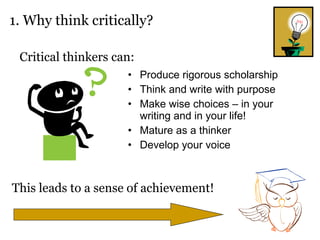
Produce rigorous scholarship Think and write with purpose Make wise choices – in your writing and in your life! Mature as a thinker Develop your voice 1. Why think critically? Critical thinkers can: This leads to a sense of achievement!
So let’s put it into practice…
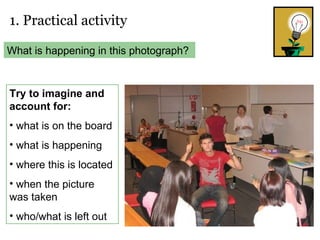
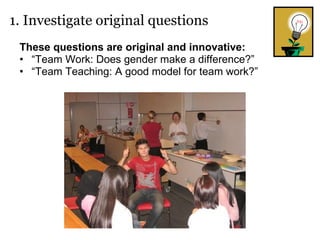
1. Practical activity What is happening in this photograph? Try to imagine and account for: what is on the board what is happening where this is located when the picture was taken who/what is left out
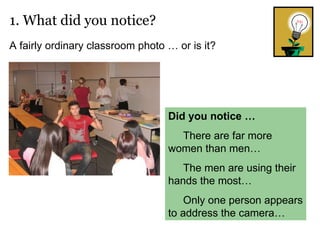
1. What did you notice? Did you notice … There are far more women than men… The men are using their hands the most… Only one person appears to address the camera… A fairly ordinary classroom photo … or is it?
These questions are original and innovative: “ Team Work: Does gender make a difference?” “ Team Teaching: A good model for team work?” 1. Investigate original questions
Critical thinkers go beyond what is ‘obvious’ and are able to: Account for ideas Imagine alternatives Show new directions for exploration 1. Reasons to ask new questions Asking new, innovative questions is often more valuable than having all the answers!
1. Be sceptical about ‘the facts’ Because critical thinkers consider HOW and WHY ideas make sense, what is written on the page is more like a starting point than a simple ‘fact.’  What is written in your readings or said in lectures is a springboard for your thinking!
Critical thinking is a skill and attitude developed and honed over a long period of time.  It is  not  easy.  But,  it   is   worthwhile … 1. A note to remember
Developing skills
You often know more than you think you know. 2. Consider your prior knowledge  When researching consider: If you have studied similar sources Whether you have read an author’s other works How you did this before What your tutor/professor suggested When you might use an idea or concept Why you chose this reading / research topic
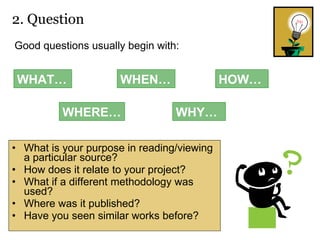
What is your purpose in reading/viewing a particular source? How does it relate to your project?  What if a different methodology was used? Where was it published? Have you seen similar works before? 2. Question  Good questions usually begin with: WHAT… WHERE… WHEN… WHY… HOW…
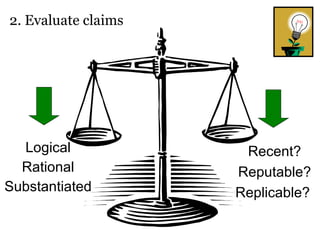
Logical Rational Substantiated 2. Evaluate claims  Recent? Reputable? Replicable?
2. Understand context   When was it written? Who published it? Who else has cited it in their work? Recently? Are the ideas and findings valid? Why? Is the methodology current? What values and attitudes were current at its time and place of publication? What implicit values and assumptions does it contain? When reading new sources, these questions will help with critical evaluation:
Assumptions are often: 2. Identify assumptions  Yours and those in your field - Cultural - Disciplinary - Contextual Consider:
Why might an author emphasise one idea over another? 2. Search for bias  Detecting bias is not an academic game of ‘gotcha.’ It is genuine enquiry into the various convictions of relevant authors in your field.
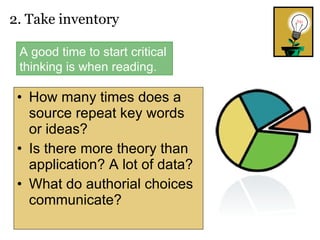
How many times does a source repeat key words or ideas?  Is there more theory than application? A lot of data? What do authorial choices communicate? 2. Take inventory  A good time to start critical thinking is when reading.
What was your initial response to an idea? Can you account for it?  What compels you in a text? What doesn’t? Why? Have you ever read a text and thought, ‘No, you’re wrong!’ or, ‘I wouldn’t do it that way,’ or, ‘What if …?’ 2. Reflect and consider  Reflecting on your response is a crucial part of critical engagement with texts and ideas.
A note to remember: Don’t allow your sources to ‘speak for you’. Use voice to  show   your   thinking . 2. Use voice   Your ideas, readings, and arguments are like pieces of a puzzle that fit together in your writing. How do you account for each piece and its place in the puzzle?     Your  voice  explains the links!
2. Do I have to read everything? There is a lot of literature being published all the time – it would be impossible to read all of it, or even a lot of it! The fact is … The truth is … Awareness of your thinking and interpretation is crucial to good scholarship. Writing is a process of thinking, so write early and often. This helps you offer new, rigorous arguments and ideas.
2. A note to remember Critical thinking skills are developed and honed over a long period of time.  Welcome your ‘slip-ups’ or mistakes: they are tools that will help you learn and understand more!
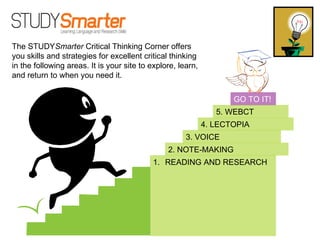
5. WEBCT GO TO IT! 4. LECTOPIA 2. NOTE-MAKING READING AND RESEARCH 3. VOICE The STUDY Smarter  Critical Thinking Corner offers you skills and strategies for excellent critical thinking in the following areas. It is your site to explore, learn, and return to when you need it.

Critical Thinking Corner Welcome

  • 1.
  • 2.
    Overview 1. Whatis critical thinking? 2. Developing skills
  • 3.
  • 4.
    Critical thinking isan approach to knowledge that focuses on how and why ideas ‘make sense.’ 1. What is critical thinking? It includes Reading actively Writing to think (rather than simply to record) Being aware of your response to ideas Making connections between ideas, texts, and contexts Maintaining a position of scepticism or doubt
  • 5.
    Produce rigorous scholarshipThink and write with purpose Make wise choices – in your writing and in your life! Mature as a thinker Develop your voice 1. Why think critically? Critical thinkers can: This leads to a sense of achievement!
  • 6.
    So let’s putit into practice…
  • 7.
    1. Practical activityWhat is happening in this photograph? Try to imagine and account for: what is on the board what is happening where this is located when the picture was taken who/what is left out
  • 8.
    1. What didyou notice? Did you notice … There are far more women than men… The men are using their hands the most… Only one person appears to address the camera… A fairly ordinary classroom photo … or is it?
  • 9.
    These questions areoriginal and innovative: “ Team Work: Does gender make a difference?” “ Team Teaching: A good model for team work?” 1. Investigate original questions
  • 10.
    Critical thinkers gobeyond what is ‘obvious’ and are able to: Account for ideas Imagine alternatives Show new directions for exploration 1. Reasons to ask new questions Asking new, innovative questions is often more valuable than having all the answers!
  • 11.
    1. Be scepticalabout ‘the facts’ Because critical thinkers consider HOW and WHY ideas make sense, what is written on the page is more like a starting point than a simple ‘fact.’ What is written in your readings or said in lectures is a springboard for your thinking!
  • 12.
    Critical thinking isa skill and attitude developed and honed over a long period of time. It is not easy. But, it is worthwhile … 1. A note to remember
  • 13.
  • 14.
    You often knowmore than you think you know. 2. Consider your prior knowledge When researching consider: If you have studied similar sources Whether you have read an author’s other works How you did this before What your tutor/professor suggested When you might use an idea or concept Why you chose this reading / research topic
  • 15.
    What is yourpurpose in reading/viewing a particular source? How does it relate to your project? What if a different methodology was used? Where was it published? Have you seen similar works before? 2. Question Good questions usually begin with: WHAT… WHERE… WHEN… WHY… HOW…
  • 16.
    Logical Rational Substantiated2. Evaluate claims Recent? Reputable? Replicable?
  • 17.
    2. Understand context When was it written? Who published it? Who else has cited it in their work? Recently? Are the ideas and findings valid? Why? Is the methodology current? What values and attitudes were current at its time and place of publication? What implicit values and assumptions does it contain? When reading new sources, these questions will help with critical evaluation:
  • 18.
    Assumptions are often:2. Identify assumptions Yours and those in your field - Cultural - Disciplinary - Contextual Consider:
  • 19.
    Why might anauthor emphasise one idea over another? 2. Search for bias Detecting bias is not an academic game of ‘gotcha.’ It is genuine enquiry into the various convictions of relevant authors in your field.
  • 20.
    How many timesdoes a source repeat key words or ideas? Is there more theory than application? A lot of data? What do authorial choices communicate? 2. Take inventory A good time to start critical thinking is when reading.
  • 21.
    What was yourinitial response to an idea? Can you account for it? What compels you in a text? What doesn’t? Why? Have you ever read a text and thought, ‘No, you’re wrong!’ or, ‘I wouldn’t do it that way,’ or, ‘What if …?’ 2. Reflect and consider Reflecting on your response is a crucial part of critical engagement with texts and ideas.
  • 22.
    A note toremember: Don’t allow your sources to ‘speak for you’. Use voice to show your thinking . 2. Use voice Your ideas, readings, and arguments are like pieces of a puzzle that fit together in your writing. How do you account for each piece and its place in the puzzle?  Your voice explains the links!
  • 23.
    2. Do Ihave to read everything? There is a lot of literature being published all the time – it would be impossible to read all of it, or even a lot of it! The fact is … The truth is … Awareness of your thinking and interpretation is crucial to good scholarship. Writing is a process of thinking, so write early and often. This helps you offer new, rigorous arguments and ideas.
  • 24.
    2. A noteto remember Critical thinking skills are developed and honed over a long period of time. Welcome your ‘slip-ups’ or mistakes: they are tools that will help you learn and understand more!
  • 25.
    5. WEBCT GOTO IT! 4. LECTOPIA 2. NOTE-MAKING READING AND RESEARCH 3. VOICE The STUDY Smarter Critical Thinking Corner offers you skills and strategies for excellent critical thinking in the following areas. It is your site to explore, learn, and return to when you need it.