Reading and  note-making
Overview Reading Note-making
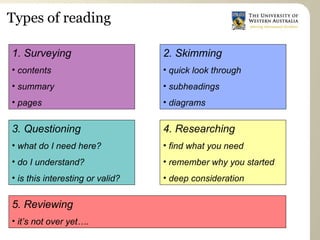
1. Surveying contents summary  pages 2. Skimming quick look through subheadings diagrams 3. Questioning what do I need here? do I understand? is this interesting or valid? 4. Researching find what you need remember why you started deep consideration  5. Reviewing it’s not over yet…. Types of reading
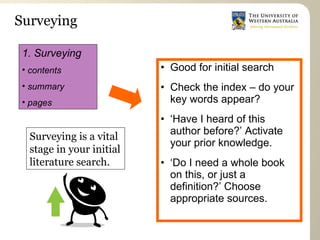
Surveying Good for initial search  Check the index – do your key words appear? ‘Have I heard of this author before?’ Activate your prior knowledge. ‘Do I need a whole book on this, or just a definition?’ Choose appropriate sources. 1. Surveying contents summary  pages Surveying is a vital stage in your initial literature search.
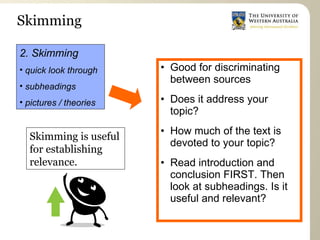
Skimming Good for discriminating between sources  Does it address your topic? How much of the text is devoted to your topic? Read introduction and conclusion FIRST. Then look at subheadings. Is it useful and relevant? 2. Skimming quick look through subheadings pictures / theories Skimming is useful for establishing relevance.
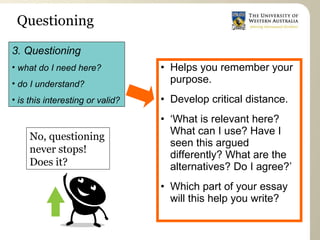
Questioning Helps you remember your purpose.  Develop critical distance. ‘What is relevant here? What can I use? Have I seen this argued differently? What are the alternatives? Do I agree?’ Which part of your essay will this help you write? 3. Questioning what do I need here? do I understand? is this interesting or valid? No, questioning never stops!  Does it?
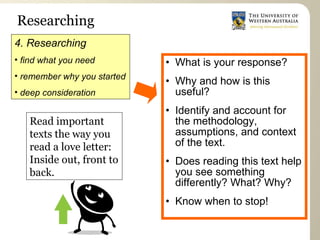
Researching What is your response?  Why and how is this useful? Identify and account for the methodology, assumptions, and context of the text. Does reading this text help you see something differently? What? Why? Know when to stop! 4. Researching find what you need remember why you started deep consideration  Read important texts the way you read a love letter: Inside out, front to back.
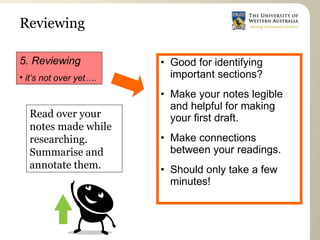
Reviewing Good for identifying important sections?  Make your notes legible and helpful for making your first draft. Make connections between your readings. Should only take a few minutes! 5. Reviewing it’s not over yet…. Read over your notes made while researching. Summarise and annotate them.
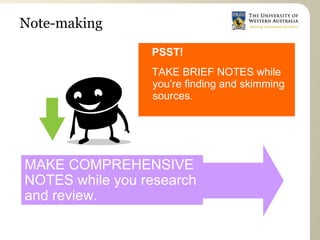
Note-making PSST! TAKE BRIEF NOTES while you’re finding and skimming sources.  MAKE COMPREHENSIVE NOTES while you research and review.
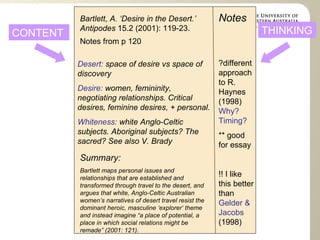
Bartlett, A. ‘Desire in the Desert.’ Antipodes  15.2 (2001): 119-23. Notes ?different approach to R. Haynes (1998)  Why? Timing? ** good for essay !! I like this better than  Gelder & Jacobs  (1998) Summary: Bartlett maps personal issues and relationships that are established and transformed through travel to the desert, and argues that white, Anglo-Celtic Australian women’s narratives of desert travel resist the dominant heroic, masculine ‘explorer’ theme and instead imagine “a place of potential, a place in which social relations might be remade” (2001: 121).  Desert:  space of desire vs space of discovery Desire:  women, femininity, negotiating relationships. Critical desires, feminine desires, + personal. Whiteness:  white Anglo-Celtic subjects. Aboriginal subjects? The sacred? See also V. Brady CONTENT THINKING Notes from p 120
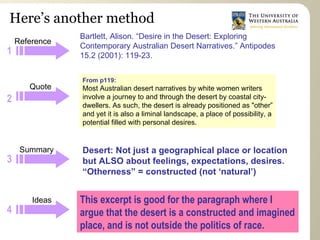
Here’s another method Bartlett, Alison. “Desire in the Desert: Exploring Contemporary Australian Desert Narratives.” Antipodes 15.2 (2001): 119-23. From p119: Most Australian desert narratives by white women writers involve a journey to and through the desert by coastal city- dwellers. As such, the desert is already positioned as "other” and yet it is also a liminal landscape, a place of possibility, a potential filled with personal desires. This excerpt is good for the paragraph where I argue that the desert is a constructed and imagined place, and is not outside the politics of race.   Desert: Not just a geographical place or location but ALSO about feelings, expectations, desires. “Otherness” = constructed (not ‘natural’)  1 2 3 4 Reference Quote Summary Ideas
Why bother with the thinking part? Know when to stop reading. Feel you understand the material enough to write. Shape paragraphs and ideas early. Consolidate your reading. Actively engage in research. Probably write more clearly, cogently, and thoughtfully. By considering how, where, and why a quote or passage is useful you will:
Using STUDY Smarter  Resources This resource was developed by the STUDY Smarter  team at UWA for students enrolled at UWA.  We are happy for our resources to be used but we would ask that you: Do not amend them Do not remove the STUDY Smarter  or UWA logos Give credit/reference to the STUDY Smarter  team where necessary

Reading and Notemaking

  • 1.
    Reading and note-making
  • 2.
  • 3.
    1. Surveying contentssummary pages 2. Skimming quick look through subheadings diagrams 3. Questioning what do I need here? do I understand? is this interesting or valid? 4. Researching find what you need remember why you started deep consideration 5. Reviewing it’s not over yet…. Types of reading
  • 4.
    Surveying Good forinitial search Check the index – do your key words appear? ‘Have I heard of this author before?’ Activate your prior knowledge. ‘Do I need a whole book on this, or just a definition?’ Choose appropriate sources. 1. Surveying contents summary pages Surveying is a vital stage in your initial literature search.
  • 5.
    Skimming Good fordiscriminating between sources Does it address your topic? How much of the text is devoted to your topic? Read introduction and conclusion FIRST. Then look at subheadings. Is it useful and relevant? 2. Skimming quick look through subheadings pictures / theories Skimming is useful for establishing relevance.
  • 6.
    Questioning Helps youremember your purpose. Develop critical distance. ‘What is relevant here? What can I use? Have I seen this argued differently? What are the alternatives? Do I agree?’ Which part of your essay will this help you write? 3. Questioning what do I need here? do I understand? is this interesting or valid? No, questioning never stops! Does it?
  • 7.
    Researching What isyour response? Why and how is this useful? Identify and account for the methodology, assumptions, and context of the text. Does reading this text help you see something differently? What? Why? Know when to stop! 4. Researching find what you need remember why you started deep consideration Read important texts the way you read a love letter: Inside out, front to back.
  • 8.
    Reviewing Good foridentifying important sections? Make your notes legible and helpful for making your first draft. Make connections between your readings. Should only take a few minutes! 5. Reviewing it’s not over yet…. Read over your notes made while researching. Summarise and annotate them.
  • 9.
    Note-making PSST! TAKEBRIEF NOTES while you’re finding and skimming sources. MAKE COMPREHENSIVE NOTES while you research and review.
  • 10.
    Bartlett, A. ‘Desirein the Desert.’ Antipodes 15.2 (2001): 119-23. Notes ?different approach to R. Haynes (1998) Why? Timing? ** good for essay !! I like this better than Gelder & Jacobs (1998) Summary: Bartlett maps personal issues and relationships that are established and transformed through travel to the desert, and argues that white, Anglo-Celtic Australian women’s narratives of desert travel resist the dominant heroic, masculine ‘explorer’ theme and instead imagine “a place of potential, a place in which social relations might be remade” (2001: 121). Desert: space of desire vs space of discovery Desire: women, femininity, negotiating relationships. Critical desires, feminine desires, + personal. Whiteness: white Anglo-Celtic subjects. Aboriginal subjects? The sacred? See also V. Brady CONTENT THINKING Notes from p 120
  • 11.
    Here’s another methodBartlett, Alison. “Desire in the Desert: Exploring Contemporary Australian Desert Narratives.” Antipodes 15.2 (2001): 119-23. From p119: Most Australian desert narratives by white women writers involve a journey to and through the desert by coastal city- dwellers. As such, the desert is already positioned as "other” and yet it is also a liminal landscape, a place of possibility, a potential filled with personal desires. This excerpt is good for the paragraph where I argue that the desert is a constructed and imagined place, and is not outside the politics of race. Desert: Not just a geographical place or location but ALSO about feelings, expectations, desires. “Otherness” = constructed (not ‘natural’) 1 2 3 4 Reference Quote Summary Ideas
  • 12.
    Why bother withthe thinking part? Know when to stop reading. Feel you understand the material enough to write. Shape paragraphs and ideas early. Consolidate your reading. Actively engage in research. Probably write more clearly, cogently, and thoughtfully. By considering how, where, and why a quote or passage is useful you will:
  • 13.
    Using STUDY Smarter Resources This resource was developed by the STUDY Smarter team at UWA for students enrolled at UWA. We are happy for our resources to be used but we would ask that you: Do not amend them Do not remove the STUDY Smarter or UWA logos Give credit/reference to the STUDY Smarter team where necessary