CRITICAL THEORY
Presented By
Garret Raja Immanuel
St.John’s College, Palayamkottai.
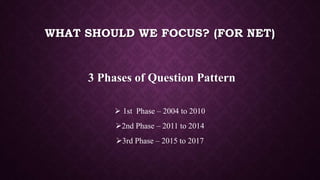
WHAT SHOULD WE FOCUS? (FOR NET)
3 Phases of Question Pattern
 1st Phase – 2004 to 2010
2nd Phase – 2011 to 2014
3rd Phase – 2015 to 2017
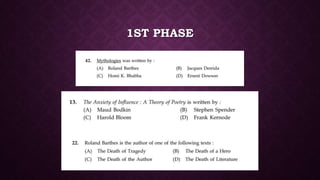
1ST PHASE
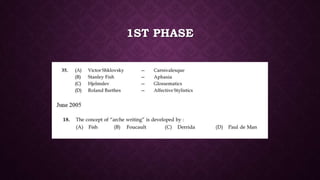
1ST PHASE
1ST PHASE
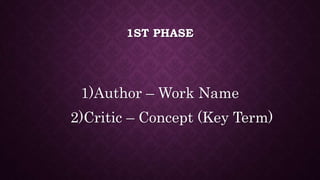
1)Author – Work Name
2)Critic – Concept (Key Term)
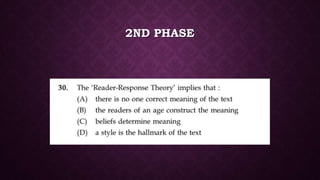
2ND PHASE
2ND PHASE
2ND PHASE
2ND PHASE
2ND PHASE
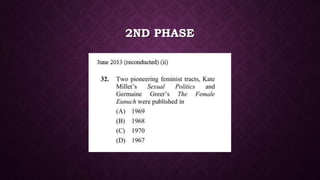
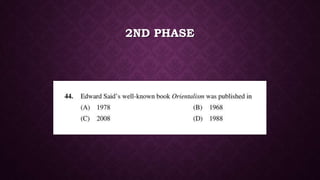
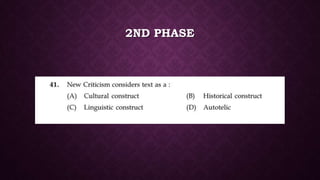
1)YEARS OF CRITICAL WORKS
2)DEFINITION /CHARACTERISTICS OF SCHOOL
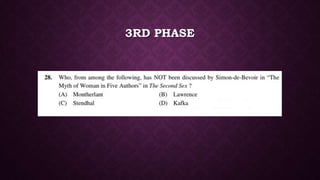
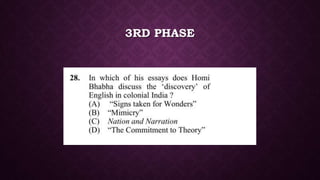
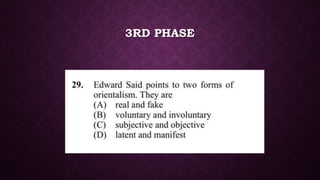
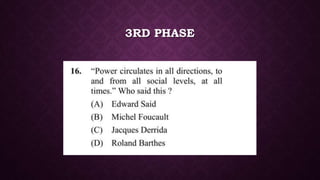
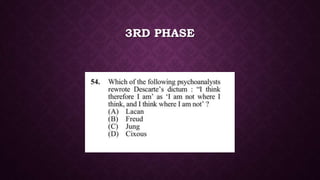
3RD PHASE
3RD PHASE
3RD PHASE
3RD PHASE
3RD PHASE
3RD PHASE
1)WITH IN THE CRITICAL WORK
2)QUOTES OF CRITICS FROM WORKS
A ROOM OF ONE’S OWN
• A Room of One's Own is an extended essay
by Virginia Woolf.
• She was asked to give a lecture on “Women and
Fiction”.
•According to Woolf "a woman must have
money and a room of her own if she is to
write fiction"
PARTLY-FICTIONALIZED
"call me Mary Beton, Mary Seton, Mary
Carmichael or by any name you please—it is not a
matter of any importance“.
OXBRIDGE (Fictional University)
Thinking = Fishing
Idea or Thought = Fish
Grass – Only for Scholars and Fellows
Gravel Path - Women
• “ladies are only admitted to the library if
accompanied by a Fellow of the College or
furnished with a letter of introduction."
•Thinks about the lunch that was served at
the college.
• "a cat without a tail" – Lacking in Lunch Party.
•describes a meal at Fernham.
•Compares it With OXBRIDGE.
•Retires to her friend Mary Seton’s
Room.
BRITISH MUSEUM
• Books about women
• Checking the "M" listings
• “Been written in the red light of emotion and not
in the white light of truth”
• Five hundred pounds a year by her aunt, Mary
Beton.
JUDITH SHAKESPEARE
• Judith is as gifted perhaps as her brother.
• Denied Formal Education.
• She becomes engaged
• She wants to go into acting
• She is finally taken up by a theater-manager,
• becomes pregnant by him, and commits suicide.
WOMEN WRITERS IN HISTORY
• 1)Alphra Ben
• 2)Emily Bronte
• 3)Jane Austen
• “But women may not always choose to write
novels. They have poetry in them still
unexpressed.”
MARY CARMICHAEL
• “Life's Adventure by Mary Carmichael”
• "Chloe liked Olivia.“
• Lesbianism.
MR. A
• An imagined male author
• “Women, then, have not had a dog's chance of
writing poetry. That is why I have laid so much
stress on money and a room of one's own."
TOWARDS FEMINIST POETICS
• Elaine Showalter’s Critical Essay.
• Published in 1979.
• Feminist criticism can be divided into two
varieties.
TWO TYPES OF FEMINIST CRITICISM
•1. Woman as reader [Feminist Critique]
Male-oriented , We get only experience of
whaat men have felt
•2. Woman as writer [Gynocritics]
•Female language
3 STAGES OF WOMEN WRITERS
• “A Literature of Their Own”
• 1) The first phase, the feminine phase dates
from about 1840-1880
• During that period women wrote in an effort to
equal the intellectual achievements of the male
culture.
• sign of this period is the male pseudonym
FEMINIST PHASE
• 2) The feminist phase lasted about 38 years; from
1882 to 1920
• The women writers of this phase protested against
the male canons and values
• They rejected any text that stereotyped the women
FEMALE PHASE
• The Female Phase (1920 to present):- The writers such as
Rebecca West, Katherine Mansfield, and Dorothy
Richardson
• women reject both imitation and protest—two forms of
dependency
• Independability.
ORIENTALISM (1978)
•Orientalism by Edward Said
•Europeans divided the world into two
parts
•Occident vs Orient
CHAPTER 1: THE SCOPE OF ORIENTALISM
• orientals started considering the orientals as
non-human beings
• divided the world in to two parts
• ours and theirs
• The orients were regarded as uncivilized people
• since they were the refined race it was their duty to civilize
these people and in order to achieve their goal.
• the orients themselves were incapable of running their own
government.
• every thing the orientals said and did was recorded
irrespective of its context, and projected to the civilized
• Europeans was that they defined themselves by
defining the orientals.
• culture of the orientals was explained to the
European audience by linking them to the western
culture
• Mohammadism
CHAPTER 2: ORIENTALIST STRUCTURES AND
RESTRUCTURES
• literary work
• romanticized by the European poets
• they were biologically superior, and secondly it were
the Europeans who discovered the orients not the
orients who discovered the Europeans.
• orientalists of the 19th century, namely Silvestre de
Sacy and Ernest Renan
CHAPTER 3 : ORIENTALISM NOW
• The earlier orientalists did not interact a lot with the
orients, whereas the new orients lived with them as if they
were one of them
• Lawrence of Arabia was one of such orienatlists.
• two other scholars Massignon and Gibb.
• Islam as a weak religion.
• orient perspective too.
Critical theory

Critical theory

  • 1.
    CRITICAL THEORY Presented By GarretRaja Immanuel St.John’s College, Palayamkottai.
  • 2.
    WHAT SHOULD WEFOCUS? (FOR NET) 3 Phases of Question Pattern  1st Phase – 2004 to 2010 2nd Phase – 2011 to 2014 3rd Phase – 2015 to 2017
  • 3.
  • 4.
  • 5.
    1ST PHASE 1)Author –Work Name 2)Critic – Concept (Key Term)
  • 6.
  • 7.
  • 8.
  • 9.
  • 10.
    2ND PHASE 1)YEARS OFCRITICAL WORKS 2)DEFINITION /CHARACTERISTICS OF SCHOOL
  • 11.
  • 12.
  • 13.
  • 14.
  • 15.
  • 16.
    3RD PHASE 1)WITH INTHE CRITICAL WORK 2)QUOTES OF CRITICS FROM WORKS
  • 17.
    A ROOM OFONE’S OWN • A Room of One's Own is an extended essay by Virginia Woolf. • She was asked to give a lecture on “Women and Fiction”.
  • 18.
    •According to Woolf"a woman must have money and a room of her own if she is to write fiction"
  • 19.
    PARTLY-FICTIONALIZED "call me MaryBeton, Mary Seton, Mary Carmichael or by any name you please—it is not a matter of any importance“. OXBRIDGE (Fictional University)
  • 20.
    Thinking = Fishing Ideaor Thought = Fish Grass – Only for Scholars and Fellows Gravel Path - Women
  • 21.
    • “ladies areonly admitted to the library if accompanied by a Fellow of the College or furnished with a letter of introduction." •Thinks about the lunch that was served at the college. • "a cat without a tail" – Lacking in Lunch Party.
  • 22.
    •describes a mealat Fernham. •Compares it With OXBRIDGE. •Retires to her friend Mary Seton’s Room.
  • 23.
    BRITISH MUSEUM • Booksabout women • Checking the "M" listings • “Been written in the red light of emotion and not in the white light of truth” • Five hundred pounds a year by her aunt, Mary Beton.
  • 24.
    JUDITH SHAKESPEARE • Judithis as gifted perhaps as her brother. • Denied Formal Education. • She becomes engaged • She wants to go into acting • She is finally taken up by a theater-manager, • becomes pregnant by him, and commits suicide.
  • 25.
    WOMEN WRITERS INHISTORY • 1)Alphra Ben • 2)Emily Bronte • 3)Jane Austen • “But women may not always choose to write novels. They have poetry in them still unexpressed.”
  • 26.
    MARY CARMICHAEL • “Life'sAdventure by Mary Carmichael” • "Chloe liked Olivia.“ • Lesbianism.
  • 27.
    MR. A • Animagined male author • “Women, then, have not had a dog's chance of writing poetry. That is why I have laid so much stress on money and a room of one's own."
  • 28.
    TOWARDS FEMINIST POETICS •Elaine Showalter’s Critical Essay. • Published in 1979. • Feminist criticism can be divided into two varieties.
  • 29.
    TWO TYPES OFFEMINIST CRITICISM •1. Woman as reader [Feminist Critique] Male-oriented , We get only experience of whaat men have felt •2. Woman as writer [Gynocritics] •Female language
  • 30.
    3 STAGES OFWOMEN WRITERS • “A Literature of Their Own” • 1) The first phase, the feminine phase dates from about 1840-1880 • During that period women wrote in an effort to equal the intellectual achievements of the male culture. • sign of this period is the male pseudonym
  • 31.
    FEMINIST PHASE • 2)The feminist phase lasted about 38 years; from 1882 to 1920 • The women writers of this phase protested against the male canons and values • They rejected any text that stereotyped the women
  • 32.
    FEMALE PHASE • TheFemale Phase (1920 to present):- The writers such as Rebecca West, Katherine Mansfield, and Dorothy Richardson • women reject both imitation and protest—two forms of dependency • Independability.
  • 33.
    ORIENTALISM (1978) •Orientalism byEdward Said •Europeans divided the world into two parts •Occident vs Orient
  • 34.
    CHAPTER 1: THESCOPE OF ORIENTALISM • orientals started considering the orientals as non-human beings • divided the world in to two parts • ours and theirs
  • 35.
    • The orientswere regarded as uncivilized people • since they were the refined race it was their duty to civilize these people and in order to achieve their goal. • the orients themselves were incapable of running their own government. • every thing the orientals said and did was recorded irrespective of its context, and projected to the civilized
  • 36.
    • Europeans wasthat they defined themselves by defining the orientals. • culture of the orientals was explained to the European audience by linking them to the western culture • Mohammadism
  • 37.
    CHAPTER 2: ORIENTALISTSTRUCTURES AND RESTRUCTURES • literary work • romanticized by the European poets • they were biologically superior, and secondly it were the Europeans who discovered the orients not the orients who discovered the Europeans. • orientalists of the 19th century, namely Silvestre de Sacy and Ernest Renan
  • 38.
    CHAPTER 3 :ORIENTALISM NOW • The earlier orientalists did not interact a lot with the orients, whereas the new orients lived with them as if they were one of them • Lawrence of Arabia was one of such orienatlists. • two other scholars Massignon and Gibb. • Islam as a weak religion. • orient perspective too.