1
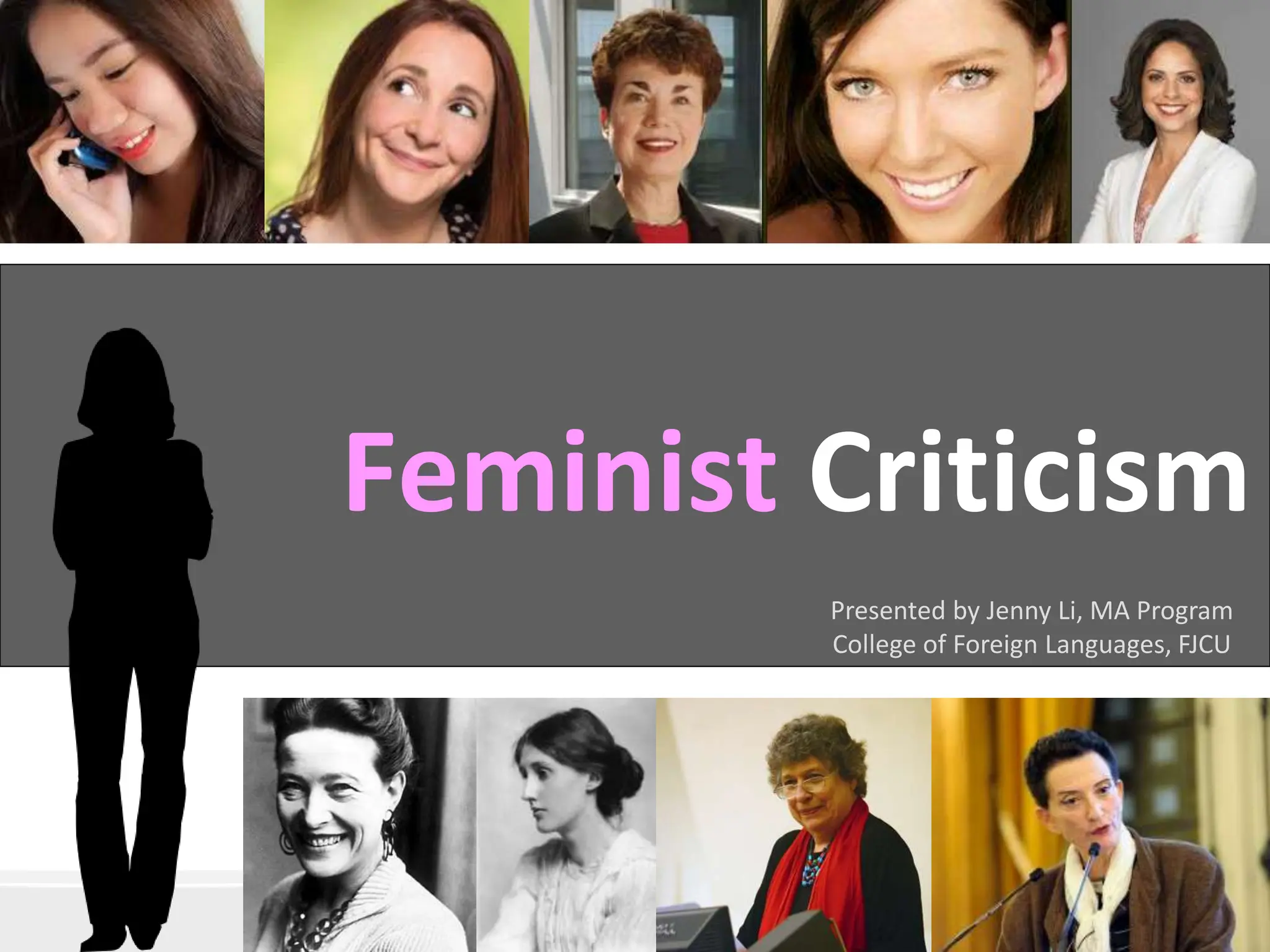
Feminist Criticism
Presented by Jenny Li, MA Program
College of Foreign Languages, FJCU
2
Presentation Outline
Feminism and feminist criticism
Feminist criticism and the role of theory
Feminist criticism and language
Feminist criticism and psychoanalysis
Woman’s role: Wuthering Heights
Questions
Works cited
3
• The “women’s movement” of the 1960s: a renewal
 Mary Wollstonecraft’s A Vindication of the Rights of Women
(1792)
 Virginia Woolf’s A Room of One’s Own (1929)
• The direct product of the women’s movement of
the 1960s
• The movement realized the significance of the
images of women promulgated by literature
 Not an off-shoot or a spin-off from feminism
 But one of its most practical ways of influencing everyday
conduct and attitudes
Feminism and feminist criticism
4
• The representation of women in literature: socialization
Toril Moi’s explanation
 Feminist: A political position
 Female: A matter of biology
 Feminine: A set of culturally defined characteristics
 19th-century fiction: the focus of interest is on the heroine’s choice
of marriage partner, which will decide her ultimate social position.
• 1970s: exposing “mechanisms of patriarchy”
 The cultural “mind-set” in men and women which perpetuated
sexual inequality (male writers constructed typical images of
women)
 Elaine Showaiter: “andro-texts”→“gynotexts”
Feminism and feminist criticism
5
• 1980s
 Feminist criticism became much more eclectic (drew upon other
criticism)
 Attacking male versions of the world→Exploring the nature of the
female world and outlook.
• Elaine Showaiter: the history of women’s writing
 Feminine phase (1840-1880): imitated
 Feminist phase (1880-1920): maintained
 Female phase (1920 onwards): looked particularly at…
• Three particular areas: theory, language,
psychoanalysis
Feminism and feminist criticism
6
• A major division within feminist criticism has
concerned disagreements about the amount and
type of theory.
Anglo-American version of feminism: more skeptical
about recent critical theory, and more cautious in using
it. (close reading and explication of individual literary
texts)
English feminist criticism: tends to be “socialist feminist”
in orientation. (cultural materialism and Marxism)
French feminists: language and psychology (the literary
text is never primarily a representation of reality.)
Feminist criticism and the role of theory
7
• Do women have any specific language form?
• Virginia Woolf: language use is gendered
• A “woman’s sentence”: the clauses are linked in
looser sequences, rather than carefully balanced
and patterned as in male prose.
• Helene Cixous, French theorist: ecriture feminine
It is associated with the feminine, and facilitating the
free play of meanings within the framework of loosened
grammatical structures.
Feminist criticism and language
8
• Kate Millett’s Sexual Politics (1969)
it condemns Freud as a prime source of the patriarchal
attitudes against which feminists must fight.
• Juliet Mitchell’s Psychoanalysis and Feminism
(1974)
a defense for Freud against Millett.
• Simone de Beauvoir, The Second Sex (1949)
“One is not born a woman; rather, one becomes a
woman.”
Feminist criticism and psychoanalysis
9
Woman’s role: Wuthering Heights
• Gilbert and Gubar’s strategy with Bronte’s
novel: a female version of the male form
In male form: the hero’s growth to manhood is traced,
as a process of “triumphant self-discovery”, whereby
an identity is discovered and a mission in life
conceived and embarked upon.
In female form: the heroine’s growth to womanhood
records a process of “anxious self-denial”, this being
the “ultimate product of a female education.”
10
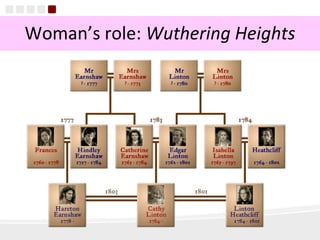
Woman’s role: Wuthering Heights
11
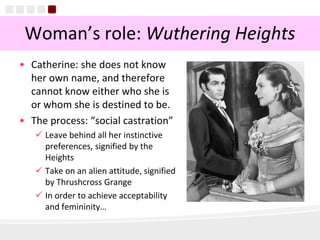
Woman’s role: Wuthering Heights
• Catherine: she does not know
her own name, and therefore
cannot know either who she is
or whom she is destined to be.
• The process: “social castration”
 Leave behind all her instinctive
preferences, signified by the
Heights
 Take on an alien attitude, signified
by Thrushcross Grange
 In order to achieve acceptability
and femininity…
12
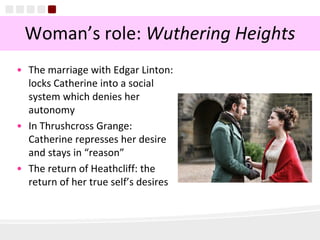
Woman’s role: Wuthering Heights
• The marriage with Edgar Linton:
locks Catherine into a social
system which denies her
autonomy
• In Thrushcross Grange:
Catherine represses her desire
and stays in “reason”
• The return of Heathcliff: the
return of her true self’s desires
13
Questions
• Do women/men have any specific language form?
• Do you agree that women are “defined” or “constructed”
by society/men? If not, then who/what defines women?
(language?)
• Are the terms such as “male/female”, “hero/heroine”,
“history/herstory” the products of feminism? Do they
strive for a gender balance in language?
• If a man concerns about female issues, and makes great
contributions in this field, can he be called as a “feminist”?
(The Guy’s Guide to Feminism by Michael Kimmel and
Michael Kaufman) (ex. abolitionist)
14
• Barry, Peter. Beginning Theory: An Introduction
to Literary and Cultural Theory. 2nd ed.
Manchester University P. 2002.
• 塞爾登等著,劉象愚譯。《當代文學理論導
讀》,五版,北京:北京大學出版社。2006年
12月。
Works Cited

2014s_jenny_feminist_criticism.ppt

  • 1.
    1 Feminist Criticism Presented byJenny Li, MA Program College of Foreign Languages, FJCU
  • 2.
    2 Presentation Outline Feminism andfeminist criticism Feminist criticism and the role of theory Feminist criticism and language Feminist criticism and psychoanalysis Woman’s role: Wuthering Heights Questions Works cited
  • 3.
    3 • The “women’smovement” of the 1960s: a renewal  Mary Wollstonecraft’s A Vindication of the Rights of Women (1792)  Virginia Woolf’s A Room of One’s Own (1929) • The direct product of the women’s movement of the 1960s • The movement realized the significance of the images of women promulgated by literature  Not an off-shoot or a spin-off from feminism  But one of its most practical ways of influencing everyday conduct and attitudes Feminism and feminist criticism
  • 4.
    4 • The representationof women in literature: socialization Toril Moi’s explanation  Feminist: A political position  Female: A matter of biology  Feminine: A set of culturally defined characteristics  19th-century fiction: the focus of interest is on the heroine’s choice of marriage partner, which will decide her ultimate social position. • 1970s: exposing “mechanisms of patriarchy”  The cultural “mind-set” in men and women which perpetuated sexual inequality (male writers constructed typical images of women)  Elaine Showaiter: “andro-texts”→“gynotexts” Feminism and feminist criticism
  • 5.
    5 • 1980s  Feministcriticism became much more eclectic (drew upon other criticism)  Attacking male versions of the world→Exploring the nature of the female world and outlook. • Elaine Showaiter: the history of women’s writing  Feminine phase (1840-1880): imitated  Feminist phase (1880-1920): maintained  Female phase (1920 onwards): looked particularly at… • Three particular areas: theory, language, psychoanalysis Feminism and feminist criticism
  • 6.
    6 • A majordivision within feminist criticism has concerned disagreements about the amount and type of theory. Anglo-American version of feminism: more skeptical about recent critical theory, and more cautious in using it. (close reading and explication of individual literary texts) English feminist criticism: tends to be “socialist feminist” in orientation. (cultural materialism and Marxism) French feminists: language and psychology (the literary text is never primarily a representation of reality.) Feminist criticism and the role of theory
  • 7.
    7 • Do womenhave any specific language form? • Virginia Woolf: language use is gendered • A “woman’s sentence”: the clauses are linked in looser sequences, rather than carefully balanced and patterned as in male prose. • Helene Cixous, French theorist: ecriture feminine It is associated with the feminine, and facilitating the free play of meanings within the framework of loosened grammatical structures. Feminist criticism and language
  • 8.
    8 • Kate Millett’sSexual Politics (1969) it condemns Freud as a prime source of the patriarchal attitudes against which feminists must fight. • Juliet Mitchell’s Psychoanalysis and Feminism (1974) a defense for Freud against Millett. • Simone de Beauvoir, The Second Sex (1949) “One is not born a woman; rather, one becomes a woman.” Feminist criticism and psychoanalysis
  • 9.
    9 Woman’s role: WutheringHeights • Gilbert and Gubar’s strategy with Bronte’s novel: a female version of the male form In male form: the hero’s growth to manhood is traced, as a process of “triumphant self-discovery”, whereby an identity is discovered and a mission in life conceived and embarked upon. In female form: the heroine’s growth to womanhood records a process of “anxious self-denial”, this being the “ultimate product of a female education.”
  • 10.
  • 11.
    11 Woman’s role: WutheringHeights • Catherine: she does not know her own name, and therefore cannot know either who she is or whom she is destined to be. • The process: “social castration”  Leave behind all her instinctive preferences, signified by the Heights  Take on an alien attitude, signified by Thrushcross Grange  In order to achieve acceptability and femininity…
  • 12.
    12 Woman’s role: WutheringHeights • The marriage with Edgar Linton: locks Catherine into a social system which denies her autonomy • In Thrushcross Grange: Catherine represses her desire and stays in “reason” • The return of Heathcliff: the return of her true self’s desires
  • 13.
    13 Questions • Do women/menhave any specific language form? • Do you agree that women are “defined” or “constructed” by society/men? If not, then who/what defines women? (language?) • Are the terms such as “male/female”, “hero/heroine”, “history/herstory” the products of feminism? Do they strive for a gender balance in language? • If a man concerns about female issues, and makes great contributions in this field, can he be called as a “feminist”? (The Guy’s Guide to Feminism by Michael Kimmel and Michael Kaufman) (ex. abolitionist)
  • 14.
    14 • Barry, Peter.Beginning Theory: An Introduction to Literary and Cultural Theory. 2nd ed. Manchester University P. 2002. • 塞爾登等著,劉象愚譯。《當代文學理論導 讀》,五版,北京:北京大學出版社。2006年 12月。 Works Cited