







LATE VICTORIAN
LITERATURE (1880-
1900)
The Late Victorian Period (1880-
1900)
 Decay of Victorian values
 British imperialism
 Boer War Irish question
 Bismarck's Germany became a rival
power
 United States became a rival power
 Economic depression led to mass
immigration
 Socialism
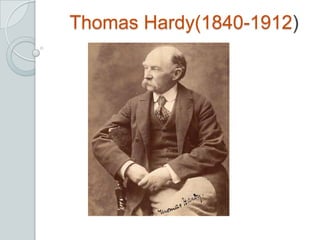
Thomas Hardy(1840-1912)
Biography
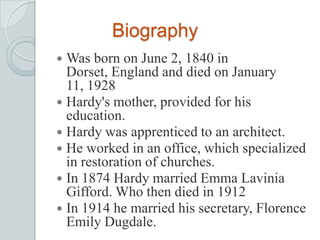
 Was born on June 2, 1840 in
Dorset, England and died on January
11, 1928
 Hardy's mother, provided for his
education.
 Hardy was apprenticed to an architect.
 He worked in an office, which specialized
in restoration of churches.
 In 1874 Hardy married Emma Lavinia
Gifford. Who then died in 1912
 In 1914 he married his secretary, Florence
Emily Dugdale.
Occupation
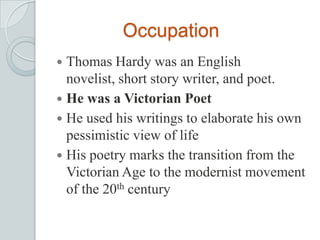
 Thomas Hardy was an English
novelist, short story writer, and poet.
 He was a Victorian Poet
 He used his writings to elaborate his own
pessimistic view of life
 His poetry marks the transition from the
Victorian Age to the modernist movement
of the 20th century
Achievements
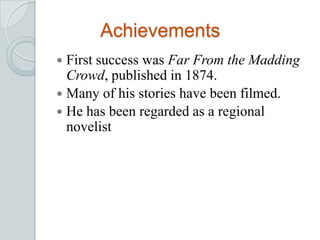
 First success was Far From the Madding
Crowd, published in 1874.
 Many of his stories have been filmed.
 He has been regarded as a regional
novelist
Novels
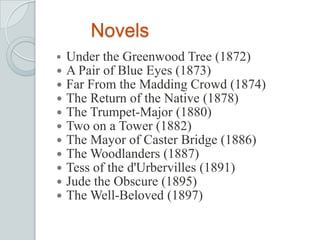
 Under the Greenwood Tree (1872)
 A Pair of Blue Eyes (1873)
 Far From the Madding Crowd (1874)
 The Return of the Native (1878)
 The Trumpet-Major (1880)
 Two on a Tower (1882)
 The Mayor of Caster Bridge (1886)
 The Woodlanders (1887)
 Tess of the d'Urbervilles (1891)
 Jude the Obscure (1895)
 The Well-Beloved (1897)
Short Stories
 Barbara of the House of Grebe (1890)
 The Vampirine Fair (1909)
 Absent-mindedness in a Parish Choir
 The Duke's Reappearance
 The Return of the Native (excerpt)
 Squire Petrick's Lady
 Tony Kytes, the Arch-Deceiver
 The Withered Arm
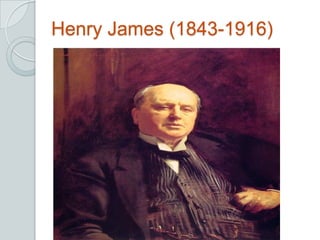
Henry James (1843-1916)
Henry James
American-born writer, gifted with
talents in literature, psychology, and
philosophy.
 James wrote 20 novels, 112 stories, 12
plays and a number of works of literary
criticism.
His Major Achievement and
Specific Feature of His Works
 James first achieved recognition as a writer
of the “international novel” (international
theme)---a story which brings together
persons of various nationalities who
represent certain characteristics of their
countries.
 The American’s, however, usually have a
morality and innocence which the Europeans
lack.
 James seemed to value both the
sophistication of Europe and the idealism of
America.
Notable works by James
 Novels
 Novellas and tales
 Travel writings
 Literary criticism
 Memoirs and Autobiography
 Plays
 Biographies
Novels
 Watch and Ward (1871) )
 The American (1877)
 The Europeans (1878)
 Confidence (1879)
 Washington Square (1880)
 The Portrait of a Lady (1881)
 The Bostonians (1886)
 The Tragic Muse (1890)
 The Other House (1896)
 The Awkward Age (1899
 The Sacred Fount (1901)
 The Wings of the Dove (1902)
 The Ambassadors (1903)
 The Golden Bowl (1904)
 The Outcry (1911)
Travel writings
 A Little Tour in France (1884)
 English Hours (1905)
 The American Scene (1907)
 Italian Hours (1909)
Plays
Theatricals (1894)
Theatricals: Second Series
(1895)
 Guy Dom Ville (1895)
James' Literary Criticism
Henry James' literary criticism
is an indispensable part of his
contribution to literature.
He worked out his influential
principles of fiction in The Art
of Fiction (1884).
Themes
The Importance of Place
The Lived vs. Unlived Life
The American Abroad
Aestheticism
• Ruskin had emphasized the importance of Art and
Beauty as a means of moral progress.
• The Pre-Raphaelites had also worshipped beauty
above everything.
• The Oxford university professor Walter Pater, in his
essays published in 1867–68, stated that life had to be
lived intensely, following an ideal of beauty.
• Therefore it was quite easy for the painter James
McNeill Whistler to introduce the French doctrine of
“Art for Art’s sake” into England.
• This doctrine placed the artist’s activity outside and
above morals and led to the beginning of English
literary Aestheticism, which can be defined as....
• a reaction against any utilitarian or moral conception
of Art .
Aestheticism
 Art for Art’s sake” meant:
art for the pleasure and sensations that it
could produce, without any regard to standards
of morality or utility.
 The fundamental principles of this movement
were the following:
 The cult of beauty.
 The choice for a life beyond common
morality.
 The solution of the dichotomy between senses
and spirit through the theory of the
spiritualization of the senses.
 The reversal of the principle of art imitating
life into that of life imitating art.
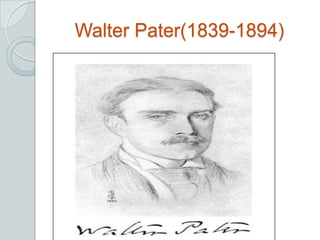
Walter Pater(1839-1894)
Walter Pater
 Born in Stepney in London's East End
 Dr Pater died while Walter was an infant
and the family moved to Enfield, London.
• Pater was the defender of hedonism, a
doctrine according to which ...
• Pleasure is the chief good to be pursued
by man, i.e. the end of all human
actions.
• In his opinion , life should be treated in
the spirit of art, i.e. life as a work of art.
Literary Works
• In his “Studies in the history of Renaissance”(1873) he
stated that:
1. “the secret of happiness lies in the enjoyment of
beauty”;
2. “the finest sensations are to be found in art”;
3. “the deepest and noblest emotions can be
experienced in a life meant as a work of art.”
• Through our senses we can enjoy any form of artistic
beauty and thus live a deep spiritual experience.
• This is particularly true if we live our life as if it were a
work of art.
• These ideas made him a sort of ascetic hedonist.
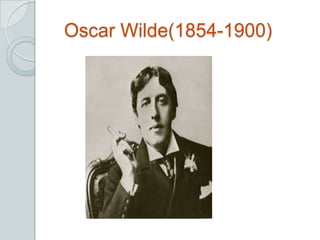
Oscar Wilde(1854-1900)
Oscar Wilde
 Born on October 16 1855
 He was one of the most successful
playwrights of late Victorian London and
one of the greatest celebrities of his days.
 He suffered a dramatic downfall and was
imprisoned after been convicted of “gross
indecency” for homosexual acts.
 He died in Paris in 1900.
Oscar Wilde’s Aestheticism
• Oscar Wilde adopted the aesthetical ideal:
he affirmed “my life is like a work of art”.
• His aestheticism clashed with the
didacticism of Victorian novels.
• The artist = the creator of beautiful
things.
Literary Works
 Poetry; Poems 1891 The Ballad of Reading
Gaol, 1898
 Fairy tales: The Happy Prince and other
Tales, 1888 The House of
Pomegranates, 1891
 Novel: The Picture of Dorian Gray, 1891
 Plays: Lady Windermere’s Fan, 1892 A
Woman of no Importance, 1893 The
Importance of Being Earnest, 1895
Salomé, 1893 Only Connect
GEORGE BERNARD SHAW
(1856-1950)
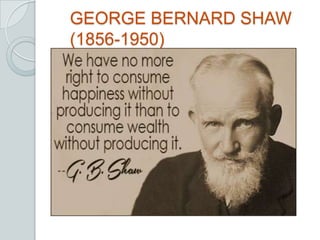
GEORGE BERNARD SHAW
He was born in Dublin, Ireland in 1856.
In 1876, Shaw, moved to London.
 With his background in economics and
politics, Shaw's socialist viewpoint gave his
writing a sense of hope for human improvement.
 After the turn of the century, Shaw's plays
gradually began to achieve production
and, eventually, acceptance in England Shaw
received the Nobel Prize for literature in 1925
 In 1950, Shaw fell off a ladder while trimming a
tree on his property outside of London, and died
a few days later of complications from the
injury, at the age of 94.
SHAW INFLUENCES
 Shaw first worked as an art critic, then music
critic, and finally, from 1895 to 1898, as
Theatre Critic for the Saturday Review .
 Founded the Fabian Society, a socialist
political organization dedicated to
transforming Britain into a socialist state
through education.
 The Fabian society would later be
instrumental in founding the London School
of Economics and the Labor Party.
SHAW INFLUENCES
 The outbreak of war in 1914 changed Shaw's
life.
 For Shaw, the war represented the
bankruptcy of the capitalist system and a
tragic waste of young lives, all under the
guise of patriotism.
 He expressed his opinions in a series of
newspaper articles which proved to be a
disaster for Shaw's public stature: he was
treated as an outcast, and there was even talk
of his being tried for treason.
Victorian period  introduction of revival of drama

Victorian period introduction of revival of drama

  • 3.
  • 5.
    The Late VictorianPeriod (1880- 1900)  Decay of Victorian values  British imperialism  Boer War Irish question  Bismarck's Germany became a rival power  United States became a rival power  Economic depression led to mass immigration  Socialism
  • 6.
  • 7.
    Biography  Was bornon June 2, 1840 in Dorset, England and died on January 11, 1928  Hardy's mother, provided for his education.  Hardy was apprenticed to an architect.  He worked in an office, which specialized in restoration of churches.  In 1874 Hardy married Emma Lavinia Gifford. Who then died in 1912  In 1914 he married his secretary, Florence Emily Dugdale.
  • 8.
    Occupation  Thomas Hardywas an English novelist, short story writer, and poet.  He was a Victorian Poet  He used his writings to elaborate his own pessimistic view of life  His poetry marks the transition from the Victorian Age to the modernist movement of the 20th century
  • 9.
    Achievements  First successwas Far From the Madding Crowd, published in 1874.  Many of his stories have been filmed.  He has been regarded as a regional novelist
  • 10.
    Novels  Under theGreenwood Tree (1872)  A Pair of Blue Eyes (1873)  Far From the Madding Crowd (1874)  The Return of the Native (1878)  The Trumpet-Major (1880)  Two on a Tower (1882)  The Mayor of Caster Bridge (1886)  The Woodlanders (1887)  Tess of the d'Urbervilles (1891)  Jude the Obscure (1895)  The Well-Beloved (1897)
  • 11.
    Short Stories  Barbaraof the House of Grebe (1890)  The Vampirine Fair (1909)  Absent-mindedness in a Parish Choir  The Duke's Reappearance  The Return of the Native (excerpt)  Squire Petrick's Lady  Tony Kytes, the Arch-Deceiver  The Withered Arm
  • 12.
  • 13.
    Henry James American-born writer,gifted with talents in literature, psychology, and philosophy.  James wrote 20 novels, 112 stories, 12 plays and a number of works of literary criticism.
  • 14.
    His Major Achievementand Specific Feature of His Works  James first achieved recognition as a writer of the “international novel” (international theme)---a story which brings together persons of various nationalities who represent certain characteristics of their countries.  The American’s, however, usually have a morality and innocence which the Europeans lack.  James seemed to value both the sophistication of Europe and the idealism of America.
  • 15.
    Notable works byJames  Novels  Novellas and tales  Travel writings  Literary criticism  Memoirs and Autobiography  Plays  Biographies
  • 16.
    Novels  Watch andWard (1871) )  The American (1877)  The Europeans (1878)  Confidence (1879)  Washington Square (1880)  The Portrait of a Lady (1881)  The Bostonians (1886)  The Tragic Muse (1890)  The Other House (1896)  The Awkward Age (1899  The Sacred Fount (1901)  The Wings of the Dove (1902)  The Ambassadors (1903)  The Golden Bowl (1904)  The Outcry (1911)
  • 17.
    Travel writings  ALittle Tour in France (1884)  English Hours (1905)  The American Scene (1907)  Italian Hours (1909)
  • 18.
    Plays Theatricals (1894) Theatricals: SecondSeries (1895)  Guy Dom Ville (1895)
  • 19.
    James' Literary Criticism HenryJames' literary criticism is an indispensable part of his contribution to literature. He worked out his influential principles of fiction in The Art of Fiction (1884).
  • 20.
    Themes The Importance ofPlace The Lived vs. Unlived Life The American Abroad
  • 22.
    Aestheticism • Ruskin hademphasized the importance of Art and Beauty as a means of moral progress. • The Pre-Raphaelites had also worshipped beauty above everything. • The Oxford university professor Walter Pater, in his essays published in 1867–68, stated that life had to be lived intensely, following an ideal of beauty. • Therefore it was quite easy for the painter James McNeill Whistler to introduce the French doctrine of “Art for Art’s sake” into England. • This doctrine placed the artist’s activity outside and above morals and led to the beginning of English literary Aestheticism, which can be defined as.... • a reaction against any utilitarian or moral conception of Art .
  • 23.
    Aestheticism  Art forArt’s sake” meant: art for the pleasure and sensations that it could produce, without any regard to standards of morality or utility.  The fundamental principles of this movement were the following:  The cult of beauty.  The choice for a life beyond common morality.  The solution of the dichotomy between senses and spirit through the theory of the spiritualization of the senses.  The reversal of the principle of art imitating life into that of life imitating art.
  • 24.
  • 25.
    Walter Pater  Bornin Stepney in London's East End  Dr Pater died while Walter was an infant and the family moved to Enfield, London. • Pater was the defender of hedonism, a doctrine according to which ... • Pleasure is the chief good to be pursued by man, i.e. the end of all human actions. • In his opinion , life should be treated in the spirit of art, i.e. life as a work of art.
  • 26.
    Literary Works • Inhis “Studies in the history of Renaissance”(1873) he stated that: 1. “the secret of happiness lies in the enjoyment of beauty”; 2. “the finest sensations are to be found in art”; 3. “the deepest and noblest emotions can be experienced in a life meant as a work of art.” • Through our senses we can enjoy any form of artistic beauty and thus live a deep spiritual experience. • This is particularly true if we live our life as if it were a work of art. • These ideas made him a sort of ascetic hedonist.
  • 28.
  • 29.
    Oscar Wilde  Bornon October 16 1855  He was one of the most successful playwrights of late Victorian London and one of the greatest celebrities of his days.  He suffered a dramatic downfall and was imprisoned after been convicted of “gross indecency” for homosexual acts.  He died in Paris in 1900.
  • 30.
    Oscar Wilde’s Aestheticism •Oscar Wilde adopted the aesthetical ideal: he affirmed “my life is like a work of art”. • His aestheticism clashed with the didacticism of Victorian novels. • The artist = the creator of beautiful things.
  • 31.
    Literary Works  Poetry;Poems 1891 The Ballad of Reading Gaol, 1898  Fairy tales: The Happy Prince and other Tales, 1888 The House of Pomegranates, 1891  Novel: The Picture of Dorian Gray, 1891  Plays: Lady Windermere’s Fan, 1892 A Woman of no Importance, 1893 The Importance of Being Earnest, 1895 Salomé, 1893 Only Connect
  • 32.
  • 33.
    GEORGE BERNARD SHAW Hewas born in Dublin, Ireland in 1856. In 1876, Shaw, moved to London.  With his background in economics and politics, Shaw's socialist viewpoint gave his writing a sense of hope for human improvement.  After the turn of the century, Shaw's plays gradually began to achieve production and, eventually, acceptance in England Shaw received the Nobel Prize for literature in 1925  In 1950, Shaw fell off a ladder while trimming a tree on his property outside of London, and died a few days later of complications from the injury, at the age of 94.
  • 34.
    SHAW INFLUENCES  Shawfirst worked as an art critic, then music critic, and finally, from 1895 to 1898, as Theatre Critic for the Saturday Review .  Founded the Fabian Society, a socialist political organization dedicated to transforming Britain into a socialist state through education.  The Fabian society would later be instrumental in founding the London School of Economics and the Labor Party.
  • 35.
    SHAW INFLUENCES  Theoutbreak of war in 1914 changed Shaw's life.  For Shaw, the war represented the bankruptcy of the capitalist system and a tragic waste of young lives, all under the guise of patriotism.  He expressed his opinions in a series of newspaper articles which proved to be a disaster for Shaw's public stature: he was treated as an outcast, and there was even talk of his being tried for treason.