FEMINIST APPROACH IN “ TO THE LIGHTHOUSE”
AND “ A ROOM OF ONE’S OWN” BY VIRGINIA
WOOLF
Name – Megha B Trivedi
Course – M.A. English
Sem – 3
Batch – 2016-2018
Enrolment No – 2069108420170030
Submitted to – Smt. S.B.Gardi Department of
English, MK Bhavnagar University
Email ID – meghatrivedi666@gmail.com
Roll No – 18
Paper No – 9 The Modernist Literature
FEMINISM AS A TERM
 Feminism is a theory of the
political, Economical and
Social equality of the sexes
and organized activity on
behalf of women’s rights and
interest.
 1) Simone De Beauvoir (1908)
 “ The second sex” (1949)
 2) Helene Cixous (1938)
 3) Elaine Showalter (1941)
 4) Virginia Woolf
 “ To The Lighthouse”
 “ A room of one’s own”
(1929)
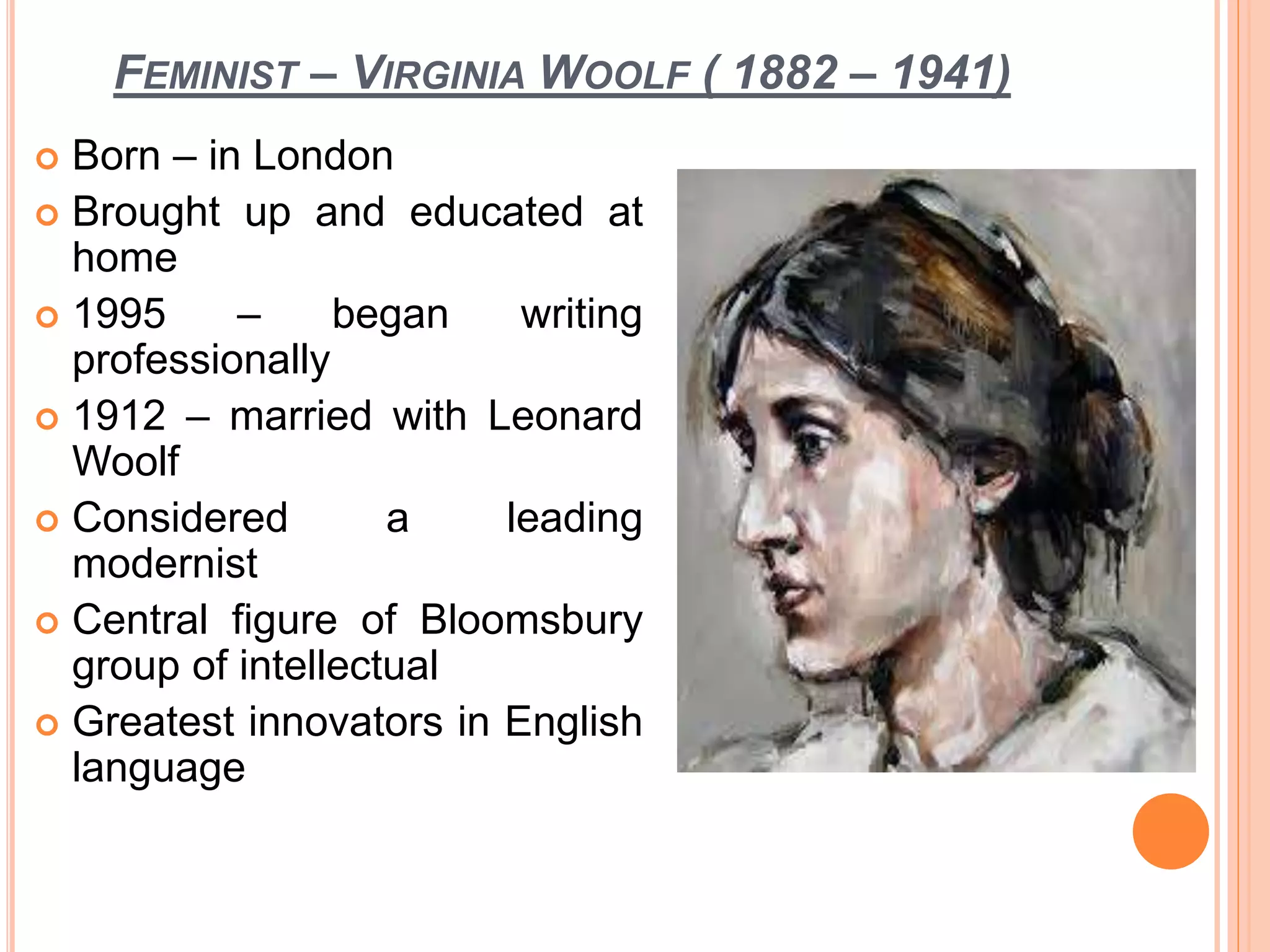
FEMINIST – VIRGINIA WOOLF ( 1882 – 1941)
 Born – in London
 Brought up and educated at
home
 1995 – began writing
professionally
 1912 – married with Leonard
Woolf
 Considered a leading
modernist
 Central figure of Bloomsbury
group of intellectual
 Greatest innovators in English
language
CONTINUE….
- Stream of consciousness
- Underlying psychological / emotional motives of
characters
- Fractured narrative and chronology
 1941 – Committed suicide by drowning herself near
her home in Rodmell
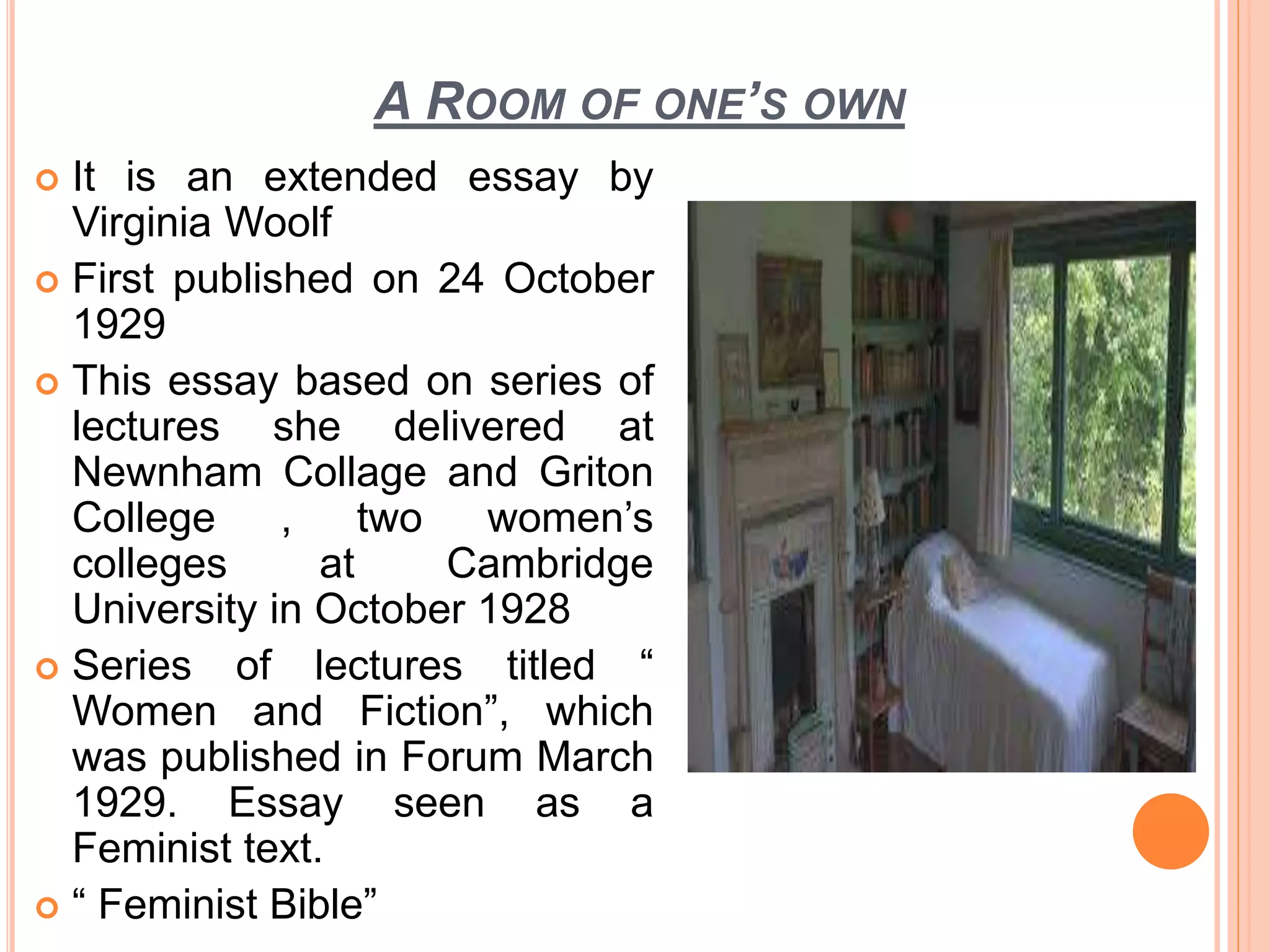
A ROOM OF ONE’S OWN
 It is an extended essay by
Virginia Woolf
 First published on 24 October
1929
 This essay based on series of
lectures she delivered at
Newnham Collage and Griton
College , two women’s
colleges at Cambridge
University in October 1928
 Series of lectures titled “
Women and Fiction”, which
was published in Forum March
1929. Essay seen as a
Feminist text.
 “ Feminist Bible”
CONTINUE…
 Tries to explain the reason why there had been so few
women writers up to then.
 According to her views, women lacked her own space
and independence
 She starts the essay with “BUT”
 She rejects the traditional “I” that represent the
patriarchal discourse and she speaks through several
person : Mary Beton, Mary Seton, Mary Hamilton and
Mary Carmichael, all of them fictitious
 In the first chapter - Hypothesis about what women
need to be able to write : money and a room of their
own
CONTINUE…
 In chapter two – effect of poverty on the writing of
fiction, men’s anger against women
 In chapter three – contrast between the constant
presence of women as character in the fiction written
by men. Why women didn’t access to the literary world.
Gave the example of fictional sister of Shakespeare,
Judith Shakespeare. Judith, who had as much talent
as he did.
 In chapter four – She said so why is it that so many of
these works by women were novels? She states the
need of tradition, apart from social recognition and
material condition to learn the craft and master it. 1)
Charlotte Bronte
2) Jane Austen
CONTINUE…
 In chapter five she talked on how women writers
wrote and how male writers wrote about women.
Women must not write like a men neither in theme nor
in form. Women’s writing is always feminine.
 In chapter six she talks about ideal state of mind of
men and women, as two faced mind with masculine
and feminine part.
 she demonstrate through all essay that money and
space are linked to fictional writing .
 Why was one sex so prosperous and other so poor?
A ROOM OF ONE’S OWN AND TO THE LIGHTHOUSE
 Lily Briscoe – Young single painter,
as a “ New women”, “ Ideal Women”
 Mrs. Ramsay – “ Angel of the
House”, “Victorian mother”,
“Traditional women”
 Mr. Ramsay – depend on women
 Education – Charles Tansly – Young
philosopher, Mr. Ramsay –
Philosopher and professor , Mrs.
Ramsay and her daughters not
educated
 Symbols – Window – Female
Lighthouse - Male
Fisherman’s story
 Gave the important – “ Angel out of
house”.
EXAMPLE OF MOVIES
“ WOMEN CAN’T WRITE, WOMEN CAN’T PAINT”
Feminist Approach in " To The Lighthouse" and " A Room Of one's own" by Virginia Woolf

Feminist Approach in " To The Lighthouse" and " A Room Of one's own" by Virginia Woolf

  • 1.
    FEMINIST APPROACH IN“ TO THE LIGHTHOUSE” AND “ A ROOM OF ONE’S OWN” BY VIRGINIA WOOLF Name – Megha B Trivedi Course – M.A. English Sem – 3 Batch – 2016-2018 Enrolment No – 2069108420170030 Submitted to – Smt. S.B.Gardi Department of English, MK Bhavnagar University Email ID – meghatrivedi666@gmail.com Roll No – 18 Paper No – 9 The Modernist Literature
  • 2.
    FEMINISM AS ATERM  Feminism is a theory of the political, Economical and Social equality of the sexes and organized activity on behalf of women’s rights and interest.  1) Simone De Beauvoir (1908)  “ The second sex” (1949)  2) Helene Cixous (1938)  3) Elaine Showalter (1941)  4) Virginia Woolf  “ To The Lighthouse”  “ A room of one’s own” (1929)
  • 3.
    FEMINIST – VIRGINIAWOOLF ( 1882 – 1941)  Born – in London  Brought up and educated at home  1995 – began writing professionally  1912 – married with Leonard Woolf  Considered a leading modernist  Central figure of Bloomsbury group of intellectual  Greatest innovators in English language
  • 4.
    CONTINUE…. - Stream ofconsciousness - Underlying psychological / emotional motives of characters - Fractured narrative and chronology  1941 – Committed suicide by drowning herself near her home in Rodmell
  • 5.
    A ROOM OFONE’S OWN  It is an extended essay by Virginia Woolf  First published on 24 October 1929  This essay based on series of lectures she delivered at Newnham Collage and Griton College , two women’s colleges at Cambridge University in October 1928  Series of lectures titled “ Women and Fiction”, which was published in Forum March 1929. Essay seen as a Feminist text.  “ Feminist Bible”
  • 6.
    CONTINUE…  Tries toexplain the reason why there had been so few women writers up to then.  According to her views, women lacked her own space and independence  She starts the essay with “BUT”  She rejects the traditional “I” that represent the patriarchal discourse and she speaks through several person : Mary Beton, Mary Seton, Mary Hamilton and Mary Carmichael, all of them fictitious  In the first chapter - Hypothesis about what women need to be able to write : money and a room of their own
  • 7.
    CONTINUE…  In chaptertwo – effect of poverty on the writing of fiction, men’s anger against women  In chapter three – contrast between the constant presence of women as character in the fiction written by men. Why women didn’t access to the literary world. Gave the example of fictional sister of Shakespeare, Judith Shakespeare. Judith, who had as much talent as he did.  In chapter four – She said so why is it that so many of these works by women were novels? She states the need of tradition, apart from social recognition and material condition to learn the craft and master it. 1) Charlotte Bronte 2) Jane Austen
  • 8.
    CONTINUE…  In chapterfive she talked on how women writers wrote and how male writers wrote about women. Women must not write like a men neither in theme nor in form. Women’s writing is always feminine.  In chapter six she talks about ideal state of mind of men and women, as two faced mind with masculine and feminine part.  she demonstrate through all essay that money and space are linked to fictional writing .  Why was one sex so prosperous and other so poor?
  • 9.
    A ROOM OFONE’S OWN AND TO THE LIGHTHOUSE  Lily Briscoe – Young single painter, as a “ New women”, “ Ideal Women”  Mrs. Ramsay – “ Angel of the House”, “Victorian mother”, “Traditional women”  Mr. Ramsay – depend on women  Education – Charles Tansly – Young philosopher, Mr. Ramsay – Philosopher and professor , Mrs. Ramsay and her daughters not educated  Symbols – Window – Female Lighthouse - Male Fisherman’s story  Gave the important – “ Angel out of house”.
  • 10.
  • 11.
    “ WOMEN CAN’TWRITE, WOMEN CAN’T PAINT”