PERT/CPM Models for Project Management
AgendaWhat is Project ManagementDiscuss PERT/CPMMotivating Case Study: The Reliable Construction CompanyWays of Finding the Critical PathConsidering Time-Cost Trade-Offs
What is Project ManagementProject management can be defined as the coordination of activities with the potential use of many organizations, both internal and external to the business, in order to conduct a large scale project from beginning to end.There are two management science techniques that are used for project management:Program and Evaluation Review Technique (PERT)Critical Path Method (CPM)
PERT/CPMPERTPERT was designed to examine projects from the standpoint of uncertainty.CPMCPM was designed to examine projects from the standpoint of costs.PERT and CPM techniques have been combined over time.PERT and CPM both rely heavily on the use of networks to help plan and display the coordination of all the activities for a project.
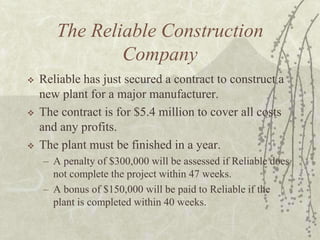
The Reliable Construction CompanyReliable has just secured a contract to construct a new plant for a major manufacturer.The contract is for $5.4 million to cover all costs and any profits.The plant must be finished in a year.A penalty of $300,000 will be assessed if Reliable does not complete the project within 47 weeks.A bonus of $150,000 will be paid to Reliable if the plant is completed within 40 weeks.
Needed TerminologyActivityA distinct task that needs to be performed as part of the project.Start NodeThis is a node that represents the beginning of the project.Finish NodeThis node represents the end of the project.
Needed Terminology Cont.Immediate PredecessorThese are activities that must be completed by no later than the start time of the given activity.Immediate SuccessorGiven the immediate predecessor of an activity, this activity becomes the immediate successor of each of these immediate predecessors.If an immediate successor has multiple immediate predecessors, then all must be finished before an activity can begin.
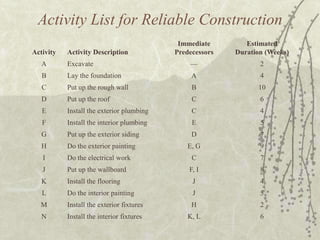
Activity List for Reliable Construction
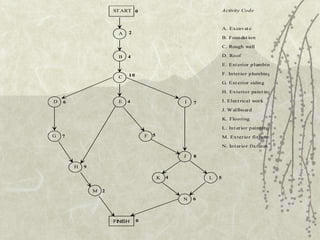
Questions Needed to be AnsweredHow can the project be displayed graphically?How much time is required to finish the project if no delays occur?When is earliest start and finish times for each activity if no delays occur?What activities are critical bottleneck activities where delays must be avoided to finish the project on time?
Questions Needed to be Answered Cont.For non bottleneck activities, how much can an activity be delayed and yet still keep the project on time?What is the probability of completing the project by the deadline?What is the least amount of money needed to expedite the project to obtain the bonus?How should costs be monitored to keep the project within budget?
Project NetworkA project network is a network diagram that uses nodes and arcs to represent the progression of the activities is a project from start to finish.Three pieces of information needed:Activity informationPrecedence relationshipTime information
Project Network Cont.Two types of project networksActivity-on-Arc (AOA)On this diagram, the activity is represented on an arc, while a node is used to separate an activity from its immediate predecessors. Activity-on-Node (AON)On this diagram, the activity is represented by the node, while the arc is used to showed the precedence relationship between the activities.
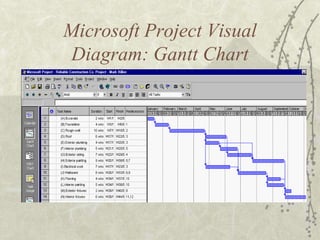
Microsoft Project Visual Diagram: Gantt Chart
Scheduling Using PERT/CPMA path through a project network is a route that follows a set of arcs from the start node to the finish node.The length of a path is defined as the sum of the durations of the activities of the path.What are the paths and their corresponding lengths for Reliable?
Critical PathThis is the path that has the longest length through the project.The shortest time that a project can conceivably be finished is the critical path.Why?
More TerminologyEarliest start time of an activity (ES)The time at which an activity will begin if there are no delays in a project.Earliest finish time of an activity (EF)The time at which an activity will finish if there are no delays in a project.Latest start time of an activity (LS)The latest possible time that an activity can start without delaying the project.
More Terminology Cont.Latest finish time of an activity (LF)The latest possible time that an activity can be completed without delaying the project.Forward passThe process of moving through a project from start to finish to determine the earliest start and finish times for the activities in the project.
More Terminology Cont.Backward passThe process of moving through a project from finish to start to determine the latest start and finish times for the activities in the project.Slack for an activityThe amount of time that a particular activity can be delayed without delaying the whole project.It is calculated by taking the difference between the latest finish time with the earliest finish time.
More Terminology Cont.Earliest start time ruleThe earliest start time for an activity is equal to the largest of the earliest finish times of its immediate predecessors.Latest finish time ruleThe latest finish time is equal to the smallest of the latest start times of its immediate successors.
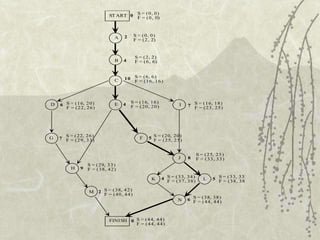
Procedure for Obtaining Earliest TimesStep 1: For the activity that starts the project, assign an earliest start time of zero, i.e., ES=0.Step 2: For each activity whose ES has just been obtained, calculate its earliest finish time as ES plus duration of the activity.Step 3: For each new activity whose immediate predecessors have EF values, obtain its ES by using the earliest start time rule.
Procedure for Obtaining Earliest Times Cont.Step 4: Apply step 2 to calculate EF.Step 5: Repeat step 3 until ES and EF have been obtained for all activities including the finish node.
Procedure for Obtaining Latest TimesStep 1: For each of the activities that together complete the project, set its latest finish time equal to the earliest finish time of the finish node.Step 2: For each activity whose LF value has just been obtained, calculate its latest start time as LS equals LF minus the duration of the activity.
Procedure for Obtaining Latest Times Cont.Step 3: For each new activity whose immediate successors now have LS values, obtain its LF by applying the latest finish time rule.Step 4: Apply step 2 to calculate its LS.Step 5: Repeat step 3 until LF and LS have been obtained for all activities.
Ways of Finding the Critical PathExamine all the paths and find the path with the maximum length.Calculate the slack for an activity.If the slack is zero, it is on the critical path.If the slack is positive, it is not on the critical path.
Time-Cost Trade-OffsReliable had an incentive bonus of $150,000 to finish the project in 40 weeks.Is it worth while for Reliable to speed-up the project?
CrashingCrashing an activity refers to taking on extra expenditures in order to reduce the duration of an activity below its expected value.Crashing a project refers to crashing a number of activities to reduce the duration of the project.
CPM Method of Time-Cost Trade-OffsThis is a method concerned with whether it is worthwhile to crash activities to reduce the anticipated duration of the project to a desired value.This assumes that there is a trade-off between time and cost that has an inverse relationship.
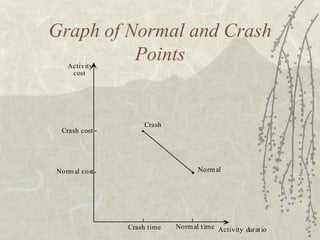
More TerminologyNormal Point is the time and cost of an activity when it is performed in a normal way.Crash point show the time and cost when the activity is fully crashed.
Graph of Normal and Crash Points
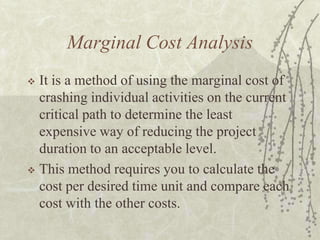
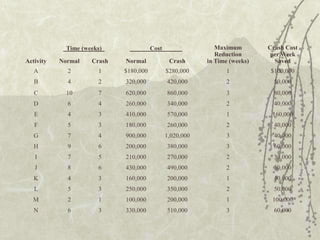
Marginal Cost AnalysisIt is a method of using the marginal cost of crashing individual activities on the current critical path to determine the least expensive way of reducing the project duration to an acceptable level.This method requires you to calculate the cost per desired time unit and compare each cost with the other costs.
Marginal Cost Analysis Cont.Once the marginal cost for crashing each activity has been conducted, you next want to choose the crashing that has the smallest marginal cost.Next, calculate the effect that the crash has on each path.Note: Crashing can potentially cause another path to become a critical path.
Solving Crashing Problems Using LPThere are three decisions to be made:The start time of each activityThe reduction in each activity due to crashingThe finish time of the projectLP model will be examined in class.

Critical path method & pert

  • 1.
    PERT/CPM Models forProject Management
  • 2.
    AgendaWhat is ProjectManagementDiscuss PERT/CPMMotivating Case Study: The Reliable Construction CompanyWays of Finding the Critical PathConsidering Time-Cost Trade-Offs
  • 3.
    What is ProjectManagementProject management can be defined as the coordination of activities with the potential use of many organizations, both internal and external to the business, in order to conduct a large scale project from beginning to end.There are two management science techniques that are used for project management:Program and Evaluation Review Technique (PERT)Critical Path Method (CPM)
  • 4.
    PERT/CPMPERTPERT was designedto examine projects from the standpoint of uncertainty.CPMCPM was designed to examine projects from the standpoint of costs.PERT and CPM techniques have been combined over time.PERT and CPM both rely heavily on the use of networks to help plan and display the coordination of all the activities for a project.
  • 5.
    The Reliable ConstructionCompanyReliable has just secured a contract to construct a new plant for a major manufacturer.The contract is for $5.4 million to cover all costs and any profits.The plant must be finished in a year.A penalty of $300,000 will be assessed if Reliable does not complete the project within 47 weeks.A bonus of $150,000 will be paid to Reliable if the plant is completed within 40 weeks.
  • 6.
    Needed TerminologyActivityA distincttask that needs to be performed as part of the project.Start NodeThis is a node that represents the beginning of the project.Finish NodeThis node represents the end of the project.
  • 7.
    Needed Terminology Cont.ImmediatePredecessorThese are activities that must be completed by no later than the start time of the given activity.Immediate SuccessorGiven the immediate predecessor of an activity, this activity becomes the immediate successor of each of these immediate predecessors.If an immediate successor has multiple immediate predecessors, then all must be finished before an activity can begin.
  • 8.
    Activity List forReliable Construction
  • 9.
    Questions Needed tobe AnsweredHow can the project be displayed graphically?How much time is required to finish the project if no delays occur?When is earliest start and finish times for each activity if no delays occur?What activities are critical bottleneck activities where delays must be avoided to finish the project on time?
  • 10.
    Questions Needed tobe Answered Cont.For non bottleneck activities, how much can an activity be delayed and yet still keep the project on time?What is the probability of completing the project by the deadline?What is the least amount of money needed to expedite the project to obtain the bonus?How should costs be monitored to keep the project within budget?
  • 11.
    Project NetworkA projectnetwork is a network diagram that uses nodes and arcs to represent the progression of the activities is a project from start to finish.Three pieces of information needed:Activity informationPrecedence relationshipTime information
  • 12.
    Project Network Cont.Twotypes of project networksActivity-on-Arc (AOA)On this diagram, the activity is represented on an arc, while a node is used to separate an activity from its immediate predecessors. Activity-on-Node (AON)On this diagram, the activity is represented by the node, while the arc is used to showed the precedence relationship between the activities.
  • 14.
    Microsoft Project VisualDiagram: Gantt Chart
  • 15.
    Scheduling Using PERT/CPMApath through a project network is a route that follows a set of arcs from the start node to the finish node.The length of a path is defined as the sum of the durations of the activities of the path.What are the paths and their corresponding lengths for Reliable?
  • 16.
    Critical PathThis isthe path that has the longest length through the project.The shortest time that a project can conceivably be finished is the critical path.Why?
  • 17.
    More TerminologyEarliest starttime of an activity (ES)The time at which an activity will begin if there are no delays in a project.Earliest finish time of an activity (EF)The time at which an activity will finish if there are no delays in a project.Latest start time of an activity (LS)The latest possible time that an activity can start without delaying the project.
  • 18.
    More Terminology Cont.Latestfinish time of an activity (LF)The latest possible time that an activity can be completed without delaying the project.Forward passThe process of moving through a project from start to finish to determine the earliest start and finish times for the activities in the project.
  • 19.
    More Terminology Cont.BackwardpassThe process of moving through a project from finish to start to determine the latest start and finish times for the activities in the project.Slack for an activityThe amount of time that a particular activity can be delayed without delaying the whole project.It is calculated by taking the difference between the latest finish time with the earliest finish time.
  • 20.
    More Terminology Cont.Earlieststart time ruleThe earliest start time for an activity is equal to the largest of the earliest finish times of its immediate predecessors.Latest finish time ruleThe latest finish time is equal to the smallest of the latest start times of its immediate successors.
  • 21.
    Procedure for ObtainingEarliest TimesStep 1: For the activity that starts the project, assign an earliest start time of zero, i.e., ES=0.Step 2: For each activity whose ES has just been obtained, calculate its earliest finish time as ES plus duration of the activity.Step 3: For each new activity whose immediate predecessors have EF values, obtain its ES by using the earliest start time rule.
  • 22.
    Procedure for ObtainingEarliest Times Cont.Step 4: Apply step 2 to calculate EF.Step 5: Repeat step 3 until ES and EF have been obtained for all activities including the finish node.
  • 23.
    Procedure for ObtainingLatest TimesStep 1: For each of the activities that together complete the project, set its latest finish time equal to the earliest finish time of the finish node.Step 2: For each activity whose LF value has just been obtained, calculate its latest start time as LS equals LF minus the duration of the activity.
  • 24.
    Procedure for ObtainingLatest Times Cont.Step 3: For each new activity whose immediate successors now have LS values, obtain its LF by applying the latest finish time rule.Step 4: Apply step 2 to calculate its LS.Step 5: Repeat step 3 until LF and LS have been obtained for all activities.
  • 26.
    Ways of Findingthe Critical PathExamine all the paths and find the path with the maximum length.Calculate the slack for an activity.If the slack is zero, it is on the critical path.If the slack is positive, it is not on the critical path.
  • 27.
    Time-Cost Trade-OffsReliable hadan incentive bonus of $150,000 to finish the project in 40 weeks.Is it worth while for Reliable to speed-up the project?
  • 28.
    CrashingCrashing an activityrefers to taking on extra expenditures in order to reduce the duration of an activity below its expected value.Crashing a project refers to crashing a number of activities to reduce the duration of the project.
  • 29.
    CPM Method ofTime-Cost Trade-OffsThis is a method concerned with whether it is worthwhile to crash activities to reduce the anticipated duration of the project to a desired value.This assumes that there is a trade-off between time and cost that has an inverse relationship.
  • 30.
    More TerminologyNormal Pointis the time and cost of an activity when it is performed in a normal way.Crash point show the time and cost when the activity is fully crashed.
  • 31.
    Graph of Normaland Crash Points
  • 32.
    Marginal Cost AnalysisItis a method of using the marginal cost of crashing individual activities on the current critical path to determine the least expensive way of reducing the project duration to an acceptable level.This method requires you to calculate the cost per desired time unit and compare each cost with the other costs.
  • 34.
    Marginal Cost AnalysisCont.Once the marginal cost for crashing each activity has been conducted, you next want to choose the crashing that has the smallest marginal cost.Next, calculate the effect that the crash has on each path.Note: Crashing can potentially cause another path to become a critical path.
  • 35.
    Solving Crashing ProblemsUsing LPThere are three decisions to be made:The start time of each activityThe reduction in each activity due to crashingThe finish time of the projectLP model will be examined in class.