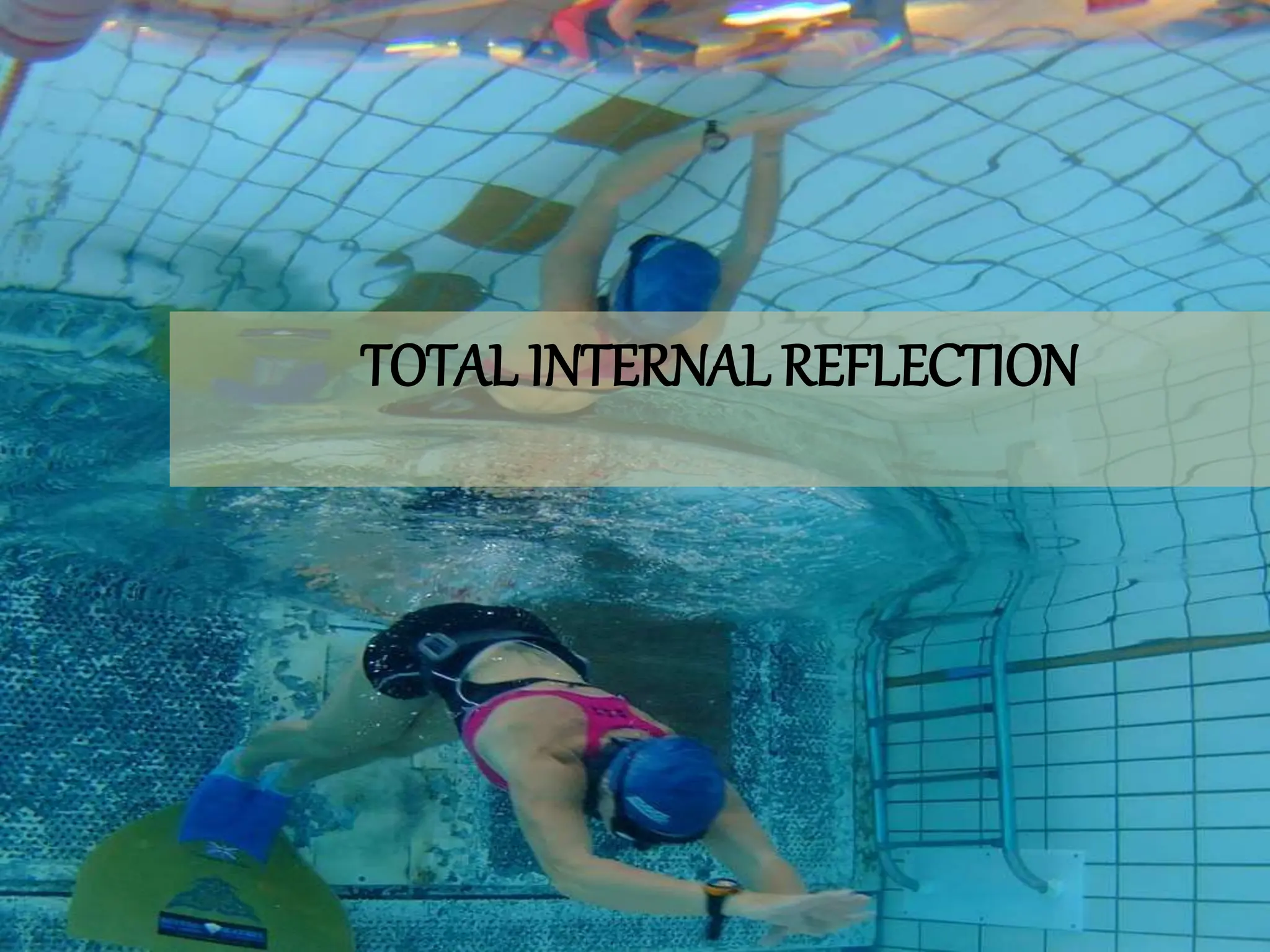
TOTAL INTERNAL REFLECTION
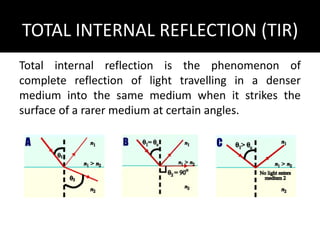
TOTAL INTERNAL REFLECTION (TIR)
Total internal reflection is the phenomenon of
complete reflection of light travelling in a denser
medium into the same medium when it strikes the
surface of a rarer medium at certain angles.
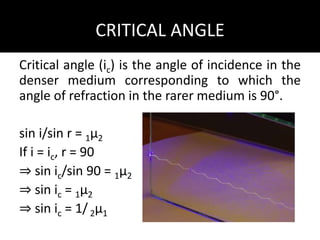
CRITICAL ANGLE
Critical angle (ic) is the angle of incidence in the
denser medium corresponding to which the
angle of refraction in the rarer medium is 90°.
sin i/sin r = 1µ2
If i = ic, r = 90
⇒ sin ic/sin 90 = 1µ2
⇒ sin ic = 1µ2
⇒ sin ic = 1/ 2µ1
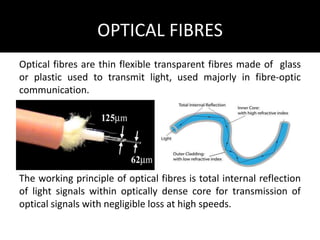
OPTICAL FIBRES
Optical fibres are thin flexible transparent fibres made of glass
or plastic used to transmit light, used majorly in fibre-optic
communication.
The working principle of optical fibres is total internal reflection
of light signals within optically dense core for transmission of
optical signals with negligible loss at high speeds.
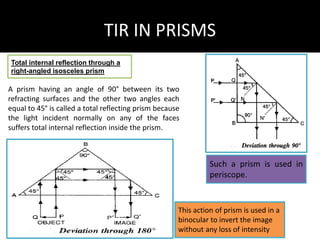
TIR IN PRISMS
Total internal reflection through a
right-angled isosceles prism
Such a prism is used in
periscope.
This action of prism is used in a
binocular to invert the image
without any loss of intensity
A prism having an angle of 90° between its two
refracting surfaces and the other two angles each
equal to 45° is called a total reflecting prism because
the light incident normally on any of the faces
suffers total internal reflection inside the prism.
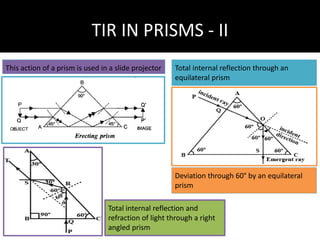
TIR IN PRISMS - II
This action of a prism is used in a slide projector Total internal reflection through an
equilateral prism
Deviation through 60° by an equilateral
prism
Total internal reflection and
refraction of light through a right
angled prism
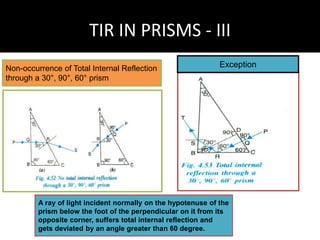
TIR IN PRISMS - III
Non-occurrence of Total Internal Reflection
through a 30°, 90°, 60° prism
Exception
A ray of light incident normally on the hypotenuse of the
prism below the foot of the perpendicular on it from its
opposite corner, suffers total internal reflection and
gets deviated by an angle greater than 60 degree.
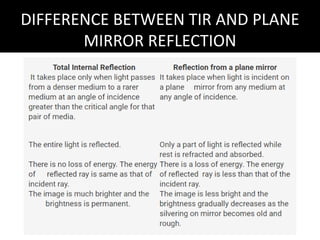
DIFFERENCE BETWEEN TIR AND PLANE
MIRROR REFLECTION
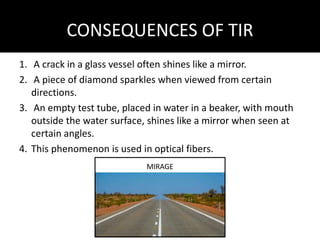
CONSEQUENCES OF TIR
1. A crack in a glass vessel often shines like a mirror.
2. A piece of diamond sparkles when viewed from certain
directions.
3. An empty test tube, placed in water in a beaker, with mouth
outside the water surface, shines like a mirror when seen at
certain angles.
4. This phenomenon is used in optical fibers.
MIRAGE
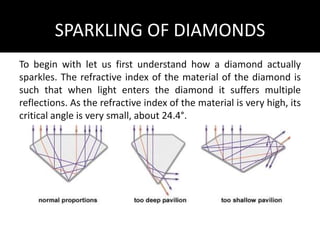
SPARKLING OF DIAMONDS
To begin with let us first understand how a diamond actually
sparkles. The refractive index of the material of the diamond is
such that when light enters the diamond it suffers multiple
reflections. As the refractive index of the material is very high, its
critical angle is very small, about 24.4°.

Total Internal Reflection - Causes and Effects

  • 1.
  • 2.
    TOTAL INTERNAL REFLECTION(TIR) Total internal reflection is the phenomenon of complete reflection of light travelling in a denser medium into the same medium when it strikes the surface of a rarer medium at certain angles.
  • 3.
    CRITICAL ANGLE Critical angle(ic) is the angle of incidence in the denser medium corresponding to which the angle of refraction in the rarer medium is 90°. sin i/sin r = 1µ2 If i = ic, r = 90 ⇒ sin ic/sin 90 = 1µ2 ⇒ sin ic = 1µ2 ⇒ sin ic = 1/ 2µ1
  • 4.
    OPTICAL FIBRES Optical fibresare thin flexible transparent fibres made of glass or plastic used to transmit light, used majorly in fibre-optic communication. The working principle of optical fibres is total internal reflection of light signals within optically dense core for transmission of optical signals with negligible loss at high speeds.
  • 5.
    TIR IN PRISMS Totalinternal reflection through a right-angled isosceles prism Such a prism is used in periscope. This action of prism is used in a binocular to invert the image without any loss of intensity A prism having an angle of 90° between its two refracting surfaces and the other two angles each equal to 45° is called a total reflecting prism because the light incident normally on any of the faces suffers total internal reflection inside the prism.
  • 6.
    TIR IN PRISMS- II This action of a prism is used in a slide projector Total internal reflection through an equilateral prism Deviation through 60° by an equilateral prism Total internal reflection and refraction of light through a right angled prism
  • 7.
    TIR IN PRISMS- III Non-occurrence of Total Internal Reflection through a 30°, 90°, 60° prism Exception A ray of light incident normally on the hypotenuse of the prism below the foot of the perpendicular on it from its opposite corner, suffers total internal reflection and gets deviated by an angle greater than 60 degree.
  • 8.
    DIFFERENCE BETWEEN TIRAND PLANE MIRROR REFLECTION
  • 9.
    CONSEQUENCES OF TIR 1.A crack in a glass vessel often shines like a mirror. 2. A piece of diamond sparkles when viewed from certain directions. 3. An empty test tube, placed in water in a beaker, with mouth outside the water surface, shines like a mirror when seen at certain angles. 4. This phenomenon is used in optical fibers. MIRAGE
  • 10.
    SPARKLING OF DIAMONDS Tobegin with let us first understand how a diamond actually sparkles. The refractive index of the material of the diamond is such that when light enters the diamond it suffers multiple reflections. As the refractive index of the material is very high, its critical angle is very small, about 24.4°.