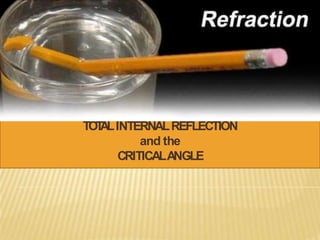
TOT
ALINTERNALREFLECTION
and the
CRITICALANGLE
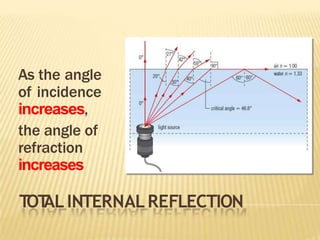
As the angle
of incidence
increases,
the angle of
refraction
increases
T
OT
AL INTERNALREFLECTION
Critical Angle
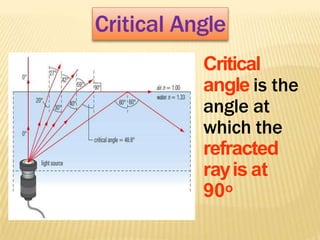
Critical
angle is the
angle at
which the
refracted
rayis at
90o
Total Internal Reflection (TIR)
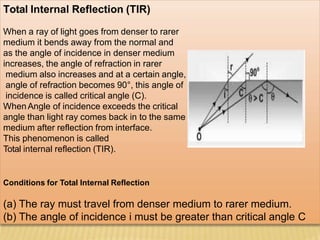
When a ray of light goes from denser to rarer
medium it bends away from the normal and
as the angle of incidence in denser medium
increases, the angle of refraction in rarer
medium also increases and at a certain angle,
angle of refraction becomes 90°, this angle of
incidence is called critical angle (C).
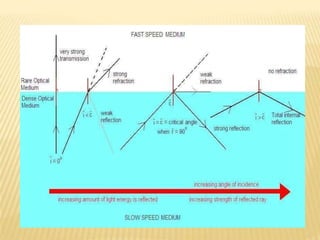
WhenAngle of incidence exceeds the critical
angle than light ray comes back in to the same
medium after reflection from interface.
This phenomenon is called
Total internal reflection (TIR).
Conditions for Total Internal Reflection
(a) The ray must travel from denser medium to rarer medium.
(b) The angle of incidence i must be greater than critical angle C
TOTAL REFLECTION
Total internal reflection
🞭 It takes place when light passes from a denser medium to a rare
medium when angle of incidence is greater than the critical angle
🞭 The entire light is reflected
🞭 There is no loss of energy
🞭 The image is much brighter and the brightness is permanent
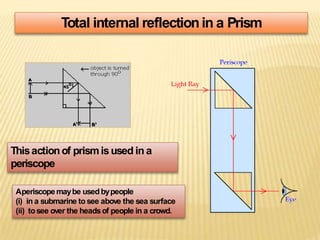
Total internal reflectionin a Prism
Aperiscopemaybe usedbypeople
(i) in a submarine tosee above the sea surface
(ii) tosee over the headsof people in a crowd.
Thisactionof prismisused in a
periscope
Deviation through180 degree
This action of prism is used in binocular
Erecting Prism
This action of prism is used in a slide projector
Deviation through60 degree byan Equilateral
Prism
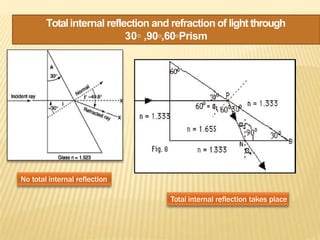
Totalinternal reflection and refraction of light through
30◦ ,90◦,60◦Prism
No total internal reflection
Total internal reflection takes place
CONSEQUENCES OF TOTAL INTERNAL REFLECTION
TIR in Diamonds
Sparkling is due to:
1. Cut of diamond faces
2. High index of refraction which means a very
small critical angle (n = 2.42, C = 24.4°)
Incident rays can undergo multiple TIR inside
a diamond before exiting the top of the
diamond.
MIRA
GE
LOOMING
Light does not escape as
it travels along the fiber
optics cable because it
undergoes total internal
reflection
Optical Fibre

total_internal_reflection

  • 1.
  • 2.
    As the angle ofincidence increases, the angle of refraction increases T OT AL INTERNALREFLECTION
  • 4.
    Critical Angle Critical angle isthe angle at which the refracted rayis at 90o
  • 6.
    Total Internal Reflection(TIR) When a ray of light goes from denser to rarer medium it bends away from the normal and as the angle of incidence in denser medium increases, the angle of refraction in rarer medium also increases and at a certain angle, angle of refraction becomes 90°, this angle of incidence is called critical angle (C). WhenAngle of incidence exceeds the critical angle than light ray comes back in to the same medium after reflection from interface. This phenomenon is called Total internal reflection (TIR). Conditions for Total Internal Reflection (a) The ray must travel from denser medium to rarer medium. (b) The angle of incidence i must be greater than critical angle C
  • 7.
    TOTAL REFLECTION Total internalreflection 🞭 It takes place when light passes from a denser medium to a rare medium when angle of incidence is greater than the critical angle 🞭 The entire light is reflected 🞭 There is no loss of energy 🞭 The image is much brighter and the brightness is permanent
  • 8.
    Total internal reflectionina Prism Aperiscopemaybe usedbypeople (i) in a submarine tosee above the sea surface (ii) tosee over the headsof people in a crowd. Thisactionof prismisused in a periscope
  • 9.
    Deviation through180 degree Thisaction of prism is used in binocular
  • 10.
    Erecting Prism This actionof prism is used in a slide projector
  • 11.
    Deviation through60 degreebyan Equilateral Prism
  • 12.
    Totalinternal reflection andrefraction of light through 30◦ ,90◦,60◦Prism No total internal reflection Total internal reflection takes place
  • 13.
    CONSEQUENCES OF TOTALINTERNAL REFLECTION TIR in Diamonds Sparkling is due to: 1. Cut of diamond faces 2. High index of refraction which means a very small critical angle (n = 2.42, C = 24.4°) Incident rays can undergo multiple TIR inside a diamond before exiting the top of the diamond.
  • 14.
  • 15.
    Light does notescape as it travels along the fiber optics cable because it undergoes total internal reflection Optical Fibre