

Done by: Mohammad Alzubaidi
INTRODUCTION
 Gene editing is a series of molecular tools that changes the sequence of the DNA
in a site-specific locus.
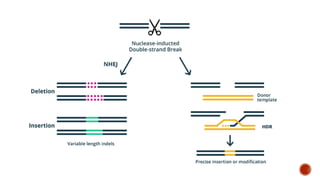
 DSBs can be repaired through non-homologous end joining (NHEJ), resulting in
small insertions and/or deletions (INDELs), leading to gene disruption.
 DSBs can be repaired through homology-driven repair (HDR), in the presence of
donor homologous DNA sequences, resulting to gene editing.
 Upon cleavage the target locus typically undergoes for DNA damage repair
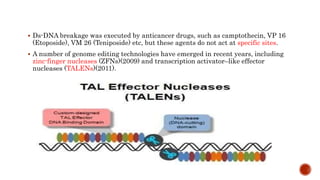
 Ds-DNA breakage was executed by anticancer drugs, such as camptothecin, VP 16
(Etoposide), VM 26 (Teniposide) etc, but these agents do not act at specific sites.
 A number of genome editing technologies have emerged in recent years, including
zinc-finger nucleases (ZFNs)(2009) and transcription activator–like effector
nucleases (TALENs)(2011).
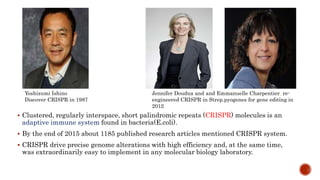
Jennifer Doudna and and Emmanuelle Charpentier re-
engineered CRISPR in Strep.pyogenes for gene editing in
2012
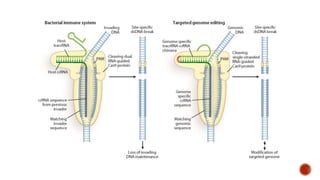
 Clustered, regularly interspace, short palindromic repeats (CRISPR) molecules is an
adaptive immune system found in bacteria(E.coli).
 By the end of 2015 about 1185 published research articles mentioned CRISPR system.
 CRISPR drive precise genome alterations with high efficiency and, at the same time,
was extraordinarily easy to implement in any molecular biology laboratory.
Yoshizumi Ishino
Discover CRISPR in 1987
LIMITATION
 Creating vectors express the CRISPR components is simple but designing a
proper RNA- guided engineered nucleases (RGENs) binds to the proto-
spacer adjacent motif (PAM) (20 bp) in DNA is challenging.
 There is an off-target mutagenesis rate needs more investigation.
 The cell prefer to use non-homologous end joining (NHEJ) instead of homology-
driven repair.
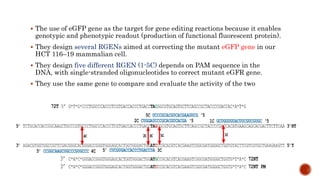
 The use of eGFP gene as the target for gene editing reactions because it enables
genotypic and phenotypic readout (production of functional fluorescent protein).
 They design several RGENs aimed at correcting the mutant eGFP gene in our
HCT 116–19 mammalian cell.
 They design five different RGEN (1-5C) depends on PAM sequence in the
DNA, with single-stranded oligonucleotides to correct mutant eGFR gene.
 They use the same gene to compare and evaluate the activity of the two
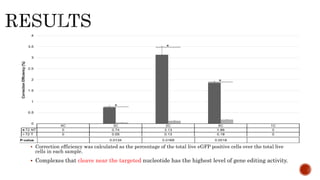
 Correction efficiency was calculated as the percentage of the total live eGFP positive cells over the total live
cells in each sample.
 Complexes that cleave near the targeted nucleotide has the highest level of gene editing activity.
 On Oct 2016 Researcher Identified 492 AML-specific genes, including several
established therapeutic targets such as DOT1L, BCL2, and MEN using CRISPR
system.
 They choose a gene called KAT2A, inhibition of this gene will induce myeloid
differentiation and apoptosis.
 The first clinical trial involving CRISPR began at the West China Hospital in
Chengdu in October 2016.
 Doctors removed immune cells from the blood of a person with lung cancer, used
CRISPR to disable a gene called PD-1 and then returned the cells to the body.
 PD-1 codes for an immune cell “off” switch. Tumours can flip this switch to
prevent immune cells attacking, so if immune cells lack the PD-1 switch then
cancer cells cannot manipulate them.
 On 21 June 2017 the US National Institutes of Health (NIH) approved a proposal
to use CRISPR–Cas9 to cancer therapies:
 The researchers will remove T cells from 18 patients with several types of cancers
and perform three CRISPR edits on them.
 One edit will insert a gene for a protein engineered to detect cancer cells and
instruct the T cells to target them.
 A second edit removes a natural T-cell protein that could interfere with this
process.
 The third is defensive: it will remove the gene for a protein that identifies the T
cells as immune cells and prevent the cancer cells from disabling them.
 The researchers will then infuse the edited cells back into the patient.
 Instead of editing cells outside the body, a gel containing DNA coding for the
CRISPR machinery will be applied to the cervix.
 The CRISPR machinery should leave the DNA of normal cells untouched, but in
cells infected by human papillomavirus (HPV), it should destroy the viral genes,
preventing them from turning cancerous.
 Another study used tripronuclear zygotes to investigate CRISPR/CAS9 mediated
gene editing in human β-globin gene.
 CRISPR effectively cleave the gene but homologous recombination directed repair
(HDR) rate was low and the edited embryo was mosaic.
 CRISPR could be used to cure genetic diseases like β-thalassemia but it needs
further investigation first.
 On 6 July 2017 researcher from Peking University, China. Used CRISPR to
eliminate a whole chromosome by single-guide RNA (sgRNA) that targets multiple
chromosome-specific sites.
 They eliminate sex chromosome in cultured cells, embryos and tissue in vivo.
 CRISPR could be a new approach to develop animal models with chromosome
deletions, and a potential therapeutic strategy for human aneuploidy diseases
involving additional chromosomes (trisomy 21).
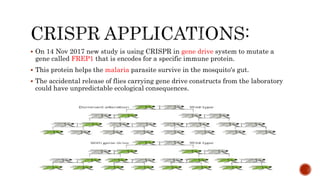
 On 14 Nov 2017 new study is using CRISPR in gene drive system to mutate a
gene called FREP1 that is encodes for a specific immune protein.
 This protein helps the malaria parasite survive in the mosquito's gut.
 The accidental release of flies carrying gene drive constructs from the laboratory
could have unpredictable ecological consequences.
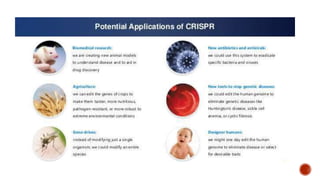
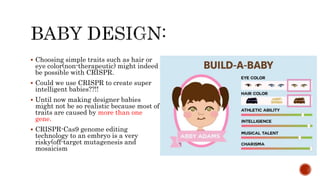
 Choosing simple traits such as hair or
eye color(non-therapeutic) might indeed
be possible with CRISPR.
 Could we use CRISPR to create super
intelligent babies??!!
 Until now making designer babies
might not be so realistic because most of
traits are caused by more than one
gene.
 CRISPR-Cas9 genome editing
technology to an embryo is a very
risky(off-target mutagenesis and
mosaicism
 What is the ethical consequences of changing human genome?!!
 Gene-editing will lead to a world where parents will be able to customize their
own baby.
 will open the door to the loss of human diversity.
 Scientist is asking for open discussion around the appropriate action of how to use
gene editing.
The future of gene editing

The future of gene editing

  • 1.
  • 3.
    INTRODUCTION  Gene editingis a series of molecular tools that changes the sequence of the DNA in a site-specific locus.  DSBs can be repaired through non-homologous end joining (NHEJ), resulting in small insertions and/or deletions (INDELs), leading to gene disruption.  DSBs can be repaired through homology-driven repair (HDR), in the presence of donor homologous DNA sequences, resulting to gene editing.  Upon cleavage the target locus typically undergoes for DNA damage repair
  • 5.
     Ds-DNA breakagewas executed by anticancer drugs, such as camptothecin, VP 16 (Etoposide), VM 26 (Teniposide) etc, but these agents do not act at specific sites.  A number of genome editing technologies have emerged in recent years, including zinc-finger nucleases (ZFNs)(2009) and transcription activator–like effector nucleases (TALENs)(2011).
  • 6.
    Jennifer Doudna andand Emmanuelle Charpentier re- engineered CRISPR in Strep.pyogenes for gene editing in 2012  Clustered, regularly interspace, short palindromic repeats (CRISPR) molecules is an adaptive immune system found in bacteria(E.coli).  By the end of 2015 about 1185 published research articles mentioned CRISPR system.  CRISPR drive precise genome alterations with high efficiency and, at the same time, was extraordinarily easy to implement in any molecular biology laboratory. Yoshizumi Ishino Discover CRISPR in 1987
  • 9.
    LIMITATION  Creating vectorsexpress the CRISPR components is simple but designing a proper RNA- guided engineered nucleases (RGENs) binds to the proto- spacer adjacent motif (PAM) (20 bp) in DNA is challenging.  There is an off-target mutagenesis rate needs more investigation.  The cell prefer to use non-homologous end joining (NHEJ) instead of homology- driven repair.
  • 10.
     The useof eGFP gene as the target for gene editing reactions because it enables genotypic and phenotypic readout (production of functional fluorescent protein).  They design several RGENs aimed at correcting the mutant eGFP gene in our HCT 116–19 mammalian cell.  They design five different RGEN (1-5C) depends on PAM sequence in the DNA, with single-stranded oligonucleotides to correct mutant eGFR gene.  They use the same gene to compare and evaluate the activity of the two
  • 11.
     Correction efficiencywas calculated as the percentage of the total live eGFP positive cells over the total live cells in each sample.  Complexes that cleave near the targeted nucleotide has the highest level of gene editing activity.
  • 13.
     On Oct2016 Researcher Identified 492 AML-specific genes, including several established therapeutic targets such as DOT1L, BCL2, and MEN using CRISPR system.  They choose a gene called KAT2A, inhibition of this gene will induce myeloid differentiation and apoptosis.
  • 14.
     The firstclinical trial involving CRISPR began at the West China Hospital in Chengdu in October 2016.  Doctors removed immune cells from the blood of a person with lung cancer, used CRISPR to disable a gene called PD-1 and then returned the cells to the body.  PD-1 codes for an immune cell “off” switch. Tumours can flip this switch to prevent immune cells attacking, so if immune cells lack the PD-1 switch then cancer cells cannot manipulate them.
  • 15.
     On 21June 2017 the US National Institutes of Health (NIH) approved a proposal to use CRISPR–Cas9 to cancer therapies:  The researchers will remove T cells from 18 patients with several types of cancers and perform three CRISPR edits on them.  One edit will insert a gene for a protein engineered to detect cancer cells and instruct the T cells to target them.  A second edit removes a natural T-cell protein that could interfere with this process.  The third is defensive: it will remove the gene for a protein that identifies the T cells as immune cells and prevent the cancer cells from disabling them.  The researchers will then infuse the edited cells back into the patient.
  • 16.
     Instead ofediting cells outside the body, a gel containing DNA coding for the CRISPR machinery will be applied to the cervix.  The CRISPR machinery should leave the DNA of normal cells untouched, but in cells infected by human papillomavirus (HPV), it should destroy the viral genes, preventing them from turning cancerous.
  • 17.
     Another studyused tripronuclear zygotes to investigate CRISPR/CAS9 mediated gene editing in human β-globin gene.  CRISPR effectively cleave the gene but homologous recombination directed repair (HDR) rate was low and the edited embryo was mosaic.  CRISPR could be used to cure genetic diseases like β-thalassemia but it needs further investigation first.
  • 18.
     On 6July 2017 researcher from Peking University, China. Used CRISPR to eliminate a whole chromosome by single-guide RNA (sgRNA) that targets multiple chromosome-specific sites.  They eliminate sex chromosome in cultured cells, embryos and tissue in vivo.  CRISPR could be a new approach to develop animal models with chromosome deletions, and a potential therapeutic strategy for human aneuploidy diseases involving additional chromosomes (trisomy 21).
  • 19.
     On 14Nov 2017 new study is using CRISPR in gene drive system to mutate a gene called FREP1 that is encodes for a specific immune protein.  This protein helps the malaria parasite survive in the mosquito's gut.  The accidental release of flies carrying gene drive constructs from the laboratory could have unpredictable ecological consequences.
  • 20.
     Choosing simpletraits such as hair or eye color(non-therapeutic) might indeed be possible with CRISPR.  Could we use CRISPR to create super intelligent babies??!!  Until now making designer babies might not be so realistic because most of traits are caused by more than one gene.  CRISPR-Cas9 genome editing technology to an embryo is a very risky(off-target mutagenesis and mosaicism
  • 21.
     What isthe ethical consequences of changing human genome?!!  Gene-editing will lead to a world where parents will be able to customize their own baby.  will open the door to the loss of human diversity.  Scientist is asking for open discussion around the appropriate action of how to use gene editing.