NATIONAL MENTAL
HEALTH POLICY
R.RUPPAMERCY
M.Sc Nursing II year
“
▪ CONTENTS
▪ INTRODUCTION
▪ DEFINITION OF NMHP
▪ MAGNITUDE SCALE
▪ MENTAL HEALTH SERVICES AT VARIOUS LEVELS
▪ NMHP - MAJOR HIGHIGHTS
▪ EVOLUTION OF NMHP
▪ AIMS
▪ VISION
▪ OBJECTIVES
▪ APPROACHES
▪ ADMINISTRATIVE LEVELS
▪ COMPONENTS
▪ FUNCTIONS
▪ ACTIVITIES
▪ STRATEGIES AND RECOMMENDATIONS
▪ ROLE OF NURSE
▪ JOURNAL REFERENCE
2
INTRODUCTION
The attitude towards mental illness and the treatment of mentally ill have undergone
considerable changes through the years where before Mentally ill were often beaten,
starved, burned and tortured in order to make the body unsuitable place for demons. The
organization of mental health services demands a wide variety of interventions, regarding
from public awareness, early identification, treatment for illness, family education, long
term care, rehabilitation, and ensure human rights of the ill persons. To create more
awareness on mental health among rural people, National mental health policy was
started in 1982 in Maharashtra by the Government of India.
Slogan of National Mental Health Programme: Reaching The Unreached
3
DEFINITION
▪ Mental Health:- (WHO):- Mental health is a state of wellbeing in which an
individual realize his/ her own abilities can cope with the normal stresses of
life, can work productively and is able to make a contribution to his/her
community.
▪ Mental Illness:- A mental illness is a medical condition that disrupts person's
thinking, feeling, mood, ability, to release to others and daily functioning .
mental illness are medical condition that often result in diminished capacity
for coping with the ordinary demands of life.
4
NMHP - DEFINITION
According to WHO,
“Mental Health Policies describe the values, objectives & strategies of the
Government to reduce the Mental Health burden & to improve mental health.
5
“
As per census 2011(2016) updated, there are 72 million people are
suffering from some form of mental illness ranging from
depression to schizophrenia.According to the World Health
Organisation’s Mental Health Report of 2011, less than 1% of the
total health budget is spent on mental health in India. Plus, India
also lacks mental health professionals.
According to the report, there is just one psychiatrist for every 3.4
lakh people.
The policy aims to provide universal psychiatric care to the entire
population.
6
MAGNITUDE OF THE PROBLEMS
MENTAL HEALTH SERVICES AT VARIOUS LEVELS
7
NATIONAL MENTAL HEALTH POLICY
A Mental Health Action Plan has been launched by our government backed by
the mental health action plan 365, which highlights roles of Central and State
governments, media and civil society organizations. The policy is an attempt to
decrease the treatment gap, disease burden and extent of disability due to
mental illness by integrating mental health with general health, inter-
sectional coordination focusing on illness and disability, promotion of human
rights, reforms in mental hospitals, response to the needs of vulnerable groups
including women, children, homeless people and support for caregivers and
family.
8
MAJOR HIGHLIGHTS OF THE NMHP ARE…
NMHP underwent major strategic revisions over its course, starting from setting a district
as the unit for program planning and implementation under the District Mental Health
Program (DMHP) to incorporating it with the National Rural Health Mission (NRHM) for
effectively scaling up the program.
▪ More emphasis on funding: The new policy emphasizes the need for more fund
allocation in total health budget, including social welfare, school education and women
and child development, so as to handle mental health appropriately for all.
▪ Emphasis on care-givers: The policy aims to give family members access to
information and guided access to special services
9
CONTD…
▪ Identifying vulnerable groups: The policy also emphasizes that there are certain
sections of the population who are more vulnerable to mental health issues,
like people suffering from mental health among the poor, the homeless, people in
custodial institutions, orphans, children, and the elderly, including sex workers or
victims of human trafficking.
▪ Promoting awareness on the problem of mental health: focuses on the need to
create awareness among the people on this problem and how to prevent it.
▪ Policy aims to decriminalize suicide: aims to decriminalize attempted suicide,
which is at present considered as a punishable offence in India.
10
EVOLUTION OF THE NMHP IN INDIA
▪ 1970 community surveys of mental disorders carried out in different parts of
the country had shown that all types of mental disorders were widely
prevalent in India.
▪ Gross neglect of mental disorders in developing countries.
▪ Sigma, misconceptions
▪ Inadequate budgets for health care including mental health
▪ Acute shortage of trained mental health personnel
▪ In 1980, the Government of India felt the necessity of evolving a plan of
action aimed at the mental health component of the NMHP
CONTD..
▪ In Febraury 1981, a drafting committee met in Lucknow and prepared the first
draft of the NMHP. This was presented at a workshop at New Delhi on 20-21
July, 1981.
▪ In August 1982, the highest policy making body in the field of health in the
country, the Central Council of Health and Family Welfare adopted and
recommended for implementation of NMHP.
▪ The first draft of NMHP was prepared in late 2001& came into existence in
2003.
12
NMHP - 2014
In April 2011 the GoI constituted a
policy group.
Based on the recommendations of the
experts, The National Mental Health
Policy was considered in accordance
with World Health assembly
resolution.
It incorporates an integrated,
participatory rights and evidence
based approach.
13
VISION
The vision of the National Mental Health Policy is to promote mental health,
prevent mental illness, enable recovery from mental illness, promote
destigmatization and desegregation, and ensure socio-economic inclusion of
persons affected by mental illness by providing accessible, affordable and quality
health and social care to all persons through their life-span within a rights-based
frame work.
14
AIMS
▪ Prevention and treatment of mental and Neurological disorders and
associated disabilities
▪ Use of Mental Health technologies to improve general health services
▪ Application of mental health principles in total national development to
improve quality of life
15
OBJECTIVES OF
NMHP
16
APPROACHES
To realize these objectives the following approaches were envisaged:
▪ Integration of the mental health care services with the existing general health
services.
▪ Utilization of the existing health services infrastructure to deliver minimum
mental health care services.
▪ Provision of appropriate task oriented training to the existing health staff.
▪ Linking of mental health services with the
17
ADMINISTRATIVE LEVELS OF NMHP
MINISTER OF HEALTH & FAMILY WELFARE GOVERNMENT OF INDIA
DIRECTOR GENERAL OF HEALTH SERVICES JOINT DIRECTOR – MENTAL HEALTH
(Central Monitoring Agency for DMHP)
SECRETARY STATE MENTAL HEALTH AUTHORITY (State Monitoring Agency) [Jt. Director
– Mental Health; Project Co-ordinator]
DISTRICT PROJECT OFFICER (District Level)
18
19
STIGMA
People
inside
custodial
institutions
like prisons,
juvenile
Vulnerable
population
Orphans
Elders in
old age
homes
ISSUES THAT HAVE AN
IMPACT ON THE
FULFILMENT OF GOALS OF
THIS POLICY.
VALUES AND PRINCIPLES OF NMHP
20
 Equity
 Justice
 Integrated care
 Evidenced based
care
 Quality
 Participatory
approach
 Government
delivery
 Teaching
programme
 Holistic approach to
mental health
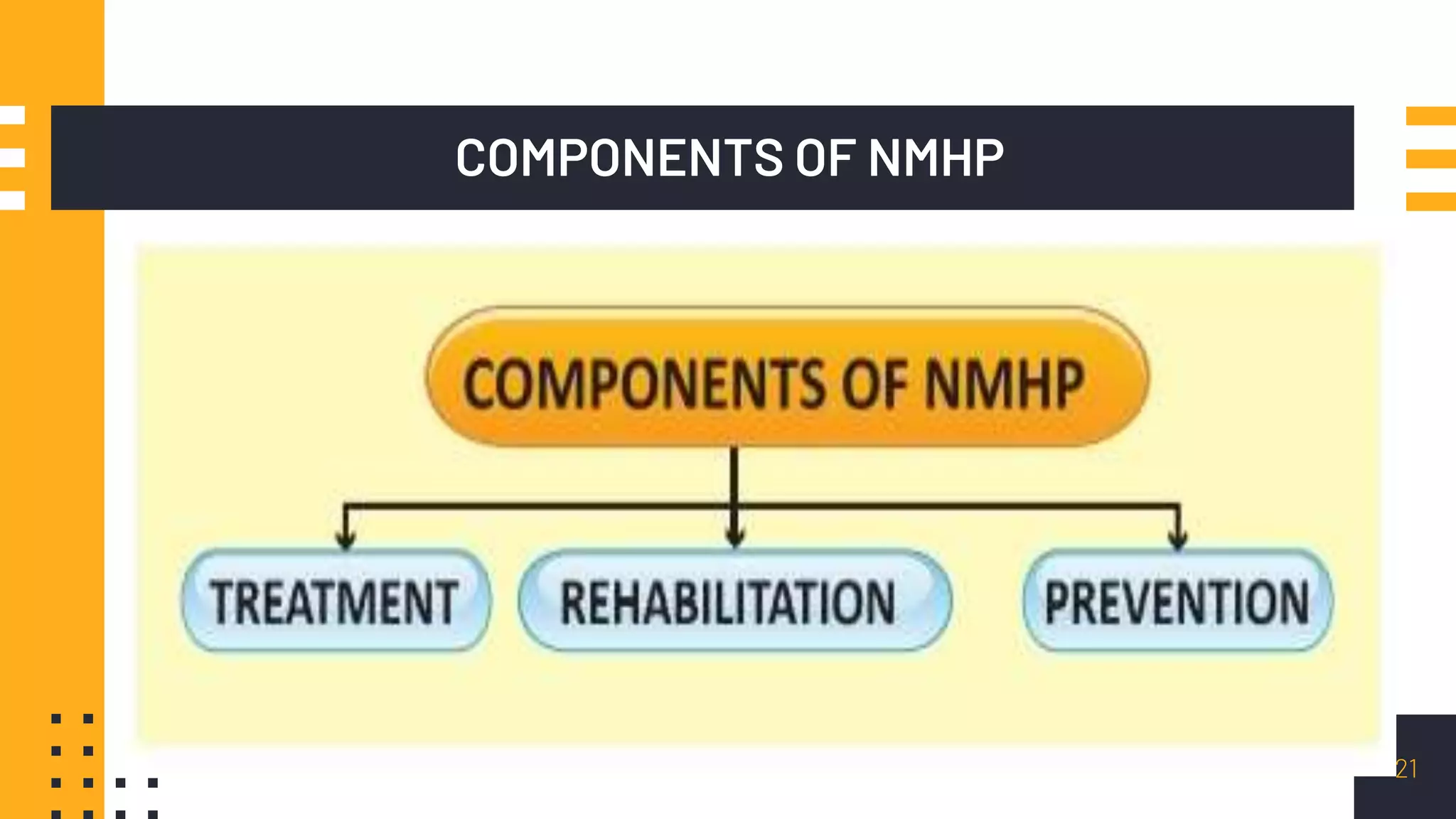
COMPONENTS OF NMHP
21
TREATMENT – MULTIPLE LEVELS
PRIMARY LEVEL
▪ Village and sub Centre level multiple health supervisor under the supervision
of the medical officer to be trained for :
▪ Management of psychiatric emergencies
▪ Administration and supervision of maintenance treatment for chronic
psychiatric disorder
▪ Diagnosis and management of epilepsy especially in children.
▪ With local school teacher and parents regarding mental retardation and
behavioral problem children & Counseling problem related to alcohol and drug
abuse
22
SECONDARY LEVEL
Medical officer of PHC aids by health supervisor to be trained for :
▪ Supervision of multiple purpose worker performance
▪ Elementary diagnosis
▪ Treatment of functional psychosis
▪ Management of uncomplicated psychosocial problem
▪ Epidemiological surveillance of mental morbidity
23
TERTIARY LEVEL
▪ It was recognized that there should be a psychiatrist attached to every district
hospitals an integral part of the district health services.
▪ The district hospital would have 30 - 50 psychiatric bed
▪ The psychiatric in a district hospital was to devote only a part of his time to
clinical care and a greater part in training and supervision of non specialist
health worker
24
REHABILITATION
The component of this sub programme include treatment of epileptic and
psychotic at the community level and development of rehabilitations center at
both the district level and higher referral
25
PREVENTION
The prevention component is to be community based with initial focus on
prevention and control of alcohol related problem
Later on problem like addiction juveniles delinquency and acute adjustment
problem like suicidal attempt are to be addressed
26
FUNCTIONS OF NMHP
▪ Mental Hospitals
Very chronic and disturbed patient who cannot be looked after in the community, to be certified
and admitted in mental hospitals.
▪ Medical Colleges
Will take the responsibility of training of general practioners and the medical offices in the primary
health centres. They will function as research centres.
▪ District and Taluk Hospitals
Will have the department of psychiatry and psychiatrist.
They will supervise the medical officers and general practioners in the PHC
Community health workers attached to PHC will identify the patients who suffer from psychiatric
disorders and refereeing the patient to the PHC for treatment 27
ACTIVITIES OF NMHP
▪ Integration of mental health services to all existing general health services
▪ Early detection and follow up
▪ Increase the awareness of mental health programme
▪ Eradication of stigmatization of mentally ill
▪ Providing counseling services for alcoholic , drug addicted and delinquents
▪ Establishment of tertiary health Institution for treatment of mental illness
▪ Training of mental health team at noble institute in state
▪ Training the trainer from states at NIMHAMS, Bangalore
▪ Recommendation of mentally ill patient and their rights 28
STRATEGIES AND RECOMMENDATIONS OF ACTION
29
The strategic areas for action are linked to
the situation analysis, cross cutting issues
and goals and objectives of the Mental
Health Policy. These intervention areas
are all equally relevant and need to be
pursued in parallel.
• Effective governance and delivery
mechanisms for mental health
• Promotion of mental health
• Prevention of mental illness, reduction
of suicide and attempted suicide
 Universal access to mental health
services
 Improved availability of adequately
trained mental health human resources
to address the mental health needs to
the community.
 Community participation for mental
health and development
 Research
The policy recommends…
▪ Need to increase specialists with public financing
▪ Integration with the primary care approach – to identify metally ill persons, refer and
follow up with medications and tele medicine linkages.
▪ Specially trained general medical officers and nurses for some referral support at the
secondary care level.
▪ Supplementing primary level facilities with counsellors and psychologists.
▪ Creating a network of community members to provide psycho-social support for such
problems.
30
ROLE OF NURSE IN NMHP
31
 Understand the characteristics of
mentally healthy person and
differentiate abnormal form normal
behavior in the community.
 Identified refer follow up the mentally
ill person in the community.
 Provide first aid during emergencies.
 Assist and co-ordinate the activities
related to care of mentally ill in the
community health center.
 Conduct mental health education to pt.
and there family members.
 Providing training to health worker in
mental health care.
 Supervision and monitor the activities
of health worker related mental health
care.
 Participate in various therapies used in
treating psychiatric patients.
 Assist medical officer and co-ordinate
the progress activity related to NMHP.
 Organize and co-ordinate the
rehabilitation activity for mentally ill
the community.
Place your screenshot here
32
Tuesday, October 27, 2020
Health has always been a matter of great
concern and the recently framed National
Healthcare Policy goes to prove that
right. But, sadly, not much importance has
been given to the topic of mental well-
being, because of the social taboos and
stigmas attached to it. Hence the Mental
Health Care Bill that was recently passed
in Rajya Sabha has been well received by
the general public and the health care
providers.
SALIENT FEATURES OF MENTAL HEALTH CARE BILL
every person the right to access mental health
care and treatment from health services run or
funded by the Govt.
bill assures free treatment for mentally-ill
persons if they are homeless or poor, even if
they do not possess a Below Poverty Line card.
bill has a “patient-centric” approach with the
aim of increasing participation of service users.
“Suicide is a mental disease. It will not be a
criminal act, it will be decriminalised
The bill provides right to make an advance
directive in writing specifying the way the
person wishes to be cared
Photographs or any other information pertaining
to the person cannot be released to the media
without the consent of the person with mental
illness – right to confidentiality
The government will set up a Central Mental
Health Authority at the national level and a State
Mental Health Authority in every state.
Under the Mental Healthcare Bill, the punishment
for flouting of provisions will attract up to six
months in prison or Rs 10,000 fine or both.
Repeat offenders can face up to two years in jail
or a fine of Rs 50,000 to Rs 5 lakh or both. 33
JOURNAL REFERENCE
▪ TITLE - Models and roles in National Mental Health Programme
AUTHOR - G Balamurugan, G Radhakrishnan, M Vijayarani
▪ Indian Journal of Psychiatric Nursing
▪ Year : 2019 | Volume : 16 | Issue : 1 | Page : 52-54
▪ While implementing NMHP, a lot of hurdles were raised such as funding (Who has to fund the
program? central or state government) and feasibility in implementing in larger population. The
majority of the stakeholders stressed upon finding out a model to implement NMHP at district
level. Hence, the NIMHANS developed a model (Bellary model) to deliver NHMP at Bellary
district, Karnataka.
34
BELLARY MODEL
STRATEGIES
▪ A provision of six essential psychotropic and
antiepileptic drugs (chlorpromazine, amitriptyline,
trihexyphenidyl, injection fluphenazine decanoate,
phenobarbitone, and diphenylhydantoin) at all
primary health centers (PHCs) and subcenters
(SCs)
▪ A system of simple mental health case records
▪ A system of monthly reporting, regular
monitoring, and feedback from the district level
mental health team.
TEAM OF BELLARY MODEL
AT DISTRICT LEVEL
▪ Psychiatrist
▪ Clinical psychologist
▪ Psychiatric social worker
▪ Statistical clerk.
35
DMHP
▪ The District Mental Health Program (DMHP) was launched under NMHP in the
year 1996 (in IX Five Year Plan). The DMHP was based on ‘Bellary Model’ with
the following components:
▪ Early detection & treatment.
▪ Training: imparting short term training to general physicians for diagnosis and
treatment of common mental illnesses with limited number of drugs under
guidance of specialist. The Health workers are being trained in identifying
mentally ill persons.
▪ Public awareness generation.
▪ Monitoring: the purpose is for simple Record Keeping. 36
37
SLOGAN - REACHING THE UNREACHED
38
TAKE A QUIZ
▪ In which year the DNMP was launched?
▪ Slogan of NMHP
▪ Vision of NMHP
▪ Components of NMHP
▪ What is the name of the model developed by NIMHANS to deliver NMHP
39
40
Thanks!

National Mental Health Policy

  • 1.
  • 2.
    “ ▪ CONTENTS ▪ INTRODUCTION ▪DEFINITION OF NMHP ▪ MAGNITUDE SCALE ▪ MENTAL HEALTH SERVICES AT VARIOUS LEVELS ▪ NMHP - MAJOR HIGHIGHTS ▪ EVOLUTION OF NMHP ▪ AIMS ▪ VISION ▪ OBJECTIVES ▪ APPROACHES ▪ ADMINISTRATIVE LEVELS ▪ COMPONENTS ▪ FUNCTIONS ▪ ACTIVITIES ▪ STRATEGIES AND RECOMMENDATIONS ▪ ROLE OF NURSE ▪ JOURNAL REFERENCE 2
  • 3.
    INTRODUCTION The attitude towardsmental illness and the treatment of mentally ill have undergone considerable changes through the years where before Mentally ill were often beaten, starved, burned and tortured in order to make the body unsuitable place for demons. The organization of mental health services demands a wide variety of interventions, regarding from public awareness, early identification, treatment for illness, family education, long term care, rehabilitation, and ensure human rights of the ill persons. To create more awareness on mental health among rural people, National mental health policy was started in 1982 in Maharashtra by the Government of India. Slogan of National Mental Health Programme: Reaching The Unreached 3
  • 4.
    DEFINITION ▪ Mental Health:-(WHO):- Mental health is a state of wellbeing in which an individual realize his/ her own abilities can cope with the normal stresses of life, can work productively and is able to make a contribution to his/her community. ▪ Mental Illness:- A mental illness is a medical condition that disrupts person's thinking, feeling, mood, ability, to release to others and daily functioning . mental illness are medical condition that often result in diminished capacity for coping with the ordinary demands of life. 4
  • 5.
    NMHP - DEFINITION Accordingto WHO, “Mental Health Policies describe the values, objectives & strategies of the Government to reduce the Mental Health burden & to improve mental health. 5
  • 6.
    “ As per census2011(2016) updated, there are 72 million people are suffering from some form of mental illness ranging from depression to schizophrenia.According to the World Health Organisation’s Mental Health Report of 2011, less than 1% of the total health budget is spent on mental health in India. Plus, India also lacks mental health professionals. According to the report, there is just one psychiatrist for every 3.4 lakh people. The policy aims to provide universal psychiatric care to the entire population. 6 MAGNITUDE OF THE PROBLEMS
  • 7.
    MENTAL HEALTH SERVICESAT VARIOUS LEVELS 7
  • 8.
    NATIONAL MENTAL HEALTHPOLICY A Mental Health Action Plan has been launched by our government backed by the mental health action plan 365, which highlights roles of Central and State governments, media and civil society organizations. The policy is an attempt to decrease the treatment gap, disease burden and extent of disability due to mental illness by integrating mental health with general health, inter- sectional coordination focusing on illness and disability, promotion of human rights, reforms in mental hospitals, response to the needs of vulnerable groups including women, children, homeless people and support for caregivers and family. 8
  • 9.
    MAJOR HIGHLIGHTS OFTHE NMHP ARE… NMHP underwent major strategic revisions over its course, starting from setting a district as the unit for program planning and implementation under the District Mental Health Program (DMHP) to incorporating it with the National Rural Health Mission (NRHM) for effectively scaling up the program. ▪ More emphasis on funding: The new policy emphasizes the need for more fund allocation in total health budget, including social welfare, school education and women and child development, so as to handle mental health appropriately for all. ▪ Emphasis on care-givers: The policy aims to give family members access to information and guided access to special services 9
  • 10.
    CONTD… ▪ Identifying vulnerablegroups: The policy also emphasizes that there are certain sections of the population who are more vulnerable to mental health issues, like people suffering from mental health among the poor, the homeless, people in custodial institutions, orphans, children, and the elderly, including sex workers or victims of human trafficking. ▪ Promoting awareness on the problem of mental health: focuses on the need to create awareness among the people on this problem and how to prevent it. ▪ Policy aims to decriminalize suicide: aims to decriminalize attempted suicide, which is at present considered as a punishable offence in India. 10
  • 11.
    EVOLUTION OF THENMHP IN INDIA ▪ 1970 community surveys of mental disorders carried out in different parts of the country had shown that all types of mental disorders were widely prevalent in India. ▪ Gross neglect of mental disorders in developing countries. ▪ Sigma, misconceptions ▪ Inadequate budgets for health care including mental health ▪ Acute shortage of trained mental health personnel ▪ In 1980, the Government of India felt the necessity of evolving a plan of action aimed at the mental health component of the NMHP
  • 12.
    CONTD.. ▪ In Febraury1981, a drafting committee met in Lucknow and prepared the first draft of the NMHP. This was presented at a workshop at New Delhi on 20-21 July, 1981. ▪ In August 1982, the highest policy making body in the field of health in the country, the Central Council of Health and Family Welfare adopted and recommended for implementation of NMHP. ▪ The first draft of NMHP was prepared in late 2001& came into existence in 2003. 12
  • 13.
    NMHP - 2014 InApril 2011 the GoI constituted a policy group. Based on the recommendations of the experts, The National Mental Health Policy was considered in accordance with World Health assembly resolution. It incorporates an integrated, participatory rights and evidence based approach. 13
  • 14.
    VISION The vision ofthe National Mental Health Policy is to promote mental health, prevent mental illness, enable recovery from mental illness, promote destigmatization and desegregation, and ensure socio-economic inclusion of persons affected by mental illness by providing accessible, affordable and quality health and social care to all persons through their life-span within a rights-based frame work. 14
  • 15.
    AIMS ▪ Prevention andtreatment of mental and Neurological disorders and associated disabilities ▪ Use of Mental Health technologies to improve general health services ▪ Application of mental health principles in total national development to improve quality of life 15
  • 16.
  • 17.
    APPROACHES To realize theseobjectives the following approaches were envisaged: ▪ Integration of the mental health care services with the existing general health services. ▪ Utilization of the existing health services infrastructure to deliver minimum mental health care services. ▪ Provision of appropriate task oriented training to the existing health staff. ▪ Linking of mental health services with the 17
  • 18.
    ADMINISTRATIVE LEVELS OFNMHP MINISTER OF HEALTH & FAMILY WELFARE GOVERNMENT OF INDIA DIRECTOR GENERAL OF HEALTH SERVICES JOINT DIRECTOR – MENTAL HEALTH (Central Monitoring Agency for DMHP) SECRETARY STATE MENTAL HEALTH AUTHORITY (State Monitoring Agency) [Jt. Director – Mental Health; Project Co-ordinator] DISTRICT PROJECT OFFICER (District Level) 18
  • 19.
    19 STIGMA People inside custodial institutions like prisons, juvenile Vulnerable population Orphans Elders in oldage homes ISSUES THAT HAVE AN IMPACT ON THE FULFILMENT OF GOALS OF THIS POLICY.
  • 20.
    VALUES AND PRINCIPLESOF NMHP 20  Equity  Justice  Integrated care  Evidenced based care  Quality  Participatory approach  Government delivery  Teaching programme  Holistic approach to mental health
  • 21.
  • 22.
    TREATMENT – MULTIPLELEVELS PRIMARY LEVEL ▪ Village and sub Centre level multiple health supervisor under the supervision of the medical officer to be trained for : ▪ Management of psychiatric emergencies ▪ Administration and supervision of maintenance treatment for chronic psychiatric disorder ▪ Diagnosis and management of epilepsy especially in children. ▪ With local school teacher and parents regarding mental retardation and behavioral problem children & Counseling problem related to alcohol and drug abuse 22
  • 23.
    SECONDARY LEVEL Medical officerof PHC aids by health supervisor to be trained for : ▪ Supervision of multiple purpose worker performance ▪ Elementary diagnosis ▪ Treatment of functional psychosis ▪ Management of uncomplicated psychosocial problem ▪ Epidemiological surveillance of mental morbidity 23
  • 24.
    TERTIARY LEVEL ▪ Itwas recognized that there should be a psychiatrist attached to every district hospitals an integral part of the district health services. ▪ The district hospital would have 30 - 50 psychiatric bed ▪ The psychiatric in a district hospital was to devote only a part of his time to clinical care and a greater part in training and supervision of non specialist health worker 24
  • 25.
    REHABILITATION The component ofthis sub programme include treatment of epileptic and psychotic at the community level and development of rehabilitations center at both the district level and higher referral 25
  • 26.
    PREVENTION The prevention componentis to be community based with initial focus on prevention and control of alcohol related problem Later on problem like addiction juveniles delinquency and acute adjustment problem like suicidal attempt are to be addressed 26
  • 27.
    FUNCTIONS OF NMHP ▪Mental Hospitals Very chronic and disturbed patient who cannot be looked after in the community, to be certified and admitted in mental hospitals. ▪ Medical Colleges Will take the responsibility of training of general practioners and the medical offices in the primary health centres. They will function as research centres. ▪ District and Taluk Hospitals Will have the department of psychiatry and psychiatrist. They will supervise the medical officers and general practioners in the PHC Community health workers attached to PHC will identify the patients who suffer from psychiatric disorders and refereeing the patient to the PHC for treatment 27
  • 28.
    ACTIVITIES OF NMHP ▪Integration of mental health services to all existing general health services ▪ Early detection and follow up ▪ Increase the awareness of mental health programme ▪ Eradication of stigmatization of mentally ill ▪ Providing counseling services for alcoholic , drug addicted and delinquents ▪ Establishment of tertiary health Institution for treatment of mental illness ▪ Training of mental health team at noble institute in state ▪ Training the trainer from states at NIMHAMS, Bangalore ▪ Recommendation of mentally ill patient and their rights 28
  • 29.
    STRATEGIES AND RECOMMENDATIONSOF ACTION 29 The strategic areas for action are linked to the situation analysis, cross cutting issues and goals and objectives of the Mental Health Policy. These intervention areas are all equally relevant and need to be pursued in parallel. • Effective governance and delivery mechanisms for mental health • Promotion of mental health • Prevention of mental illness, reduction of suicide and attempted suicide  Universal access to mental health services  Improved availability of adequately trained mental health human resources to address the mental health needs to the community.  Community participation for mental health and development  Research
  • 30.
    The policy recommends… ▪Need to increase specialists with public financing ▪ Integration with the primary care approach – to identify metally ill persons, refer and follow up with medications and tele medicine linkages. ▪ Specially trained general medical officers and nurses for some referral support at the secondary care level. ▪ Supplementing primary level facilities with counsellors and psychologists. ▪ Creating a network of community members to provide psycho-social support for such problems. 30
  • 31.
    ROLE OF NURSEIN NMHP 31  Understand the characteristics of mentally healthy person and differentiate abnormal form normal behavior in the community.  Identified refer follow up the mentally ill person in the community.  Provide first aid during emergencies.  Assist and co-ordinate the activities related to care of mentally ill in the community health center.  Conduct mental health education to pt. and there family members.  Providing training to health worker in mental health care.  Supervision and monitor the activities of health worker related mental health care.  Participate in various therapies used in treating psychiatric patients.  Assist medical officer and co-ordinate the progress activity related to NMHP.  Organize and co-ordinate the rehabilitation activity for mentally ill the community.
  • 32.
    Place your screenshothere 32 Tuesday, October 27, 2020 Health has always been a matter of great concern and the recently framed National Healthcare Policy goes to prove that right. But, sadly, not much importance has been given to the topic of mental well- being, because of the social taboos and stigmas attached to it. Hence the Mental Health Care Bill that was recently passed in Rajya Sabha has been well received by the general public and the health care providers.
  • 33.
    SALIENT FEATURES OFMENTAL HEALTH CARE BILL every person the right to access mental health care and treatment from health services run or funded by the Govt. bill assures free treatment for mentally-ill persons if they are homeless or poor, even if they do not possess a Below Poverty Line card. bill has a “patient-centric” approach with the aim of increasing participation of service users. “Suicide is a mental disease. It will not be a criminal act, it will be decriminalised The bill provides right to make an advance directive in writing specifying the way the person wishes to be cared Photographs or any other information pertaining to the person cannot be released to the media without the consent of the person with mental illness – right to confidentiality The government will set up a Central Mental Health Authority at the national level and a State Mental Health Authority in every state. Under the Mental Healthcare Bill, the punishment for flouting of provisions will attract up to six months in prison or Rs 10,000 fine or both. Repeat offenders can face up to two years in jail or a fine of Rs 50,000 to Rs 5 lakh or both. 33
  • 34.
    JOURNAL REFERENCE ▪ TITLE- Models and roles in National Mental Health Programme AUTHOR - G Balamurugan, G Radhakrishnan, M Vijayarani ▪ Indian Journal of Psychiatric Nursing ▪ Year : 2019 | Volume : 16 | Issue : 1 | Page : 52-54 ▪ While implementing NMHP, a lot of hurdles were raised such as funding (Who has to fund the program? central or state government) and feasibility in implementing in larger population. The majority of the stakeholders stressed upon finding out a model to implement NMHP at district level. Hence, the NIMHANS developed a model (Bellary model) to deliver NHMP at Bellary district, Karnataka. 34
  • 35.
    BELLARY MODEL STRATEGIES ▪ Aprovision of six essential psychotropic and antiepileptic drugs (chlorpromazine, amitriptyline, trihexyphenidyl, injection fluphenazine decanoate, phenobarbitone, and diphenylhydantoin) at all primary health centers (PHCs) and subcenters (SCs) ▪ A system of simple mental health case records ▪ A system of monthly reporting, regular monitoring, and feedback from the district level mental health team. TEAM OF BELLARY MODEL AT DISTRICT LEVEL ▪ Psychiatrist ▪ Clinical psychologist ▪ Psychiatric social worker ▪ Statistical clerk. 35
  • 36.
    DMHP ▪ The DistrictMental Health Program (DMHP) was launched under NMHP in the year 1996 (in IX Five Year Plan). The DMHP was based on ‘Bellary Model’ with the following components: ▪ Early detection & treatment. ▪ Training: imparting short term training to general physicians for diagnosis and treatment of common mental illnesses with limited number of drugs under guidance of specialist. The Health workers are being trained in identifying mentally ill persons. ▪ Public awareness generation. ▪ Monitoring: the purpose is for simple Record Keeping. 36
  • 37.
    37 SLOGAN - REACHINGTHE UNREACHED
  • 38.
  • 39.
    TAKE A QUIZ ▪In which year the DNMP was launched? ▪ Slogan of NMHP ▪ Vision of NMHP ▪ Components of NMHP ▪ What is the name of the model developed by NIMHANS to deliver NMHP 39
  • 40.