Douglas Ziedonis, MD, MPH
Professor & Chair
Department of Psychiatry
University of Massachusetts Medical School & UMass
Memorial Health Care
UMass Medical School / UMass Memorial HealthcareUMass Medical School / UMass Memorial Healthcare
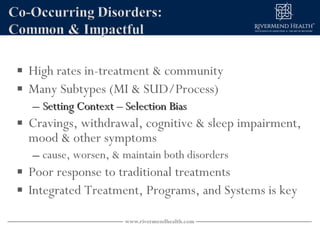
 High rates in-treatment & community
 Many Subtypes (MI & SUD/Process)
– Setting Context – Selection BiasSetting Context – Selection Bias
 Cravings, withdrawal, cognitive & sleep impairment,
mood & other symptoms
– cause, worsen, & maintain both disorders
 Poor response to traditional treatments
 Integrated Treatment, Programs, and Systems is key
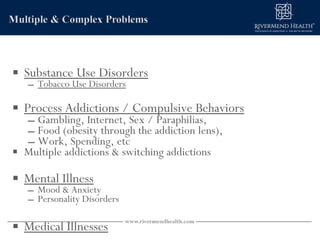
 Substance Use Disorders
– Tobacco Use Disorders
 Process Addictions / Compulsive Behaviors
– Gambling, Internet, Sex / Paraphilias,
– Food (obesity through the addiction lens),
– Work, Spending, etc
 Multiple addictions & switching addictions
 Mental Illness
– Mood & Anxiety
– Personality Disorders
 Medical Illnesses
 Increased fluctuation in mental status
– Increased suicide risk & cognitive impairment
 Multiple Addictions
 Increased episodic violence, victimization / trauma,
illegal activities (& homelessness)
 Increased morbidity & mortality
– HIV, HepC
– Tobacco caused / worsened disorders
 Worse medication compliance
Reward,
Memory/Learning,
Motivation, &
Inhibitory Control/
Executive Function
Areas to consider in
developing new
treatments
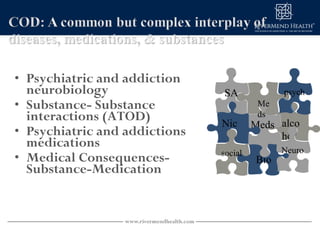
• Psychiatric and addiction
neurobiology
• Substance- Substance
interactions (ATOD)
• Psychiatric and addictions
medications
• Medical Consequences-
Substance-Medication
alco
hol
Bio
Neuro
MedsNic
social
Me
ds
psychSA
Garavan H, et al. Am J Psychiatry 2000;157:1789-1798.
IFG
Ant. Cing.
Cingulate
SignalIntensity(AU)
Cocaine Film
Erotic Film
Controls Cocaine Users
Dopamine
Dendritic
Spines
Adapted from Nestler EJ. NIDA Science & Practice Perspectives, 3(1) 2005.
 Symptoms versus Diagnosis ?
– anxiety, depression, mania, & psychosis
– intoxication, withdrawal, & chronic use
– personality factors
– symptom scales and diagnostic tools
 Primary versus Secondary ?
– timeline review, past treatments
 Self-Medication ?
– FH, significant other, pros / cons, attributions
 Changes in treatment ?Changes in treatment ?
– How long wait ???How long wait ???
 Dual Recovery Status Exam
 Blend 3 Addiction Psychosocial TreatmentsBlend 3 Addiction Psychosocial Treatments
– Motivational Enhancement TherapyMotivational Enhancement Therapy
– Relapse PreventionRelapse Prevention
– 12-Step Facilitation12-Step Facilitation
 Blend Evidence Based Treatments for specific psychiatricBlend Evidence Based Treatments for specific psychiatric
disordersdisorders
– CBT, Social Skills Training, etcCBT, Social Skills Training, etc
 Recovery Orientation: recognize the need for hope,Recovery Orientation: recognize the need for hope,
acceptance, and empowermentacceptance, and empowerment
 DetoxificationDetoxification
 Protracted abstinenceProtracted abstinence
 Harm reduction / opioid agonistsHarm reduction / opioid agonists
 Co-occurring psychiatric disordersCo-occurring psychiatric disorders
– Consider medication abuse liability, safety, & interaction
with substances
 The AA Member: Medications and Other DrugsThe AA Member: Medications and Other Drugs,,
19841984
12
 ““Pills Fix Problems”Pills Fix Problems”
 Soothing – QuickSoothing – Quick
 Switch / Add an addiction in vulnerable individualSwitch / Add an addiction in vulnerable individual
 How does it fit in working my program?How does it fit in working my program?
 Manage aversion to taking medications once inManage aversion to taking medications once in
recovery for addictionrecovery for addiction
 Substances alter impact of MedicationsSubstances alter impact of Medications
Complete Wellness:
Mental & Physical Health
Complete
Wellness
Healthy
Food Choices
Daily
Physical
Activity
Stress Management
* Mindfulness & Spirituality
Address Addictive
Behaviors
* Smoking cessation
Regular
Checkups
Mental
Health &
Recovery
Plan
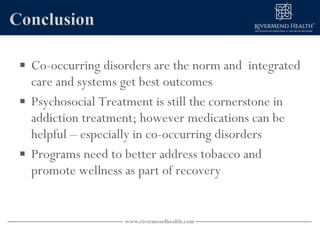
 Co-occurring disorders are the norm and integrated
care and systems get best outcomes
 Psychosocial Treatment is still the cornerstone in
addiction treatment; however medications can be
helpful – especially in co-occurring disorders
 Programs need to better address tobacco and
promote wellness as part of recovery
 SAMHSA’s TIPS #42 on COD
– www.health.org
 SAMHSA Pharmacotherapy Principles (2012)SAMHSA Pharmacotherapy Principles (2012)
 COCE: National Training Center on COD www.coce.org
 SAMHSA’s Report To Congress
 President’s New Freedom Commission on MH
 ASAM PPC II – DD Capable & DD Enhanced
 APA SA Treatment Guidelines Update
– www.psych.org (Updated May 2006)
 Parallel, Consultant Model, Fully-Integrated
 Integrated Dual Diagnosis Treatment (IDDT) - ACT
teams, housing, etc
– www.mentalhealth.samhsa.gov/cmhs/communitysup
port/toolkits/cooccurring/
 COSIG National Program – 17 States
 Addressing Tobacco Through Organizational Change
(ATTOC) in MH / SA settings
– http://www.umassmed.edu/psychiatry/ATTOC.asp
x
 UMass Addressing Tobacco Through Organizational Change
– http://www.umassmed.edu/psychiatry/attoc.aspx
 NASMHPD’s Tool Kit
– www.nasmhpd.org
 NY State Tobacco Dependence Resource Center
– www.tobaccodependence.org/
 Toolkit from The Alliance for the Prevention and Treatment of Nicotine Addiction
(APTNA)
– www.aptna.org/APTNA_Prov_Toolkits.html
 Treating Tobacco Use and Dependence - Public Health Service Clinical Practice
Guideline (2008)
– http://www.surgeongeneral.gov/tobacco/treating_tobacco_use08.pdf
 American Psychiatric Association’s Substance Use Disorder Treatment Guidelines
(2006) www.psych.org

Co-Occurring Addiction & Mental Illness

  • 1.
    Douglas Ziedonis, MD,MPH Professor & Chair Department of Psychiatry University of Massachusetts Medical School & UMass Memorial Health Care
  • 2.
    UMass Medical School/ UMass Memorial HealthcareUMass Medical School / UMass Memorial Healthcare
  • 3.
     High ratesin-treatment & community  Many Subtypes (MI & SUD/Process) – Setting Context – Selection BiasSetting Context – Selection Bias  Cravings, withdrawal, cognitive & sleep impairment, mood & other symptoms – cause, worsen, & maintain both disorders  Poor response to traditional treatments  Integrated Treatment, Programs, and Systems is key
  • 4.
     Substance UseDisorders – Tobacco Use Disorders  Process Addictions / Compulsive Behaviors – Gambling, Internet, Sex / Paraphilias, – Food (obesity through the addiction lens), – Work, Spending, etc  Multiple addictions & switching addictions  Mental Illness – Mood & Anxiety – Personality Disorders  Medical Illnesses
  • 5.
     Increased fluctuationin mental status – Increased suicide risk & cognitive impairment  Multiple Addictions  Increased episodic violence, victimization / trauma, illegal activities (& homelessness)  Increased morbidity & mortality – HIV, HepC – Tobacco caused / worsened disorders  Worse medication compliance
  • 6.
    Reward, Memory/Learning, Motivation, & Inhibitory Control/ ExecutiveFunction Areas to consider in developing new treatments
  • 7.
    • Psychiatric andaddiction neurobiology • Substance- Substance interactions (ATOD) • Psychiatric and addictions medications • Medical Consequences- Substance-Medication alco hol Bio Neuro MedsNic social Me ds psychSA
  • 8.
    Garavan H, etal. Am J Psychiatry 2000;157:1789-1798. IFG Ant. Cing. Cingulate SignalIntensity(AU) Cocaine Film Erotic Film Controls Cocaine Users
  • 9.
    Dopamine Dendritic Spines Adapted from NestlerEJ. NIDA Science & Practice Perspectives, 3(1) 2005.
  • 10.
     Symptoms versusDiagnosis ? – anxiety, depression, mania, & psychosis – intoxication, withdrawal, & chronic use – personality factors – symptom scales and diagnostic tools  Primary versus Secondary ? – timeline review, past treatments  Self-Medication ? – FH, significant other, pros / cons, attributions  Changes in treatment ?Changes in treatment ? – How long wait ???How long wait ???  Dual Recovery Status Exam
  • 11.
     Blend 3Addiction Psychosocial TreatmentsBlend 3 Addiction Psychosocial Treatments – Motivational Enhancement TherapyMotivational Enhancement Therapy – Relapse PreventionRelapse Prevention – 12-Step Facilitation12-Step Facilitation  Blend Evidence Based Treatments for specific psychiatricBlend Evidence Based Treatments for specific psychiatric disordersdisorders – CBT, Social Skills Training, etcCBT, Social Skills Training, etc  Recovery Orientation: recognize the need for hope,Recovery Orientation: recognize the need for hope, acceptance, and empowermentacceptance, and empowerment
  • 12.
     DetoxificationDetoxification  ProtractedabstinenceProtracted abstinence  Harm reduction / opioid agonistsHarm reduction / opioid agonists  Co-occurring psychiatric disordersCo-occurring psychiatric disorders – Consider medication abuse liability, safety, & interaction with substances  The AA Member: Medications and Other DrugsThe AA Member: Medications and Other Drugs,, 19841984 12
  • 13.
     ““Pills FixProblems”Pills Fix Problems”  Soothing – QuickSoothing – Quick  Switch / Add an addiction in vulnerable individualSwitch / Add an addiction in vulnerable individual  How does it fit in working my program?How does it fit in working my program?  Manage aversion to taking medications once inManage aversion to taking medications once in recovery for addictionrecovery for addiction  Substances alter impact of MedicationsSubstances alter impact of Medications
  • 14.
    Complete Wellness: Mental &Physical Health Complete Wellness Healthy Food Choices Daily Physical Activity Stress Management * Mindfulness & Spirituality Address Addictive Behaviors * Smoking cessation Regular Checkups Mental Health & Recovery Plan
  • 15.
     Co-occurring disordersare the norm and integrated care and systems get best outcomes  Psychosocial Treatment is still the cornerstone in addiction treatment; however medications can be helpful – especially in co-occurring disorders  Programs need to better address tobacco and promote wellness as part of recovery
  • 16.
     SAMHSA’s TIPS#42 on COD – www.health.org  SAMHSA Pharmacotherapy Principles (2012)SAMHSA Pharmacotherapy Principles (2012)  COCE: National Training Center on COD www.coce.org  SAMHSA’s Report To Congress  President’s New Freedom Commission on MH  ASAM PPC II – DD Capable & DD Enhanced  APA SA Treatment Guidelines Update – www.psych.org (Updated May 2006)
  • 17.
     Parallel, ConsultantModel, Fully-Integrated  Integrated Dual Diagnosis Treatment (IDDT) - ACT teams, housing, etc – www.mentalhealth.samhsa.gov/cmhs/communitysup port/toolkits/cooccurring/  COSIG National Program – 17 States  Addressing Tobacco Through Organizational Change (ATTOC) in MH / SA settings – http://www.umassmed.edu/psychiatry/ATTOC.asp x
  • 18.
     UMass AddressingTobacco Through Organizational Change – http://www.umassmed.edu/psychiatry/attoc.aspx  NASMHPD’s Tool Kit – www.nasmhpd.org  NY State Tobacco Dependence Resource Center – www.tobaccodependence.org/  Toolkit from The Alliance for the Prevention and Treatment of Nicotine Addiction (APTNA) – www.aptna.org/APTNA_Prov_Toolkits.html  Treating Tobacco Use and Dependence - Public Health Service Clinical Practice Guideline (2008) – http://www.surgeongeneral.gov/tobacco/treating_tobacco_use08.pdf  American Psychiatric Association’s Substance Use Disorder Treatment Guidelines (2006) www.psych.org

Editor's Notes

  • #2 Kendall and Carolyn: this is a new learning objective
  • #7 Brain circuits are affected by drug abuse and addiction. The areas depicted contain the circuits that underlie feelings of reward, learning and memory, motivation and drive, and inhibitory control. Each of these brain areas and the behaviors they control must be considered when developing strategies to treat drug addiction. PFC – prefrontal cortex; ACG – anterior cingulate gyrus; OFC – orbitofrontal cortex; SCC – subcallosal cortex; NAcc – nucleus accumbens; VP – ventral pallidum; Hipp – hippocampus; Amyg – amygdala
  • #9 Natural rewards become devalued in drug abusers, as drug-associated cues usurp the motivational circuits. Cocaine videos activate the brain of a drug abuser more than erotic stimuli. The bar graphs on the left show that specific brain areas in control individuals become strongly activated by erotic but not by cocaine-related films (yellow bar), while the exact opposite pattern is seen in cocaine abusers (blue bar). These results suggest that addicted individuals have an impaired capacity to extract pleasure out of normally enjoyable activities or stimuli. Garavan H, Pankiewicz J, Bloom A, Cho JK, Sperry L, Ross TJ, Salmeron BJ, Risinger R, Kelley D, Stein EA. Cue-induced cocaine craving: neuroanatomical specificity for drug users and drug stimuli. Am J Psychiatry. 2000 Nov;157(11):1789-98 OBJECTIVE: Cocaine-related cues have been hypothesized to perpetuate drug abuse by inducing a craving response that prompts drug-seeking behavior. However, the mechanisms, underlying neuroanatomy, and specificity of this neuroanatomy are not yet fully understood. METHOD: To address these issues, experienced cocaine users (N=17) and comparison subjects (N=14) underwent functional magnetic resonance imaging while viewing three separate films that portrayed 1 ) individuals smoking crack cocaine, 2) outdoor nature scenes, and 3) explicit sexual content. Candidate craving sites were identified as those that showed significant activation in the cocaine users when viewing the cocaine film. These sites were then required to show significantly greater activation when contrasted with comparison subjects viewing the cocaine film (population specificity) and cocaine users viewing the nature film (content specificity). RESULTS: Brain regions that satisfied these criteria were largely left lateralized and included the frontal lobe (medial and middle frontal gyri, bilateral inferior frontal gyrus), parietal lobe (bilateral inferior parietal lobule), insula, and limbic lobe (anterior and posterior cingulate gyrus). Of the 13 regions identified as putative craving sites, just three (anterior cingulate, right inferior parietal lobule, and the caudate/lateral dorsal nucleus) showed significantly greater activation during the cocaine film than during the sex film in the cocaine users, which suggests that cocaine cues activated similar neuroanatomical substrates as naturally evocative stimuli in the cocaine users. Finally, contrary to the effects of the cocaine film, cocaine users showed a smaller response than the comparison subjects to the sex film. CONCLUSIONS: These data suggest that cocaine craving is not associated with a dedicated and unique neuroanatomical circuitry; instead, unique to the cocaine user is the ability of learned, drug-related cues to produce brain activation comparable to that seen with nondrug evocative stimuli in healthy comparison subjects.
  • #10 Adapted from Nestler E. The Neurobiology of Cocaine Addiction. NIDA Science & Practice Perspectives. Vol 3, Number 1, December 2005. Available at: http://www.nida.nih.gov/perspectives/Vol3No1Refs.html. Accessed June 17, 2008. Work by Eric Nestler at UT southwestern and others is examining the genetic, cellular and molecular mechanisms associated with chronic drug use. This research is showing that With initial drug use such as cocaine use Neurons emanating from the ventral tegmental area release dopamine on medium spiny neurons in the NAC. Repeated cocaine use and dopamine release there is an up regulation in the gene transcription factor delta fos B that is believed to result in morphological changes to dendrites and dendritic spines on these neurons.