Human being has to maintain balance in
life; whenever he is exposed to stressor or stressful
situations he will try to overcome it by the help of
mental mechanisms. ‘EUSTRESS’ is always essential
for the individual to lead qualitative life; but when
the individual is exposed to many stressor at a time
,even with the utilization of balance factors
adequately also or one or more absence of balancing
factors result in disequilibrium and may lead to
crisis.
Crisis is a state of disequilibrium
resulting from the interaction of an event
with the individuals or family coping
mechanism ,which are inadequate to
meet the demands of the situation
,combined with the individuals or
family’s perception of the meaning of the
event.
TAYLOR 1982.
“ A sudden event that occurs
in one’s life which disturbs
the individual homeostasis
and usual coping mechanism
will not resolve the problem”
LARGERQUIST 2001
I. Lack of employment
II. History of unresolved crisis
III. History of substance abuse
IV. Loss of loved one
V. Lack of support system
VI. Sever family disorder
VII. Lack of communication skill
VIII.Lack of proper relationship with others.
 Individual is totally involved, get hurt in all way.
EX- disorganization of
Biological
Cognitive
Emotional
Behavioral
 Unable to perceive the circumstance or situation of
crisis event.
 It occurs in all the individuals at one time or other.
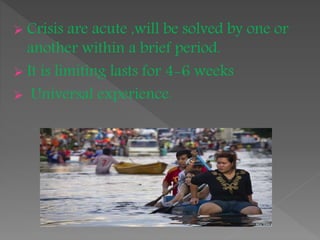
 Crisis are acute ,will be solved by one or
another within a brief period.
 It is limiting lasts for 4-6 weeks
 Universal experience.
 According to CAPLAN there are four
specific phases .these are as fallows.
PHASE 1
Whenever an individual is exposed to stressor it
result into anxiety .To over come it , individual uses
effective problem solving techniques and situation
support is provided, then the problem will be
resolved.
PHASE 2
When the mental mechanism are failed which
result in anxiety , discomfort, helplessness further
increases. Persons ability to overcome the stressors
will decreases.
PHASE 3
In this individual feel more pressure ,unable to
respond ,anxiety still increases; in this phase all
resources will be tried to resolve the crisis and to
relieve discomfort. i.e. the individual uses every
way like cognitive , emotional , psychological ways
as a last resort; if it fails the premorbid functioning
will results
PHASE 4
If problem was not solved , tension reaches to its
peak, as time passes burden increase over time.
Which result in panic state ,psychotic thinking ,
depression, distorted cognitive process, short
attention span , apprehension, impaired relationship
will results. The person will feel that ‘ loosing their
mind’ and ‘ going crazy’ extensive treatment is
necessary if negative outcomes are apparent.
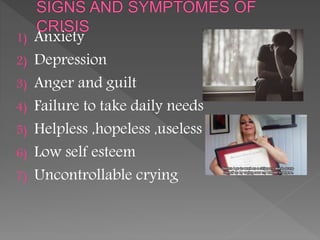
1) Anxiety
2) Depression
3) Anger and guilt
4) Failure to take daily needs
5) Helpless ,hopeless ,useless
6) Low self esteem
7) Uncontrollable crying
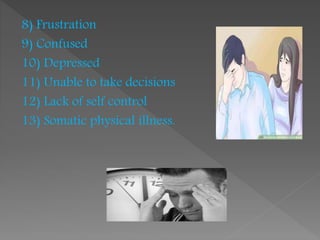
8) Frustration
9) Confused
10) Depressed
11) Unable to take decisions
12) Lack of self control
13) Somatic physical illness.
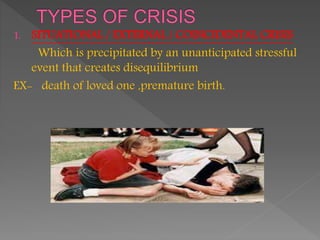
1. SITUATIONAL / EXTERNAL / COINCIDENTAL CRISIS
Which is precipitated by an unanticipated stressful
event that creates disequilibrium
EX- death of loved one ,premature birth.
2. MATURATIONAL / DEVELOPMENTAL /INTERNAL CRISIS
In this stage person’s life where adjustment
and adaptation to new responsibilities and life
patterns are necessary .
EX- capacity for emotional intimacy.
3. SOCIO- CULTURAL CRISIS
Which arises from the cultural values that are
embedded in the social structure.
EX- cast.
4. CRISIS RESULTING FROM TRAUMATIC STRESS
Which is result, due to when unexpected
external stress over which the individual has little
control .
EX- rape or robbery
5. CRISIS RESULTING FROM PSYCHOPATHOLOGY
Pre existing psychopathology has been
instrumental in precipitating the crisis
EX- sever neurosis, schizophrenia.
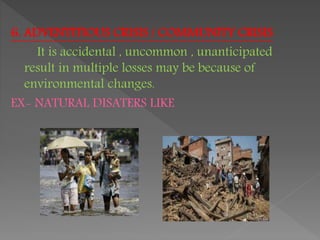
6. ADVENTITIOUS CRISIS / COMMUNITY CRISIS
It is accidental , uncommon , unanticipated
result in multiple losses may be because of
environmental changes.
EX- NATURAL DISATERS LIKE
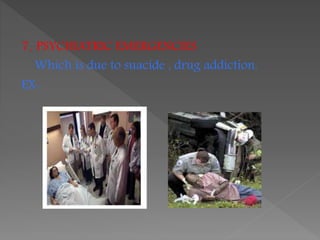
7. PSYCHIATRIC EMERGENCIES
Which is due to suacide , drug addiction.
EX-
1) Abstinence
2) Pediatric MATURATIONAL
3) Geriatric CRISIS
4) Adolescent
5) People who attempted suicide
6) Psycho somatic patient
7) Violent behavior EX-crime
8) Accidental victims
9) Family crisis
10) Sever depression
11) Sever anxiety
I. Hospital- out patient unit, inwards, emergency
room setting.
II. Mental health care centre.
III. Community setting- home visit.
IV. Telephonic counseling and hotline.
1) crisis call
2) information calls.
1) Catharsis- the release of feelings that takes
place as the patient talks about emotionally
charged.
2) Clarification- encouraging the patient to
express more clearly the relationship between
certain events.
3) Manipulation- using the patient’s emotion,
wishes to benefit the patient in the therapeutic
process.
4) Reinforcement of behavior- giving the patient
positive reinforcement to adaptive behavior.
EX- I observed you have don’t it, you can do it.
5) Support of defenses- encouraging the use of healthy
adaptive defenses and discouraging those that are
unhealthy.
6) Increasing self-esteem- helping the patient to
regain feelings of self worth.
EX- You have done so many task in your life up to
now, I feel you can be able to do this task also.
7)Exploration of solutions- examine the alternative
ways of solving immediate problem.
8) Empathy- recognizing and acknowledging patients
feelings. EX- I can hear how pain full it is for you to
talk about this.
9) Group work- Nurse and group help
the patient to solve the problem and
develop new coping strategies.
10) Patient education- the therapeutic
team members will educate and
counsel the client and his family
about problem resolving techniques,
alternative adaptive coping strategies.
1. To return to a pre crisis level of
functioning.
2.To resolve the crisis situation.
PHASE 1
Assessment
I. Ability to perceive the problematic situation.
II. Identification of precipitating event.
III. Supporting system and coping resources,
strategies that can be used.
IV. Need of the client like self –esteem
V. Nature of crisis and its effects on the individual
and family.
VI. Associated behavioral problems
Ex- suicidal potentialities.
NURSING DIAGNOSIS
1. Disturbed thought processes
2. Risk for emergency situation like suicide or
violence ,post traumatic stress
3. Altered family processes
4. Maladaptive crisis responses
PHASE 3
PLANING
Based on the assessment and nursing diagnosis
and available resources we have to make a plane
to resolve the problem.
IMPLEMENTATION OF CRISIS
1.Nure has to use reality oriented approch
2.Establish a rapid positive working relationship by
 showing unconditional acceptance
 Active listening
 Attending to immediate needs
 Appropriate communication techniques to make the
client to feel more comfortable
3.Provide adequate situational support and guidance
4. Set firm limits what is acceptable and not acceptable
5.Handle the feelings gently.
6.Encourage the client to not blem others as it
promotes escapism from taking responsibilities.
PHASE 5
EVALUATION OF CRISIS RESOUTION AND
ANTICIPATORY PLANNING
1. In which nurse should evaluate the clients for
whether the intervention has resulted in a positive
resolution of crisis.
EX- behavioral changes has been achieved or not.
Crisis and it's interventation.

Crisis and it's interventation.

  • 3.
    Human being hasto maintain balance in life; whenever he is exposed to stressor or stressful situations he will try to overcome it by the help of mental mechanisms. ‘EUSTRESS’ is always essential for the individual to lead qualitative life; but when the individual is exposed to many stressor at a time ,even with the utilization of balance factors adequately also or one or more absence of balancing factors result in disequilibrium and may lead to crisis.
  • 4.
    Crisis is astate of disequilibrium resulting from the interaction of an event with the individuals or family coping mechanism ,which are inadequate to meet the demands of the situation ,combined with the individuals or family’s perception of the meaning of the event. TAYLOR 1982.
  • 5.
    “ A suddenevent that occurs in one’s life which disturbs the individual homeostasis and usual coping mechanism will not resolve the problem” LARGERQUIST 2001
  • 6.
    I. Lack ofemployment II. History of unresolved crisis III. History of substance abuse IV. Loss of loved one V. Lack of support system VI. Sever family disorder VII. Lack of communication skill VIII.Lack of proper relationship with others.
  • 7.
     Individual istotally involved, get hurt in all way. EX- disorganization of Biological Cognitive Emotional Behavioral  Unable to perceive the circumstance or situation of crisis event.  It occurs in all the individuals at one time or other.
  • 8.
     Crisis areacute ,will be solved by one or another within a brief period.  It is limiting lasts for 4-6 weeks  Universal experience.
  • 9.
     According toCAPLAN there are four specific phases .these are as fallows. PHASE 1 Whenever an individual is exposed to stressor it result into anxiety .To over come it , individual uses effective problem solving techniques and situation support is provided, then the problem will be resolved.
  • 10.
    PHASE 2 When themental mechanism are failed which result in anxiety , discomfort, helplessness further increases. Persons ability to overcome the stressors will decreases. PHASE 3 In this individual feel more pressure ,unable to respond ,anxiety still increases; in this phase all resources will be tried to resolve the crisis and to relieve discomfort. i.e. the individual uses every way like cognitive , emotional , psychological ways as a last resort; if it fails the premorbid functioning will results
  • 11.
    PHASE 4 If problemwas not solved , tension reaches to its peak, as time passes burden increase over time. Which result in panic state ,psychotic thinking , depression, distorted cognitive process, short attention span , apprehension, impaired relationship will results. The person will feel that ‘ loosing their mind’ and ‘ going crazy’ extensive treatment is necessary if negative outcomes are apparent.
  • 12.
    1) Anxiety 2) Depression 3)Anger and guilt 4) Failure to take daily needs 5) Helpless ,hopeless ,useless 6) Low self esteem 7) Uncontrollable crying
  • 13.
    8) Frustration 9) Confused 10)Depressed 11) Unable to take decisions 12) Lack of self control 13) Somatic physical illness.
  • 14.
    1. SITUATIONAL /EXTERNAL / COINCIDENTAL CRISIS Which is precipitated by an unanticipated stressful event that creates disequilibrium EX- death of loved one ,premature birth.
  • 15.
    2. MATURATIONAL /DEVELOPMENTAL /INTERNAL CRISIS In this stage person’s life where adjustment and adaptation to new responsibilities and life patterns are necessary . EX- capacity for emotional intimacy. 3. SOCIO- CULTURAL CRISIS Which arises from the cultural values that are embedded in the social structure. EX- cast.
  • 16.
    4. CRISIS RESULTINGFROM TRAUMATIC STRESS Which is result, due to when unexpected external stress over which the individual has little control . EX- rape or robbery 5. CRISIS RESULTING FROM PSYCHOPATHOLOGY Pre existing psychopathology has been instrumental in precipitating the crisis EX- sever neurosis, schizophrenia.
  • 17.
    6. ADVENTITIOUS CRISIS/ COMMUNITY CRISIS It is accidental , uncommon , unanticipated result in multiple losses may be because of environmental changes. EX- NATURAL DISATERS LIKE
  • 18.
    7. PSYCHIATRIC EMERGENCIES Whichis due to suacide , drug addiction. EX-
  • 20.
    1) Abstinence 2) PediatricMATURATIONAL 3) Geriatric CRISIS 4) Adolescent 5) People who attempted suicide 6) Psycho somatic patient 7) Violent behavior EX-crime 8) Accidental victims 9) Family crisis 10) Sever depression 11) Sever anxiety
  • 21.
    I. Hospital- outpatient unit, inwards, emergency room setting. II. Mental health care centre. III. Community setting- home visit. IV. Telephonic counseling and hotline. 1) crisis call 2) information calls.
  • 22.
    1) Catharsis- therelease of feelings that takes place as the patient talks about emotionally charged. 2) Clarification- encouraging the patient to express more clearly the relationship between certain events. 3) Manipulation- using the patient’s emotion, wishes to benefit the patient in the therapeutic process. 4) Reinforcement of behavior- giving the patient positive reinforcement to adaptive behavior. EX- I observed you have don’t it, you can do it.
  • 23.
    5) Support ofdefenses- encouraging the use of healthy adaptive defenses and discouraging those that are unhealthy. 6) Increasing self-esteem- helping the patient to regain feelings of self worth. EX- You have done so many task in your life up to now, I feel you can be able to do this task also. 7)Exploration of solutions- examine the alternative ways of solving immediate problem. 8) Empathy- recognizing and acknowledging patients feelings. EX- I can hear how pain full it is for you to talk about this.
  • 24.
    9) Group work-Nurse and group help the patient to solve the problem and develop new coping strategies. 10) Patient education- the therapeutic team members will educate and counsel the client and his family about problem resolving techniques, alternative adaptive coping strategies.
  • 25.
    1. To returnto a pre crisis level of functioning. 2.To resolve the crisis situation.
  • 26.
    PHASE 1 Assessment I. Abilityto perceive the problematic situation. II. Identification of precipitating event. III. Supporting system and coping resources, strategies that can be used. IV. Need of the client like self –esteem V. Nature of crisis and its effects on the individual and family. VI. Associated behavioral problems Ex- suicidal potentialities.
  • 27.
    NURSING DIAGNOSIS 1. Disturbedthought processes 2. Risk for emergency situation like suicide or violence ,post traumatic stress 3. Altered family processes 4. Maladaptive crisis responses PHASE 3 PLANING Based on the assessment and nursing diagnosis and available resources we have to make a plane to resolve the problem.
  • 28.
    IMPLEMENTATION OF CRISIS 1.Nurehas to use reality oriented approch 2.Establish a rapid positive working relationship by  showing unconditional acceptance  Active listening  Attending to immediate needs  Appropriate communication techniques to make the client to feel more comfortable 3.Provide adequate situational support and guidance 4. Set firm limits what is acceptable and not acceptable 5.Handle the feelings gently.
  • 29.
    6.Encourage the clientto not blem others as it promotes escapism from taking responsibilities. PHASE 5 EVALUATION OF CRISIS RESOUTION AND ANTICIPATORY PLANNING 1. In which nurse should evaluate the clients for whether the intervention has resulted in a positive resolution of crisis. EX- behavioral changes has been achieved or not.