POST-TRAUMATIC STRESS DISORDER Amr Ellaithy
LEARNING OUTCOMES What is PTSD??? Who is at risk for PTSD??? When does PTSD start???& How long does it last??? Symptoms Consequences Physiological outcomes Psychological outcomes Self-destructive behaviors Treatment Psychotherapy Pharmacotherapy
PTSD is an anxiety disorder that develops in response to a stressful event or situation of exceptionally threatening or catastrophic nature What is PTSD?
Traumatic events that may trigger PTSD include:  violent personal assaults    Sexual assault Physical attack Abuse Stabbing natural disasters Accidents Military combat. Traumatic events
WHO IS AT RISK? Every One!!!
People with military combat experience or civilians who have been harmed by war People who have been raped, sexually abused, or physically abused People who have been involved in or who have witnessed a life-threatening event People who have been involved in a natural disaster, such as a tornado or an earthquake Who is at risk for PTSD??
SYMPTOMS
The symptoms of PTSD can start after a delay of weeks, or even months. They usually appear within 3 months after the traumatic event. Some people get better within 6 months. Others may have the illness for much longer. When does PTSD start?? & How long does it last???
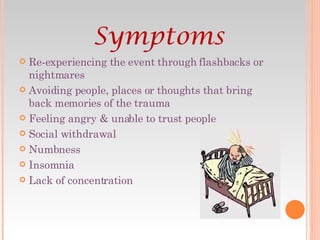
Re-experiencing the event through flashbacks or nightmares Avoiding people, places or thoughts that bring back memories of the trauma Feeling angry & unable to trust people Social withdrawal Numbness Insomnia Lack of concentration Symptoms
CONSEQUENCES 1)Physiological outcomes 2)Psychological outcomes 3)Self-destructive behaviors
Neurobiological changes  (alterations in brainwave activity and in functioning of processes such as memory and fear response)  Psychophysiological changes  Hyper-arousal of the sympathetic nervous system, Sleep disturbances Increased neurohormonal changes that result in increased stress & depression Headache Stomach or digestive problems  Dizziness 1)Physiological outcomes
Depression Other anxiety disorders (such as phobias, panic, and social anxiety)  Splitting off from the present Eating disorders 2)Psychological outcomes
Low self esteem  Alcohol and drug abuse  Suicidal attempts  Self-injury  Risky sexual behaviors leading to unplanned pregnancy or STDs, including HIV  3)Self-destructive behaviors
TREATMENT
PTSD is treated by a variety of forms of  psychotherapy  (talk therapy) and  pharmacotherapy  (medication).  There is no single best treatment, but some treatments are quite promising, especially cognitive behavioral therapy (CBT).  Treatment
COGNITIVE BEHAVIORAL   THERAPY (CBT) A  Cognitive Behavioral Therapy (CBT)  is a psychotherapy based on modifying beliefs and behaviors, with the aim of influencing disturbed emotions.  CBT includes a number of techniques such as: Cognitive restructuring Exposure therapy Eye movement desensitization and reprocessing (EMDR)
Cognitive restructuring aims at replacing dysfunctional thoughts with more realistic & helpful ones. e.g.  “ I’ll never be normal again..I am gonna die” “ I’ll get better..It will just take time” Or   “I feel scared..But I am safe” I. Cognitive Restructuring
In exposure therapy your goal is to have less fear about your memories.  By talking about your trauma repeatedly with your therapist, you'll learn to get control of your thoughts and feelings about the trauma.  You'll learn that you do not have to be afraid of your memories anymore. II. Exposure Therapy
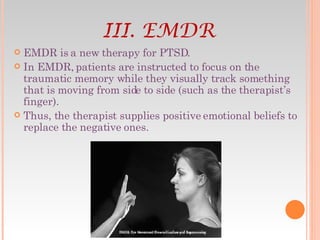
EMDR is a new therapy for PTSD. In EMDR, patients are instructed to focus on the traumatic memory while they visually track something that is moving from side to side (such as the therapist’s finger).  Thus, the therapist supplies positive emotional beliefs to replace the negative ones. III. EMDR
MEDICATION The use of medication in addition to psychotherapy has been shown to be beneficial in the treatment of PTSD. The most widely used drug treatments for PTSD are the selective serotonin reuptake inhibitors  (SSRIs),  such as  Prozac & Zoloft N.B.   Drug trials for PTSD are still at a very early stage
 

Post Traumatic Stress Disorder

  • 1.
  • 2.
    LEARNING OUTCOMES Whatis PTSD??? Who is at risk for PTSD??? When does PTSD start???& How long does it last??? Symptoms Consequences Physiological outcomes Psychological outcomes Self-destructive behaviors Treatment Psychotherapy Pharmacotherapy
  • 3.
    PTSD is ananxiety disorder that develops in response to a stressful event or situation of exceptionally threatening or catastrophic nature What is PTSD?
  • 4.
    Traumatic events thatmay trigger PTSD include: violent personal assaults Sexual assault Physical attack Abuse Stabbing natural disasters Accidents Military combat. Traumatic events
  • 5.
    WHO IS ATRISK? Every One!!!
  • 6.
    People with militarycombat experience or civilians who have been harmed by war People who have been raped, sexually abused, or physically abused People who have been involved in or who have witnessed a life-threatening event People who have been involved in a natural disaster, such as a tornado or an earthquake Who is at risk for PTSD??
  • 7.
  • 8.
    The symptoms ofPTSD can start after a delay of weeks, or even months. They usually appear within 3 months after the traumatic event. Some people get better within 6 months. Others may have the illness for much longer. When does PTSD start?? & How long does it last???
  • 9.
    Re-experiencing the eventthrough flashbacks or nightmares Avoiding people, places or thoughts that bring back memories of the trauma Feeling angry & unable to trust people Social withdrawal Numbness Insomnia Lack of concentration Symptoms
  • 10.
    CONSEQUENCES 1)Physiological outcomes2)Psychological outcomes 3)Self-destructive behaviors
  • 11.
    Neurobiological changes (alterations in brainwave activity and in functioning of processes such as memory and fear response) Psychophysiological changes Hyper-arousal of the sympathetic nervous system, Sleep disturbances Increased neurohormonal changes that result in increased stress & depression Headache Stomach or digestive problems Dizziness 1)Physiological outcomes
  • 12.
    Depression Other anxietydisorders (such as phobias, panic, and social anxiety) Splitting off from the present Eating disorders 2)Psychological outcomes
  • 13.
    Low self esteem Alcohol and drug abuse Suicidal attempts Self-injury Risky sexual behaviors leading to unplanned pregnancy or STDs, including HIV 3)Self-destructive behaviors
  • 14.
  • 15.
    PTSD is treatedby a variety of forms of psychotherapy (talk therapy) and pharmacotherapy (medication). There is no single best treatment, but some treatments are quite promising, especially cognitive behavioral therapy (CBT). Treatment
  • 16.
    COGNITIVE BEHAVIORAL THERAPY (CBT) A Cognitive Behavioral Therapy (CBT) is a psychotherapy based on modifying beliefs and behaviors, with the aim of influencing disturbed emotions. CBT includes a number of techniques such as: Cognitive restructuring Exposure therapy Eye movement desensitization and reprocessing (EMDR)
  • 17.
    Cognitive restructuring aimsat replacing dysfunctional thoughts with more realistic & helpful ones. e.g. “ I’ll never be normal again..I am gonna die” “ I’ll get better..It will just take time” Or “I feel scared..But I am safe” I. Cognitive Restructuring
  • 18.
    In exposure therapyyour goal is to have less fear about your memories. By talking about your trauma repeatedly with your therapist, you'll learn to get control of your thoughts and feelings about the trauma. You'll learn that you do not have to be afraid of your memories anymore. II. Exposure Therapy
  • 19.
    EMDR is anew therapy for PTSD. In EMDR, patients are instructed to focus on the traumatic memory while they visually track something that is moving from side to side (such as the therapist’s finger). Thus, the therapist supplies positive emotional beliefs to replace the negative ones. III. EMDR
  • 20.
    MEDICATION The useof medication in addition to psychotherapy has been shown to be beneficial in the treatment of PTSD. The most widely used drug treatments for PTSD are the selective serotonin reuptake inhibitors (SSRIs), such as Prozac & Zoloft N.B. Drug trials for PTSD are still at a very early stage
  • 21.