Crisis Communication
Muhammad Rawaha Saleem
MS Fall 2018
Department of Media & Communication Studies
Faculty of Arts & Social Sciences
International Islamic University Islamabad
What is Crisis?
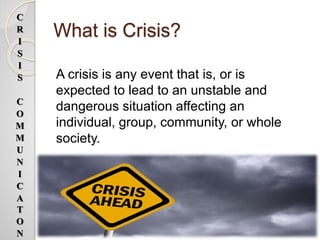
A crisis is any event that is, or is
expected to lead to an unstable and
dangerous situation affecting an
individual, group, community, or whole
society.
C
R
I
S
I
S
C
O
M
M
U
N
I
C
A
T
O
N
Types of Crisis in
Organization
 Natural Disaster
 Technological Crisis
 Confrontation
 Organizational Misdeeds
 Workplace Violence
 Rumours
 Terrorist Attacks
C
R
I
S
I
S
C
O
M
M
U
N
I
C
A
T
O
N
Threats caused by Crisis
 Damages Public Safety
 Financial Loss to Company
 Company’s Reputation Loss
C
R
I
S
I
S
C
O
M
M
U
N
I
C
A
T
O
N
Causes & Effects of Crises
 Unsafe Conditions, injuries or deaths of a
worker will result in financial and reputation
loss of the company.
 Reputation loss will have a financial impact
on the organization.
 Management’s failure to understand the issue
or public opinion on it.
 Failure to effectively engage the media
C
R
I
S
I
S
C
O
M
M
U
N
I
C
A
T
O
N
Crisis Communication
Crisis communication is a sub-
specialty of the public
relations profession that is designed to
protect and defend an individual,
company or organization who is facing
a public challenge to its reputation.
C
R
I
S
I
S
C
O
M
M
U
N
I
C
A
T
O
N
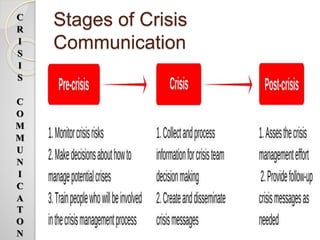
Stages of Crisis
Communication
C
R
I
S
I
S
C
O
M
M
U
N
I
C
A
T
O
N
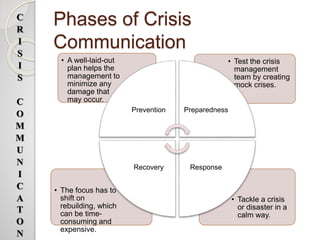
Phases of Crisis
Communication
• Tackle a crisis
or disaster in a
calm way.
• The focus has to
shift on
rebuilding, which
can be time-
consuming and
expensive.
• Test the crisis
management
team by creating
mock crises.
• A well-laid-out
plan helps the
management to
minimize any
damage that
may occur.
Prevention Preparedness
ResponseRecovery
C
R
I
S
I
S
C
O
M
M
U
N
I
C
A
T
O
N
5 C’s of Crisis Communication
 Competence
 Credibility
 Caring
 Capability
 Commitment
C
R
I
S
I
S
C
O
M
M
U
N
I
C
A
T
O
N
Competence
 PR professionals appear unsure and
tentative, since they don’t have facts or
information.
 Competence of PRO based on how they
convey the message during media interviews.
 PRO should prepare confidently to showcase
their competence.
C
R
I
S
I
S
C
O
M
M
U
N
I
C
A
T
O
N
Credibility
The best way to gain credibility is to
concede an obvious point.
C
R
I
S
I
S
C
O
M
M
U
N
I
C
A
T
O
N
Commitment
The PR Professional need to express
the deep commitment to communicate
with the general public, media and
other stake holders.
C
R
I
S
I
S
C
O
M
M
U
N
I
C
A
T
O
N
Caring
 PR professional should demonstrate caring
attitude towards the crisis and the victims of
the crisis.
 The public will be more worried about the
victims of the crisis.
C
R
I
S
I
S
C
O
M
M
U
N
I
C
A
T
O
N
Capability
PRO should be capable of resolving
the situation or solving the problem.
C
R
I
S
I
S
C
O
M
M
U
N
I
C
A
T
O
N
Key Principles of Crisis
Management
 Be sympathetic & apologetic
 Manage information flow
 Manage crisis team to focus on the event
 Assume the worst case scenario
 Have a trained spokesperson
 Resist the aggressive approach
 Understand why the media are here
 Remember all audiences
C
R
I
S
I
S
C
O
M
M
U
N
I
C
A
T
O
N
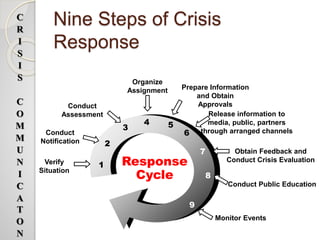
Nine Steps of Crisis
Response
1
2
3
4 5
6
7
8
9
Response
Cycle
Verify
Situation
Conduct
Notification
Conduct
Assessment
Organize
Assignment
s
Prepare Information
and Obtain
Approvals
Release information to
media, public, partners
through arranged channels
Obtain Feedback and
Conduct Crisis Evaluation
Conduct Public Education
Monitor Events
C
R
I
S
I
S
C
O
M
M
U
N
I
C
A
T
O
N
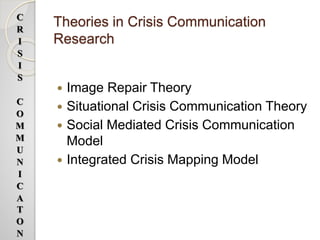
Theories in Crisis Communication
Research
 Image Repair Theory
 Situational Crisis Communication Theory
 Social Mediated Crisis Communication
Model
 Integrated Crisis Mapping Model
C
R
I
S
I
S
C
O
M
M
U
N
I
C
A
T
O
N
Image Repair Theory
 William established image repair theory (IRT)
based on apologia studies.
 IRT assumes that image is an asset that a
person or an organization attempts to protect
during a crisis.
 When the person or the organization is
attacked, the accused should draft messages
to repair its image.
 Response strategies the accused should
apply during a crisis which include: deny,
evading responsibility, reducing
offensiveness, corrective action, and
C
R
I
S
I
S
C
O
M
M
U
N
I
C
A
T
O
N
Situational Crisis Communication
Theory
 Timothy Coombs started working on SCCT in
1995.
 SCCT assumes that crises are negative
events that stakeholders attempt to attribute
responsibility.
 Coombs believes crisis managers can
employ different crisis strategies according to
different crisis types.
 SCCT is an audience-oriented theory which
focuses on stakeholders’ perceptions of crisis
situations.
C
R
I
S
I
S
C
O
M
M
U
N
I
C
A
T
O
N
Social Mediated Crisis Communication Mode
 SMCC model is introduced to investigate
crisis management in online context.
 The model first explains how the source and
form of information affect response selections
and then proposes crisis response strategies.
 The model argues that five factors influence
an organizational communication during a
crisis: crisis origin, crisis type, infrastructure,
message strategy and message form.
C
R
I
S
I
S
C
O
M
M
U
N
I
C
A
T
O
N
Integrated Crisis Mapping Model
 Jin, Pang and Cameron introduces integrated
crisis mapping model to understand
stakeholders’ varied emotion during a crisis.
 ICM assumes that people keep interpreting
their emotions during a crisis.
 Another line of crisis communication research
focuses on stakeholders’ emotional changes
in times of crises.
C
R
I
S
I
S
C
O
M
M
U
N
I
C
A
T
O
N
Thanks for Listening
Any Question?
C
R
I
S
I
S
C
O
M
M
U
N
I
C
A
T
O
N

Crisis Communication ppt

  • 1.
    Crisis Communication Muhammad RawahaSaleem MS Fall 2018 Department of Media & Communication Studies Faculty of Arts & Social Sciences International Islamic University Islamabad
  • 2.
    What is Crisis? Acrisis is any event that is, or is expected to lead to an unstable and dangerous situation affecting an individual, group, community, or whole society. C R I S I S C O M M U N I C A T O N
  • 3.
    Types of Crisisin Organization  Natural Disaster  Technological Crisis  Confrontation  Organizational Misdeeds  Workplace Violence  Rumours  Terrorist Attacks C R I S I S C O M M U N I C A T O N
  • 4.
    Threats caused byCrisis  Damages Public Safety  Financial Loss to Company  Company’s Reputation Loss C R I S I S C O M M U N I C A T O N
  • 5.
    Causes & Effectsof Crises  Unsafe Conditions, injuries or deaths of a worker will result in financial and reputation loss of the company.  Reputation loss will have a financial impact on the organization.  Management’s failure to understand the issue or public opinion on it.  Failure to effectively engage the media C R I S I S C O M M U N I C A T O N
  • 6.
    Crisis Communication Crisis communicationis a sub- specialty of the public relations profession that is designed to protect and defend an individual, company or organization who is facing a public challenge to its reputation. C R I S I S C O M M U N I C A T O N
  • 7.
  • 8.
    Phases of Crisis Communication •Tackle a crisis or disaster in a calm way. • The focus has to shift on rebuilding, which can be time- consuming and expensive. • Test the crisis management team by creating mock crises. • A well-laid-out plan helps the management to minimize any damage that may occur. Prevention Preparedness ResponseRecovery C R I S I S C O M M U N I C A T O N
  • 9.
    5 C’s ofCrisis Communication  Competence  Credibility  Caring  Capability  Commitment C R I S I S C O M M U N I C A T O N
  • 10.
    Competence  PR professionalsappear unsure and tentative, since they don’t have facts or information.  Competence of PRO based on how they convey the message during media interviews.  PRO should prepare confidently to showcase their competence. C R I S I S C O M M U N I C A T O N
  • 11.
    Credibility The best wayto gain credibility is to concede an obvious point. C R I S I S C O M M U N I C A T O N
  • 12.
    Commitment The PR Professionalneed to express the deep commitment to communicate with the general public, media and other stake holders. C R I S I S C O M M U N I C A T O N
  • 13.
    Caring  PR professionalshould demonstrate caring attitude towards the crisis and the victims of the crisis.  The public will be more worried about the victims of the crisis. C R I S I S C O M M U N I C A T O N
  • 14.
    Capability PRO should becapable of resolving the situation or solving the problem. C R I S I S C O M M U N I C A T O N
  • 15.
    Key Principles ofCrisis Management  Be sympathetic & apologetic  Manage information flow  Manage crisis team to focus on the event  Assume the worst case scenario  Have a trained spokesperson  Resist the aggressive approach  Understand why the media are here  Remember all audiences C R I S I S C O M M U N I C A T O N
  • 16.
    Nine Steps ofCrisis Response 1 2 3 4 5 6 7 8 9 Response Cycle Verify Situation Conduct Notification Conduct Assessment Organize Assignment s Prepare Information and Obtain Approvals Release information to media, public, partners through arranged channels Obtain Feedback and Conduct Crisis Evaluation Conduct Public Education Monitor Events C R I S I S C O M M U N I C A T O N
  • 17.
    Theories in CrisisCommunication Research  Image Repair Theory  Situational Crisis Communication Theory  Social Mediated Crisis Communication Model  Integrated Crisis Mapping Model C R I S I S C O M M U N I C A T O N
  • 18.
    Image Repair Theory William established image repair theory (IRT) based on apologia studies.  IRT assumes that image is an asset that a person or an organization attempts to protect during a crisis.  When the person or the organization is attacked, the accused should draft messages to repair its image.  Response strategies the accused should apply during a crisis which include: deny, evading responsibility, reducing offensiveness, corrective action, and C R I S I S C O M M U N I C A T O N
  • 19.
    Situational Crisis Communication Theory Timothy Coombs started working on SCCT in 1995.  SCCT assumes that crises are negative events that stakeholders attempt to attribute responsibility.  Coombs believes crisis managers can employ different crisis strategies according to different crisis types.  SCCT is an audience-oriented theory which focuses on stakeholders’ perceptions of crisis situations. C R I S I S C O M M U N I C A T O N
  • 20.
    Social Mediated CrisisCommunication Mode  SMCC model is introduced to investigate crisis management in online context.  The model first explains how the source and form of information affect response selections and then proposes crisis response strategies.  The model argues that five factors influence an organizational communication during a crisis: crisis origin, crisis type, infrastructure, message strategy and message form. C R I S I S C O M M U N I C A T O N
  • 21.
    Integrated Crisis MappingModel  Jin, Pang and Cameron introduces integrated crisis mapping model to understand stakeholders’ varied emotion during a crisis.  ICM assumes that people keep interpreting their emotions during a crisis.  Another line of crisis communication research focuses on stakeholders’ emotional changes in times of crises. C R I S I S C O M M U N I C A T O N
  • 22.
    Thanks for Listening AnyQuestion? C R I S I S C O M M U N I C A T O N