Crisis & Response
Communication
COMS 322
Hoffman
SP 19
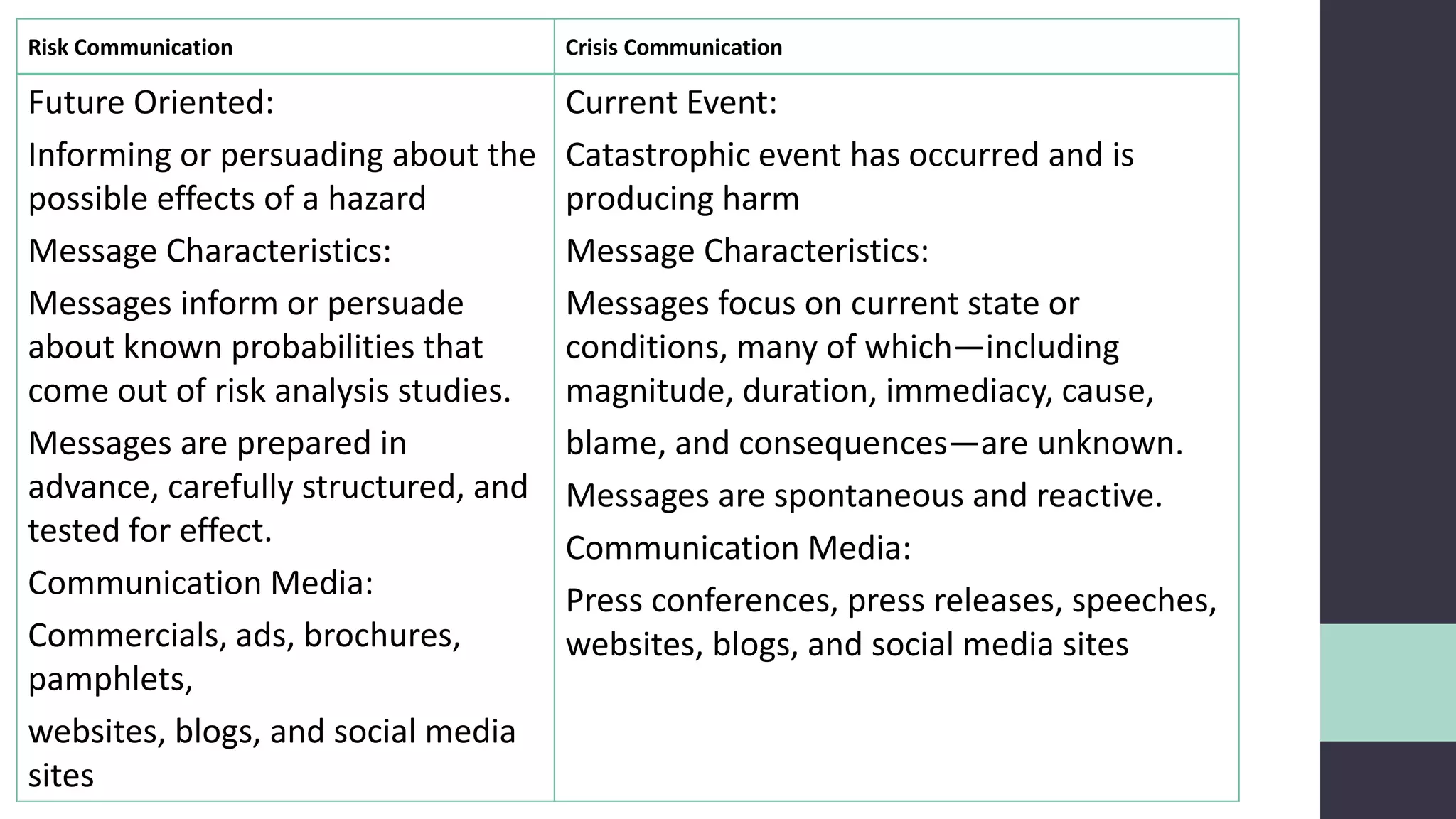
Risk Communication Crisis Communication
Future Oriented:
Informing or persuading about the
possible effects of a hazard
Message Characteristics:
Messages inform or persuade
about known probabilities that
come out of risk analysis studies.
Messages are prepared in
advance, carefully structured, and
tested for effect.
Communication Media:
Commercials, ads, brochures,
pamphlets,
websites, blogs, and social media
sites
Current Event:
Catastrophic event has occurred and is
producing harm
Message Characteristics:
Messages focus on current state or
conditions, many of which—including
magnitude, duration, immediacy, cause,
blame, and consequences—are unknown.
Messages are spontaneous and reactive.
Communication Media:
Press conferences, press releases, speeches,
websites, blogs, and social media sites
Introduction
• “a set of factors designed to
combat crises and to lessen the
actual damage inflicted”
(Coombs, 2007, p. 5).
• General goal is to prevent or
lessen the negative effects of a
crisis.
• Crisis management serves to
protect constituents,
organizations, industries, and
the environment from harm.
• Pre-Crisis Planning (Coombs, 2009)
• Emphasize prevention and
preparation
• Identify and act on warning signs
• Prepare to manage crises
• Develop/test Crisis
Management Plan (CMP)
• Training Crisis Management
Team
• Selection/informing Crisis
Spokespersons
INTRODUCTION
Crisis
Examples
Accident
chemical
spill
tampering
Fire
Loss of
shareholder
value
bankruptcy
IT failure
Types of Crises
Natural – e.g., Hurricane
Technological – Losing power at store
Confrontation – e.g., disgruntled former
employees
Malevolence – Extreme tactics from
external/outsider
Skewed management values/Financial – e.g.,
Housing crisis of 07-08
Deception – False information
Human error – e.g., Exxon Valdez
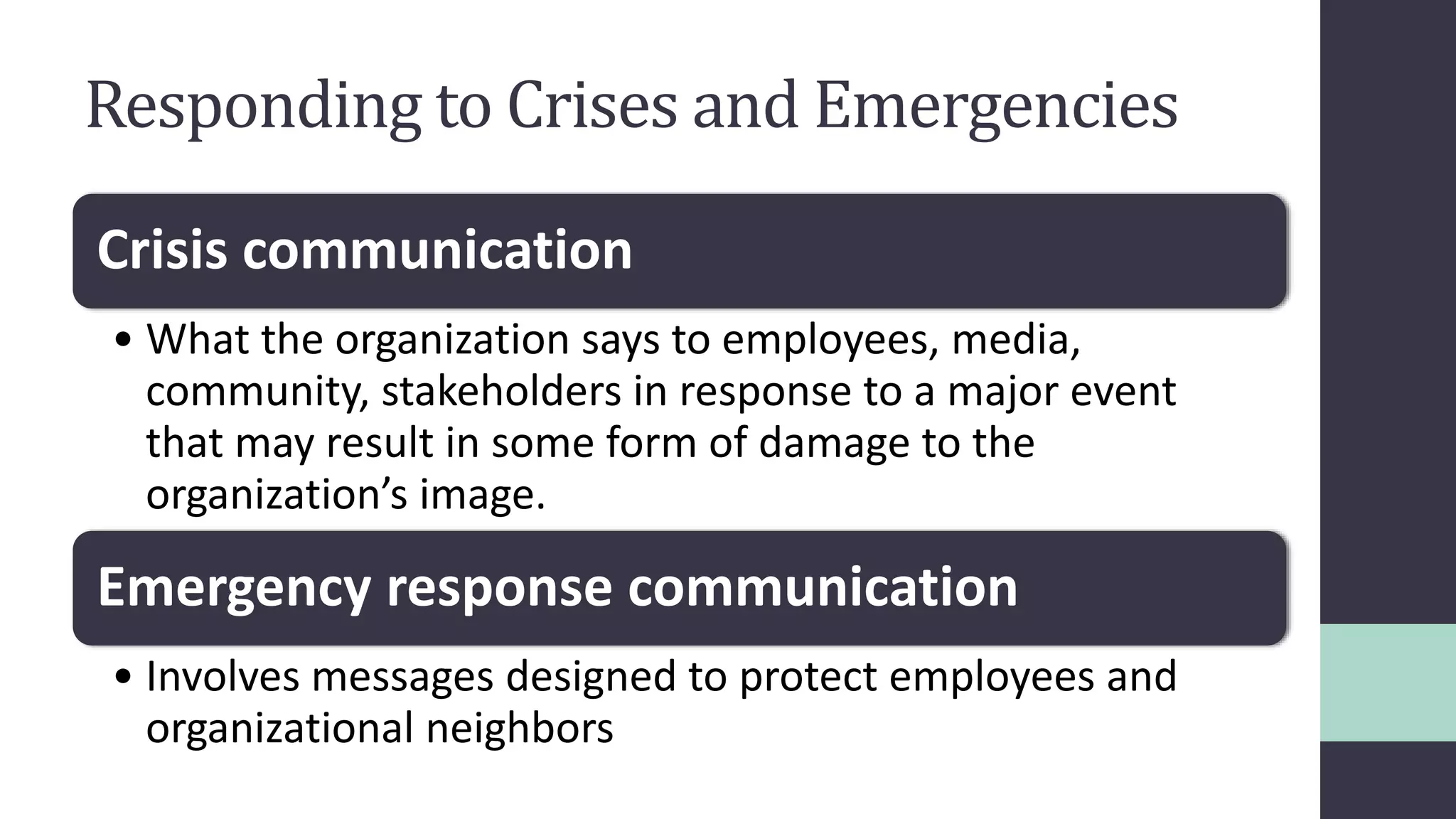
Responding to Crises and Emergencies
Crisis communication
• What the organization says to employees, media,
community, stakeholders in response to a major event
that may result in some form of damage to the
organization’s image.
Emergency response communication
• Involves messages designed to protect employees and
organizational neighbors
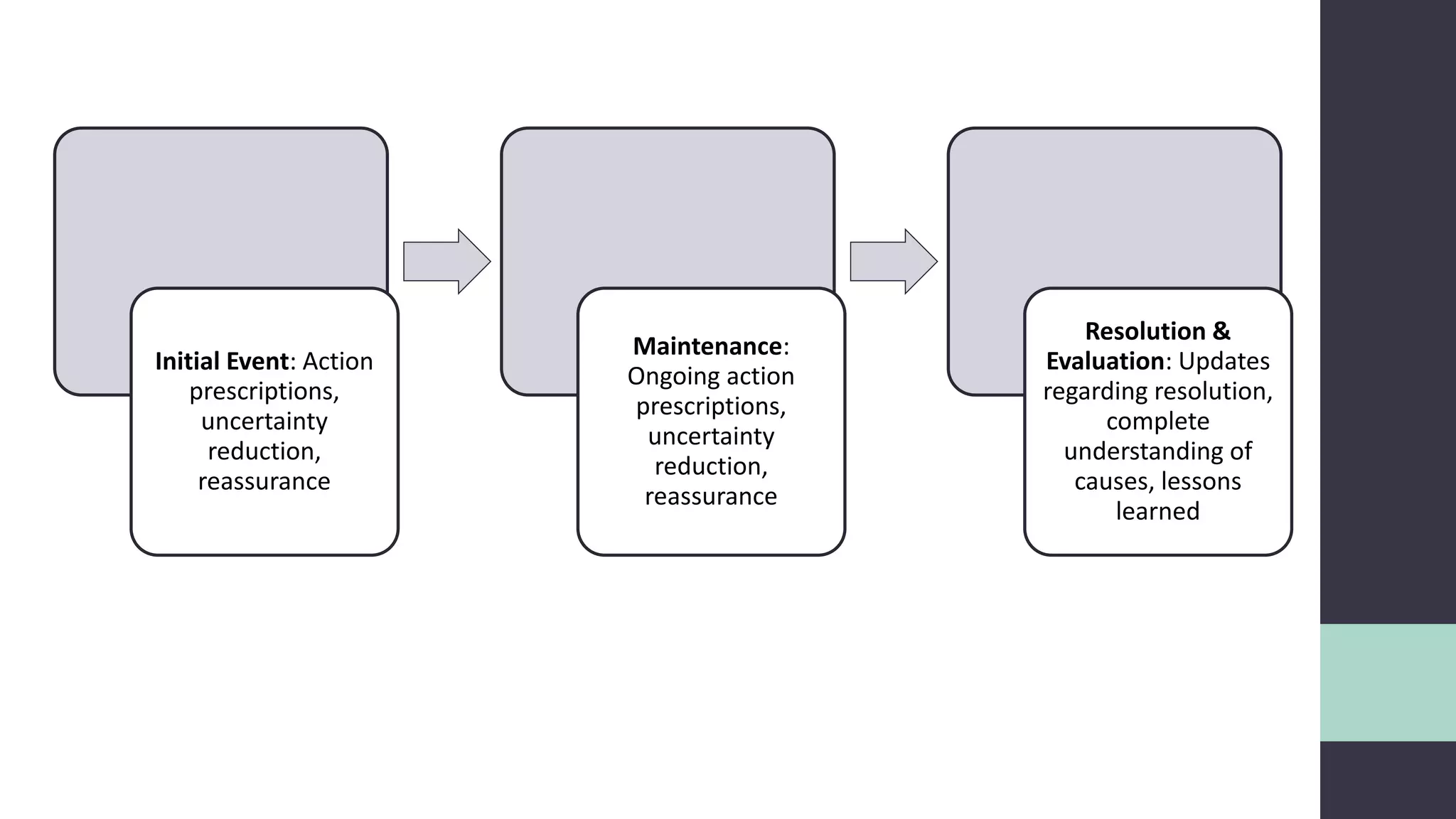
ResponseGuidelines(DiSanza& Legge, 2017)
Initial Event Maintenance
Resolution
and Evaluation
Initial Event: Action
prescriptions,
uncertainty
reduction,
reassurance
Maintenance:
Ongoing action
prescriptions,
uncertainty
reduction,
reassurance
Resolution &
Evaluation: Updates
regarding resolution,
complete
understanding of
causes, lessons
learned
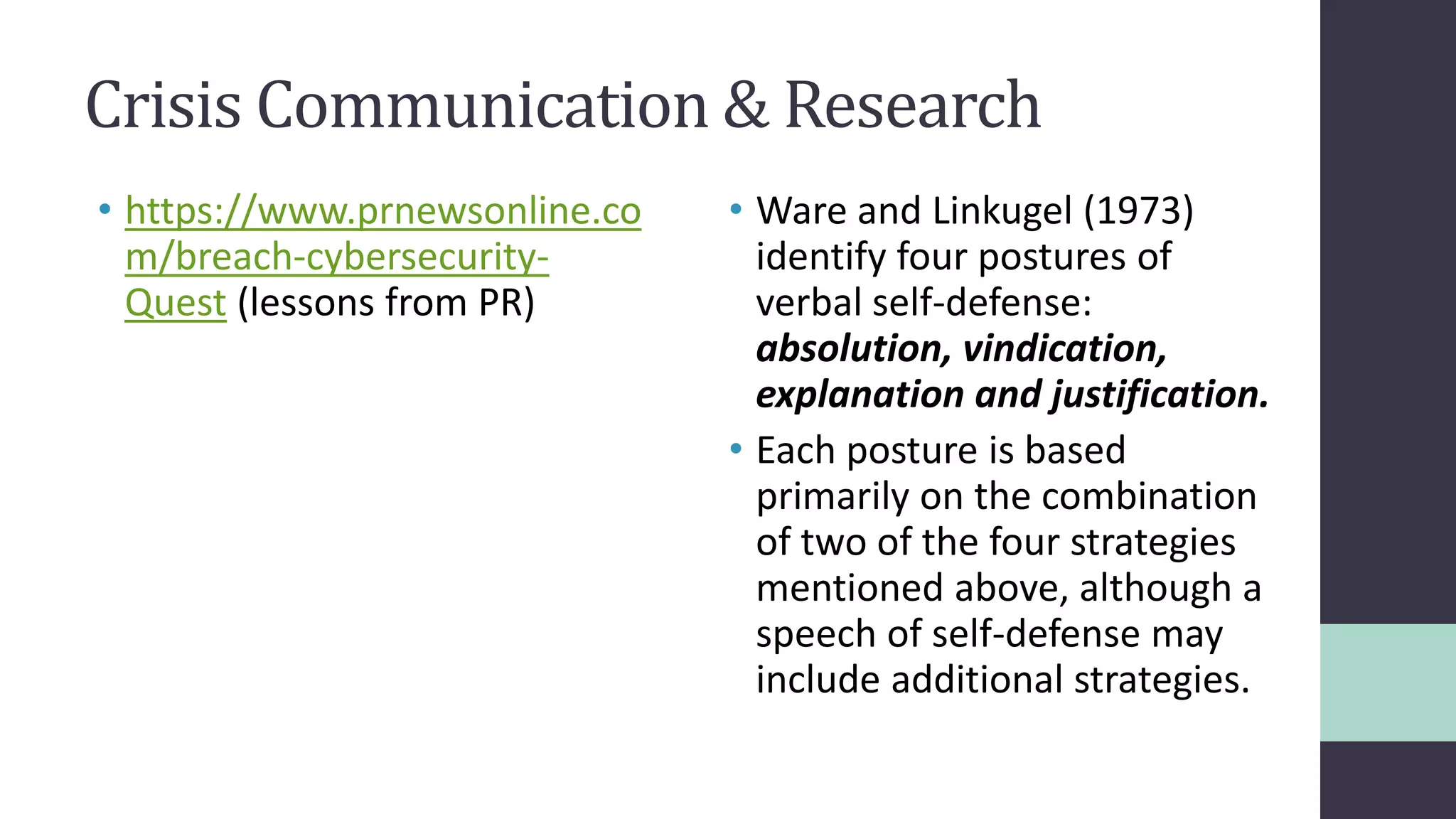
Crisis Communication & Research
• https://www.prnewsonline.co
m/breach-cybersecurity-
Quest (lessons from PR)
• Ware and Linkugel (1973)
identify four postures of
verbal self-defense:
absolution, vindication,
explanation and justification.
• Each posture is based
primarily on the combination
of two of the four strategies
mentioned above, although a
speech of self-defense may
include additional strategies.
IMAGE REPAIR AND RESTORATION
Image Repair – Resolving an undesirable
action or story of which you or your
organization are considered responsible
ImageRepairStrategies
(fromDiSanza&Legge,2017;alsoseeBenoit,1995,2015)
Denial - "Nothing to see here"
Evade Responsibility – “I was never aware of this…”
Reduce Offensiveness – “We have started a fund for wildlife…”
Corrective Action – “We moved quickly to change…”
Mortification – “Okay, yes…There is something to see here”
ImageRepairStrategies
Denial
• Denies what happens; never occurred
• Shifting blame, simple denial
Evading Responsibility
• Evade or minimize the organization’s responsibility
• Provoke, defeasibility, good intentions, accidents
Reducing Offensiveness
• Bolster, Minimize, Differentiation, transcendence, attack accuser, compensation
Corrective Action
• Promises to restore situation/pledges to improve or not let this happen again
Confess/Mortification
• Admits wrongdoing
Evasion of Responsibility
• This general image repair strategy has many
versions. A firm can say its act was merely a
response to another's offensive act, and that the
behavior can be seen as a reasonable reaction to
that provocation. For example, a company might
claim it moved its plant to another state because
the first state passed a new law reducing its
profit margin (from Crisis Comm handbook)
• Another specific form of evading responsibility is
defeasibility.
• Here, the business alleges a lack of
information about or control over important
elements of the situation. For instance, a busy
executive who missed an important meeting
could claim that "I was never told that the
meeting had been moved up a day." If true,
the lack of information excuses the absence.
• A third option is to claim the offensive action
occurred by accident. If the company can
convince the audience that the act in question
happened accidentally, it should be held less
accountable.
Denial
• One general approach to image repair is
denial.
• For example, Pepsi-Cola accused Coca-Cola
of requiring its other accounts to pay higher
prices, subsidizing its largest customer,
McDonald's. Coke replied by simply and
directly denying Pepsi's charges: charges
that Coke increased prices for some
customers but not all "were absolutely
false;" price increases were "universally
applied; there were no exceptions." Here,
Coke rejects Pepsi's charges as false. A firm
may deny that the act occurred, that the
firm performed the act, or that the act was
harmful to anyone (from Crisis Comm
handbook)
• A second form of denial is shifting the blame,
arguing that another person or organization
is actually responsible for the offensive act.
Reduce offense
A corporation may use bolstering to strengthen the audience's positive feelings
toward the itself
• in order to offset the negative feelings connected with the wrongful act.
Could minimize the negative feelings associated with the wrongful act.
• After the Valdez oil spill, Exxon officials also tried to downplay the extent of the damage. Baker
explained that "On May 19, when Alaska retrieved corpses of tens of thousands of sea birds,
hundreds of otters, and dozens of bald eagles, an Exxon official told National Public Radio that
Exxon had counted just 300 birds and 70 otters.”
Third, a firm can employ differentiation, in which the act is distinguished from
other similar but more offensive actions.
• Sears argued that the acts labeled unneeded repairs were actually preventative maintenance.
Clearly, its actions sound much less offensive when understood as preventative maintenance instead
of as fraud (from Crisis Comm handbook)
Corrective action
Corrective Action :
• Another general image restoration
strategy is corrective action, in which the
company promises to correct the problem.
This action can take the form of restoring
the state of affairs existing before the
offensive action, and/or promising to
prevent the recurrence of the offensive act.
Use multiple strategies; Support all strategies with strong reasoning and
evidence
Inductive reasoning – specific to general
Deductive reasoning – general to specific
Credibility appeals – high credibility = higher acceptance
Audiences
Animated – Considers situation serious but does
not blame organization
Bemused – Does not perceive the situation to be
serious or believe organization is responsible
Concern – Organization responsible, but severity
of event is not perceived as intensely
Antagonistic – Both severity and blame (on
organization) are higher in this case
Severity
High
Low
Responsibility
Antagonistic
Audience
High
Bemused
Audience
Concerned
Audience
Animated
Audience
EXXON VALDEZ SPILL IN ALASKA
https://www.youtube.com/watch?v=VaRdUHrUnBs&t=9s
Crisis Presentation (Final Presentation)
• Create a briefing based on a
case study of a particular
organizational crisis. The goal
of this briefing is to restore the
image of the organization.
• Select an organizational crisis
from the list provided in your
textbook or from your research
of crises in a private, public, or
non-profit organization.
• Beech Nut (1982)
• Tylenol (1982)
• Union Carbide (1984)
• J&J, Kimberly-Clark,
Proctor & Gamble (1985)
• Tylenol (1986)
• NPS policy during
Yellowstone fires (1988)
• Exxon Valdez (1989)
• Very fine Juices (1989)
• Florida Snapps (1990)
• Sudafed (1991)
• United Way (1991)
• AT&T (1991)
• Sears Auto (1991)
• Dateline on NBC (1993)
• Jack in the Box (1993)
• Pepsi (1993)
• Texaco (1996)
• Hudson Foods (1997)
• Salt Lake City Olympic
Committee (1998)
• Coca Cola (1999)
• Sabre Tech (1999)
• Texas A&M (1999)
• Phillips petroleum (2000)
• Alaska Airlines (2000)
• Firestone & Ford (2000)
• Enron (2001 and 2002)
• Arthur Andersen (2002)
• Martha Stewart (2002)
• WV Coal Mining Representative
(2003)
• NHL (2004 and 2005)
• MLB (2005)
• US Govt. and Hurricane Katrina (2005)
• Wendy’s (false claim against Wendy’s)
(2005)
• Taco Bell (2006)
• Jetblue (2007)
• Menu Foods (pet food) (2007)
• Mattel (2007)
• Continental Express (2007)
• NBA (2007)
• Deutsche (2007-2008)
• Toyota (2010)
• BP (2010)
• Penn State (2011)
• Susan G. Komen (2012)
• Chipotle (2015)
• Volkswagon (2015)
• United Airlines (2017)
• Marriott (2018)
Examples (from text)
Identify
potential
issues
Analyze
potential
significance/
attention
Strategies
Developed
Follow
through with
action
Evaluate
Crisis & Response
• How do they unfold?
• Is the organization
prepared?
• Risk, Hazard, or
Outrage?
• Note: A crisis and bad
publicity are distinctive.
Risk Assessment
Development
Responders
Recovery
Crisis Management Strategy
• A potentially negative occurrence, with uncertain outcomes; affects organizations,
company, industry, and public (product/service; name)
• Fearn-Bank (1996) Approach:
• Let people know what constitutes a crisis situation
• Designate a leader
• Have media relationships BEFORE something happens
• Educate others on how to handle the situation
• Supplies – If electricity/web services are not available
• Plan ahead to accommodate team members & address the public
PUBLIC RELATIONS (PR)
Concerns managing
relationships that are
mutually viable for
organizations and their
publics
PublicRelations Advertising
• Any paid promotion of
goods, services, or ideas
distributed through the
mass media
Marketing
• Approach and
philosophy of
completing business
transactions that
focuses on customers’
needs and wants
Public Relations
• Concerns managing
relationships that are
mutually viable for
organizations and their
publics
Privately Held Corporations
• Owned by one person, a
small group of investors, or a
family
Publicly Traded
Corporations
• Offer their own registered
securities to the general public
and other investors for purchase
Government(s)
• Public health
• Environment
• Safety
• Security
• Transportation
• Military
Nonprofit
Organizations
• Examples
• Susan G.
Komen
• The United Way
• Habitat for
Humanity
• Nature
Conservancy
Associations
and Societies
• Approximately
150,000 in the
United States
• Example:
American
Automobile
Association

Crisis communication, Response to Crisis Situations

  • 1.
  • 2.
    Risk Communication CrisisCommunication Future Oriented: Informing or persuading about the possible effects of a hazard Message Characteristics: Messages inform or persuade about known probabilities that come out of risk analysis studies. Messages are prepared in advance, carefully structured, and tested for effect. Communication Media: Commercials, ads, brochures, pamphlets, websites, blogs, and social media sites Current Event: Catastrophic event has occurred and is producing harm Message Characteristics: Messages focus on current state or conditions, many of which—including magnitude, duration, immediacy, cause, blame, and consequences—are unknown. Messages are spontaneous and reactive. Communication Media: Press conferences, press releases, speeches, websites, blogs, and social media sites
  • 3.
    Introduction • “a setof factors designed to combat crises and to lessen the actual damage inflicted” (Coombs, 2007, p. 5). • General goal is to prevent or lessen the negative effects of a crisis. • Crisis management serves to protect constituents, organizations, industries, and the environment from harm. • Pre-Crisis Planning (Coombs, 2009) • Emphasize prevention and preparation • Identify and act on warning signs • Prepare to manage crises • Develop/test Crisis Management Plan (CMP) • Training Crisis Management Team • Selection/informing Crisis Spokespersons
  • 4.
  • 5.
    Types of Crises Natural– e.g., Hurricane Technological – Losing power at store Confrontation – e.g., disgruntled former employees Malevolence – Extreme tactics from external/outsider Skewed management values/Financial – e.g., Housing crisis of 07-08 Deception – False information Human error – e.g., Exxon Valdez
  • 6.
    Responding to Crisesand Emergencies Crisis communication • What the organization says to employees, media, community, stakeholders in response to a major event that may result in some form of damage to the organization’s image. Emergency response communication • Involves messages designed to protect employees and organizational neighbors
  • 7.
    ResponseGuidelines(DiSanza& Legge, 2017) InitialEvent Maintenance Resolution and Evaluation
  • 8.
    Initial Event: Action prescriptions, uncertainty reduction, reassurance Maintenance: Ongoingaction prescriptions, uncertainty reduction, reassurance Resolution & Evaluation: Updates regarding resolution, complete understanding of causes, lessons learned
  • 9.
    Crisis Communication &Research • https://www.prnewsonline.co m/breach-cybersecurity- Quest (lessons from PR) • Ware and Linkugel (1973) identify four postures of verbal self-defense: absolution, vindication, explanation and justification. • Each posture is based primarily on the combination of two of the four strategies mentioned above, although a speech of self-defense may include additional strategies.
  • 10.
    IMAGE REPAIR ANDRESTORATION Image Repair – Resolving an undesirable action or story of which you or your organization are considered responsible
  • 11.
    ImageRepairStrategies (fromDiSanza&Legge,2017;alsoseeBenoit,1995,2015) Denial - "Nothingto see here" Evade Responsibility – “I was never aware of this…” Reduce Offensiveness – “We have started a fund for wildlife…” Corrective Action – “We moved quickly to change…” Mortification – “Okay, yes…There is something to see here”
  • 12.
    ImageRepairStrategies Denial • Denies whathappens; never occurred • Shifting blame, simple denial Evading Responsibility • Evade or minimize the organization’s responsibility • Provoke, defeasibility, good intentions, accidents Reducing Offensiveness • Bolster, Minimize, Differentiation, transcendence, attack accuser, compensation Corrective Action • Promises to restore situation/pledges to improve or not let this happen again Confess/Mortification • Admits wrongdoing
  • 13.
    Evasion of Responsibility •This general image repair strategy has many versions. A firm can say its act was merely a response to another's offensive act, and that the behavior can be seen as a reasonable reaction to that provocation. For example, a company might claim it moved its plant to another state because the first state passed a new law reducing its profit margin (from Crisis Comm handbook) • Another specific form of evading responsibility is defeasibility. • Here, the business alleges a lack of information about or control over important elements of the situation. For instance, a busy executive who missed an important meeting could claim that "I was never told that the meeting had been moved up a day." If true, the lack of information excuses the absence. • A third option is to claim the offensive action occurred by accident. If the company can convince the audience that the act in question happened accidentally, it should be held less accountable. Denial • One general approach to image repair is denial. • For example, Pepsi-Cola accused Coca-Cola of requiring its other accounts to pay higher prices, subsidizing its largest customer, McDonald's. Coke replied by simply and directly denying Pepsi's charges: charges that Coke increased prices for some customers but not all "were absolutely false;" price increases were "universally applied; there were no exceptions." Here, Coke rejects Pepsi's charges as false. A firm may deny that the act occurred, that the firm performed the act, or that the act was harmful to anyone (from Crisis Comm handbook) • A second form of denial is shifting the blame, arguing that another person or organization is actually responsible for the offensive act.
  • 14.
    Reduce offense A corporationmay use bolstering to strengthen the audience's positive feelings toward the itself • in order to offset the negative feelings connected with the wrongful act. Could minimize the negative feelings associated with the wrongful act. • After the Valdez oil spill, Exxon officials also tried to downplay the extent of the damage. Baker explained that "On May 19, when Alaska retrieved corpses of tens of thousands of sea birds, hundreds of otters, and dozens of bald eagles, an Exxon official told National Public Radio that Exxon had counted just 300 birds and 70 otters.” Third, a firm can employ differentiation, in which the act is distinguished from other similar but more offensive actions. • Sears argued that the acts labeled unneeded repairs were actually preventative maintenance. Clearly, its actions sound much less offensive when understood as preventative maintenance instead of as fraud (from Crisis Comm handbook)
  • 15.
    Corrective action Corrective Action: • Another general image restoration strategy is corrective action, in which the company promises to correct the problem. This action can take the form of restoring the state of affairs existing before the offensive action, and/or promising to prevent the recurrence of the offensive act.
  • 16.
    Use multiple strategies;Support all strategies with strong reasoning and evidence Inductive reasoning – specific to general Deductive reasoning – general to specific Credibility appeals – high credibility = higher acceptance
  • 17.
    Audiences Animated – Considerssituation serious but does not blame organization Bemused – Does not perceive the situation to be serious or believe organization is responsible Concern – Organization responsible, but severity of event is not perceived as intensely Antagonistic – Both severity and blame (on organization) are higher in this case
  • 18.
  • 19.
    EXXON VALDEZ SPILLIN ALASKA https://www.youtube.com/watch?v=VaRdUHrUnBs&t=9s
  • 20.
    Crisis Presentation (FinalPresentation) • Create a briefing based on a case study of a particular organizational crisis. The goal of this briefing is to restore the image of the organization. • Select an organizational crisis from the list provided in your textbook or from your research of crises in a private, public, or non-profit organization.
  • 21.
    • Beech Nut(1982) • Tylenol (1982) • Union Carbide (1984) • J&J, Kimberly-Clark, Proctor & Gamble (1985) • Tylenol (1986) • NPS policy during Yellowstone fires (1988) • Exxon Valdez (1989) • Very fine Juices (1989) • Florida Snapps (1990) • Sudafed (1991) • United Way (1991) • AT&T (1991) • Sears Auto (1991) • Dateline on NBC (1993) • Jack in the Box (1993) • Pepsi (1993) • Texaco (1996) • Hudson Foods (1997) • Salt Lake City Olympic Committee (1998) • Coca Cola (1999) • Sabre Tech (1999) • Texas A&M (1999) • Phillips petroleum (2000) • Alaska Airlines (2000) • Firestone & Ford (2000) • Enron (2001 and 2002) • Arthur Andersen (2002) • Martha Stewart (2002) • WV Coal Mining Representative (2003) • NHL (2004 and 2005) • MLB (2005) • US Govt. and Hurricane Katrina (2005) • Wendy’s (false claim against Wendy’s) (2005) • Taco Bell (2006) • Jetblue (2007) • Menu Foods (pet food) (2007) • Mattel (2007) • Continental Express (2007) • NBA (2007) • Deutsche (2007-2008) • Toyota (2010) • BP (2010) • Penn State (2011) • Susan G. Komen (2012) • Chipotle (2015) • Volkswagon (2015) • United Airlines (2017) • Marriott (2018) Examples (from text)
  • 22.
  • 23.
    Crisis & Response •How do they unfold? • Is the organization prepared? • Risk, Hazard, or Outrage? • Note: A crisis and bad publicity are distinctive. Risk Assessment Development Responders Recovery
  • 24.
    Crisis Management Strategy •A potentially negative occurrence, with uncertain outcomes; affects organizations, company, industry, and public (product/service; name) • Fearn-Bank (1996) Approach: • Let people know what constitutes a crisis situation • Designate a leader • Have media relationships BEFORE something happens • Educate others on how to handle the situation • Supplies – If electricity/web services are not available • Plan ahead to accommodate team members & address the public
  • 25.
    PUBLIC RELATIONS (PR) Concernsmanaging relationships that are mutually viable for organizations and their publics
  • 26.
    PublicRelations Advertising • Anypaid promotion of goods, services, or ideas distributed through the mass media Marketing • Approach and philosophy of completing business transactions that focuses on customers’ needs and wants Public Relations • Concerns managing relationships that are mutually viable for organizations and their publics
  • 27.
    Privately Held Corporations •Owned by one person, a small group of investors, or a family Publicly Traded Corporations • Offer their own registered securities to the general public and other investors for purchase Government(s) • Public health • Environment • Safety • Security • Transportation • Military
  • 28.
    Nonprofit Organizations • Examples • SusanG. Komen • The United Way • Habitat for Humanity • Nature Conservancy Associations and Societies • Approximately 150,000 in the United States • Example: American Automobile Association

Editor's Notes

  • #2 Integrity, commitment – People want to buy from these companies; People want to work for these companies Commitment and trust are strong predictors of decision making – i.e., likelihood one will continue to purchase your product, visit your store, buy from you online, etc. is correlated with the image one has of the company promoting these products and services --- Organizational crisis – a major event – potential damage - for employees, products, financial, reputation Distinct from problems – crisis – crisis is threat to organization image
  • #3 Characteristics of risk and crisis communication are given Risk communication is different from crisis communication Risk communication is future oriented Crisis communication concentrates on current events Goals of crisis comm: protecting public, restoring image
  • #7 Organizational crisis – a major event – potential damage - for employees, products, financial, reputation Distinct from problems – crisis – crisis is threat to organization image
  • #11 Communication is goal driven Positive reputation is one of these goals The key to understanding image repair strategies is to consider the nature of attacks or complaints that prompt such responses or instigate a corporate crisis.(4) An attack has two components: 1. The accused is held responsible for an action. 2. That act is considered offensive. No matter what happened, it is not reasonable to form an unfavorable impression of a firm unless that company is believed to be responsible for that act. Responsibility can appear in many guises: for example, a business can be blamed for acts that it performed, ordered, encouraged, facilitated, or permitted to occur (or for acts of omission or poorly performed acts that it appears responsible for). Furthermore, if nothing happened - or if what did happen is not considered offensive - then the company's image is not threatened. Importantly, a salient audience (or audiences) must be thought to disapprove of the act. Second, for both conditions, perceptions are more important than reality. The important point is not whether the business in fact is responsible for the offensive act, but whether the firm is thought to be responsible for it by the relevant audience. Of course, if the firm is not really to blame for the offensive act, this can be an important component of its response. As long as the audience thinks the firm at fault, the image is at risk. Similarly, the key question is not if the act was in fact offensive, but whether the act is believed by the relevant audience(s) to be heinous. Of course, if the act in question was not actually offensive, that can be an important part of its defense. But the most important question is whether the salient audience believes the act to be offensive. Finally, corporations often address multiple audiences. For example, a business might face local citizens, governmental regulators, stockholders, employees, pressure groups, and politicians. Each audience potentially has diverse interests, concerns, and goals. The crisis communicator must identify the most important audience (or prioritize important audiences).
  • #12 Concepts of Image Restoration Theory The key to understanding image repair strategies is to consider the nature of attacks or complaints that prompt such responses or instigate a corporate crisis.(4) An attack has two components: 1. The accused is held responsible for an action. 2. That act is considered offensive. No matter what happened, it is not reasonable to form an unfavorable impression of a firm unless that company is believed to be responsible for that act. Responsibility can appear in many guises: for example, a business can be blamed for acts that it performed, ordered, encouraged, facilitated, or permitted to occur (or for acts of omission or poorly performed acts that it appears responsible for). Furthermore, if nothing happened - or if what did happen is not considered offensive - then the company's image is not threatened. Importantly, a salient audience (or audiences) must be thought to disapprove of the act. Second, for both conditions, perceptions are more important than reality. The important point is not whether the business in fact is responsible for the offensive act, but whether the firm is thought to be responsible for it by the relevant audience. Of course, if the firm is not really to blame for the offensive act, this can be an important component of its response. As long as the audience thinks the firm at fault, the image is at risk. Similarly, the key question is not if the act was in fact offensive, but whether the act is believed by the relevant audience(s) to be heinous. Of course, if the act in question was not actually offensive, that can be an important part of its defense. But the most important question is whether the salient audience believes the act to be offensive. Finally, corporations often address multiple audiences. For example, a business might face local citizens, governmental regulators, stockholders, employees, pressure groups, and politicians. Each audience potentially has diverse interests, concerns, and goals. The crisis communicator must identify the most important audience (or prioritize important audiences).
  • #13  Denial One general approach to image repair, with two variants, is denial. For example, Pepsi-Cola accused Coca-Cola of requiring its other accounts to pay higher prices, subsidizing its largest customer, McDonald's. Coke replied by simply and directly denying Pepsi's charges: charges that Coke increased prices for some customers but not all "were absolutely false;" price increases were "universally applied; there were no exceptions."(8) Here, Coke rejects Pepsi's charges as false. A firm may deny that the act occurred, that the firm performed the act, or that the act was harmful to anyone. A second form of denial is shifting the blame, arguing that another person or organization is actually responsible for the offensive act. After the Exxon Valdez oil spill, Rawl, Chair of Exxon, "blamed state officials and the Coast Guard for the delay, charging ... that the company could not obtain immediate authorization on the scene to begin cleaning up the oil or applying a chemical dispersant."(9) If Exxon was not at fault for the delay, their image should not be tarnished. Evasion of Responsibility This general image repair strategy has four versions. A firm can say its act was merely a response to another's offensive act, and that the behavior can be seen as a reasonable reaction to that provocation. For example, a company might claim it moved its plant to another state because the first state passed a new law reducing its profit margin. Another specific form of evading responsibility is defeasibility. Here, the business alleges a lack of information about or control over important elements of the situation. For instance, a busy executive who missed an important meeting could claim that "I was never told that the meeting had been moved up a day." If true, the lack of information excuses the absence. A third option is to claim the offensive action occurred by accident. If the company can convince the audience that the act in question happened accidentally, it should be held less accountable, and the damage to that business's image should be reduced. After charges of auto repair fraud, Sears' Chairman Brennan characterized the auto repair mistakes as "inadvertent," rather than intentional.(10) Fourth, the business can suggest that the offensive behavior was performed with good intentions. Brennan also stressed Sears' good intentions, declaring that "Sears wants you to know that we would never intentionally violate the trust customers have shown in our company for 105 years."(11) This remark functions to stress Sears' good intentions toward its customers. Reduce Offensiveness A company that is accused of wrongful actions can also try to reduce the perceived offensiveness of that act. This general image repair strategy has six versions. First, a corporation may use bolstering to strengthen the audience's positive feelings toward the itself, in order to offset the negative feelings connected with the wrongful act. Businesses may describe positive characteristics they have or positive acts they have done in the past. After the Valdez oil spill, for example, Exxon's Chairman Rawl declared that "Exxon has moved swiftly and competently to minimize the effect this oil will have on the environment, fish, and other wildlife." He expressed his sympathy to "the residents of Valdez and the people of the State of Alaska."(12) These sentiments, if accepted, should bolster its image and offset damage to its reputation. A second possibility is to try to minimize the negative feelings associated with the wrongful act. After the Valdez oil spill, Exxon officials also tried to downplay the extent of the damage. Baker explained that "On May 19, when Alaska retrieved corpses of tens of thousands of sea birds, hundreds of otters, and dozens of bald eagles, an Exxon official told National Public Radio that Exxon had counted just 300 birds and 70 otters."(13) This statement works to minimize the apparent problem. Third, a firm can employ differentiation, in which the act is distinguished from other similar but more offensive actions. Sears argued that the acts labeled unneeded repairs were actually preventative maintenance.(14) Clearly, its actions sound much less offensive when understood as preventative maintenance instead of as fraud. A fourth way of reducing offensiveness is transcendence, which attempts to place the act in a more favorable context. A company that experiments on animals could claim the benefits to humans from such research outweigh the harms to animals. Fifth, those accused of wrong-doing may decide to attack their accusers. After Coca-Cola argued that Coke is more profitable than Pepsi, Pepsi-Cola counter-attacked in advertisements aimed at retail outlets. One ad claimed that Coke charged other firms more than McDonald's: "Coke's pricing policy is requiring you to subsidize the operations of your largest competitor."(15) This attack on Coke this might reduce the damage from Coke's criticism of Pepsi. Compensation is the final form of reducing offensiveness. If it is acceptable to the victim, the firm's image should be improved. For example, a group of disabled people were denied admittance to a movie theater. An official later apologized and offered them free passes to a future movie to help compensate for this offensive act.(16) Corrective Action Another general image restoration strategy is corrective action, in which the company promises to correct the problem. This action can take the form of restoring the state of affairs existing before the offensive action, and/or promising to prevent the recurrence of the offensive act. For instance, in 1993 AT&T experienced a breakdown in long distance service to and from New York City. Chairman Allen relied heavily on corrective action: "We have already taken corrective and preventive action at the affected facility" in New York City, including "a thorough examination of all of our facilities and practices, from the ground up." He also announced plans "to spend billions more over the next few years to make them even more reliable."(17) Thus, he not only promised to correct the current problem but also to prevent future problems. Mortification The final general strategy for image restoration is to confess and beg forgiveness, which Burke labels mortification.(18) Another part of AT&T's response was mortification, or apology: "I apologize to all of you who were affected, directly or indirectly."(19) A potential drawback to this strategy is that it might invite lawsuits from victims. Several studies illustrate the potential of this theory. Benoit applied this theory to the Exxon Valdez oil spill, to Union Carbide's response to the Bhopal gas leak, and to a series of advertisements by Coca-Cola and Pepsi-Cola in Nation's Restaurant News.(20) Benoit and Brinson applied it to AT&T's handling of the long distance service interruption in New York City.(21) Benoit also applied it to Sears' response to accusations of auto repair fraud in California.(22) Brinson and Benoit analyzed DOW Corning's handling of the breast implant crisis.(23) Benoit and Czerwinski analyzed USAir's discourse following the crash near Pittsburgh and a hostile story published in the New York Times.(24)
  • #24 Time frame Internal/external messaging Delivery system Tracking and managing
  • #28 Must publish an annual financial report of company’s performance
  • #29 Non profit Groups or companies whose business isn’t conducted or maintained by gross profit outcomes Associations - Groups that exist to further the interests and enhance the status and reputations of a particular profession and to provide a collective voice for members on political and social issues