
CRISIS COMMUNICATION
How to communicate effectively during a crisis
Jan 26, 2017
Geri Dreiling
• Strategic communicator, professor, lawyer
• Award-winning journalist for outlets including
Missouri Lawyers Weekly, Riverfront Times,
ABA Journal
• Former Public Information Officer for the
Circuit Attorney’s Office
Meet the presenter
This presentation is divided into four parts:
1. Why it is important to communicate
during a crisis
2. The role of a Crisis Communication
Plan
3. Tips for answering media questions
4. Analyzing a recent example
CRISIS COMMUNICATIONS
Crisis Communications
• What crisis situations have you
addressed in the past five years?
• What crisis scenarios worry you the
most?
• How many of you have prepared a
crisis management plan?
• If you have a crisis plan, how often
is it reviewed?
ON CRISIS COMMUNICATIONS
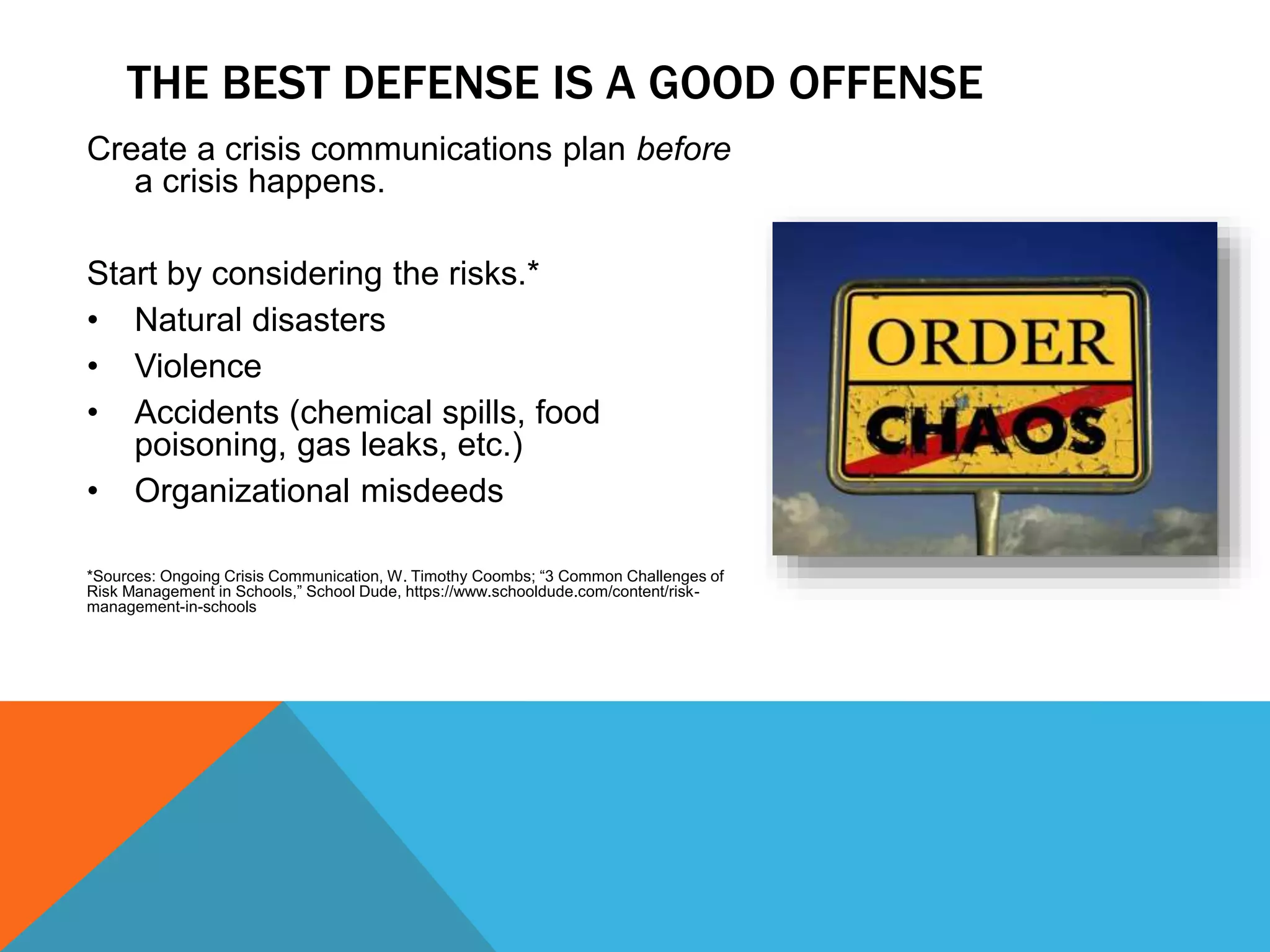
Create a crisis communications plan before
a crisis happens.
Start by considering the risks.*
• Natural disasters
• Violence
• Accidents (chemical spills, food
poisoning, gas leaks, etc.)
• Organizational misdeeds
*Sources: Ongoing Crisis Communication, W. Timothy Coombs; “3 Common Challenges of
Risk Management in Schools,” School Dude, https://www.schooldude.com/content/risk-
management-in-schools
THE BEST DEFENSE IS A GOOD OFFENSE
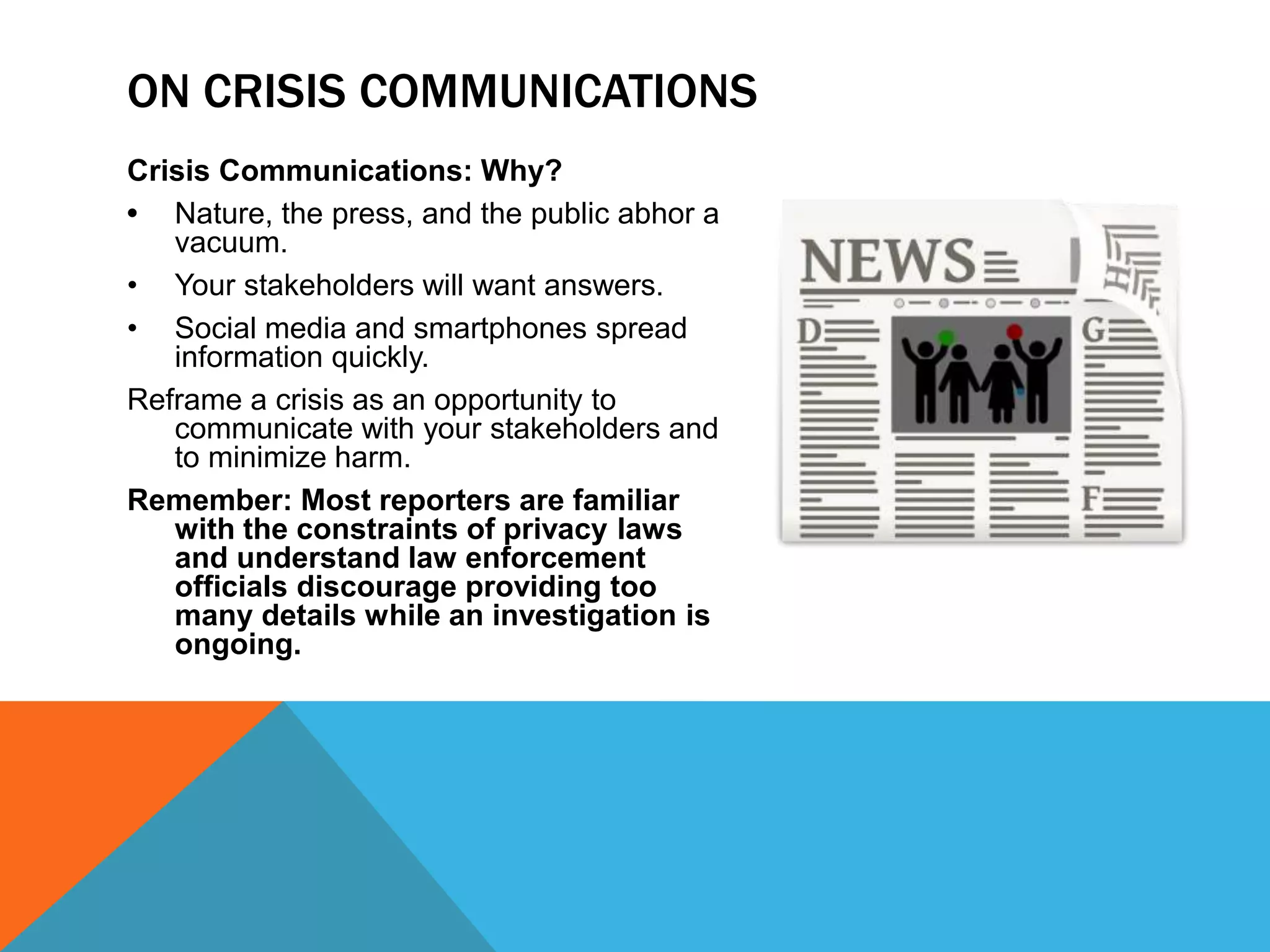
Crisis Communications: Why?
• Nature, the press, and the public abhor a
vacuum.
• Your stakeholders will want answers.
• Social media and smartphones spread
information quickly.
Reframe a crisis as an opportunity to
communicate with your stakeholders and
to minimize harm.
Remember: Most reporters are familiar
with the constraints of privacy laws
and understand law enforcement
officials discourage providing too
many details while an investigation is
ongoing.
ON CRISIS COMMUNICATIONS
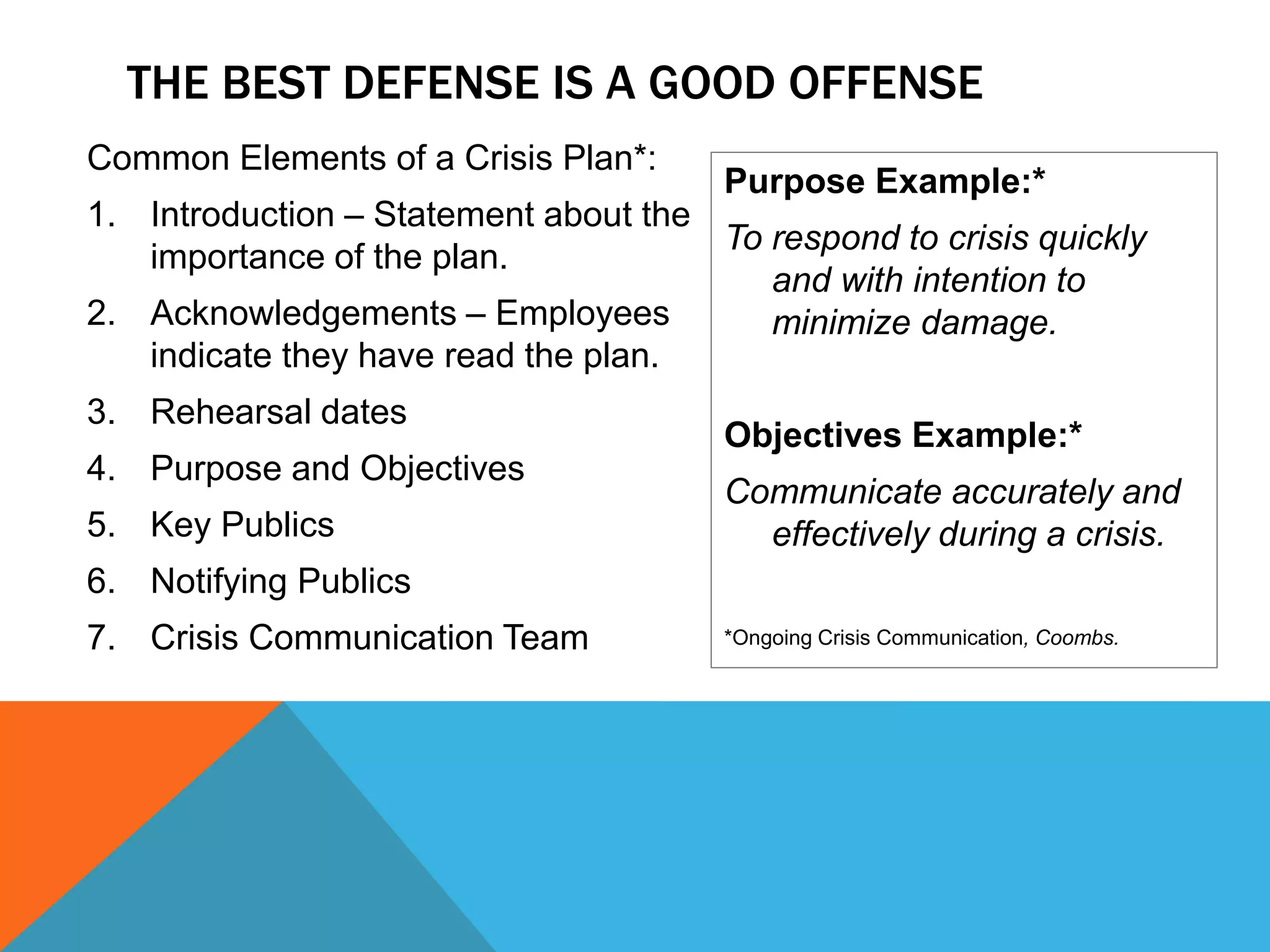
Common Elements of a Crisis Plan*:
1. Introduction – Statement about the
importance of the plan.
2. Acknowledgements – Employees
indicate they have read the plan.
3. Rehearsal dates
4. Purpose and Objectives
5. Key Publics
6. Notifying Publics
7. Crisis Communication Team
Purpose Example:*
To respond to crisis quickly
and with intention to
minimize damage.
Objectives Example:*
Communicate accurately and
effectively during a crisis.
*Ongoing Crisis Communication, Coombs.
THE BEST DEFENSE IS A GOOD OFFENSE
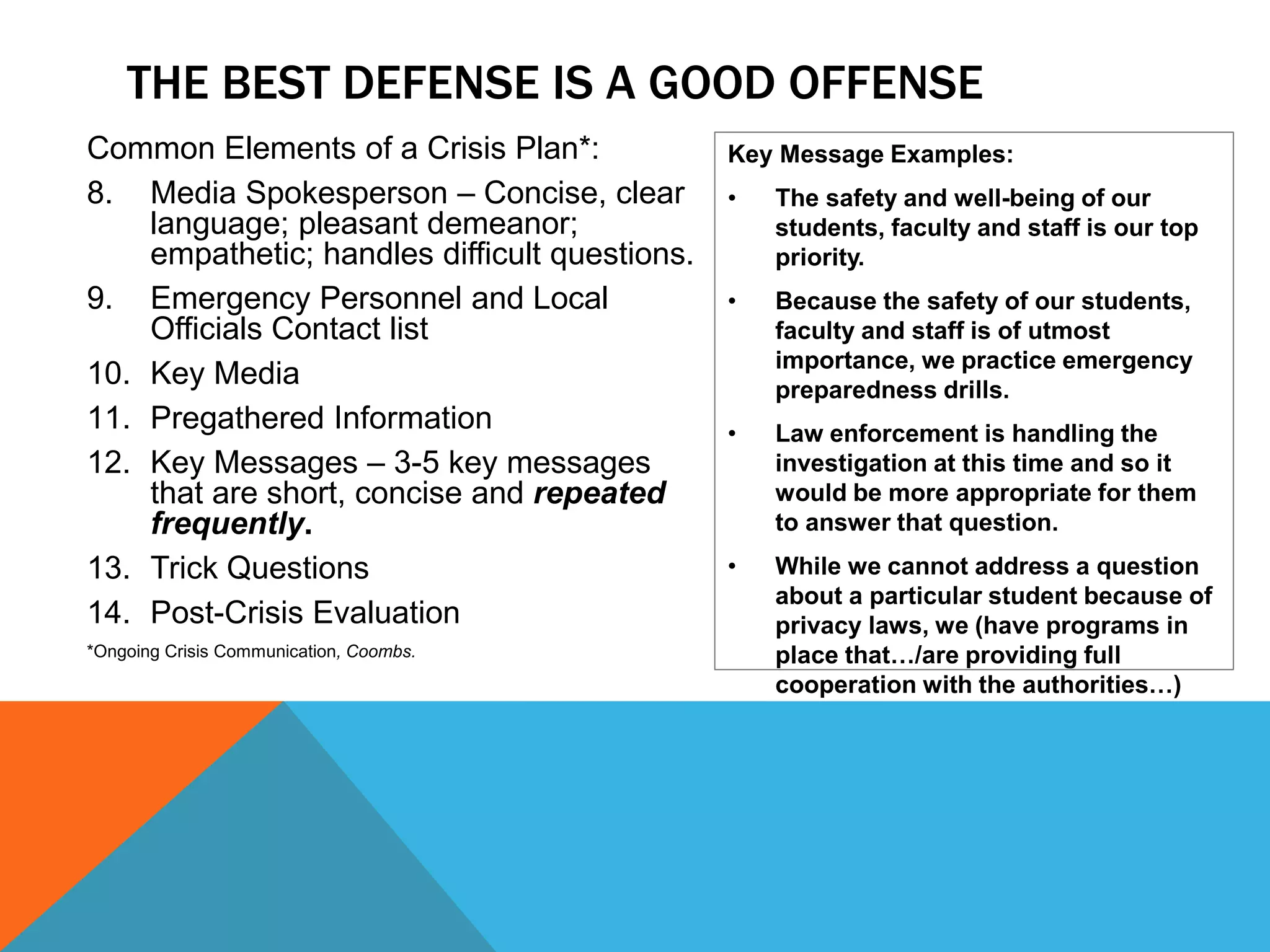
Common Elements of a Crisis Plan*:
8. Media Spokesperson – Concise, clear
language; pleasant demeanor;
empathetic; handles difficult questions.
9. Emergency Personnel and Local
Officials Contact list
10. Key Media
11. Pregathered Information
12. Key Messages – 3-5 key messages
that are short, concise and repeated
frequently.
13. Trick Questions
14. Post-Crisis Evaluation
*Ongoing Crisis Communication, Coombs.
Key Message Examples:
• The safety and well-being of our
students, faculty and staff is our top
priority.
• Because the safety of our students,
faculty and staff is of utmost
importance, we practice emergency
preparedness drills.
• Law enforcement is handling the
investigation at this time and so it
would be more appropriate for them
to answer that question.
• While we cannot address a question
about a particular student because of
privacy laws, we (have programs in
place that…/are providing full
cooperation with the authorities…)
THE BEST DEFENSE IS A GOOD OFFENSE
• Designate the individual who handles
media contacts. Consider a contact who
isn’t an official with the district because
this puts space between an on-the-
record comment and the story.
• Interview the reporter.
• Are emailed questions and answers
possible?
• Identify your 3-5 key messages and
stick to them.
CRISIS COMMUNICATIONS: HOW?
• Open, honest and transparent
communication is the key to building
trust. (And when you can’t answer a
question, explain why.)
• Anticipate answering the who, what,
when, why and how questions that
journalists will ask.
• Never say, “No comment.” Use a
bridging technique instead.
• Compile a briefing sheet with the factual
information.
• Prepare for trick questions.
CRISIS COMMUNICATIONS: HOW?
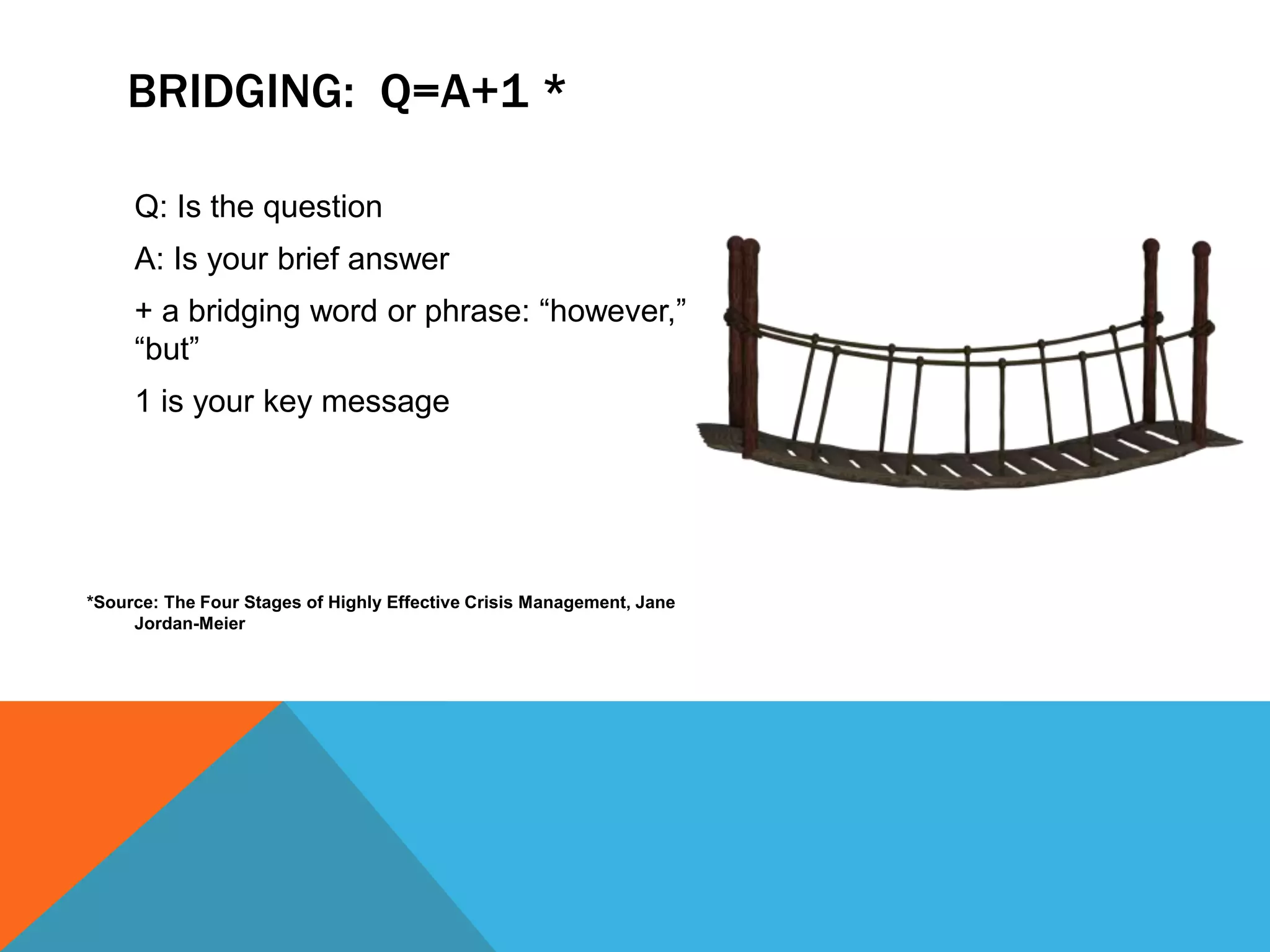
Q: Is the question
A: Is your brief answer
+ a bridging word or phrase: “however,”
“but”
1 is your key message
*Source: The Four Stages of Highly Effective Crisis Management, Jane
Jordan-Meier
BRIDGING: Q=A+1 *
Key bridging phrases that allow you to emphasize your key
messages:*
• That is an interesting perspective....
• That is a great question....
• On the contrary....
• I've heard that too....
• There is a bigger picture....
• There is more at stake or more to it than your question
suggests....
• There is more to the situation than you are asking....
• What you are really asking me is....
• Before I get to the heart of the question, let me give you
some background that will be useful in understanding
what is really going on....
• As much as I'd like to help you, that would be violating
the student’s privacy rights. What I can tell you....
*Source: The Four Stages of Highly Effective Crisis Management, Jane
Jordan-Meier
BRIDGING
Never repeat negative
language.
• To test the validity of your claims.
• To sort out the reality from the rhetoric.
• To probe for facts as the crisis unfolds
• To get the other side of the story -- balance.
• To see if ulterior motives are at play.
• To substantiate off-the-record or unsourced
information.
• To elicit a response to another party's claims.
• To resolve conflicting claims and information
-- who is telling the truth?
*Source: The Four Stages of Highly Effective Crisis Management, Jane Jordan-
Meier
WHY DO JOURNALISTS ASK DIFFICULT
QUESTIONS?*
RECENT EXAMPLE
How are the who, what,
when, where, why and
how questions addressed
at the outset?
What are the key
messages?
What work was done
before this press
conference to prepare?
How effective was each
speaker?
FINALLY
• Consider daily or weekly media review round-ups involving
other school districts for ideas on how to communicate during a
crisis.
• Consider scheduling regular crisis communication meetings to
review protocols and to practice handling difficult questions.
Even informal, short meetings are helpful.
Recommended Reading:
The Four Stages of Highly Effective Crisis Management: How to Manage the
Media in a Digital Age, Jane Jordan-Meier, CRC Press 2011
Crisis communications: How to communicate effectively during a crisis

Crisis communications: How to communicate effectively during a crisis

  • 1.
    CRISIS COMMUNICATION How tocommunicate effectively during a crisis Jan 26, 2017
  • 2.
    Geri Dreiling • Strategiccommunicator, professor, lawyer • Award-winning journalist for outlets including Missouri Lawyers Weekly, Riverfront Times, ABA Journal • Former Public Information Officer for the Circuit Attorney’s Office Meet the presenter
  • 3.
    This presentation isdivided into four parts: 1. Why it is important to communicate during a crisis 2. The role of a Crisis Communication Plan 3. Tips for answering media questions 4. Analyzing a recent example CRISIS COMMUNICATIONS
  • 4.
    Crisis Communications • Whatcrisis situations have you addressed in the past five years? • What crisis scenarios worry you the most? • How many of you have prepared a crisis management plan? • If you have a crisis plan, how often is it reviewed? ON CRISIS COMMUNICATIONS
  • 5.
    Create a crisiscommunications plan before a crisis happens. Start by considering the risks.* • Natural disasters • Violence • Accidents (chemical spills, food poisoning, gas leaks, etc.) • Organizational misdeeds *Sources: Ongoing Crisis Communication, W. Timothy Coombs; “3 Common Challenges of Risk Management in Schools,” School Dude, https://www.schooldude.com/content/risk- management-in-schools THE BEST DEFENSE IS A GOOD OFFENSE
  • 6.
    Crisis Communications: Why? •Nature, the press, and the public abhor a vacuum. • Your stakeholders will want answers. • Social media and smartphones spread information quickly. Reframe a crisis as an opportunity to communicate with your stakeholders and to minimize harm. Remember: Most reporters are familiar with the constraints of privacy laws and understand law enforcement officials discourage providing too many details while an investigation is ongoing. ON CRISIS COMMUNICATIONS
  • 7.
    Common Elements ofa Crisis Plan*: 1. Introduction – Statement about the importance of the plan. 2. Acknowledgements – Employees indicate they have read the plan. 3. Rehearsal dates 4. Purpose and Objectives 5. Key Publics 6. Notifying Publics 7. Crisis Communication Team Purpose Example:* To respond to crisis quickly and with intention to minimize damage. Objectives Example:* Communicate accurately and effectively during a crisis. *Ongoing Crisis Communication, Coombs. THE BEST DEFENSE IS A GOOD OFFENSE
  • 8.
    Common Elements ofa Crisis Plan*: 8. Media Spokesperson – Concise, clear language; pleasant demeanor; empathetic; handles difficult questions. 9. Emergency Personnel and Local Officials Contact list 10. Key Media 11. Pregathered Information 12. Key Messages – 3-5 key messages that are short, concise and repeated frequently. 13. Trick Questions 14. Post-Crisis Evaluation *Ongoing Crisis Communication, Coombs. Key Message Examples: • The safety and well-being of our students, faculty and staff is our top priority. • Because the safety of our students, faculty and staff is of utmost importance, we practice emergency preparedness drills. • Law enforcement is handling the investigation at this time and so it would be more appropriate for them to answer that question. • While we cannot address a question about a particular student because of privacy laws, we (have programs in place that…/are providing full cooperation with the authorities…) THE BEST DEFENSE IS A GOOD OFFENSE
  • 9.
    • Designate theindividual who handles media contacts. Consider a contact who isn’t an official with the district because this puts space between an on-the- record comment and the story. • Interview the reporter. • Are emailed questions and answers possible? • Identify your 3-5 key messages and stick to them. CRISIS COMMUNICATIONS: HOW?
  • 10.
    • Open, honestand transparent communication is the key to building trust. (And when you can’t answer a question, explain why.) • Anticipate answering the who, what, when, why and how questions that journalists will ask. • Never say, “No comment.” Use a bridging technique instead. • Compile a briefing sheet with the factual information. • Prepare for trick questions. CRISIS COMMUNICATIONS: HOW?
  • 11.
    Q: Is thequestion A: Is your brief answer + a bridging word or phrase: “however,” “but” 1 is your key message *Source: The Four Stages of Highly Effective Crisis Management, Jane Jordan-Meier BRIDGING: Q=A+1 *
  • 12.
    Key bridging phrasesthat allow you to emphasize your key messages:* • That is an interesting perspective.... • That is a great question.... • On the contrary.... • I've heard that too.... • There is a bigger picture.... • There is more at stake or more to it than your question suggests.... • There is more to the situation than you are asking.... • What you are really asking me is.... • Before I get to the heart of the question, let me give you some background that will be useful in understanding what is really going on.... • As much as I'd like to help you, that would be violating the student’s privacy rights. What I can tell you.... *Source: The Four Stages of Highly Effective Crisis Management, Jane Jordan-Meier BRIDGING Never repeat negative language.
  • 13.
    • To testthe validity of your claims. • To sort out the reality from the rhetoric. • To probe for facts as the crisis unfolds • To get the other side of the story -- balance. • To see if ulterior motives are at play. • To substantiate off-the-record or unsourced information. • To elicit a response to another party's claims. • To resolve conflicting claims and information -- who is telling the truth? *Source: The Four Stages of Highly Effective Crisis Management, Jane Jordan- Meier WHY DO JOURNALISTS ASK DIFFICULT QUESTIONS?*
  • 14.
    RECENT EXAMPLE How arethe who, what, when, where, why and how questions addressed at the outset? What are the key messages? What work was done before this press conference to prepare? How effective was each speaker?
  • 15.
    FINALLY • Consider dailyor weekly media review round-ups involving other school districts for ideas on how to communicate during a crisis. • Consider scheduling regular crisis communication meetings to review protocols and to practice handling difficult questions. Even informal, short meetings are helpful. Recommended Reading: The Four Stages of Highly Effective Crisis Management: How to Manage the Media in a Digital Age, Jane Jordan-Meier, CRC Press 2011