Public Relations strategies in a crisis
The Storm before the Storm
Almost one year to the day before Hurricane Katrina
ravaged the U.S. Gulf Coast, representatives of local,
state, and federal agencies participated in a mock
disaster called Hurricane Pam. The scenario, developed
by a consulting firm, came eerily close to what actually
happened in late August 2005, when Katrina became
the worst natural disaster in the nation’s history.
 The purpose of the exercise was to learn what might
happen if the much-feared “big one” made a direct hit on
New Orleans, considered most vulnerable.
 A 109-page report issued a few weeks later recommended
“an extraordinary level of advance planning to improve
government readiness.” Unfortunately, Katrina struck
before government officials had their plans in place.
 The dangers facing New Orleans had been known for
decades. Even in the days before the hurricane made
landfall, the Federal Emergency Management Agency
warned that the city’s levees might not hold the storm
surge, potentially resulting in a catastrophe.
 What happened has been well documented. Regardless of
whose version of events one may choose to believe, there is
an undeniable fact: a widespread belief that people charged
with the responsibility of protecting their fellow citizens
had failed in their duties when they were needed most.
 The Katrina fiasco was not just an emergency management
failure. It was also a public relations failure. At the core was
a failure to manage relationships among key stakeholders,
including public and private response agencies. The
coordination of crisis response fell apart, in part, because
of poor inter-agency communication.
 Crises can happen to anyone. History suggests that no one
is immune to crises. “It can’t happen here” is more wishful
thinking than fact. From a scandal involving the world’s
best golfer to a disastrous oil well fire in the Gulf of Mexico,
crises happen with unnerving regularity. Amazingly, most
crises are predictable and can be avoided.
The Anatomy of a Crisis
 What is a crisis? A crisis is “a disruption that physically
affects a system as a whole and threatens its basic
assumptions.” (Pauchant/Mitroff)
 Problem vs. Crisis - Problems are commonplace
occurrences, frequently predictable, capable of being
handled with little public attention. Crises tend to be
less predictable, require considerable time and
resources to resolve, and bring unwanted public
attention.
 Crises are situations often marked by
forewarning and run the risk of:
 escalating in intensity
 falling under close government or media
scrutiny
 interfering with normal operations
 jeopardizing the image of the organization
 damaging a company’s bottom line
1. Warning stage -- Most crises don’t “just happen.”
There are usually advance signs of trouble. If we can
recognize them and act upon them, the crisis can be
avoided.
2. Point of no return -- This is when a crisis is
unavoidable and some damage will be done. How
much depends, to a large degree, on the amount of
preparation that has been done.
Four Stages of a Crisis
3. Cleanup phase -- This is the stage in which efforts are
undertaken to resolve the situation.
4. Things return to normal -- This is a bit deceptive.
After all, what was normal before the crisis may not be
normal after. It is a time for introspection and
evaluation.
 Key point: Crises don’t have to happen. Management
can take steps to minimize or eliminate crises by either
identifying trouble before it occurs or learning from
the lessons of the past.
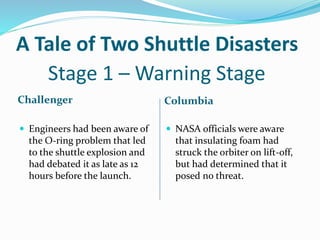
A Tale of Two Shuttle Disasters
Challenger Columbia
 Engineers had been aware of
the O-ring problem that led
to the shuttle explosion and
had debated it as late as 12
hours before the launch.
 NASA officials were aware
that insulating foam had
struck the orbiter on lift-off,
but had determined that it
posed no threat.
Stage 1 – Warning Stage
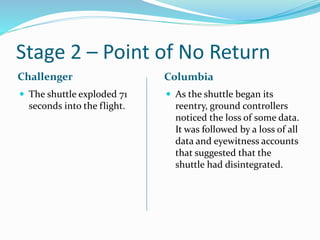
Stage 2 – Point of No Return
Challenger Columbia
 The shuttle exploded 71
seconds into the flight.
 As the shuttle began its
reentry, ground controllers
noticed the loss of some data.
It was followed by a loss of all
data and eyewitness accounts
that suggested that the
shuttle had disintegrated.
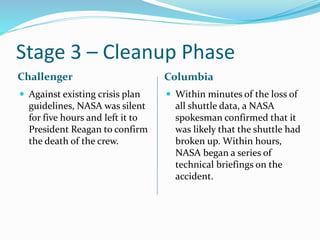
Stage 3 – Cleanup Phase
Challenger Columbia
 Against existing crisis plan
guidelines, NASA was silent
for five hours and left it to
President Reagan to confirm
the death of the crew.
 Within minutes of the loss of
all shuttle data, a NASA
spokesman confirmed that it
was likely that the shuttle had
broken up. Within hours,
NASA began a series of
technical briefings on the
accident.
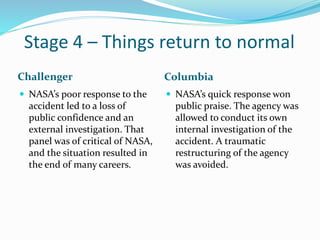
Stage 4 – Things return to normal
Challenger Columbia
 NASA’s poor response to the
accident led to a loss of
public confidence and an
external investigation. That
panel was of critical of NASA,
and the situation resulted in
the end of many careers.
 NASA’s quick response won
public praise. The agency was
allowed to conduct its own
internal investigation of the
accident. A traumatic
restructuring of the agency
was avoided.
Crises Bring Opportunity
 Potential benefits result from crises:
 Heroes are born
 Change is accelerated
 Latent problems are faced
 New strategies evolve
 Early warning systems develop
Crisis Communication Planning
Step One: Risk Assessment
 Risk assessment is the identification of the various
threats under which an organization operates. Some
risks, such as weather and on-the-job accidents, are
common to many organizations. Others may be
specific to either what business an organization is in or
where it is doing its business.
Step Two: Developing the plan
 Develop a precise definition of what constitutes a crisis
within the organization. Everyone should be using the
same terminology, and that terminology should have
the same meaning for everyone.
 Develop a crisis management team, the people whose
job it will be to respond.
 Identify where the response will be coordinated.
 Identify where reporters can go to get information.
 The role of the Internet
 Employee training
Step Three: Response
 This is the stage in which the crisis plan is executed. If
the necessary steps have already been taken, especially
employee training, this is where the organization
benefits from all of that hard work.
 Like any other plan, a crisis communications plan
must be flexible to address any changes in the
environment.
Step Four: Recovery
 This is a time for evaluation and learning from what
was done right and what could have been done better.
It is a time for asking key questions:
 Were our actions during and after the crisis consistent
with our organization’s values?
 What aspects of the crisis did our plan anticipate? How
can we build upon these successes?
 What aspects of the crisis did our plan fail to anticipate?
What changes do we need to make?
Crisis Planning Ethics
 Crisis planning is not just a practical matter; it is an
ethical matter, as well. Considering the consequences -
- to those inside and outside the organization – of
being ill prepared, there is a moral obligation to plan
for the worst.
 Many organizations plan only technical contingencies
required for responding to a potential crisis. They
should also be prepared to address the public
perceptions that will arise.

Crisis communications - Power Point presentation

  • 1.
  • 2.
    The Storm beforethe Storm Almost one year to the day before Hurricane Katrina ravaged the U.S. Gulf Coast, representatives of local, state, and federal agencies participated in a mock disaster called Hurricane Pam. The scenario, developed by a consulting firm, came eerily close to what actually happened in late August 2005, when Katrina became the worst natural disaster in the nation’s history.
  • 3.
     The purposeof the exercise was to learn what might happen if the much-feared “big one” made a direct hit on New Orleans, considered most vulnerable.  A 109-page report issued a few weeks later recommended “an extraordinary level of advance planning to improve government readiness.” Unfortunately, Katrina struck before government officials had their plans in place.  The dangers facing New Orleans had been known for decades. Even in the days before the hurricane made landfall, the Federal Emergency Management Agency warned that the city’s levees might not hold the storm surge, potentially resulting in a catastrophe.
  • 4.
     What happenedhas been well documented. Regardless of whose version of events one may choose to believe, there is an undeniable fact: a widespread belief that people charged with the responsibility of protecting their fellow citizens had failed in their duties when they were needed most.  The Katrina fiasco was not just an emergency management failure. It was also a public relations failure. At the core was a failure to manage relationships among key stakeholders, including public and private response agencies. The coordination of crisis response fell apart, in part, because of poor inter-agency communication.  Crises can happen to anyone. History suggests that no one is immune to crises. “It can’t happen here” is more wishful thinking than fact. From a scandal involving the world’s best golfer to a disastrous oil well fire in the Gulf of Mexico, crises happen with unnerving regularity. Amazingly, most crises are predictable and can be avoided.
  • 5.
    The Anatomy ofa Crisis  What is a crisis? A crisis is “a disruption that physically affects a system as a whole and threatens its basic assumptions.” (Pauchant/Mitroff)  Problem vs. Crisis - Problems are commonplace occurrences, frequently predictable, capable of being handled with little public attention. Crises tend to be less predictable, require considerable time and resources to resolve, and bring unwanted public attention.
  • 6.
     Crises aresituations often marked by forewarning and run the risk of:  escalating in intensity  falling under close government or media scrutiny  interfering with normal operations  jeopardizing the image of the organization  damaging a company’s bottom line
  • 7.
    1. Warning stage-- Most crises don’t “just happen.” There are usually advance signs of trouble. If we can recognize them and act upon them, the crisis can be avoided. 2. Point of no return -- This is when a crisis is unavoidable and some damage will be done. How much depends, to a large degree, on the amount of preparation that has been done. Four Stages of a Crisis
  • 8.
    3. Cleanup phase-- This is the stage in which efforts are undertaken to resolve the situation. 4. Things return to normal -- This is a bit deceptive. After all, what was normal before the crisis may not be normal after. It is a time for introspection and evaluation.  Key point: Crises don’t have to happen. Management can take steps to minimize or eliminate crises by either identifying trouble before it occurs or learning from the lessons of the past.
  • 9.
    A Tale ofTwo Shuttle Disasters Challenger Columbia  Engineers had been aware of the O-ring problem that led to the shuttle explosion and had debated it as late as 12 hours before the launch.  NASA officials were aware that insulating foam had struck the orbiter on lift-off, but had determined that it posed no threat. Stage 1 – Warning Stage
  • 10.
    Stage 2 –Point of No Return Challenger Columbia  The shuttle exploded 71 seconds into the flight.  As the shuttle began its reentry, ground controllers noticed the loss of some data. It was followed by a loss of all data and eyewitness accounts that suggested that the shuttle had disintegrated.
  • 11.
    Stage 3 –Cleanup Phase Challenger Columbia  Against existing crisis plan guidelines, NASA was silent for five hours and left it to President Reagan to confirm the death of the crew.  Within minutes of the loss of all shuttle data, a NASA spokesman confirmed that it was likely that the shuttle had broken up. Within hours, NASA began a series of technical briefings on the accident.
  • 12.
    Stage 4 –Things return to normal Challenger Columbia  NASA’s poor response to the accident led to a loss of public confidence and an external investigation. That panel was of critical of NASA, and the situation resulted in the end of many careers.  NASA’s quick response won public praise. The agency was allowed to conduct its own internal investigation of the accident. A traumatic restructuring of the agency was avoided.
  • 13.
    Crises Bring Opportunity Potential benefits result from crises:  Heroes are born  Change is accelerated  Latent problems are faced  New strategies evolve  Early warning systems develop
  • 14.
  • 15.
    Step One: RiskAssessment  Risk assessment is the identification of the various threats under which an organization operates. Some risks, such as weather and on-the-job accidents, are common to many organizations. Others may be specific to either what business an organization is in or where it is doing its business.
  • 16.
    Step Two: Developingthe plan  Develop a precise definition of what constitutes a crisis within the organization. Everyone should be using the same terminology, and that terminology should have the same meaning for everyone.  Develop a crisis management team, the people whose job it will be to respond.  Identify where the response will be coordinated.  Identify where reporters can go to get information.  The role of the Internet  Employee training
  • 17.
    Step Three: Response This is the stage in which the crisis plan is executed. If the necessary steps have already been taken, especially employee training, this is where the organization benefits from all of that hard work.  Like any other plan, a crisis communications plan must be flexible to address any changes in the environment.
  • 18.
    Step Four: Recovery This is a time for evaluation and learning from what was done right and what could have been done better. It is a time for asking key questions:  Were our actions during and after the crisis consistent with our organization’s values?  What aspects of the crisis did our plan anticipate? How can we build upon these successes?  What aspects of the crisis did our plan fail to anticipate? What changes do we need to make?
  • 19.
    Crisis Planning Ethics Crisis planning is not just a practical matter; it is an ethical matter, as well. Considering the consequences - - to those inside and outside the organization – of being ill prepared, there is a moral obligation to plan for the worst.  Many organizations plan only technical contingencies required for responding to a potential crisis. They should also be prepared to address the public perceptions that will arise.

Editor's Notes

  • #9 Go through the “Tales of Two Shuttle Disasters” to illustrate the four stages.