Crisis Communications


                        1
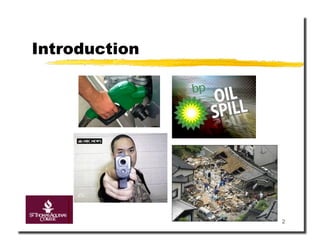
Introduction


               2
What’s a Crisis?

“A crisis is unpredictable but not
  unexpected.”
                          - Timothy Combs


   But what actually is a crisis?


                                       3
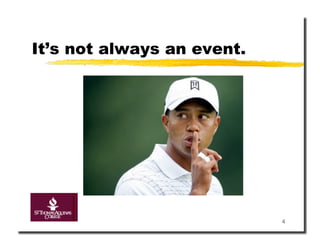
It’s not always an event.


                            4
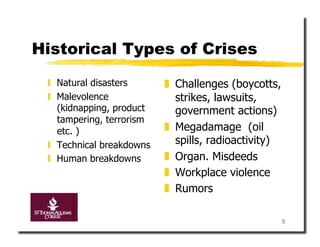
Historical Types of Crises
   Natural disasters        Challenges (boycotts,
   Malevolence               strikes, lawsuits,
    (kidnapping, product      government actions)
    tampering, terrorism
    etc. )                   Megadamage (oil
   Technical breakdowns      spills, radioactivity)
   Human breakdowns         Organ. Misdeeds
                             Workplace violence
                             Rumors

                                                       5
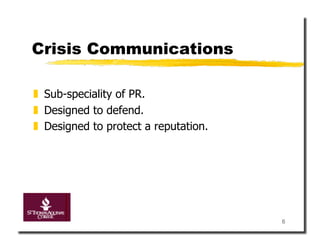
Crisis Communications

  Sub-speciality of PR.
  Designed to defend.
  Designed to protect a reputation.


                                       6
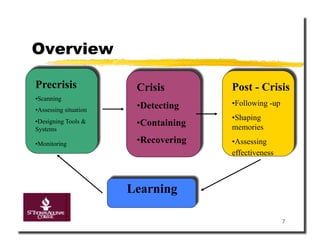
Overview

Precrisis                Crisis         Post - Crisis
• Scanning
                         • Detecting    • Following -up
• Assessing situation
                                        • Shaping
• Designing Tools &      • Containing   memories
Systems

• Monitoring             • Recovering   • Assessing
                                        effectiveness


                        Learning

                                                          7
Proactive vs. Reactive
 An effective crisis communications plan should:
 · Define response strategies that can be implemented
 when a crisis occurs;
 · Assign crisis communications resources and
 responsibilities;
 · Enable you to reach target audiences with key
 messages, and
 · Launch public information and media relations
 campaigns immediately during a crisis.


                                                        8
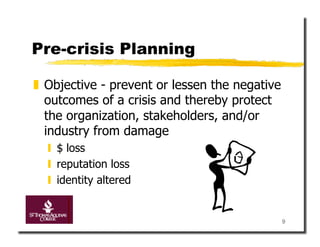
Pre-crisis Planning

  Objective - prevent or lessen the negative
   outcomes of a crisis and thereby protect
   the organization, stakeholders, and/or
   industry from damage
    $ loss
    reputation loss
    identity altered


                                                9
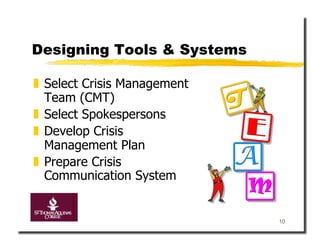
Designing Tools & Systems

  Select Crisis Management
   Team (CMT)
  Select Spokespersons
  Develop Crisis
   Management Plan
  Prepare Crisis
   Communication System


                              10
Selecting the CMT

  A cross-functional group who have been
   designated to handle ANY crisis
  Characteristics of a good CMT
      Work together (conflict mgt)
      Apply the CMP (manage stress)
      Listen to others
      Make the right decisions
      Communicate proactively


                                            11
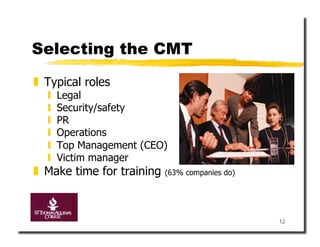
Selecting the CMT
  Typical roles
       Legal
       Security/safety
       PR
       Operations
       Top Management (CEO)
       Victim manager
  Make time for training   (63% companies do)


                                                 12
Selecting Spokespersons

  Principle - “One voice is more important than
   one person”
  Role - Manage the accuracy & consistency of
   the messages coming from the organization
  Communication should be guided by the 5
   C’s: Concern, clarity, control,
   confidence, & competence


                                               13
Develop Crisis
Management Plan

  What is it?
    A potential action plan
    Used during the crisis
    Focuses on “how-to”
  What it is not?
    Overly detailed
    Rigid


                               14
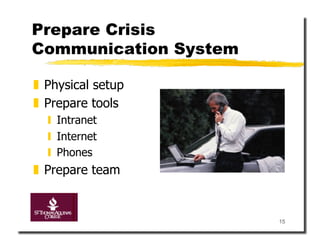
Prepare Crisis
Communication System

  Physical setup
  Prepare tools
    Intranet
    Internet
    Phones
  Prepare team


                       15
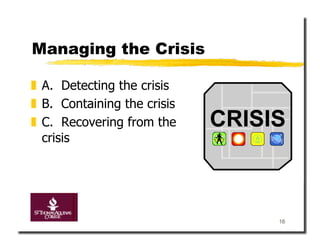
Managing the Crisis

  A. Detecting the crisis
  B. Containing the crisis
  C. Recovering from the
   crisis


                              16
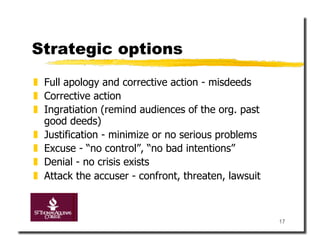
Strategic options
  Full apology and corrective action - misdeeds
  Corrective action
  Ingratiation (remind audiences of the org. past
   good deeds)
  Justification - minimize or no serious problems
  Excuse - “no control”, “no bad intentions”
  Denial - no crisis exists
  Attack the accuser - confront, threaten, lawsuit


                                                      17
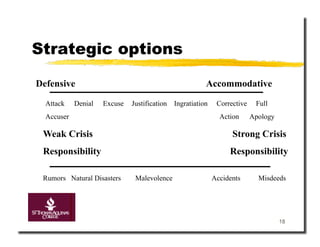
Strategic options

Defensive                                              Accommodative
  Attack    Denial   Excuse   Justification Ingratiation    Corrective    Full
  Accuser                                                    Action      Apology

 Weak Crisis                                                     Strong Crisis
 Responsibility                                                 Responsibility

 Rumors Natural Disasters      Malevolence                 Accidents       Misdeeds


                                                                                   18
Managing Post-Crisis

  Assessing effectiveness
  Examine records
  Look at phases of crisis
  Determine changes


                              19
Learning

  New protocols and systems
  New training opportunities
  New personnel


                                20
Questions?

  Thank you for the opportunity to present
   this lecture today.

  Christine@cbcreativeinc.com
  www.cbcreativeinc.com


                                              21

Crisis Communications

  • 1.
  • 2.
  • 3.
    What’s a Crisis? “Acrisis is unpredictable but not unexpected.” - Timothy Combs But what actually is a crisis? 3
  • 4.
    It’s not alwaysan event. 4
  • 5.
    Historical Types ofCrises   Natural disasters   Challenges (boycotts,   Malevolence strikes, lawsuits, (kidnapping, product government actions) tampering, terrorism etc. )   Megadamage (oil   Technical breakdowns spills, radioactivity)   Human breakdowns   Organ. Misdeeds   Workplace violence   Rumors 5
  • 6.
    Crisis Communications   Sub-specialityof PR.   Designed to defend.   Designed to protect a reputation. 6
  • 7.
    Overview Precrisis Crisis Post - Crisis • Scanning • Detecting • Following -up • Assessing situation • Shaping • Designing Tools & • Containing memories Systems • Monitoring • Recovering • Assessing effectiveness Learning 7
  • 8.
    Proactive vs. Reactive An effective crisis communications plan should: · Define response strategies that can be implemented when a crisis occurs; · Assign crisis communications resources and responsibilities; · Enable you to reach target audiences with key messages, and · Launch public information and media relations campaigns immediately during a crisis. 8
  • 9.
    Pre-crisis Planning   Objective- prevent or lessen the negative outcomes of a crisis and thereby protect the organization, stakeholders, and/or industry from damage   $ loss   reputation loss   identity altered 9
  • 10.
    Designing Tools &Systems   Select Crisis Management Team (CMT)   Select Spokespersons   Develop Crisis Management Plan   Prepare Crisis Communication System 10
  • 11.
    Selecting the CMT  A cross-functional group who have been designated to handle ANY crisis   Characteristics of a good CMT   Work together (conflict mgt)   Apply the CMP (manage stress)   Listen to others   Make the right decisions   Communicate proactively 11
  • 12.
    Selecting the CMT  Typical roles   Legal   Security/safety   PR   Operations   Top Management (CEO)   Victim manager   Make time for training (63% companies do) 12
  • 13.
    Selecting Spokespersons   Principle- “One voice is more important than one person”   Role - Manage the accuracy & consistency of the messages coming from the organization   Communication should be guided by the 5 C’s: Concern, clarity, control, confidence, & competence 13
  • 14.
    Develop Crisis Management Plan  What is it?   A potential action plan   Used during the crisis   Focuses on “how-to”   What it is not?   Overly detailed   Rigid 14
  • 15.
    Prepare Crisis Communication System  Physical setup   Prepare tools   Intranet   Internet   Phones   Prepare team 15
  • 16.
    Managing the Crisis  A. Detecting the crisis   B. Containing the crisis   C. Recovering from the crisis 16
  • 17.
    Strategic options   Fullapology and corrective action - misdeeds   Corrective action   Ingratiation (remind audiences of the org. past good deeds)   Justification - minimize or no serious problems   Excuse - “no control”, “no bad intentions”   Denial - no crisis exists   Attack the accuser - confront, threaten, lawsuit 17
  • 18.
    Strategic options Defensive Accommodative Attack Denial Excuse Justification Ingratiation Corrective Full Accuser Action Apology Weak Crisis Strong Crisis Responsibility Responsibility Rumors Natural Disasters Malevolence Accidents Misdeeds 18
  • 19.
    Managing Post-Crisis   Assessingeffectiveness   Examine records   Look at phases of crisis   Determine changes 19
  • 20.
    Learning   New protocolsand systems   New training opportunities   New personnel 20
  • 21.
    Questions?   Thank youfor the opportunity to present this lecture today.   Christine@cbcreativeinc.com   www.cbcreativeinc.com 21