CREDIT RATING
Credit rating
 A credit rating estimates the credit worthiness of an
individual, corporation, or even a country.
 It is an evaluation made by credit bureaus of a borrower’s
overall credit history.
 Credit ratings are based on financial history and current
assets and liabilities.
 Typically, a credit rating tells a lender or investor the
probability of the subject being able to pay back a loan.
 Commercial credit risk is the largest and most elementary
risk faced by many banks and it is a major risk for many
other kinds of financial institutions and corporations as
well.
 Many uncertain elements are involved in determining
both how likely it is that an event of default will happen
and how costly default will turn out to be if it does occur.
There are fourMajorRating agencies in
India
 CRISIL(Credit Rating Information Services of
India Ltd)
 ICRA(Information and Credit Rating Services
Ltd)
 CARE (Credit Analysis and Research Ltd)
 FITCH India
Registration
 Credit Rating agencies are regulated by SEBI.
 Registration with SEBI is mandatory for carrying
out the rating Business.
 A registration fee of Rs. 25000 should be paid to
SEBI
Uses of Credit Rating
 Investors
 Issuers
 Intermediaries
 Regulators
Factors for successful credit
rating
 Credible & independent structure and
procedure
 Objectivity & impartiality of opinions
 Analytical research, integrity and consistency
 Professionalizm and industry related expertize
 Confidentiality
 Timeliness of rating review and announcemnt
of changes
 Ability to reach wide range of of investors
(media)
Important issues in credit rating
 Investment and Speculative grades
 Surveillance
 Credit watch
 Ownership as a rating consideration
Rating Methodologies
 Industry Risk
 Company’s industry and market position
 Operating Efficiencies
 Accounting Qualilty
 Financial flexibility
 Earnings protection
 Financial leverage
 Cash flow adequacy
 Management Evaluation
Promoter
 A Credit rating agency can be promoted by:
 Public Financial Institution
 Scheduled Bank
 Foreign Bank operating in India with RBI
approval
 Foreign Credit Rating agency having at least
five years experience in rating securities
 Any company having a continuous net worth of
minimum 100 cores for the previous five years.
Eligibility Criteria
 Is set up and registered as a company
 Has specified rating activity as one of its main
objects in its Memorandum of Association.
 Has a minimum Net worth of Rs 5 Crore.
 Has adequate Infrastructure
 Promoters have professional competence,
financial soundness and a general reputation of
fairness and integrity in Business transactions ,
to the satisfaction of SEBI.
 Has employed persons with adequate
professional and other relevant experience, as
per SEBI directions.
Grant of Certificate of
Registration
 SEBI will grant to eligible applicants a
Certificate of Registration on the payment of a
fee subject to certain conditions. (Valid only for
3 years)
 Application fee – Rs.50,000/-
 Regn. Fee forgrant of certificate –
Rs.5,00,000/-
 Renewal fees – Rs.10,00,000/-
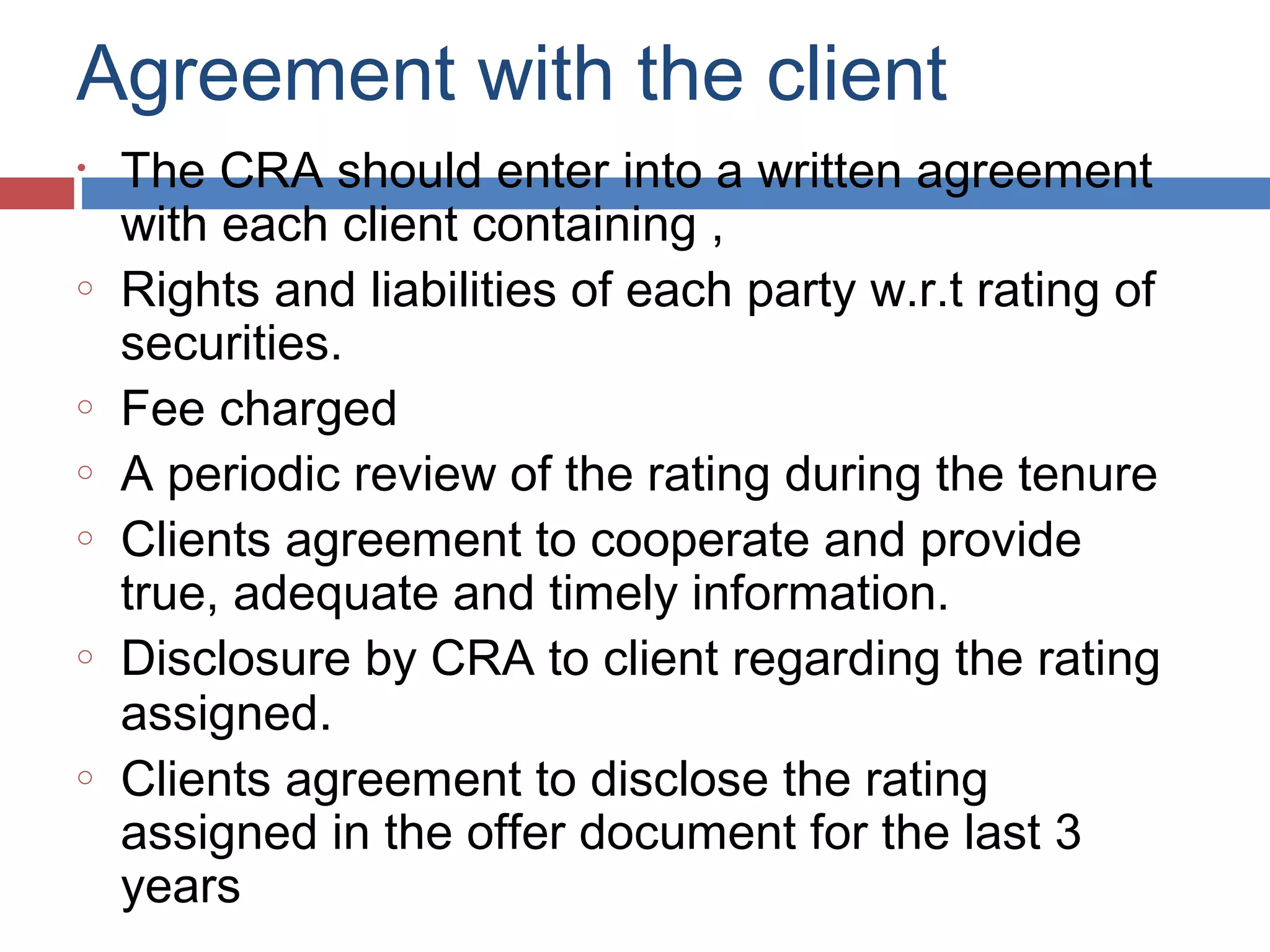
Agreement with the client
• The CRA should enter into a written agreement
with each client containing ,
o Rights and liabilities of each party w.r.t rating of
securities.
o Fee charged
o A periodic review of the rating during the tenure
o Clients agreement to cooperate and provide
true, adequate and timely information.
o Disclosure by CRA to client regarding the rating
assigned.
o Clients agreement to disclose the rating
assigned in the offer document for the last 3
years
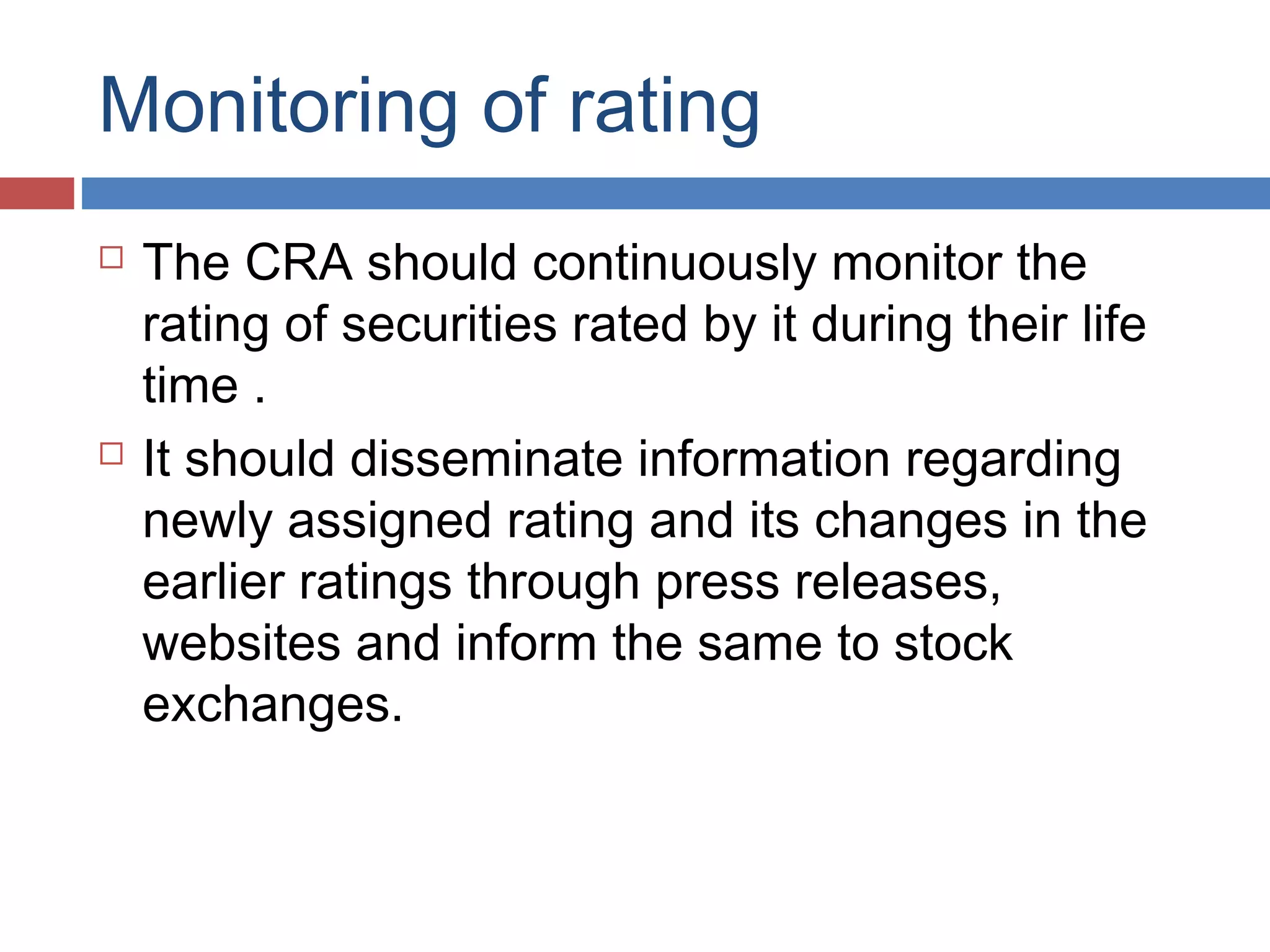
Monitoring of rating
 The CRA should continuously monitor the
rating of securities rated by it during their life
time .
 It should disseminate information regarding
newly assigned rating and its changes in the
earlier ratings through press releases,
websites and inform the same to stock
exchanges.
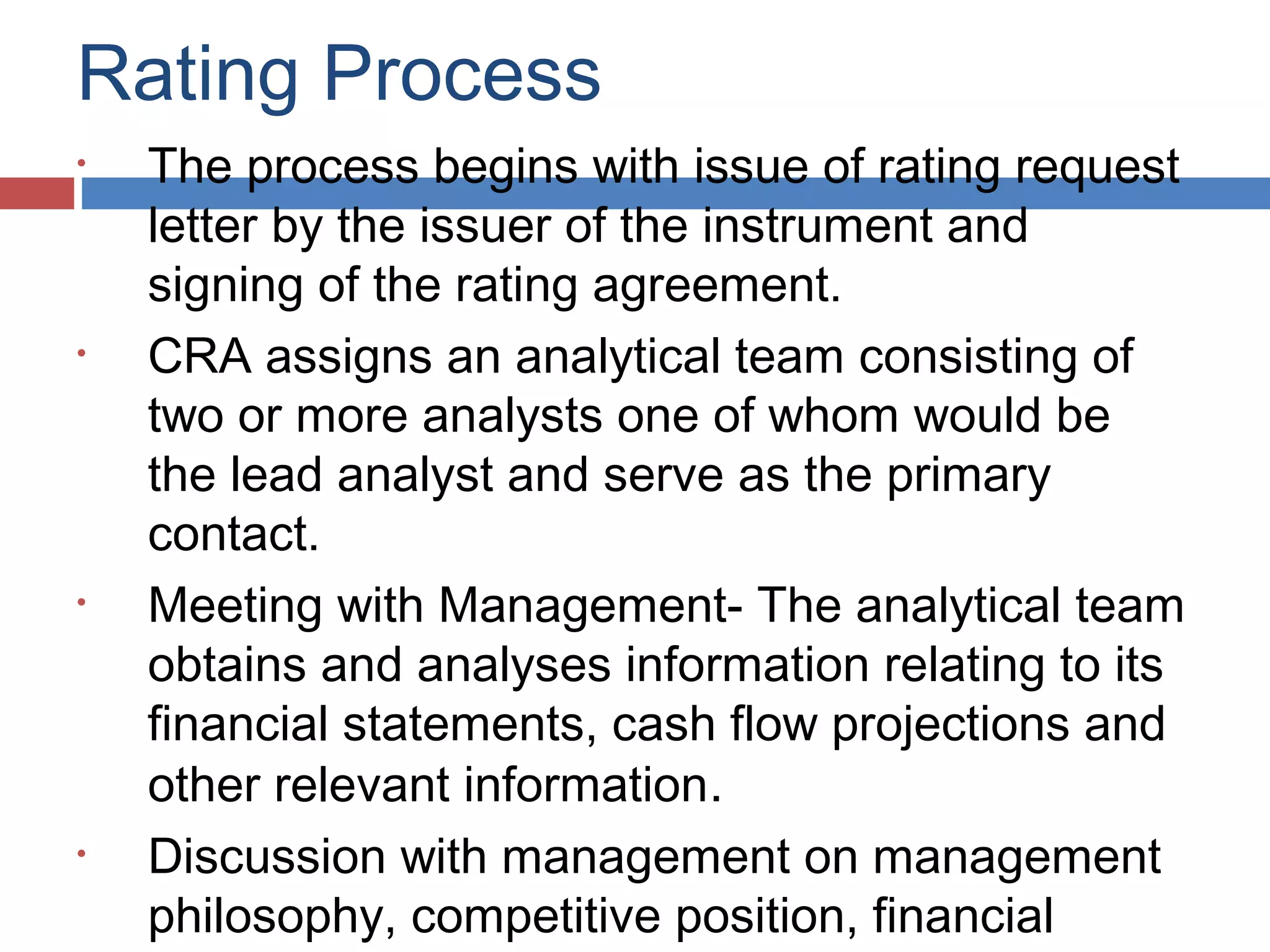
Rating Process
• The process begins with issue of rating request
letter by the issuer of the instrument and
signing of the rating agreement.
• CRA assigns an analytical team consisting of
two or more analysts one of whom would be
the lead analyst and serve as the primary
contact.
• Meeting with Management- The analytical team
obtains and analyses information relating to its
financial statements, cash flow projections and
other relevant information.
• Discussion with management on management
philosophy, competitive position, financial
Rating Process [Contd.]
 Discussions on financial projections based on
objectives and growth plan , risks and
opportunities.
 Rating committee- after meeting with the
management the analysts present their report
to a rating committee which then decides on
the rating.
 After the committee has assigned the rating,
the rating decision is communicated to the
issuer, with reasons or rationale supporting the
rating.
 Dissemination to the Public: Once the issuer
Rating Review for a possible
change The rated company is on the surveillance system
of the CRA, and from time to time, the earlier
rating is reviewed. The CRA constantly monitors
all rating with respect to new political ,economic,
financial development and industry trends.
 Analysts review new information or data
available on the company. On preliminary
analysis of the new information if the analyst feel
that there is a possibility for change in the rating
then they meet with the management and
proceed with comprehensive rating analysis.
Credit Rating Watch
• During the review monitoring or surveillance
exercise, rating analysts might become aware of
imminent events like mergers and so on, which
effect the rating and warrants a rating change.
• In such a possibility, the issuer’s rating is put on
‘credit watch’ indicating the direction of a
possible change and supporting reasons for
review.
• Once a decision to either change or present the
rating had been made, the issue will be
removed from credit watch.
Rating Methodology
 The rating methodology involves an analysis
of industry risk, issuer’s business and financial
risk. A rating is assigned after assessing all
factors that could affect the credit worthiness
of the entity. The industry analysis is done first
followed by the company analysis.
Credit rating for financial service
sector
 When rating debt instruments of financial
institutions, banks, NBFCs in addition to the
financial analysis and management evaluation
the following factors are considered
 Regulatory and competitive environment
 Fundamental analysis
 Capital adequacy
 Asset quality
 Liquidity management
 Profitability and financial position
 Interest and tax sensitivity
Rating symbols/Grades
• Rating symbols are a symbolic expression of
the opinion/assessment of the credit rating
agency regarding the investment, credit
quality, grade of the debt, obligation
instrument.
• CRISIL rating symbols: The rating symbols of
CRISIL with respect debentures, fixed
deposits, short term instruments(CPs), credit
assessment, structured obligations, bond
funds, bank loans, collective investment
schemes, Indian states, real estate developers
are as follows.
Rating symbols for Debentures
 High Investment Grade:
 AAA-(Triple A ) Highest security- Offer the
highest safety against payment of interest and
principal
 AA(Double A) High Safety - Offer high safety
against payment of interest and principal.
 A- Adequate safety- Offer adequate safety
against payment of interest and principal. In
adverse conditions might affect such issues.
 BBB(Triple B)- Moderate safety- Offer sufficient
safety against payment of interest and principal.
Circumstances may lead to weakened capacity
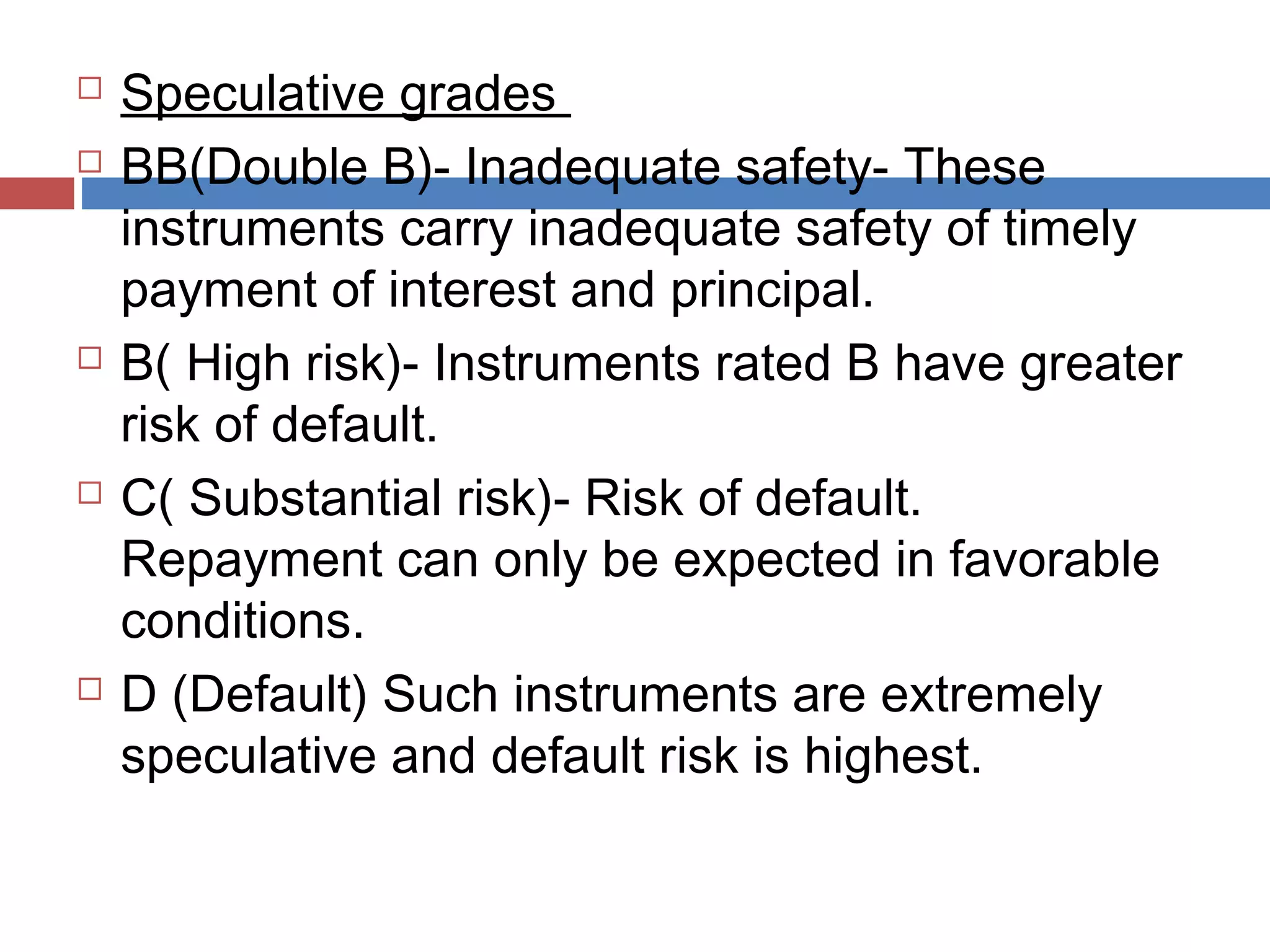
 Speculative grades
 BB(Double B)- Inadequate safety- These
instruments carry inadequate safety of timely
payment of interest and principal.
 B( High risk)- Instruments rated B have greater
risk of default.
 C( Substantial risk)- Risk of default.
Repayment can only be expected in favorable
conditions.
 D (Default) Such instruments are extremely
speculative and default risk is highest.
Rating symbols for Fixed
deposits. FAAA( F triple A)- Highest safety
 FAA( F- double A)- High safety
 FA- Adequate safety
 FB- Inadequate safety
 FC- High Risk
 FD- Default
Rating symbols for Short term
instruments
 P-1 (highest safety)
 P-2 (High Safety)
 P-3( Adequate safety)
 P-4(Inadequate safety)
 P_5 (default)
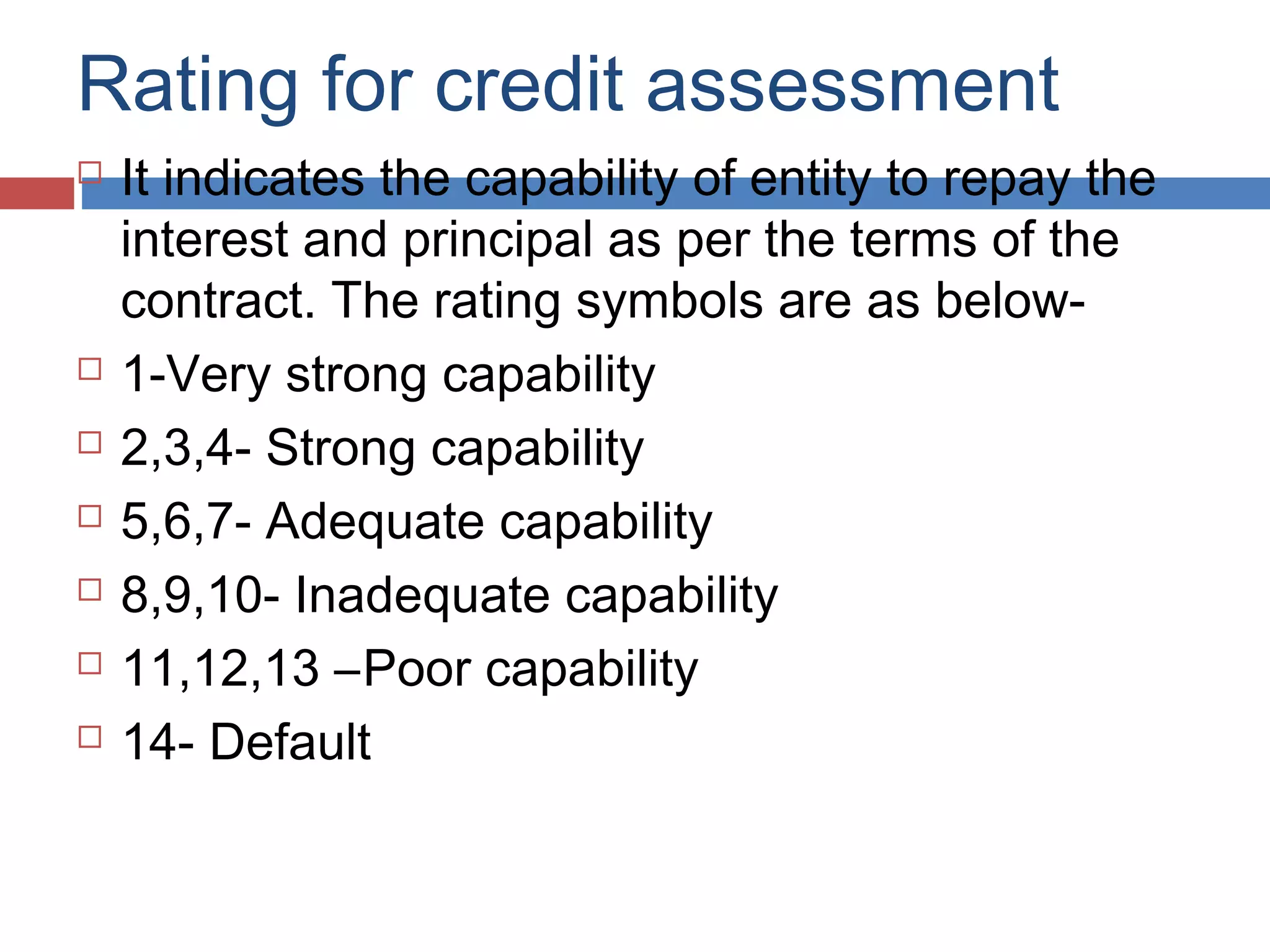
Rating for credit assessment
 It indicates the capability of entity to repay the
interest and principal as per the terms of the
contract. The rating symbols are as below-
 1-Very strong capability
 2,3,4- Strong capability
 5,6,7- Adequate capability
 8,9,10- Inadequate capability
 11,12,13 –Poor capability
 14- Default
Ratings for structured
obligations• High investment grades:
• AAA(SO)- Highest safety
• AA(SO)- high safety
• Investment grades:
• A(SO) –Adequate safety
• BBB(SO)- Moderate safety
• Speculative grades:
• BB(SO)- Inadequate safety
• B(SO) – High Risk
• C (SO)- Substantial risk)
• D (SO)- Default
Ratings for bond funds
 AAAf – Very Strong Protection against losses
 AAf - Strong Protection against losses
 Af- Adequate Protection against losses
 BBBf- Moderate Protection against losses
 BBf - Inadequate Protection against losses
 Cf – vulnerable to credit defaults.
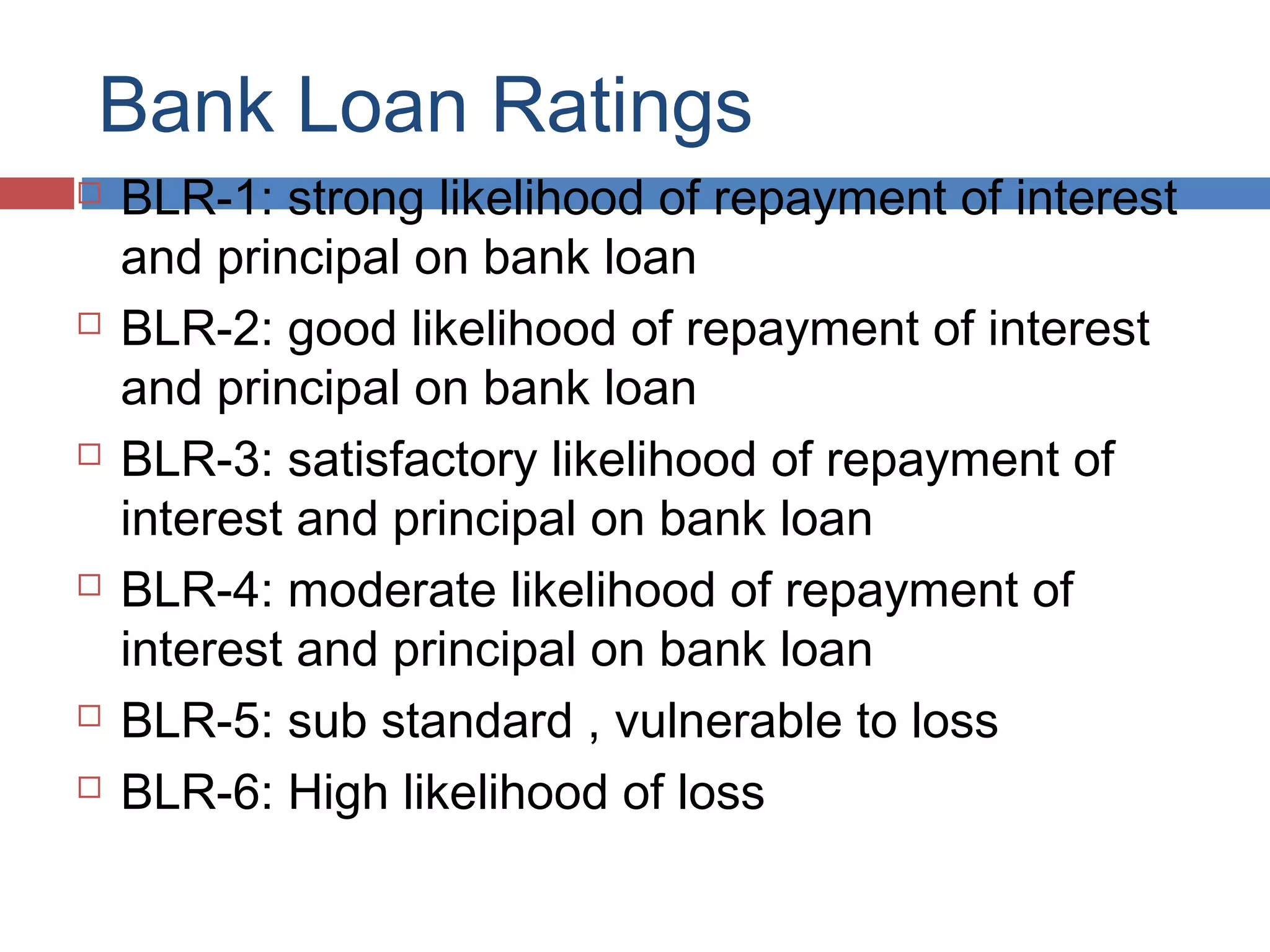
Bank Loan Ratings
 BLR-1: strong likelihood of repayment of interest
and principal on bank loan
 BLR-2: good likelihood of repayment of interest
and principal on bank loan
 BLR-3: satisfactory likelihood of repayment of
interest and principal on bank loan
 BLR-4: moderate likelihood of repayment of
interest and principal on bank loan
 BLR-5: sub standard , vulnerable to loss
 BLR-6: High likelihood of loss

Credit rating

  • 1.
  • 2.
    Credit rating  Acredit rating estimates the credit worthiness of an individual, corporation, or even a country.  It is an evaluation made by credit bureaus of a borrower’s overall credit history.  Credit ratings are based on financial history and current assets and liabilities.  Typically, a credit rating tells a lender or investor the probability of the subject being able to pay back a loan.  Commercial credit risk is the largest and most elementary risk faced by many banks and it is a major risk for many other kinds of financial institutions and corporations as well.  Many uncertain elements are involved in determining both how likely it is that an event of default will happen and how costly default will turn out to be if it does occur.
  • 3.
    There are fourMajorRatingagencies in India  CRISIL(Credit Rating Information Services of India Ltd)  ICRA(Information and Credit Rating Services Ltd)  CARE (Credit Analysis and Research Ltd)  FITCH India
  • 4.
    Registration  Credit Ratingagencies are regulated by SEBI.  Registration with SEBI is mandatory for carrying out the rating Business.  A registration fee of Rs. 25000 should be paid to SEBI
  • 5.
    Uses of CreditRating  Investors  Issuers  Intermediaries  Regulators
  • 6.
    Factors for successfulcredit rating  Credible & independent structure and procedure  Objectivity & impartiality of opinions  Analytical research, integrity and consistency  Professionalizm and industry related expertize  Confidentiality  Timeliness of rating review and announcemnt of changes  Ability to reach wide range of of investors (media)
  • 7.
    Important issues incredit rating  Investment and Speculative grades  Surveillance  Credit watch  Ownership as a rating consideration
  • 8.
    Rating Methodologies  IndustryRisk  Company’s industry and market position  Operating Efficiencies  Accounting Qualilty  Financial flexibility  Earnings protection  Financial leverage  Cash flow adequacy  Management Evaluation
  • 9.
    Promoter  A Creditrating agency can be promoted by:  Public Financial Institution  Scheduled Bank  Foreign Bank operating in India with RBI approval  Foreign Credit Rating agency having at least five years experience in rating securities  Any company having a continuous net worth of minimum 100 cores for the previous five years.
  • 10.
    Eligibility Criteria  Isset up and registered as a company  Has specified rating activity as one of its main objects in its Memorandum of Association.  Has a minimum Net worth of Rs 5 Crore.  Has adequate Infrastructure  Promoters have professional competence, financial soundness and a general reputation of fairness and integrity in Business transactions , to the satisfaction of SEBI.  Has employed persons with adequate professional and other relevant experience, as per SEBI directions.
  • 11.
    Grant of Certificateof Registration  SEBI will grant to eligible applicants a Certificate of Registration on the payment of a fee subject to certain conditions. (Valid only for 3 years)  Application fee – Rs.50,000/-  Regn. Fee forgrant of certificate – Rs.5,00,000/-  Renewal fees – Rs.10,00,000/-
  • 12.
    Agreement with theclient • The CRA should enter into a written agreement with each client containing , o Rights and liabilities of each party w.r.t rating of securities. o Fee charged o A periodic review of the rating during the tenure o Clients agreement to cooperate and provide true, adequate and timely information. o Disclosure by CRA to client regarding the rating assigned. o Clients agreement to disclose the rating assigned in the offer document for the last 3 years
  • 13.
    Monitoring of rating The CRA should continuously monitor the rating of securities rated by it during their life time .  It should disseminate information regarding newly assigned rating and its changes in the earlier ratings through press releases, websites and inform the same to stock exchanges.
  • 14.
    Rating Process • Theprocess begins with issue of rating request letter by the issuer of the instrument and signing of the rating agreement. • CRA assigns an analytical team consisting of two or more analysts one of whom would be the lead analyst and serve as the primary contact. • Meeting with Management- The analytical team obtains and analyses information relating to its financial statements, cash flow projections and other relevant information. • Discussion with management on management philosophy, competitive position, financial
  • 15.
    Rating Process [Contd.] Discussions on financial projections based on objectives and growth plan , risks and opportunities.  Rating committee- after meeting with the management the analysts present their report to a rating committee which then decides on the rating.  After the committee has assigned the rating, the rating decision is communicated to the issuer, with reasons or rationale supporting the rating.  Dissemination to the Public: Once the issuer
  • 16.
    Rating Review fora possible change The rated company is on the surveillance system of the CRA, and from time to time, the earlier rating is reviewed. The CRA constantly monitors all rating with respect to new political ,economic, financial development and industry trends.  Analysts review new information or data available on the company. On preliminary analysis of the new information if the analyst feel that there is a possibility for change in the rating then they meet with the management and proceed with comprehensive rating analysis.
  • 17.
    Credit Rating Watch •During the review monitoring or surveillance exercise, rating analysts might become aware of imminent events like mergers and so on, which effect the rating and warrants a rating change. • In such a possibility, the issuer’s rating is put on ‘credit watch’ indicating the direction of a possible change and supporting reasons for review. • Once a decision to either change or present the rating had been made, the issue will be removed from credit watch.
  • 18.
    Rating Methodology  Therating methodology involves an analysis of industry risk, issuer’s business and financial risk. A rating is assigned after assessing all factors that could affect the credit worthiness of the entity. The industry analysis is done first followed by the company analysis.
  • 19.
    Credit rating forfinancial service sector  When rating debt instruments of financial institutions, banks, NBFCs in addition to the financial analysis and management evaluation the following factors are considered  Regulatory and competitive environment  Fundamental analysis  Capital adequacy  Asset quality  Liquidity management  Profitability and financial position  Interest and tax sensitivity
  • 20.
    Rating symbols/Grades • Ratingsymbols are a symbolic expression of the opinion/assessment of the credit rating agency regarding the investment, credit quality, grade of the debt, obligation instrument. • CRISIL rating symbols: The rating symbols of CRISIL with respect debentures, fixed deposits, short term instruments(CPs), credit assessment, structured obligations, bond funds, bank loans, collective investment schemes, Indian states, real estate developers are as follows.
  • 21.
    Rating symbols forDebentures  High Investment Grade:  AAA-(Triple A ) Highest security- Offer the highest safety against payment of interest and principal  AA(Double A) High Safety - Offer high safety against payment of interest and principal.  A- Adequate safety- Offer adequate safety against payment of interest and principal. In adverse conditions might affect such issues.  BBB(Triple B)- Moderate safety- Offer sufficient safety against payment of interest and principal. Circumstances may lead to weakened capacity
  • 22.
     Speculative grades BB(Double B)- Inadequate safety- These instruments carry inadequate safety of timely payment of interest and principal.  B( High risk)- Instruments rated B have greater risk of default.  C( Substantial risk)- Risk of default. Repayment can only be expected in favorable conditions.  D (Default) Such instruments are extremely speculative and default risk is highest.
  • 23.
    Rating symbols forFixed deposits. FAAA( F triple A)- Highest safety  FAA( F- double A)- High safety  FA- Adequate safety  FB- Inadequate safety  FC- High Risk  FD- Default
  • 24.
    Rating symbols forShort term instruments  P-1 (highest safety)  P-2 (High Safety)  P-3( Adequate safety)  P-4(Inadequate safety)  P_5 (default)
  • 25.
    Rating for creditassessment  It indicates the capability of entity to repay the interest and principal as per the terms of the contract. The rating symbols are as below-  1-Very strong capability  2,3,4- Strong capability  5,6,7- Adequate capability  8,9,10- Inadequate capability  11,12,13 –Poor capability  14- Default
  • 26.
    Ratings for structured obligations•High investment grades: • AAA(SO)- Highest safety • AA(SO)- high safety • Investment grades: • A(SO) –Adequate safety • BBB(SO)- Moderate safety • Speculative grades: • BB(SO)- Inadequate safety • B(SO) – High Risk • C (SO)- Substantial risk) • D (SO)- Default
  • 27.
    Ratings for bondfunds  AAAf – Very Strong Protection against losses  AAf - Strong Protection against losses  Af- Adequate Protection against losses  BBBf- Moderate Protection against losses  BBf - Inadequate Protection against losses  Cf – vulnerable to credit defaults.
  • 28.
    Bank Loan Ratings BLR-1: strong likelihood of repayment of interest and principal on bank loan  BLR-2: good likelihood of repayment of interest and principal on bank loan  BLR-3: satisfactory likelihood of repayment of interest and principal on bank loan  BLR-4: moderate likelihood of repayment of interest and principal on bank loan  BLR-5: sub standard , vulnerable to loss  BLR-6: High likelihood of loss