School Values Exploration:
         Creativity!

Presented as part of the Skills and
       Knowledge Subject
              for the
     Year 9 Imagine Program
School Vision


         A world of learning
School Values

 • Creativity
   – Encouraging behaviours which encompass notions
     of innovation, originality, liberation and generative
     problem-solving in all that we do.
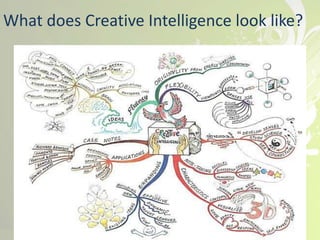
What does Creative Intelligence look like?
Definition:
Edward De Bono
Six Thinking Hats


        An aid to creative thinking
           ‘You can analyse the past,
         and you can design the future.’
                           Edward de Bono
Six Thinking Hats


                         Informative
Intuitive
                                          Constructive

                         Creative
      Reflective


                                       Cautious
The Green Hat Thinking:
Movement instead of Judgement
               • This is the creative
                 mode of thinking.
               • Green represents
                 growth and
                 movement.
               • Wearing the green hat
                 we look to new ideas
                 and solutions.
               • Lateral thinking wears
                 a green hat.
Challenge 1

              • Research has shown that the
                best way to stimulate the
                creative part of the brain, is to
                stimulate it with practice.
              • You have 60 seconds to write
                as many uses as you can think
                of for wire coat hangers
How many uses did you
   come up with?

          On average 12
          year old boys
          come up with 25
          uses of the coat
          hanger.
Is our ability to think creatively at risk
 of being lost?
In most cases pre-school    • As children become
   children explore their     older, the prescriptive
   world through              world of formal education
   imagination and            pushes children through a
   investigation and          series of educational
   exercise ‘possibility      narrow gates reduces their
   thinking’                  capacity to exercise
(the engagement of            ‘possibility thinking.’
   everyday problems at a
   deep level).
Knowledge is limited, but
  creativity encircles the
   earth.’ Albert Einstein
What are the characteristics of
creative thinking?

                     Creative thinking is
                       characterised by:
                     • Imagination
                     • Open-mindedness
                     • A willingness to
                       explore unexpected
                       routes
                     • Offer tools to address
                       the issue.
How can we recognise creative
thinking?
                          When students are thinking
                          and behaving creatively in
                          the classroom, they most
                          often will be:
                      •   Questioning and challenging
                      •   Making connections and
                          seeing relationships.
                      •   Envisaging what might be
                      •   Exploring ideas, keeping
                          options open
                      •   Reflecting critically on
                          ideas, actions and outcomes.
An Artist's Perspective on creativity?


                 The fear and excitement
                 associated with the possibility
                 that comes with a blank
                 canvas.

                   Jackson Pollock dancing colours - revisiting Pollock
                   movie with Ed Harris

                   http://www.youtube.com/watch?v=Z2HN9G4Lx_w
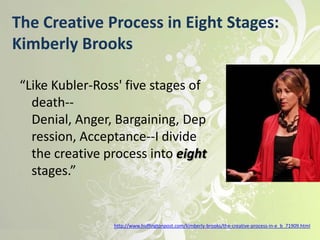
The Creative Process in Eight Stages:
Kimberly Brooks

 “Like Kubler-Ross' five stages of
   death--
   Denial, Anger, Bargaining, Dep
   ression, Acceptance--I divide
   the creative process into eight
   stages.”


                 http://www.huffingtonpost.com/kimberly-brooks/the-creative-process-in-e_b_71909.html
The Creative Process in Eight Stages:
Kimberly Brooks
 The first two are (1) Vision and (2) Hope.

 I don't care who you are or what the medium, whether
    writer, filmmaker, musician, or lithographer or lawyer, or
    postman, every person goes through these two phases when
    they get struck by an idea.

 Vision tends to come in a flash.

 Then Hope makes the heart swoon and the mind swell around
   it. Being a great daydreamer helps.

                      Everyone is an artist.
                          http://www.huffingtonpost.com/kimberly-brooks/the-creative-process-in-e_b_71909.html
The Creative Process in Eight Stages:
 Kimberly Brooks
The difference between artists who create and
  artists who walk around pregnant with ideas
  is the third stage which I call (3) Diving In.

That's the scary one.

My father is a surgeon and I used to watch him
  operate a lot when I was a kid. I'll never forget
  that singular moment, in the theatre of the
  operating room, when he had to press the
  scalpel into the flesh and make the cut. That's
  a surgeon's "Diving In".

Mine just had less blood!
• The next four stages are (4) Excitement
   (5) Suspicion (6) Clarity and (7)
   Obsession.
Often I bounce between Excitement and
   Suspicion--suspicion that perhaps my
   instincts are wrong; that I'm heading in
   the wrong direction -- (Anxiety!
   Despair!)
Finally I move on to Clarity. Clarity, like
   Vision, often happens in a moment--
   when the sky opens and I can hear the
   angels sing.
Then my favourite part is the tireless
   consuming fever of Obsession, the life
   force of every artist.
• The entire sequence can tend to form
   an infinite loop.
The Creative Process in Eight Stages:
 Kimberly Brooks
The last stage is (8) Resolution. Very
  elusive. The composer Aaron Copland
  said he didn't finish compositions so
  much as abandon them. When it's finally
  over, it feels like a whole relationship has
  ended.
And then the anticipated rush of doing it all
  over begins again...
The Creative Process in Eight Stages:
 Kimberly Brooks
The often not attempted ninth stage of the
  eight stage process! ;)


               EXHIBIT
Share your creativity with the world in any
               way possible.
Your Turn now... A new hat to wear.


  What do all inventors have? Creativity!

 • Think-Pair-Share Activity
 • Aim: Form a team to design an invention
   that could change the world.
What do all inventors have? Creativity!
Activity
  • An invention is a product of the
    imagination, which can be a device or a
    process. Individually make a list of inventions
    that make your life easier.
  • Share your list of helpful inventions with your
    group.
  • Discuss with your group what your lives would
    be like without these inventions. What
    wouldn't you be able to do?
What do all inventors have? Creativity!
Activity
  • Now make a group list of inventions that you wish
    were available. What tasks could be made easier?
    How?
  • With others in your group, choose one invention
    to make. Together, draw a sketch of your
    invention on Butchers paper-large enough to
    present to the class.
  • Create a paragraph to explain the name of your
    invention, how it works, and its purpose.
  • Each group will have an opportunity to present
    their invention to the rest of the class
Video Clips

  • TEDxDoha - Taika Waititi - The Art of Creativity
    – http://www.youtube.com/watch?v=pL71KhNmnls


  • TEDxFullerton - Kimberly Brooks - Creative
    Process In 8 Stages
    – http://www.youtube.com/watch?v=8mLxxZ7BllI


  • OSCON 2010: Paul Fenwick, "The World's Worst
    Inventions“
    – http://www.youtube.com/watch?v=EyRdnV1D-mI
To finish……..
‘Perhaps the most important benefit from
teaching thinking is the increase in self-
esteem and self-confidence of those taught.
A youngster taught thinking feels in control
of his of her life-instead of feeling like a cork
carried along by a stream of life and
controlled by the currents.’
                                  Edward de Bono.
Presentation Created By
                           Ragnar Haabjoern
www.thewonderingecologist.blogspot.com.au
       http://au.linkedin.com/in/rhaabjoern

Creativity Presentation Haabjoern

  • 1.
    School Values Exploration: Creativity! Presented as part of the Skills and Knowledge Subject for the Year 9 Imagine Program
  • 2.
    School Vision A world of learning
  • 3.
    School Values •Creativity – Encouraging behaviours which encompass notions of innovation, originality, liberation and generative problem-solving in all that we do.
  • 4.
    What does CreativeIntelligence look like?
  • 5.
  • 6.
    Edward De Bono SixThinking Hats An aid to creative thinking ‘You can analyse the past, and you can design the future.’ Edward de Bono
  • 7.
    Six Thinking Hats Informative Intuitive Constructive Creative Reflective Cautious
  • 8.
    The Green HatThinking: Movement instead of Judgement • This is the creative mode of thinking. • Green represents growth and movement. • Wearing the green hat we look to new ideas and solutions. • Lateral thinking wears a green hat.
  • 9.
    Challenge 1 • Research has shown that the best way to stimulate the creative part of the brain, is to stimulate it with practice. • You have 60 seconds to write as many uses as you can think of for wire coat hangers
  • 10.
    How many usesdid you come up with? On average 12 year old boys come up with 25 uses of the coat hanger.
  • 11.
    Is our abilityto think creatively at risk of being lost? In most cases pre-school • As children become children explore their older, the prescriptive world through world of formal education imagination and pushes children through a investigation and series of educational exercise ‘possibility narrow gates reduces their thinking’ capacity to exercise (the engagement of ‘possibility thinking.’ everyday problems at a deep level).
  • 12.
    Knowledge is limited,but creativity encircles the earth.’ Albert Einstein
  • 13.
    What are thecharacteristics of creative thinking? Creative thinking is characterised by: • Imagination • Open-mindedness • A willingness to explore unexpected routes • Offer tools to address the issue.
  • 14.
    How can werecognise creative thinking? When students are thinking and behaving creatively in the classroom, they most often will be: • Questioning and challenging • Making connections and seeing relationships. • Envisaging what might be • Exploring ideas, keeping options open • Reflecting critically on ideas, actions and outcomes.
  • 15.
    An Artist's Perspectiveon creativity? The fear and excitement associated with the possibility that comes with a blank canvas. Jackson Pollock dancing colours - revisiting Pollock movie with Ed Harris http://www.youtube.com/watch?v=Z2HN9G4Lx_w
  • 16.
    The Creative Processin Eight Stages: Kimberly Brooks “Like Kubler-Ross' five stages of death-- Denial, Anger, Bargaining, Dep ression, Acceptance--I divide the creative process into eight stages.” http://www.huffingtonpost.com/kimberly-brooks/the-creative-process-in-e_b_71909.html
  • 17.
    The Creative Processin Eight Stages: Kimberly Brooks The first two are (1) Vision and (2) Hope. I don't care who you are or what the medium, whether writer, filmmaker, musician, or lithographer or lawyer, or postman, every person goes through these two phases when they get struck by an idea. Vision tends to come in a flash. Then Hope makes the heart swoon and the mind swell around it. Being a great daydreamer helps. Everyone is an artist. http://www.huffingtonpost.com/kimberly-brooks/the-creative-process-in-e_b_71909.html
  • 18.
    The Creative Processin Eight Stages: Kimberly Brooks The difference between artists who create and artists who walk around pregnant with ideas is the third stage which I call (3) Diving In. That's the scary one. My father is a surgeon and I used to watch him operate a lot when I was a kid. I'll never forget that singular moment, in the theatre of the operating room, when he had to press the scalpel into the flesh and make the cut. That's a surgeon's "Diving In". Mine just had less blood!
  • 19.
    • The nextfour stages are (4) Excitement (5) Suspicion (6) Clarity and (7) Obsession. Often I bounce between Excitement and Suspicion--suspicion that perhaps my instincts are wrong; that I'm heading in the wrong direction -- (Anxiety! Despair!) Finally I move on to Clarity. Clarity, like Vision, often happens in a moment-- when the sky opens and I can hear the angels sing. Then my favourite part is the tireless consuming fever of Obsession, the life force of every artist. • The entire sequence can tend to form an infinite loop.
  • 20.
    The Creative Processin Eight Stages: Kimberly Brooks The last stage is (8) Resolution. Very elusive. The composer Aaron Copland said he didn't finish compositions so much as abandon them. When it's finally over, it feels like a whole relationship has ended. And then the anticipated rush of doing it all over begins again...
  • 21.
    The Creative Processin Eight Stages: Kimberly Brooks The often not attempted ninth stage of the eight stage process! ;) EXHIBIT Share your creativity with the world in any way possible.
  • 22.
    Your Turn now...A new hat to wear. What do all inventors have? Creativity! • Think-Pair-Share Activity • Aim: Form a team to design an invention that could change the world.
  • 23.
    What do allinventors have? Creativity! Activity • An invention is a product of the imagination, which can be a device or a process. Individually make a list of inventions that make your life easier. • Share your list of helpful inventions with your group. • Discuss with your group what your lives would be like without these inventions. What wouldn't you be able to do?
  • 24.
    What do allinventors have? Creativity! Activity • Now make a group list of inventions that you wish were available. What tasks could be made easier? How? • With others in your group, choose one invention to make. Together, draw a sketch of your invention on Butchers paper-large enough to present to the class. • Create a paragraph to explain the name of your invention, how it works, and its purpose. • Each group will have an opportunity to present their invention to the rest of the class
  • 25.
    Video Clips • TEDxDoha - Taika Waititi - The Art of Creativity – http://www.youtube.com/watch?v=pL71KhNmnls • TEDxFullerton - Kimberly Brooks - Creative Process In 8 Stages – http://www.youtube.com/watch?v=8mLxxZ7BllI • OSCON 2010: Paul Fenwick, "The World's Worst Inventions“ – http://www.youtube.com/watch?v=EyRdnV1D-mI
  • 26.
    To finish…….. ‘Perhaps themost important benefit from teaching thinking is the increase in self- esteem and self-confidence of those taught. A youngster taught thinking feels in control of his of her life-instead of feeling like a cork carried along by a stream of life and controlled by the currents.’ Edward de Bono.
  • 27.
    Presentation Created By Ragnar Haabjoern www.thewonderingecologist.blogspot.com.au http://au.linkedin.com/in/rhaabjoern