title CREATIVITY FOR  CREATIVE MINDS An Interdisciplinary Look at Creativity Dr. Lori Kent
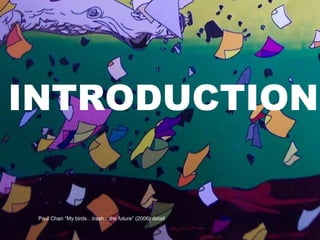
INTRODUCTION INTRODUCTION Paul Chan “My birds…trash…the future” (2006) detail
Assumption   META COGNITION Thinking about thinking By being aware of processes of  one’s own best thinking one can further perfect thinking…
Who are we as creative people…  how do we function ?
GOALS GOALS
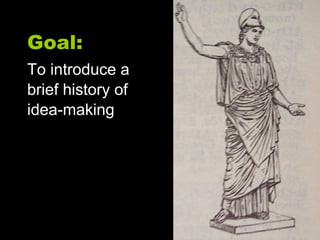
Goal: To introduce a  brief history of  idea-making
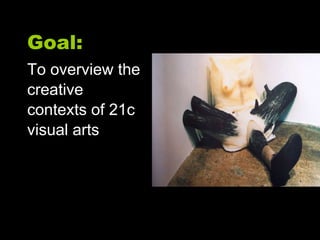
Goal: To overview the  creative  contexts of 21c  visual arts
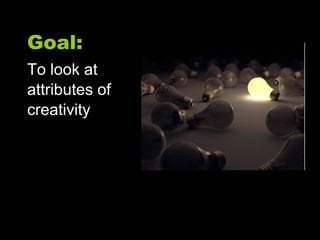
Goal: To look at  attributes of  creativity
Goal: To offer methods  for maximizing  creativity…
SOME DEFINITIONS SOME DEFINITIONS
What is creativity ?
cre • a • tiv • i • ty From the Latin  creatus  meaning “to  make or produce” or  literally “to grow”
cre • a • tiv • i • ty The term did not come  into popular parlance  until…
The  1950s when it was popularized by psychologists
cre • a • tiv • i • ty “ [human’s] capacity to produce  new  ideas,  insights, inventions or artistic objects, which  are accepted of being of social, spiritual,  aesthetic, scientific, or technological value.” -   Dictionary of Developmental and Educational Psychology (1986)
 
What are some  common misconceptions ?
General Views of Creativity Life would be really bad without it Genius and talent are essential to being a creative person It’s the main thing that differentiates art from other practices, such as business It comes from a mysterious place deep inside of a person
General Views of Creativity
General Views of Creativity Life would be really bad without it Genius and talent are essential to being a creative person It’s the main thing that differentiates art from other practices, such as business It comes from a mysterious place deep inside of a person
 
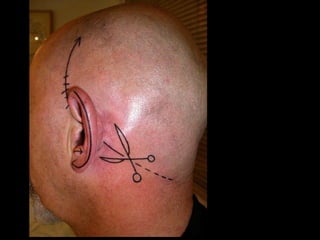
Teaching Creativity to the Creative  ? ? ? ? Artists perpetuate myths about creativity  (for example, art students who think depression = talent, also known as the “Van Gogh’s Ear Syndrome”)
 
Teaching Creativity to the Creative  ? ? ? ? Over a lifetime, adults build defenses that inhibit creative thinking.
 
Teaching Creativity to the Creative  ? ? ? ? Artists are not necessary creative *
 
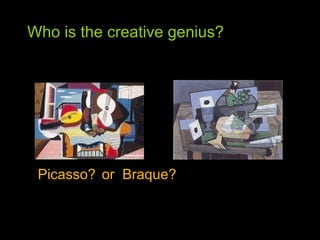
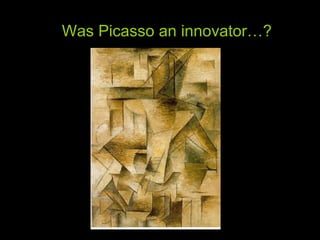
Who is the creative genius? Picasso?  or  Braque?
Was Picasso an innovator…?
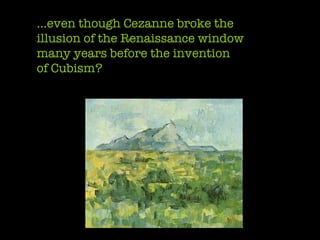
… even though Cezanne broke the  illusion of the Renaissance window many years before the invention  of Cubism?
Continuities Discontinuities Weisberg’s  Creativity: Beyond the Myth of Genius
 
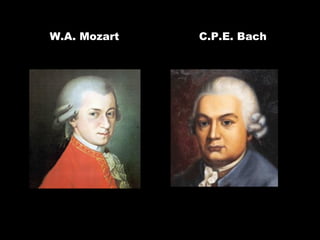
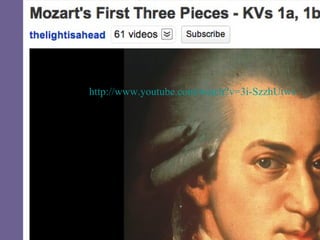
W.A. Mozart C.P.E. Bach
http://www.youtube.com/watch?v=3i-SzzhUtws
The Seven Year Rule Weisberg’s  Creativity: Beyond the Myth of Genius
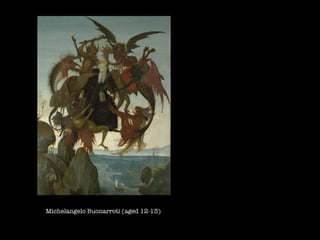
Michelangelo Buonarroti (aged 12-13)
CREATIVITY THRU THE AGES CREATIVITY THROUGH THE AGES
Not much is known about prehistoric conceptions of creativity… Some things must have been perceived as creative such as the creation myths that were passed from one generation to another.
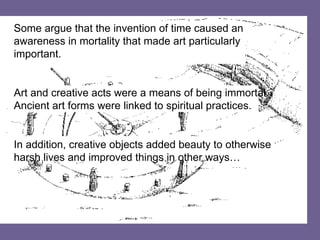
Some argue that the invention of time caused an awareness in mortality that made art particularly important. Art and creative acts were a means of being immortal. Ancient art forms were linked to spiritual practices. In addition, creative objects added beauty to otherwise harsh lives and improved things in other ways…
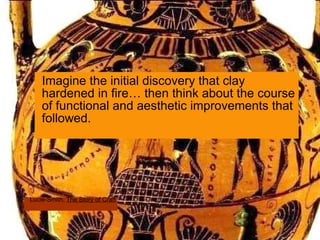
Imagine the initial discovery that clay hardened in fire… then think about the course of functional and aesthetic improvements that followed.  Lucie-Smith,  The Story of Craft
Throughout early Western history…   certain motifs, stylizations and themes   must have been perceived as beautiful   or valuable because they    were perpetuated.
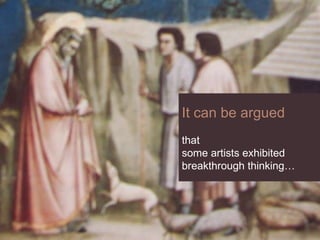
It can be argued that some artists exhibited  breakthrough thinking…
But   they were influenced by a rigid cultural context. Artistic creation was restricted in its content,  technologies, forms, and values until the age of modernism.
Today ,  we look at models of creative behavior from many years ago despite the fact that we live in very different worlds .
CREATIVITY THRU THE AGES CREATIVITY IN A  CONTEMPORARY CONTEXT
Today, we live in a (post) postmodern age.
Today, we live in a (post) postmodern age Contemporary art reflects the cultural context(s) of postmodernism
postmodernism is  pluralistic eclectic reflexive de-constructed  and de-centered
which makes cultural production much more complicated
Contemporary Creation
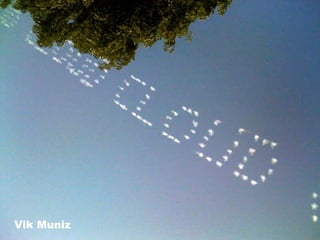
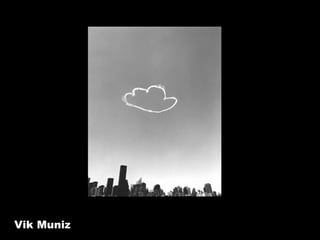
Vik Muniz
Vik Muniz
 
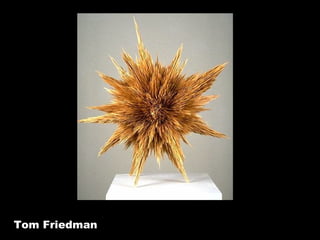
Tom Friedman
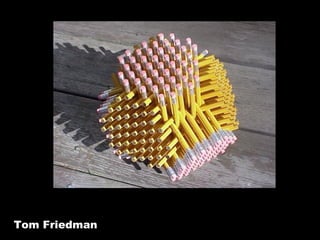
Tom Friedman
Tom Friedman
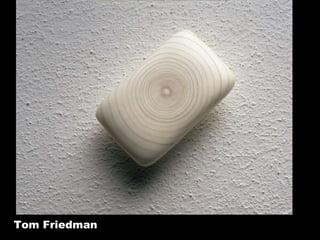
Tom Friedman
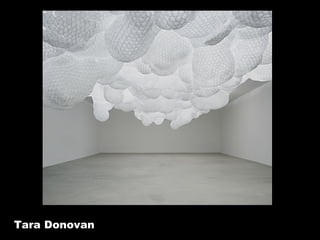
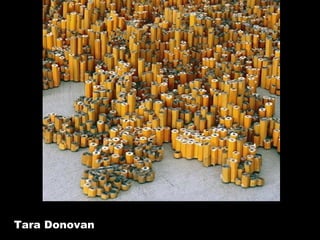
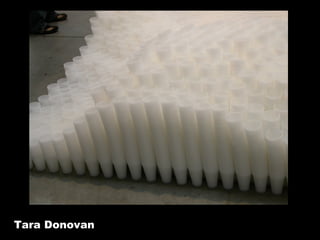
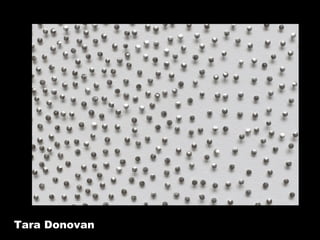
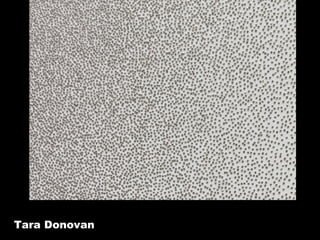
Tara Donovan
Tara Donovan
Tara Donovan
Tara Donovan
Tara Donovan
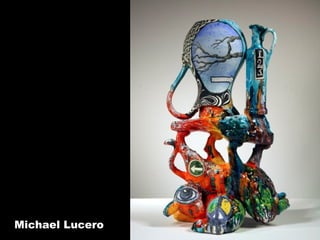
Michael Lucero
 
http://www.youtube.com/watch?v=ul8kgtiD4yg
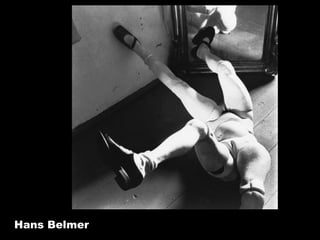
Hans Belmer
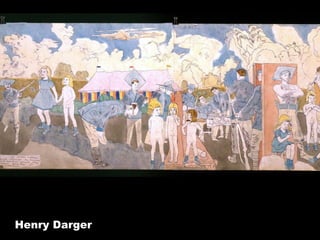
Henry Darger
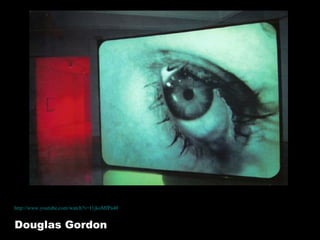
Douglas Gordon http://www.youtube.com/watch?v=I1jkoMfPa40
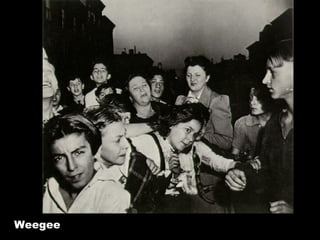
Weegee
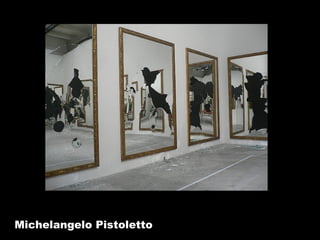
Michelangelo Pistoletto
http://www.youtube.com/watch?v=VF9- sEbqDvU
ATTRITBUTES OF CREATIVIVE THINKERS BELIEFS  ABOUT  CREATIVITY
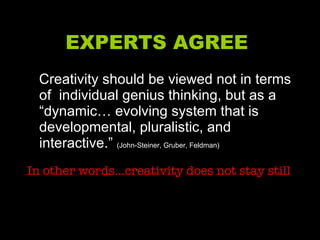
EXPERTS AGREE  Creativity should be viewed not in terms of  individual genius thinking, but as a “dynamic… evolving system that is developmental, pluralistic, and interactive.”  (John-Steiner, Gruber, Feldman) In other words…creativity does not stay still
EXPERTS AGREE  Thinking strategies that are important to being creative are…
THINKING… 1. “Breaking set” or breaking out of old patterns.
 
THINKING… 2.Understanding complexities.
motherboard
THINKING… 3.Suspending judgment. (particularly in brainstorming)
Statue of justice
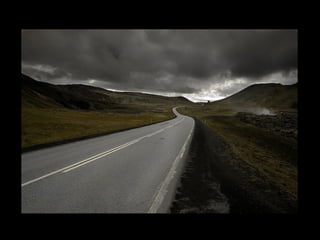
THINKING… 4.Keeping options open as long as possible.
Long road
THINKING… 5.Thinking broadly and seeing relationships.
 
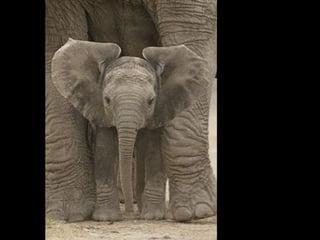
THINKING… 6. Remembering accurately.
 
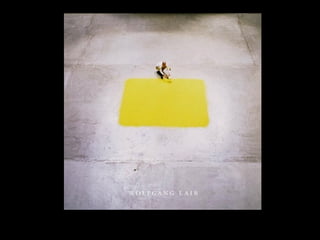
THINKING… 7. Perceiving freshly.
 
 
THINKING… 8.Using “tricks”. (making the familiar strange and the strange familiar, playing with ideas, investigating paradoxes, etc)
 
ATTRITBUTES OF CREATIVIVE THINKERS ATTRIBUTES OF  CREATIVE  THINKERS
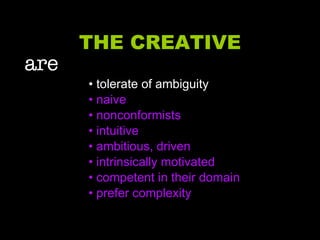
THE CREATIVE are   • tolerate of ambiguity •  naive •  nonconformists •  intuitive •  ambitious, driven •  intrinsically motivated •  competent in their domain •  prefer complexity
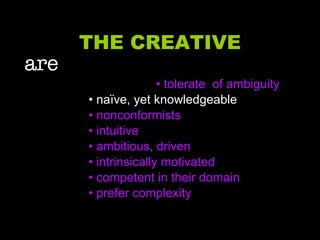
THE CREATIVE are     • tolerate  of ambiguity •  naïve, yet knowledgeable •  nonconformists •  intuitive •  ambitious, driven •  intrinsically motivated •  competent in their domain •  prefer complexity
THE CREATIVE are     • tolerate of ambiguity •  naïve, yet knowledgeable •  nonconformists •  intuitive •  ambitious, driven •  intrinsically motivated •  competent in their domain •  prefer complexity
THE CREATIVE are   • tolerate of ambiguity •  naïve, yet knowledgeable •  nonconformists •  intuitive •  ambitious, driven •  intrinsically motivated •  competent in their domain •  prefer complexity
THE CREATIVE are     • tolerate of ambiguity •  naïve, yet knowledgeable •  nonconformists •  intuitive •  ambitious, driven •  intrinsically motivated •  competent in their domain •  prefer complexity
THE CREATIVE are   • tolerate of ambiguity •  naïve, yet knowledgeable •  nonconformists •  intuitive •  ambitious, driven •  intrinsically motivated •  competent in their domain •  prefer complexity
THE CREATIVE •  tolerate of ambiguity •  naïve, yet knowledgeable •  nonconformists •  intuitive •  ambitious, driven •  intrinsically motivated •  competent in their domain •  prefer  complexity
BEING MORE CREATIVE BECOMING MORE CREATIVE
COMMON CREATIVE BLOCKS Be aware of
Emotional Blocks: Fear, Sadness, etc.
Political Oppression and Legal  Restrictions
Discrimination and Racism
Religious and  Cultural Blocks
TIPS To enhance creativity .
TIPS Create your own rituals.
TIPS Create your own ideal conditions.
1 Draw or describe your ideal working conditions for creativity.
TIPS Use background music.
2 Is there a musical artist, genre or song that inspires you to create?
TIPS Know  your domain or field.
3 What do you know the most about?
TIPS Maintain a high level of passion.
TIPS Form a support group. Converse.
TIPS Seek out the new. “ Travel is the midwife of thought.” - Alain de Botton
4 When was the last time your thought  “wow! that’s new! ? Describe.
TIPS Laugh. How many art students does it take to screw in a light bulb?  -only one…and she gets three credits for it!
5 Write down a joke.
 
TIPS Cultivate solitude.
6 How long was the most time that you have consecutively spent alone?
TIPS Intersect disciplines and ideas. Functional Fixedness
7 With a partner, make a list of ALL of the possible uses for the object you have been given.
TIPS See old things in new ways.
ART AND FEAR Part of artmaking is… Learning how  not to quit. Section on art and fear
ART AND FEAR Part of artmaking is… Finding a support group. Section on art and fear
ART AND FEAR Part of artmaking is… Drawing on imagination  and vision. Section on art and fear
ART AND FEAR Part of artmaking is… Getting in touch with materials. Section on art and fear
ART AND FEAR Part of artmaking is… Living with  uncertainty. Section on art and fear
ART AND FEAR Some Wisdom The function of the  overwhelming majority of your artwork is to simply teach you about the small fraction of your work that soars. Section on art and fear
ART AND FEAR Some Wisdom You learn how to make your artwork by  making  your artwork. Section on art and fear
THE END Create.  Solve Problems. Add some beauty to the world. Find Problems. Be curious about everything. Cultivate joy….

Foundations creativity

  • 1.
    title CREATIVITY FOR CREATIVE MINDS An Interdisciplinary Look at Creativity Dr. Lori Kent
  • 2.
    INTRODUCTION INTRODUCTION PaulChan “My birds…trash…the future” (2006) detail
  • 3.
    Assumption META COGNITION Thinking about thinking By being aware of processes of one’s own best thinking one can further perfect thinking…
  • 4.
    Who are weas creative people… how do we function ?
  • 5.
  • 6.
    Goal: To introducea brief history of idea-making
  • 7.
    Goal: To overviewthe creative contexts of 21c visual arts
  • 8.
    Goal: To lookat attributes of creativity
  • 9.
    Goal: To offermethods for maximizing creativity…
  • 10.
  • 11.
  • 12.
    cre • a• tiv • i • ty From the Latin creatus meaning “to make or produce” or literally “to grow”
  • 13.
    cre • a• tiv • i • ty The term did not come into popular parlance until…
  • 14.
    The 1950swhen it was popularized by psychologists
  • 15.
    cre • a• tiv • i • ty “ [human’s] capacity to produce new ideas, insights, inventions or artistic objects, which are accepted of being of social, spiritual, aesthetic, scientific, or technological value.” - Dictionary of Developmental and Educational Psychology (1986)
  • 16.
  • 17.
    What are some common misconceptions ?
  • 18.
    General Views ofCreativity Life would be really bad without it Genius and talent are essential to being a creative person It’s the main thing that differentiates art from other practices, such as business It comes from a mysterious place deep inside of a person
  • 19.
    General Views ofCreativity Life would be really bad without it Genius and talent are essential to being a creative person It’s the main thing that differentiates art from other practices, such as business It comes from a mysterious place deep inside of a person
  • 20.
    General Views ofCreativity Life would be really bad without it Genius and talent are essential to being a creative person It’s the main thing that differentiates art from other practices, such as business It comes from a mysterious place deep inside of a person
  • 21.
    General Views ofCreativity
  • 22.
    General Views ofCreativity Life would be really bad without it Genius and talent are essential to being a creative person It’s the main thing that differentiates art from other practices, such as business It comes from a mysterious place deep inside of a person
  • 23.
    General Views ofCreativity Life would be really bad without it Genius and talent are essential to being a creative person It’s the main thing that differentiates art from other practices, such as business It comes from a mysterious place deep inside of a person
  • 24.
    General Views ofCreativity Life would be really bad without it Genius and talent are essential to being a creative person It’s the main thing that differentiates art from other practices, such as business It comes from a mysterious place deep inside of a person
  • 25.
  • 26.
    Teaching Creativity tothe Creative ? ? ? ? Artists perpetuate myths about creativity (for example, art students who think depression = talent, also known as the “Van Gogh’s Ear Syndrome”)
  • 27.
  • 28.
    Teaching Creativity tothe Creative ? ? ? ? Over a lifetime, adults build defenses that inhibit creative thinking.
  • 29.
  • 30.
    Teaching Creativity tothe Creative ? ? ? ? Artists are not necessary creative *
  • 31.
  • 32.
    Who is thecreative genius? Picasso? or Braque?
  • 33.
    Was Picasso aninnovator…?
  • 34.
    … even thoughCezanne broke the illusion of the Renaissance window many years before the invention of Cubism?
  • 35.
    Continuities Discontinuities Weisberg’s Creativity: Beyond the Myth of Genius
  • 36.
  • 37.
  • 38.
  • 39.
    The Seven YearRule Weisberg’s Creativity: Beyond the Myth of Genius
  • 40.
  • 41.
    CREATIVITY THRU THEAGES CREATIVITY THROUGH THE AGES
  • 42.
    Not much isknown about prehistoric conceptions of creativity… Some things must have been perceived as creative such as the creation myths that were passed from one generation to another.
  • 43.
    Some argue thatthe invention of time caused an awareness in mortality that made art particularly important. Art and creative acts were a means of being immortal. Ancient art forms were linked to spiritual practices. In addition, creative objects added beauty to otherwise harsh lives and improved things in other ways…
  • 44.
    Imagine the initialdiscovery that clay hardened in fire… then think about the course of functional and aesthetic improvements that followed. Lucie-Smith, The Story of Craft
  • 45.
    Throughout early Westernhistory… certain motifs, stylizations and themes must have been perceived as beautiful or valuable because they were perpetuated.
  • 46.
    It can beargued that some artists exhibited breakthrough thinking…
  • 47.
    But they were influenced by a rigid cultural context. Artistic creation was restricted in its content, technologies, forms, and values until the age of modernism.
  • 48.
    Today , we look at models of creative behavior from many years ago despite the fact that we live in very different worlds .
  • 49.
    CREATIVITY THRU THEAGES CREATIVITY IN A CONTEMPORARY CONTEXT
  • 50.
    Today, we livein a (post) postmodern age.
  • 51.
    Today, we livein a (post) postmodern age Contemporary art reflects the cultural context(s) of postmodernism
  • 52.
    postmodernism is pluralistic eclectic reflexive de-constructed and de-centered
  • 53.
    which makes culturalproduction much more complicated
  • 54.
  • 55.
  • 56.
  • 57.
  • 58.
  • 59.
  • 60.
  • 61.
  • 62.
  • 63.
  • 64.
  • 65.
  • 66.
  • 67.
  • 68.
  • 69.
  • 70.
  • 71.
  • 72.
  • 73.
  • 74.
  • 75.
  • 76.
    ATTRITBUTES OF CREATIVIVETHINKERS BELIEFS ABOUT CREATIVITY
  • 77.
    EXPERTS AGREE Creativity should be viewed not in terms of individual genius thinking, but as a “dynamic… evolving system that is developmental, pluralistic, and interactive.” (John-Steiner, Gruber, Feldman) In other words…creativity does not stay still
  • 78.
    EXPERTS AGREE Thinking strategies that are important to being creative are…
  • 79.
    THINKING… 1. “Breakingset” or breaking out of old patterns.
  • 80.
  • 81.
  • 82.
  • 83.
    THINKING… 3.Suspending judgment.(particularly in brainstorming)
  • 84.
  • 85.
    THINKING… 4.Keeping optionsopen as long as possible.
  • 86.
  • 87.
    THINKING… 5.Thinking broadlyand seeing relationships.
  • 88.
  • 89.
  • 90.
  • 91.
  • 92.
  • 93.
  • 94.
    THINKING… 8.Using “tricks”.(making the familiar strange and the strange familiar, playing with ideas, investigating paradoxes, etc)
  • 95.
  • 96.
    ATTRITBUTES OF CREATIVIVETHINKERS ATTRIBUTES OF CREATIVE THINKERS
  • 97.
    THE CREATIVE are • tolerate of ambiguity •  naive • nonconformists •  intuitive • ambitious, driven • intrinsically motivated •  competent in their domain • prefer complexity
  • 98.
    THE CREATIVE are • tolerate of ambiguity •  naïve, yet knowledgeable • nonconformists •  intuitive • ambitious, driven • intrinsically motivated •  competent in their domain •  prefer complexity
  • 99.
    THE CREATIVE are • tolerate of ambiguity •  naïve, yet knowledgeable • nonconformists •  intuitive • ambitious, driven • intrinsically motivated •  competent in their domain •  prefer complexity
  • 100.
    THE CREATIVE are • tolerate of ambiguity •  naïve, yet knowledgeable • nonconformists •  intuitive • ambitious, driven • intrinsically motivated •  competent in their domain •  prefer complexity
  • 101.
    THE CREATIVE are • tolerate of ambiguity •  naïve, yet knowledgeable • nonconformists •  intuitive • ambitious, driven • intrinsically motivated •  competent in their domain •  prefer complexity
  • 102.
    THE CREATIVE are • tolerate of ambiguity •  naïve, yet knowledgeable • nonconformists •  intuitive • ambitious, driven • intrinsically motivated •  competent in their domain •  prefer complexity
  • 103.
    THE CREATIVE are • tolerate of ambiguity •  naïve, yet knowledgeable • nonconformists •  intuitive • ambitious, driven • intrinsically motivated •  competent in their domain •  prefer complexity
  • 104.
    THE CREATIVE • tolerate of ambiguity •  naïve, yet knowledgeable • nonconformists •  intuitive • ambitious, driven • intrinsically motivated •  competent in their domain •  prefer complexity
  • 105.
    BEING MORE CREATIVEBECOMING MORE CREATIVE
  • 106.
  • 107.
  • 108.
    Political Oppression andLegal Restrictions
  • 109.
  • 110.
    Religious and Cultural Blocks
  • 111.
    TIPS To enhancecreativity .
  • 112.
    TIPS Create yourown rituals.
  • 113.
    TIPS Create yourown ideal conditions.
  • 114.
    1 Draw ordescribe your ideal working conditions for creativity.
  • 115.
  • 116.
    2 Is therea musical artist, genre or song that inspires you to create?
  • 117.
    TIPS Know your domain or field.
  • 118.
    3 What doyou know the most about?
  • 119.
    TIPS Maintain ahigh level of passion.
  • 120.
    TIPS Form asupport group. Converse.
  • 121.
    TIPS Seek outthe new. “ Travel is the midwife of thought.” - Alain de Botton
  • 122.
    4 When wasthe last time your thought “wow! that’s new! ? Describe.
  • 123.
    TIPS Laugh. Howmany art students does it take to screw in a light bulb? -only one…and she gets three credits for it!
  • 124.
    5 Write downa joke.
  • 125.
  • 126.
  • 127.
    6 How longwas the most time that you have consecutively spent alone?
  • 128.
    TIPS Intersect disciplinesand ideas. Functional Fixedness
  • 129.
    7 With apartner, make a list of ALL of the possible uses for the object you have been given.
  • 130.
    TIPS See oldthings in new ways.
  • 131.
    ART AND FEARPart of artmaking is… Learning how not to quit. Section on art and fear
  • 132.
    ART AND FEARPart of artmaking is… Finding a support group. Section on art and fear
  • 133.
    ART AND FEARPart of artmaking is… Drawing on imagination and vision. Section on art and fear
  • 134.
    ART AND FEARPart of artmaking is… Getting in touch with materials. Section on art and fear
  • 135.
    ART AND FEARPart of artmaking is… Living with uncertainty. Section on art and fear
  • 136.
    ART AND FEARSome Wisdom The function of the overwhelming majority of your artwork is to simply teach you about the small fraction of your work that soars. Section on art and fear
  • 137.
    ART AND FEARSome Wisdom You learn how to make your artwork by making your artwork. Section on art and fear
  • 138.
    THE END Create. Solve Problems. Add some beauty to the world. Find Problems. Be curious about everything. Cultivate joy….

Editor's Notes

  • #5 Jot down a few beliefs that you hold about creativity
  • #12 Jot down a few beliefs that you hold about creativity
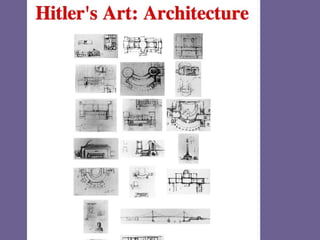
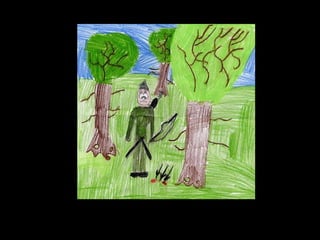
  • #17 2000-3000 drawings, paintings and prints. 1907 He took the two day entrance exam for the academy's school of painting. Confident and self assured, he awaited the result, quite sure he would get in. But failure struck him like a bolt of lightning. His test drawings were judged unsatisfactory and he was not admitted. Hitler was badly shaken by this rejection. He went back to the academy to get an explanation and was told his drawings showed a lack of talent for artistic painting, notably a lack of appreciation of the human form.
  • #18 Jot down a few beliefs that you hold about creativity
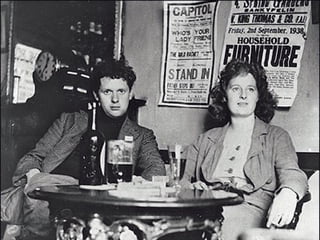
  • #20 Dylan thomas
  • #41 Michelangelo Buonarroti, "The Torment of Saint Anthony" (ca. 1487–1488). Oil and tempera on panel. 18 1/2 × 13 3/4 inches. Aged 12-13. At age 6 he apprenticed with a stone cutter.
  • #74 Weegee was an artist — a photographer — based in New York, USA. I later found out that he was born in Poland as Arthur Fellig, and that he died in 1968.
  • #75 Weegee was an artist — a photographer — based in New York, USA. I later found out that he was born in Poland as Arthur Fellig, and that he died in 1968.
  • #129 Qtips
  • #131 Qtips